
1
Introduction
BACKGROUND
The City of Pittsburgh and surrounding counties of southwestern Pennsylvania have long suffered from air and water quality degradation. Until the 1950s, the skies were darkened by soot and smoke from bituminous coal burning by residences, businesses, and railroads, as well as industrial air pollution. Acid mine drainage, raw sewage, and untreated industrial waste routinely entered local streams and the region’s three major rivers—the Allegheny, the Monongahela, and below their confluence, the Ohio (see Figure 1-1).
A smoke control law implemented in 1946, accompanied by a replacement of coal with natural gas for space heating and diesel electric for railroad locomotives in the 1950s, sharply reduced soot smoke pollution. Industrial fumes and gases, however, produced primarily by the iron and steel industry, continued to pollute the air into the 1970s when state and federal clean air laws combined with the closing of the steel mills reduced industrial air pollution (Mershon and Tarr, 2003). Water quality problems persist, however, despite the operation of a large sewage treatment plant constructed in 1958 by the Allegheny County Sanitary Authority (ALCOSAN) and other plants constructed by smaller municipalities. Combined sewer and separate sewer overflows, failing septic systems, untreated discharges from “straight pipes,” stormwater, agricultural runoff, and acid mine drainage continue to degrade the quality of local streams and impair their value for habitat, recreation, and water supply.
Annually, an estimated 16 billion gallons of mixed rainwater and sewage is introduced into the region’s waterways from combined sewer overflows (CSOs) and sanitary sewer overflows (SSOs) during wet weather in the ALCOSAN service area (WSIP, 2002). The ALCOSAN service area has 328 CSO structures from which untreated sewage is discharged into local streams during wet weather—more than any similar authority in the country (WSIP, 2002; see Chapter 4). Chapter 2 traces many of the region’s current urban water quality problems to water supply and wastewater infrastructure decisions made by and for the City of Pittsburgh and outlying areas in the past. Currently, the City of Pittsburgh, ALCOSAN, and 82 communities served by ALCOSAN, as well as some not served by ALCOSAN, face regulatory sanctions under the federal Clean Water Act (see Box 1-1) for sewer overflows.1
|
1 |
Consent orders were issued in October 2003 by the Allegheny County Health Department to 26 ALCOSAN-served communities to reduce their numbers of precipitation-triggered CSOs. Similarly, 55 communities with illegal sanitary sewer overflows were issued consent orders through the Pennsylvania Department of Environmental Protection in November 2003 to determine where their sewers are leaking as a first step to eliminating these discharges. The City of Pittsburgh and the Pittsburgh Water and Sewer Authority signed a consent order and agreement in February 2004 to address CSO outfalls. A draft consent decree between the U.S. Environmental Protection Agency and ALCOSAN had not yet been signed as this report was nearing completion in December 2004 (see Chapter 5 for further information). |
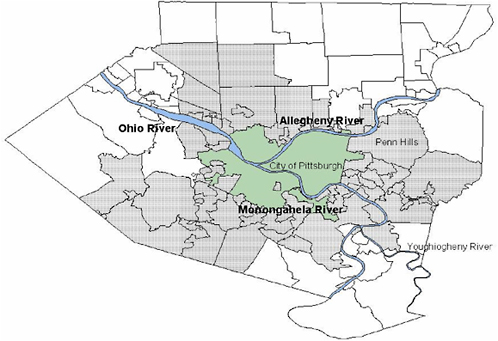
FIGURE 1-1 The Allegheny, Monongahela, and Ohio Rivers (the “Three Rivers”) in Allegheny County in southwestern Pennsylvania; shaded areas includes Allegheny County communities serviced by ALCOSAN in addition to the City of Pittsburgh.
Untreated human waste, stormwater, and agricultural runoff may spread parasitic protozoa (e.g., Giardia, Cryptosporidium), enteric bacteria and viruses, and other waterborne contaminants (NRC, 2004). Such microorganisms and contaminants are public health threats particularly to children, the elderly, the immunocompromised, and other sensitive populations (Balbus et al., 2000; NRC, 2001, 2004).
For approximately the last quarter of a century, tests of water quality by the U.S. Geological Survey (USGS), the Ohio River Valley Water Sanitation Commission (ORSANCO), and other governmental, nongovernmental, and university groups have found that fecal coliform levels (bacterial indicators of fecal contamination) have repeatedly been in violation of water quality standards at certain monitoring stations on the Monongahela and Allegheny Rivers, especially during wet weather events (WSIP, 2002; see Chapter 3). Furthermore, over the last decade, the Allegheny County Health Department has issued warnings on significant numbers of days (roughly 30 to 50 days per year during the May through December recreation season) to avoid bodily contact with the water in large portions of the rivers. During dry weather, water in the main stem rivers meets recreational guidelines for indicator microorganisms. However, water in many tributaries remains contaminated by indicator organisms and pathogens even in dry weather. Dry weather sewage treatment system problems (e.g., failing on-site sewage treatment and distribution systems [OSTDSs, or “septic systems”], malfunctioning package plants), agricultural practices, and natural sources may contribute to these dry weather
|
BOX 1-1 The federal Clean Water Act (33 USCA sec. 1251, et seq., referred to as the CWA in this report) provides the basic legal framework for safeguarding and restoring the quality of the nation’s surface waters. The law originated in the Federal Water Pollution Control Act of 1948 as significantly expanded in the 1972 Water Quality Amendments and some 35 other amendments through 2000, and is of central importance to this report. The overall goal of the CWA in its many subprograms is to protect, restore, and enhance the “waters of the United States” (including but not limited to “navigable waters”; see more below) for the protection and propagation of fish and aquatic life and wildlife, recreational purposes, and the withdrawal of water for public water supply, agricultural, industrial and other purposes. Among its diverse and complex provisions, the CWA authorizes the U.S. Environmental Protection Agency (EPA) to establish ambient water quality standards1 and limits for specific classes of pollutants. The CWA also established the National Pollutant Discharge Elimination System (NPDES),2 which regulates major industrial and sewage treatment plant discharges into the waters of the United States. Combined sewer overflows such as those in the Pittsburgh region are eligible for permits subject to various requirements to limit their environmental impacts on receiving waters, while sanitary sewer overflows are illegal. Section 404 of the CWA requires the U.S. Army Corps of Engineers to regulate public and private activities involving “dredge and fill” of navigable waters pursuant to environmental guidelines issued by EPA. Under judicial and administrative interpretation, this section underlies federal regulation of wetlands throughout the United States in conjunction with state and local wetland management programs. Under Section 303(d) of the CWA, states and authorized tribes are required to identify surface waters that are “impaired” by pollution sources, including failing septic systems, acid mine drainage, and agricultural runoff. To remediate these ambient water quality problems, states must prepare “total maximum daily load” (TMDL) plans under which the relevant pollutants are reduced through a range of measures including “best management practices” (BMPs). Ultimately, authority for implementation and enforcement of the CWA rests with the EPA. However, the Pennsylvania Department of Environmental Protection (PADEP) is a key partner in this process at the state level, while the Allegheny County Health Department (ACHD) exercises concurrent jurisdiction with PADEP over sewage and discharges of wastewater within Allegheny County.
|
conditions. Furthermore, many older homes in rural areas and former coal mining towns discharge sewage directly into local streams via straight pipes and “wildcat sewers” (see Appendix C for various sewage disposal and other terms used throughout this report).
The diverse water and sewage problems of southwestern Pennsylvania are often linked hydrologically. A downstream community’s poor water quality problem may result from an upstream community’s overflowing sewers, straight pipes, or failing septic systems. Whereas some municipalities have taken steps to address their water and sewage problems, many others face major water quality problems. Individual efforts may bring about limited improvements but
the scope of the problem is so broad that a regional approach is needed. This is a conclusion reached in several recent reports, including the April 2002 report by the Steering Committee of the Southwestern Pennsylvania Water and Sewer Infrastructure Project (WSIP) of the Western Division of the Pennsylvania Economy League, and largely concurred with by this National Research Council (NRC) committee.
The WSIP’s “best estimate” of the total investment required to fix regional water and sewer infrastructure throughout southwestern Pennsylvania without adjusting the institutional structures currently delivering these services is approximately $10 billion (WSIP, 2002). Although high, the costs of these improvements must be reconsidered in the context of the potential costs of inaction, which would include adverse impacts on public health, the environment, and economic growth and possible further federal and state regulatory action or private lawsuits by concerned parties. Compounding the problem, many individual communities in the region often lack the requisite expertise or resources needed to identify and implement the best solutions. The region’s extensive governmental fragmentation and the lack of congruence of watershed and political boundaries suggest that the most cost-effective solutions may be obtainable only through a region-wide cooperative approach. Such a cooperative approach could be facilitated by existing public, non-profit, and private organizations as well as by the creation of new organizations. The precedent for such action in response to past crises exists in actions taken during the so-called Pittsburgh Renaissance (see Preface), the formation of ALCOSAN and the Port Authority Transit of Allegheny County, and the Allegheny Regional Assets District.
To help address these issues, the WSIP Steering Committee requested that the NRC undertake a study of the regional wastewater and water quality problems of southwestern Pennsylvania (see Box 1-2).
COMMITTEE AND REPORT
As noted in the Preface, this report was written by the NRC Committee on Water Quality Improvement for the Pittsburgh region organized by the NRC’s Water Science and Technology Board. The committee was formed in early 2002 at the request of the Allegheny Conference on Community Development2 (ACCD) to conduct an independent assessment of the wastewater and water quality problems of the Pittsburgh area and to make recommendations on how these issues and needs of the region can be best addressed by multiple jurisdictions on a cooperative basis (see Box ES-1 for the full statement of task).
Following this introduction, Chapter 2 provides a description of the region’s physical setting; a history of the Pittsburgh region’s water quality problems; and an overview of the region’s demographics, economy, and land use changes. Chapter 3 provides an overview of current water quality conditions in the region, while Chapter 4 details causes of water quality
|
2 |
The ACCD was founded in 1944 as a private, nonprofit organization to unify and coordinate regional transportation and environmental improvement efforts in Greater Pittsburgh. Since its founding, the ACCD has served southwestern Pennsylvania as a prominent private sector leader group dedicated to coordinating civic action by bringing corporate, government, and community leaders together to frame, discuss, and implement civic initiatives. As such, the ACCD in conjunction with the Western Division of the Pennsylvania Economy League initiated the WSIP, culminating in the release of Investing in Clean Water: A Report by the Southwestern Pennsylvania Water and Sewer Infrastructure Project (WSIP, 2002), which is discussed throughout this report (see also Appendix B). |
|
BOX 1-2 There are multiple ways to define southwestern Pennsylvania as a region for a variety of purposes, such as regulation as part of Region 5 (Southwest Region) of the Pennsylvania Department of Environmental Protection (PADEP); economic and community planning and development by the ACCD and Southwestern Pennsylvania Commission (SPC); U.S. census purposes (e.g., designation of a metropolitan statistical area, or MSA) as illustrated in the following figure. However, for the purposes of this report, and unless otherwise noted, use of the term “southwestern Pennsylvania” or “Pittsburgh region” refers to these 11 counties that also correspond to the study area of the 2002 WSIP report. 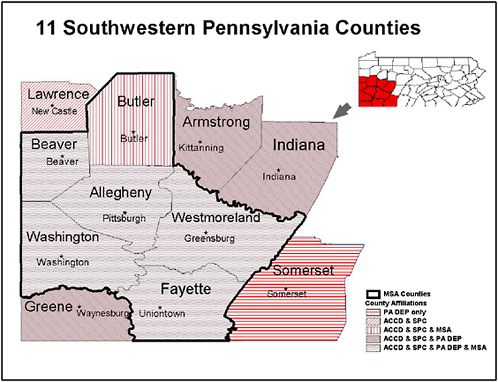 |
impairment including urban and rural handling of human waste, acid mine drainage, and agricultural and urban runoff. Chapter 5 focuses on decision-making strategies and technical solutions for regional water quality improvement, and Chapter 6 provides and assesses potential institutional and financial solutions for the region’s water quality problems. Lastly, during the course of this study of water quality improvement in southwestern Pennsylvania, the committee gained knowledge and insights on several technical, policy, and institutional issues that have broader national implications. These are discussed in Chapter 7. Although detailed conclusions can be found within individual chapters and in the chapter summaries, the report’s recommendations pertaining to water quality improvement in southwestern Pennsylvania are contained in Chapters 5 and 6.
REFERENCES
Balbus, J., R. Parkin, and M. Embrey. 2000. Susceptibility in microbial risk assessment: Definitions and research needs. Environmental Health Perspectives 108(9):901-905.
Mershon, S. and J. Tarr. 2003. Strategies for clean air: The Pittsburgh and Allegheny County smoke control movements, 1940-1960. In Devastation and Renewal: An Environmental History of Pittsburgh and Its Region, J. Tarr (ed.). Pittsburgh, PA: University of Pittsburgh Press.
NRC (National Research Council). 2001. Classifying Drinking Water Contaminants for Regulatory Consideration. Washington, DC: National Academy Press.
NRC. 2004. Indicators for Waterborne Pathogens. Washington, DC: National Academies Press.
WSIP (Southwestern Pennsylvania Water and Sewer Infrastructure Project Steering Committee). 2002. Investing in Clean Water: A Report from the Southwestern Pennsylvania Water and Sewer Infrastructure Project Steering Committee. Pittsburgh, PA: Campaign for Clean Water.


