
Executive Summary
BACKGROUND
The City of Pittsburgh is located in southwestern Pennsylvania where the Allegheny and Monongahela Rivers meet to form the Ohio River (see Figures ES-1 and ES-2). These “Three Rivers” have been central to the history, economy, and identity of the region. Pittsburgh initially thrived as a commercial and transportation center in the mid-nineteenth century but soon transformed to a region characterized by a growing industrial sector with a specialty in metals production and major mining activity. This growth, however, came at a high environmental cost in terms of polluted air and water, which afflicted the Pittsburgh region for most of the twentieth century. By the 1980s, new laws, advances in technology, and the significant decline of the steel industry-based economy combined to reduce industrial air pollution. Water quality problems in the region, although lessened, have persisted.
Drainage from abandoned coal mines—typically a highly acidic solution bearing a large load of iron, either dissolved or precipitated as ferric hydroxide—is the source of significant residual water pollution in certain streams in southwestern Pennsylvania and can produce biologically “dead” waters. However, beginning in the late 1960s, state and federal legislation requiring the treatment of polluted water prior to discharge to local streams has reduced (but not eliminated) the widespread ecological impacts of this drainage.
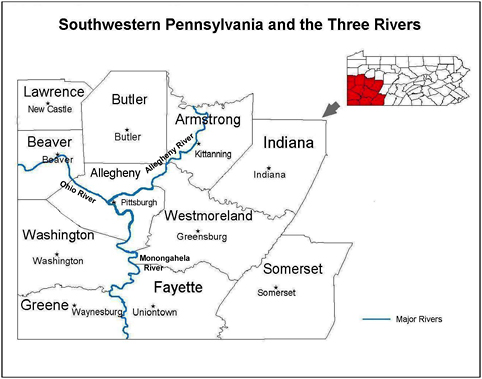
FIGURE ES-1 Eleven counties of southwestern Pennsylvania. See Figure ES-2 for a map of Allegheny County and the City of Pittsburgh.
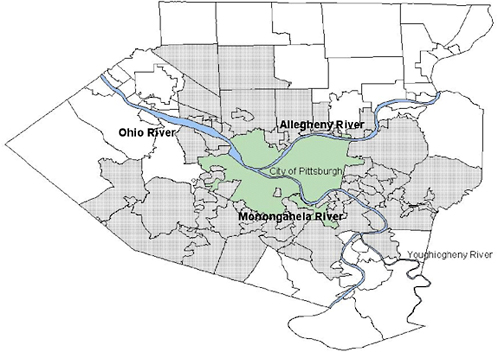
FIGURE ES-2 The Allegheny, Monongahela, and Ohio Rivers in Allegheny County in southwestern Pennsylvania; shaded areas include the 83 Allegheny County communities serviced by the Allegheny County Sanitary Authority (ALCOSAN), including the City of Pittsburgh.
Since the late 1950s, the development of sewage treatment plants throughout the region—the largest of which is operated by the Allegheny County Sanitary Authority (ALCOSAN) and serves the City of Pittsburgh and 82 other communities in Allegheny County (see Figure ES-2)—has alleviated downstream pollution in the Ohio River from the municipal sewers that previously discharged directly to local waterways. Yet releases of untreated sewage and surface runoff, especially on wet weather days and due to failing sewers, continue to degrade the quality of waters and impair their value for habitat, recreation, and water supply. Sewage-related water quality problems also persist in dry weather because of aging and deteriorating on-site sewage treatment and disposal (“septic”) systems and sewage pipes that may be a significant source of contamination to groundwater supplies. These problems threaten the region’s public health, environment, economy, and image. For example, there has been a steady rise in the last decade in the number of days of the summer recreational season that the Allegheny County Health Department (ACHD) has issued river advisories (i.e., when rainfall in the region is great enough to potentially cause sewer overflows and lead to excessive levels of bacterial indicator organisms1) that recommend restricted recreational contact exposure. Indeed, the City of Pittsburgh, ALCOSAN, and other communities in the region face extensive and costly regulatory
|
1 |
Because it is impractical to test waters for all possible pathogenic microorganisms, the microbial quality of water is often assessed through the use of indicator microorganisms (usually bacteria). Although such fecal indicator bacteria are generally not pathogenic, they provide estimates of the amount of feces and, indirectly, the presence and quantity of fecal pathogens in water (see Chapter 3 for further information). |
action under the federal Clean Water Act for both combined sewer overflows (CSOs) and sanitary sewer overflows (SSOs) resulting from wet weather conditions.
The costs of water and sewer infrastructure improvements necessary to address the release of untreated or inadequately treated sewage into the region’s surface waters are uncertain; however, based on investments made in other cities and on national studies, significant investment is expected to be needed to rehabilitate and upgrade aging municipal infrastructure and replace failing on-site systems. Meeting such costs is expected to be difficult given the economic climate of the region. Although the region’s economic base has shifted in the last two decades from mining and traditional manufacturing to other sectors, many communities in southwestern Pennsylvania continue to experience significant economic weakness as reflected in population decline (in both the central city and its metropolitan area), unemployment rates, and other indicators such as poverty level and income (see Chapter 2 for further information). Unlike the 1970s and 1980s, little federal and state assistance is available for the development and expansion of major water supply and wastewater facilities, and even that is likely to be restricted to extreme situations and poor communities. The costs of these improvements must be considered in the context of the potential costs of inaction, which would include adverse impacts on public health, the environment, and economic growth, and possible further federal and state regulatory action or private lawsuits by concerned parties.
This report was written by the Committee on Water Quality Improvement for the Pittsburgh Region overseen by the National Research Council (NRC)’s Water Science and Technology Board. The committee was formed in 2002 at the request of the Allegheny Conference on Community Development (ACCD) to conduct an independent assessment of the wastewater and water quality problems of the Pittsburgh area in southwestern Pennsylvania and to make recommendations on how these issues and needs of the region can best be addressed by multiple jurisdictions on a cooperative basis. The study goals combined to create a framework of guidance and recommendations to help make water quality improvement-related investments. The committee’s statement of task is included in Box ES-1. This report’s content, conclusions, and recommendations reflect the collective expertise and consensus of the committee. Detailed conclusions are contained in the individual chapters and in chapter summaries. The report’s principal recommendations pertaining to water quality improvement in southwestern Pennsylvania are contained in Chapters 5 and 6.
WATER QUALITY AND CAUSES OF IMPAIRMENT
The condition of waterbodies across the United States is determined by comparing certain measured physical, chemical, and biological parameters within those waters to state water quality standards. Each water quality standard consists of two primary and distinct parts: (1) designated beneficial use(s) of the waterbody (e.g., aquatic life support, drinking water supply); and (2) narrative and numeric water quality criteria for biological, chemical, and physical parameters that measure attainment of designated use(s). Waterbodies can be impaired for any of their designated uses by a variety of contaminants. It is important to note that inadequacies in the type and extent of water quality data available in southwestern Pennsylvania prevented the committee from assessing the full extent of adverse effects due to pollution. Almost all of the water quality data available to the committee during this study were derived from single studies in specific areas for limited durations. Recently, several agencies have expanded water quality data collec-
|
BOX ES-1 The NRC will establish an expert committee to undertake an assessment of the wastewater and water quality problems of the Pittsburgh, Pennsylvania area and make recommendations on how these issues and needs of the region can be best addressed by the multiple jurisdictions on a cooperative basis. The study will address several key questions, including:
|
tion in the region, although there appears to be little coordination of these activities. Therefore, it is difficult to fully identify the sources of pollution that cause these impairments, to assess the extent of adverse effects, and to prioritize remediation efforts.
Surface waters in southwestern Pennsylvania are impaired for several uses including contact recreation due to the presence of indicator microorganisms in excess of levels expected to cause human illness; fish consumption due to organic and inorganic chemicals known to bioaccumulate in fish tissue and to represent a human health risk; and aquatic habitat due to metal concentrations and low pH that alter ecosystems and can harm aquatic organisms. Statewide, the committee found that the major causes of water quality impairment in the Commonwealth of Pennsylvania are the following: (1) acid mine drainage, (2) agriculture, (3) urban and stormwater runoff, and (4) human waste handling.
Improperly managed wastewaters resulting from various human activities are degrading the microbiological water quality in the region, although available data are not sufficient to determine the relative contribution of different sources to surface and groundwaters. More specifically, wet weather biological water quality in the main stem rivers is demonstrably worse than that in dry weather, suggesting that stormwater and sewer overflows (CSOs and SSOs) may be important contributors. Furthermore, water quality in many tributaries does not meet biological standards in either wet or dry weather conditions, suggesting that failing septic
systems may be important contributors. However, regional waters are not considered impaired for use as sources of drinking water because of the extensive treatment that is routinely performed on drinking water sources, particularly surface water sources. Although groundwater used for public drinking supplies generally meets water quality guidelines, private wells2 show significant variability in terms of microbial contamination, and the effects of mining are apparent in some areas. There is no evidence that southwestern Pennsylvania has recently experienced any waterborne disease outbreak that would link impaired source water quality with human health effects. However, as with water quality data, significant gaps exist in public health monitoring, thus preventing an adequate assessment of possible endemic waterborne disease occurrences.
The contribution of agriculture to pathogen loading in rural areas of southwestern Pennsylvania could not be determined, but this is a well-known pathogen source in many parts of the nation, and many livestock management practices in southwestern Pennsylvania are likely to contribute pathogens to streams. Relative nonpoint contributions of human and nonhuman pathogen sources in both urban and rural watersheds are not known.
Acid mine drainage is a significant cause of water quality impairment in the region, predominately affecting streams and tributaries. This regional water quality issue extends beyond Pennsylvania to encompass much of the Appalachian Range. Presently, acid mine drainage is being addressed by multiple jurisdictions including federal and state programs, and continued public funding to combat this water pollution problem is essential to future water quality improvement in southwestern Pennsylvania.
WATER QUALITY IMPROVEMENT: DECISION-MAKING STRATEGIES AND TECHNICAL SOLUTIONS
From a regulatory perspective, the most important water quality problem in the region in terms of the potential for adverse human health effects is controlling microbial contamination of streams that derives from the effect of wet weather conditions on sewer systems (CSOs, SSOs, and stormwater), failing septic systems, and agricultural and urban runoff. The U.S. Environmental Protection Agency (EPA) has adopted regulations requiring CSO and SSO controls and issued consent orders through the Pennsylvania Department of Environmental Protection (PADEP) and the ACHD to many ALCOSAN partner communities (see also Figure ES-2) to address this pervasive wet weather problem through increased attention to centralized sewer systems. A similar consent decree for ALCOSAN with EPA is pending and expected to be finalized soon. The evaluation of water quality improvements related to such remedial activities will be critical. However, the implementation of solutions for identified sources of impairment does not preclude the need for additional information related to other sources and their contributions to water quality impairment in the region. To develop better understanding of sources of contamination in southwestern Pennsylvania, water quality monitoring and modeling efforts should take place concurrently with mandated remedial activities.
It is clear that the causes and nature of water quality impairments, the parties responsible, and the individuals and waterways affected differ for each of the problem contaminants in the region. A comprehensive watershed-based approach is needed to address the spectrum of water
quality problems, including wet weather problems; such a systematic approach should recognize interrelationships among problems and the need for parties responsible for each water quality problem to share in its solution. The technical approach is embodied in what the committee calls the “Three Rivers Comprehensive Watershed Assessment and Response Plan,” or CWARP.
The framework recommended for planning and implementation of CWARP consists of the following five basic steps: (I) problem identification; (II) assessment of existing conditions including quantification of loads and modeling their relationships to water quality; (III) projection of future loads and their timing, location, and impacts on streams; (IV) formulation and evaluation of alternative management strategies, including assessment of the effects of alternatives on future conditions and the preferential ordering and scheduling of various elements of the preferred strategy; and (V) adaptive implementation of elements of the strategy, relying on feedback from implementation of each element to provide the basis for continued planning of subsequent elements. This five-step CWARP process must be adapted to address planning and management needs at the following four interrelated scales: (1) river basin, (2) multicounty/metropolitan scale, (3) high-density urban areas, and (4) rural areas.
The committee recognizes that the region is not starting with a blank slate, and Step I has been largely completed for each of these scales. Substantial progress has been made on Step II, but significant gaps remain. Because the problems are largely associated with existing conditions and there is only modest growth in the region as a whole, Step III may be less important, but changes in land use that are occurring in suburban (formerly rural) areas cannot be ignored. Lastly, Steps IV and V do not appear to have been well developed in any respect and thus deserve much greater attention.
Because regional information on the biological quality (see Box 5-2 for further information) of receiving waters is scant, its collection during and in support of CWARP at the river basin scale is critical. Information collection for CWARP should include biological data to both assist in ecosystem health assessment benchmarking and to help document changes to the ecosystem that occur as a result of changing stressors. To this end, an effort should be made to expand the Ohio River component of the rejuvenated Great Rivers program of EPA’s Environmental Monitoring and Assessment Program with an emphasis on the biological water quality of the main stem rivers.
At least two aspects of water management are of concern at the multicounty/metropolitan scale of CWARP. First, and at the very least, water quality planning at this scale should be sufficient to inform regional interests of the potential effects (including constraints, if any) of water quality conditions on future transportation and land development, the consequences of development on water quality where it occurs, and how those effects and consequences can and should be modified. Second, planning at this scale should also result in the identification of opportunities for economies of scale in the delivery of water and wastewater services through cooperative arrangements among local governments. The Southwestern Pennsylvania Commission (SPC) or an alternative organization should formulate regional water resource plans and integrate them with transportation and land use plans.
Several entities have estimated recently that solving wet weather problems in the urban core of the region by conventional means, using a combination of storage, conveyance, and treatment improvements, could cost several billion dollars. Investing large sums of capital based only on currently available data may not ultimately solve the most important problems or provide appropriate solutions. Although it is true that no amount of additional data and analyses would remove all uncertainty about water quality investments, it is clear that currently available
information is lacking in several critical respects (e.g., how much surface water runoff from separate stormwater sewers affects water quality in receiving streams during wet weather events). Until these facts are known better, planning and implementation of cost-effective remedial measures will be impeded.
Whereas receiving water quality modeling activities appear to be extremely limited currently in the region’s three main stem rivers, they should be used to estimate impacts of pollution loadings on the receiving streams and to help prioritize alternatives for pollution control. Other modeling activities required to implement CWARP in the region’s urban core include sewer system routing models, dynamic sewer system modeling, dynamic stormwater modeling, and real-time sewer flow control modeling for analysis and operation. Projections of changes in the regional landscape are important in the planning and implementation of CWARP in the region’s urban core. Planning studies conducted at the multicounty/metropolitan scale should be sufficient for this purpose and include projections for several land use, transportation, water supply, and wastewater parameters.
The first route to successful improvement of water quality in the region is to optimize utilization of existing infrastructure. To this end, the committee strongly recommends that all wastewater collection systems located in the watershed, particularly in the region’s urban core, be fully compliant with EPA’s Capacity, Management, Operations, and Maintenance (CMOM) policy or an equivalent program. Thereafter, related information, approaches, and technologies recommended in this report would be available to help guide major longterm investments in improving the region’s water quality. Furthermore, ALCOSAN’s draft long term control plan (LTCP) for controlling CSOs, which was drafted in 1999 and was the subject of an extensive third party review in 2001 through 2002, should be reevaluated in the context of the overall CWARP approach to reflect ongoing consent order negotiations, CMOM, and information from CWARP as it is developed in the future.
The CWARP approach is recommended as a framework for development of the LTCP and similar documents because of the circumstances (especially data limitations) that exist in southwestern Pennsylvania and, in principle, would apply in other regions of the United States with similar water quality problems and circumstances. In addition, in the development of a final LTCP, ALCOSAN and other wastewater treatment providers in southwestern Pennsylvania should evaluate the utilization of real-time control of CSOs. Storage and treatment of CSOs in nearby abandoned mine voids, which is being evaluated for the Township of Upper St. Clair, Pennsylvania, should also be evaluated. Also recommended is consideration of several innovative approaches and technologies to determine what, if any, role they may have for improving water quality in southwestern Pennsylvania—especially in the region’s urban core areas.
Best management practices for septic systems should be implemented throughout the region using the CWARP framework. Although individual systems are permitted locally, and current technical standards are available to ensure proper performance, they may be ignored. Furthermore, prevention of the discharge of untreated sewage into local waterways or ditches is difficult to enforce. The region needs a coordinated, well-funded program for oversight and routine maintenance of cluster and individual septic systems. Such a program can be self-sustaining through user charges providing they are applied on a cooperative regional or county basis. Several actions to help improve water quality in the predominantly rural areas of southwestern Pennsylvania are discussed and recommended for consideration.
There are no comprehensive estimates of the economic benefits of addressing the remaining water quality problems for southwestern Pennsylvania or from proposed projects to address the region’s water quality problems. Nevertheless, the region would be expected to benefit economically from measures that significantly reduce drinking water risks and enhance recreational opportunities. The CWARP process can identify a list of alternative management strategies and projects that are technically feasible and capable of addressing the region’s water quality problems at a variety of scales, but the question remains: Which is the better option? A variety of economic evaluation frameworks are available; some of the more prominent are discussed in this report, including cost-effectiveness analysis, benefit-cost analysis, and multicriteria methods. In this regard, the use of cost-effectiveness as the primary method for evaluating options for achieving water quality objectives in the region is recommended and should include an analysis of incremental costs to achieve elimination of low-probability contamination events. The committee recommends the use of benefit-cost analysis in the evaluation of water quality improvement projects in the region and in helping to set priorities among them.
As the CWARP process is being planned and implemented, it is essential that it be integrated with the ongoing process of establishing total maximum daily loads (TMDLs) for impaired streams being conducted by PADEP under requirements of the federal Clean Water Act. Lastly, the recommended CWARP effort should be completed quickly to provide timely support for those water quality improvements that are required and others in the public interest. It is difficult to estimate the cost of implementing CWARP, but in the committee’s judgment it should be small compared to the cost of improvements and more than offset by potential savings.
WATER QUALITY IMPROVEMENT: INSTITUTIONAL AND FINANCIAL SOLUTIONS
Water planning issues in southwestern Pennsylvania need to be addressed on a regional and holistic basis, taking into account water quality; water supply; flood hazard mitigation; aquatic and riparian habitat protection and restoration; and recreation. Moving toward regionalization will be challenging because water resource and quality management in southwestern Pennsylvania currently is highly fragmented among federal and state governments as well as 11 counties, 595 municipalities, and 492 water and sewerage providers. In choosing an appropriate organization or set of organizations to address these concerns, the following three factors should be considered: (1) water resource management functions for which improvements are necessary or desirable; (2) the level of government or private sector enterprise to which management functions should be entrusted and to which legal authority should be delegated by the legislature; and (3) the geographic scale that is appropriate to achieve efficiency by exploiting economies of scale and making significant regional interdependencies internal to the planning area. Consistent with the recommended CWARP approach, changes are necessary to address the water resource issues of southwestern Pennsylvania at the following geographic scales: (1) river basins and interstate river basins and watersheds; (2) metropolitan region scale (multicounty areas); (3) metropolitan urban areas; and (4) rural areas. In addition, information that exists today, as well as that developed under elements of CWARP, should be made readily available to the public. This would include sources of water quality problems, their significance, appropriate solutions, costs, and their social impacts.
River Basin
Some water quality problems—particularly those related to long distance transport of pathogenic organisms, heavy metals, and persistent toxic chemicals—transcend regional, state, and political boundaries. At the largest scale of river basins, water monitoring and management is the responsibility of federal agencies (particularly the EPA, U.S. Geological Survey, and the U.S. Army Corps of Engineers) and the state (PADEP). The Ohio River Valley Water Sanitation Commission (ORSANCO) also conducts water monitoring and modeling for the Ohio River basin and its tributaries; ORSANCO and the PADEP are the appropriate agencies to establish the formulation of management strategies at the river basin scale.
Metropolitan Region
The Southwestern Pennsylvania Commission (SPC) is the primary organization for transportation planning and economic development at the multicounty regional scale. Those plans can significantly affect regional land use and water-related services. Concerns about land use and associated water supplies, wastewater disposal, and stormwater management should be incorporated in planning at that scale. The SPC is probably the region’s best choice for carrying out this planning function, but its present representative structure and lack of water resource expertise limit its capacity to do so. Its regional databases on land use, transportation, and economic development are its strengths relative to water resource planning.
An important step that SPC, in coordination with ORSANCO, could take to broaden representation and advance public education on regional water resources would be to establish a Three Rivers Regional Water Forum as conceptually illustrated in Figure ES-3 (see also Box 6-4). The forum should be charged with a broad mandate to assess priorities for water infrastructure planning, maintenance, and construction as those activities are related to regional transportation, land use, economic development, and current infrastructure capacity and condition. The forum should include elected and appointed officials of local governments, regional leaders in the private sector, academia, environmental organizations, and other nongovernmental organizations, and participation should be encouraged by all organizations that share some responsibility for the proposed CWARP. Although there are several options for the creation and organization of a regional water forum, an unincorporated network of public and private stakeholders established by voluntary memoranda of understanding is recommended for careful consideration. However, the participants and exact organization plan should be determined locally.
High-Density Urban Areas
As stated previously, the primary water quality management problem in the Pittsburgh region’s urban core is periodic discharges of untreated wastewater from combined and separate sanitary sewers. Continued fragmented management of the sewer collection-conveyance-treatment system (i.e., maintaining the status quo) is not a satisfactory situation. Rather, planning and management of sanitary and combined sewers should be integrated with stormwater management. At least five viable organizational arrangements, represented by the
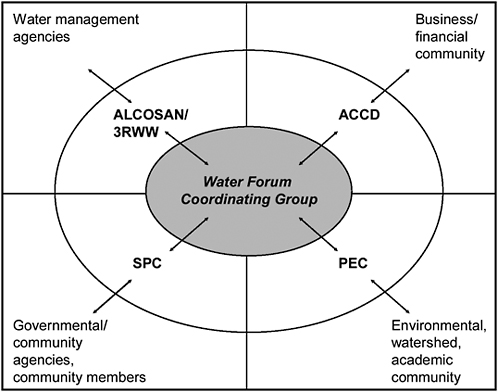
FIGURE ES-3 Concept diagram for a Three Rivers Regional Water Forum. Coordination of the forum would be provided by a group that represents major nongovernmental organizations, local, state, and federal government stakeholders; and regional academic experts, among others. NOTE: 3RWW is the 3 Rivers Wet Weather Demonstration Program; PEC is the Pennsylvania Environmental Council (see Chapter 6 for further information).
following options, could serve that purpose, including (A) merger of City of Pittsburgh and neighboring municipalities with Allegheny County; (B) establishment of county-wide management either by dedication of the systems to Allegheny County or through an administrative arrangement with Allegheny County using authority under Pennsylvania Acts 67 and 68; (C) creation of one or more special districts for sewer management; (D) expansion of the role of ALCOSAN to include sewer collection systems, with or without authority over stormwater management; and (E) continuation of the decentralized system but with performance standards and voluntary participation in a regional maintenance organization (RMO) provided on a fee-for-service basis. ALCOSAN would be encouraged to establish the RMO.
All five options are viable, and discussions on merger of services between Allegheny County and the City of Pittsburgh have already occurred. A merger of city and county government, although politically difficult, is desirable from the perspective of water quality management as it would create the potential for implementing CWARP over a significant portion of the urban core. However, such a merger would be much more effective if it included other large municipalities that generate stormwater, sanitary sewage, or combined sewage that flows through the high density core of the region. Allegheny County should take a leadership role in search of a consensus on one of the four remaining options. The committee also prefers Option
B (establishment of county-wide management) to Options C, D, or E because it captures economies of scale in planning and management, facilitates the use of a systems approach, and keeps decision making closer to politically accountable public officials.
ORSANCO, with its prior experience with similar problems in the Ohio River basin, can be of valuable assistance in reaching a consensus on all of the preceding options. The 3 Rivers Wet Weather Demonstration Program (3RWW) should be continued or expanded to conduct public education programs for stormwater and CSO management; to provide technical assistance to local governments for stormwater and CSO management; to provide education to local government on identifying and correcting illegal connections to sewer systems; and to monitor, analyze, and report on the status of stormwater and CSO management in Allegheny County.
Rural Areas
Additional steps are also needed to address water supply and wastewater disposal systematically in rural and small urban areas outside of the region’s urban core. The actions recommended in Chapter 5 to address septic system deficiencies should be undertaken cooperatively by several agencies. At the state level, the Watershed Restoration Action Strategies program should be expanded to include assessment of effects of inadequate wastewater disposal on water quality. In doing so, PADEP should work closely with local governments having legal authority over such systems. The SPC could and should take strong leadership in bringing local governments together to address these issues. In addition to PADEP, SPC should request assistance from EPA and nongovernmental organizations having prior experience with programs of this kind. The Allegheny County experience in these activities should provide a sound foundation for other counties in the region.
Financing
The following actions are recommended regarding a framework for regional financing of water quality improvements in southwestern Pennsylvania:
-
Develop and implement a sewer and/or water user surcharge to fund at least the first few years of planning and data gathering under CWARP or a similar program. Ideally, the charge would be in addition to wastewater/water bills throughout the basin or, as a minimum, in the region’s urban core.
-
Initiate a flow-based repayment system for ALCOSAN and other regional wastewater treatment providers that reflects, to the extent practicable, the actual contributions of flow into sewerage systems.
-
Select one or more forms of regional governance that have the necessary legal authority and administrative expertise to finance capital improvements and operating and maintenance expenses of management programs. Such authorities should include the power to incur debt for capital projects, establish user charges, and collect revenues necessary to pay for all expenses except those financed by intergovernmental grants.
-
Continue efforts to increase regional assistance through PENNVEST (Pennsylvania Infrastructure Investment Authority) and other sources of funds that can generate support for
-
specific programs, such as development of county-based management programs for on-site septic systems and acid mine drainage control.
-
To the extent that assistance is not available, continuing studies are needed regarding the efficient application of current local taxes and user charges to cover start-up efforts identified above, with the goal of creating repayment mechanisms based on an equitable regional user charge system. Ultimately the system would generate sufficient revenues to repay debt obligations that will be necessary to fund priority facilities.
IMPLICATIONS BEYOND SOUTHWESTERN PENNSYLVANIA
During the course of this study of water quality improvement in southwestern Pennsylvania, the committee gained knowledge and insights on several matters that have broader implications and, in the committee’s judgment, might be considered useful by others responsible for national efforts to protect and enhance water quality. These are discussed in Chapter 7 of this report in the following areas: (1) information systems, (2) health and ecological impacts of water quality, (3) potential federal policy conflicts with regional optimization, (4) stakeholder representation and participation, (5) paying for water quality improvements, and (6) regionalization and cooperation.
SUMMARY
As this report makes clear, water quality problems in southwestern Pennsylvania are complex and region wide. Many of southwestern Pennsylvania’s current and most pressing water quality problems, such as those attributable to sewer overflows and stormwater, can be traced to historical water supply and wastewater infrastructure decisions made by individual municipalities at a time when today’s population and economic and industrial climate could not have been foreseen. Other problems, such as acid mine drainage, are a legacy of the region’s past heavy mining and manufacturing economy. Ongoing remediation activities and those planned to address wet weather-related problems for the mostly urban ALCOSAN service area may not be optimal (in terms of either effectiveness or economics) and, in any case, are not designed to address the full set of problems in the 11-county region or the Allegheny and Monongahela River basins. Furthermore, because of the paucity of data, it is not possible at present to make reliable predictions of water quality improvements that will result from such investments. Indeed, as stated earlier, the limited data available provide no evidence that southwestern Pennsylvania has recently experienced any waterborne disease outbreak that would link impaired source water quality with adverse human health effects.
The committee concludes that the interrelated water quality problems of southwestern Pennsylvania must be confronted on a regional basis and in a systematic way. Such an approach should improve public awareness of the issues and promote regional cooperation through the involvement of key stakeholder groups with an interest in water quality improvement. In this regard, one or more regional decision-making authorities should take responsibility for leading the development of a Comprehensive Watershed Assessment and Response Plan that would have as its principal objective the meeting of water quality standards throughout the region in the most cost-effective manner. A first step in determining effective infrastructure investment and
management strategies for water quality improvement and an integral part of the CWARP is to undertake coordinated basin-wide monitoring (including biological monitoring) and modeling to estimate the amounts and relative impacts of various sources of pollutants entering the region’s surface and groundwater. This is critical to ensuring that remediation efforts are appropriately targeted to the most important sources of pollution and that limited funds for remediation are spent on the highest-risk problems. The southwestern Pennsylvania experience is repeated to a greater or lesser extent around the United States, and the solutions suggested in this report relating to cooperation and regionalization are widely recognized as having national implications and benefits. Thus, the program recommended herein for water quality improvement in southwestern Pennsylvania can serve as a model for other regions. Lastly, effective implementation of this report’s recommendations regarding water pollution reduction is not intended to delay current progress in regional water quality improvement.


