
2
Environmental Health Overview
WHAT IS ENVIRONMENTAL HEALTH?
Lynn Goldman
Human health has been defined by the World Health Organization as “a state of complete physical, mental, and social well-being, and not merely the absence of illness or infirmity.” Environmental health or environmental public health is one component of human health; it is concerned with those aspects of human health that are determined by interactions with physical, chemical, biological, cultural, and social factors in the environment. As the biologist René Dubos noted, “Indices of environmental health are expressions of the success or failure experienced by the [human] organism in its efforts to respond adaptively to environmental challenges” (Dubos, 1987). A complication for our own species and the many others with which we share the planet is that these challenges vary over time because we humans are constantly changing our environments. It follows, then, that environmental health isn’t just about describing and understanding how aspects of the environment affect our health; it is also about correcting those problems. We want to be able to assess, control, and prevent factors in the environment that might adversely affect not only our own health but the health of future generations.
Environmental public health occurs on many levels, from the molecular and genetic to the global. At this meeting, our focus is the community and regional scales; we want to learn about the interplay between health and the environment, throughout this region and in its individual neighborhoods, and the actions that people are taking to address it.
|
We want to be able to assess, control, and prevent factors in the environment that might adversely affect not only our own health but the health of future generations. Lynn Goldman |
Environmental health is very important for the overall status of health in our population. In a recent review, the Centers for Disease Control and Prevention (CDC), listed 10 public health achievements, that are largely responsible for the fact that life expectancy in our country has increased by 30 years in the last century. A number of these are environmental health measures, such as improved sanitation, better nutrition, and better housing. In fact, environmental health measures are responsible for more than three-quarters of these improvements. Medical care, although important, made a relatively modest contribution to our increased longevity (CDC, 1999).
Houston, like many local regions in the United States, is concerned with chronic disease—and for good reason. For the nation as a whole, chronic disease has become the number one killer, and it is responsible for the majority of our health care costs (Figure 2.1). At the same time, we are challenged by infectious disease—particularly from new threats such as SARS (severe acute respiratory syndrome), West Nile virus, and other pathogens that seem to be emerging from the environment. We also have the threat of terrorism and consequent demands on the public health system to address all of these concerns. I don’t think there has ever been a time when people appreciated the public health system more, but I also think that there has never been a time when the public health system was more overtaxed.
In addressing these challenges, the Roundtable believes we should think systemically. Environment, after all, has three interacting aspects—the natural
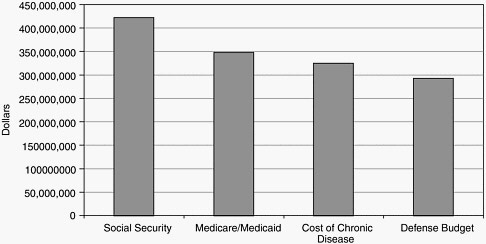
FIGURE 2.1 The U.S. population spends as much on the burden of chronic disease as the U.S. government spends on Medicare and Medicaid and the defense budget. SOURCE: Jim O’Hara, unpublished. Reprinted with permission.
environment, the built environment, and the social environment. We know that the built environment has major impacts on our health because it contributes to sedentary life-styles, to greater automobile pollution, and to global warming. Similarly, the social environment is very important, because many social and cultural factors help produce unhealthy lifestyles and diets. Also, of course, the natural environment is critical to our health. Our basic needs of food, water, and air, and even some of our spiritual and emotional needs, come from the natural environment. There is a tremendous health benefit to the experience of being in nature.
Environmental protection laws are in essence public health laws. Over the last 30 years since the establishment of the U.S. Environmental Protection Agency (EPA), there has been significant progress in environmental protection and public health in this country. Across the nation, communities have cleaner air and water in most places, and remediation of numerous hazardous waste sites has occurred. We also see new and different measures for reducing or preventing waste as many industries are attempting to use cleaner methods for manufacturing products. We recognize from public opinion polls that most Americans now consider themselves to be environmentalists who daily pursue practices such as recycling.
Although there has been great progress, numerous challenges remain. For example, many older industrial facilities were grandfathered by the Clean Air Act, and today the government doesn’t have any reasonable policies in place for addressing this problem. Additionally, we still have a long list of hazardous waste sites that need to be remediated. Meanwhile, although the Endangered Species Act has saved many species, we continue to lose the biodiversity that is important to us. I used to play with Texas horned lizards when I was growing up nearby in Galveston County. These are truly fascinating and wonderful creatures, ubiquitous in this region back then, but I would be hard pressed to find one of them today. We don’t really know exactly what brought this creature to the brink, and we don’t know what to do to bring it back.
Similarly, as a child I could take for granted the many indigenous pelicans and dolphins. Watching pelicans dive-bomb for fish, seeing dolphins following the Bolivar Ferry, or finding a variety of shells on the beach meant so much. These experiences are part not only of our natural landscape but also of the landscape of childhood, as well. Nowadays, we don’t see as many dolphins, and bird populations have also declined. We don’t yet know for sure what the environmental factors responsible for such changes in the natural environment are doing to human health, although we do know that they have diminished the quality of life for children and adults alike.
An important point to keep in mind while addressing the tasks still undone is that in these and other environmental issues, our society has become highly polarized. In my experience, the primary obstacle to achieving progress in environmental protection is the tendency to point the finger to someone else’s re-
sponsibility for the environmental health issue. For example, regarding the impacts of air pollutants on our lungs, one might point to industrial plants. However, people in those industries can point to automobile pollution, the growth of automobile usage, and the lack of good public transportation. Similarly, car manufacturers may point to smoking and the harmful effects of tobacco exposure. As long as responsibility is avoided by placing the blame elsewhere, we will not step up to the plate to address our share of the problem. The only way to move forward is for everyone to come forward and contribute to the solutions. From the standpoint of a baby’s lungs, it doesn’t matter where the pollutant came from.
That we often learn from our mistakes is also shown by how disasters of the past have helped us devise improved emergency preparedness procedures or preventive measures. Going back again to the lore of my childhood in this region, the Texas City disaster of 1947—in which a ship full of ammonium nitrate fertilizer caught fire—was a case of responders failing to follow protocol (Figure 2.2). Not towing the ship out to sea resulted in a chain reaction of explosions involving many of the refineries in the area and a second ship as well. In the end, thousands of people died. It is certainly a reminder of the importance of prevention and being prepared for emergencies.
Another infamous event in the Houston/Galveston area was the great hurricane of 1900. Its 130-mile-per-hour (mph) winds killed at least 8,000 people and destroyed 3,500 homes and buildings. To prevent a recurrence of this type of disaster, we have invested significant resources to build a seawall, deploy weather forecasting systems, and establish emergency shelters so that people won’t be harmed if there is flooding. However, this region still has more than its share of flooding and problems with disasters each year.
Appropriate ways to prevent such events or, if they do occur, to minimize their impacts have not necessarily been easy to determine or to implement. Yet some of the issues that scientists and public policymakers are addressing are far more subtle, spread out over time and place, and not readily amenable to solutions—or even to acknowledgment.
A case in point is global warming. Global temperatures have been gradually rising as carbon dioxide (CO2) emissions have increased (Figure 2.3). We don’t yet know when the atmosphere will be warm enough to create catastrophic conditions. However, we do know some of the likely consequences: a rise in the level of seawater (many low-lying locations in the Houston area should be of great local concern) and the probability of greater instability in weather (including more hurricanes). So while CO2 buildup has to be looked at with great urgency, in my view it has not yet been adequately confronted. Because we have only one planet, we cannot experiment on multiple planets to see what is going to happen. Instead, we need to take action to stem climate change and to protect sensitive environments such as the low lying communities in the region. This means being willing to put aside our tendency to shift blame to others and in-
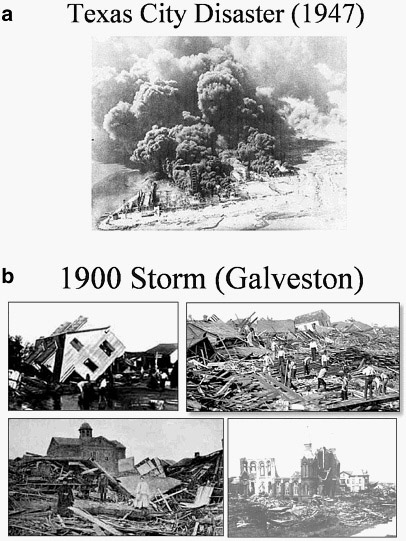
FIGURE 2.2 Both human-made (a) and natural (b) disasters can have an effect on human health. Although these occur infrequently, the loss of lives and the economic impact can linger. SOURCE: (a) Texas City Library. (b) National Oceanic and Atmospheric Administration/U.S. Department of Commerce. Reprinted with permission.
stead look for some way that each of us can contribute to a healthier environment for all, now and in the future.
In the final analysis, whether the issue is local and well defined or global and subtle, an important part of achieving environmental protection is simply listening. In searching for solutions, we must make ecosystems more important than our ego systems.
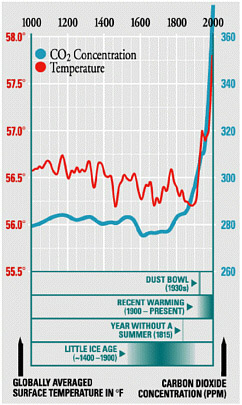
FIGURE 2.3 There is a correlation between carbon dioxide emissions and the increase in global temperature seen since 1951. SOURCE: Marian Koshland Science Museum of the National Academy of Sciences. Reprinted with permission.
ENVIRONMENTAL HEALTH CHALLENGES IN HOUSTON
Ken Sexton
Houston is a dichotomy of perception. It has been described as a model of growth and economic development; a free-market city; a place unfettered by zoning, excessive taxes, and unnecessary government regulation; and an international cosmopolitan enclave. However, it also has been called an urban environmental war zone; a poster city for urban sprawl and traffic congestion; the smog capital of the United States; and a national environmental sacrifice area.
Clearly there are differences of opinion about Houston. It is important to keep the dichotomy in mind and to understand that how one views Houston has a major impact on the perception of environmental health challenges for the region. Although these perceptions are highly subjective, they are not mutually exclusive, and there is some truth in all of them. Some of the city’s greatest challenges are discussed in more detail in Box 2.1.
|
Box 2.1
|
A GROWING DISPARITY
With a population of about 2 million, Houston is the fourth largest city in the United States (after New York, Los Angeles, and Chicago). Houston is also one of the most culturally and ethnically diverse cities in the nation. It has the fourth highest number of Hispanics, the fourth highest number of African Americans, and the eighth highest number of Asians. As many observers have noted, Houston has a “majority minority” population (see Chapter 4). In the 2000 Census, the city was about 37 percent Hispanic, 31 percent Anglo, 25 percent African American, and 7 percent Asian and other.
Perhaps one of the most dramatic features of the Census data was the rate of growth in Houston’s Hispanic population, which averaged 60 percent per decade for the last 20 years. If this growth rate continues anywhere near that level, Hispanics will soon be a clear majority. Data from the 2000 Census suggested that approximately 12 percent of Houston families and almost 30 percent of single-mother families were living below the poverty level and that the disparity between people who earned the lowest incomes and those earning the highest was actually increasing. This disparity is likely to continue growing for the foreseeable future, in fact.
The overall population in Houston is getting older. More than 75 percent of people aged 60 and older are Anglos, while the younger people—18 to 29 years old—are primarily non-Anglos. Blacks and Latinos comprise almost two-thirds of Houston’s younger adults (Klineberg, 2002), and their educational levels are considerably lower than those of Anglos. Without a significant closing of the educational gap between Anglos and non-Anglos, the future implications are fairly stark. For one thing, poverty and lack of education are major risk factors
for inadequate environmental health. The first challenge for the Houston metropolitan area will be to understand and address the environmental health impacts of such cultural, economic, demographic, and social realities—both at present and as they are likely to manifest themselves in the future.
WHO’S ON FIRST? WHAT’S ON SECOND?
A related set of tasks for this city should be the setting of priorities through comparative risk assessment—a method of evaluating, comparing, and ranking very different sorts of risks—combined with the analysis of costs. This will provide a conceptual framework and, combined with cost–benefit analysis, will formalize a scientific method of setting environmental health priorities.
Some initial efforts have already been made in this region. In 1991, the Houston Advanced Research Center convened panels of experts to perform a large comparative risk assessment—prioritizing 19 environmental problems in the eight-county metropolitan area. The group focused on three major domains: health, ecosystems, and socioeconomic impacts.
During their deliberations, the panels ranked the relative risks from lowest concerns to highest concerns (Figure 2.4). In preparation for a 2001 Houston-area town hall meeting on environmental health, Winifred Hamilton of Baylor College of Medicine and her colleagues asked, using Spanish and English telephone and written surveys, 311 area residents about their concerns regarding pollution and their health. A subsequent ranking of the concerns found that the top three types of pollution of concern, in order of importance, were air pollution from petrochemical plants, air pollution from cars, and ozone smog; the top three pollution-related illnesses were asthma, cancer other than leukemia or lung cancer, and allergies (Hamilton, 2002).
Houstonians have to recognize, however, that the setting of environmental health priorities is loaded with difficulties. It can be confounded by the complexity and interconnectedness of the problems, by the scientific uncertainties involved, and by basic disagreements among stakeholders about problem definitions and the proper role of regulation. Often overlooked, moreover, is the fact that even if scientists manage to do a reasonably good job of assessing comparative risks, the discretion of decision makers is often limited by legislative and organizational fragmentation. The public may deliver a fine prioritization among air issues and water issues, for example, but often the enabling legislation doesn’t allow agencies to move money from one medium or one program to another, and the elegant exercise comes to naught.
Despite such restrictions, it still makes great sense to pursue this more holistic approach and try to look across problem areas, because the results will ultimately change many of the practical constraints. The second challenge, therefore, is to set priorities and make necessary trade-offs across traditional boundaries so that environmental health is adequately protected for current and future
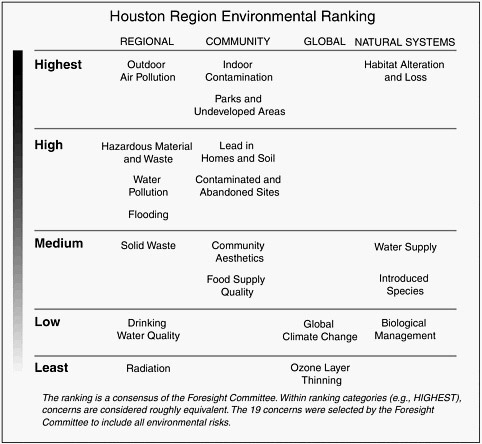
FIGURE 2.4 Comparative risk assessment by a committee convened by the Houston Advanced Research Center to rank the levels of concern related to the environment from high to low. Indoor and outdoor air pollution and loss of habitat had the highest ranking for the level of concern. SOURCE: Houston Advanced Research Center, 1996. Reprinted with permission.
generations. I would especially emphasize the words “across traditional boundaries”—not only political and legislative boundaries, but also scientific boundaries. Environmental health issues are truly interdisciplinary in nature and must be addressed from a broad, systematic, and team-oriented perspective.
BROADER ISSUES AND BASIC CAUSES
In the field of environmental health, more and more people are realizing that we have tended in the past to identify and define problems in overly narrow and restrictive ways. We now understand that problems are best viewed from a holis-
tic and ecological perspective, as illustrated by this definition of environmental health from Healthy People 2010:
In its broadest sense, environmental health comprises those aspects of human health, disease, and injury that are determined or influenced by factors in the environment. This includes not only the study of the direct pathological effects of various chemical, physical, and biological agents but also the effects on health of the broad physical and social environment, which includes housing, urban development, land-use and transportation, industry, and agriculture.
As we try to define environmental health in a more holistic way, at the same time we must stop relying on after-the-fact regulations to fix past mistakes. It is imperative that we spend at least equal amounts of time and effort looking to the future and trying to prevent problems before they occur. Similarly, because most of us in the environmental health field have been trained to focus on the outcomes of environmental health problems, we have not devoted enough attention to understanding fundamental causes.
The third critical challenge is to identify and address the basic underlying drivers of environmental health risks, and these are not necessarily the ones we have traditionally emphasized. We must be thinking about things such as population growth, urban sprawl, economic expansion, resource consumption, technological development, modes and patterns of transportation, and environmental attitudes and perceptions, to cite just a few. This process is not always comfortable, and it is not always easy, but until we begin to focus on fundamental causes we are unlikely to make as much progress as we would wish in alleviating current problems and preventing new ones.
MULTIPLE STRESSORS AND COMBINED EFFECTS
Because there is rarely just one causative factor behind a particular environmental health problem, Houston and many other metropolitan areas will ultimately have to take on the fourth challenge: the need to assess and manage cumulative risks to human populations and the natural environment by taking account of multiple stressors and their combined effects.
Many in the environmental health field have been talking about this concept for several years, and it was recently acknowledged in the U.S. Environmental Protection Agency’s first guidelines on cumulative risk assessment. Analysis of cumulative risk is likely to be a high priority issue over the next 10 or 20 years, and it will undoubtedly serve as a catalyst to broaden our thinking about risks and vulnerable populations. However, this can happen only if we address two related issues: (1) the need to enhance scientific knowledge and understanding about combined effects of multiple stressors and (2) the need to improve associated decision-making tools and processes.
In the first case, anyone who has ever attempted a cumulative risk assessment knows that when you try to evaluate aggregate effects on a population from a diversity of environmental stressors, the discussion rapidly moves away from the science because the science simply isn’t there. The process necessarily becomes qualitative and attitudes, biases, and perceptions play a prominent role in the final outcome. We therefore have to strengthen the scientific underpinnings that are the foundation for realistic assessment of cumulative risks.
Equally important, though rarely talked about, is the need to develop new tools and approaches for integrating cumulative risk information into environmental decisions. Moreover, we must train risk managers to appreciate the subtleties and nuances of cumulative risk assessment and to use these new methods to make sound choices that are protective of environmental health for current and future generations.
A QUESTION OF BALANCE
Finally, we face a fifth and overarching challenge: the need to make better environmental health decisions, where “better” means effective (actions achieve desired results), efficient (results are achieved at reasonable cost), and equitable (those who benefit also bear the costs, and vice versa). The complexity and expense of dealing with twenty first-century environmental health problems, like global climate change, make it essential that decisions are sustainable. The concept of “sustainability” accentuates simultaneous attainment of three complementary goals: environmental protection (safeguard and restore the natural environment); economic prosperity (improve the quality of human life); and social justice (ensure equitable distribution of costs and benefits). The ultimate goal of environmental health decisions must be to meet the needs of the present without compromising the ability of future generations to meet their own needs.


