
4
Social Environment
The social environment that a community inherits, endures, improves, or creates can have a profound influence on the health of its people and the quality of its natural and built environments. Achieving a comfortable social environment is difficult enough under routine circumstances, but in a region of rapid transitions it is particularly challenging. Thus, although Houston has attained the distinction in recent years of being one of the most ethnically balanced regions in the country—at least on a city-wide basis—and the cultural and political health in many neighborhoods is growing stronger, Houstonians generally agree that they still have a lot of work to do to realize the full potential of their city’s young, diverse, and ambitious population. They need to build an urban environment in which other people will want to settle and actively participate in the community—an environment that can serve as a model for a state and nation whose demographics are similarly in transition.
A panel of speakers described the dramatic changes over the past 50 years, and particularly in the last 20 years, in the size, age, and ethnic mix of Houston’s population; the variability of the region’s economic health during recent decades and the transformation of its industrial base; the growing environmental consciousness of individuals and local organizations (both public and private); the buildup of social capital in Houston; and the social problems that still have to be seriously addressed.
THE DEMOGRAPHIC AND SOCIOECONOMIC TRENDS IN HOUSTON
Throughout most of its history, Houston was a bi-racial southern city dominated by Caucasian men. However, in the past 20 years, Houston has undergone a demographic revolution, becoming one of the most ethnically and culturally diverse cities in America, observed Stephen L. Klineberg of Rice University. More than 3.4 million people now live in Harris County, Texas, which com-
prises much of the city’s metropolitan area, and today there is no predominant majority in the county (Figure 4.1).
Today, Houston has a more even balance among the four ethnic communities than any of the other “multiethnic melting pot” American cities. It has more African Americans than Los Angeles, more Asians than Miami, and more Hispanics than San Francisco. This is where the four communities meet in a more equal division than anywhere else, said Klineberg. In that sense, it represents a test case for the rest of the state and the country. According to the U.S. Census, by early 2005, Texas will have joined California as a “majority minority” state, and it is projected that the United States as a whole will attain that status before the middle of this century. Thus, Houston’s ability to navigate its demographic transition successfully could have enormous significance not just for the city’s future but for America’s future as well.
Accompanying this “browning” trend is a “graying” trend: as people continue to live longer, healthier lives and baby boomers move into retirement, the U.S. population aged 65 and older will double in the next 25 years. These older individuals will be overwhelmingly Caucasian, while younger Americans will be disproportionately non-Caucasian. For 22 years, Klineberg has been conducting the annual Houston Area Survey that confirms the following trend: the Caucasian population is getting older, while there is virtually no aging trend among the African Americans or Hispanics.
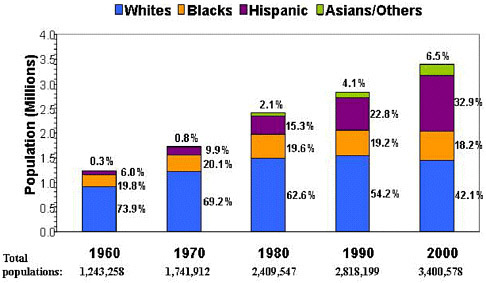
FIGURE 4.1 The population of Harris County, Texas, has shifted from predominantly Caucasian in 1980 to culturally and ethnically diverse in 2000, such that no ethnic group is a majority in the county. SOURCE: U.S. Census. Reprinted with permission.
The trends reflect the composition, amount, and timing of migration into Houston. People tend to migrate when they are young, noted Klineberg, and whereas large numbers of young Caucasians came to Houston in the 1960s and 1970s, they stopped arriving after the oil bust in 1982. Since then, the vast majority of new arrivals have been African Americans, Hispanics, and Asians. Almost two-thirds of all Hispanics currently living in the city are first-generation immigrants, as are 90 percent of all adult Asians. The net effect on the Houston population at present is that 75 percent of all residents aged 60 years and older are Caucasian and 75 percent under 30 are non-Caucasian (Klinenberg, 2002).
Had Houston not been one of the great magnets for the new immigration of the last 20 years, this city would have suffered the same fate as Philadelphia, Pittsburgh, Cleveland, Cincinnati, St. Louis, Baltimore, and Detroit—major metropolitan areas that have lost population in the last 20 years, said Klineberg. Instead, Houston is one of the most rapidly growing and vibrant cities in America, purely because of the influx of immigrants from Asia, Latin America, Africa, and the Caribbean.
The Houston Area Survey1, which asks respondents many of the same basic questions year after year to gauge changes in public perceptions, started out in prosperous times, but the first survey, which revealed great economic optimism, was followed just two months later, in May 1982, by the collapse of the twentieth-century oil boom, which until then had driven a period of unrelieved economic expansion. Not surprisingly, responses in surveys to the question “How would you rate job opportunities in the Houston area: excellent, good, fair, or poor” tracked the subsequent recession, as well as the later recovery into a restructured economy (Figure 4.2).
While the price of oil was $31.50 a barrel in early 1982, by 1987 it had fallen to less than $10. One out of every seven jobs in Houston in 1982 had disappeared by 1987. This was the worst regional recession in any part of the country at any time since the Great Depression, said Klineberg. Yet by 1990, Houston had recovered all of the jobs lost between 1982 and 1987; its fortunes were now much less dependent on the local oil business and were largely locked into the national and global economies. Since then, despite a short-lived recession in the early 1990s and the current recession of the past few years, Houston has experienced significant economic growth and a shift into a radically new kind of economy.
The opportunity for a young man or woman with just a high school diploma to enter the Houston workforce and expect to make a middle-class wage is gone forever, said Klineberg. From now on, what one earns depends on what one has
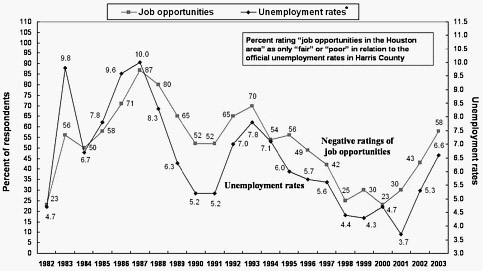
FIGURE 4.2 The Houston Area Survey records public perceptions of job opportunities, which correlate closely with the official unemployment rates. SOURCE: Houston Area Survey and Texas Workforce Commission. Reprinted with permission.
learned. College education has become almost essential for the ability to move up in the knowledge economy.
One major consequence of this change has been a new and growing inequality in an economy that is producing numerous jobs for highly skilled technical workers and many low-paid, no-benefit service jobs for unskilled or semi-skilled workers, with fewer jobs in between. Another consequence is that when the source of wealth is knowledge rather than natural resources, quality-of-life issues and the physical attractiveness of the city become high priorities. Turning Houston into a city where people will want to live has become important for economic success in a way that was not the case during most of the twentieth century, when Houston’s location near the East Texas oilfields was the guarantor of economic prosperity. Suddenly, factors such as mobility, air quality, revitalization of downtown areas, and the richness of hiking and boating areas have become critical determinants of urban prosperity.
|
When the source of wealth is knowledge rather than natural resources, quality-of-life issues and physical attractions of the city become high priorities. Stephen Klineberg |
Thus, there is a new understanding among Houston’s business elite about
the importance of environmental protection. Strategies for economic success in the region now require a much broader appreciation of quality-of-life issues in a way that has not been seen before locally, and initiatives are emerging to address them, noted Klineberg. For example, members of Houston’s business community, represented by the Greater Houston Partnership, has joined with organizations such as Trees for Houston and Scenic Houston into the Quality of Life Coalition, with goals such as turning bayous into linear parks, tearing down billboards, doubling the city’s park space, and ultimately ensuring that up to a million trees get planted in the area during the next decade.
In a similar spirit, the partnership has formed the Center for Houston’s Future, committed to the identification of emerging largely non-Caucasian leaders and bringing them together in forums to explore the nature and importance of civic leadership for Houston in the twenty-first century. The center is also working with groups such as the Greater Houston Collaborative for Children to guarantee that all children in the city between the ages of 3 and 4 get quality preschool education before starting kindergarten.
This increasingly enlightened attitude within the Houston business community is catching up with trends already evident among the area’s residents, noted Klineberg. Whereas Houston Area Survey (HAS) respondents were preoccupied with the economy in the 1980s and with crime in the 1990s as the biggest problems facing the people of Houston, they are now citing issues such as mobility, air quality, health care, and education (www.houstonareasurvey.org). The population is no longer preoccupied with either economic insecurity or personal safety but has begun thinking seriously about what must be done collectively to position Houston for success in the very different world of the twenty-first century.
Still, although it’s encouraging that people are “talking the talk,” what counts is whether they “walk the walk,” said Klineberg. As indicated by HAS survey results (Figure 4.3), education levels among Houston’s residents, particularly African Americans and Hispanics, show considerable room for improvement. It is a safe statement to make that, if Houston’s African-American and Hispanic young people are unprepared to succeed in the knowledge economy of the twenty-first century, it is hard to imagine a prosperous future for Houston, said Klineberg.
Despite the enormous challenge, there is room for optimism because of an unprecedented set of opportunities, driven by personal and business objectives alike, for the coming together of economic, environmental, and humanitarian interests to refashion Houston for success in the new century.
BUILDING THE CITY’S SOCIAL CAPITAL
In his book Bowling Alone: The Collapse and Revival of American Community, Putnam (2000) regrets the country’s general loss of social capital. Americans, he observes, sign fewer petitions, belong to fewer organizations, know fewer neighbors, meet with friends less often, and even socialize with their fami-
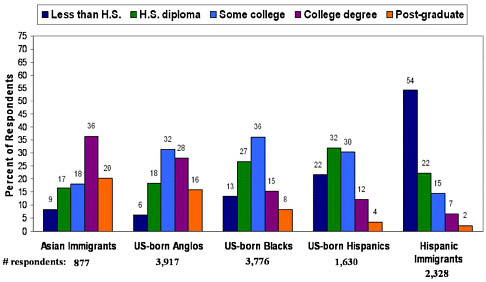
FIGURE 4.3 There are sharp disparities among various ethnic groups in Houston in the level of education achieved. Hispanic immigrants are less likely to have a high-school diploma compared to other ethnic groups and immigrants. SOURCE: Houston Area Survey. Reprinted with permission.
lies on a diminishing basis. To cite the book’s title metaphor, whereas Americans used to enjoy bowling in leagues, now they are more likely to bowl alone (Putnam, 2000). Putnam defines social capital as the collective value of all social networks, particularly regarding norms of reciprocity—the inclinations that allow people to do things for each other. The central premise of social capital is that social networks have value and lead to healthier communities (Putnam, 2000).
Houston appears to be accepting this premise while bucking the alleged national trend; although they might phrase it differently, most residents agree that the metropolitan area’s stock of social capital has grown appreciably in recent years. Beverly J. Gor, of the Center for Research on Minority Health and a native Houstonian, has observed this phenomenon firsthand. She attributes the growth to the city’s transformation from a sleepy white–black town to a multiculturally diverse region in which no racial or ethnic group holds the majority and to Houstonians’ general tolerance and acceptance of this diversity.
Gor discussed four specific aspects of social capital and how they have fared in Houston:
-
Information flows. The city boasts a variety of ethnic and language-specific newspapers, radio stations, television stations, and other media outlets. The Houston Chronicle often publishes articles in Spanish, has sections that
-
report on activities in the Asian-American community, and publishes special sections celebrating events of particular importance to the African-American community. News anchors and reporters on major television stations reflect ethnic diversity, and some stations even carry special programming targeted at local ethnic communities. Public information initiatives reflect the area’s diversity too; printed materials for a recent educational campaign on hepatitis B, for example, were provided in English, Chinese, Vietnamese, and Spanish.
-
Norms of reciprocity. According to Putnam, these norms are demonstrated in the mutual aid that builds networks between individuals who are similar and create bridges between diverse individuals. Houston has numerous organizations—professional, cultural, recreational, religious, neighborhood, and civic—that form such mutually beneficial connections. They are aided by the region’s educational institutions, which not only reflect racial diversity themselves but support cross-cultural exchanges in the general community. For example, many health professionals are enrolling in medical Spanish classes to improve their communication with clients.
-
Collective action. Houstonians are known for their generosity and for stepping up to the plate when there is a publicized need in the community, said Gor. When there are house fires, food drives, or relief efforts under way, local people get involved in large numbers. Similarly, the Mayor’s Night Out campaign encourages neighborhood people to get better acquainted. Neighbors who know one another feel more secure and they tend to watch out for each other’s homes and property.
-
Broader identities and solidarity. Houstonians are viewing themselves as a racially mixed population, said Gor. As evidence of Houston’s acceptance of diversity, she noted the mix of races, ethnic groups, and gender in city government. The city of Houston’s controller is openly gay and very well accepted as a community leader; Houston has its first Pakistani City Council member; and more Hispanics and women are represented on the Council.
There is a large, vocal, and active religious community in Houston that promotes racial harmony, preferring to see the community as rich in opportunities for cross-cultural interaction, said Gor. Meanwhile, educators are trying to teach young people to become more color-blind and judge others by their character rather than the color of their skin. She acknowledged, however, that although Houston’s interethnic relations are good—or at least not fraught with bitter confrontation—racial tensions do simmer under the surface, driven, for example, by alleged police brutality toward non-Caucasians, racial profiling by business owners, or more benign cultural dissonances
|
Although many of the city’s neighborhoods are richly ethnic, they tend to be predominantly of single ethnicity and to interact minimally with each other. Angelina Espasza |
such as complaints in ethnically mixed communities of live chickens running around in neighbors’ backyards.
In fact, ethnically mixed communities are the exception rather than the rule, said Angeline Esperza, past president of the Houston Hispanic Health Coalition. They tend to be predominantly of single ethnicity and to interact minimally with each other. Klineberg agreed, noting that the 2000 Census found Caucasians to be more segregated today than they were 10 years ago—it is less likely that a Caucasian family in Houston today will have an African American or Hispanic neighbor, than was the case in 1990.
Part of the reason is that Houston is the most spread out major city in the United States, with one-third the population density even of infamously sprawling Los Angeles (approximately 2,000 people per square mile in Houston versus 6,000 in Los Angeles). The eight-county area that the U.S. Census defines as the Houston metropolitan area covers a geographical space the size of New Jersey. The result is tremendous spread, in which people tend to live in separate little enclaves, said Klineberg.
Other factors also put constraints on the buildup of Houston’s social capital, said Esparza: unsafe communities, lack of support for education, alienation of some individuals (including the elderly and newly arrived), absent or loose regulations that fail to protect public health in general, and inadequate or no access to basic medical care for some communities.
When an uninsured individual is forced to utilize the emergency room after many failed attempts at other sources, trauma emergency care for all Houston citizens is impaired. As hospital and trauma units go on drive-by status, no one can access these services. We have to focus more attention and social capital on this problem. We must promote more preventive medicine and ensure proper health care for our children in order to secure a healthier future, concluded Esparza.


