
5
Built Environment
In recent years, the interdependence of the built environment and human health has generated considerable interest among public health professionals. The report of the Roundtable’s first workshop in 2001, Rebuilding the Unity of Health and the Environment: A New Vision for the 21st Century (IOM, 2001), highlighted the need for a broader definition of environmental health, which would include the built environment. In the United States, many of our cities are experiencing rapid growth resulting in sprawl that stretches to the horizon because of the increasing reliance on automobiles. Houston is one such example, which has led some individuals to refer to the city as “the blob that ate East Texas.” A panel of local and national speakers addressed the health impacts of the built environment and ways in which individuals, the city, corporations, and organizations can improve the connections.
AN IMPACT ON HEALTH
The built environment has a significant influence on human health and well-being. It defines the spaces in which we live, work, or play, and it affects us though associated land-use strategies, natural resource consumption, and patterns of waste disposal. A poorly designed built environment consumes excessive amounts of water and energy, produces unnecessary waste, and generally degrades living conditions for human beings; a well-designed built environment, by contrast, tends to conserve resources and improve our lives.
Unfortunately, said Samuel H. Wilson, deputy director of the National Institute of Environmental Health Sciences, the typical American community is characterized by the poorly designed and often unplanned version, replete with such characteristics as traffic congestion, poor air quality, and a weak sense of community—all of which appear to be true of Houston, though it is by no means alone. This pattern of urban development is known as sprawl—growth in outly-
|
The typical American community is characterized by the poorly designed and often unplanned version, replete with such characteristics as traffic congestion, poor air quality, and a weak sense of community. Samuel H. Wilson |
ing low-density areas that often neglects the influence of the built environment on the social and natural environments, and on human health and quality of life.
Wilson illustrated the contrast between sprawl and the plan of a traditional neighborhood, on whose streets one can easily walk to a nearby school or shopping destination (Figure 5.1). Services and needs in such neighborhoods are within convenient reach of residents, who thus may often forgo the use of their cars. In the suburban sprawl pattern, by contrast, residences are built in clusters well removed from services and needs. Walking or bicycling is inconvenient—even dangerous, sidewalks are often lacking, and a major roadway is usually part of the route. Moreover, this built environment pattern, whose
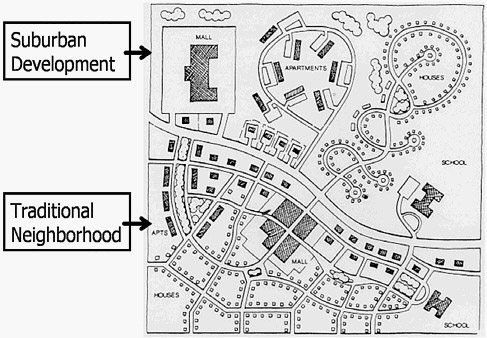
FIGURE 5.1 As populations move, there is a shift from traditional neighborhoods to suburban areas. In traditional neighborhoods, residents can walk to nearby schools, shopping destinations, and other conveniences. By contrast, in suburban areas the emphasis is on building in clusters, often removed from necessary services. This encourages greater dependence on the automobile and often discourages walking and biking. SOURCE: Spielberg, 1989. Reprinted with permission.
separation of different land uses and low connectivity not only discourages outdoor physical activity but also restricts social interaction, is seen over and over again across the country.
Transportation and Health
With increased dependence on the automobile, traffic congestion has increased, resulting in extended times for commuting, enhanced risk of accidents, additional exposure to exhausts, and heightened stress and frustration. When it comes to serious and severe crashes of automobiles, crashes with trucks, and crashes with rail vehicles in at-grade crossings, the Houston metropolitan area has the highest rates in Texas and ranks very close to the top in the nation, reported Catherine Pernot of the Gulf Coast Institute. In 1999, for example, the region had more than 80,000 serious crashes that caused 518 fatalities and almost 52,000 injuries (McCann and Ewing, 2003). Considering its walker-unfriendly roadways, pedestrians don’t fare much better. According to the Surface Transportation Policy Project (STPP; a national, largely foundation-funded organization), Houston is the nation’s seventh most dangerous place for pedestrian traffic (McCann and Ewing, 2003). Consistent with studies showing that the wider the street, the more dangerous it is for pedestrians, Pernot pointed out that the city’s worst sections in this regard are its sprawling south and west, which include an abundance of wide and high-speed arterials.
Built Environment and Disease
The built environment contributes not only to human injury but also to human disease, as illustrated by the epidemic in obesity and overweight now manifest across the country, said Wilson. Ranking second only to tobacco-related deaths, this epidemic accounts for more than 300,000 premature deaths each year—a major human health and public health problem (Mokdad et al., 1999; Mokdad et al., 2001). By constructing communities with decreased population density and employment density, increased numbers of automobile trips, and decreased amounts of exercise, we incur higher levels of overweight and obesity. Researchers in this field target the level of physical activity, not the amount of food intake, as the primary cause, he said (Stein and Colditz, 2004).
After analyzing 400 counties around the nation, the STTP concluded that people who live in counties marked by sprawling development are likely to walk less and weigh more than people who live in less sprawling counties (Figure 5.2). Further, some areas of Houston, which have a higher sprawl index, also have greater odds of residents being obese (Figure 5.3). The STTP also found that the proportion of adults who walked or bicycled to school when they were young was 71 percent, while only 18 percent of children now walk or bicycle to school (Surface Transportation Policy Project, 2003). These numbers may have
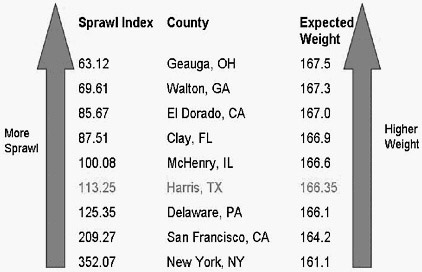
FIGURE 5.2 A relationship exists between the urban sprawl index and expected weight gain. The sprawl index used data from the U.S. Census Bureau and other federal sources to quantify development patterns. Counties with a higher degree of sprawl received a lower numerical value on the index. The sprawl indexed was compared to the body weight optained from the Behavioral Risk Factor Surveillance System, which is maintained by the Centers for Disease Control and Prevention. The comparison shows that areas in the United States with greater sprawl have a higher body weight for their citizens then regions with less sprawl. SOURCE: McCann, Ewing, 2003. Reprinted with permission.
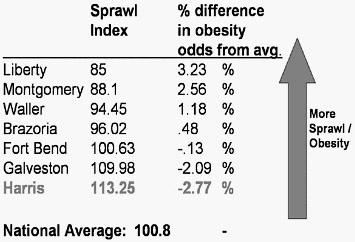
FIGURE 5.3 Similar to national trends, the regions that encompass the greater Houston metropolitan area vary in overall obesity odds. The sprawl index used data from the U.S. Census Bureau and other federal sources to quantify development patterns. Counties with a higher degree of sprawl received a lower numerical value on the index. Regions within the Houston area that have less sprawl also have lower obesity odds compared to the national average. SOURCE: McCann, Ewing, 2003. Reprinted with permission.
something to do with the differences in each generation’s built environments, noted Pernot.
At present, an estimated 70 percent of U.S. adults do not achieve the weekly recommended amount of exercise, and 25 percent are considered altogether sedentary, Wilson reported. The result is that 65 percent of individuals are overweight or obese, and one person in three is obese—the result of a worsening trend (Figure 5.4) that is projected to continue into the near future (Mokdad et al., 1999, Mokdad et al., 2001).
Being overweight is a problem in numerous ways, and a notable example is its public health burden. The condition is associated with overall mortality and particularly with enhanced risk of cardiovascular disease, diabetes, hypertension, gall bladder disease, several different types of cancer, (e.g., such as gastrointestinal tract, kidney, and breast) and other illnesses.
Similarly, the built environment contributes to greater air pollution exposure and thus to higher levels of respiratory disease and cancer. Ramon Alvarez of Environmental Defense made the point earlier about the reduced levels of ve-
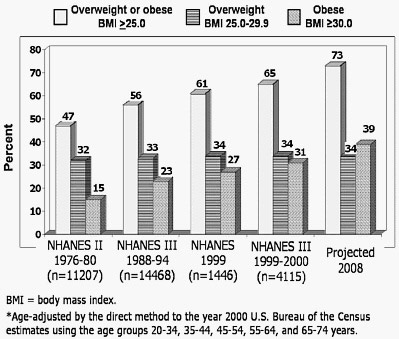
FIGURE 5.4 From 1976 to 2000, the prevalence of overweight (25.0–29.9 body mass index [BMI]) and obese (≥ 30.0 BMI) individuals among U.S. adults aged 20–74 increased from 47 to 65 percent. Current projections suggest that by 2008, 73 percent of U.S. adults will be either overweight or obese. SOURCE: James O. Hill, unpublished. Reprinted with permission.
hicular traffic in Atlanta during the 1996 Olympics and the simultaneous decrease in local asthma burdens; the number of acute asthma cases at local hospitals and treatment centers went down by as much as 44 percent during that period (Figure 5.5) (Friedman et al., 2001). Medical visits for other ailments were unchanged.
Under more typical conditions, however, researchers observe increased rates of illness. Baylor College of Medicine’s Winifred J. Hamilton, for example, noted that an increasing number of studies link exposure to highway-associated pollution and illness, and that—as the Atlanta study indirectly reported—the association is largely dependent on the number of daily vehicles and proximity. For example, children are nearly twice as likely to be hospitalized for asthma if they live within 200 meters of a freeway as if they live farther away (Lin et al., 2002). Similarly, several studies have found that children who attend a school near heavy traffic are more likely to exhibit more inflammatory markers and a greater frequency of respiratory infections and symptoms (Janssen et al., 2003; Mukala et al., 1996; Shima et al., 2003; Steerenberg et al., 2001).
The Gulf Coast Institute did a study of Houston’s I-10 corridor and found that some 13 schools were located in the “danger zone” within 1,000 feet of that freeway, Pernot noted (Fraser, 2004). Considering that this road is now in the process of almost doubling its width to accommodate greater volumes of traffic, the respiratory risks to children in these schools will surely be heightened, she suggested.
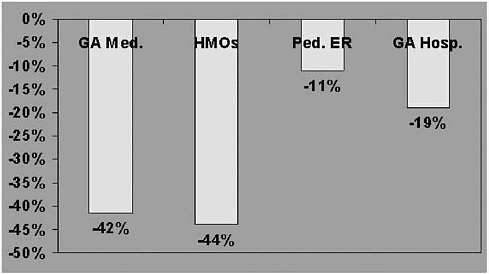
FIGURE 5.5 During the Atlanta Olympics, citizens were encouraged to use mass transit. Compared to the times immediately before and after, the number of emergency room and doctor visits for asthma decreased during the period of the Olympics. Other medical visits were unchanged. SOURCE: Friedman et al., 2001. Reprinted with permission.
Population Growth as a Problem of the Built Environment
Causing or exacerbating this unhealthy built environment trend, Wilson said, is population growth. With 4 million births and the arrival of 1 million immigrants per year, the U.S. population is expected to be 400 million by 2050, according to Census Bureau projections (U.S. Census, 1996). The eight fastest growing states will double their populations in less than 35 years. Although the most densely populated region of the country at present is the Northeast (with an average of 767 people per square mile), this concentration will eventually be equaled or surpassed by other regions. The population density in coastal California, for example, is expected to be 1,050 by the year 2010. Such growth overburdens the natural environment, depleting resources and increasing production of waste, he maintained. It degrades the social environment and produces built environments that are creating a veritable environmental health crisis.
What is needed for a successful response? One element, Wilson suggested, is the commitment to a responsible leadership posture, characterized by environmental stewardship and a holistic approach to the built and natural environments alike. Anthony J. DeLucia, past chair of the American Lung Association, strongly agreed that adopting the holistic approach—as opposed to facing crises de jour one by one and not necessarily in a coordinated way—is the wisest course.
Partnerships and collaborations between different social groups—academics, community members, the private sector, and public leaders and representatives, for example—are another element, said Wilson, as is environmentally conscious design and planning.
With regard to the built environment, specifically as it affects physical activity, DeLucia stressed the need for city planning, zoning, and sustainable design, together with appropriate incentives—for walkable and bikeable communities, for example, and for buildings configurations that encourage the use of stairs. In this spirit, Pernot noted that although authorities in the Houston area expect to increase the number of lane-miles in the region by 53 percent over the next 20 years—a gain of about 10,000 lane-miles—they also plan to bolster mass transit and implement other kinds of local development in order to reduce vehicular emissions and create more walkable neighborhoods. One serious proposal, for example, is to build a light-rail system in the heart of the city and then build an urban area around the light rail. The first 7.5-mile light- rail line was opened in January 2004, and in November 2003, voters had approved a further proposed 72 miles of light rail.
A final important element, especially for buy-in by communities, is the existence of indicators—measures of the status of local environmental health in our communities—according to Wilson. Health officials have not had much success in using general environmental pollutants as indicators, he observed, so in creating our strategies we must think outside the box.
One such approach, DeLucia noted, might be to monitor highly vulnerable groups—differentiated, say, by age, gender, or type of patient. He cited, for
example, fetuses, the elderly, people with preexisting conditions such as asthma, and those who do heavy exercise or work outdoors.
BUILDING HEALTHIER BUILDINGS
Buildings currently consume excessive and massive amounts of water and energy; produce solid waste streams; and because of where and how we site them, create serious resource-consumption and pollutant emission problems in the transportation sector as well, said Brian Yeoman, senior research scientist at the Houston Advanced Research Center. Moreover, a vicious cycle is at work whereby individuals are spending 90 percent of their time indoors, becoming more sedentary and obese, and designing buildings to actually fit that life paradigm: we oversize heating and cooling systems in tightly sealed boxes that are notably inefficient and that actually create “sick” buildings as mold, fungus, bacteria, and viruses are recirculated through our HVAC (heating, ventilation, and air-conditioning) systems. Similarly, buildings are often made using cheap materials that encourage the growth of microorganisms, and the paints, stains, and other products applied to the walls continue to emit toxic fumes.
Overall, he estimated, the U.S. built environment accounts for 68 percent of electricity consumption (U.S. Department of Energy, 2001) and uses more then a third of all primary energy. It is responsible for 35 percent of the country’s greenhouse emissions (U.S. Department of Energy, 2001) and consumes 12 percent of its potable water (U.S. Geological Service, 1998). In construction and demolition wastes alone, the built environment produces 136 million tons annually (EPA, 1998).
However, given its well-defined status, being a product of technology and therefore subject to change, the built environment is also highly amenable to solutions. It may well represent the “low hanging fruit,” Yeoman said, and our greatest opportunity to address global climate change and other environmental health issues. It is possible to build healthier buildings that have drastically reduced energy consumption; because minimal disturbance to ecosystems; are sited in clustered developments so that transportation requirements are reduced; are built from materials providing long service lives and causing no adverse effects among occupants; feature renewable energy systems; and are designed for flexibility and adaptive reuse.
Green buildings do face impediments, however, because they challenge the status quo, particularly in getting the development and financial communities to seriously consider the total cost of ownership and not focus principally on first cost, Yeoman suggested. Green buildings challenge many of the preconceived notions taught in architectural and engineering curricula. They stress the long term rather than the quick turnaround. Also, they must overcome a negative image resulting from the earliest designs, which sometimes were unappealing both aesthetically and in their implied Spartan lifestyles.
A major step in the right direction, he said, is a tool called LEED (Leadership in Energy and Environmental Design). Generated by the United States Green Building Council—a consortium of industry, the design community, manufacturers, and government—LEED is now the de facto national standard for healthier buildings. It addresses five basic macro levels of design, construction, and operations, encompassing stringent criteria for building certification. Although it omits direct references to health, this objective is addressed indirectly by practices that are inherently more healthful, said Yeoman; however, advocates are currently working to explicitly include health in LEED.
|
Green buildings challenge many of the preconceived notions taught in architectural and engineering curricula. They stress the long term rather than the quick turnaround. Brian Yeoman |
At present, there are 1,017 registered sites of new construction conforming to LEED, and they are spread across 49 states (all but South Dakota). Texas ranks in the top 10 with 13 projects totaling about 5 million square feet, while California is in the lead (Figure 5.6).
Future steps, according to Yeoman, should include national funding of basic research that links built systems and health; good-government statements, emanating particularly from the academic sector, that strongly encourage all political subdivisions to adopt and employ LEED in the construction of public buildings; and a nationwide campaign of public education directed toward individual
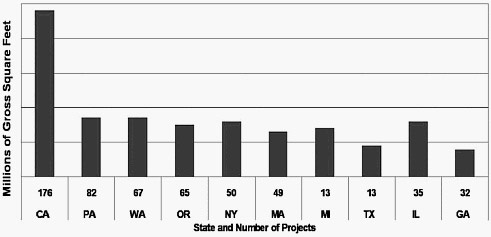
FIGURE 5.6 Top 10 states with LEED new construction. Forty nine states have projects that meet LEED construction. Of the 1,017 registered sites, more than half (582) are in the top 10 states. SOURCE: U.S. Green Building Council. Reprinted with permission.
homeowners’ options for improving the safety and health of their families. In the meantime, he offered a list of “Twelve Steps to Healthy Buildings” that may be implemented readily:
-
Properly site the building.
-
Provide maximum day lighting to occupants.
-
Provide personal control and environmental control.
-
Ensure low levels of VOCs (volatile organic compounds).
-
Provide PVC (polyvinyl chloride)-free workplace.
-
Provide efficient and effective HVAC systems.
-
Provide “superflexible” workplaces that occupants may shape to their own needs.
-
Encourage health through design—such as for walking and bicycling.
-
Provide healthy food.
-
Provide integrated pest management.
-
Provide nonfossil fuel–based cleaning products.
-
Provide public air quality monitoring systems.
TURNING DOWN THE HEAT
Cities, in which some 80 percent of the American people live, are sometimes called “heat islands” in recognition of the fact that they are warmer than their suburbs and surrounding countryside. As a region’s urbanization intensifies moreover, so does its heat island status: the temperature goes up. Hashem Akbari, leader of the Heat Island Group at the Lawrence Berkeley National Laboratory, demonstrated this phenomenon with data from Los Angeles spanning some 100 years. From 1880 to the mid-1930s, this desert-like area cooled down as irrigation and orchards arrived. However, in the ensuing decades, when an east–west migration caused farmland to be converted to city—complete with great expanses of blacktop and black roofs—the Los Angeles temperature began increasing, and by the 1980s it had risen approximately 6 to 7°F on average.
Los Angeles may be an extreme case, but it is not the only one. Akbari noted that at least a dozen other cities throughout the world, including Tokyo, Japan, and Shanghai, show the same general trend.
As the temperature goes up, there is an increased demand for power from utilities. In turn, this means an increase in emissions of air pollutants such as SO2 and NOX. In addition, the formation of Los Angeles–type smog—a brew of nitrogen oxides, reactive organic compounds, and other chemicals—is enhanced by increased temperature, which suggests an alternate strategy for smog reduction, said Akbari. Until now, the strategy has been to try to reduce smog by reducing the levels of its precursors. Yet because smog formation is a photochemical process that is highly temperature sensitive, when the temperature is low the oven will not cook as fast—smog formation will be lower. So what
researchers are now proposing is not only to reduce the precursor pollutants but also to cool the oven.
Heat, of course, is dangerous in its own right, as recent events have demonstrated. In the heat wave of 1980, more than 1,000 Americans died. In 1995, a heat wave killed 500 people in the city of Chicago alone. In the European heat wave of 2003, some 2,000 people died in Italy and at least 10,000 (perhaps as many as 15,000) died in France. In these and numerous other places, Akbari noted, those who suffered heat-related deaths were usually older people living in upper-floor apartments. He noted that something simple such as a cooler roof for these buildings would probably have saved many lives.
Humanity’s basic way to stay cooler—use light-colored surfaces and plant trees—was actually known, pre-air conditioning, for thousands of years, and it can certainly be reinstituted with the aid of modern, technology-derived materials to improve the heat island problems in a big city such as Houston, said Akbari. This can happen at a steady, although not rapid, pace. Within the next 10 to 15 years, when the time comes to change roofs on houses, he suggested that people should consider a cooler roof. This could save approximately $100 per Houston household per year, he estimated, and the consequently reduced air-conditioning would require less power from the power plant, leading to reduced emissions of CO2, SO2, NOX, VOCs (volatile organic compounds), and ultimately, lower ozone and smog levels.
Another aspect of heat island mitigation is the treatment of paved surfaces, particularly for a place such as Houston whose land area is covered so extensively with concrete pavement. When roadway sections or sidewalks have to be replaced, new high-reflectance types of pavements can be used to produce cooler surfaces and, as a result, lower air temperatures. As shown in a demonstration of three different asphalt types (Figure 5.7), a 35°F difference is readily achievable.
Meanwhile, planting trees throughout a metropolitan area can also reduce air temperature and smog formation, Akbari pointed out. In Los Angeles, for example, planting 11 million trees—about 3 trees per house—could lower the temperature of some sections of the city by as much as 5–6°F. These plantings (in combination with cool roofs and cool pavements) could decrease the concentration of ozone by about 30 to 40 parts per billion—an effect comparable to that of making half of the cars in the Los Angeles basin electric.
Akbari and his colleagues have computed that if all these heat island reduction steps were taken in Los Angeles, the smog level would be reduced by 12 percent, some $350 million dollars per year could be saved in health costs, and energy savings could amount to $170 million (Rosenfeld et al., 1998). Similarly, annual reductions in Houston’s energy consumption for air conditioning could be about $80 million. These model-derived estimates are not numbers you can take to the bank, he acknowledged, but they do indicate huge opportunities for improving air quality that should be explored.
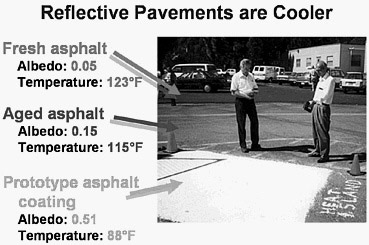
FIGURE 5.7 Temperatures of roadways and sidewalks can vary. This can be particularly important in large cities where much of the city is built and there is a paucity of green space. Fresh asphalt can have a significantly higher temperature than highly reflective pavements. When sunlight hits a surface some fraction of its energy is reflected (albedo = â) and the remainder is absorbed (αλπηα = 1 – â). High-albedo surfaces become cooler than low-albedo surfaces and consequently lower the cooling load of a building. SOURCE: Lawrence Berkeley National Laboratory and the Heat Island Group, unpublished. Reprinted with permission.
BROWNFIELDS AND ENVIRONMENTAL JUSTICE
Environmental regulation in general—and the cleanup of hazardous waste sites in particular—does not have a history of fairness to all segments of society; some segments of the population have had to suffer pollution’s adverse effects more than others. Thus, the concept of environmental justice has evolved, triggered by a long series of injustices. Martina E. Cartwright, director of the Environmental Law and Justice Center of the Thurgood Marshall School of Law, offered a definition of environmental justice that she said is now widely accepted by community groups and environmental professionals: “the fair treatment and meaningful involvement of all people of color, national origin, or income with respect to development, implementation, and enforcement of environmental laws, regulations, and policies.”
The environmental justice movement began in earnest in 1982, she said, when the State of North Carolina tried to locate a PCB (polychlorinated biphenyl) landfill in a predominantly minority community. As citizens endeavored to stop this project, civil rights activists linked arms with environmentalists for the first time. Although they were not successful in realizing their primary goal—ultimately, the landfill was sited there—they did make clear to the general public
and its leaders that low-income and minority communities were disproportionately affected not only by toxic wastes during routine industrial operations but also by the location of the wastes’ final disposal sites.
More evidence soon followed. A 1983 study by the U.S. General Accounting Office concluded that in the Environmental Protection Agency (EPA) Region IV, which includes Georgia and the Carolinas, three out of every four hazardous waste landfills was sited near a community of color (U.S. General Accounting Office, 1995). In 1987, a national study by the United Church of Christ’s Commission on Racial Justice found that nearly three out of five African Americans or Hispanics live near an unregulated hazardous waste site (United Church of Christ Commission for Social Justice, 1987). Even solutions to such problems, it appears, were inequitably applied. A 1992 study by the National Law Journal found that the EPA took 20 percent longer to remediate sites near minority communities and levied smaller penalties against the polluters involved (LaVelle et al., 1992).
Thus, a traditional violation of environmental justice has been in the administration, or lack thereof, of brownfields—which Cartwright defined as abandoned, idled, or underutilized industrial and commercial facilities, where expansion or redevelopment is complicated by real or perceived environmental contamination, that often cause a nuisance and health threat to the surrounding community. It has been estimated that 223 American cities contain more than 19,000 brownfield sites comprising more than 178,000 acres and that returning them to productive use could generate tax revenues of as much as $2.7 billion annually and provide more than 675,000 jobs (U.S. Conference of Mayors, 1999).
A seeming step in the right direction, she said, was the Comprehensive Environmental Response, Compensation, and Liabilities Act (CERCLA) of 1980, which mandated a mechanism for the safe and efficient remediation of brownfields. Yet given its potential widespread liability—anyone with some tie to a particular contaminated site could potentially be assessed for its clean-up costs—CERCLA may have actually contributed to urban blight and flight. Business people often opted to move away from inner cities to the outlying areas, where they could enjoy green fields with no question of any type of potential liability, noted Cartwright. However, new initiatives at the federal and state levels (including Texas) have been addressing these concerns. For instance, voluntary compliance programs (VCPs) offer a streamlined administrative process, relaxed remediation standards, financing through low-interest loans and grants, and liability protection—“SMOAs” (Superfund Memoranda of Agreements) encourage businesses to remediate long-abandoned industrial sites and to create community-safe and friendly business endeavors, by limiting their potential liability.
Still, brownfield redevelopment continues to have some problems, Cartwright noted. These include the potential for re-pollution of the site through its new use; autonomy of developers (who are usually not obliged to communicate with impacted communities, much less involve them in the redevelopment pro-
cess); frequent exclusion of pertinent state agencies and city development entities; gentrification and cultural displacement; loss of affordable housing; and failure to maintain historical cultural characteristics of the community.
The integration of environmental justice into brownfield redevelopment, Cartwright maintained, should observe the “Three E’s”:
-
Educate. Outreach efforts to local communities should include publications, community meetings and seminars, and partnerships with civic associations, nonprofits, churches, and chambers of commerce.
-
Enable. Tools and technical assistance should be provided to communities, allowing them to actively participate in decision making.
-
Empower. Participation of community residents in the developmental process should be encouraged and invited, perhaps through the mechanism of neighborhood advisory groups that would assist in reviewing potential local projects and development proposals. Another way to involve the community is through training residents to work in the new businesses created by redeveloped brownfields.
ENVIRONMENTAL HEALTH IN INDUSTRY: PARTNERSHIPS AND RESPONSIBLE CARE
In the spirit of dialogue and mutual respect among diverse stakeholders that has been engendered by the Roundtable on Environmental Health Sciences, Research, and Medicine, Carol J. Henry, American Chemistry Council (ACC), described the progress of the chemical industry toward the environmental health goals discussed by previous speakers.
The chemical industry is a critical element of the nation’s economy: it has revenues of about $450 billion dollars a year, is the largest exporter in the United States, invests more in research and development than any other industrial sector, and is responsible for about a million jobs. Moreover, the chemical industry is important to developing many of the innovative products and building the green systems that most analysts believe are needed to ensure improved environmental health in the future.
The ACC’s members, some 140 firms that are among the leading companies in the industry, she said, are committed to improvements in environmental health and safety performance through their own spending in these areas—some $8 billion a year—and through their involvement in several major ACC activities. Support of two of the ACC’s projects—in particular, its Responsible Care® program and Long-Range Research Initiative—is in fact a requirement for membership.
Responsible Care® has a relatively simple but highly ambitious vision—“No accidents, injuries, or harm to the environment”—toward which the ACC’s members have made great progress since the program was launched in 1988,
said Henry. This program, which aims to achieve continuous improvement beyond levels required by the U.S. government, has resulted in significant reductions in releases of chemicals to air, land, and water and has provided major improvements in the workplace and community safety. Based on statistics gathered by the federal government, workplaces at ACC companies in 2001 were four times safer (in terms of injury and illness rates) than the combined average of all U.S. manufacturing industries, and ACC members were twice as safe as the chemical industry overall—whose emissions have actually been reduced by 71 percent since 1988 even as volume has increased 26 percent (EPA, 2003).
These achievements have been made possible by developing the vision into a set of explicit guiding principles and pursued through member companies’ commitment to an Enhanced Responsible Care® Management System. This system, Henry explained, includes policy and leadership; planning; implementation, operation, and accountability; performance measures and corrective action; and management systems review.
ACC has committed that these systems will be verified and certified by external third parties—groups such as the fire department or a respected auditing organization—that do not work for the chemical industry. ACC has endorsed third-party verification because it will improve performance, responds to expectations, promotes cross-functional integration of programs, enhances external credibility, and meets customer expectations. ACC members will be measuring their own year-to-year progress, beginning in 2004, through the 11 standardized performance metrics shown in Table 5.1. These metrics reflect Responsible Care® environmental, health, safety, and security performance as well as efforts to safeguard reputation, sustainable development, products, and other initiatives.
This means that the companies are opening themselves up to public review and scrutiny and that the data will be public, she said. The ACC and its members believe that this will enhance their external transparency and increase their credibility.
Such an approach reflects the fact that, consistent with their guiding principles, ACC companies are already reaching out to the public and to the communities in which they operate. The Responsible Care® companies view themselves as members of their communities, said Henry, and have formed some 250 to 300 Community Advisory Panels, 10 of which are in the Houston area, to communicate with neighbors about company operations in progress. These are independent bodies that are not controlled by the plant or industry, she said. Members are individuals who live near or around a chemical facility, and they use the Panel as a forum to regularly meet with management to discuss issues of mutual interest.
The ACC is also doing outreach to the scientific and regulatory communities, in large part through its Long-Range Research Initiative (LRI) that aims to extend knowledge worldwide through research on health, safety, and environmental impacts of the chemical industry’s products and processes; support in-
TABLE 5.1 Examples of Performance Measures to Benchmark Industrial Progress
|
Performance Metric |
Collection of Information by Company or ACC |
Information to Be Reported on Company or Industry Basis |
Public Reporting Begins |
|
|
Metrics Reflecting Responsible Care Environmental, Health, Safety, and Security Performance |
||||
|
1. |
Pounds of TRI-air, land, and water releases (reported separately) |
Company |
Company |
2004 |
|
2. |
Number of reportable distribution incidents |
Company |
Company |
2004 |
|
3. |
Number of process safety incidents |
Company |
Company |
2004 |
|
4a. |
OSHA recordable incident—rate-employees |
Company |
Company |
2004 |
|
4b. |
OSHA recordable incident—rate-contractors |
Company |
Company |
2005 |
|
5a. |
Percent facilities completing security assessments based on Security Code schedule (%) |
Company |
Industry |
2004 |
|
5b. |
Facilities completing security enhancements or verifications based on Security Code schedule (%) |
Company |
Industry |
2005 |
|
6. |
Certification of Responsible Care® Management System (yes/no) |
Company |
Company |
2004 (companies will have from 2004 to 2007 to complete certification) |
|
Metrics Reflecting Reputation, Sustainable Development, Products, and Other Initiatives |
||||
|
7. |
Greenhouse gas emissions (pounds of C02 equivalent net emissions per pound of production) indexed to base year |
Company |
Industry |
2005 |
|
8. |
Energy efficiency (BTUs consumed per pound of production) indexed to base year |
Company |
Industry |
2005 |
|
9. |
Industry economic performance: |
ACC |
Industry |
2004 |
|
9a. |
Total industry R&D investment |
|
||
|
9b. |
Total number of industry employees |
|
||
|
9c. |
Total value of industry payroll |
|
||
|
9d. |
Total value of U.S. industry net exports |
|
||
|
Performance Metric |
Collection of Information by Company or ACC |
Information to Be Reported on Company or Industry Basis |
Public Reporting Begins |
|
|
10. |
Company has in place a documented process for characterizing and managing product risk, and a summary of the process is available to the public (“yes”/“no”) |
Company |
Company |
2005 |
|
11. |
Company has in place a process to communicate results of the risk characterization and management process in an effort to facilitate public knowledge (“yes”/“no”) |
Company |
Company |
2005 |
|
SOURCE: OSHA. |
||||
formed decision making by providing scientific data and understanding; and develop new tools to assess chemicals—especially as questions emerge about potential health and environmental impacts, Henry said. As in other ACC activities, results of research will be made public. The investigators own their own data, and they are completely free to publish or conclude whatever they have been working on without prior editing or review by the ACC or its members.
Encouraging listeners and readers to acquire more information on the Council’s LRI (www.uslri.org) and its Responsible Care® program and other activities (www.americanchemistry.com) to convince themselves of ACC’s sincerity, Henry acknowledged that changing and impacting public opinion, scientific standards, and the industry’s reputation can’t be achieved overnight. But the companies are in this for the long haul, she added. They are committed to realizing ACC’s objectives through prolonged and coordinated research and outreach efforts.
COMING TOGETHER
Commitments by government—whether national, state, or local—won’t be achieved overnight either, but officials from all branches report heightened understanding of the public-health impacts of the built environment, together with steady progress.
Victor Ayres of Houston Mayor Bill White’s Office of Environmental Policy noted that the city has become aggressive in addressing its air pollution prob-
lems—for example, it has been retrofitting its vehicle fleet to reduce diesel and other fuel-based emissions. But a constraint is that pollution comes from different areas, moves around, and knows no boundaries, he noted. The city of Houston occupies only 617 square miles in an 8,000-square-mile ozone nonattainment region. Although the city can’t do it by itself, said Ayres, it is going to do what it can to serve as a catalyst to encourage local governments and other entities to get involved as well. There’s a great need for communication and partnership—between urban and suburban, and between the public and private sectors.
Jane Laping, executive director of Mothers for Clean Air, took Ayres’s expression of environmental reality to its logical conclusion. This is a global community, she said. We don’t just live in Houston, and we don’t just live in Texas or the United States. We live on the planet Earth. People in Texas know that we get dust from the Sahara here, and we get smoke from fires in Central America. We all depend on each other, and we have to help other communities learn from what we have learned.
Similarly, Laping suggested that in the human-centric vision and preoccupation with modern technology that enhances our power even more, we seem to forget that other forms of life also occupy this planet and that we in fact depend on them for life. Humans cannot continue to degrade the environment, push out animals and plants, and use their space, she said. We need them for our own survival.
Another need for survival, suggested a participant, centers on the spiritual. It is very difficult to come together to care about something if what is there has been done carelessly, he said. Because values such as beauty, proportion, scale, and harmony have great meaning to people, the degradation of the physical environment and the loss of quality in architectural social capital have an accumulating effect on the spiritual and mental health of the community. Public health would therefore be well advised to spend a lot more time and effort in trying to understand what community mental health really is and what role it plays in social cohesion.


