
Agricultural Drought Management in Iran
Sayed-Farhad Mousavi
INTRODUCTION
Deserts and arid lands have always presented a harsh environment in which to live, and their sunburned people make a great effort to survive. They have done their best to find ways of better living. Water is a vital commodity in these areas, and the art and technology of saving water for consumption is critical to these people.
Drought is a natural phenomenon that can occur in any region and cause economic, social, and environmental losses. It has greater effects in dry and water-deficient regions and is a global threat, but it has not been studied in detail in many countries. During recent decades, drought has exceeded any other natural disaster in number and frequency.
Drought is the result of an abnormally dry period that lasts long enough to cause an imbalance in hydrologic processes (storage and consumption). Reduced precipitation or increased temperature, either alone or together, can cause drought. At the present time, 40 percent of the population of the world is confronted with periodic droughts, affecting some arid and semiarid countries in the north of Africa, parts of India, the north of China, the Middle East, Mexico, Middle Asia, Australia, and the western United States. Severe climatic changes, increase of greenhouse gases, and El Niño/Southern Oscillation (ENSO) phenomena are responsible for these droughts. When vegetation cover is destroyed, droughts are intensified. Climatic, hydrologic, and agricultural droughts are the most important categories.
WATER RESOURCES OF IRAN
The state of water resources in Iran is summarized as follows. The main source of water is precipitation, which normally amounts to 252 mm or 413 billion cubic meters (bcm) annually. This precipitation depth is less than one-third of worldwide average precipitation (831mm) and about one-third of the average precipitation in Asia (732mm). About 30 percent of the precipitation is in the form of snow, and the rest is rain and other forms of precipitation. While 1 percent of the world population lives in Iran, our share of renewable freshwater is only 0.36 percent. Of the 413 bcm of annual precipitation, 296 bcm are lost as evapotranspiration, 92 bcm runs as surface flows, and 25 bcm infiltrates into groundwater resources. Annually, about 13 bcm of water flows into Iran from neighboring countries. So, total renewable water resources are 130 bcm annually. From these sources, about 88.5 bcm is withdrawn, of which 82.5 bcm (93.2 percent) goes to agriculture, 4.5 bcm (5.1 percent) is for drinking, and 1.5 bcm (1.7 percent) is allocated for industry, mines, and miscellaneous uses. While the world uses 45 percent of its freshwater resources, Iran uses about 66 percent.
Precipitation in Iran does not have spatial and temporal uniformity. Part of the country receives less than 50 mm, while the northern part receives more than 850 mm of rain annually (Figure 1). More than 50 percent of the rain falls in winter, and less than 18 percent falls in summer. From the middle of the spring, river and stream discharges start to decrease, and groundwater is the only water source for summer and fall seasons. Statistics show that in 1996 and 2000 about 59.41 and 61.2 bcm, respectively, were withdrawn from the aquifers. Nonuniform temporal distribution of precipitation causes droughts in the years when most annual rainfall occurs in a short time and runs off quickly.
On the basis of studies performed by United Nations (UN) experts, the per capita water resources of Iran are projected to be about 726-860 m3 in 2025, compared with 2,200 m3 in 1990. Overpopulation in an arid and semiarid country causes diverse problems, including increased demand for scarce water and intensified competition between different sectors (agriculture, human consumption, and industry). Overpopulation in Iran will contribute to the country reaching a state of water crisis before the year 2025. Unplanned and irregular expansion of the main and satellite cities in the past 100 years has increased the population six-fold and contributed to water shortage problems. In the last 40 years, the population of Iran has increased by 45 million people, 30 million of whom have been added in the last 20 years. The water crisis and water scarcity will intensify in the future.
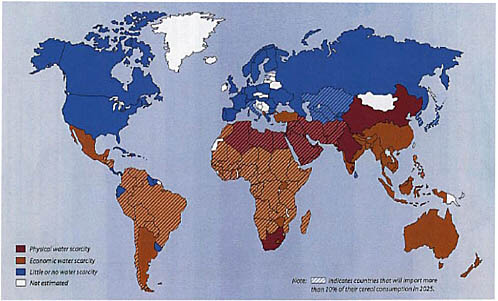
Water balance of many countries is in desperate straits, since aquifers are exploited severely, water is diverted from the agricultural sector to drinking and industrial supplies, and demand for more food and better diets is increasing. So, water is scarce, and as the studies of the International Water Management Institute (IWMI) show, it will get scarcer (Figure 2). The countries in dark grey in
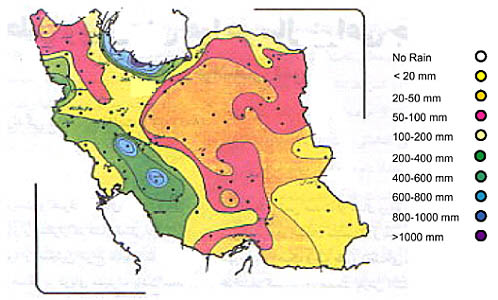
FIGURE 1 Distribution of total annual rainfall (1999-2001).
Figure 2 do not have enough water resources to meet their future demands, despite investment in this section. The countries in medium grey may meet their projected demands, provided new water resources (including large dams) are developed.
Iran is located in an arid region of the earth (25 to 40 degrees north). With more than 90 percent of the country’s area in arid and dry regions, drought periods and their effects, which are more frequent than floods, are of great concern to politicians and planners. Drought is a natural and climatologic fact for Iran and should not be considered a surprise. In the last 23 years, there were 13 years of dry periods, and the extent of the social, economic, and human damage was more severe than flood damage. Sensitivity of the southern parts of Iran to severe drought is higher than other parts of the country.
EFFECTS OF DROUGHT
Drought has different direct and indirect effects. The direct effects include decreasing production in agriculture and rangelands, groundwater depletion, low flows in the rivers and streams, exposing of all natural or human ecosystems to destruction and contamination, soil erosion, and mortality of livestock and wild life. Indirect effects include lowering farmers’ income, decreasing government’s
tax income, increasing the cost of water and forage transport, and increasing migration of farmers to small and big cities. Reduced yields and quality of grain, and increased incidence of pests and diseases are the most detrimental effects of drought in the agricultural sector.
DROUGHT DAMAGE
Iran has experienced a severe drought during the last three years (1999-2001), the worst drought period in the last 40 years. On the basis of reports by Iran Meteorological Organization, precipitation during 1999, 2000, and 2001 was 24.2, 40, and 28.5 percent less than normal, respectively. Twenty provinces of the country were faced with the crisis, and 62,500 billion Rials (BR) (U.S. $1 = 8,000 Rials) worth of damage occurred. This damage occurred mainly in the agriculture sector and mainly affected poor people. Drought was more severe in the south, center, southeast, and east. The Khorasan, Sistan and Baluchestan, Fars, Isfahan, Hormozgan, Kerman, Boushehr, Yazd, Ilam, Kermanshah, Lorestan, Markazi, Qom, Hamadan, Semnan, and Tehran provinces were affected the most.
Although parts of the country are confronted with drought in one way or another each year, national figures for damage will not be announced unless it is extensive. A summary of damages that occurred to agriculture, forests, rangelands, and water resources follows.
-
The Ministry of Agriculture has announced the damages to farms, orchards, and agricultural structures in 1999 as 10,000 BR. The amount of investment to compensate and mitigate drought effects temporarily was about 27,000 BR (2.5 times 1998 expenditures).
-
One hundred cities out of the 700 cities and towns in the country with a population of more than 20 million are confronted with water shortage; more than 20 million head of livestock have been slaughtered or lost; 3,731 springs, 2,500 qanats, and thousands of water wells have dried up. About 200,000 tribal people have lost their only revenue.
-
The agricultural sector, which makes up 27 percent of gross national product (GNP), has suffered damage causing GNP to decrease by about 6 percent. The value of 6 million tons of agricultural products is about 8,000 BR.
-
Other than vast mining of groundwater resources, with overdraft of 6 bcm per year, 40 percent of the forest land has been converted to other uses in the past 40 years, and forest area has decreased from 21.5 million ha to 12.5 million ha.
-
Soil erosion has increased from 10 tons/ha/year in the last decade to more than 30 tons/ha/year, and the total soil loss is about 4 billion tons/year.
-
Total surface flows and groundwater recharge of Khorasan Province was 7.5 bcm in 2001, which is 43 percent less than a normal year. Precipitation and river discharge have declined about 40 percent and 90 percent, respectively.
-
In Mashhad plain, average well discharge was about 33 liters/second in 1970, but has decreased to 19.5 liters/second in 2001. Electrical conductivity of water has increased 0.035 deciSiemens/meter (dS/m) annually, providing evidence of the increased salinity of groundwater.
-
Sistan and Baluchestan, Hormozgan, and Kerman Provinces had 81 percent, 50 percent, and 48 percent rainfall reduction. About 200,000 ha of dryland orchards, more than 10,000 ha of tea farms, and 2,000 ha of banana farms in Sistan and Baluchestan and Jiroft are damaged.
-
Overdraft of groundwater resources has caused negative balance of groundwater, and out of 612 plains of the country, 150 plains are restricted.
-
More than 70 percent of Fars Province has experienced severe to very severe drought. As a result, 37 percent of the rangelands in this province are damaged 70-100 percent. In 2000, hay production was reduced by 52 percent.
-
In Isfahan Province, the extent of damage to 80,000 ha of agricultural land and 79,000 ha of orchards was 2,840 BR. The damage to wells and qanats was 380 BR. The drought of 1999 affecting 6.6 million ha reduced hay and grass production by 20 percent, valued at 24 BR. Drawdown of the water table in wells was 1.5-8.5 m for 1999-2001, although many wells were dry and abandoned completely. In 2000, 762,000 ha of land was not cultivated or had an unsatisfactory yield. Average reservoir storage capacity of Zayandehrud dam decreased by 58 percent. Modern irrigation networks did not receive water or were operating with less than normal capacities.
-
Severe droughts caused a reduction of water storage in Sepidrud dam, located in Gilan Province in the north of Iran where droughts are much less common. The farmers were forced to dig wells, and since they did not have much experience with this condition, they were affected badly and sustained a lot of damage.
-
In Kohgiloyeh-Boyerahmad Province, grass and hay production from 17,000 km2 rangelands has been reduced by one-half.
-
In Khuzestan province, discharge of the Karkheh, Karun, and Marun Rivers has decreased by 49, 37, and 40 percent, respectively, in 2000-2001 as compared with the average of the past 32 years.
-
Displacement costs of wells have not yet been reported but are expected to be high.
-
Migration of rural and tribal people and farmers to small towns and big cities has caused numerous problems.
-
6,000 BR of credit was allocated to mitigate drought effects in 2001. Of this amount, 4,000 BR was given to banks as financial aid, 500 BR as financial assistance to farmers, and 1,000 BR to provinces. The share of Khorasan, Fars, Kerman and Sistan, and Baluchestan Provinces was 51.7, 50.8, 45, and 44.3 BR, respectively, of the 1,000 BR assistance to provinces.
MEASURES TO MITIGATE DROUGHT EFFECTS
Water resources experts, agronomists, politicians, and citizens have proposed different measures and approaches to mitigate the adverse effects of agricultural drought. A summary of these proposals is as follows, and the possibility of applying such measures needs further discussion and investigation.
-
Use appropriate irrigation methods and technologies (surge, low energy sprinkler, trickle).
-
Achieve better allocation of available water. Irrigation systems and farmers should be flexible enough to adapt to changing conditions. Different degrees of scarcity demand different allocation rules.
-
Substitute the maxim of “more crop per ha” with “more crop per drop.” At the present time, only 0.7 kg is produced from each cubic meter of water. The irrigated land is 8 million ha, with an average yield for wheat, 2,844 kg/ha, cotton, 2,237 kg/ha, sugar beet, 32,224 kg/ha, and citrus, 11,357 kg/ha.
-
Practice the “reduce, reuse, and recycle” water-usage maxim in each sector.
-
Breed crop varieties to tolerate water deficiency and poor quality irrigation water.
-
Substitute “strategic agriculture” with “trading agriculture.”
-
Prevent surface and groundwater pollution.
-
Substitute “crisis management” with “risk management.” At the present time, crisis management is applied for curing drought effects and damage.
-
Establish a National Drought Commission.
-
Establish citizen participation and local management systems.
-
Improve watershed and aquifer management. These measures have different benefits such as control and storage of flood flows, groundwater recharge, hay production, increasing vegetation cover, return of farmers to their villages, control of desertification, and employment possibilities. About 41 million ha of alluvium is suitable to receive flood flows, and 50 bcm of floods could be distributed over 15 million ha of alluvial plains.
-
Improve collaboration and communication between the research sector and the water custodians.
-
Develop local water-harvesting methods and soil moisture storage.
-
Conserve forests and rangelands.
-
Prevent desertification.
-
Educate managers, planners, and producers.
-
Encourage foreign investment.
-
Conserve the environment.
-
Manage water consumption patterns. The percent of people living in urban and rural areas is 63 and 37 percent, respectively. About 32 percent of the water consumed comes from surface and 68 percent from groundwater sources.
-
Control population growth.
-
Prevent decline of rural and tribal economies.
Water scarcity in the future will mainly be due to unplanned usage and not water shortage. It is not too late to consider the actual facts and figures of Iran’s water resources carefully and restructure agricultural drought management. Drought can serve as a catalyst for positive change—a move toward new and more sustainable approaches to managing water. Above-average rainfalls in one or two years should not deceive us into forgetting drought and water scarcity problems. We should think of the future generations.
SELECTED BIBLIOGRAPHY
Bird, J. and P. Wallace. 2001. Dams and development-An insight to the report of the world commission on dams. ICID, J. Irrigation and Drainage 50(1): 53-64.
Dealing with drought. 2002. available at www.cgiar.org/iwmi/home/drought.htm.
Perry, C. 2001. World commission on dams: Implications for food and irrigation. ICID, J. Irrigation and Drainage 50(2): 101-107.
Postel, S. 1999. Pillar of Sands. London: Norton and Company.
Proceedings of First National Conference on Drought Mitigation and Water Shortage, Feb. 27-28, 2001, Jahad Daneshgahi, Shahid Bahonar University, Kerman, Iran.
Proceedings of First National Conference on Water Crisis Mitigation Strategies, March 9-10, 2002, University of Zabul, Zabul, Iran.
Seckler, D., U. Amarasinghe, D. Molden, R. de Silva, and R. Barker. 1999. World water demand and supply, 1990 to 2025: Scenarios and Issues. International Water Management Institute (IWMI).
Water scarcity variations within a country. 2000. A case study of Sri Lanka, available at www.isnar.org.
Wilson, E. 1999. One third of world’s population 2.7 billion people will experience severe water scarcity by 2025, says new study. www.futureharvest.org/news.


