
Solar Desalination for Domestic Applications
Mehdi N. Bahadori
ABSTRACT
Water may be considered a more important resource than energy, given that a water crisis is life threatening. However, fresh water may be produced from sea or brackish water using energy. Large-scale sea water desalination processes are discussed, and an example project on the Persian Gulf coast is described. For small-scale fresh water production, basin type solar stills are viable options. Such stills may be designed to meet an individual family’s needs or the needs of small villages scattered in the southern part of Iran. Heat transfer equations governing the operation of basin type solar stills are given, and climatological data of four cities on the Persian Gulf and Oman Sea are presented. Based on their design and operating conditions, solar stills may produce three to six liters of fresh water per square meter per day, with an estimated average production rate of 1.5 cubic meters per square meter per year (m3/m2/y) for the southern region of the country.
INTRODUCTION
Water is no longer the infinitely renewable resource that we once thought it was. In fact, water shortages threaten to make water a potentially more critical resource than energy. A water crisis, in contrast to an energy crisis, is life threatening. Unlike oil, fresh water has no viable substitute, and its depletion both in quantity and quality has even more profound economic and social effects. However, there are available techniques to produce fresh water artificially.
It is now technically and economically feasible to produce volumes of water of suitable purity through the desalination of seawater. Of course, the challenge
is to produce fresh water for communities for their continuous health, development, and growth at an acceptable cost. To meet the challenge, large desalination systems, including dual-purpose power and desalination plants, have been built to reduce the cost of production of electricity and water. Thermal energy extracted or exhausted from power plants is used effectively in the desalination process. It is estimated that there are over 25,000 megawatts (MW) of power combined with desalination plants used in the cogeneration concept. However, not all water demands are coupled with the need for additional electric power.
A worldwide inventory shows that by the end of 1995 there were over 11,000 desalting units with total capacity of 20 million cubic meters per day. Desalination is already used in 120 countries around the world. The exponential growth of desalination can be illustrated by the fact that in 1971 total worldwide capacity was only 1.5 million cubic meters per day. In 1976 the total was 4 million cubic meters per day and in 1995 it was 20 million cubic meters per day. In the last 10 years, worldwide capacity grew from 12 to about 22 million cubic meters per day.
The Middle Eastern countries are the biggest users of desalination technology, with about 50 percent of the world’s capacity installed in the area. The dominant plant type is Multi Stage Flash (MSF), which accounts for 86.7 percent of the desalting capacity, while the Reverse Osmosis type accounts for only 10.7 percent. In the state of Hormozgan, in the southern part of Iran, about 45 percent of the fresh water produced from the sea for the cities and islands is through MSF, 20 percent through Multi Effect Distillation (MED), 31 percent through Vapor Compression (VC), and 4 percent through Reverse Osmosis (RO). Worldwide, 48.1 percent of the total installed or contracted capacity is based on the MSF principle, reflecting a continuing decline from the proportion reached in 1991 (51.5 percent). In comparison, the Reverse Osmosis process increased its share from 32.7 percent to 35.9 percent in the same period.
LARGE-SCALE DESALINATION PROCESSES
Desalination can be classified into phase-change and single-phase processes. The most commonly used phase-change processes are Multi Stage Flash (MSF), Multi Effect Distillation (MED), Vapor Compression (VC), and Solar Distillation. Highly developed single-phase processes are Reverse Osmosis (RO) and Electrodialysis (ED), which use membranes to separate impurities from water (Assimacopoulos, 2001).
Solar energy may be employed to produce fresh water from the sea. This may be accomplished in a large system or in a simple basin type desalination unit. For a large quantity of fresh water production, a unit was constructed in the city of Abu Dhabi on the Persian Gulf coast using solar energy (El-Nashar, 2001). The plant consists of three subsystems: the solar collector field, the heat accumulator, and the sea water evaporator. It is designed for an expected yearly
average fresh water production of 85 cubic meters per day, using sea water with a salinity of 55,000 ppm or 5.5 percent (El-Nashar, 2001).
The solar energy collecting subsystem converts solar energy into thermal energy when solar radiation is available during the day, using a bank of solar collectors. The thermal energy is stored in the heat accumulator subsystem for heating the evaporator with minimum fluctuation in the supply temperature.
The basic unit in the bank of solar collectors is an evacuated tube panel that employs selective coating absorber plates enclosed in glass tubes maintained under high vacuum of 10 mm Hg. Ten glass tubes with their absorber plates are incorporated in each panel. Along the center line of each glass tube is a single copper tube, which is attached to the middle of the absorber plate. Heat collecting water flows through this center pipe and absorbs the solar energy collected.
Each panel has an absorber area of 1.75 square meters, and the selective coating on the absorber plates has an absorptivity of 0.91 and an emissivity of 0.12. The collector bank consists of 1,064 panels making up a total collector absorber area of 1,862 square meters (El-Nashar, 2001).
In order to make solar desalination more efficient, a horizontal tube, a thin film multiple effect evaporator is used with a rated capacity of 120 cubic meters per day. Preheated feedwater is sprayed on the top of the first effect tube bundle and descends down the evaporator stack, flowing as a thin film over each following effect tube. The feedwater flashes and thereby is cooled by several degrees as it passes from one effect tube to the next. It is rejected at the bottom of the last effect tube as cool concentrated brine, which is discharged to the sea. In the top effect tube, heating water from the accumulator is used to partially evaporate the thin seawater film on the outside of the tubes (El-Nashar, 2001).
BASIN TYPE SOLAR STILLS
The process discussed above, and other desalination processes mentioned earlier, are primarily for large-scale fresh water production using seawater. There are many small villages or communities that use small quantities of fresh water. For small-scale fresh water production, using sea or brackish water, simple basin type solar desalination seems to be a viable option.
To see the need for small-scale fresh water production, we may consider the state of Hormozgan again. About 60 percent of the population of this state lives in over 2,000 villages, each village housing about 50 families. These families draw their water needs from wells, rivers, cisterns, or other reservoirs. The water drawn from such sources is often slightly salty and many times not hygienic. To meet the fresh water needs of each family, or a village of about 50 families, simple solar desalination or distillation systems may be employed.
Basin type solar distillation is the simplest desalination process and is based on the greenhouse effect. Glass and other transparent materials have the property of transmitting incident short-wave solar radiation but do not transmit infrared
radiation. Incident short-wave solar radiation passes though the glass into the still where it is trapped and evaporates the water, which is then condensed on the glass surface and is collected as distillate. The equipment is simple to construct and operate. However, a large area of land is required.
The first known application of solar distillation was in 1872, when a still at Las Salinas on the northern deserts of Chile started its three decades of operation to provide drinking water for animals used in nitrate mining (Duffie and Beckman, 1981). The still utilized a shallow black basin to hold the salt water and absorb solar radiation; water vaporized from the brine, condensed on the underside of a sloped transparent cover, ran into troughs, and was collected in tanks at the end of the still. Most stills built and studied since then have been based on the same concepts, though many variations in geometry, materials, methods of construction, and operation have been employed (Duffie and Beckman, 1981).
A basin type still is shown in section in Figure 1. A solar desalination plant may have many bays side by side, each of the type shown. The covers are usually glass; they may also be air-supported plastic films. The basin may be on the order of 10 to 20 mm deep (referred to as shallow basins), or they may be 100 mm or more deep (referred to as deep basins). The widths are on the order of 1 to 2 m, with length widely variable up to 50 to 100 m (Duffie and Beckman, 1981).
In operation, solar radiation is transmitted through the cover and absorbed by the salt water and basin. The solution is heated, water evaporates, and vapor rises to the cover by convection, where it is condensed on the under side of the cover. Condensate flows by gravity into the collection troughs at the lower edges of the cover; the covers must be at sufficient slope so that the surface tension of the water will cause it to flow into the troughs without dripping back into the basin. The trough is constructed with enough pitch along its length so that the condensate will flow to the lower end of the still, where it drains into a product
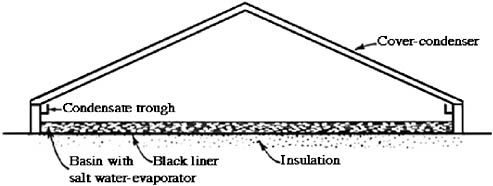
FIGURE 1 Schematic cross section of a basin type solar still.
collection system. Operation of a still may be continuous or batch. If sea water (approximately 3.5 percent salt) is used as feed, the concentration is usually allowed to double before the brine is removed, so about half of the water in the feed is distilled off.
The glass cover may be sloped between 15 and 30 degrees. However, with special treatment of the glazing by hydrofluoric acid or sodium silicate, the surface can be made more wettable (Bahadori and Edlin, 1973). With such treatments of the glass cover, it is possible to reduce the slope of the cover down to 3 degrees and increase the fresh water production of the solar still between 50 and 70 percent (Bahadori and Edlin, 1973). The fresh water production rates of simple basin type solar stills are between 3 and 8 liters per square meter per day, depending on the design and the operating climatic conditions, particularly the solar radiation intensity.
GOVERNING EQUATIONS IN BASIN TYPE SOLAR STILLS
Figure 2 shows the major energy flows in a still while it is operating. The objective of still design is to maximize Qevap, the transport of absorbed solar radiation to the cover-condenser by water vapor, as this is directly proportional to the still productivity. All other energy transfer from basin to surroundings should be suppressed, as far as is possible. Most energy flows can be evaluated from basic principles, but terms such as leakage and edge losses are difficult to quantify and may be lumped together and determined experimentally for a particular still (Duffie and Beckman, 1981).
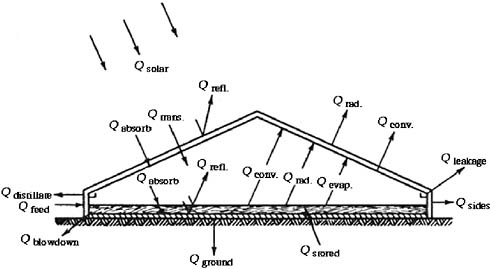
FIGURE 2 The major energy transport mechanisms in a basin type still.
Energy transfer from basin to cover occurs by evaporation and condensation, in addition to convection and radiation. The losses from the back of the still are to the ground. The depth of the water in the still is usually such that its capacitance must be taken into account.
A thermal network is shown in Figure 3, where the resistances correspond to the energy flows in Figure 2. Terms for leakage, edge losses, entering feedwater, and leaving brine or product are not shown (Duffie and Beckman, 1981).
The convection heat transfer coefficient in a still is (Duffie and Beckman, 1981)
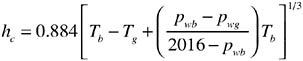
(1)
where hc is the heat transfer coefficient, Tb is the brine water temperature in degrees Kelvin, Tg is the glazing temperature, pwb is the saturation pressure of water at the brine temperature, and pwg the saturation pressure of water at the glazing temperature, both in mm Hg.
The heat transfer between the basin and cover is
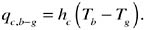
(2)
By analogy between heat and mass transfer, the mass transfer rate can be written as

(3)
where  is the mass transfer rate in kg/m2s.
The heat transfer by evaporation and condensation is

(4)
where hfg is the latent heat of water, in J/ kg. Equation 3 shows that fresh water production is directly proportional with (pwb – pwg). While it is highly desirable to have a very high brine temperature (Tb), it is also necessary to have as low a glazing temperature (Tg) as possible.
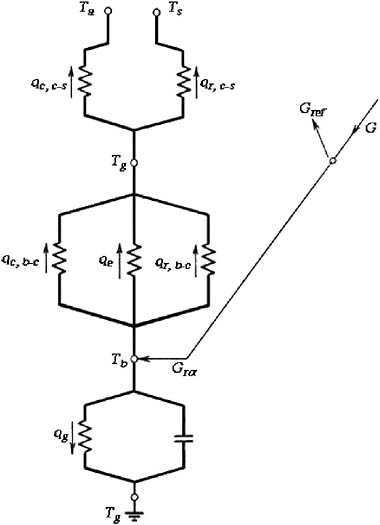
FIGURE 3 Basic thermal network for a basin type still.
If the still has insulation under the basin, heat loss to the ground can be written

(5)
where Ug is an overall loss coefficient to ground, assuming the ground to be at a temperature equal to the ambient (Ta). This term will be small in a well-designed still.
The efficiency of a still is defined as the ratio of the heat transfer in the still by evaporation and condensation to the radiation (G) incident on the still.

(6)
This is usually integrated over some extended period (e.g., day or month) to indicate long-term performance. If there is any loss of product water back into the basin (by dripping from the cover or leakage from collecting troughs), less product will be available than is indicated by this equation. Efficiency from experimental measurements is

(7)
where  is the rate at which distillate is produced from the still (which may be less than
  ), and hfg is the latent heat of vaporization.
The objective of still design is to maximize qe (i.e., ), which is proportional to the vapor pressure difference between basin and cover. Thus it is desirable to have the basin temperature as high as possible, which will increase the ratio of heat transfer by evaporation and condensation to that by convection and radiation. Shallow basins with small heat capacity will heat up more rapidly than will deep basins, and operate at higher mean temperatures.
Many practical considerations govern solar still design and operation. Shallow basins require precise leveling of large areas, which is costly. Crystals of salt build up on dry spots in basins, leading to reduced overall absorbance and reduced effective basin area. Leakage can cause problems in three ways: distillate can leak back into the basin; hot salt water can leak out of the basin; and humid air from inside the still can leak out through openings in the cover. Occasional flushing of still basins has been found to be necessary to remove accumulations of salt and organisms such as algae that grow in the brines. Growths can be controlled by additions of algaecides (Duffie and Beckman, 1981).
A wide variety of experimental basin type stills has been built and studied. Two design trends have evolved. Large area deep basin stills, which can be built by standard construction techniques, are durable and are relatively inexpensive. Modular shallow basin stills have lower thermal capacitance, produce somewhat
more water, but may be more expensive to construct (Duffie and Beckman, 1981; Bahadori and Edlin, 1973).
The base of the basin should have the property of absorbing solar radiation as much as possible. Black paint may be employed on this surface. A problem with such paints occurs during the period when the stills are left in the sun with no seawater in them. The temperature of the paint may increase greatly, thus destroying the paint. To remedy this problem, a thin layer of black pebbles may be employed at the bottom of the basin. This increases the water evaporation rate from the basin to some extent.
RECENT EXPERIMENTAL RESULTS
Small simple basin type solar stills, built of stainless steel and insulated on the sides and bottom, were tested in Tehran and Bandar Abbas. These stills had one and two layers of glazings on top. Their fresh water production rates varied between 4 and 5.9 liters per square meter per day (liter/m2/day), during August and September 2002, under clear sky conditions (Haghbin, 2002). The still with double glazing produced more fresh water than the one with single glazing. Figure 4 shows the experimental setup in Tehran (Haghbin, 2002).
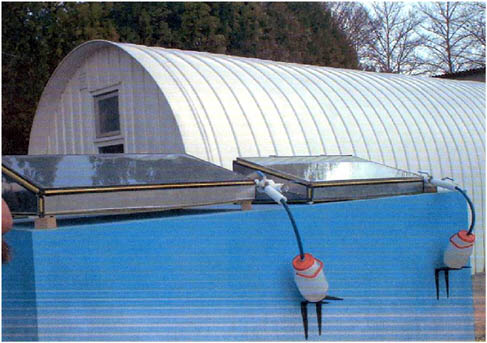
FIGURE 4 The experiment setup of solar stills built of stainless steel.
Similar experiments were carried out in Tehran, employing small stills built of plexiglass. No insulations were employed on the sides of the stills, and the condensate produced on the side walls of the stills was also collected. The fresh water production of these stills varied between 3.5 and 4.5 liter/m2/day during the month of August 2002, under clear sky conditions (Ahmadi, 2002). Different materials, including black paint and small pebbles, were employed at the bottom of the stills. It was found that the still with small black pebbles performed best. Figure 5 shows the experimental setup, and Figure 6 the efficiency of the still, using black pebbles at the base of the still (Ahmadi, 2002). It is estimated that one can produce about 1.5 m3/m2/y of fresh water in the southern region of Iran by simple basin type solar stills.
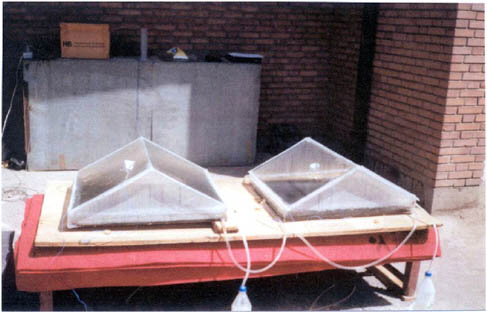
FIGURE 5 The experiment setup of solar stills built of Plexiglass.
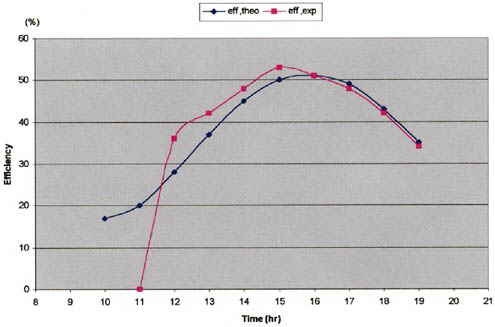
FIGURE 6 Experimental and theoretical values of efficiencies for the Plexiglass solar still, using a layer of black pebbles at the bottom of the still. Values for Tehran during August 2002.
REFERENCES
Ahmadi, N. 2002. Experimental-analytical evaluation of the performance of solar desalination designs. B.Sc. Project, Sharif University of Technology.
Assimacopoulos, D. 2001. Water water everywhere, desalination powered by renewable energy sources. REFOCUS (July/ August), Pp. 38-43.
Bahadori, M.N. and Edlin, F.E. 1973. Improvement of solar stills by the surface treatment of glass. Solar Energy 14:339-352.
Duffie, J.D. and W.A. Beckman. 1981. Solar Engineering of Thermal Processes. New York: John Wiley and Sons.
El-Nashar, A.M. 2001. Water from the sun—Case study: the Abu Dhabi solar desalination plant. REFOCUS (March), Pp. 26-29.
Haghbin, M. 2002. Solar Desalination Project. Final report submitted to Water Resources Management of Iran, Ministry of Power, Tehran.


