
2
The Promise of Nanotechnology1
Nanotechnology is often described as an emerging technology—one that not only holds promises for society but is capable of revolutionizing our approaches to common problems. Nanotechnology is not a completely new field; however it is only recently that discoveries have advanced so far as to warrant examination of their impact upon the world around us. Nobel laureate Richard P. Feynman, in his famous speech to the American Physicist Society in 1959, said “in the year 2000, when they look back at this age, they will wonder why it was not until the year 1960 that anybody began seriously to move in this direction.”
PRODUCTS OF TODAY
The value of nanomaterials in many technology areas is high because of their versatile properties. Investment in nanotechnology in the United States government has had a very steady growth; in 2004 we are approaching the $1 billion a year in investment from many different federal agencies, said Olden. Industrial investment in this area is also growing steadily. It is said that the future of nanotechnology is potentially boundless if we can avoid the pitfalls. Some of the items that exist today were a topic of science fiction a decade ago and have the potential to transform our society very quickly, said Douglas Mulhall, author of Our Molecular Future; How Nanotechnology, Robotics, Genetics, and Artificial Intelligence Will Transform Our World. Today, some of the nanomaterials are already being used in commerce. For example, Proctor and Gamble is using titanium dioxide (TiO2) nanoparticles to provide transparency in sunscreen
lotions, as a less toxic alternative to the organic molecules currently used as UV absorbers in many sunscreen formulations. Other nanomaterials are incorporated in sporting equipment, clothing, telecommunication infrastructure, and fuel cells.
The future of nanotechnology is potentially boundless if we can avoid the pitfalls. Some of the items that exist today were a topic of science fiction a decade ago.
—Douglas Mulhall
Other examples of current nanotechnologies are three-dimensional printing with nanoparticles, high speed computing driven by nanotechnology, and computer-assisted design software with generic algorithms that learn by themselves. Three-dimensional printers were invented in the 1990s and commercialized in 2000 and are already being used to make products such as surgical models. Surgical models have the potential to match the exact needs of an individual patient while allowing surgeons to eliminate the need for exploratory surgery when they are doing reconstructive work.
Today it is technologically feasible to manufacture programmable nano-filters that eliminate the pressure requirement for desalinization and reduce the expenses by 99 percent, meaning the end of water shortages in arid regions. It could also potentially alter regional environments and convert deserts to forests by removing large amounts of fresh water from the oceans, postulated Mulhall.
With the invention of solar paint and principal solar cells based on nanoengineered organic plastics, fossil fuel dependence may begin to recede. Another nanotechnology-based invention is extremely strong materials called nanostructured aerogels. These materials are inexpensive and they could make structures resistant to earthquakes and hurricanes, which will have significant societal benefits, said Mulhall.
ENVIRONMENTAL APPLICATIONS FOR NANOTECHNOLOGY
Some of the greatest potential uses or applications for nanotechnology in the environment are sensors, treatment, remediation, and green nanotech manufacturing and engineering, stated Barbara Karn of the Environmental Protection Agency. These applications can be further categorized as either reactive to existing environmental problems or proactive in anticipating and preventing future problems.
Reactive Applications
Reactive applications involve sensors, treatment, and remediation. Diverse research is being conducted on the use of nanoparticles as sensors to allow for accurate, real-time simultaneous sensing of a variety of compounds, often at extremely low concentrations and in hostile environments. Karn discussed a number of research projects sponsored by the Environmental Protection Agency that are aimed at developing applications for nanotechnology.
The research of Nongjian Tao at Arizona State University focuses on “lab on a chip” nanotechnology for on-site detection of ultratrace levels of heavy metal ions, including radioactive compounds, using a silicon chip which contains nanoscale electrodes separated by an atomic-scale gap. Thus, with the electrode position of only a few metal ions in this gap, the circuit can be completed, indicating the presence of various compounds.
Nanoscale sensors are also being investigated for detection of biological compounds such as algal toxins in the marine environment or mycobacteria present in drinking water. Robert Gawley of the University of Arkansas has developed fluorescent dendrimers displaying spatially resolved microdomains on polymer beads for the detection of different algal toxins. The binding of different toxins results in specific fluorescence wavelengths, depending upon the spatial resolution of the dendrimers on the polymer beads, which correlate to known toxins (Figure 2-1). This technology would be a less costly and time consuming alternative to current methods used to monitor shellfish populations,
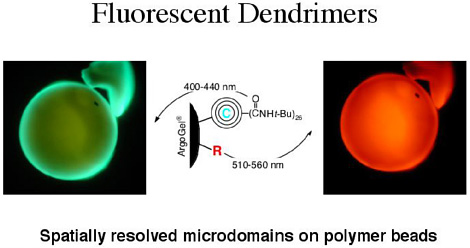
FIGURE 2-1 Depending upon the spatial resolution of the fluorescent dendrimers on polymer beads, the binding of different toxins results in a correlating specific fluorescence wavelength. SOURCE: Cardona, et al., 2002. © Helvetica Chimica Acta AG. Reprinted with permission.
which are especially sensitive to marine toxins such as those responsible for large fish kills on the Eastern seaboard.
Advances in nanodetection would allow not only for detection of microbial pathogens in drinking water, but also the quantization of these organisms, noted Karn. A piezoelectric microcantilever sensor is a method of detection and quantization being developed by Wan Shih of Drexel University, which involves the use of micron-scale cantilever arms coated with specific DNA strands. Test water is run through the piezoelectric cantilever sensor and when target molecules bind the cantilever becomes heavier, changing its rate of vibration and creating an electric current. Thus movement of the cantilever by just a few nanometers correlates with the number of molecules captured on its surface, allowing for detection and quantization of specific pathogens in the water.
Treatment and remediation are two other reactive applications made possible by nanotechnology research. Nanoscale molecules used in treatment and remediation have the ability to access areas that larger molecules cannot, and can be coated to prevent reactivity with surrounding soil particles. In addition, the researchers are following the paths of these nanoparticles, so the fate and transport of these molecules as well as the clean-up efficiency is being studied, added Karn. For example, iron oxide particles encapsulated in a protein shell can be used for the reduction of heavy metals such as hexavalent chromium, a frequent groundwater contaminant. Karn pointed out that clean-up is where nanoscale makes an impact: for example, the smaller the radius of zero-valent iron particles, the more milligrams of trichloroethylene (TCE) are reduced per milligram Fe per hour. Iron particles with a radius of 1 µm can reduce 0.186 mg TCE/mg Fe/h. However, this same type of particle with a radius of 1 nm can reduce 186 mg TCE/mg Fe/h. The nanoscale particle is three orders of magnitude smaller, but its rate of TCE reduction is three orders of magnitude greater than that of the microscale particle.
Nanotechnology will make possible great advances in our ability to retroactively solve environmental issues.
—Barbara Karn
Research varies in the approaches taken to reach the endpoint of treatment or remediation, said Karn. Some researchers attempt to surface-coat molecules to pull them together, and maybe detoxify them while others coat them so that the desired nanoproduct is isolated and collectable. Regardless of the strategy utilized, Karn proposes that nanotechnology will make possible great advances in our ability to clean up the environment.
Environmental Proactive Applications
Proactive applications mainly include green manufacture and green energy productions. Green energy can be produced using nanotechnology to create solar
and fuel cells as potential sources of commercially available alternative clean energy sources. Green manufacturing has two aspects: the use of nanotechnology in the design process to eliminate polluting waste products at their source and, alternately, the efficient production of nanomaterials themselves.
Green manufacturing improves catalysis specificity, producing more of the desired compounds and less waste and pollution. Researchers are exploring how to stabilize nanoparticles without harmful additives that would pollute water and soil. Often these processes require less time, sometimes hours instead of days, and can potentially significantly reduce the cost of making nanoparticles. Consumption of energy during the manufacturing processes can also be reduced, and Karn noted that many aspects of nanotechnology and its application in manufacturing are devoted to the research and production of cleaner and more efficient energy sources.
Green energy can be produced using nanotechnology to create solar and fuel cells as potential sources of commercially available alternative clean energy sources.
—Barbara Karn
Nanotechnology has a great future for providing solutions in the area of green energy applications, said Karn. New research is exploring the use of electro-chemistry, nanoscale photosynthesis, micro fluidic biofuel cells, and photo electro-chemical cells, among other endeavors, to address the growing need for safe, inexpensive, and renewable energy resources. For example, solid state lighting can be enhanced by the use of nanocrystals/polymer composites for light-emitting diodes (LED). This allows for brighter, more efficient, and less costly lighting for use in such equipment as traffic signals. Karn stated that use of LED technology could reduce the consumption of light energy up to 50 percent by 2020 in the United States alone. Reduction of carbon emissions by an estimated 28 million metric tons per year has obvious climate change and materialization implications. Economically, this translates to a savings of $100 billion in fewer than 20 years (Bergh et al., 2001).
The challenges facing researchers with regard to fuels in the realm of transportation are three-fold: how to produce the fuel, how to transport it to the location where it is needed, and how to store the fuel safely. These questions are especially pertinent to hydrogen fuels and were addressed in President Bush’s State of the Union address. Aimed at putting an appreciable number of motor vehicles on the road that are powered by hydrogen fuel by 2020, the initiative allocates $1.2 billion to research and production of these vehicles.
Nanotechnology may offer solutions in all these areas of concern, noted Karn. Nanomaterials may be used to create harder alloys and ceramics for cutting tools to increase the efficiency of manufacture. Motors may be made more efficiently by incorporating low-loss, high-performance magnets. The use of lightweight materials with low failure rates and surface tailoring of parts to
produce less friction and increase resistance to wear, would decrease fuel consumption while improving the safety of ground and air transportation. Finally, the use of nano catalysts will lead to cleaner, less costly, and environmentally friendly petroleum refining and the production of more efficient and productive batteries and fuel cells, said Karn.
Sustainability is a top consideration in the quest for new fuel sources, particularly with reference to the issue of global climate change. The harm to human health and the environment that the transportation systems produce is well known; thus, with the better catalysts, better kinds of tires, better, lighter materials that nanotechnologies can offer, this can help affect climate change by changing the kind and amounts of resources consumers use, said Karn. Lighter-weight materials lower the amount of fuel needed for transportation, more efficient electronics use less electrical energy, less production energy can be used with increased production efficiency, and fuels themselves can burn cleaner due to better filtration.
Research on Nanotechnology Life Cycles
Prospects for the use of nanotechnology also extend into the realm of environmental protection and remediation. Karn stated that by 2008, the total global demand of nanoscale materials, tools, and devices is projected to be about $29 billion (Business Communication Company, 2004). To ensure that universities and research centers in the United States can perform the highest quality research in this rapidly growing area of technology, the EPA has plans to fund research in the areas of treatment and remediation, environmental implications, and the health and environmental effects of manufacturing nanomaterials, exploring topics such as toxicology, fate and transport, and bioavailability and bioaccumulation.
The EPA is especially concerned with the study of manufactured nanomaterials and their life cycle aspects, the role of industrial ecology, toxicology, and exposure. One EPA project examines the full life cycle of nanomaterials and researches the following:
-
Where are the impacts of products that have nanomaterials in them?
-
Where in the life cycle are their impacts going to fall?
-
Are there any impacts in the use stage like automobiles; the disposal stage, like electronic equipment; or the extraction stage like some of our mining endeavors?
-
How will the move to nanotechnology change a material’s flow within a particular sector?
Scientists need to look where in the full life cycle the impacts from these products and processes may occur. Nanotechnology can offer direct beneficial applications to the environment, and society can take advantage of this for both
environmental and sustainability benefits. However, it is important to remember that this evolving technology can also have indirect effect on the environment. If solar paint has a persistence problem in the environment, but avoids the pollution created by fossil fuels, or if super-strong materials have similar problems, but help us to avoid the pollution that comes from whole communities being destroyed by a chemical spill, then researchers must be careful to weigh the implications concurrently with the benefits of developing nanotechnology applications, said Karn.
If solar paint has a persistence problem in the environment, but avoids the pollution created by fossil fuels, then researchers must be careful to weigh the implications concurrently with the benefits of developing nanotechnology applications.
—Barbara Karn
Nanotechnology has direct beneficial applications for medicine, public health, and the environment but it also has peripheral effects that can impact the environment, both within the human body and within the natural ecosystem. While taking advantage of this new technology for health, environmental, and sustainability benefits, the U.S. government also must examine the risks concurrently with development of new applications.
NANOTECHNOLOGY, HUMAN HEALTH, AND MEDICINE
NIH is supporting the development of effective, high output, informative, and less costly systems and has identified several areas for research in nanomedicine, which it defines as integration of nanotechnology and medicine. NIH is planning to support the research on biological molecules such as proteins, DNA, and RNA as well as research into how these molecules interact with each other and with environmental agents. One of its primary objectives is acquisition of a comprehensive database and development of quantitative nanomaterial measurements, said Olden. NIH researchers and independent scientists have identified the need for mathematical and analytical tools to quantify manipulations and interpret measurements of nanomolecules. Thus, mathematicians and chemists need to get involved in the effort to understand what these variations, changes, and readouts mean to biological processes.
Once an early biomarker of a disease or dysfunction is identified, then scientists can use targeted pharmaceutical or gene therapy to correct the faulty components.
—Kenneth Olden
Additionally, NIH is planning to develop very sensitive detection systems that would be able to detect a single cell or a few cells that are diseased or perturbation of a pathway. Once an early biomarker of a disease or dysfunction
is identified, then scientists can use targeted pharmaceutical or gene therapy to correct the faulty components, noted Olden.
Pebble Chemistry as an Example of a Medical Application of Nanotechnology
Nanotechnology, especially as it is applied to biological systems, is an intricate, interdisciplinary field, said Martin Philbert of the University of Michigan. Researchers have begun to build nanoparticles that are intrinsically biocompatible, that do not alert the immune system to their presence, and that can contain a variety of highly functional and highly specific elements that might be toxic but which are shielded from the biology by a shell. One example, the Probes Encapsulated by Biologically Localized Embedding (PEBBLE) was created as a nanoparticle platform with multi-functional capabilities (Figure 2-2).
Generally, PEBBLEs are fluorescent dyes that are encased in a molecular shell, protecting cells from the dye and protecting the dye from cellular degradation or manipulation, stated Philbert. The presence and intensity of the fluorescence is directly proportional to the pathway or molecule that the sensor is measuring.
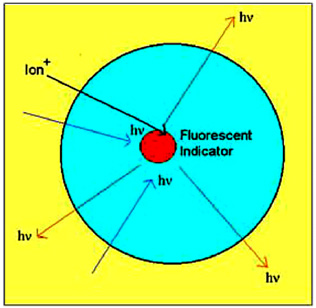
FIGURE 2-2 PEBBLEs are fluorescent dyes that are encased in a molecular shell, protecting cells from the dye and protecting the dye from cellular degradation or manipulation. SOURCE Martin Philbert, unpublished. Reprinted with permission.
Currently, they are being used in research facilities and offer researchers the ability to measure real-time binding, translocation, and molecule production, instead of the widely used tools available for steady-state or endpoint measurements. However, they may have use for a wide range of research and medical needs.
PEBBLE Chemistry
The simplest iteration of a PEBBLE is a polymer shell that contains a fluorescent molecule, ranging in size from 20 nanometers to 600 nanometers in diameter. One 20 nanometer particle occupies 1 thousandth of a human motor neuron in the anterior horn of the spinal cord; thus, cells have a potentially tremendous capacity for the retention of a wide range of PEBBLEs sensing and reporting on a variety of cellular pathways and processes.
Philbert stated that the analytical chemistry that can be performed within the conserved space of the cell is much more sophisticated. A dye can be incorporated that changes with time as a function of the analyte of interest. The system can also be constructed in a more complex fashion using ionophores. When irradiated with the appropriate wavelength of a laser, light is emitted and can be measured, allowing for an amazingly useful property where the measurement system is completely calibratable and the fluorescence is reversible, said Philbert.
PEBBLEs as Stepping Stones to Understanding Cellular Processes
One aspect of nanoparticle research has focused on the use of nanoparticles as sensors of cellular activity. This can include extra cellular measurements, such as the presence of oxygen or nitrogen radicals in the extra cellular space and the presence of the molecules in the blood and tissue, or measurements at the subcellular level. Protein movement, oxidation or reduction reactions, and the production of super oxide ions within the cell may be tracked by the use of fluorescent nanoparticles. There are also design prototypes for measuring lead and mercury, and soon, according to Philbert, the ability to measure phosphorylation and other chemical reactions inside the cell will be possible.
The light emitted from individual nanoprobes introduced into the volume of the cell can be viewed using confocal microscopy. The concentration of oxygen at each individual point is reported by a dot in the co-focal viewing field when observing the cell. The intensity of the light emitted by the dot indicates the concentration of oxygen at that point in the cell. With this new look at the cell, Philbert suggested that our assumptions about how oxygen enters the cell, diffuses through the cell, and is used in the cell may not be entirely correct.
Nanoparticles can also be used to track the movement of particular cellular compartments. Endosomes can take up the nanoparticle, and depending on surface charge, size, and other characteristics, transport them to the apical surface or the basal lateral surface of the cell.
The reason why scientists have attempted to go smaller and smaller is that they were trying to find out if there is a point at which the sensors that are being designed and placed into systems to measure biological activity begin affecting or changing the very processes they are intended to measure. Once a molecule is below 100 nanometers, it begins interacting with proteins, potentially signaling proteins, and can result in entirely unintended consequences, which is why PEBBLEs have been kept close to 100, and less than 200, nanometers. Thus while there are many advantages to keeping PEBBLES very small, scientists really do not know yet what the interactions with proteins and other elements of the cell are going to be, said Philbert.
With this new look at the cell our assumptions about how oxygen enters the cell, diffuses through the cell, and is used in the cell may not be entirely correct.
—Martin Philbert
PEBBLEs on the Path to Understanding Tumor Biology
One area of research, according to Philbert, focuses on targeting molecules to tumors for treatment and eradication. Coating a PEBBLE nanoparticle with a magnetically responsive metal allows researchers to target nanoparticles to specific locations within the body and to obtain a better image of tumors from magnetic resonance imaging (MRI). These MRI images reveal a significant contrast enhancement due to the presence of the nanoparticles within the tumor tissue, that is, nanoparticles allow for very good contrast from normal tissue, where the tumor becomes clearly visible to the observer (Figure 2-3).
Fine resolution of small tumors is not the only possibility within the same nanoparticle. Ruthenium (Sol Gel Ru-DNPs ) can also be included within the nanoparticle. When a laser is turned on, Sol Gel Ru-DNPs can produce a large amount of singlet oxygen only when it reaches the target, in this case a brain tumor called 9L gliosarcoma produced in the rat brain. Therefore, researchers can kill this clone of the gliosarcoma, which does not respond to chemotherapy or radiation therapy. Coupled with a fiber optic that is only a millimeter in diameter, the tumor can be stopped or at least reduced in size with time. Because the 9L gliosarcoma is extremely aggressive, if one or two cells are left, after some time the tumor will re-grow. However, with a single injection and only 10 minutes of laser irradia-
The ultimate goal of this research is to create particles that are not going to interfere with the normal biology of the organism and are going to have very high therapeutic index.
—Martin Philbert
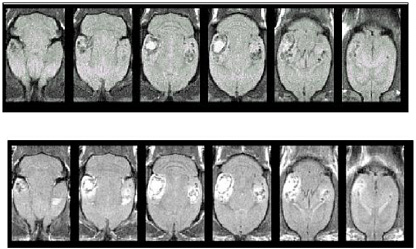
FIGURE 2-3 Effect of PEG Weight on Dynamic MRI Scanning of Nanoparticles. This figure shows Transverse multislice T1-weighted MR images acquired prior to injection of Gd: PEBBLEs and Transverse multislice T1-weighted MR images acquired 60 minutes post-intravenous injection of Gd: PEBBLEs revealing a significant contrast enhancement due to the presence of the nanoparticles within the tumor tissue. SOURCE: Brian Ross, University of Michigan, unpublished. Reprinted with permission.
tion Philbert’s group demonstrated good cessation of growth or actual reduction in the tumor mass and increased life span of these animals by using these Sol Gel Ru DNPs.
Nanoparticles used in tumor killing experiments are larger than 100 nanometers; thus, they do not cross the blood–brain barrier (BBB), and therefore are excluded from healthy brain tissue, said Philbert. These nanoparticles penetrate into the tumor only when a tumor changes the porosity of the blood vessel. This process of BBB penetration takes approximately 5–10 minutes and once clearance through renal and other mechanisms is considered to be complete, the laser is turned on. The nanoparticles are delivered systemically and then pass through the BBB before a laser is turned on to activate the killing activity, but further research will be need to understand what happens to these particles as they circulate through other parts of the body?
Approximately twenty different kinds of these nanoparticles have been created and researched in vivo in the Philbert lab alone, all of which have shown effects on the reticular endothelial system and the kidneys. These nanoparticles are discarded as the ultimate goal of this research is to create particles that are
not going to interfere with the normal biology of the organism, yet have a very high therapeutic index. Philbert suggested that many of the products that can be created will ultimately not be deployable because early safety testing will show them to be completely unfeasible from a toxicological standpoint.


