
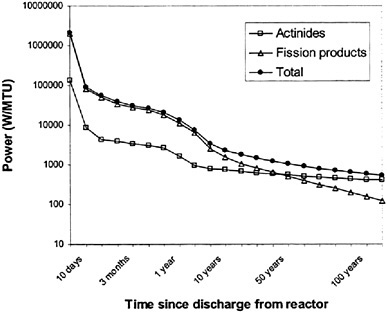
FIGURE 1.2 Decay-heat power for spent fuel (measured in watts per metric ion of uranium) plotted on a logarithmic scale as a function of time after reactor discharge. Note that the horizontal axis is a data series, not a scale. SOURCE: Based on data from USNRC (1984).
1.4.2 Storage of Spent Nuclear Fuel
Storage technologies for spent nuclear fuel have three primary objectives:
-
Cool the fuel to prevent heat-up to high temperatures from radioactive decay.
-
Shield workers and the public from the radiation emitted by radioactive decay in the spent fuel and provide a barrier for any releases of radioactivity.
-
Prevent criticality accidents (uncontrolled fission chain reactions).
After the fuel assemblies are unloaded from the reactor they are stored in water pools, called spent fuel pools. The water in the pools provides radiation shielding and cooling and captures all but noble gas radionuclides in case of fuel rod leaks.10 The geometry of the fuel and neutron absorbers (such as boron, hafnium, and cadmium) within the racks that hold the spent fuel or in the cooling water help prevent criticality events.11 The water in the pool is circulated through heat exchangers for cooling and ion exchange filters to capture any radionuclides and other contaminants that get into the water. Makeup water is also added to the pool to replace pool water lost to evaporation. The operation of the pumps and heat exchangers is especially important during and immediately after reactor
|
10 |
If the cladding in the fuel rods is breached some radioactive materials will be released into the pool. |
|
11 |
See the Glossary (Appendix E) for a definition of criticality. Most of the fuel’s capacity for sustaining criticality is expended in the reactor as the uranium and plutonium are fissioned. |

