
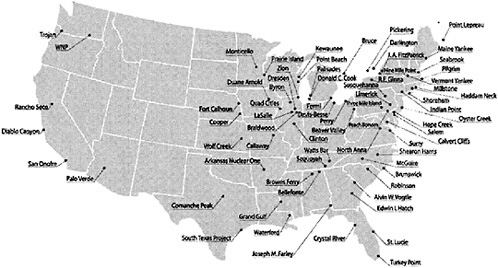
FIGURE 1.3 Locations of spent fuel storage facilities in the United States.
TABLE 1.1 provides a listing of the 30 operating Independent Spent Fuel Storage InstalEations (ISFSIs14) in the United States. These ISFSIs include the dry storage facilities at operating and shutdown commercial power reactor sites as well as the storage facilities at the Morris and Idaho sites, as described above. The committee did not examine the Morris and Idaho facilities as part of this study. At-reactor pool storage is not considered to be an ISFSI because it operates under the power reactor license.
1.4.4 History of Spent Fuel Storage
Spent fuel pools at commercial nuclear power plants were not designed to accommodate all the fuel used during the operating lifetime of the reactors they service. Most commercial power plants were designed with small pools under the assumption that fuel would be cooled for a short period of time after discharge from the reactor and then be sent offsite for recycling (i.e., reprocessing).15 A commercial reprocessing industry never developed, however, for the reasons discussed in Appendix D. Newer power plants were designed with larger pool storage capacities. Even plants with larger-capacity pools will run out of pool space if they operate beyond their initial 40-year licenses. In 2000, the nuclear power industry projected that roughly three or four plants per year would run out of needed storage space in their pools without additional interim storage capacity (see FIGURE 1.4).
Another development that logically could reduce the demand for storage of spent nuclear fuel at the sites of power plants is the availability of a geologic repository for
TABLE 1.1: Operating ISFSIs in the United States as of July 2004
|
Name |
Location |
|
Palo Verde |
Arizona |
|
Arkansas Nuclear One |
Arkansas |
|
Rancho Seco |
California |
|
San Onofre |
California |
|
Diablo Canyon |
California |
|
Fort St. Vrain 1 |
Colorado |
|
Edwin L.Hatch |
Georgia |
|
DOE-INL 2 |
Idaho |
|
G.E.Morris 3 |
Illinois |
|
Dresden |
Illinois |
|
Duane Arnold |
Iowa |
|
Maine Yankee |
Maine |
|
Calvert Cliffs |
Maryland |
|
Big Rock Point |
Michigan |
|
Palisades |
Michigan |
|
Prairie Island |
Minnesota |
|
Yankee Rowe |
Massachusetts |
|
Oyster Creek |
New Jersey |
|
J.A.FitzPatrick |
New York |
|
McGuire |
North Carolina |
|
Davis-Besse |
Ohio |
|
Trojan |
Oregon |
|
Susquehanna |
Pennsylvania |
|
Peach Bottom |
Pennsylvania |
|
Robinson |
South Carolina |
|
Oconee |
South Carolina |
|
North Anna |
Virginia |
|
Surry |
Virginia |
|
Columbia Gen. Station |
Washington |
|
Point Beach |
Wisconsin |
|
NOTES: 1The Fort St. Vrain ISFSI stores fuel from a commercial gas-cooled reactor. The facility is operated by the Department of Energy. 2The DOE-INL facility stores fuel from the Three-Mile Island Unit 2 reactor. The facility is operated by the Department of Energy. 3The G.E.Morris ISFSI is a wet storage facility. SOURCES: Data from the USNRC (2004). |
|
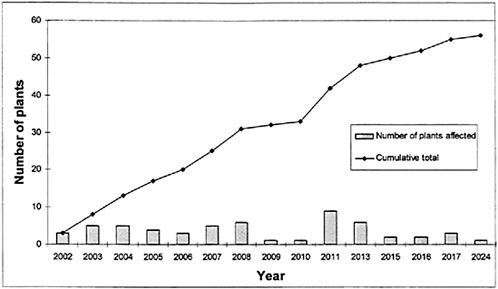
FIGURE 1.4 Projection of the number of commercial nuclear power plants that will run out of needed space in their spent fuel pools in coming years if they do not add interim storage. These data, looking only at plants that did not already use dry cask storage, were provided to the Nuclear Regulatory Commission in 2000. SOURCE: USNRC (2001b).
disposal of spent nuclear fuel. But a nuclear waste repository is not expected to be in operation until at least 2010, and even then It will take several decades for all of the spent fuel to be shipped for disposal. Thus, onsite storage of spent fuel is likely to continue for at least several decades,
Power plant operators have made two changes in spent fuel storage procedures to increase the capacity of onsite storage. First, starting in the late 1970s, plant operators began to install high-density racks that enable more spent fuel to be stored in the pools. This has increased storage capacities in some pools by up to about a factor of five (USNRC, 2003b). Second, as noted above, many plant operators have moved older spent fuel from the pools into dry cask storage systems (see Chapter 4) or into other pools when available to make room for freshly discharged spent fuel and to maintain the capacity for a full-core offload,16
The original spent fuel racks, sometimes called “open racks,” were designed to store spent fuel in an open array, with open vertical and lateral channels between the fuel assemblies to promote water circulation. The high-density storage racks eliminated many of the channels so that the fuel assemblies could be packed closer together (FIGURE 1.5). This configuration does not allow as much water (or air circulation in loss-of-pool-cootant events) through the spent fuel assemblies as the original open-rack design.
Several nuclear utilities have already submitted license applications to the Nuclear Regulatory Commission to build 16 new ISFSIs, Among the potential new ISFSIs, a consortium of utilities has submitted a license for a private fuel storage facility (PFS) in Utah for interim dry storage of up to 40,000 metric tons of spent fuel.
Most or all pools store some spent fuel that has aged more than five years after discharge from the reactor, and so could be transferred to dry-cask storage. The amount that could be transferred depends on plant-specific information such as pool size and configuration, operating history of the reactor, the enrichment and burn-up level in the fuel, and availability of an ISFSI.
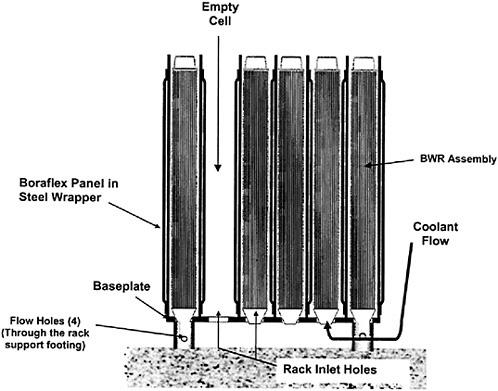
FIGURE 1.5 Dense spent fuel pool storage racks for BWR fuel. This cross-sectional illustration shows the principal elements of the spent fuel rack, which sits on the bottom of the pool. SOURCE: Nuclear Regulatory Commission briefing materials (2004).


