
4.1 BACKGROUND ON DRY CASK STORAGE
The storage of spent fuel in dry casks has the same three primary objectives as pool storage (Chapter 3):
-
Cool the fuel to prevent heat-up to high temperatures from radioactive decay.
-
Shield workers and the public from the radiation emitted by radioactive decay in the spent fuel and provide a barrier for any releases of radioactivity.
-
Prevent criticality accidents.
Dry casks are designed to achieve the first two of these objectives without the use of water or mechanical systems. Fuel cooling is passive: that is, it relies upon a combination of heat conduction through solid materials and natural convection or thermal radiation through air to move decay heat from the spent fuel into the ambient environment. Radiation shielding is provided by the cask materials: Typically, concrete, lead, and steel are used to shield gamma radiation, and polyethylene, concrete, and boron-impregnated metals or resins are used to shield neutrons. Criticality control is provided by a lattice structure, referred to as a basket, which holds the spent fuel assemblies within individual compartments in the cask (FIGURE 4.1). These maintain the fuel in a fixed geometry, and the basket may contain boron-doped metals to absorb neutrons.3
Passive cooling and radiation shielding are possible because these casks are designed to store only older spent fuel. This fuel has much lower decay heat than freshly discharged spent fuel as well as smaller inventories of radionuclides.
The industry sometimes refers to these casks using the following terms:
-
Single-, dual-, and multi-purpose casks.
-
Bare-fuel and canister-based casks.
The terms in the first bullet indicate the application for which the casks are intended to be used. Single-purpose cask systems are licensed4 only to store spent fuel. Dual-purpose casks are licensed for both storage and transportation. Multi-purpose casks are intended for storage, transportation, and disposal in a geologic repository. No true multi-purpose casks exist in the United States (or in any other country for that matter) because specifications for acceptable containers for geologic disposal have yet to be finalized by the Department of Energy. Current plans for Yucca Mountain do not contemplate the use of multi-purpose casks.
Nevertheless, some cask vendors still refer to their casks as “multi-purpose.” These are at best dual-purpose casks, however, because they have been licensed only for storage and transport. Because true multi-purpose casks do not now exist and are not likely to exist in the future, the committee did not consider them further in this study.
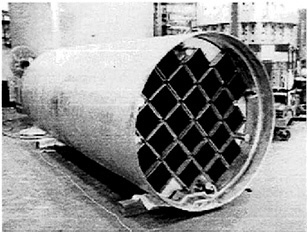
FIGURE 4.1 Photo of NUHOMS canister showing the internal basket for holding the spent fuel assemblies in a fixed geometry. This canister is shown for illustrative purposes only.
SOURCE: Courtesy of Transnuclear, Inc., an Areva Company.
The terms in the second bullet indicate how spent fuel is loaded into the casks. In bare-fuel5 casks, spent fuel assemblies are placed directly into a basket that is integrated into the cask itself (see FIGURE 4.3B), The cask has a bolted lid closure for sealing. In canister-based casks, spent fuel assemblies are loaded into baskets integrated into a thin-wall (typically 1/2-inch [1.3-centimeter] thick) steel cylinder, referred to as a canister (see FIGURE 4.1 and 4.3A), The canister is sealed with a welded lid. The canister can be stored or transported if it is placed within a suitable overpack. This overpack is closed with a bolted lid.
Bare-fuel and canister-based systems are sometimes referred to as “thick-walled” and “thin-walled” casks, respectively, by some cask vendors. This designation is not strictly correct because the overpacks in canister-based systems have thick walls. The only thin-walled component is the canister, which is designed to be stored or transported within the overpack.
The designation of a cask as single- or dual-purpose often has less to do with its design and more to do with licensing decisions. Indeed, bare-fuel and canister-based casks can be licensed for either single or dual purposes. Consequently, one should not expect the performance of a cask in accidents or terrorist attacks to depend on its designation as single- or dual-purpose. Rather, performance will depend on the type of attack and construction of the cask. For the purposes of discussion in this chapter, therefore, the committee uses the designations “bare-fuel” and “canister-based,” rather than single- or dual-purpose, when referring to various cask designs.
All bare-fuel casks in use in the United States are designed to be stored vertically. Most canister-based systems also are designed for vertical storage, but one overpack
system is designed as a horizontal concrete module (FIGURE 4.2).6 The principal characteristics of dry cask storage systems are summarized in TABLE 4.1, which is located at the end of this chapter.
Dry casks are designed to hold up to about 10 to 15 metric tons of spent fuel. This is equivalent to about 32 pressurized water nuclear reactor (PWR) spent fuel assemblies or 68 boiling water nuclear reactor (BWR) spent fuel assemblies. Although the dimensions vary among manufacturers, fuel types (i.e., BWR or PWR fuel), and amounts of fuel stored, the casks are typically about 19 feet (6 meters) in height, 8 feet (2.5 meters) in diameter, and weigh 100 tons or more when loaded.
The casks (for bare-fuel designs) or canisters (for canister-based designs) are placed directly into the spent fuel pool for loading. After they are loaded, the canisters or casks are drained, vacuum dried, and filled with an inert gas (typically helium). The loaded canisters or casks are then removed from the pool, their outer surfaces are decontaminated,7 and they are moved to the dry storage facility on the property of the reactor site. Loading of a single cask or canister can take up to one week. The vacuum drying process is the longest step in the loading process.
In the United States, dry casks are stored on open concrete pads within a protected area of the plant site.8,9 This protected area may be contiguous with the protected area of the plant itself or may be located some distance away in its own protected area (see FIGURE 2.1).
According to the information provided to the committee by cask vendors, nuclear power plant operators are currently purchasing mostly dual-purpose casks for spent fuel storage. The horizontal NUHOMS cask design is one of the most-ordered designs at present (TABLE 4.3). The vendors informed the committee that cost is the chief consideration for their customers when making purchasing decisions. Cost considerations are driving the cask industry away from all-metal cask designs and toward concrete designs for storage.
|
6 |
In addition, there is one modular concrete vault design in the United States: the Fort St. Vrain, Colorado, Independent Spent Fuel Storage Installation, which stores spent fuel from a high-temperature gas-cooled reactor. This reactor operated until 1989 and is now decommissioned. Because this is a one-of-a-kind facility, and the time available to the committee was short, it was not examined in this study. |
|
7 |
Small amounts of radioactive contamination are present in the cooling water in the spent fuel pool. Some of this contamination is transferred to the cask or canister surfaces when it is immersed in the pool for loading. |
|
8 |
There may be exceptions in the future. Private Fuel Storage has requested a license from the Nuclear Regulatory Commission to construct a dry cask storage facility in Utah that will store fuel from multiple reactor sites. An underground dry cask storage facility has been proposed at the Humbolt Bay power plant in California to store old, low decay-heat fuel. The underground design is being proposed primarily because the site has very demanding seismic design requirements and is possible only because the fuel to be stored generates little heat. |
|
9 |
In Germany, dry casks are stored in reinforced concrete buildings. These buildings were originally designed to provide additional radiation shielding (beyond what is provided by the cask itself) to reduce doses at plant site boundaries to background levels. Some of these buildings are sufficiently robust to provide protection against crashes of large aircraft. A subgroup of the committee visited spent fuel storage sites at Ahaus and Lingen during this study. See Appendix C for details. |


