
C
TOUR OF SELECTED SPENT FUEL STORAGE-RELATED INSTALLATIONS IN GERMANY
On April 25–28, 2004, six committee members visited spent fuel storage-related installations in Germany. The following is a summary of some of the pertinent information obtained from that trip.
Several organizations and individuals worked with committee staff to make this trip possible. The committee would especially like to acknowledge Alfons Lührmann and William McConaghy of GNB/GNSI (Gesellschaft für Nuklear-Behälter, mbH/General Nuclear Systems, Inc.), who organized site visits; Klaus Janberg (STP engineering); Michael Sailer, chairman of RSK (Reaktorsicherheitskommission—reactor safety commission); Holger Broeskamp manager of GNS (Gesellchaft für Nuklear-Service, mbH—Germany’s nuclear industry consortium) and his staff; Wolfgang Sowa, managing director of GNB (Gesellschaft für Nuklear-Behälter, mbH) and his staff; Florentin Lange of GRS (Gesellschaft für Anlagen-und Reaktorsicherheit, mbH); and Hubertus Flügge, vice-president of the RWE Power AG plants in Lingen and his staff, who allowed the committee to visit the reactor building and the site’s spent fuel storage facility.
C.1 GERMAN COMMERCIAL NUCLEAR POWER PLANTS
Germany currently has 18 operating commercial nuclear power reactors at 12 sites. Approximately one-third of the reactors are boiling water reactors (BWRs) and two-thirds are pressurized water reactors (PWRs).
The design for PWR plants is illustrated schematically in FIGURE C.1. It consists of a dome-shaped reactor building constructed of reinforced concrete and a spherical inner containment structure constructed of steel. The reactor core, spent fuel pool, and steam generators are located within the inner containment. The emergency core-cooling systems are located outside the inner containment but within the reactor building.
The German BWR reactor building design is generally similar to a PWR, However, the spent fuel pool is outside the inner containment structure but within the reactor building. The reactor building is also a different shape (rectangular or cylindrical).
There are three generations of commercial nuclear power plants in Germany, each having increasingly thick walls:
-
First-generation plants have reactor building walls that are less than 1 meter thick. There are four plants of this type.
-
Second-generation plants have reactor building walls that are slightly more than 1 meter thick. There are five plants of this type.
-
Third-generation plants have reactor building walls that are about 2 meters thick, There are nine plants of this type.1
Some first- and second-generation plants have independent emergency systems in a bunkered building that contains some safety trains and a control room. These systems are capable of delivering water to the reactor after an accident or attack if the pipe systems within the reactor building survive.
Second- and third-generation plants were designed to withstand the crash of military fighter jets. Second-generation plants were designed to withstand the crash of a Starfighter jet at the typical landing speed. Third-generation plants were designed to withstand the crash of a Phantom jet at the typical cruising speed. This is considered to be part of the “design basis threat” for nuclear power plants in Germany. This information on the design basis threat has been made available to the public by the German government.
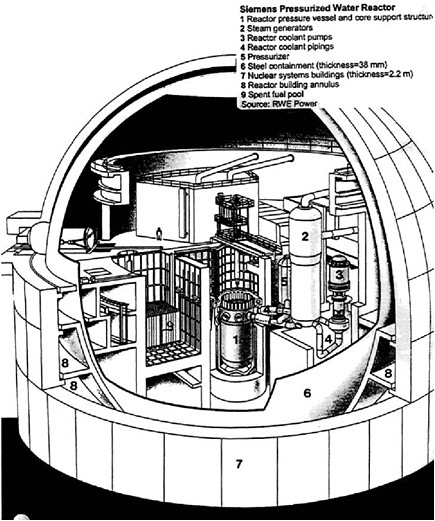
FIGURE C.1 Schematic illustration of the Lingen PWR power plant, a third-generation power plant design. SOURCE: RWE Power.


