
5
Toxicological Effects of Dispersants and Dispersed Oil
One of the most difficult decisions that oil spill responders and natural resources managers face during a spill is evaluating the environmental trade-offs associated with dispersant use. The objective of dispersant use is to transfer oil from the water surface into the water column. When applied before spills reach the coastline, dispersants will potentially decrease exposure for surface dwelling organisms (e.g., seabirds) and intertidal species (e.g., mangroves, salt marshes), while increasing it for water-column (e.g., fish) and benthic species (e.g., corals, oysters). Decisions should be made regarding the impact to the ecosystem as a whole, and this often represents a trade-off among different habitats and species that will be dictated by a full range of ecological, social, and economic values associated with the potentially affected resources. Comparing the possible ecological consequences and toxicological impacts of these trade-offs is difficult. First, each oil spill represents a unique situation and second, it is often difficult to extrapolate from published research data into field predictions, especially regarding the possibility of long-term, sublethal toxicological impacts to resident species (Box 5-1 provides definitions for most the common terms used in discussions of toxicological effects).
Historically, the use of dispersants in the United States has been restricted primarily to deepwater (>10 m), offshore spills. In addition, the focus and the recommendations of the 1989 NRC report on oil dispersants were based on expected impacts of dispersants and dispersed oil during open ocean spills (NRC, 1989). As the potential use of dispersants is expanded into nearshore, estuarine, and perhaps even freshwater systems,
|
BOX 5-1 Exposure—Contact with a chemical by swallowing, breathing, or direct contact (such as through the skin or eyes). Exposure may be either acute or chronic. Acute—An intense event occurring over a short time, usually a few minutes or hours. An acute exposure can result in short-term or long-term health effects. An acute effect happens within a short time after exposure. Acute toxicity to aquatic organisms can be estimated from relatively short exposures (i.e., 24, 48, or 96 hr) with death as the typical endpoint. Chronic—Occurring over a long period of time, generally several weeks, months or years. Chronic exposures occur over an extended period of time or over a significant fraction of a lifetime. Chronic toxicity to aquatic organisms can be estimated from partial life-cycle tests of relatively short duration (i.e., 7 days). Sublethal—Below the concentration that directly causes death. Exposure to sublethal concentrations of a material may produce less obvious effects on behavior, biochemical and/or physiological function (i.e., growth and reproduction), and histology of organisms. Delayed Effects—Effects or responses that occur some extended time after exposure. Static Exposures—Exposures for aquatic toxicity tests in which the test organisms are exposed to the same test solution for the duration of the test (static non-renewal) or to a fresh solution of the same concentration or sample at prescribed intervals such as every 24 hr (static renewal). The concentration of the test material may change during the test due to bio- |
the trade-offs become even more complex. For example, the protection of sensitive habitats, such as tropical coral reefs and mangroves, is a priority in oil spill response decisions. Many studies have shown that oil, floating above subtidal reefs, has no adverse effects on the coral; however, if allowed to reach the shoreline, the oil may have long-term impacts to a nearby mangrove system. In addition, oil may persist in the mangrove system creating a chronic source of oil pollution in the adjacent coral reefs. The trade-off would be to consider the use of dispersants. Application of
|
logical uptake, volatilization, adherence to the test vessel, chemical degradation, etc. Flow-Through Exposures—Sample to be tested is pumped continuously into a dilutor system and then to the test vessels. This method is used to control sample concentration throughout the duration of the test. Spiked Exposures—Spiked Declining (SD) Exposures: Concentration of dispersant sample is highest at start and then declines to non-detectable levels after 6–8 hr using a flow-through exposures protocol developed by Chemical Response to Oil Spills Environmental Research Forum (CROSERF) participants. LCp—Lethal Concentration: The toxicant concentration that would cause death in a given percent (p) of the test population. For example, the LC50 is the concentration that would cause death in 50 percent of the population. The lower the LC, the greater the toxicity. ECp—Effective Concentration: A point estimate of the toxicant concentration that would cause an observable adverse effect on a quantal (“all or nothing”) response in a given percent (p) of the population. ICp—Inhibition Concentration: A point estimate of the toxicant concentration that would cause a given percent (p) reduction in a non-quantal biological measurement such as reproduction or growth. NOEC—No-Observed-Effect-Concentration: The highest concentration of toxicant to which organisms are exposed in a full or partial (short-term) life-cycle test that causes no observable adverse effects on the test organisms (i.e., the highest concentration of toxicant at which the values for the observed responses are not statistically different from the control). SOURCES: Singer et al., 1991; Rand, 1995; Grothe et al., 1996; EPA, 2002a,b, 2005; New York Department of Health, 2005. |
dispersant would result in dispersion of the oil in the water column and so provide some degree of protection to the mangroves; however, the reef system would now have to endure the consequences of an increase in dispersed oil in the water column (see section on coral reefs later in this chapter). Therefore, for oil spill responders to decide upon appropriate response strategies, it is important that decisions are based on sound scientific data. Ecological factors that go into this decision include: expected sensitivity of exposed resources, proportion of the resource that would be
affected, and recovery rates (Pond et al., 2000). There is a tremendous need to reduce the uncertainty associated with each of these decision criteria.
This chapter reviews recent laboratory, mesocosm, and field studies on the toxicological effects of dispersants and dispersed oil, particularly those published since the 1989 NRC report on oil dispersants (NRC, 1989). The intention is first to summarize the current state of understanding regarding the biological effects of dispersants and dispersed oil, and second to make recommendations for additional studies that will help fill critical data gaps in the knowledge and understanding of the behavior and interaction of dispersed oil and the biotic components of ecosystems. The following discussion is limited primarily to studies of the toxicological effects on individual organisms, as opposed to populations or communities. This narrower scope reflects the current state of science in ecotoxicology (see Box 5-2). Although the research and management communities recognize the importance of considering higher order ecological effects, not enough is known to extrapolate from toxicity tests to population or community-level impacts—an issue that concerns all applications of ecotoxicology. Consequently, the explicit consideration of these impacts, and formulation of research to address them, is beyond the scope of this report on the application of ecotoxicological principles to oil spill research.
Due to implementation of several of the recommendations made in 1989 (NRC, 1989), particularly the standardization of toxicity testing methods and information garnered from long-term monitoring of field studies, some general conclusions about the toxicity of dispersants and dispersed oil can be reached. However, there are still areas of uncertainty that will take on greater importance as the use of dispersants is considered in shallow water systems. Specifically, there is insufficient understanding of the fate of dispersed oil in aquatic systems, particularly interactions with sediment particles and subsequent effects on biotic components of exposed ecosystems. In addition, the relative importance of different routes of exposure, that is, the uptake and associated toxicity of oil in the dissolved phase versus dispersed oil droplets versus particulate-associated phase, is poorly understood and not explicitly considered in exposure models. Photoenhanced toxicity has the potential to increase the impact “footprint” of dispersed oil in aquatic organisms, but has only recently received consideration in the assessment of risk associated with spilled oil. One of the widely held assumptions is that chemical dispersion of oil will dramatically reduce the impact to seabirds and aquatic mammals. However, few studies have been conducted since 1989 to validate this assumption. Finally, more work is needed to assess the long-term environmental effects of dispersed oil through monitoring and analysis of spills on which
|
BOX 5-2 The decision of whether or not to use chemical dispersants in aquatic systems involves evaluation of the trade-offs between potential impacts on various natural resources. Toxicity tests are one of the primary tools that are used to predict these impacts. Much of the toxicological literature focuses on the effects of dispersed oil on individual organisms, because this is the level of biological organization that is most readily studied. Of far greater significance—and of far greater complexity as well—are the effects of dispersed oil on populations and communities of organisms. How to make meaningful predictions about toxicological effects on populations or communities is a problem that is not unique to the assessment of the impacts of an oil spill, but rather is a central question in the field of ecotoxicology. How does the loss or impairment of one or more individual organisms impact a population? How does damage to single or multiple populations impact a community? In the case of dispersed oil, numerous ecological factors may affect the impacts to, and recovery of, these higher levels of biological organization, including the proportion of the resource affected (which in turn involves an understanding of the toxicological sensitivity of organisms as well as the behavior, habits, and habitats that will affect the probability of a species being exposed to oil), birth and death rates of the affected species, the current status of the population (e.g., endangered or common species), life stages that are present, and time of year (e.g., nesting or spawning season, seasonal migration). Population and community models are tools that show promise in enhancing our understanding of the toxicological impacts to these higher levels of biological organization. Despite recent efforts to advance these approaches (SETAC, 2003), there is no scientific consensus on this issue. Consequently, the majority of ecological risk assessments of environmental chemicals are still based on species-specific tests of toxicological effects on individual organisms. Until population and community-level approaches are more widely accepted and utilized in ecotoxicology, evaluations regarding the impacts of oil spills will remain largely based on qualitative assessments and best professional judgment. However, progress has been made in our understanding of the long-term effects of oil spills on biological communities. The NRC (2003) report on Oil in the Sea III: Inputs, Fates and Effects provides a good summary of some of the long-term studies that have been conducted after oil spills, especially those assessing effects on benthic communities and seabirds. For the moment, these types of studies represent the best chance of improving our understanding of the effects of spilled and dispersed oil on biological populations and communities. SOURCE: SETAC, 2003. |
dispersants have been used. Interestingly, several of these data gaps were also identified in 1989 (NRC, 1989).
TESTING PROCEDURES FOR DISPERSANT AND DISPERSED OIL TOXICITY
Toxicity Tests
Much that is currently known about the toxicity and biological effects of dispersants and dispersed oil has been derived from bench-scale acute toxicity tests. These tests typically consist of exposing a single species to varying dilutions of dispersant or dispersed oil preparations under carefully controlled laboratory conditions. Factors that influence such tests include:
-
choice of test organism and life stage
-
condition of oil (fresh versus weathered)
-
method of preparing test solutions
-
exposure conditions
-
choice of response parameters
Commonly used test organisms include fish, mollusks, arthropods, annelids, and algae. The choice of test organism is dictated by a combination of factors including potential risk, comparative sensitivity, suitability of the species to the testing conditions, and relative ecological and economic significance. An additional consideration is the specific life stage to be tested, because larvae and adults may respond to exposure in significantly different ways.
The method of preparing test solutions is particularly important in the case of dispersed oil testing. Water and oil are not easily miscible, so factors such as mixing energy and loading method can readily affect the relative concentrations of oil components to which test organisms are exposed. Dispersants can also separate and form films on water unless test solutions are properly prepared and mixed.
Exposure conditions in toxicity tests for dispersants and dispersed oil vary with the choice of test chamber (e.g., open or closed), the exposure model (e.g., static or flow-through, spiked or continuous), route of exposure (e.g., water or food), test duration, and other factors such as temperature, salinity, and buffering capacity. The choice of test duration alone can significantly overestimate or underestimate toxicity depending on the actual oil spill situation being simulated.
The choice of response parameters measured in a test can be significant as well. Current generation dispersants appear to cause toxicity
through disruptive effects on membrane integrity and a generalized narcosis mechanism (NRC, 1989). Dispersed oil, on the other hand, exerts a toxic effect through multiple pathways including narcosis, more specific receptor-mediated pathways associated with elevated dissolved phase exposures, and possibly by additional pathways such as smothering by dispersed oil droplets. The presence of receptor-mediated pathways suggests that relatively short-term toxicity tests with death as the primary or sole endpoint may not be sufficient to adequately assess the potential risks of dispersed oil. Short-term tests are also incapable of addressing potential delayed effects due to metabolism of oil constituents, bioaccumulation, or possible photoenhanced toxicity.
Although much of the literature on the toxicity of dispersants and dispersed oil is based on typical static exposures of 48–96 hr duration, such tests have been criticized as potentially overestimating the toxicity of oil and dispersed oil in actual spill scenarios (NRC, 1989; George-Ares, et al., 1999). In response to these concerns, a university-industry-government working group, the Chemical Response to Oil Spills Environmental Research Forum (CROSERF), was organized to coordinate and disseminate research on oil spill dispersant use. CROSERF developed toxicity test protocols involving spiked exposures of shorter durations and standardized preparations of water accommodated fractions (WAF) of oil and chemically enhanced water accommodated fractions of dispersed oil (CEWAF) (Singer et al., 1991, 1993, 1994a,b, 1995, 2000, 2001a,b; Clark et al., 2001; Rhoton et al., 2001). For clarity, the term “CEWAF” will only be used in this chapter when referring to a dispersed oil water accommodated fraction that is prepared using the CROSERF protocols. “Chemically dispersed oil” will be used to describe non-CROSERF preparation methods. The CROSERF test methods are summarized in Table 5-1.
The main focus of CROSERF was to standardize methods (i.e., preparation and quantification of fractions and exposure protocols) to allow for greater comparability of toxicological data. In this regard, CROSERF was quite successful. Significant toxicological information was generated using these protocols that successfully addressed the relative toxicity of different dispersants and oil, as well as the relative sensitivity of test organisms.
Refinements to the CROSERF protocols may be warranted for future toxicity testing of dispersants and dispersed oil, either to address specific concerns with the current test procedures (as highlighted below) or to provide greater site-specificity for risk assessment purposes (e.g., dispersant use in nearshore areas). For example, several refinements to the CROSERF procedures have been proposed to adapt the test to subarctic conditions, including changes in WAF preparation, exposure and light regimes, analytical chemistry, and use of subarctic test organisms (Barron
TABLE 5-1 CROSERF Toxicity Test Specificationsa
|
Parameter |
CROSERF Procedure |
|
WAF and CEWAF Preparation |
|
|
Water |
Local seawater recommended; minimal 0.45 µm filtration |
|
Oil |
Fresh and artificially weatheredb |
|
Oil loading |
Variable loading (0.01–25 g of oil per liter of water); serial dilution not recommended |
|
Vessel |
1–20 L carboys or aspirator bottles as appropriate for amount of solution required |
|
Head space |
20–25% by volume |
|
Mixing energy/durationc |
Original: 18–24 h at low mixing energy (approximately 200 rpm with no vortex) and no settling time for WAF, and moderate mixing energy (20–25% vortex) with 3–6 h settling time for CEWAF; Modifiedd: WAF and CEWAF both prepared with moderate mixing energy and settling |
|
Mixing conditions |
Sealed in dark at test temperatures |
|
Analytical chemistrye |
TPH and <C10 volatile hydrocarbons required, other analyses optional; TPH, alkanes measured by GC/FID; VOCs and PAHs measured by GC/MS |
|
Dispersant (dispersant:oil) |
Primarily Corexit 9500 and/or 9527 (1:10); occasionally Corexit 9554 and others |
|
Dispersant concentration verification |
UV–spectroscopy |
|
Test Procedures |
|
|
Test design |
Five treatments plus control, each with three replicates |
|
Test concentrations |
Exposure concentrations derived from a series of geometrically progressing oil loading rates; for toxicity comparisons, total hydrocarbon content (THC: TPH plus <C10 volatile hydrocarbons) recommended as concentration endpoint |
|
Exposure regime |
48 or 96 h tests in sealed vessels; static-renewal exposures for duration of test, aeration discouraged; flow-through “spiked exposures” with concentrations decreasing to nondetectable levels in <8 h |
|
Test maintenance |
Renew solutions at unspecified intervals for static renewal tests, removing dead organisms; dead organisms not removed in flow-through exposures; feeding as specified for test species, with food amount adjusted for loss of test organisms |
and Ka’aihue, 2003). However, the potential benefits of altering test protocols from the CROSERF procedures should be carefully weighed against the implications for potential loss of data comparability and reproducibility.
Some factors to consider in possible refinements to the current CROSERF test protocols for future testing efforts include:
-
procedures for making dilutions to be tested
-
exposure regimes, including test chambers
-
methods for quantifying petroleum exposure
-
chemical measurements
-
response parameters
-
potential photoenhanced toxicity
Two alternate methods for preparing WAF and CEWAF fractions have been suggested, discussed at great length, and remain the subject of scientific debate (see Singer et al., 2000; 2001a; Barron and Ka’aihue, 2003) The CROSERF protocols recommend preparation of toxicity test solutions
by variable loading using a series of decreasing concentrations of applied oil and dispersant (Figure 5-1). Other researchers (for example see Barron and Ka’aihue, 2003) have proposed the use of a single oil:water loading rate and the preparation of test solutions using various dilutions of the stock preparation. The decision of which method to use may depend ultimately on the specific scientific question being addressed. Singer et al. (2001a) argue for the variable loading method because they believe it is more “field relevant” since spilled oil slicks tend to be dynamic, continu-
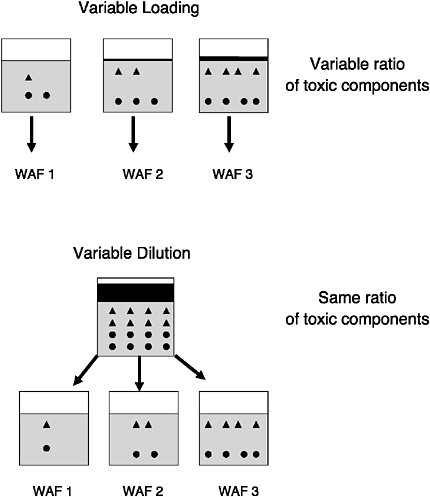
FIGURE 5-1 Comparison of variable loading and variable dilution methods of preparing toxicity test solutions.
SOURCE: Barron and Ka’aihue, 2003; courtesy of Elsevier.
ally changing in size, shape, and thickness. Consequently, these tests address the question: “At what oil to water loading ratio is WAF (CEWAF) toxic?” Barron and Ka’aihue (2003) advocate a variable dilution method for preparing a WAF for testing dispersant that standardizes the oil:water ratio and provides a consistent chemical concentration in a test-series for each oil-dispersant combination (Figure 5-1). This approach answers the question: “At what dilution is a given oil:water ratio of WAF (CEWAF) toxic?” Because it has not been conclusively demonstrated that either method more accurately simulates the temporal dilution of dispersed oil under actual spill conditions, we do not endorse one method over the other. As noted below, there are drawbacks to both approaches.
In the variable loading method, the dispersant:oil ratios do not change and, therefore, each test preparation will have different amounts of oil and dispersant relative to the volume of water in the test chamber. As a result mixing energies change as loading rate (Singer et al., 2000), potentially affecting droplet size or coalescence. The drawback of the variable dilution method has been described as the production of the equal ratio of each specific PAH across the dilution range (Barron and Ka’aihue, 2003). WAF and CEWAF produce significant proportions of oil in the droplet phase, such that increasing dilution may differentially affect the partitioning of the PAH into the aqueous phase. In addition, Barron and Ka’aihue (2003) have argued that the variable dilution approach provides economies in analytical costs by reducing the need to analyze the composition of every tested concentration. However, if chemical analyses were limited to stock solutions, inaccuracies may occur due to differential partitioning in the test dilutions, adsorption of compounds onto test chambers, or loss to the gaseous phase.
The interpretation of the results of toxicity tests can be significantly affected by the method of WAF and CEWAF preparation because of the variable solubilities of the many components in oil. For example, the variable loading method yields different mixtures of petroleum hydrocarbons at different loading rates (see Figure 5-1). The problems that arise between the two methods are due to the fact that often both methods report their data in the same form (i.e., in ppm of some overall metric, such as TPH or tPAH). Therefore, the elimination of any fractional characteristics can lead to a misunderstanding of what that concentration actually represents. For example, LC50 data derived from tPAH or TPH alone may result in under-or overestimation of toxicity depending on test preparation method used. Hence, more complete characterizations of chemical analytes are needed.
Another issue with the CROSERF protocols concerns the mixing energies involved in the process of preparing test solutions. The various CROSERF protocols employ equal mixing energies for the production of CEWAF, but differ in the approaches for the production of WAF. For ex-
ample, initial CROSERF protocols (e.g., Singer et al., 2000) used slow mixing (200 rpm) with no vortex for WAF and a vortex of 20–25 percent for CEWAF preparations. Additional modifications of the method were made (e.g., Clark et al., 2001) so that CEWAF and WAF were prepared using equal mixing energies and a 20–25 percent vortex. Unless a clear rationale can be provided for doing otherwise, it is recommended that equal mixing energies for both WAF and CEWAF be considered for standardization purposes.
A potential issue with the exposure regimes of the CROSERF test is the use of airtight test chambers for flow-through tests. Volatiles, although highly toxic, tend to evaporate very rapidly from spilled oil (NRC, 2003) but are retained in the CROSERF test with unweathered oil because of the sealed nature of the test chamber. The advantage of this approach is that it attempts to standardize the exposure regime, but the drawback is that it may result in an overestimation of toxicity. In most instances, the application of dispersant during an oil spill will happen at least several hours after the initiation of the spill, such that substantial weathering of spilled oil will have occurred (see modeling results in Appendix E). In order to better reflect actual exposure scenarios, open chambers could be considered for use with unweathered oil. Alternatively, tests with closed chambers could be conducted with weathered oil. The choice of experimental protocol will depend on the purpose of the experiment (e.g., standardization or site-specific assessment). Similarly, the temporal exposure regimes of the CROSERF test may not provide an appropriate simulation for some spill situations. For instance, spiked, flow-through exposures in the recommended CROSERF test protocols have oil concentrations decreasing by half about every 2 hr with nondetectable concentrations being reached at about 8 hr. This exposure regime may be a relatively accurate approximation of the exposure situation for the majority of offshore spills in temperate climes. However other temperate zone oil spills (French-McCay, 1998), especially subarctic spills (Neff and Burns, 1996; Short and Harris, 1996), may cause much longer periods of elevated PAH, compounds that contribute significantly to the toxicity of chemically and physically dispersed oil. Furthermore, future potential uses of dispersants in either semi-enclosed inshore waters or freshwater situations could conceivably result in much longer exposure durations than originally envisioned by the CROSERF working group. Thus, the CROSERF spiked protocol may reflect the typical offshore, open-water spill conditions relatively accurately, but longer test durations may yield exposure scenarios that more realistically recreate certain spill conditions. Spiked exposure data yield significantly lower toxicity values than standard constant exposure tests of longer duration (Figure 5-2; also, Clark et al., 2001; Fuller and Bonner, 2001). Consequently, the use of CROSERF spiked exposure data in risk
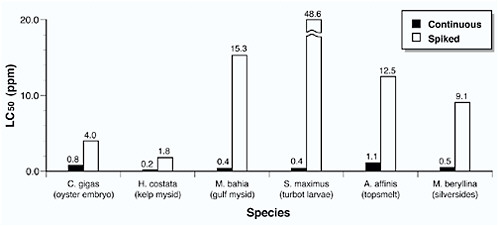
FIGURE 5-2 Comparison of the LC50s for continuous versus spiked exposure regimes using chemically enhanced water accommodated fraction (CEWAF) of different oils. Continuous exposures were 96 hours in duration, except for tests with oyster larvae that were 48 hours. Spiked tests represented an 8-hour declining exposure. Species were exposed to fresh Forties crude oil and Corexit 9500, except for topsmelt, which were exposed to fresh Prudhoe Bay crude oil, and kelp mysid, which were exposed to fresh Kuwait crude oil and Corexit 9527. LC50s for spiked exposures were based on the initial total petroleum hydrocarbon concentration of the CEWAF.
SOURCE: Data are from Clark et al. (2001) and Singer et al. (2001b).
assessment should be evaluated in the context of the specific spill scenarios under consideration.
Additionally, the literature calls for better exposure quantification in testing protocols, moving away from nominal doses and simple estimates of total petroleum hydrocarbon (TPH) to the measurement of specific toxicants in the exposure media, both dissolved and suspended (NRC, 1989; Singer et al., 2000; Shigenaka, 2001; Barron and Ka’aihue, 2003). The CROSERF protocol recommends the measurement of TPH and volatile organic compound (VOC) concentrations in test mixtures, as well as analysis of each PAH in some instances. In comparison with many of the previous studies that reported only nominal concentrations of petroleum products in the test mixtures, the CROSERF protocols were a major improvement. However, future studies should clearly specify at what point during the toxicity test chemical analyses were performed and explain how these measurements were used to calculate the toxicological endpoints. In addition, other methods of quantifying exposure deserve further consideration, including the potential use of toxic units to summarize the toxicity of the various active components of dispersed oil preparations (see discussion under Mode of Action). The primary impediment to
applying the toxic unit approach is that not all of the toxic components of petroleum are well-characterized. However, when this issue is better resolved, the toxic unit approach holds considerable promise for more accurately relating exposure and toxicity.
Photoenhanced toxicity is another factor that has not been adequately considered in dispersant and dispersed oil toxicity testing under either CROSERF or non-CROSERF protocols. The toxicity of oil dispersed in water has been shown in some studies to be many times higher in the presence of the ultraviolet radiation from sunlight, yet to date only a single study has examined the photoenhanced toxicity of chemically dispersed oil (Barron et al., 2004). Photoenhanced toxicity as it relates to the effects of dispersed oil is discussed later in the chapter.
Mesocosms
Laboratory experimentation, field trials, and monitoring of spills of opportunity have supplied much of what is currently known of the potential toxicological consequences of oil spills and oil spill response measures. Laboratory experiments cannot adequately address the scale or complexity of actual spills. Field studies to better simulate actual oil spill conditions are restricted by high costs, difficulties in replicating experiments, and regulatory restrictions. Mesocosm-scale tests have been proposed as a way to bridge the gap between laboratory and field studies for testing purposes (Coelho et al., 1999). However, mesocosms have been employed in only a limited number of such studies to date.
The Shoreline Environmental Research Facility (SERF; formerly Coastal Oil Spill Simulation System) in Corpus Christi, Texas discussed in Chapter 3 was used in a series of oil spill experiments to examine bioaccumulation (Coelho et al., 1999) and in-situ toxicological responses of various coastal organisms, including fish and various invertebrate species (Lessard et al., 1999; Bragin et al., 1999). Also, laboratory tests were used to evaluate the toxicity of test sediments from these experiments (Fuller et al., 1999). More recently, Ohwada et al. (2003) employed a small-scale mesocosm facility in Japan to examine the fate of soluble fractions of oil and measure their effect on several marine coastal microorganisms, including bacteria, viruses, and heterotrophic nano-flagellates.
The SERF tests indicate both the potential and the limitations of mesocosms in helping explain and predict the ecological effects of oil spill response measures. However, such studies are not as readily controlled as laboratory experiments nor are they as realistic as spill-of-opportunity studies. Additional mesoscale investigations of toxicological responses to oil spill response measures are therefore considered a lower priority for future funding compared to targeted laboratory experimentation and
spill-of-opportunity studies. However, if mesocosm studies are conducted for other dispersant-related purposes, consideration should be given to the addition of carefully designed studies that examine the effects of dispersants or dispersed oil on organisms or groups of organisms that cannot be readily studied in laboratory-scale tests.
DISPERSANT TOXICITY
Early dispersant formulations (prior to 1970) were essentially solvent-based degreasing agents adapted from other uses. These early dispersants proved to be highly toxic to aquatic organisms, as seen following treatment of the Torrey Canyon spill, resulting in an unfavorable public impression of dispersant use that persists today. Concerns about dispersant use after the Torrey Canyon spill were summarized in the previous NRC dispersant review as toxicity of the products themselves, and concern that effective dispersant use would make oil constituents more bioavailable enhancing their toxicity (NRC, 1989). However, the previous NRC report concluded that the acute lethal toxicity of chemically dispersed oil is primarily associated not with the current generation of dispersants but with the dispersed oil and dissolved oil constituents following dispersion (NRC, 1989). There has been little evidence in the intervening years to support a different conclusion.
Dispersants in use today are much less toxic than early generation dispersants, with acute toxicity values (measured in standard 96 h LC50 tests) typically in the range of approximately 190–500 mg/L (Fingas, 2002a) as compared with dispersed oil values in the typical range of 20–50 mg/L. An abundant literature exists on the toxicity of the Corexit dispersants currently approved for use in the United States (Tables 5-2 and 5-3; George-Ares and Clark, 2000). Numerous studies have found current dispersants to be significantly less toxic than oil or dispersed oil in direct comparisons (Figure 5-3; also Adams et al., 1999; Mitchell and Holdaway, 2000; Clark et al., 2001; Fingas, 2002a), although a few studies have reported greater dispersant toxicity compared with oil or dispersed oil toxicity (Gulec et al., 1997). Sensitivity to dispersants and dispersed oil can vary significantly by species and life stage. Embryonic and larval stages appear to be more sensitive than adults to both dispersants and dispersed oil (Clark et al., 2001), with LC50s for both oyster and fish larvae reported to be as low as 3 mg/L for dispersant alone and about 1 mg/L for dispersed oil. However, some studies report higher larval toxicity values (i.e., lower sensitivity) for both dispersant and dispersed oil that are closer to the adult values (Coutou et al., 2001). Variable sensitivity of early life stages to dispersants could be related to species-dependent variability in egg permeability (Georges-Ares and Clark, 2000).
TABLE 5-2 Aquatic Toxicity of Corexit® 9527 (Adapted from George-Ares and Clark, 2000)
|
Common Namea |
Species |
Exposureb (h) |
Endpointc |
|
Cnidarians |
|||
|
Green Hydra |
Hydra viridissima |
96 |
LC50 |
|
Green Hydra |
Hydra viridissima |
168 |
NOEC |
|
Crustaceans |
|||
|
Brine shrimp |
Artemia sp. |
48 |
LC50 |
|
Brine shrimp |
Artemia salina |
48 |
LC50 |
|
Isopod, F |
Gnorimospaeroma oregonensis |
96 |
LC50 |
|
Amphipod, F |
Anonyx laticoxae |
96 |
LC50 |
|
Amphipod, F |
Anonyx nugax |
96 |
LC50 |
|
Amphipod, F |
Boeckosimus sp. |
96 |
LC50 |
|
Amphipod, F |
Boeckosimus edwardsi |
96 |
LC50 |
|
Amphipod, F |
Onisimus litoralis |
96 |
LC50 |
|
Amphipod, (juvenile), F |
Gammarus oceanicus |
96 |
LC50 |
|
Amphipod, F |
Allorchestes compressa |
96 |
LC50 |
|
Copepod, F |
Pseudocalanus minutus |
48 |
LC50 |
|
Copepod, F |
Pseudocalanus minutus |
96 |
LC50 |
|
Grass shrimp, F |
Palaemonetes pugio |
96 |
LC50 |
|
Grass shrimp, F |
Palaemonetes pugio |
96 |
LC50 |
|
Ghost shrimp |
Palaemon serenus |
96 |
LC50 |
|
Giant freshwater prawn (embryo-larval) |
Macrobrachium rosenbergii |
288 |
EC50 Hatching |
|
Prawn |
Penaeus monodon |
96 |
LC50 |
|
Shrimp |
Penaeus vannemai |
96 |
LC50 |
|
White shrimp (postlarvae), F |
Penaeus setiferus |
96 |
LC50 |
|
Gulf mysid |
Mysidopsis bahia |
96 |
LC50 |
|
Gulf mysid |
Mysidopsis bahia |
48 |
LC50 |
|
Gulf mysid |
Mysidopsis bahia |
SD |
LC50 |
|
Kelp forest mysid, F |
Holmesimysis costata |
96 |
LC50 |
|
Kelp forest mysid, F |
Holmesimysis costata |
SD |
LC50 |
|
Kelp forest mysid, F |
Holmesimysis costata |
96 |
LC50 |
|
Kelp forest mysid, F |
Holmesimysis costata |
SD |
LC50 |
|
Kelp forest mysid |
Holmesimysis costata |
96 |
LC50 |
|
Blue crab (larvae), F |
Callinectes sapidus |
96 |
LC50 |
|
Molluscs |
|||
|
Scallop, F |
Argopecten irradians |
6 |
LC50 |
|
Scallop, F |
Argopecten irradians |
6 |
LC50 |
|
Scallop, F |
Argopecten irradians |
6 |
LC50 |
|
Red abalone (embryos) |
Haliotis rufescens |
48 |
EC50 |
|
Red abalone (embryos) |
Haliotis rufescens |
SD |
EC50 |
|
Effect Concentration (ppm) |
References |
|
230f |
Mitchell and Holdaway (2000)f |
|
<15f |
Mitchell and Holdaway (2000)f |
|
52–104 |
Wells et al. (1982) |
|
53–84 |
Briceno et al. (1992) |
|
>1000 |
Duval et al. (1982) |
|
>140 |
Foy (1982) |
|
97–111 |
Foy (1982) |
|
>175 |
Foy (1982) |
|
>80 |
Foy (1982) |
|
80–160 |
Foy (1982) |
|
>80 |
Foy (1982) |
|
3.0 |
Gulec et al. (1997)e |
|
8–12 |
Wells et al. (1982) |
|
5–25 |
Wells et al. (1982) |
|
640 (27°C) |
National Research Council (1989) |
|
840 (17°C) |
National Research Council (1989) |
|
49.4f |
Gulec and Holdaway (2000)f |
|
80.4 |
Law (1995) |
|
35–45 |
Fucik et al. (1995) |
|
35–45 |
Fucik et al. (1995) |
|
11.9 |
Fucik et al. (1995) |
|
29.2,d |
19–34 Briceno et al. (1992); George-Ares et al. (1999); Exxon Biomedical Sciences (1993a); Pace and Clark (1993) |
|
Inchcape Testing Services (1995); Clark et al. 2001f |
|
|
>1014d |
Pace et al. (1995); Clark et al. (2001)f |
|
Pace and Clark (1993); Exxon Biomedical Sciences (1993b,c); Clark et al. 2001f |
|
|
195d |
George-Ares and Clark (2000); Clark et al. (2001)f |
|
Singer et al. (1990, 1991) |
|
|
Singer et al. (1991) |
|
|
15.3d |
Coelho and Aurand (1996) |
|
77.9–81.2 |
Fucik et al. (1995) |
|
200 (20°C) |
Ordsie and Garofalo (1981) |
|
1800 (10°C) |
Ordsie and Garofalo (1981) |
|
2500 (2°C) |
Ordsie and Garofalo (1981) |
|
Singer et al. (1990, 1991) |
|
|
Singer et al. (1991) |
|
Common Namea |
Species |
Exposureb (h) |
Endpointc |
|
Clam, F |
Protothaca stamiea |
96 |
LC50 |
|
Pacific oyster (embryos) |
Crassostrea gigas |
48 |
LC50 |
|
Pacific oyster (embryos) |
Crassostrea gigas |
SD |
LC50 |
|
Marine sand snail, F |
Polinices conicus |
24 |
EC50 |
|
Fish |
|||
|
Medaka |
Oryzias latipes |
24 |
LC50 |
|
Rainbow trout |
Oncorhynchus mykiss |
96 |
LC50 |
|
Spot (embryos) |
Leiostomus xanthurus |
48 |
LC50 |
|
Spot (embryo-larval), F |
Leiostomus xanthurus |
48 |
LC50 |
|
Top smelt (larvae) |
Atherinops affinis |
96 |
LC50 |
|
Top smelt (larvae) |
Atherinops affinis |
SD |
LC50 |
|
Fourhorn sculpin, F |
Myoxocephalus quadricornis |
96 |
LC50 |
|
Mummichog |
Fundulus heteroclitus |
96 |
LC50 |
|
Inland silverside (larvae) |
Menidia beryllina |
96 |
LC50 |
|
Inland silverside (larvae) |
Menidia beryllina |
SD |
LC50 |
|
Inland silverside (embryos) |
Menidia beryllina |
96 |
LC50 |
|
Red drum (embryo-larval), F |
Sciaenops ocellatus |
48 |
LC50 |
|
Sheepshead minnow |
Cyprinodon variegatus |
96 |
LC50 |
|
Atlantic menhaden (embryo-larval), F |
Brevoortia tyrannus |
48 |
LC50 |
|
Australian bass (larvae) |
Macquaria novemaculeata |
96 |
LC50 |
|
Seagrass |
|||
|
Turtlegrass, F |
Thalassia tesudimum |
96 |
LC50 |
|
Macroalgae |
|||
|
Giant kelp (zoospores), F |
Macrocystis pyrifera |
48 |
NOEC |
|
Giant kelp (zoospores), F |
Macrocystis pyrifera |
SD |
NOEC |
|
Giant kelp (zoospores), F |
Macrocystis pyrifera |
SD |
IC50 |
|
Brown alga |
Phyllospora comosa |
48 |
EC50 |
|
Bacteria |
|||
|
Microtox™ |
Vibrio fisheri |
0.25 |
EC50 |
|
aF: field collected. bSD: spiked, declining exposure (107 min half-life). cEC50: concentrations causing effect in 50% of organisms; LC50: concentration causing mortality in 50% of organisms; IC50: concentration causing inhibition in 50% of organisms; NOEC: no effect concentration. dMeasured values. eListed as Gulec et al., 1994 in George-Ares and Clark (2000). fUpdated entries not provided in George-Ares and Clark (2000). |
|||
|
Effect Concentration (ppm) |
References |
|
ca. 100 |
Hartwick et al. (1982) |
|
3.1d |
George-Ares and Clark (2000); Clark et al. (2001)f |
|
13.9d |
George-Ares and Clark (2000); Clark et al. (2001)f |
|
33.8 |
Gulec et al. (1997)e |
|
130–150 seawater |
George-Ares and Clark (2000) |
|
400 |
freshwater |
|
96–293 |
Wells and Doe (1976) |
|
61.2–62.3 |
Slade (1982) |
|
27.4 |
Fucik et al. (1995) |
|
Singer et al (1990, 1991) |
|
|
Singer et al. (1991) |
|
|
<40 |
Foy (1982) |
|
99–124 |
Briceno et al. (1992) |
|
52.3,d |
14.6–57 Briceno et al. (1992); Fucik et al. (1995); Pace and Clark (1993); Inchcape Testing Services (1995); Exxon Biomedical Sciences (1993d); Clark et al. (2001)f |
|
58.3d |
George-Ares and Clark (2000); Clark et al. (2001)f |
|
>100 |
Fucik et al. (1995) |
|
52.6 |
Fucik et al. (1995) |
|
74–152 |
Briceno et al. (1992) |
|
42.4 |
Fucik et al. (1995) |
|
14.3 |
Gulec and Holdaway (2000)f |
|
200 |
Baca and Getter (1984) |
|
Singer et al. (1990, 1991) |
|
|
Singer et al. (1991) |
|
|
Singer et al. (1991) |
|
|
30 |
Burridge and Shir (1995) |
|
4.9–12.8 |
George-Ares et al. (1999); Exxon Biomedical Sciences (1992) |
TABLE 5-3 Aquatic Toxicity of Corexit® 9500 (adapted from George-Ares and Clark, 2000)
|
Common Namea |
Species |
Exposureb (h) |
Endpointc |
|
Cnidarians |
|||
|
Green Hydra |
Hydra viridissima |
96 |
LC50 |
|
Green Hydra |
Hydra viridissima |
168 |
NOEC |
|
Crustaceans |
|||
|
Amphipod, F |
Allorchestes compressa |
96 |
LC50 |
|
Brine shrimp |
Artemia salina |
48 |
LC50 |
|
White shrimp, F |
Palaemonetes varians |
6 |
LC50 |
|
Ghost shrimp |
Palaemon serenus |
96 |
LC50 |
|
Gulf mysid |
Mysidopsis bahia |
48 |
LC50 |
|
Gulf mysid |
Mysidopsis bahia |
96 |
LC50 |
|
Gulf mysid |
Mysidopsis bahia |
SD |
LC50 |
|
Copepod (adult) |
Eurytemora affinis |
96 |
LC50 |
|
Kelp forest mysid, F |
Holmesimysis costata |
SD |
LC50 |
|
Kelp forest mysid, F |
Holmesimysis costata |
SD |
NOEC |
|
Prawn (larval), F |
Penaeus monodon |
96 |
LC50 |
|
Tanner crab (larvae), F |
Chionoecetes bairdi |
96 |
EC50 |
|
Tanner crab (larvae), F |
Chionoecetes bairdi |
SD |
EC50 |
|
Molluscs |
|||
|
Marine sand snail, F |
Polinices conicus |
24 |
EC50 |
|
Red abalone (embryos) |
Haliotis rufescens |
48 |
NOEC |
|
Red abalone (embryos) |
Haliotis rufescens |
SD |
NOEC |
|
Red abalone (embryos) |
Haliotis rufescens |
SD |
LC50 |
|
Fish |
|||
|
Barramundi (juvenile) |
Lates calcarifer |
96 |
LC50 |
|
Turbot (yolk-sac larvae) |
Scophthalmus maximus |
48 |
LC50 |
|
Turbot (yolk-sac larvae) |
Scophthalmus maximus |
SD |
LC50 |
|
Rainbow trout |
Oncorhynchus mykiss |
96 |
LC50 |
|
Mummichog |
Fundulus heteroclitus |
96 |
LC50 |
|
Sheepshead minnow (larvae) |
Cyprinodon variegatus |
96 |
LC50 |
|
Sheepshead minnow (larvae) |
Cyprinodon variegatus |
SD |
LC50 |
|
Mozambique tilapia |
Sarotherodon mozambicus |
96 |
LC50 |
|
Zebra danio |
Brachydanio rerio |
24 |
LC50 |
|
Inland silverside (larvae) |
Menidia beryllina |
96 |
LC50 |
|
Inland silverside (larvae) |
Menidia beryllina |
SD |
LC50 |
|
Effect Concentration (ppm) |
References |
|
160f |
Mitchell and Holdaway (2000)f |
|
13f |
Mitchell and Holdaway (2000)f |
|
3.5 |
Gulec et al. (1997)e |
|
21 |
George-Ares and Clark (2000) |
|
8103 |
Beaupoil and Nedelec (1994) |
|
83.1f |
Gulec and Holdaway (2000)f |
|
32.2 |
Inchcape Testing Services (1995) |
|
George-Ares and Clark (2000); Fuller and Bonner (2001)f; Clark et al. (2001)f; Rhoton et al. (2001)f |
|
|
Coehlo and Aurand (1997); Fuller and Bonner (2001)f; Clark et al. (2001)f; Rhoton et al. (2001)f |
|
|
5.2d |
Wright and Coehlo (1996) |
|
Singer et al (1996) |
|
|
Singer et al. (1996) |
|
|
48 |
Marine and Freshwater Resources Institute (1998) |
|
Rhoton et al. (2001)f |
|
|
Rhoton et al. (2001)f |
|
|
42.3 |
Gulec et al. (1997)e |
|
0.7d |
Aquatic Testing Laboratories (1994) |
|
Singer et al. (1996) |
|
|
Singer et al. (1996) |
|
|
143 |
Marine and Freshwater Resources Institute (1998) |
|
74.7d |
George-Ares and Clark (2000); Clark et al. (2001)f |
|
>1055d |
George-Ares and Clark (2000); Clark et al. (2001)f |
|
354 |
George-Ares and Clark (2000) |
|
140 |
George-Ares and Clark (2000) |
|
Fuller and Bonner (2001)f |
|
|
Fuller and Bonner (2001)f |
|
|
150 |
George-Ares and Clark (2000) |
|
>400 |
George-Ares and Clark (2000) |
|
Inchcape Testing Services (1995); Fuller and Bonner (2001)f; Rhoton et al., 2001f |
|
|
Common Namea |
Species |
Exposureb (h) |
Endpointc |
|
Hardy heads (juvenile), F |
Atherinosoma microstoma |
96 |
LC50 |
|
Australian bass (larvae) |
Macquaria novemaculeata |
96 |
LC50 |
|
Algae |
|||
|
Diatom |
Skeletonema costatum |
72 |
EC50 |
|
Brown alga (zygotes), F |
Phyllospora comosa |
48 |
EC50 |
|
Bacteria |
|||
|
Microtox™ |
Vibrio fisheri |
0.25 |
EC50 |
|
aF: field collected. bSD: spiked, declining exposure (107 min half-life). cEC50: concentrations causing effect in 50% of test organisms; LC50: concentration causing mortality in 50% of test organisms; NOEC: no effect concentration. dMeasured values. eListed as Gulec et al 1994 in George-Ares and Clark (2000). fUpdated entries not provided in George-Ares and Clark (2000). |
|||
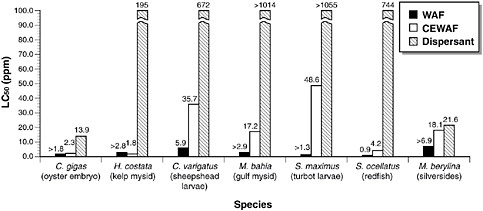
FIGURE 5-3 Comparison of the LC50s derived from spiked exposures of water accommodated fractions (WAF), chemically enhanced water accommodated fraction (CEWAF), and dispersants using either fresh crude oil (Kuwait, Forties, Prudhoe Bay, and Venezuela), weathered-crude oil (Arabian medium) or fresh Medium Fuel Oil, and Corexit 9500 or Corexit 9527. LC50s were based on initial concentrations of total petroleum hydrocarbons.
SOURCE: Data are from Clark et al. (2001); Fuller and Bonner (2001); and Wetzel and Van Fleet (2001).
|
Effect Concentration (ppm) |
References (embryo-larval) |
|
50 |
Marine and Freshwater Resources Institute (1998) |
|
19.8 |
Gulec and Holdaway (2000)f |
|
20 |
Norwegian Institute for Water Research (1994) |
|
0.7 |
Burridge and Shir (1995) |
|
Fuller and Bonner (2001)f |
In addition to acute toxicity, dispersants may have more subtle effects that influence organism health. Dispersant has been reported to significantly affect the uptake, but not necessarily bioaccumulation, of oil constituents (Wolfe et al., 1998a,b,c; 1999a,b; 2001). In addition, dispersants have been reported to have toxic effects on microbial processes that could potentially interfere with oil decomposition (Varadaraj et al., 1995), but this effect may be offset by other factors that appear to promote oil biodegradation (Swannell and Daniel, 1999). For further discussion on the effect of dispersants and dispersed oil on microbial processes, see section on Microbial Communities (found later in this chapter) and Chapter 4.
TOXICITY OF DISPERSED OIL
Oils are a complex mixture of literally thousands of compounds of varying volatility, water solubility, and toxicity. The purpose of chemical dispersants is to facilitate the movement of oil into the water column. The result is a complex, multi-phase mixture composed of dissolved dispersant, dissolved petroleum hydrocarbons, oil/dispersant droplets, and bulk, undispersed oil. Consequently, aquatic organisms are potentially exposed to many toxicants with different modes of action and through different
routes of exposure. Toxicity of dispersed oil in the environment will depend on many factors, including the effectiveness of the dispersion, mixing energy, type of oil, the degree of weathering, type of dispersant, temperature, salinity, duration of exposure, and degree of light penetration into the water column. There is a wealth of information on the biological effects, particularly acute toxicity, associated with exposure to different types of oil (summarized in NRC, 2003). Rather than review these findings, the purpose here is to focus on the issues that are pertinent to understanding the bioavailability and toxicity of chemically dispersed oil.
Route of Exposure
Acute toxicity of oil is the result of a number of interacting chemical, physical, and physiological factors. Thus, toxicity is highly dependent on the conditions of constantly changing exposure. Adverse effects resulting from dispersed oil can be a result of: (1) dissolved materials (e.g., aromatic petroleum hydrocarbons, or dispersant), (2) physical effects due to contact with oil droplets, (3) enhanced uptake of petroleum hydrocarbons through oil/organism interactions, or (4) a combination of these factors (Singer et al., 1998). In general, bioavailability and toxicity of individual hydrocarbons are related to their solubility in water because dissolved hydrocarbons diffuse across the gills, skin, and other exposed membranes of aquatic organisms. The compounds of most concern are the low-molecular-weight alkanes and monocyclic, polycyclic, and heterocyclic aromatic hydrocarbons (Lewis and Aurand, 1997). The monocyclic aromatic hydrocarbons (e.g., benzene, toluene, ethylbenzenes, and xylenes) and low-molecular-weight alkanes are soluble and toxic to aquatic organisms, but these compounds are also very volatile, typically vaporizing rapidly (see Figures 4-2, 4-5, and 4-6 in Chapter 4). As the oil weathers, the concentrations of PAH in the oil plume (including the parent compounds and alkyl substituted homologues) will become relatively enriched compared to the low-molecular-weight alkanes and monocyclic aromatics contributing more to the longer-term toxicity of oil. Because substantial weathering of oil may occur before dispersant is applied (typically at least several hours after the spill), the consequent enrichment of PAH may be particularly important for evaluating the potential toxicity of dispersed oil. Although PAH may drive the toxicity of oil in many instances, some studies have found stronger relationships between TPH concentrations and toxicity than between PAH and toxicity. For example, Barron et al. (1999) conducted studies on the effects of WAF from three different weathered oils on the mysid shrimp, Mysidopsis bahia. The median lethal concentrations for the three oils were within a factor of two when expressed as TPH (range from 0.88 to 1.5 mg/L TPH), but differed by nearly a factor
of five when expressed as total PAH (range from 2.2 to 9.2 µ/L). Similarly, Clark et al. (2001) found a significant association with TPH, but not PAH or volatiles, in experiments comparing the toxicity of dispersed and untreated oil to early life stages of several marine organisms. McGrath et al. (2003) evaluated the toxicity of various types of gasoline in WAF preparations using an alga, a fish, and a daphnid, and found that both aromatic and aliphatic hydrocarbons contributed to toxicity, with the relative importance of the fractions dependent on the type of gasoline. Furthermore, other components of oil, for example the heterocyclic aromatics, also may be contributing to toxicity (Barron et al., 1999). Some of these fractions are not typically measured in laboratory or field studies, but may be toxicologically important depending on the type of oil and amount of weathering. Another confounding factor in determining the cause of toxicity is that chemical analyses typically measure concentrations in whole samples that include hydrocarbons in the dissolved, colloidal, and particulate phases while the bioavailability of these phases may differ (Fuller et al., 1999). As highlighted below, distinguishing among these phases is important for understanding the fate and effects of dispersed oil.
Oil droplets can physically affect exposed organisms, for example by smothering through the physical coating of gills and other body surfaces. For some organisms, dispersed oil droplets may also be an important route of exposure to petroleum hydrocarbons, through either oil droplet/gill interactions or ingestion of oil droplets. Ramachandran et al. (2004) exposed juvenile rainbow trout to chemically dispersed oil and WAF using Corexit 9500 and Mesa crude oil and then used epifluorescence1 to microscopically observe PAH uptake in the fish gills. Uptake of PAH from WAF was manifested as an even background of fluorescence on the fish gill with occasional bright spots. Gills of fish exposed to chemically dispersed oil showed localized focal fluorescence (i.e., bright spots), suggesting oil droplets on the gill surface. The authors hypothesized that oil droplets on the fish gill could facilitate uptake of dissolved hydrocarbons.
If dispersion is effective, oil droplets generally range in size from <3 to 80 µm (Franklin and Lloyd, 1986; Lunel, 1993, 1995b). The particle-size distribution of dispersed oil overlaps with the preferred size range of food ingested by many suspension-feeding organisms. For example, common zooplankton, such as copepods, feed on particles in the range of 5 to 60 µm, often switching their preferred particle size depending on the size distribution of available particles (Valiela, 1984). Similarly, benthic and
epibenthic suspension feeders such as oysters, amphipods, and polychaetes are also known to select particles in size ranges that overlap with dispersed oil droplets, similar to the sizes of some common phytoplankton cells such as Isochrysis galbana (4–8 µm), Chaetocerus spp. (15–17 µm), and Skeletonema spp. (20–25 µm).
The importance of PAH uptake via ingestion of particulate-bound PAH is well known (e.g., Menon and Menon, 1999; Lee, 1992). For example, during the New Carissa oil spill near Coos Bay, Oregon, Payne and Driskell (2003) collected dissolved and oil droplet/suspended particulate material (SPM) phase water samples of physically dispersed oil and compared the PAH profiles with those of tissue samples from mussels (a suspension feeder) and Dungeness crabs (an omnivore). The results suggested that mussels accumulated PAH from both the dissolved and the oil droplet/SPM phases, with the latter predominating, while crabs accumulated PAH primarily from the dissolved phase (Figure 5-4). In addition, body burdens of mussels were approximately 500 times greater than those of crabs, indicating the relative importance of these routes of exposure.
Estimating the relative contribution of oil droplets versus particulate-bound oil to total oil exposure is problematic due to the difficulty in distinguishing uptake of these two phases. For physically dispersed oil, interactions with SPM can be very important in the ultimate fate and transport of bulk oil through the formation of oil/SPM agglomerates (see discussion in Chapter 4). Although a limited amount of work has been conducted on the interactions between chemically dispersed oil and SPM, more data are clearly needed to better understand and model the fate and effects of dispersed oil, particularly in shallow water systems with high suspended solids. The limited information available suggests that fairly high oil and SPM concentrations are required before chemically dispersed oil interacts with SPM, and that chemically dispersed oil has a much lower tendency to form SPM agglomerates compared to physically dispersed oil.
Aquatic organisms may also be exposed to oil due to contamination of their food. Wolfe et al. (1998a) evaluated the bioavailability and trophic transfer of PAH from dispersed (Corexit 9527) and untreated Prudhoe Bay crude oil in a simple marine food chain: from phytoplankton, Isochrysis galbana, to a rotifer, Branhionus plicatilis. Using [14C] naphthalene as a model PAH, direct aqueous exposure was compared to dietary exposure by allowing the rotifers to feed on algae that had been pre-exposed to either WAF or chemically dispersed oil. Results indicated that approximately 20 to 45 percent of uptake was due to dietary exposure, but there was no difference in uptake via the diet between WAF and chemically dispersed oil. Information related to trophic transfer of contaminants is relevant to evaluating the risk of oil exposure, because models based solely on dissolved concentrations may substantially underestimate exposure.
In general, there is insufficient understanding of the fate of dispersed oil in aquatic systems, including interactions with sediment particles and biotic components of ecosystems. In order to better understand the fate and effects of dispersed oil, studies should be conducted to estimate the relative contribution to toxicity of dissolved-, colloidal-, and particulate-phase oil (including an evaluation of oil droplets versus oil/SPM agglomerates) in representative species. Chemical characterization should accompany these tests, including analysis of dissolved and particulate oil concentrations and bioaccumulation. The ability of decisionmakers to estimate the impacts of dispersants on aquatic organisms would be enhanced through greater understanding of these variables used in decision-making tools such as fate and effects models and risk rankings.
Mode of Action
Many oil constituents, most notably the PAH and monoaromatics, are Type I narcotics (DiToro et al., 2000). Narcosis is defined as a reversible state of arrested activity of protoplasmic structures (Bradbury et al., 1989) and is thought to be the primary mechanism of acute toxicity of oil. Often the terms “narcotic” and “anesthetic” are used interchangeably. Type I narcotics are non-polar organic chemicals with a similar mode of action, i.e., narcosis, such that toxicological effects are additive. On the other hand, Type II narcotics, also called polar narcotics, have a different mode of action than the Type I narcotics, and tend to be more toxic. Examples of polar narcotics include nitrogen heterocycles (DiToro et al., 2000). Hence, in oil the heterocyclic aromatics may act as Type II narcotics.
Regardless of their Type I or Type II classification, all organic chemicals in a field mixture contribute to toxicity by narcosis (Deneer et al., 1988); therefore, mixtures of organic chemicals, such as found during an oil spill, would be expected to exhibit additive toxicity over a range of composition ratios (van Wezel et al., 1996). Toxic unit models have been applied to estimate the acute toxicity of PAH and other oil components (Swartz et al., 1995; DiToro et al., 2000; French-McCay, 2002). A toxic unit is the ratio of the measured concentration of a chemical and the corresponding effective concentration in the same medium. Assuming toxicity is additive, the toxic unit value for individual constituents can be summed to estimate acute toxicity of the mixture. DiToro et al. (2000) and French-McCay (2002) incorporated the critical body residue (i.e., lethal body burden) concept into the narcosis toxic unit model. The assumption for this toxicological model, known as the narcosis target lipid model (McGrath et al., 2004), is that mortality occurs when the concentration of narcotic chemicals in the target lipid reaches a threshold concentration. The acute toxicity threshold is assumed to be species specific.
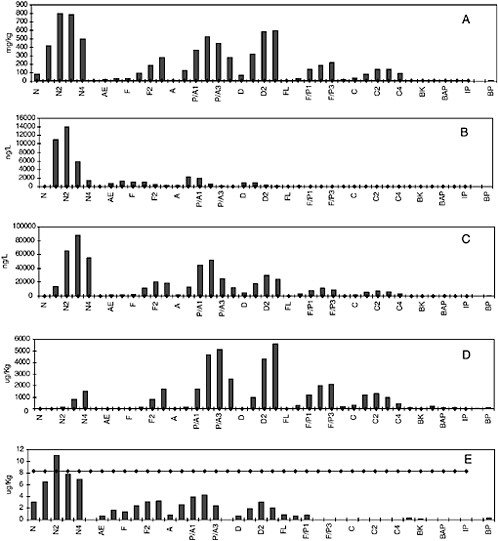
FIGURE 5-4 PAH histograms for: (A) mixed M/V New Carissa source oil “blend” (ET-2) collected from the beach adjacent to the vessel on 2/11/99; (B) dissolved-and (C) oil droplet-phase samples collected in the surf zone with the portable large volume water sampling system (PLVWSS) on 2/12/99; (D) mussels collected from the outside north jetty entrance to Coos Bay on 2/14/99; and (E) Dungeness crab collected inside Coos Bay midway up the main channel on 2/19/99. The diamonds connected by the horizontal line represent the sample-specific method detection limits. Note: Also provided is a complete list of analytes and abbreviations, in order, presented in Figure 5-4.
|
Analytes |
Abbreviation |
|
Naphthalene |
N |
|
C1-Naphthalenes |
N1 |
|
C2-Naphthalenes |
N2 |
|
C3-Naphthalenes |
N3 |
|
C4-Naphthalenes |
N4 |
|
Biphenyl |
BI |
|
Acenaphthylene |
AC |
|
Acenaphthene |
AE |
|
Fluorene |
F |
|
C1-Fluorenes |
F1 |
|
C2-Fluorenes |
F2 |
|
C3-Fluorenes |
F3 |
|
Anthracene |
A |
|
Phenanthrene |
P |
|
C1-Phenanthrene/Anthracenes |
P/A1 |
|
C2-Phenanthrene/Anthracenes |
P/A2 |
|
C3-Phenanthrene/Anthracenes |
P/A3 |
|
C4-Phenanthrene/Anthracenes |
P/A4 |
|
Dibenzothiophene |
D |
|
C1-Dibenzothiophenes |
D1 |
|
C2-Dibenzothiophenes |
D2 |
|
C3-Dibenzothiophenes |
D3 |
|
Fluoranthene |
FL |
|
Pyrene |
PYR |
|
C1-Fluoranthene/Pyrenes |
F/P1 |
|
C2-Fluoranthene/Pyrenes |
F/P2 |
|
C3-Fluoranthene/Pyrenes |
F/P3 |
|
Benzo(a)Anthracene |
BA |
|
Chrysene |
C |
|
C1-Chrysenes |
C1 |
|
C2-Chrysenes |
C2 |
|
C3-Chrysenes |
C3 |
|
C4-Chrysenes |
C4 |
|
Benzo(b)fluoranthene |
BB |
|
Benzo(k)fluoranthene |
BK |
|
Benzo(e)pyrene |
BEP |
|
Benzo(a)pyrene |
BAP |
|
Perylene |
PER |
|
Indeno(1,2,3-cd)pyrene |
IP |
|
Dibenzo(a,h)anthracene |
DA |
|
Benzo(g,h,i)perylene |
BP |
|
SOURCE: Data from Payne and Driskell, 2003; courtesy of the American Petroleum Institute. |
|
The accuracy of toxic unit models is typically based on three assumptions: (1) all the constituents contributing to toxicity are known and measured; (2) effects concentrations of the constituents are known; and (3) chemical equilibrium exists between the organism and the exposure media (but see French-McCay, 2002). Clearly, under dispersed oil scenarios, whether in the laboratory or the field, these assumptions are not apt to be met. Nonetheless, the narcosis model may provide a better estimate of the potential acute effects of oil or dispersed oil than existing measures that rely on determining relationships between toxicity and mixtures of total volatiles, PAH, and/or TPH.
One advantage of the narcosis target lipid model is that it can and has been incorporated into oil fate models to allow estimation of toxicity to aquatic organisms (e.g., French-McCay, 2002, 2004; McGrath et al., 2003). For example, French-McCay (2002) developed an oil toxicity and exposure model, OilToxEx, as a submodel of the Spill Impact Model Application Program (SIMAP). In this model, oil toxicity is predicted by applying the narcosis target lipid model to the predicted concentrations of dissolved aromatic constituents of spilled oil. In a wide range of laboratory exposures with WAF, French-McCay (2002) found good agreement between the narcosis target lipid model predicted LC50s and measured LC50s. McGrath et al. (2003) used the narcosis target lipid model to estimate laboratory toxicity of different gasoline blends. Their model estimated the fate and effects of “hydrocarbon blocks,” rather than tracking individual hydrocarbon components (e.g., individual aromatics). The hydrocarbon blocks represented pseudo-components with similar physical chemical properties (usually boiling point as reflected by distillate cut ranges; see Chapter 4). Their analysis indicated that reliable toxicity predictions could be achieved by modeling the fate and toxicity of the hydrocarbon blocks. The utility of this approach is being further explored to predict the fate and effects of spilled oil by incorporation into current models (e.g., GNU Network Object Model Environment) for use in pre-spill planning as well as real-time spill modeling. Nevertheless, more work needs to be done to link the additive compound-specific toxicity data with the component concentrations and mixtures within each hydrocarbon block or pseudocomponent.
It should be noted that narcosis may not account for all the toxic effects due to exposure to oil or dispersed oil, particularly sublethal or long-term effects. Barron et al. (2004) evaluated the ability of four mechanism-based toxicity models, including narcosis, to predict chronic toxicity of oil to early life stage fish. They found that the narcosis model underpredicted the observed toxicity and appeared to be mechanistically inconsistent with many of the observed effects of early life stage toxicity in PAH-exposed embryos, including edema, deformities, and cardiovascular dysfunction.
Hence, in these chronic (16 to 35 days) exposures, narcosis appeared not to be the primary mode of action. In conclusion, narcosis models have utility in predicting acute mortality due to exposure to dispersed oil, but may underestimate toxicity in cases where petroleum compounds with non-narcotic modes of action are important components (e.g., alkyl phenanthrenes, heterocyclic aromatics) and where sublethal or delayed effects are manifested (Barron et al., 1999, 2004).
Photoenhanced Toxicity
A number of laboratory studies have indicated that toxicity due to PAH increases significantly (from 12 to 50,000 times) in exposures conducted under ultraviolet light, compared to exposures under the more typical conditions of fluorescent lights (e.g., Landrum et al., 1987; Ankley et al., 1994; Boese et al., 1997; Pelletier et al., 1997). This phenomenon, known as photoenhanced toxicity or phototoxicity, occurs through two mechanisms: photomodification and photosensitization (Neff, 2002; Figure 5-5). Both mechanisms result from the absorption of ultraviolet (UV) radiation by the conjugated double bonds of PAH, exciting them to the triplet state. With photomodification, the excited PAH molecule leads to the formation of highly reactive free radicals that oxidize to form products that are often more toxic than the parent PAH. As described earlier in Chapter 4, photomodification of PAH produces a wide variety of oxygenated products, including quinones, peroxides, and ketones, all of which are more water soluble than the parent PAH (Neff, 2002). Photosensitization occurs when the excited PAH transfers the energy to dissolved oxygen, forming reactive oxygen species. Because of the short-half life of these photoproducts in water, these reactions are only important when products bioaccumulate in the tissues of aquatic organisms (Newsted and Giesy, 1987) and attack cell membranes, bind DNA, or generate secondary radicals. Hence, photosensitization, the primary mechanism of photoenhanced toxicity, causes impacts that differ from the narcosis effects typically associated with PAH toxicity.
Photoenhanced toxicity has only recently received consideration in the assessment of risk associated with spilled oil (Pelletier et al., 1997; Ho et al., 1999; Barron and Ka’aihue, 2001; Duesterloh et al., 2002; Barron et al., 2004). This phenomenon has the potential to increase toxicity under spill scenarios where the opportunity for UV exposure is greatest, e.g., oil stranded on the shoreline, in a surface slick, or in shallow water. Because dispersants generally increase the water-column concentrations of dissolved and particulate petroleum hydrocarbons (including the photoactive compounds) relative to undispersed oil, photoenhanced toxicity of some PAH is an important consideration for evaluating toxicity associ-
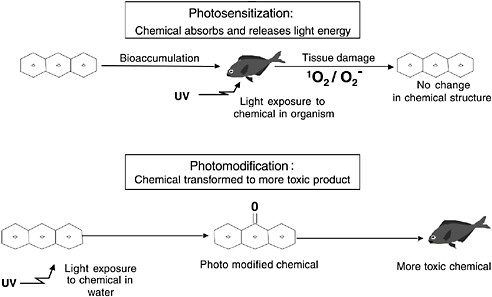
FIGURE 5-5 Mechanisms of photoenhanced toxicity.
SOURCE: Barron, 2000; courtesy of the Prince William Sound Regional Citizen’s Advisory Council.
ated with water-column exposure to dispersed oil (Barron and Ka’aihue, 2001; Barron et al., 2004). Photoenhanced toxicity also has implications for the toxicological testing of spilled and dispersed oil. For example, Duesterloh et al. (2002) found that the toxicity of weathered Alaska North Slope crude oil for two calanoid copepod species was dramatically increased upon exposure of the copepods to natural sunlight. In this experiment, Calanus marhallae and Metridia okhotensis were exposed for 24 hr to low levels of oil in seawater and then exposed to different levels of natural sunlight for 3.8 to 8.2 hr. Toxicity to the copepods increased by up to 80 percent after exposure to UV in sunlight. Similarly, Pelletier et al. (1997) investigated phototoxicity in larvae and juveniles of the bivalve, Mulinia lateralis, and juvenile mysid shrimp, Mysidopsis bahia, exposed to WAF of several different petroleum products (No. 2 fuel oil, Arabian Light crude, Prudhoe Bay crude, No. 6 fuel oil). Large increases in toxicity (from 2 to 100-fold) in UV light exposures were seen in tests with Arabian Light crude, Prudhoe Bay crude, and No. 6 fuel oil, with the predominant increases found in heavier crudes corresponding to increases in the amount of higher-molecular-weight phototoxic PAH. In contrast, No. 2 fuel oil was highly toxic under both fluorescent and UV light. Finally, Barron et al. (2004) investigated the photoenhanced toxicity of weathered Alaska North Slope crude with and without dispersant (Corexit 9527) to eggs and larvae
of the Pacific herring, Clupea pallasi. Brief exposure to sunlight (~ 2.5 hr per day for 2 days) increased toxicity from 1.5 to 48-fold over control lighting. In addition, the toxicity of chemically dispersed oil was similar to oil alone in the control treatment, but was significantly more toxic than oil alone in the treatments exposed to sunlight. Accumulation of even small amounts of PAH may make translucent organisms susceptible to toxicological effects if these animals are subsequently exposed to sunlight in the upper part of the water column. Organisms most susceptible to photoenhanced toxicity include translucent pelagic larvae and epibenthic or benthic organisms living in shallow water areas. This phenomenon may not be important for organisms that are opaque (e.g., adult fish, crabs) or avoid sunlight through vertical migration below the photic zone (Valiela, 1984).
Current dispersed oil testing protocols do not typically include exposure to natural sunlight as a factor in evaluating toxicity; thus they may underestimate toxicity for some species, and hence underestimate the “footprint” of toxicological effects on aquatic organisms in the field. Additional toxicological studies are needed to incorporate phototoxicity into effects models, including the identification of phototoxic compounds. Models can be used to overlay this information with expected species distribution in the water column to estimate potential impacts.
Toxicity of Chemically Versus Physically Dispersed Oil
A review of the recent literature (since the publication of the 1989 NRC report on oil dispersants) reveals no consensus in the evaluation of the relative toxicities of chemically dispersed and physically dispersed oil (Clark et al., 2001; Singer et al., 1998; Fingas, 2002a; Fucik et al,. 1994). Some of the inconsistency can be attributed to studies that have drawn conclusions about relative toxicity based on comparing nominal loading rates of oil and dispersant, not on measured concentrations of dissolved hydrocarbons (e.g., Epstein et al., 2000; Adams et al., 1999; Bhattacharyya et al., 2003; Gulec et al., 1997). Loading rate data are useful for comparing the toxicity of different oils when dispersed, different dispersants with the same oil, or sensitivity comparisons among species. However, this approach has limited utility in evaluating the relative toxicity of chemically dispersed versus untreated oil based on exposure to oil in the water column. The degree to which a dispersant facilitates dissolution of petroleum hydrocarbons into the water column will influence the resulting degree of toxicity observed. Many studies have found that the concentrations of PAH are higher in the chemically dispersed oil than in WAF for equal loading of oil. This is likely due to partitioning kinetics between the dispersed oil droplets and water. That is, the increased number of oil droplets and smaller droplet diameters increase the surface area to volume
ratio such that more of the hydrocarbon components enter the dissolved phase. Consequently, it is essential to measure actual exposure concentrations to evaluate whether the bioavailability and toxicity of dispersed oil is greater than what would be expected based on the amount of oil in the water column.
Clark et al. (2001) tested three types of crude oil (Kuwait, weathered Kuwait, and Forties) and two dispersants (Corexit 9500 and 9527) in continuous and short-term spiked exposures using the early life stages of several marine species. They found that physically dispersed oil appears less toxic than chemically dispersed oil when LC50 is expressed as the nominal loading concentration (Figure 5-6), but when effects are based on the amount of oil measured in water (i.e., TPH), dose-response relationships are similar between chemically and physically dispersed oil.
Similarly, Ramachandran et al. (2004) measured induction of CYP1A (the liver enzyme ethoxyresorufin-O-deethylase or EROD) in rainbow trout to WAF and chemically dispersed oil (using Corexit 9500) made from three types of crude oil. They found that EROD activity was as much as 1,100 times higher in chemically dispersed oil treatments compared to WAF when results were expressed on percent (v/v) basis; however, when expressed as measured PAH concentrations, there was little difference between the EC50 values for EROD activity.
In contrast, Singer et al. (1998) concluded that the relative toxicity of CEWAF versus WAF was dependent on the test species, exposure time, and endpoint evaluated. In a series of tests, they evaluated the acute effects of untreated and dispersant-treated (Corexit 9527) Prudhoe Bay crude oil on early life stages of three Pacific marine species: red abalone, Haliotis rufescens, kelp forest mysid shrimp, Holmesimysis costata, and topsmelt, Atherinops affinis. Experiments were conducted using CROSERF spiked exposure protocols, including standard preparation of WAF and CEWAF. In addition to the standard toxicity test endpoints, Singer et al. (1998) evaluated initial narcosis in the exposures with H. costata and A. affinis by making behavioral observations during the first 6–7 hr of exposure and tallying the number of inactive and active animals. Narcosis was defined as those animals initially affected, but that recovered to an active state later in the exposure. Results are summarized in Table 5-4 (taken from Singer et al., 1998) and expressed as EC50 or LC50 values based on total hydrocarbon content (THC(C7-C30)) measured at the beginning of the exposures. In tests with H. rufescens and H. costata, significant effects were seen in the CEWAF exposures at total hydrocarbon concentrations (THC) two to three times lower than in WAF tests (Table 5-4). In contrast, effects on mortality of the topsmelt, A. affinis, and initial narcosis were more severe in WAF exposures. Singer et al. (1998) suggest that a likely explanation for these results is compositional differences in dissolved petro-
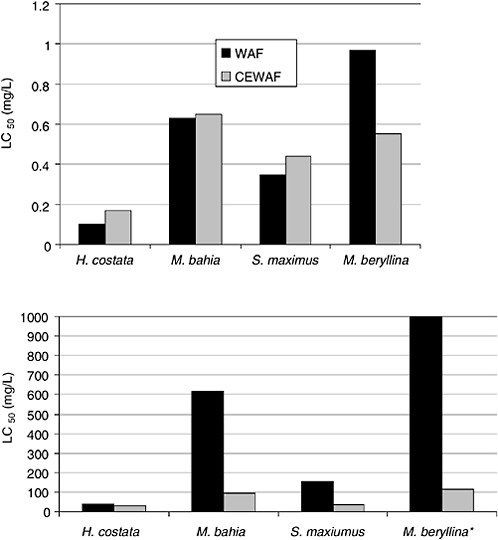
FIGURE 5-6 Comparison of expressing toxicity in terms of measured lethal concentrations (LC) of total petroleum hydrocarbons (TPH) or lethal loading (LL) concentrations based on nominal “oil added” values. Tests were constant 96-hour static-renewal tests with Kuwait oil and Corexit 9527 for the mysids (Holmesimysis costata and Mysidopsis bahia) and silversides (Menidia beryllina). Exposures of turbot (Scophthalmus maximus) were 48 hour exposures with Forties crude oil and Corexit 9500. Data expressed as LL imply that CEWAF is more toxic than WAF, but when expressed as measured TPH, toxicities are roughly equivalent.* The LL50 for M. beryllina exposed to WAF was 5,020 mg/L, but was not displayed for scaling purposes.
SOURCE: Data are from Clark et al., 2001.
TABLE 5-4 Results of Spiked Exposure Toxicity Tests Using Prudhoe Bay Crude Oil Alone and Combined with Corexit 9527 (O:D ratio = 10:1) from Singer et al., 1998 (Results are expressed as the EC or LC50 in mg/L of THC(C7–C30))
|
Species/Endpoint |
WAF |
CEWAF |
||||
|
Test 1 |
Test 2 |
Test 3 |
Test 1 |
Test 2 |
Test 3 |
|
|
Haliotis |
||||||
|
Larval abnormality |
>34.03a |
>46.99 |
>33.58 |
19.09 |
32.70 |
17.80 |
|
Holmesimysis |
||||||
|
96-h mortality |
>34.68 |
>25.45 |
>28.55 |
10.54 |
10.75 |
10.83 |
|
Initial narcosis |
11.31 |
11.58 |
15.90 |
11.07 |
>38.33 |
48.03 |
|
Atherinops |
||||||
|
96-h mortality |
16.34 |
40.20 |
35.73 |
28.60 |
74.73 |
34.06 |
|
Initial narcosis |
26.63 |
>48.22 |
31.76 |
>101.82 |
>140.97 |
>62.22 |
|
aEC/LC50 estimated to be above the highest test concentration. |
||||||
leum hydrocarbons between CEWAF and WAF due to differences in mixing energy and loading rates used to prepare the exposure media. For example, WAF solutions were found to have a larger proportion of volatiles (96 percent) as compared to the CEWAF (67 percent). They conclude that different fractions of oil may drive toxicity in different types of solutions. Consequently, reporting toxicity based on only a few of the oil components may make comparisons across studies difficult (see Figure 5-6).
A similar conclusion was drawn by Fucik et al. (1994) in a series of tests comparing the toxicity of chemically dispersed oil, dispersant (Corexit 9527), and WAF to a variety of fish and invertebrate species and life stages from the Gulf of Mexico. Fucik et al. (1994) reported that the toxicity of dispersed oil was proportionately less than WAF when results were compared using a Toxicity Index (TI) applied to the measured TPH data. The TI expresses toxicity as a function of concentration and duration of exposure (e.g., ppm-h). Experiments included both static renewal and flow-through exposures in open containers that allowed significant volatilization of the petroleum constituents. To explain this result, Fucik et al. (1994) speculated that volatilization from dispersed oil was enhanced compared to WAF. Therefore, concentrations of benzene, toluene, ethylbenzene, and xylenes (BTEX) were higher in WAF, potentially enhancing toxicity in these exposures. Alternatively, they suggested that oil droplets
or emulsions in the chemically dispersed oil may have lower bioavailability than the dissolved hydrocarbons. This explanation seems unlikely given recent studies suggesting that oil droplets may enhance uptake of petroleum hydrocarbons (Payne and Driskell, 2003; Ramachandran et al., 2004).
In conclusion, there is no compelling evidence that the toxicity of chemically dispersed oil is enhanced over physically dispersed oil if comparisons are based on measured concentrations of petroleum hydrocarbons in the water column. This conclusion is further discussed in the section on toxicological effects of dispersed oil on water column organisms. A similar conclusion was reached in the NRC (1989) review of oil dispersants. CROSERF testing protocols recommend analyzing total hydrocarbon content (composed of total petroleum hydrocarbons and volatile hydrocarbons) at a minimum, but also suggest in-depth investigations include the analysis of PAH (Singer et al., 2000; Table 5-5). The studies reviewed above clearly indicated that measuring fractional components of aqueous oil (e.g., TPH, total PAH, total volatiles) may not give the resolution necessary to adequately interpret toxicity test data. Consequently, it is recommended that chemical analyses in conjunction with toxicity tests should routinely include dissolved- and oil droplet-phase analyses of the full suite of parent and alkyl-substituted PAH and heterocyclics as well as the n-alkanes that typically comprise the THC. In addition, application of additive toxicity models for PAH and other petroleum constituents may facilitate the interpretation of toxicity test results.
Although acute toxicity studies do not indicate differences in the lethal or sublethal responses of organisms exposed to chemically dispersed or untreated oil, some studies have suggested that the bioaccumulation kinetics of PAH from dispersed oil may differ from those for undispersed oil. In a series of experiments, Wolfe et al. (1998a,b,c; 1999a; 2001) have investigated the bioavailability of naphthalene and phenanthrene in chemically dispersed oil versus WAF, including an assessment of uptake and depuration kinetics, to address the question of whether dispersants alter bioavailability of compounds. The premise of these experiments was that the bioavailability of dispersed oil may be enhanced due to interactions between dispersant, oil, and biological membranes, possibly as a result of dispersant-mediated changes in membrane permeability, osmoregulation, or other cellular mechanisms. Several experiments examined bioaccumulation of naphthalene as a model PAH by the microalga Isochrysis galbana. Naphthalene was selected because it has negligible dispersant facilitated solubility such that changes in bioavailability could be examined in the absence of differences in dissolved-phase concentrations between dispersed and untreated oil. In these experiments, algal cells were exposed to laboratory preparations of either WAF of Prudhoe Bay crude
TABLE 5-5 Recommended Target Analyte List for PAH from Singer et al. (2000)
|
Naphthalene |
Fluoranthene |
|
C-1 naphthalenes |
Pyrene |
|
C-2 naphthalenes |
C-1 pyrenes |
|
C-3 naphthalenes |
C-2 pyrenes |
|
C-4 naphthalenes |
C-3 pyrenes |
|
Biphenyl |
C-4 pyrenes |
|
Fluorene |
Benzo(a,h)anthracene |
|
C-1 fluorenes |
Chrysene |
|
C-2 flurorenes |
C-1 chrysenes |
|
C-3 fluorenes |
C-2 chrysenes |
|
Dibenzothiophene |
C-3 chrysenes |
|
C-1 dibenzothiophenes |
C-4 chrysenes |
|
C-2 dibenzothiophenes |
Benzo(b)fluoranthene |
|
C-3 dibenzothiophenes |
Benzo(k)fluoranthene |
|
C-4 dibenzothiophenes |
Benzo(e)pyrene |
|
Phenanthrene |
Benzo(a)pyrene |
|
C-1 phenanthrenes |
Perylene |
|
C-2 phenanthrenes |
Indeno(g,h,i)pyrene |
|
C-3 phenanthrenes |
Dibenzo(a,h)anthracene |
|
C-4 phenanthrenes |
Benzo(1,2,3-cd)perylene |
oil (PBCO) or dispersed oil mixture of PBCO and Corexit 9527 spiked with [U-14C] naphthalene. Results suggest that dispersants enhanced the initial uptake of naphthalene by microalgae under a variety of temperature and salinity conditions. However, there were no differences in bioaccumulation as indicated by similarity in bioaccumulation factors between dispersed oil and WAF, suggesting that depuration rates were also enhanced. Wolfe et al. (1998a,b,c; 1999a,b; 2001) extended these experiments to a model food chain, including I. galbana, the rotifer Brachionus plicatilis, and larval topsmelt, Atherinops affinis. Direct aqueous exposures to phenanthrene and naphthalene were compared with aqueous plus dietary exposures. Depuration of phenanthrene by rotifers decreased significantly following dispersed oil exposures, while uptake and depuration of naphthalene by larval topsmelt significantly increased in both aqueous and dietary exposures to dispersed oil. These detailed and elegant experiments have enhanced our understanding of the bioaccumulation kinetics of dispersed oil PAH. These studies should be expanded to include other organisms and PAH. In addition, this model food chain could also be used to answer questions related to the importance of PAH uptake via the dissolved versus oil droplet phases.
EFFECTS ON BIOLOGICAL COMMUNITIES
In the sections that follow, the recent (post-1989) literature on the toxicological effects of chemically dispersed oil is reviewed by habitat type. A detailed review on dispersant toxicity studies pre-1989 was provided in NRC (1989). Besides avoiding duplication, for the most part these earlier studies are not included because many were based on comparisons using the older dispersant formulations and limited by the use of nominal exposures. Studies from freshwater systems are included where possible. It is noted, however, that the amount of literature concerned with dispersants and chemically dispersed oil effects on freshwater organisms is sparse, most likely a function of the fact that the most common U.S. dispersants, Corexit 9500 and 9527, have low efficacy in freshwater. Furthermore, the use of dispersants in freshwater is assumed to be unlikely because the increase in water-column burden of hydrocarbons would preclude their use in freshwater systems that provide a source of drinking water.
Water-Column Organisms
This section reviews the literature pertaining to dispersed oil effects on water column organisms, including larval stages of benthic organisms (Tables 5-6, 5-7, and 5-8). The review was limited by many studies that are still based on comparisons of nominal concentrations, despite the recommendation made in NRC (1989) that future studies include chemical analyses of the exposure media. One common technique is to measure TPH (and /or VOC and PAH) in the stock solutions and infer TPH levels upon serial dilutions of these solutions. While this is an improvement over the use of purely nominal values, it still limits the interpretation of the results unless some minimal and random sampling of test exposures provides confirmation that expected concentrations approximate measured concentrations. It is extremely important to provide an estimate of exposure based on measured concentrations when conducting toxicity tests.
In general, studies that concluded that chemically dispersed oil was more toxic were based on nominal loading of oil, not measured concentrations. For example, Clark et al. (2001) using three types of oil (variable loadings), two dispersants (Corexit 9500 and 9527), continuous and short-term spiked exposures, and early life stages of several marine organisms in 46 and 96 hr tests found that physically dispersed oil appears less toxic than chemically dispersed oil when LC50s were expressed as nominal loading concentrations (see earlier in Chapter 5). When toxicity effects were based on measured TPH, no difference between chemically and physically dispersed oil was observed using continuous exposures. In an exposure study using freshwater fish, Pollino and Holdaway (2002b) con-
TABLE 5-6 Acute Effects of Chemically Dispersed Oil in Comparison to Physically Dispersed Oil in Water-Column Organisms (studies since 1989)
|
Species |
Oil (D:O ratio) |
Dispersant |
Exposure (hr) |
Type of Exposure (static/flow-through) |
|
(1) Marine studies: |
||||
|
MOLLUSCS |
||||
|
Crassostrea gigas (Pacific oyster) |
Kuwait (1:10) |
Corexit 9527 |
48 |
constant |
|
Crassostrea gigas |
Kuwait (1:10) |
Corexit 9527 |
48 |
spiked |
|
Crassostrea gigas |
Forties crude (1:10) |
Corexit 9500 |
48 |
constant |
|
Crassostrea gigas |
Forties crude (1:10) |
Corexit 9500 |
48 |
spiked |
|
Crassostrea gigas |
Medium fuel oil (1:10) |
Corexit 9527 |
48 |
constant |
|
Crassostrea gigas |
Medium fuel oil (1:10) |
Corexit 9527 |
48 |
spiked |
|
Octopus pallidus (octopus) |
BSC (1:50) |
Corexit 9527 |
24 |
semi-static |
|
Octopus pallidus |
BSC (1:50) |
Corexit 9527 |
48 |
semi-static |
|
CRUSTACEANS |
||||
|
Balanus amphitrite (barnacle) |
Diesel oil (1:10) |
Vecom B-1425 |
24 |
static |
|
Balanus amphitrite |
Diesel oil (1:10) |
Vecom B-1425 |
48 |
static |
|
Balanus amphitrite |
Diesel oil (1:10) |
Norchem OSD-570 |
24 |
static |
|
Balanus amphitrite |
Diesel oil (1:10) |
Norchem OSD-570 |
48 |
static |
|
Palaemon serenus (ghost shrimp) |
BSC (1:10) |
Corexit 9500 |
96 |
static (50% daily renewal) |
|
Palaemon serenus |
BSC (1:10) |
Corexit 9527 |
96 |
static (50% daily renewal) |
|
Palaemon elegans (prawn) |
Middle East Crude Oil |
Not disclosed |
24 |
static |
|
Allorchestes compressa (Amphipod) |
BSC (1:10) |
Corexit 9527 |
96 |
static (60% daily renewal) |
|
Allorchestes compressa |
BSC (1:10) |
Corexit 9500 |
96 |
static (60% daily renewal) |
|
Mysidopsis bahia (gulf mysid shrimp) |
Kuwait (1:10) |
Corexit 9527 |
96 |
constant |
|
Mysidopsis bahia |
Kuwait (1:10) |
Corexit 9527 |
96 |
spiked |
|
Mysidopsis bahia |
Kuwait (W) (1:10) |
Corexit 9527 |
96 |
constant |
|
Endpoint |
Oil Treatment Effect Conc. (LC50) mg/L |
Dispersed Oil Effect Conc. (LC50) mg/L |
Concentration Estimatee |
Reference |
|
larval mortality |
NA |
0.5 |
Initial TPH |
Clark et al., 2001 |
|
larval mortality |
NA |
1.92 |
Initial TPH |
Clark et al., 2001 |
|
larval mortality |
NA |
0.81 |
Initial TPH |
Clark et al., 2001 |
|
larval mortality |
NA |
3.99 |
Initial TPH |
Clark et al., 2001 |
|
larval mortality |
>1.14 |
0.53 |
Initial TPH |
Clark et al., 2001 |
|
larval mortality |
>1.83 |
2.28 |
Initial TPH |
Clark et al., 2001 |
|
hatchling mortality |
0.51 |
3.11 |
Average TPH over 24 |
Long and Holdaway, hr 2002 |
|
hatchling mortality |
0.39 |
1.8 |
Average TPH over 24 |
Long and Holdaway, hr 2002 |
|
larval mortality |
NA |
514 |
Initial nominala |
Wu et al., 1997 |
|
larval mortality |
NA |
48 |
Initial nominala |
Wu et al., 1997 |
|
larval mortality |
NA |
505 |
Initial nominala |
Wu et al., 1997 |
|
larval mortality |
NA |
71 |
Initial nominala |
Wu et al., 1997 |
|
mortality |
258,000 |
3.6 |
Initial nominal |
Gulec and Holdaway, 2000 |
|
mortality |
258,000 |
8.1 |
Initial nominal |
Gulec and Holdaway, 2000 |
|
mortality |
83.5b |
1.1b |
Initial nominal |
Unsal, 1991 |
|
mortality |
311,000 |
16.2 |
Initial nominal |
Gulec et al., 1997 |
|
mortality |
311,000 |
14.8 |
Initial nominal |
Gulec et al., 1997 |
|
mortality |
0.63 |
0.65 |
Initial TPH |
Clark et al., 2001 |
|
mortality |
>2.93 |
17.2 |
Initial TPH |
Clark et al., 2001 |
|
mortality |
NA |
0.11 |
Initial TPH |
Clark et al., 2001 |
|
Species |
Oil (D:O ratio) |
Dispersant |
Exposure (hr) |
Type of Exposure (static/flow-through) |
|
Mysidopsis bahia |
Kuwait (W) (1:10) |
Corexit 9527 |
96 |
spiked |
|
Mysidopsis bahia |
Forties crude (1:10) |
Corexit 9500 |
96 |
constant |
|
Mysidopsis bahia |
Forties crude (1:10) |
Corexit 9500 |
96 |
spiked |
|
Mysidopsis bahia |
AMC (W) (1:10) |
Corexit 9500 |
96 |
spiked |
|
Mysidopsis bahia |
AMC (W) (1:10) |
Corexit 9500 |
96 |
static (75% daily renewal), sealed |
|
Mysidopsis bahia |
ANS (1:10) |
Corexit 9500 |
96 |
spiked |
|
Mysidopsis bahia |
ANS (1:10) |
Corexit 9500 |
96 |
continuous |
|
Mysidopsis bahia |
VCO (1:10) |
Corexit 9500 |
96 |
static (90% daily renewal), sealed |
|
Mysidopsis bahia |
VCO (1:10) |
Corexit 9500 |
96 |
spiked |
|
Mysidopsis bahia |
PBCO (1:10) |
Corexit 9500 |
96 |
spiked |
|
Mysidopsis bahia |
VCO (W) (1:10) |
Corexit 9500 |
96 |
spiked |
|
Mysidopsis bahia |
KCO (1:10) |
Corexit 9527 |
96 |
spiked |
|
Mysidopsis bahia |
KCO (1:10) |
Corexit 9527 |
96 |
static daily renewal, sealed |
|
Holmesimysis costata (kelp mysid shrimp) |
Kuwait (1:10) |
Corexit 9527 |
96 |
constant |
|
Holmesimysis costata |
Kuwait (1:10) |
Corexit 9527 |
96 |
spiked |
|
Holmesimysis costata |
PBCO (1:10) |
Corexit 9527 |
96 |
spiked |
|
Americamysis (Holmesimysis) costata (kelp forest mysid) |
PCBO (1:10) |
Corexit 9500 |
96 |
spiked |
|
Americamysis (Holmesimysis) costata |
PCBO (W) (1:10) |
Corexit 9500 |
96 |
spiked |
|
CNIDARIANS |
||||
|
Hydra viridissima (green hydra) |
BSC (1:29) |
Corexit 9527 |
96 |
static |
|
Hydra viridissima |
BSC (1:29) |
Corexit 9500 |
96 |
static |
|
FISH |
||||
|
Clupea pallasi (Pacific herring) |
Weathered ANS (1:25) |
Corexit 9527 |
24 |
static |
|
Endpoint |
Oil Treatment Effect Conc. (LC50) mg/L |
Dispersed Oil Effect Conc. (LC50) mg/L |
Concentration Estimatee |
Reference |
|
mortality |
>0.17 |
111 |
Initial TPH |
Clark et al., 2001 |
|
mortality |
NA |
0.42 |
Initial TPH |
Clark et al., 2001 |
|
mortality |
NA |
15.3 |
Initial TPH |
Clark et al., 2001 |
|
larval mortality |
26.1–83.1 |
56.5–60.8 |
Initial TPH |
Fuller and Bonner, 2001 |
|
larval mortality |
0.56–0.67 |
0.64–0.65 |
Initial TPH |
Fuller and Bonner, 2001 |
|
larval mortality |
8.21 |
5.08 |
Initial THC |
Rhoton et al., 2001 |
|
larval mortality |
2.61 |
1.4 |
Initial THC |
Rhoton et al., 2001 |
|
larval mortality |
0.15–0.4 |
0.50–0.53 |
Average TPH |
Wetzel and van Fleet, 2001 |
|
larval mortality |
0.59–0.89 |
10.2–18.1 |
Average TPH |
Wetzel and van Fleet, 2001 |
|
larval mortality |
>6.86 |
15.9 |
Average TPH |
Wetzel and van Fleet, 2001 |
|
larval mortality |
>0.63–>0.83 |
72.6–120.8 |
Average TPH |
Wetzel and van Fleet, 2001 |
|
mortality |
>2.9 |
17.7 |
Initial TPH |
Pace et al., 1995 |
|
mortality |
0.78 |
0.98 |
Initial TPH |
Pace et al., 1995 |
|
mortality |
0.1 |
0.17 |
Initial TPH |
Clark et al., 2001 |
|
mortality |
>2.76 |
1.8 |
Initial TPH |
Clark et al., 2001 |
|
juvenile mortality |
>25.45–>34.68 |
10.54–10.83 |
Initial THCc |
Singer et al., 1998 |
|
early-life stage mortality |
14.23–>17.5 |
9.46–14.40 |
Initial THCc |
Singer et al., 2001 |
|
early-life stage mortality |
0.951–>1.03 |
5.72–33.27 |
Initial THCc |
Singer et al., 2001 |
|
mortality |
0.7 |
9 |
Initial stock TPH |
Mitchell and Holdaway, 2000 |
|
mortality |
0.7 |
7.2 |
Initial stock TPH |
Mitchell and Holdaway, 2000 |
|
larval mortality |
~0.045 |
0.199 |
Initial tPAH |
Barron et al., 2004 |
|
Species |
Oil (D:O ratio) |
Dispersant |
Exposure (hr) |
Type of Exposure (static/flow-through) |
|
Cyprinodon variegatus (sheepshead minnow) |
No. 2 fuel oil (1:1 to 1:10) |
Omniclean |
96 |
static |
|
Cyprinodon variegatus |
AMC (W) (1:10) |
Corexit 9500 |
96 |
spiked |
|
Cyprinodon variegatus |
AMC (W) (1:10) |
Corexit 9500 |
96 |
static (75% daily renewal), sealed |
|
Atherinops affinis (topsmelt) |
PBCO (1:10) |
Corexit 9527 |
96 |
spiked |
|
Atherinops affinis |
PBCO (1:10) |
Corexit 9500 |
96 |
spiked |
|
Atherinops affinis |
PBCO (W) (1:10) |
Corexit 9500 |
96 |
spiked |
|
Scophthalamus maxiumus (turbot) |
Kuwait (1:10) |
Corexit 9527 |
48 |
constant |
|
Scophthalamus maxiumus |
Kuwait (1:10) |
Corexit 9527 |
48 |
spiked |
|
Scophthalamus maxiumus |
Forties (1:10) |
Corexit 9500 |
48 |
constant |
|
Scophthalamus maxiumus |
Forties (1:10) |
Corexit 9500 |
48 |
spiked |
|
Menidia beryllina (Inland silveride) |
Kuwait (1:10) |
Corexit 9527 |
96 |
constant |
|
Menidiae beryllina |
Kuwait (1:10) |
Corexit 9527 |
96 |
spiked |
|
Menidia beryllina |
Kuwait (W) (1:10) |
Corexit 9527 |
96 |
constant |
|
Menidia beryllina |
Kuwait (W) (1:10) |
Corexit 9527 |
96 |
spiked |
|
Menidia beryllina |
Forties (1:10) |
Corexit 9500 |
96 |
constant |
|
Menidia beryllina |
Forties (1:10) |
Corexit 9500 |
96 |
spiked |
|
Menidia beryllina |
PBCO (1:10) |
Corexit 9500 |
96 |
spiked |
|
Menidia beryllina |
ALC (W) (1:10) |
Corexit 9500 |
96 |
spiked |
|
Menidia beryllina |
ALC (W) (1:10) |
Corexit 9500 |
96 |
static (75% daily renewal), sealed |
|
Menidia beryllina |
PBCO (W) (1:10) |
Corexit 9500 |
96 |
spiked |
|
Menidia beryllina |
ANS (1:10) |
Corexit 9500 |
96 |
spiked |
|
Menidia beryllina |
ANS (1:10) |
Corexit 9500 |
96 |
continuous |
|
Menidia beryllina |
PBCO (1:10) |
Corexit 9500 |
96 |
spiked |
|
Me nidia beryllina |
PBCO (1:10) |
Corexit 9500 |
96 |
continuous |
|
Menidia beryllina |
VCO (1:10) |
Corexit 9500 |
96 |
static (90% daily renewal), sealed |
|
Menidia beryllina |
VCO (1:10) |
Corexit 9500 |
96 |
spiked |
|
Menidia beryllina |
PBCO (1:10) |
Corexit 9500 |
96 |
spiked |
|
Endpoint |
Oil Treatment Effect Conc. (LC50) mg/L |
Dispersed Oil Effect Conc. (LC50) mg/L |
Concentration Estimatee |
Reference |
|
larval mortality |
94 |
~ 80–165d |
Nominal initial mg/L |
Adams et al., 1999 |
|
larval mortality |
>5.7–6.1 |
31.9–39.5 |
Initial TPH |
Fuller and Bonner, 2001 |
|
larval mortality |
3.9–4.2 |
>9.7–10.8 |
Initial TPH |
Fuller and Bonner, 2001 |
|
larval mortality |
16.34–40.20 |
28.6–74.73 |
Initial THC |
Singer et al., 1998 |
|
early life stage mortality |
9.35–12.13 |
7.27–17.70 |
Initial THC |
Singer et al., 2001 |
|
early life stage mortality |
>1.45–>1.60 |
16.86–18.06 |
Initial THC |
Singer et al., 2001 |
|
mortality |
NA |
2 |
Initial TPH |
Clark et al., 2001 |
|
mortality |
NA |
16.5 |
Initial TPH |
Clark et al., 2001 |
|
mortality |
0.35 |
0.44 |
Initial TPH |
Clark et al., 2001 |
|
mortality |
>1.33 |
48.6 |
Initial TPH |
Clark et al., 2001 |
|
mortality |
0.97 |
0.55 |
Initial TPH |
Clark et al., 2001 |
|
mortality |
>1.32 |
6.45 |
Initial TPH |
Clark et al., 2001 |
|
mortality |
0.14 |
1.09 |
Initial TPH |
Clark et al., 2001 |
|
mortality |
>0.66 |
10.9 |
Initial TPH |
Clark et al., 2001 |
|
mortality |
NA |
0.49 |
Initial TPH |
Clark et al., 2001 |
|
mortality |
NA |
9.05 |
Initial TPH |
Clark et al., 2001 |
|
early life stage mortality |
11.83 |
32.47 |
Initial THC |
Singer et al., 2001 |
|
larval mortality |
>14.5–32.3 |
24.9–36.9 |
Initial TPH |
Fuller and Bonner, 2001 |
|
larval mortality |
4.9–5.5 |
1.5–2.5 |
Initial TPH |
Fuller and Bonner, 2001 |
|
early life stage mortality |
NA |
20.28 |
Initial THC |
Singer et al., 2001 |
|
larval mortality |
26.36 |
12.22 |
Initial THC |
Rhoton et al., 2001 |
|
larval mortality |
15.59 |
12.42 |
Initial THC |
Rhoton et al., 2001 |
|
larval mortality |
>19.86 |
12.29 |
Initial THC |
Rhoton et al., 2001 |
|
larval mortality |
14.81 |
4.57 |
Initial THC |
Rhoton et al., 2001 |
|
larval mortality |
<0.11 |
0.68 |
Average TPH |
Wetzel and van Fleet, 2001 |
|
larval mortality |
0.63 |
2.84 |
Average TPH |
Wetzel and van Fleet, 2001 |
|
larval mortality |
>6.86 |
18.1 |
Average TPH |
Wetzel and van Fleet, 2001 |
|
Endpoint |
Oil Treatment Effect Conc. (LC50) mg/L |
Dispersed Oil Effect Conc. (LC50) mg/L |
Concentration Estimatee |
Reference |
|
larval mortality |
0.79 |
0.65 |
Initial THC |
Rhoton et al., 2001 |
|
larval mortality |
>1.13 |
18.89 |
Initial THC |
Rhoton et al., 2001 |
|
larval mortality |
0.85 |
4.23 |
Average TPH |
Wetzel and van Fleet, 2001 |
|
larval mortality |
465,000 |
14.1 |
Initial nominal |
Gulec and Holdaway, 2000 |
|
larval mortality |
465,000 |
28.5 |
Initial nominal |
Gulec and Holdaway, 2000 |
|
mortalilty |
|
|
Initial TPH on stocks |
Cohen and Nugegoda, 2000 |
|
mortality |
0.7 |
9 |
Initial stock TPH |
Mitchell and Holdaway, 2000 |
|
mortality |
0.7 |
7.2 |
Initial stock TPH |
Mitchell and Holdaway, 2000 |
|
embryo mortality |
4.48 |
2.62 |
Initial stock TPH |
Pollino and Holdaway, 2002b |
|
embryo |
3.38 |
1.94 |
Initial stock mortality |
Pollino and Holdaway, TPH 2002b |
|
embryo |
2.1 |
1.67 |
Initial stock mortality |
Pollino and Holdaway, TPH 2002b |
|
embryo mortality |
1.28 |
1.37 |
Initial stock TPH |
Pollino and Holdaway, 2002b |
|
embryo mortality |
3.38 |
2.92 |
Initial stock TPH |
Pollino and Holdaway, 2002b |
|
embryo mortality |
2.1 |
1.25 |
Initial stock TPH |
Pollino and Holdaway, 2002b |
|
embryo mortality |
1.28 |
0.74 |
Initial stock TPH |
Pollino and Holdaway, 2002b |
|
NOTE: THC, summation of total hydrocarbon content C6 to C36; (W), weathered; ANS, Alaska North Slope crude oil; PBCO, Prudhoe Bay crude oil; BSC, Bass Strait crude oil; ALC, Arabian light crude; VCO, Venezuelan medium crude oil. larval mortality >1.06 30.8 Average TPH Wetzel and van Fleet, 2001 |
||||
TABLE 5-7 Sublethal Effects of Chemically Dispersed Oil in Comparison to Physically Dispersed Oil in Water-Column Organisms (studies since 1989)
|
Species |
Life Stage |
Oil |
Dispersant (D:O ratio) |
Exposure (hr) |
Type of Exposure (Static/Flow-through) |
Endpoint |
|
(1) Marine studies: |
||||||
|
CRUSTACEANS |
||||||
|
Holmesimysis costata (kelp mysid shrimp) |
Adult |
PBCO |
Corexit 9527 (1:10) |
96 |
spiked-flow through |
initial narcosis |
|
Balanus amphitrite (barnacle) |
Larvae |
Diesel oil |
Vecom B-1425 (1:10) |
24 |
static |
phototaxis inhibition |
|
Balanus amphitrite (barnacle) |
Larvae |
Diesel oil |
Vecom B-1425 (1:10) |
48 |
static |
phototaxis inhibition |
|
Balanus amphitrite (barnacle) |
Larvae |
Diesel oil |
Norchem OSD-570 (1:10) |
24 |
static |
phototaxis inhibition |
|
Balanus amphitrite (barnacle) |
Larvae |
Diesel oil |
Norchem OSD-570 (1:10) |
48 |
static |
phototaxis inhibition |
|
MOLLUSCS |
||||||
|
Haliotis rufescens (red abalone) |
Adult |
PBCO |
Corexit 9527 (1:10) |
48 |
spiked-flow through |
larval abnormality |
|
FISH |
||||||
|
Atherinops affinis (topsmelt) |
Adult |
PBCO (variable) |
Corexit 9527 (1:10) |
96 |
spiked-flow through |
initial narcosis |
|
Clupea pallasi (Pacific herring) |
embryos/larvae |
ANS (W) |
Corexit 9257 (1:25) |
static. Daily renewal (for egg studies) |
hatching time |
|
|
Oil Treatment Effect Conc. (EC50) mg/L |
Dispersed Oil Effect Conc. |
Concentration Estimatec |
Comments |
Reference |
|
11.31–15.90 |
111.07–48.03 |
Initial THC |
|
Singer et al., 1998 |
|
NA |
LOEC; 400b |
Initial nominal |
No oil alone comparison. |
Wu et al., 1997 |
|
NA |
LOEC; 60Lb |
Initial nominal |
|
Wu et al., 1997 |
|
NA |
LOEC; 400b |
Initial nominal |
Wu et al., 1997 |
|
|
NA |
LOEC; 80b |
Initial nominal |
Wu et al., 1997 |
|
|
> 33.58–>46.99 |
17.81–32.70 |
Initial THC |
Singer et al., 1998 |
|
|
16.34–40.20 |
>62.22–>140.97 |
Initial THC |
Singer et al., 1998 |
|
|
NA |
NA |
Initial tPAH |
1 µm filtering of WAF/DO. Similar toxicity WAF & DO in control and UVA treatments but DO more toxic in sunlight. |
Barron et al., 2003 |
|
Species |
Life Stage |
Oil |
Dispersant (D:O ratio) |
Exposure (hr) |
Type of Exposure (Static/Flow-through) |
Endpoint |
|
Clupea pallasi |
Embryos/larvae |
ANS (W) |
Corexit 9257 (1:25) |
static. Daily renewal (for egg studies) |
Hatching success |
|
|
Clupea pallasi |
Embryos/larvae |
ANS (W) |
Corexit 9257 (1:25) |
static. Daily renewal (for egg studies) |
Larval abnormalities |
|
|
Macquaria novemaculeata (Australian bass) |
Juvenile |
BSC |
Corexit 9527 (1:30) |
96 |
constant flow-through (2% of stock prepared daily) |
Cytochrome C oxidase (CCO) |
|
Macquaria novemaculeata |
Juvenile |
BSC |
Corexit 9527 (1:30) |
96 |
constant flow-through (2% of stock prepared daily) |
Lactate dehydrogenase (LDH) |
|
Macquaria novemaculeata |
Juvenile |
BSC |
Corexit 9527 (1:30) |
96 |
constant flow-through (2% of stock prepared daily) |
Oxygen consumption rate |
|
Menidia beryllina (Inland silversides) |
Embryonic/larval |
No. 2 Fuel Oil |
Corexit 7664 (1:40) and 9527 (1:50) |
240 |
static |
Teratogenic endponts |
|
Salmo salar (Atlantic salmon) |
Immature |
BSC |
Corexit 9527 (1:50) |
144 (plus 29 days recovery) |
constant flow-through (1% of stock WAF) |
Serum sorbitol dehydrogenase (SDH; indicator of liver damage) |
|
Oil Treatment Effect Conc. (EC50) mg/L |
Dispersed Oil Effect Conc. |
Concentration Estimatec |
Comments |
Reference |
|
NA |
NA |
Initial tPAH |
1 µm filtering of WAF/DO. Similar toxicity WAF & DO in control and UVA treatments but DO more toxic in sunlight. |
Barron et al., 2003 |
|
NA |
NA |
Initial tPAH |
1 µm filtering of WAF/DO. Similar toxicity WAF & DO in control and UVA treatments but DO more toxic in sunlight. |
Barron et al., 2003 |
|
NA |
NA |
Initial TPH on stocks |
Stimulated activity if DO cf WAF in gills; in livers stimulated in both WAF and DO WAF. DO WAF concentrations >5x higher cf. WAF |
Cohen et al., 2001a |
|
NA |
NA |
Initial TPH on stocks |
LDH activity higher in DO WAF cf WAF. DO WAF concentrations >5x higher cf. WAF |
Cohen et al., 2001a |
|
NA |
NA |
Initial TPH on stocks |
Oxygen consumption higher in DO WAF cf WAF. DO WAF concentrations >5x higher cf. WAF |
Cohen et al., 2001a |
|
NA |
NA |
Initial THC on stocks |
WAF effect only at 100% stock solution; WAF 7664 effects at 1% stock and WAF 9527 at 10%. |
Middaugh and Whiting, 1995 |
|
NA |
NA |
Initial TPH |
No change with any treatment. |
Gagnon and Holdaway, 1999 |
|
Species |
Life Stage |
Oil |
Dispersant (D:O ratio) |
Exposure (hr) |
Type of Exposure (Static/Flow-through) |
Endpoint |
|
Salmo salar |
Immature |
BSC |
Corexit 9527 (1:50) |
144 (plus 29 days recovery) |
constant flow-through (1% of stock WAF) |
Hepatic EROD activity |
|
Cyprinodon variegatus (sheepshead minnow) |
0–24 h old fry |
No. 2 Fuel oil |
Omniclean (1:1 to 1:10) |
168 (ELS) |
static |
Biomass |
|
ALGAE |
||||||
|
Scenedesmus armatus (chlorococcal alga) |
NA |
No. 2 Fuel oil |
DP 105 (1:20) |
24 |
static |
Variety of growth and reproductive endpoints |
|
Isochrysis galbana |
NA |
PBCO |
Corexit 9527 (1:100) |
24 |
static |
HSP60 |
|
ECHINODERM |
||||||
|
Coscinasterias muricata (eleven-armed asteroid) |
Adult |
BSC |
Corexit 9500 (1:10) |
96 |
Daily static renewal |
Alkaline phosphatase activity (AP), cytochrome P450, behavioral assays |
|
ROTIFERA |
||||||
|
Brachionus plicatilis (rotifer) |
Adult |
PBCO |
Corexit (1:50) |
8 to 24 |
static |
Heat-shock 60 |
|
Oil Treatment Effect Conc. (EC50) mg/L |
Dispersed Oil Effect Conc. |
Concentration Estimatec |
Comments |
Reference |
|
NA |
NA |
Initial TPH |
Induction of EROD by 2 days in WAF and DO WAF—induction levels higher and more persistent in DO WAF. |
Gagnon and Holdaway, 2000 |
|
NA |
25 |
Initial nominal |
EC50s reported as nominal mixed (oil and/or dispersant) mg/L values. Oil/dispersant mixtures equal or more toxic than oil alone. |
Adams et al., 1999 |
|
NA |
NA |
Initial nominal |
No clear difference between O and DO mixes. Nominal Tukaj, exposures. |
Zachleder and 1993 |
|
NA |
NA |
Initial nominal |
No differnce between WAF or DO |
Wolfe et al., 1999 |
|
NA |
NA |
Initial PAH |
tPAH in stocks WAF 1.8mg/L and dispersed oil 3.5 mg/L. AP no differences. P450 decreased in dispersed oil cf control or WAF. WAF and dispersed oil impacted behavior. |
Georgiades et al., 2003 |
|
NA |
NA |
Initial nominal |
8 h significant elevations in HSP60 in WAF, only elevated in DO exposures in unfed exposures. |
Wheelock et al., 2002 |
|
Species |
Life Stage |
Oil |
Dispersant (D:O ratio) |
Exposure (hr) |
Type of Exposure (Static/Flow-through) |
Endpoint |
|
(2) Freshwater studies: |
||||||
|
CNIDARIANS |
||||||
|
Hydra viridissima (green hydra) |
Adult |
BSC |
Corexit 9527 (1:29) |
168 |
static renewal |
population growth rate |
|
Hydra viridissima (green hydra) |
Adult |
BSC |
Corexit 9500 (1:29) |
168 |
static renewal |
population growth rate |
|
FISH |
||||||
|
Salmar salmar (rainbow trout) |
Juvenile |
Mesa sour crude (W) |
Corexit 9500 (1:20) |
48 |
static daily renewal |
EROD activity (CYP1A induction) |
|
Salmar salmar |
Juvenile |
Tera Nova |
Corexit 9500 (1:20) |
48 |
static daily renewal |
EROD activity (CYP1A induction) |
|
Salmar salmar |
Juvenile |
Scotian light |
Corexit 9500 (1:20) |
48 |
static daily renewal |
EROD activity (CYP1A induction) |
|
Melanotaenia fluviatilis (Australian crimson-spotted rainbowfish) |
Adult |
BSC |
Corexit 9500 (1:50) |
72 |
50% daily static renewal |
EROD activity |
|
Melanotaenia fluviatilis |
Adult |
BSC |
Corexit 9500 (1:50) |
72 |
50% daily static renewal |
Citrate synthase activity |
|
Melanotaenia fluviatilis |
Adult |
BSC |
Corexit 9500 (1:50) |
72 |
50% daily static renewal |
LDH activity |
|
Oil Treatment Effect Conc. (EC50) mg/L |
Dispersed Oil Effect Conc. |
Concentration Estimatec |
Comments |
Reference |
|
>0.6 |
0.6 |
Initial stock TPH |
|
Mitchell and Holdaway, 2000 |
|
>0.6 |
4 |
Initial stock TPH |
|
Mitchell and Holdaway, 2000 |
|
0.00072 |
0.0006 |
Initial TPH and PAH |
CYP1A induction x106 in CEWAF (if expressed as % v/v ratio) |
Ramachandran et al., 2004 |
|
0.0018 |
0.0015 |
Initial TPH and PAH |
CYP1A induction x1116 in CEWAF (if expressed as % v/v ratio) |
Ramachandran et al., 2004 |
|
0.00156 |
0.002 |
Initial TPH and PAH |
CYP1A induction x6 in CEWAF (if expressed as % v/v ratio) |
Ramachandran et al., 2004 |
|
NA |
NA |
Initial (daily averages) TPH |
Higher activity cf controls in males at 0.8, 2.6, & 7.8 mg/L TPH WAF and in males and females at 14.5 mg/L TPH DCWAF. |
Pollino and Holdaway, 2003 |
|
NA |
NA |
Initial (daily averages) TPH |
Higher activity cf controls at 2.6 & 7.8 mg/L TPH WAF and 1.4 & 14.5 mg/L TPH DCWAF. |
Pollino and Holdaway, 2003 |
|
NA |
NA |
Initial (daily averages) TPH |
Higher activity cf controls at 7.8 mg/L TPH WAF and 14.5 mg/L TPH DCWAF. |
Pollino and Holdaway, 2003 |
TABLE 5-8 Dispersed Oil Effects on Water Column Organisms—Field Studies
|
Species |
Treatment |
Nominal/Measured Concentrations |
Results |
Reference |
|
Plankton, bioassays (Daphnia, rainbow trout, and microtox) |
O: NWC D: Corexit 9550 (1:10 D/O ratio) Details: Fen lake plots, monitored 29 days before exposure and 30 days post-exposure Response: plankton counts, metabolic rate, aqueous microbial counts, bioassays (Daphnia, rainbow trout, and microtox) |
Measured (fluorescence in field); TPH in lab |
Bioassays no toxicity for O or DO plots |
Brown et al., 1990 |
|
No change in phyto- or zoo-plankton density, planktonic biomass, metabolic rates, or microbial populations with O or DO plots |
||||
|
NOTE: O, oil; D, dispersant; DO, chemically dispersed oil; NWC, Norman Wells Crude Oil. |
||||
|
Oil Treatment Effect Conc. (EC50) mg/L |
Dispersed Oil Effect Conc. |
Concentration Estimatec |
Comments |
Reference |
|
NA |
NA |
Initial (daily averages) TPH |
No significant differences between WAF or DC WAF. |
Pollino and Holdaway, 2002a |
|
NA |
NA |
Initial (daily averages) TPH |
No significant differences betweenWAF or DC WAF (high variability), although DC WAF exposure caused cessation in egg production at 14.5 mg/L. |
Pollino and Holdaway, 2002a |
|
NOTE: ANS, Alaska North Slope Crude Oil; BSC, Bass Strait Crude Oil; PBCO, Prudhoe Bay Crude Oil; (W), weathered. |
||||
cluded that 96-hr LC50s for WAF and chemically dispersed oil were similar for both first- and second-generation fish based on measured TPH concentrations. It should be noted that a complex preparation of the chemically dispersed oil using Corexit 9527 and 9500 was used. The chemically dispersed oil was prepared by mixing oil and water for 24 hr, removing crude oil from the top, and then applying the dispersant to this oil. The chemically dispersed oil was then prepared by adding 1 mL of this mixture to 1L of WAF.
Singer et al. (1998) evaluated the acute effects of untreated and dispersant-treated (Corexit 9527) Prudhoe Bay crude oil on early life stages of three Pacific marine species: the red abalone, Haliotis rufescens, a kelp forest mysid shrimp, Holmesimysis costata, and the topsmelt, Atherinops affinis and concluded that CEWAF versus WAF toxicity was dependent upon test species and exposure time (also see earlier in Chapter 5). Results were expressed as measured THC concentrations and it was observed that WAF was more toxic at early time points (<1 hr), but in tests with H. rufescens and H. costata significant effects were seen in the CEWAF exposures at THC concentrations two to three times lower than in WAF tests (Table 5-4). Cohen and Nugegoda (2000) exposed fish to Bass Straight crude oil and Corexit 9527 and found that the chemically dispersed oil
was more toxic than WAF, based on a comparison of measured TPH values. As noted previously (see earlier section in this chapter on toxicity of chemically versus physically dispersed oil), these results are likely due to compositional differences in dissolved petroleum hydrocarbons in chemically dispersed oil compared to WAF and argue for more detailed chemical evaluations of exposure. Other studies that indicate an enhanced acute toxicity from dispersed oil on a variety of marine and freshwater organisms are listed in Table 5-6, but are not discussed because they employed nominal exposures.
Since the NRC (1989) recommendation for increased investigations of chronic and sublethal effects of dispersed oil, many studies have been undertaken (sublethal studies summarized in Table 5-7). Many endpoints including molecular targets through behavioral responses have been assessed in a variety of species from phytoplankton to various early life stages of common nearshore benthic and water-column species. Again, several of these studies report nominal exposures (e.g., all of the phytoplankton reports, which demonstrate no effect of chemically dispersed oil versus WAF), although the majority of studies do evaluate at least TPH. Ramachandran et al. (2003) measured induction of hepatic CYP1A in juvenile rainbow trout in WAF and chemically dispersed oil (using Corexit 9500) using three types of crude oil. They found that CYP1A expression (measured as EROD activity) was as much as 1,100 times higher in the CEWAF exposures compared with WAF when results were expressed on a percent (v/v) basis; however, when expressed as measured PAH concentrations there was little difference between the EC50 values for EROD activity. Similarly, Cohen et al. (2001a,b) using juvenile fish exposed to Bass Straight crude oil and Corexit 9527 found that chemically dispersed oil increased the response in many of the biochemical indicators examined (e.g., cytochrome C oxidase). Barron et al. (2004) demonstrated that CEWAF and WAF toxicity were similar in exposed fish eggs and larvae. Other studies have demonstrated mixed responses (depending on metrics chosen) or decreased effects of chemically dispersed oil compared to WAF in both marine and freshwater species (e.g., Pollino and Holdaway, 2003; Gagnon and Holdaway, 2000; Wheelock et al., 2002; Georgiades et al., 2003).
Intertidal and Subtidal Habitats
These habitats include benthic invertebrates and plants inhabiting subtidal and intertidal areas in both hard and soft-bottom environments, as well as intertidal wetlands. Under most deepwater spill scenarios (>10 m), use of dispersants is thought to present minimal risk to benthic subtidal communities because water-column concentrations of petroleum
hydrocarbon will be sufficiently dilute (McAuliffe et al., 1981; Mackay and Wells, 1983). In shallow-water systems, these organisms are more likely to be exposed to and affected by dispersed rather than floating oil. Consequently, increased impacts on subtidal benthic resources may be one of the environmental trade-offs of using dispersants. Intertidal areas, such as salt marshes and mangroves, are often considered sensitive areas because they serve as habitat for many adult, juvenile, and larval organisms. Hence, if valuable resources exist in the intertidal area, dispersing oil before it reaches this habitat may be preferable. In terms of short-term effects, an extensive evaluation of the relative acute sensitivities of benthic and water-column species to a variety of chemicals, including PAH, suggests that the toxicity of dispersed oil to benthic organisms would be similar to that on water-column organisms (DiToro et al., 1991). However, this evaluation does not consider the potential for long-term exposure to oil that may occur as a result of the persistence of oil in sediments, particularly in low-energy areas with minimal flushing. Thus, in order to adequately evaluate the potential effects on subtidal and intertidal temperate communities in shallow water systems, the persistence and behavior of dispersed oil versus untreated oil in benthic sediments and on the shoreline should be assessed. Field studies conducted in the 1980s still constitute much of what is known about these fate and effects processes and are summarized below.
In 1981, a field study in Long Cove, Searsport, Maine compared the fate and effects of dispersed and undispersed crude oil on nearshore temperate habitats (Gilfillan et al., 1986). The cove was divided into three areas: a control, dispersed oil (using Corexit 9527), and untreated oil. The spill of 250 gallons of untreated oil was released during high tide in water approximately 1.5 to 2.0 m deep. The oil was allowed to coat the beach and after two tidal cycles, oil was cleansed from the beach using conventional methods. The dispersed oil (10:1, O:D) was mixed and released into approximately 2.5 to 3.0 m. The deepest samples were taken near the center of the cove, in approximately 18 m depth. The treated oil quickly dispersed into the water column, reaching concentrations of 15–20 ppm near the bottom. However, this short-term exposure appeared to have little effect on the benthic community in this treatment. On the other hand, significant amounts of oil remained in the intertidal sediments exposed to untreated oil, but not in sediments exposed to the dispersed oil. In addition, hydrocarbons were found in clams and mussels near the untreated oil site, but were not detected in similar species collected at the dispersed oil site. Finally, effects on infaunal benthic communities were found in the untreated oil site but not in the area exposed to dispersed oil. Researchers attributed these differences to the greater persistence of undispersed oil in the intertidal sediments.
Similar results were seen in the Baffin Island Oil Spill Project (BIOS) initiated in 1980 (Blackall and Sergy, 1981). This large-scale field project consisted of four bays, two of which received either 94 barrels of untreated, partly weathered crude oil released on the surface or an underwater release of oil and dispersant (10:1). The untreated oil caused no immediate effects on benthic organisms, but some intertidal amphipods and larval fish were affected by physical coating. Oil concentrations in the top 1 m of water ranged from 0.01 to 2.8 ppm. In the dispersed oil treatment, concentrations of oil on the bottom (approximately 10 m) ranged from approximately 50 ppm to a high of 167 ppm. Benthic organisms appeared stressed in this treatment, most likely due to narcotic effects. However, systematic monitoring of benthic populations demonstrated that exposure to dispersed oil did not cause large-scale mortality. After one year, there was no statistical difference in benthic community composition between the dispersed oil treatment and the control bays. As in the Searsport study, the persistence of dispersed oil in subtidal sediments was much less (approaching background after 1 year) than at the untreated oil site. However, in this study there was no attempt to recover oil from the untreated oil site; hence, amounts of residual oil were likely higher than would have occurred had some recovery been attempted.
Michel and Henry (1997) evaluated PAH uptake and depuration by oysters after use of dispersants on a shallow water oil spill in El Salvador (see Box 5-3). Because the PAH levels dropped to nearly background within three weeks after application of dispersant, the authors concluded that the subtidal sediments in the spill site did not contain residual oil and therefore did not constitute a continuing source of oil to coastal resources. Studies in which the sediments were a major reservoir for spilled oil have reported elevated levels of PAH in oysters for months to years after the spill (Neff and Haensly, 1982; Blumer et al., 1970). Because most of the oil in the El Salvador spill was dispersed there was no opportunity to compare uptake and depuration of dispersed oil versus untreated oil. Thus, it was not possible to determine if the use of dispersants increased the amount of oil that reached benthic habitats. However, a qualitative comparison of PAH measurements in oysters collected during other oil spills where dispersants were not applied, does not suggest any dramatic difference in uptake (Michel and Henry, 1997). The SERF in Corpus Christi, Texas, was used in a series of mesocosm experiments to evaluate the ecological effects of shorelines impacted by oil and chemically dispersed oil (Coelho et al., 1999; Fuller et al., 1999; Bragin et al., 1999). Simulated beaches were constructed in experimental wave tanks (described in detail in Chapter 3) with fine sand. Treatments included artificially weathered Arabian medium crude oil, oil premixed with Corexit 9500, and controls. Six liters of oil or oil-dispersant mixture were poured onto the surface of
the tanks. After an initial mixing period of one hour, fresh sea water was circulated continuously through the wave tanks to simulate tides with a 12-hour period. A variety of organisms (fiddler crabs, polychaete worms, amphipods, fish, and oysters) were exposed in situ in the wave-tank mesocosms or ex-situ in laboratory toxicity tests. In the oil-only treatment, the TPH concentrations in water peaked at 15,360 µg/L at 6 hr and then declined to a concentration of 2,948 µg/L at 24 hr (Coelho et al., 1999). The resulting total PAH concentrations in fish (Cyprinodon variegatus) and oysters (Crassostrea virginica) in the wave tanks at 24 hr were 8,420 and 8,590 µg/g, respectively. In the dispersed oil treatment, the TPH concentrations in water peaked at one hour at 48,580 µg/L and declined to 5,258 µg/L after 24 hr. The total PAH concentrations in fish and oysters were 18,440 and 3,550 µg/g, respectively after 24 hr. The similarity in PAH concentrations in oysters under the two treatments may be related to the oil-only exposure being limited to certain phases of the tidal cycle. As has been documented in field studies, sediment concentrations of TPH in the dispersed oil treatments were very low compared to the oil-only treatment, a consequence of the untreated oil becoming trapped in the mesocosm wave tank (Coelho et al., 1999). Interpretation of toxicological evaluations was confounded, in some instances, by unacceptable control mortality. However, in general, results suggested comparable toxicity of chemically and physically dispersed oil in these mesocosm experiments (Fuller et al., 1999; Bragin et al., 1999).
In general, the available information from field and mesocosm studies seems to indicate that dispersants will reduce the persistence of oil in subtidal and intertidal sediments compared to untreated oil. Consequently, there may be a trade-off between short-term acute effects due to increased concentrations of petroleum hydrocarbons in the water column countered by the reduction in long-term chronic exposure to petroleum hydrocarbons from stranded oil. However, this conclusion is based on limited information, and the interactions between dispersed oil and sediments are still poorly understood. For example, Ho et al. (1999) found that toxicity of sediments in the vicinity of the North Cape spill (a spill that had incredibly high physical dispersion of home heating oil) lasted for more than 6 months in some areas. Sediments in this study were fine grained, unlike those in the SERF mesocosms that were sandy. Consequently, a focused series of experiments should be conducted to quantify the final fate of chemically dispersed oil droplets compared to undispersed oil, including an evaluation of the interaction with a broader range of sediment types.
|
BOX 5-3 Spilled Oil Type/Volume/Conditions. An estimated 400 ± 100 barrels of a blended crude oil called Venezuela Recon was released about 1 km offshore at the mooring buoy off the Refineria de Acajutla, El Salvador on 23 June 1994. Venezuela Recon is a 50:50 blend of a heavy Venezuelan crude and light, intermediate products such as naphtha and gas oil. It appeared much like a black diesel. Properties were: API gravity of 34.9; viscosity of 4.38 cSt; and pour point of −15°C. It would be readily dispersible. Physical and Biological Setting. The spill affected open, exposed coastline consisting of rocky shores and sand beaches. Water depths were 4–6 m over mixed sand and rock bottom. Winds were high during the spill, but calm during dispersant applications over the next few days. There are inshore fisheries both for finfish (by boat) and for benthic oysters attached to rock outcrops (by free diving). Dispersant Application. Thirty barrels of Corexit 9527 were applied over a 3-day period, for an application rate of 1:13. Applications followed guidelines in the facility’s oil spill contingency plan. Dispersant was first applied on 24 June within 12–15 hr after the spill by fixed wing aircraft and workboats. Some Corexit 7664 was applied from shore to oil in the surf zone. Small nearshore slicks were treated with Corexit 9527 sprayed by workboats for two more days. On the morning of 27 June, no visible slicks were reported. |
Wildlife
One of the widely held assumptions concerning the use of dispersants is that chemically dispersion of oil will dramatically reduce the impacts to seabirds and aquatic mammals, primarily by reducing their exposure to petroleum hydrocarbons (e.g., French-McCay, 2004). Evaluating the validity of this assumption is critical because it is often a key factor in the decision on whether or not to use dispersants on a particular spill. Unfortunately, little is known about the effects of dispersed oil on wildlife, especially aquatic mammals. Oil can affect wildlife through a combination of effects: toxicity due to ingestion of oil or contaminated prey; inhalation of petroleum vapors; and loss of thermoregulatory capacity due to physical oiling of feathers and fur. In addition, adults that become oiled may transfer oil from their plumage to their more sensitive eggs or
|
Monitoring Results. Effectiveness: Monitors conducting visual observations during overflights reported that the application was highly effective. The small amount of oil that stranded onshore was removed manually. Effects: Because of concern over potential impacts of the spill and dispersant use on fisheries, a monitoring plan was developed. Fishermen were queried to determine if they had encountered any oil on their nets or catch or any dead organisms. No encounters were reported. Commercial fishermen were hired to free-dive for oysters at four locations (included two background locations). Whole oysters (including the gut) were analyzed for PAH to fingerprint the oil and monitor for the presence and bioavailability of oil to benthic resources at 7, 28, 185, and 280 days post-spill (though there was another small spill reported just prior to the 185 day sampling event). Two samples of oysters from the area where the oil was dispersed in 4–6 m of water contained total PAH of 147 and 164 ppm, dry weight, compared to background levels less than 1.0 ppm. The PAH patterns indicated that the oil in the oysters was slightly weathered whole oil. Since the oysters had been exposed to clean water for at least five days, it is likely that they were already depurating the oil and the oil measured represents a body burden rather than oil in the digestive glands. Four weeks post-spill, PAH levels in oysters from these areas decreased by 94–98 percent. Half-lives for 2- and 3-ringed PAH were calculated to range from 2.8 to 4.7 days, and 4- to 6-ringed PAH ranged from 3.7 to 30 days. These values were similar to results of laboratory studies. These studies showed that dispersed oil did reach benthic communities when dispersed in 4–6 m of water in open-water conditions. Uptake by oysters was rapid, and depuration was complete within 28 days. SOURCE: Summary based on Michel and Henry (1997). |
hatchlings—refined oil is highly toxic to avian embryos. The limited available information suggests comparable toxicity of dispersed and untreated oil to seabirds and mammals. A literature review by Peakall et al. (1987) concluded that, from the toxicological perspective, the effects of oil and chemically dispersed oil on seabirds were similar, based on sublethal responses at the biochemical and physiological level. Similarly, studies on the effects of oil on the hatching success of bird eggs (summarized in NRC, 1989) also indicated that toxicities of oil and dispersed oil were similar.
Hence, the main concern for the impacts of dispersed oil and dispersants is in the physical loss of insulative properties of the feathers and fur of wildlife when coated with oil, which in turn can lead to hypothermia, stress, starvation, and ultimately death of the animal. The effect of external oiling on the thermal insulation of plumage has been shown to be
dependent on the amount of water that is absorbed into the plumage as a function of the amount of oil exposure. Peakall et al. (1987) derived a mathematical model to estimate the amount of dispersed oil to which seabirds would be exposed. The risk of exposure to oil is dependent on the behavioral characteristics of birds. Because the purpose of dispersants is to drive oil into the water column, only those activities that cause seabirds to submerge, such as feeding, would lead to an increased exposure to oil. Based on their modeling analysis, Peakall et al. (1987) concluded that there is no significant exposure of birds to oil in the water column, rather, the highest exposure occurs when the bird dives or returns to the water-oil surface. They concluded that the assumption that dispersing oil benefits seabirds depends on the efficiency of the dispersion. However, several later evaluations have challenged this assumption, asserting that exposure to even small amounts of organic petroleum compounds and surfactants may result in adverse effects to birds and potentially bird populations (Jenssen, 1994; Briggs et al., 1996; Stephenson, 1997).
The waterproof properties of feathers and their value as thermal insulators are due to their composition and their structure. The keratin of feathers is inherently water repellant. In addition, the lattice structure and contour of feathers promote the shedding of water droplets from the surface of the feather (Stephenson, 1997). Thus, it is reasonable to predict that any factors that compromise the integrity of the plumage, such as exposure to oil or dispersants, will affect thermoregulation and result in a physiological cost to the animal. Similar effects would be expected in aquatic mammals, such as otters, that rely on water-repellant fur to maintain normal thermal regulation (Jenssen, 1994).
As noted previously, very few studies have evaluated the effects of dispersed oil on thermoregulation. Lambert et al. (1982) compared metabolic rates of mallards exposed to Prudhoe Bay crude oil and Corexit 9527. They found higher metabolic rates in birds exposed to dispersant, presumably due to increased energy expended to maintain a normal body temperature. Jenssen and Ekker (1991) reported that a much smaller volume of chemically treated oil compared to crude oil was required to cause significant effects on plumage insulation and thermoregulation in eiders. Because dispersants are surface active agents that reduce water surface tension, they may also increase the wettability of bird feathers and hence disrupt their insulation properties (Stephenson, 1997). Stephenson and Andrews (1997) concluded that adult bird feathers could be wetted when the surface tension of water is reduced below a certain threshold. In addition, Stephenson (1997) indicates that a multitude of surface-active organic contaminants, including petroleum compounds and detergents, may have detrimental effects on aquatic birds due to alterations in water surface tension. Application of chemical dispersants during an oil spill
may lower the amount of oil to which a bird or aquatic mammal is exposed while at the same time increasing the potential loss of the insulative properties of feathers or fur through reduction of surface tension at the feather/fur-water interface. Clearly, more studies are needed to address the uncertainties associated with the impacts of dispersants and dispersed oil on wildlife. A similar conclusion was also reached by NRC (1989), and very few studies have been conducted since that initial recommendation.
Microbial Communities
During the decision-making process an important factor to be considered is whether degradation of the spilled oil will be enhanced or inhibited using dispersants, thereby affecting the ultimate fate of the oil. As discussed in Chapter 4, there is no conclusive evidence demonstrating either the enhancement or the inhibition of microbial biodegradation when dispersants are used. Studies specifically addressing the toxic effects of dispersants or dispersed oil on microorganisms are limited and effects are often inferred from inhibited rates of oil biodegradation (see Chapter 4 and Table 5-9). To determine toxic effects to bacterial populations as a result of dispersant use, consideration should be given as to the transport mechanism involved for oil uptake by the particular species under study. Transport mechanisms include uptake from the dissolved phase or via a direct contact mechanism. Addition of dispersants can alter the concentration of dissolved phase hydrocarbons and interfere with normal bacteria-oil droplet attachment mechanisms (Zhang and Miller, 1994) as discussed in Chapter 4. These changes could result in enhanced or decreased exposure of the bacteria to particular hydrocarbons, which may be either advantageous or detrimental (toxic) to the microbe. There are few studies that directly examine routes of exposure and toxicity to microorganisms.
Inhibition of biodegradation rates may be caused by a variety of factors, including toxicity, though it could also result from the fact that the dispersant may substitute for the oil as the carbon source. However, it is also possible that an increased concentration of dispersed oil (or dispersant) could cause temporary toxic effects to natural microbial populations. Studies of biodegradation rates that report changes in bacterial growth (numbers) or uptake of glucose as indicators of toxic effects should be interpreted with caution. Many other factors could be limiting, such as nutrients and other growth factors. Extrapolating data from laboratory tests is difficult because hydrocarbon degradation rates are often several orders of magnitude higher compared with in-situ rates. Conversely, any toxic or inhibitory effects are also likely to be magnified in the laboratory setting (NRC, 1989).
Studies addressing specific toxicity issues in microbial communities are very limited, with the majority being an indirect observation from biodegradation studies using enhanced or inhibited growth of microbial populations. For example, Linden et al. (1987), in a microcosm system aimed at modeling the littoral ecosystem of the Baltic Sea, demonstrated elevated numbers of water-borne heterotrophic bacteria after 30 hr in dispersed oil treatments relative to oil alone. After 7 days post-exposure, the differences between treatments were not significant. This study indicates no toxic effect to the microbial population as a whole with the use of dispersants; however, growth as measured by bacterial counts may mask selective toxicity to some bacterial strains concordant with elevations in numbers of tolerant or specific hydrocarbon degrading strains. It should be noted that a 100-fold increase of C16-specific organisms was observed after 30 hr in the dispersant-oil treatment compared with oil alone (Linden et al., 1987). A similar elevation in bacterial numbers in response to chemical (Corexit 9500) versus physical dispersion was observed by MacNaughton et al. (2003), again measured by total bacterial counts. Some dispersant studies have demonstrated that when microbial processes are inhibited, rates of oil decomposition decline (see Chapter 4; NRC, 1989; Mulyono et al., 1994; Varadaraj et al., 1995).
Although there are a few studies specifically on microbial toxicity, none examined natural marine microbial populations. George et al. (2001) indirectly addressed the toxicity of oil and oil plus dispersant treatments to microbes by determining effects on the intestinal flora of rats and the mutagenic potential of these mixtures using an assay on bacteria (see below). The reasoning behind this study was to determine the adverse health effects of cleanup options on marine mammals. It was hypothesized that even low levels of oil (with or without dispersant) may cause toxic effects following ingestion due to the alteration in gastrointestinal tract metabolic processes. The rat was used as a model organism to determine if coadministration of Corexit 9527 enhanced oil toxicity or mutagenicity. The study demonstrated that oil exposure reduced several cecal microflora populations (see Table 5-9 and 5-10), and Corexit alone reduced the lactose-fermenting enterobacteria Conversely, the oil plus dispersant treatment increased the lactose fermenting group with no changes in other bacterial populations. It should be noted that these data were derived from only three rats. In test treatments, the authors found that both dispersants (Corexit 9500 and 9527) were mutagenic in various strains of Salmonella typhimurium (employed for the Ames histidine reversion bioassay), using dilutions up to 1:1,000, but weathered Nigerian crude oil was not mutagenic. No data were available for the dispersed oil mixture. A similar study also found Corexit 9527 alone to be toxic in the Microtox assay with an EC20 of 1 ppm (Poremba and Gunkel, 1990). Although both studies
demonstrated the toxic effects of dispersant, dispersed oil was not investigated. Because these studies examined a single laboratory species exposed to relatively high levels of dispersant, the potential effects on natural mixed, marine bacterial populations cannot be assessed.
There are a multitude of implications regarding the effects of dispersant and dispersed oil on microbial communities. A lack of toxicity is often inferred in studies that show increases in numbers of bacteria. However, this may not accurately reflect the entire microbial community because elevations in some bacterial (tolerant) species may mask the inhibition (toxicity) of other types. A lack of inhibition observed at the community levels does not necessarily indicate the absence of toxicity. Elevated numbers of bacteria may also reflect an indirect enhancement if dispersant or dispersed oil is toxic to bacteriovores (Lee et al., 1985). The removal of the bacterial grazers would also cause elevated bacterial counts, although these would probably be temporary. Alterations in bacterial species composition may have severe consequences for the ecosystem as a whole. In addition, elevated numbers of bacteria may result in toxic effects to other forms of life. For example, elevated bacterial numbers may deplete oxygen levels in benthic substrates, resulting in indirect toxic effects to organisms inhabiting this environment. Additionally, some microbial pathways may lead to transformation of the oil into more toxic byproducts. The impact of dispersants and/or dispersed oil on gut microflora, particularly in relation to ingestion by marine mammals, has been discussed above. Because of their importance in aquatic systems, targeted toxicity studies should be conducted to address the effects of dispersant and dispersed oil on the composition and metabolic activities of mixed microbial populations representing marine (or estuarine/freshwater) communities.
Coral Reefs
Compared with other test species, data on the effects of dispersants and/or chemically dispersed oil and comparisons with physically dispersed oil on coral species are even more limited. The majority of research was conducted in the 1970s and 1980s, and these studies (field and laboratory based) have been adequately discussed and summarized in NRC (1989). Many of the early studies were conducted by researchers at the Bermuda Biological Station (e.g., Cook and Knap, 1983; Dodge et al., 1984, 1995; Knap, 1987; Knap et al., 1983, 1985; Wyers, 1985; Wyers et al., 1986) who conducted an extensive series of laboratory and field based studies on the effects of dispersants (e.g., Corexit 9527 and BP1100WD) and dispersed oil (Arabian light crude) on the brain coral Diploria strigosa. These studies were based on 6 to 24 hr exposures followed by recovery in clean seawater. They found no significant differences between the oil and the
TABLE 5-9 Detail of Studies Addressing Effects of Dispersant/Dispersed Oil on Microbial Populations
|
Microbial sps./Community |
Dispersant/Oil (D:O ratio) |
Metrics Used |
|
Indigenous mixed microbial population |
D; Corexit 8666, Gamlen Sea Clean, GH Woods degreaser, Formula 11470, Sugee 2 O; Arabian Crude (1:1) |
Bacterial no. (growth; drop-plate method). Species diversity. |
|
|
D; Corexit 8666, Shell oil herder #3, Smith oil herder O; Crude oil |
CO2 evolution |
|
Arthrobacter simplex Candida tropicalis |
D; ONGC-1, ONGC-2, ONGC-3, ONGC-4 O; Saudi Arabian Crude, Bombay high crude (1:5) |
Growth (turbidity) |
|
Indigenous mixed bacterial population |
D; IB 2/80, IB 1/80, IB 11/80, IB 12/80, IB 13/80, BP 1100WD, BP 1100 O; Saudi Arabian Crude (1:1) |
Bacterial no. (spread plate method) |
|
Mixed population |
D; Corexit 9500 O; Forties crude (W), ANS (W) (1:10) |
Bacterial no. |
|
Mixed culture of oil degrading bacteria |
D; 15 FW dispersants O; Newman-wells (D:O various) |
Bacterial no.’s CO2 evolution |
|
Photobacterium phosphoreum |
D; E09, DK50, DK 160 O; Ekofisk crude (± W) (1:100–10,000) |
Microtox assay (loss of bacterial bioluminescence indicates toxicity) |
|
Rat intestinal bacterial mixed population Salmonella typhimimurium (mutagenicity study) |
D; Corexit 9527, Corexit 9500 O; Weathered Bonnie light Nigerian crude oil |
Bacterial no.’s Species diversity Bacterial enzymes quantitation |
|
Natural flora (from pond) |
D; Corexit 9550 O; Forties North Sea (1:10) |
No. heterotrophic bacteria, plus 4 specific-species counts |
|
Acinetobacter calcoaceticus, Photobacterium phosphoreum and Serratia marioruba P.phosphoreum (microtox test) |
D; Finasol OSR-5, Corexit 9527 (plus biosurfactants and other synthetic surfactants) O; none |
Bacterial no.’s Bacterial bioluminescense (microtox test) |
|
Natural flora (enclosed ecosystem—SEAFLUXES) |
D; Corexit 9527 O; Prudhoe Bay Crude Oil (1:10) (No oil alone test) |
Heterotrophic bacterial production (thymidine incorporation) Direct counts (epifluor. microscope) Bacterial biomass (electron micros.) |
|
Finding |
Reference |
|
Increased no.’s with D alone Elevated no.’s in DO c.f. O alone Changes in species diversity with DO (genus level). |
Mulkins-Phillips & Stewart, 1974 |
|
Increased CO2 evolution in DO c.f. O |
|
|
D non-toxic (growth). Increased growth DO c.f. O alone |
Bhosle & Mavinkurve, 1984 |
|
Only D toxic was IB 2/80. No difference in growth with D c.f. DO. O alone toxic. |
Bhosle & Row, 1983 |
|
Bacterial no.’s increase with DO c.f. O (forties). ANS study, DO bacterial no.’s initial elevation (quick colonization), no difference c.f. O alone at later time-points |
aMacNaughton et al., 2003 |
|
Changes in no.’s and species diversity is D dependent, some toxic, others no-effect or increase growth |
bFoght et al., 1987 |
|
Decreased toxicity of DO c.f. O. High levels of D toxic. |
cPoremba, 1993 |
|
Treatment changes in bacterial enzyme activities. Oil reduction of microflora in 3 populations; D alone 1 reduction and DO slight elevation (1 population) Species composition changes. D toxic to S. typhimum (O alone not). |
George et al., 2001 |
|
30 hr-increase bacterial no.’s in DO c.f. O; no differences at 7 days C16-organisms 100x in DO c.f. O, other species same |
Linden et al., 1987 |
|
No inhibition of growth, some elevated. EC20 Corexit and Finasol at 1mg/L |
dPoremba, 1993 |
|
Elevated bacterial production by D and highest in DO test. Toxicity to bacteriovors |
Lee et al., 1985 |
TABLE 5-10 Cecal microflora Effects Following 5 Weeks of Nigerian Crude Oil and Corexit 9527 Treatment of F344 Rats
|
Microflora Population |
Selective Medium |
Controla |
Oil |
Corexit |
Oil + Corexit |
|
Enterocci |
KF |
4.72 |
0.00b |
4.90 |
4.74 |
|
Lactose-fermenting enterobacteria |
MacConkey + |
3.25 |
0.00b |
2.59b |
4.10b |
|
Lactose-nonfermenting enterobacteria |
MacConkey − |
4.92 |
0.00b |
4.71 |
4.90 |
|
Total anaerobic count |
Blood agar |
8.46 |
8.32 |
8.39 |
8.42 |
|
Obligately anaerobic Gram-negative rods |
VK |
8.19 |
8.12 |
8.13 |
8.24 |
|
Lactobactilli |
Rogosa |
7.73 |
7.81 |
7.78 |
7.64 |
|
aMale Fischer 344 rats were gavaged for 5 weeks with Nigerian crude oil (1:20) with and without Corexit 9527 (1:50). The cecum was removed from each animal, homogenized under CO2, and diluted and plated anaerobically on selective media for enumeration. Results are an average from three rats. bSignificant at p < 0.05, one-way ANOVA. SOURCE: modified from George et al., 2001. |
|||||
|
Finding |
Reference |
|
No inhibition, some elevations (temporary) |
eNyman, 1999 |
|
No toxicity/mutagenicity of O or DO, slight short-term effects, i.e., O decreased no.’s but DO elevated no.’s (7 days) |
Dutka & Kwan, 1984 |
|
cDispersants alone. dUsing Microtox toxicity test bacteria. eSoil study. |
|
dispersed oil treatments using an array of biometrics including tentacle extension, mucus production, pigmentation loss, tissue swelling, and skeletal growth. Any stress effects were transient and recovery occurred within one week post-exposure. However, they did note reduced photosynthesis of the zooxanthellae (symbiotic algae) within the coral resulting from 8 hr exposure to 19 ppm dispersed oil, whereas this was not apparent in treatments with either oil or dispersant alone. Carbon fixation and lipid synthesis recovered to normal levels within 24 hr.
One of the more robust and extensive studies on early life stages of corals was undertaken by Negri and Heyward (2000). They exposed Acropora millepora eggs and sperm to WAF (heavy crude oil) and chemically dispersed oil (using Corexit 9527; dispersant to oil ratio at1:100 and 1:10) or dispersant alone for 4 hr and assessed fertilization rates. They found no inhibition of fertilization at >0.165 ppm THC in WAF exposures (>10 percent dilution of stock WAF) but significant inhibition for exposure to dispersed oil (1:10 DOR) at 0.0325 ppm (equal to a 1 percent dilution). Exposure concentrations were estimates based on measured concentrations of THC in the stock solutions used to make the dilutions. Dispersants alone resulted in significant inhibition (final dilution of 0.1 percent), although at a lower magnitude than dispersed oil at the same dispersant concentrations. Although fertilization in this species appeared to be relatively insensitive to naturally dispersed oil droplets, crude oil
and dispersant alone inhibited larval metamorphosis, with the greatest inhibition observed when larvae were exposed to chemically dispersed oil. Metamorphosis was inhibited at 0.0824 ppm THC and 0.0325 ppm THC for crude oil and chemically dispersed oil (1:10 DOR), respectively. The authors concluded that there may be additive toxicity of dispersants and oil and recommended that the timing of spawning events be considered in management decisions on dispersant use in coralline environments. However, as noted previously, without evaluation of specific chemical constituents in the various exposures regimes, conclusions regarding relative toxicity of chemically dispersed versus physically dispersed oil are tenuous.
A study by Epstein et al. (2000) investigated the toxicity of five third-generation dispersants to early life stages of coral. Planula larvae of stony coral (Stylophora pistillata) and soft coral (Heteroxenia fuscesense) were exposed to varying concentrations of WAF, chemically dispersed oil (1:10, DOR), and dispersants alone (0.5–500 ppm) using short-term (2–96 hr) bioassays. WAF treatments resulted in a concentration-dependent reduction in planulae settlement, but no mortality. All the tested dispersants also decreased settlement rates, even at the lowest tested concentrations (0.5 ppm). In addition, larval survival at 50 and 500 ppm after 96 hr was completely or significantly reduced in most of the dispersants tested. Chemically dispersed oil exposures resulted in a dramatic increase in acute toxicity to both coral species larvae. In addition, the authors reported that dispersants and dispersed oil treatments caused larval morphological deformations, loss of normal swimming behavior, and rapid tissue degeneration. Interpretations of physically versus chemically dispersed oil toxicities in this study are hampered by the use of nominal exposures.
A recent study investigating the effects of dispersant and dispersed oil by Shafir et al. (2003) using coral nubbins of the hard coral Stylophora pistillata exposed to water-soluble fractions (WSF), dispersant, and chemically dispersed oil for 24 hr (static exposures) followed by recovery for long-term assessments in clean seawater. No mortality was observed at any of the WSF concentrations, but extensive mortality was observed with dispersant alone (at 24 hr all doses including 1 percent stock dilution) with a delayed enhanced mortality occurring at the 0.1 percent concentration after 6 days. Survivorship of chemically dispersed oil exposed corals was similar to that described for dispersant alone.
The Tropical Oil Pollution Investigations in Coastal Systems (TROPICS) field experiments are particularly useful in evaluating the impacts and trade-offs of dispersants and dispersed oil on corals, seagrasses, and mangroves (Ballou et al., 1987, 1989; Dodge et al., 1995). In these field experiments in Panama, corals were exposed to oil and chemically dispersed oil for relatively short periods (1–5 days) followed by extensive
monitoring for 1–10 years post-exposure (see Box 5-4). Sites were monitored repeatedly in the first two years, and at two later dates (ten years final). At the untreated oil site no significant impacts to corals were observed at any of the time points (Dodge et al., 1995). At the dispersed oil site, corals were exposed to higher concentrations of oil (i.e., 24 hr averages of 5.1 ppm vs. 0.14 ppm at the untreated oil site). Significant impacts to the coral reef were observed and at two-years post-exposure these included reduced coral coverage and reduced growth in two hard coral species (Agaricia tennuifolia and Porites porites) with no reduction in two other species (Montastrea annularis and Acropora cervicornis). However, at the 10 year monitoring time point, recovery was complete and comparable to pre-spill conditions and conditions at the control site (Dodge et al., 1995).
Another field experiment using two oil exposure regimes was conducted in the Arabian Gulf by LeGore et al. (1983, 1989). Exposures consisted of oil alone (Arabian light crude), dispersant alone (Corexit 9527), and oil/dispersant mixtures with analysis of water chemistry. The two series of experiments consisted of a 24 hr or 5 day (120 hr) exposure period. The authors concluded that coral growth appeared to be unaffected by exposure to the toxicants, although some Acropora sp. exposed to the dispersed oil for 5 days did exhibit delayed, but minor effects, that became apparent only during the relatively cold and stressful winter season.
Corals are particularly susceptible to PAH dissolved in seawater or adsorbed to particles because the layer of tissue covering the coral skeleton is thin (approximately 100 µm; Peters et al., 1997). Also, coral tissue is rich in lipids (high lipid/protein ratios), facilitating the direct uptake and bioaccumulation of lipophilic chemicals, including PAH found in oil (Peters et al., 1981). Indeed, it has been observed that oil is quickly and readily bioaccumulated in coral tissues and is slow to depurate, possibly reflecting inefficient contaminant metabolism or lack of detoxification pathways (see Shigenaka, 2001). Long residence times of PAH were indicated by high PAH concentrations found in oiled corals (up to 50 mg hydrocarbon g lipid−1) from Panama as long as 5 months after the original spill (Burns and Knap, 1989). A laboratory study by Kennedy et al. (1992) demonstrated a linear uptake rate of benzo(a)pyrene in corals and their zooxanthellae. Accumulated levels were slowly eliminated with 38–65 percent of the accumulated benzo(a)pyrene remaining after 144 hr depuration (recovery) in clean seawater (Kennedy et al., 1992). This rapid uptake and slow depuration may be of particular relevance to oil toxicity mechanisms in corals. Many studies have shown that a brief exposure to oil may not result in immediate death to coral species (acute oil toxicity), but induces mortality over an extended period of time (delayed effects) (see Shigenaka, 2001 for a summary). On a similar theme, Fucik et al. (1984) suggested that acute toxicity is probably not a good indicator of oil impact, stating
that it is much more likely that adverse effects to coral species would be manifested at sublethal levels.
One relatively unstudied hypothesis that could explain delayed effects is that most of the toxicity is derived from exposure to the UV radiation in sunlight (see earlier section on Phototoxicity in this chapter). This phenomenon may be of particular relevance in explaining the high toxicity of accumulated oil in corals, species that are slow to depurate PAH.
|
BOX 5-4 Spilled Oil Type/Volume/Conditions. In 1984, a field oil experiment called the Tropical Oil Pollution Investigations in Coastal Systems (TROPICS) was conducted in Panama. The objective of the TROPICS experiment was to evaluate the relative impacts of oil and dispersed oil on mangroves, seagrasses, and corals. Exposure concentrations were targeted to be as high as 50 ppm, in a worst-case scenario, with dispersants applied to oil directly over corals. Physical and Biological Setting. Sheltered shallow area near Bocas del Toro, Panama (Figures 5-7 and 5-8). Mature mangroves with extensive seagrass beds (water depth average about 40 cm), and coral reefs (water depth average 60 cm). Oil and Dispersed Oil Application. The oil, or dispersed oil, was applied inside boomed areas 30 m wide and 30 m deep, extending across all three habitats. The pre-mixed dispersed oil (4.5 barrels) was released over a 24-hour period so that the dispersed oil concentrations would stay elevated over the exposure period. The untreated whole oil (6 barrels) was released in two periods over the 24 hr, at an application rate of 1 liter/m2. After one more day, the remaining floating oil was removed with sorbents. Monitoring Results. Water Column Monitoring: Oil concentrations at each treatment site (oil or dispersed oil) were monitored continuously for 24 hr using a field fluorometer that was calibrated to convert fluorescence into the concentration of physically and chemically dispersed oil. Discrete and unfiltered water samples were collected for chemical analysis by gas chromatography (GC). In comparing the oil concentrations in the water as measured by both approaches, the field fluorometer readings were 3 times higher that the GC concentration for samples from the dispersed oil site, and they were 17 times higher than the samples from the undispersed oil site. Therefore, the oil concentrations as measured in the discrete water samples by GC were used to calculate the oil exposures because these results are more quantitative. |
Not only are corals in high-light environments, they are translucent and seek high intensity light environments (by regulating pigments or altering their position with respect to the sun) to foster the symbiotic relationship with photosynthetic algae.
An additional stress for corals may be attributed to the physical toxicity of oil droplets. It has been observed that oil droplets adhere to the surface of the coral, which results in a complete breakdown of the under-

lying tissues (Johannes, 1975). Again this phenomenon may be of direct relevance in interpreting physically versus chemically dispersed oil toxicities. NRC (1989) stated that the smaller droplets in chemically dispersed oil did not adhere to the corals, in contrast to the larger, physically dispersed oil droplets, some of which were found on coral a few weeks after
|
eraging 22 ppm over 24 hr with a maximum of 70 ppm as measured in discrete water samples analyzed by GC. Even at these high exposures (the maximum likely oil concentrations), no negative effects were observed for plant survival, growth rates, or leaf blade area at the dispersed oil treatment site compared to the non-oiled reference site. Untreated, whole oil caused significant impacts to mangrove habitats with high levels of defoliation and 17 percent mortality of adult mangroves after 2 years. After 10 years, mangrove mortality increased to 46 percent and some subsidence of the sediment surface was observed at the oiled site. After 18 years, the oiled site started to show some recovery as new trees replaced the dead trees (Figure 5-9; Ward et al., 2003). This field experiment clearly demonstrates the trade-offs associated with dispersant use in shallow tropical settings. 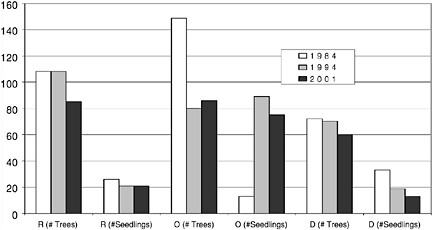 FIGURE 5-9 Results of 18 years of monitoring impacts to mangroves in Panama as part of TROPICS. Histograms reflect mangrove tree or seedling population counts (1984–2001) from whole oil (Site O) and dispersed oil (Site D) compared to a reference site (Site R). SOURCE: Ward et al., 2003; courtesy of the American Petroleum Institute. SOURCE: Summary compiled from Ballou et al. (1987), Dodge et al. (1995), and Ward et al. (2003). |
exposure to oil. In addition, a common stress response to oil pollution that has repeatedly been observed in coral species is the excessive production of mucus (see Shigenaka, 2001). This protective response can reduce the bioaccumulation of chemical contaminants by binding them in this lipid-rich mucus matrix that is ultimately “sloughed off” (or eaten by grazing
fish) the surface of the coral, so protecting the underlying tissues. It is unclear whether chemically dispersed droplets or physically dispersed droplets or accumulation of dissolved components could alter this response. The excessive production of mucus takes energy away from normal cellular processes potentially reducing the overall health and fitness of the coral. In the case of chronic oil pollution events, such as continued leaching from mangrove sediments, excess mucus production could ultimately lead to coral death.
In conclusion, recent studies of coral larvae clearly demonstrate impacts of dispersants and dispersed oil on corals and, because of their life history and habitat characteristics, these species may be especially susceptible (Table 5-11). Consequently, decisions concerning dispersant use should take coral toxicity studies into consideration. In addition, laboratory studies are needed to estimate the relative contribution of dissolved-and particulate-phase oil to toxicity in representative coral species. Because corals typically experience high levels of natural sunlight, these toxicity tests should include an evaluation of delayed effects and photoenhanced toxicity.
Mangroves
Few reports have been published that address the use of dispersants in treating oil spills close to mangroves. Early work by Getter and Ballou (1985) used an experimental spill at a site in Panama and concluded that dispersant use reduced the overall impact of oil on mangroves. This was a long-term project (10 years), but lacked replication of study sites (Dodge et al., 1995). In order to investigate the types of oil spill responses that might reduce the impact of oil spills and to address the need for more relevant information on the effects of oil spills on mangroves, Duke, Burns and co-workers carried out a number of field trials to assess the benefits of two remediation strategies for mangrove forests (see Burns et al., 1999; Duke and Burns, 1999; Duke et al., 1998a,b,c, 1999, 2000). These experiments were aimed at bridging the gap between surveys of real spill incidents (e.g., Volkman et al., 1994; Duke et al., 1997, 1998c) and those obtained from seedling laboratory experiments (Lai and Lim, 1984; Wardrup, 1987; Duke et al., 1998a). Field experiments, named the Gladstone trials, investigated the effects of different oils and remediation strategies on mangroves over both short and long-term time scales (1995–1998) utilizing a variety of replicated trials. One study compared the effects of dispersant (Corexit 9527) or bioremediation (aeration plus nutrients) strategies on a controlled spill using pre-weathered (24 hr) Gippsland light crude oil. It should be noted that the dispersant Corexit 9527 was premixed and weathered with the oil mixture before application. There were
no differences observed between oil alone and dispersed oil treatments on resident fauna. Death of mangrove trees, however, was significantly lower in the plots treated with dispersant, similar to data previously obtained from laboratory and field studies (Duke et al., 1998a,c; Duke and Burns, 1999). With oil alone, long-term impacts on the fauna and little sign of recovery of trees led the authors to conclude that dispersion of spilled oil before it reaches mangroves should be considered for reducing the long-term impact of oil on mangrove habitat. It was interesting to note that the use of Corexit 9527 resulted in no difference in the amount of oil absorbed by the sediments, the penetration of oil to depth, or the weathering patterns of the oil over time.
IMPROVING THE USE OF INFORMATION ABOUT EFFECTS IN DECISIONMAKING
As discussed in Chapter 2, the ultimate decision regarding the use of dispersants in spill response generally rests upon answering the question as to whether use of dispersants will reduce the overall impact (Figure 2-4 in Chapter 2) by reducing the effects on some specific and sensitive species or habitat, without causing unacceptable harm to another specific and sensitive species or habitat. This decision represents a trade-off that will be dictated by a range of ecological, social, and economic values associated with the potentially affected resources. When spills occur offshore, where the potential magnitude and duration of impacts on organisms in the water column or seafloor can be assumed to be minimal, a decision to use dispersant can be made with information that is generally available. As the capability to deploy dispersants offshore increases, however, the capability to use dispersants in nearshore and shallower water settings will also increase. At the present time, the current understanding of the risk of dispersant use to shallow water or benthic species during a given spill is typically not adequate to allow rapid and confident decision-making. Several factors contribute to this uncertainty.
The rate of processes controlling the ultimate fate of dispersed oil is poorly understood. Of particular concern is the fate of dispersed oil in areas with high suspended solids and areas of low flushing rates. There is insufficient information to determine how chemically dispersed oil interacts with suspended sediments, as well as biotic components of aquatic systems, both short- and long-term, compared to naturally dispersed oil. Relevant state and federal agencies, industry, and appropriate international partners should develop and implement a focused series of experiments to quantify the weathering rates and final fate of chemically dispersed oil droplets compared to undispersed oil. Results from these experiments could be integrated with results from biological exposures
TABLE 5-11 Toxicity Studies of Chemically Dispersed Oil (or Dispersant Alone) to Coral Species in Laboratory and Field Studies (since 1988)
comparing uptake of dissolved, colloidal, and particulate oil to provide a comprehensive model of the fate of dispersed oil in aquatic systems.
There is insufficient understanding of the actual concentrations and temporal/spatial distributions and behavior of chemically dispersed oil from field settings (from either controlled experiments or actual spills). Data from field studies (both with and without dispersants) are needed to validate models, provide real-world data to improve knowledge of oil fate and effects, and fulfill other information needs. Relevant state and federal agencies, industry, and appropriate international partners should develop and implement steps to ensure that future wave-tank or spill-of-opportunity studies (or during the Natural Resource Damage
|
Response |
Comments |
Reference |
|
DO decrease in coral cover—complete elimination of A. tennuifolia. |
Continuous field measurement of TPH and C1-C10 hydrocarbons |
aBallou [et al., 1989 |
|
Delayed sublethal impacts in all plots (bleaching); DO 120 hr exposure plots recovery less. No difference in growth rates. |
HC concentrations measured over time (to 120 hr) |
aLegore et al., 1989 |
|
Mortality was D dependent. |
Nominal exposures |
Thorhaug et al., 1989 |
|
Varied with exposure—from unsuccessful larval settlement to death. D toxic, DO WAF more toxic cf. WSF (and D alone). |
Nominal exposures (dilutions of stocks) |
Epstein et al., 2000 |
|
FA; WAF no effect. DO slight more toxic c.f. D alone. LM; DO more toxic cf. WAF, D toxic but at higher levels cf. [D] in DO. |
Measured THC mg/L in stocks. Nominal concentrations calculated for dilutions. |
Negri and Heyward, 2000 |
|
No death in WSF. D alone (1% or >) very toxic within 24 hr, delayed death (day 6) at 0.1%. DO WAF similar to D alone. |
Nominal exposures (dilutions of stocks) |
Shafir et al., 2003 |
|
aField study. |
||
Assessment investigations of oil spills that are not treated with dispersants) implement a field program to measure both dissolved-phase PAH and particulate/oil-droplet phase PAH concentrations for comparison to PAH thresholds measured in toxicity tests and predicted by computer models for oil spill fate and behavior. Accomplishing this will require the development and implementation of detailed plans (including preposition of sufficient equipment and human resources) for rapid deployment of a well-designed monitoring plan for actual dispersant applications in the United States. The RRT Region 6 Spill of Opportunity Monitoring Plan for dispersant application in the Gulf of Mexico should be finalized and implemented at the appropriate time. In addition, con-
sideration should be given to long-term monitoring of sensitive habitats and species (e.g., mangroves, corals, sea grasses) after dispersant application to assess chronic effects and long-term recovery. These data will be valuable in validating the assumptions associated with environmental trade-offs of using dispersants.
One of the widely held assumptions concerning the use of dispersants is that chemical dispersion of oil will dramatically reduce the impacts of oil to seabirds and aquatic mammals, primarily by reducing their exposure to petroleum hydrocarbons. Evaluating the validity of this assumption is critical, because it is often a key factor in the decision on whether or not to use dispersants on a particular spill (e.g., in the ecological risk assessment workshop analyses). In addition, populations of waterfowl and some aquatic mammals may be higher in nearshore and estuarine areas; therefore, validating this assumption becomes even more important. Unfortunately, there is very little available information on the effects of dispersed oil on wildlife, especially aquatic mammals. Of additional concern is the effect of dispersed oil and dispersants on the waterproof properties of feathers and their role as thermal insulators. One of the recommendations of the NRC (1989) report was that studies be undertaken “to assess the ability of fur and feathers to maintain the water-repellency critical for thermal insulation under dispersed oil exposure conditions comparable to those expected in the field.” This recommendation is reaffirmed because of the importance of this assumption in evaluating the environmental trade-offs associated with the use of oil dispersants in nearshore and estuarine systems and because it has not been adequately addressed.
The primary assumption for models predicting acute toxicity of physically and chemically dispersed oil is additive effects of dissolved-phase aromatic hydrocarbons. However, the possibility of photoenhanced toxicity and particulate/oil droplet phase exposure is generally not considered. A number of laboratory studies have indicated toxicity due to PAH increases significantly (from 12 to 50,000 times) for sensitive species in exposures conducted under ultraviolet light (representative of natural sunlight), compared to those conducted under the more traditional laboratory conditions of fluorescent lights. In addition, the toxicity tests typically do not consider delayed acute or sublethal effects. Consequently, current testing protocols may significantly underestimate toxicity for some species. For example, corals appear to be particularly sensitive to dispersants and dispersed oil due to the potential for photoenhanced toxicity and delayed effects. Similarly, toxicological effects due to increased exposure to oil from smothering, ingestion, or enhanced uptake are not explicitly considered in exposure models. Better understanding of these variables will decrease the uncertainty associated with predicting ecological effects of dispersed oil. Relevant state and federal agencies, industry,
and appropriate international partners should develop and implement a series of focused toxicity studies to: (1) provide data that can be used to parameterize models to predict photoenhanced toxicity; (2) estimate the relative contribution of dissolved and particulate oil phases to toxicity with representative species, including sensitive species and life stages; and (3) expand toxicity tests to include an evaluation of delayed effects. Detailed chemical analyses should accompany these tests, including characterization of dissolved and particulate oil composition and concentrations, as well as bioaccumulation. By refining our understanding of these variables, and incorporating them into decision-making tools, such as fate and effects models and risk rankings, the ability of decisionmakers to estimate the impacts of dispersants on aquatic organisms will be enhanced.


