
2
Making Decisions about Dispersant Use
A variety of perspectives exist about the value and potential of dispersing surface slicks of spilled oil or refined products. These perspectives reflect varying degrees of knowledge and opinions about dispersants and the fate and effects of dispersed oil in the environment. It is important to recognize, however, that avoiding a decision to apply dispersants due to lack of sufficient information or understanding may place some resources at risk that otherwise would be protected if dispersants were used effectively. Thus, the real key to effective decision-making regarding dispersant use is a fuller understanding of the implications of alternative outcomes in the decision-making process.
CURRENT FRAMEWORK FOR DISPERSANT APPROVAL AND USE IN THE UNITED STATES
Under OPA 90, the national response system is the federal government’s mechanism for emergency response to discharges of oil into navigable waters of the United States. The system provides a framework for coordination among federal, state, and local responders and responsible parties. Structurally, the national response system is comprised of three organizational levels: National Response Team (NRT, co-chaired by the U.S. Coast Guard and the Environmental Protection Agency), Regional Response Teams (RRTs), and Area Committees. In addition to regional planning and response to federal incidents, the RRTs are vested with the authority over the use of chemical dispersants.
The U.S. Coast Guard is designated as the Federal On-Scene Coordinator (FOSC) responsible for ensuring a safe and effective response to all discharges of oil into the marine environment, Great Lakes, and major navigable rivers. The U.S. Coast Guard is also designated, along with the U.S. Environmental Protection Agency (EPA), as co-chairs for the RRT. At the time of an oil spill incident, a FOSC may authorize the use of dispersants on oil discharges upon concurrence of the federal co-chairs and the state representative to the RRT and in consultation with the federal natural resource trustee agencies, the U.S. Department of Commerce (DOC) and U.S. Department of the Interior (DOI). In an effort to compensate for the need to make a rapid decision regarding dispersant use early in the timeline of a spill, the NRT revised the National Contingency Plan to require both Area Committees and RRTs to address, as part of their planning activities, the desirability of using appropriate dispersants and the development of preauthorization plans (40 CFR 300.910). The status of pre-approval for dispersants in the United States, as of the publishing of this report, is presented in Appendix B and summarized in Figure 2-1. This information includes the status of dispersant-use approval zones; the conditions and zones where pre-approval exists (if applicable); and the status of monitoring and Section 7 consultation requirements. Section 7 of the Endangered Species Act requires consultation with the appropriate natural resource trustees prior to taking an action that may impact any federally listed species. Approval for use of dispersants, during both planning and emergency phases, falls into this category. Therefore, for purposes of dispersant use planning, any pre-approval agreement is subject to consultation with the trustee agencies prior to its implementation.
Pre-approval agreements are drafted at the local area and regional levels, either through the auspices of RRTs or through the Area Committee planning process; therefore some variations in terminology have developed in the agreements themselves or in the supporting literature. In this report the terms “case-by-case approval,” “expedited approval,” and “pre-approval” are used to describe the decision-making mechanism governing a given location, as defined below.
Case-by-Case Approval
(also referred to as incident-specific RRT approval)
The use of dispersants in each incident requires the FOSC to seek and gain approval from the RRT. The RRT reaches its approval through the concurrence of the U.S. Coast Guard and EPA co-chairs and affected state(s) and in consultation with DOI and DOC.
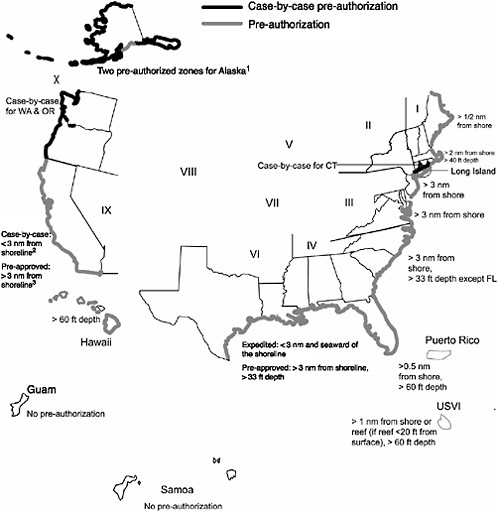
FIGURE 2-1 The status of pre-approval agreements, at the time of this writing, in the United States by Regional Response Team region.
1Agreements exist for Cook Inlet and Prince William Sound in Alaska.
2And/or borders with Oregon and Mexico within National Marine Sanctuary Boundaries.
3And/or borders with Oregon and Mexico outside of the National Marine Sanctuary boundary.
SOURCE: Modified from U.S. Coast Guard, http://www.uscg.mil/vrp/maps/dispmap.shtml.
Expedited Approval
(also referred to as quick approval)
The use of dispersants for each incident requires the FOSC to obtain the agreement of several key individuals (typically, the U.S. Coast Guard and EPA co-chairs, as well as state and federal trustee agencies). Expe-
dited approval agreements usually limit the quantity and type of information the FOSC must provide in order to obtain concurrence, as well as the time agencies may take prior to approving or disapproving use. Expedited approvals are generally associated with a limited time in which a decision must be reached (typically less than 2 hours). Expedited approval may be limited to a particular geographic zone, distance from shore, depth of water, or season within a given area or region. RRT 6 has ratified an expedited approval for use of dispersants in the nearshore environments of Texas and Louisiana, defined as seaward of the shoreline but less than 3 miles (4.8 km) from shore. If concurrence is not given by all specified agencies then, by definition, the request for dispersant use does not meet the requirements of expedited approval. Any further consideration or request for the use of dispersants must be done as a case-by-case decision made by the RRT.
Pre-approval
(also referred to as pre-spill approval, pre-authorization, or pre-spill authorization)
The use of dispersants for each incident is at the discretion of the FOSC (in some cases, within the context of the Unified Command Structure) without further required approvals by other federal or state authorities. As pre-approval zones are generally limited to a particular geographic zone, distance from shoreline, water depth, or season, the FOSC must determine that a specific spill meets the criteria established for dispersant pre-approval. If any of these criteria are not met, the dispersant use falls outside the parameters of the pre-approval process and further consideration or request for approval must be sought as a case-by-case decision made by the RRT.
In order to ensure that dispersants are available for use on spills in preauthorized zones in a timely manner, the U.S. Coast Guard recently proposed mandatory capabilities to apply dispersants (where preauthorized) within 12 hours of the initial discovery of the release. While these rules are specifically directed to enhance spill response in preauthorized zones (generally 3 to 50 nautical miles [roughly 5 to 90 kilometers] offshore), they will have the secondary impact of making dispersants more widely available for use on spills in nearshore waters. As a consequence, greater attention is being given to the process needed to make rapid and informed decisions to use dispersants in nearshore settings. This process is complicated as dispersed oil is generally recognized as posing limited risks to open marine ecosystems, but the effects of dispersed oil on living marine resources in the water column or on or beneath the seafloor in nearshore ecosystems are less well understood.
THE DECISION-MAKING PROCESS
Every oil spill is a unique combination of events; therefore, decision-making should be flexible, rigorous, and timely in order to be effective. A decisionmaker should not only evaluate the response options available given the oil type, size and rate of release, and geographic location, but should also put these parameters into the larger environmental, social, and economic contextual needs of the overall society, as depicted in Figure 2-2. The interplay among stakeholders including responsible parties (e.g., tanker operators, oil and gas operators), elected officials, and local, state, and federal government representatives, is best seen as a perpetual state of dynamic tension. One of the most difficult challenges for an oil spill decisionmaker results from the fact that not all resources of public concern, be they environmental, economic, or historical, can possibly be protected either simultaneously or prior to the time that oil impact is likely to occur. Decisions regarding the use of dispersants can be particularly problematic, as they often involve trade-offs among natural resources whose protection falls under the jurisdiction of different government entities.
All response options, based on the rapidness of deployment and oil fate regimes, have consequences inherent in their selection. Decisionmakers are forced, by the very nature of response to oil spills in the marine environment, to identify environmental and economic trade-off choices in real time, adequately assess the risk associated with each choice,
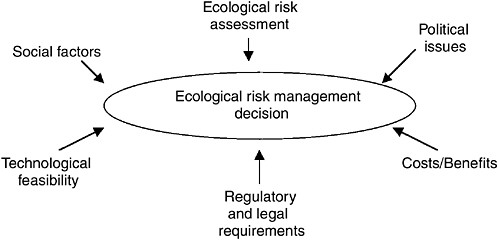
FIGURE 2-2 Relationship of ecological risk assessment to management decisions
SOURCE: Modified from Pittenger et al., 1998; courtesy of Alliance Communications Group.
and evaluate the potential magnitude of a negative unforeseen consequence of a given choice. Given the high public visibility of oil spills and oil spill response efforts, various stakeholders have become very interested in both the decision-making process and the information used in that process. Figure 2-3 is a generic, but typical decision flow chart for the
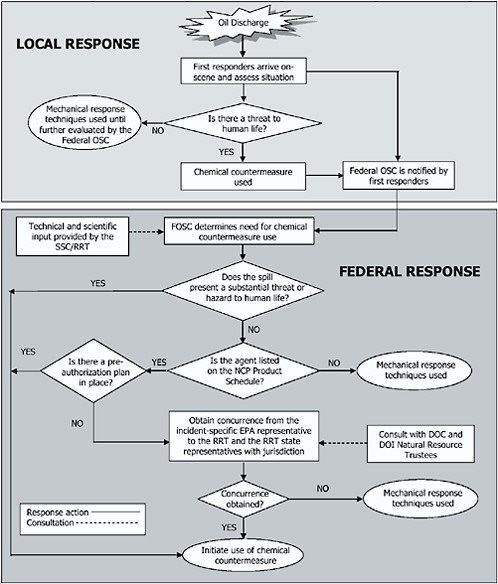
FIGURE 2-3 Example decision flow chart for using chemical countermeasures or dispersants showing federal and local responsibilities in the United States.
SOURCE: National Response Team Response Committee, 2002.
United States showing specific decision-making points for evaluating any given response option, including chemical dispersants. Numerous decision processes are used around the world, including those used in New Zealand, Norway, France, Singapore, and the United Kingdom, and each is tailored specifically to address unique regional and regulatory considerations. In areas where weather and sea state often preclude the use of response options other than dispersants, or in island environments where deep water exists right up to the shoreline, the decision to use dispersants is even further expedited. The NRC (1989) report included a detailed comparison of four such flow charts in common use in the 1980s. However different these types of flow charts may appear at first glance, the actual thought process conducted by a decisionmaker required to evaluate the appropriateness of dispersant use is remarkably similar throughout the world. A decisionmaker should answer three basic questions before further considering the social or political implications of applying chemical dispersants:
-
Will dispersants work? (i.e., predict chemical efficiency)
-
Can the spill be treated effectively? (i.e., determine potential operational efficiency)
-
What are the environmental trade-offs? (i.e., evaluate possible environmental consequences)
As depicted in Figure 2-4, many factors must be weighed and considerable information should be reviewed and evaluated in answering each of these questions. In many parts of the world, most of the decision points either are answered in advance or are answered in response to the limitations placed on response by the nature of the physical environment and subsequent logistical considerations. Figure 2-4 was developed to outline all the decision-making points that must be considered when evaluating the use of dispersants. Once the potential for damage caused by a particular oil spill has been established, the potential reduction in the amount of damage achievable by each of the response options (e.g., mechanical recovery, dispersants, in-situ burning, or do nothing) can be assessed. Such an assessment involves an evaluation of the expected effectiveness of each option within the constraining time limits and spill conditions. Because the purpose of any response is to minimize the damage caused by the oil spill, a quantitative set of criteria or measures of success needs to be defined so that decisionmakers can adequately compare response alternatives. Additionally, decisionmakers need real-time data to monitor and evaluate the effectiveness once a response option is undertaken, as well as a mechanism for determining when a response option is no longer effective or viable. A window of opportunity exists for any response decision,
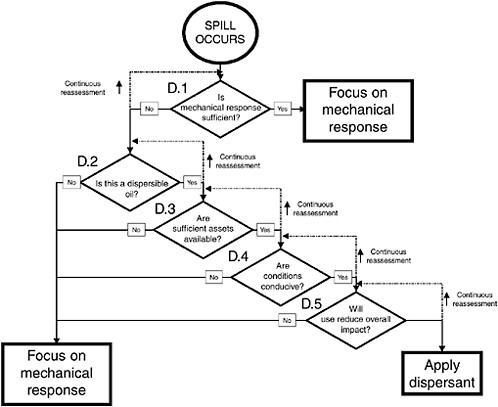
FIGURE 2-4 Idealized decision flow chart for evaluating the appropriateness of using chemical dispersants as a response option in the United States.
and any process, policy, or procedure that expedites reliable and accurate information to a decisionmaker will greatly improve not only the decision-making process but also a decisionmaker’s comfort with making challenging trade-off choices. Responses to marine oil spills are conducted within the public arena and, as such, all response decisions can be and are reviewed and questioned by the general public, the media, governmental agencies, and the legal system. Within this social context of evaluation, a decisionmaker’s choice should be seen as reasonable and prudent. Within the response context, decisions should also be viable and implementable within technically feasible constraints. Any actions that improve either the technical feasibility of a response option or the availability of timely and accurate information will enhance a decisionmaker’s ability to make an appropriate and defendable response choice.
Predicting Chemical Effectiveness
As will be discussed at greater length in Chapter 3, the factors that limit the effectiveness of a given dispersant during a given spill are complex and the significance of each may change as time passes after the initial release. All crude oils and refined products have a unique and variable chemical composition and physical (rheological) properties that play a significant role in determining whether a specific dispersant will effectively disperse a surface slick under ideal conditions. Early in a spill response, decisionmakers should rapidly determine the nature of the fresh oil or product, how it will change over time, how effectively available dispersants are known to treat a specific oil or product under ideal circumstances, and how far from ideal circumstances does the particular spill deviate.
At present, real-time decisionmaking focuses on fairly conservative and simple tools to make the decision to attempt dispersant use, which are then verified by experimentation (e.g., dispersant is applied during a test flight, and the results are used to determine whether operations should continue). Decisions as to whether an oil is dispersible (Decision D.2, Figure 2-4) rely on databases on oil properties (e.g., density, American Petroleum Institute [API] gravity, viscosity, wax/asphaltene content, boiling point fractions), simple models that predict viscosity over time under forecast spill conditions, laboratory and field tests for a small set of oils, and (mostly) best professional judgment and experience of the response team. In fact, experienced responders are essential to the decision-making process. The more difficult assessment is predicting when various oil weathering processes, such as emulsification will render the oil no longer dispersible.
Determining Potential Operational Effectiveness
One of the first operational requirements for dispersing surface oil slicks with chemicals is that the dispersant must actually hit the target oil at the desired dosage. The ability to apply dispersants in a manner that satisfies this requirement is largely a reflection of environmental conditions and operational factors. The former can only be planned for; the latter can be addressed by making adequate preparations to have dispersant, appropriate equipment, and trained human resources available at the time of the spill. Dispersant and equipment availability have been, and continue to be, a key part of the decision-making process. The window of opportunity for effective dispersant application is often hours to a few days after a release; therefore, the logistics of getting resources to the spill site can be the driving factor in the decision to use dispersants. The longer
the response time, the greater the spreading and chances of the oil stranding onshore, and the smaller the area of thicker dispersible oil. As the spreading of the oil occurs, there will be a corresponding increase in the weathering of the oil, governed by the oil type, sea conditions, and temperature. These processes will gradually reduce the effectiveness of chemical dispersants (as well as in-situ burning and mechanical response) to zero. The proposed changes in USCG regulations will, however, require the ability to apply dispersants within 12 hours after an oil release within 50 nm of shore. Getting dispersant resources to the spill site should, therefore, not be a limiting factor in the future. Logistical support for the operation should also be established. Fuel supplies, dispersant transfer equipment, and safety equipment will all need to be made available at the operating site.
The type of dispersant application platform used directly controls the operating distance offshore and amount of dispersant that can be applied in a day. Table 2-1 presents a summary of the capabilities, advantages, and disadvantages of different platforms that might be used to apply dispersants in the United States. The number of sorties per day and thus the amount of dispersants sprayed per day is a function of the operating distance; thus a C-130 can apply up to 67 tonnes (roughly 20,000 gallons) of dispersant if the target is 50 km (roughly 30 nm) from the airport, but only 55 tonnes (roughly 15,000 gallons) if the distance is 185 km (roughly 100 nm). The spill response management team needs to quickly work up a dispersant-use plan based on the volume of oil to be treated, available platforms, and other logistical factors.
Dosage control is another key operational factor. The planning goal is a dispersant:oil application rate of 1:20, though ratios of 1:40 or even 1:60 could be achievable with some dispersants and some oil types. Conversely dispersant:oil ratios of as high as 1:10 have been required with some of the more emulsified and viscous heavy oils. Assuming a uniform slick that is 0.1 mm thick (light brown or black as seen from aircraft; Figure 2-5), the dispersant application rate would be 5 gallons/acre (roughly 45 liters/hectare) for a 1:20 ratio of dispersant:oil. Realistically, slick thickness varies considerably, and most of the volume is in the thicker portions. The most efficient application strategy is to target the thicker portions of a slick, which will need higher application rates (1 mm thick oil would require 50 gallons/acre [roughly 450 liters/hectare]) and multiple passes to achieve these higher rates. Under ideal conditions, a spotter in a separate aircraft identifies the thicker portions of the slick and directs the spraying platform to these areas. There may be a case for reducing the application rate and making repeat applications of dispersant until dispersion is observed. This would be preferable to possibly overdosing an area and/or consuming available dispersant stocks prematurely.
TABLE 2-1 Characteristics of Dispersant Application Platforms for Example Operating Distancesa

FIGURE 2-5 Chart showing the area of coverage and the relationships among slick thickness, color, and volume of oil.
SOURCE: Exxon, 1992; courtesy of Exxon-Mobil Corporation.
Table 2-2 presents a summary of the operational factors that affect the effectiveness of dispersant applications. Dispersant droplet size is important, because it will affect the overall performance and accuracy of the system. Tests have shown that an optimum droplet size of 600–1,000 microns is required for spray systems (NRC, 1989). Too small a droplet size will lead to an aerosol effect that will cause the dispersant to drift off target. Too large a droplet will result in the droplet passing through the oil layer into the sea rendering it ineffective. Dispersant droplets are also subject to evaporative loss of solvents during their descent to the sea surface, with an average drop out time of 5–7 seconds from an altitude of 15 m.
Assuming adequate resources are available (Decision D.3; Figure 2-4), the next question in the decision-making process (Decision D.4) is whether sea state condition and weather allow for dispersant use. Waves provide most of the mixing energy needed to break surface oil into droplets and mix them into the water column. Dispersion, both naturally and chemically enhanced, increases with wave energy, which is driven by wind speed. Wind speed should be at least 5 m/s to generate waves for
TABLE 2-2 Operational Factors That Influence the Effectiveness of Dispersants on Spilled Oil
|
Logistics |
Dosage Control |
Droplet Size and Spray Drift |
Monitoring |
|
Platform availability and capacities affect operating distance, transit speed, swath width, sorties per day, pump rate, and the total amount of dispersant that can be applied daily |
Goal is 1:20 dispersant:oil ratio; target thick portions of the slick (>1 mm) with 50 gal/acre; uniform spraying over/under doses thin/thick slicks; use spotter to direct spraying of thicker portions |
Drop size too small causes wind drift away from slick; drop size too big causes poor slick coverage, drop penetration through slick, and herding |
Provides rapid feedback on whether or not the application is being conducted as planned and if the dispersant is effective; supports go/no go decision to continue dispersant applications |
good dispersion. Even waves 15–20 cm in height can provide sufficient mixing energy. At wind speeds greater than about 25 knots (roughly 45 kilometers per hour), the dispersant droplets will not hit the oil. It is not known how long a dispersant applied under calm conditions would remain in the oil and still be effective during later periods of increased wind speed and wave energy. For small spills, mixing energy can be added by driving boats through the treated slick or applying water spray, such as from a fire hose or spray system, after the dispersant has been successfully applied to the slick.
Evaluating Possible Ecological Consequences
To adequately evaluate the use of dispersants on marine oil spills, environmental managers and decisionmakers need to assess the ecological risk and consequences associated with any given decision. Once it is determined that a specific oil spill is conducive to dispersant use (i.e., the oil is dispersible; appropriate dispersants, equipment, personnel are available; and weather/environment conditions are favorable), a decisionmaker should evaluate the potential environmental consequences for dispersant use (e.g., how such use will adversely impact some habitats and biological resources while reducing or preventing impacts to others). The need for such a comparative analysis of risk and benefits of dispersant use has been raised by several researchers (e.g., Lindstedt-Siva, 1987; Walker
and Henne, 1991; Wiechert et al., 1991). Within the United States, Lindstedt-Siva (1991) proposed implementing a national goal for spill response: to minimize the ecological impacts of a spill. The implications of such a goal on planning and response, using the 1985 Arco Anchorage spill in Port Angeles, Washington, as an example, also were investigated. In that case, integration of response options to protect sensitive habitats—rather than to optimize cleanup—proved to be effective and acceptable to the regulatory community. However, none of these researchers developed a specific methodology for optimizing all potential response options in an integrated program. A solution is to integrate a simplified ecological risk assessment approach into the pre-spill planning process. Once an appropriate risk assessment is available, it can be used to support environmentally sound, integrated response plans and provide quantitative criteria for decisionmaking.
The EPA proposed a framework that groups the activities involved in ecological risk assessment into three phases: problem formulation, analysis, and risk characterization (EPA, 1992). A risk evaluation occurs whenever a decisionmaker needs to approve or disapprove an action. Belluck (1993) defined three classes of ecological risk assessment (scientific, regulatory, and planning) that lie along a continuum from most to least quantitative. Cost (and usually time) increases with the level of scientific detail incorporated; therefore, the desire to improve the analysis should always be weighed against the cost of the additional information. An ecological risk assessment follows a defined methodology that:
-
uses quantitative data to define effects whenever possible;
-
defines uncertainty;
-
incorporates this information into conceptual or mathematical models of the affected system; and
-
interprets information against clear, consistent endpoints that are related to the protection of resources.
Lewis and Aurand (1997) proposed a methodology for the application of risk assessment protocols to planning for dispersant use. In the case of oil spill planning, the goal is different from ecological risk assessments of proposed projects since the spilled oil cannot be prevented from entering the environment—the goal is to minimize adverse effects. Environmental planners and decisionmakers should evaluate scenarios for the expected range of incidents and focus on providing information tailored to meet the circumstances of a particular spill.
Modified ecological risk analyses with the goal of evaluating and quantifying a “net environmental benefit” have been undertaken throughout the United States (Pond et al., 2000; Addassi et al., in press) as well as
other parts of the world (IPIECA, 2000), for use both as a part of oil spill planning and during actual spill response.
Ecological Risk Assessment Applications for Oil Spill Response in the United States
This section summarizes a process of a cooperative ecological risk assessment (ERA1) currently utilized in many regions of the United States to evaluate the ecological trade-offs associated with the use of each of five potential oil spill response options: natural recovery, on-water mechanical cleanup, shoreline cleanup, dispersant use, and on-water in-situ burning. The desired outcome of the evaluation is identification of the optimum mix of response options in reducing injury to specific environments. The evaluations are usually conducted during a series of workshops where technical experts, resource managers, and stakeholders come together to develop relative ecological risk evaluations for response options. Much of the work completed during this process is later incorporated in the dispersant-use planning process.
Community Participation
Two critical elements of an ERA are that the process must involve the active participation of both response operations personnel (risk managers) and response impact assessors (risk assessors) and be conducted to achieve consensus (Kraly et al., 2001). In addition, other groups such as local governments, concerned private citizens, and the press must have access to and an understanding of the process. This broad involvement by the informed public is essential if decisions and resultant actions are to withstand scrutiny. Public trust requires that the public have confidence in the decision-making process as well as the information used to support decisionmaking.
Phases of the ERA Process
The consensus ERA generally involves a step-by-step process to help participants logically order information and, in so doing, enable participants to collect all relevant data, identify conflicts and data gaps, and
determine the optimum course of action based on consideration of trade-offs in resolving those conflicts. The process is conducted in three phases: problem definition (formulation), analysis, and risk characterization (Figure 2-6).
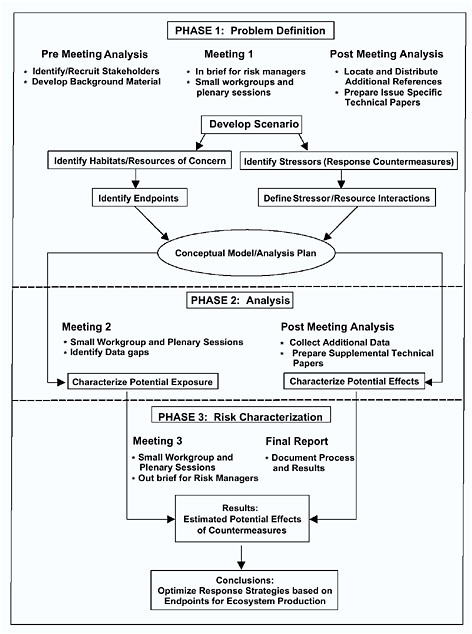
FIGURE 2-6 Diagram showing interaction among the three phases of a “representative” ERA.
SOURCE: Aurand et al., 2000.
Phase 1: Problem Definition An ERA is intended to analyze the potential environmental impacts of an oil spill and evaluate how response options can influence the nature and magnitude of those impacts. Therefore, selection of a specific scenario is critical to the risk assessment process because the scenario establishes the spatial and temporal parameters of the risk analysis. Scenario parameters include spill location, oil type, spill size, weather, seasonality, and established assessment objects.
Identify Habitats and Resources of Concern Once a scenario is established, the next step usually employs trajectory modeling to identify potentially impacted segments of the environment and the quantities of oil that may impact those segments. Additionally, because trajectory models show oil movement over time, they will also drive the determination of which response options might be appropriate in mitigating the spill. To ease evaluation, oil budgets are often developed for each response option.
The next step is identification of potentially affected natural resources. Typically, trustee agency representatives and environmental advocates with responsibility for specific resources and habitats examine the impacted areas to identify each habitat and resource category. The degree of specificity in habitat identification is dependent upon the concerns of the risk assessors and may focus on representative resources, endangered resources, or keystone resources in a particular habitat.
Identify Stressor (Response Options) The term stress can be defined as the “proximate cause of an adverse effect on an organism or system” (Suter, 1993). Although the primary stressor may be the oil itself, unique environmental stressors result from human intervention through on-water mechanical recovery, shoreline cleanup, dispersant application, in-situ burning, or any other response options. Typically five potential stressors are chosen for an ERA analysis: natural recovery, on-water mechanical recovery, shoreline cleanup, chemical dispersion, and on-water in-situ burning.
Identify Stressor/Resource Interaction While every response option is a source of potential ecological stress, the mechanisms that cause this stress are not always of the same type or magnitude. Exposure pathways that link stressors to resources are termed hazards (Kraly et al., 2001) and include air pollution, aquatic toxicity, physical trauma (mechanical impact from foot and vehicular traffic), oiling or smothering, thermal (heat exposure from in-situ burning), waste, and indirect (a secondary effect such as ingestion of contaminated food). Each stressor can be evaluated through the use of a conceptual model to show the hazards posed by that stressor on the environment and the pathways of exposure to those stressors. Figure 2-7
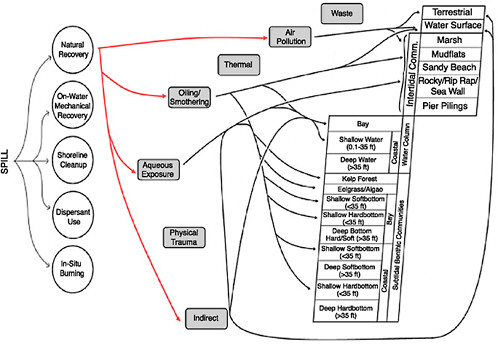
shows such a conceptual model, demonstrating the multi-layered connections between the many steps that must be completed to finish the ecological risk assessment. Figure 2-8 provides an example of a stressor-matrix developed for a surface microlayer habitat in a 500 barrel (roughly 21,000 gallons, 71.4 tonnes) spill scenario. Throughout the ERA process, any adverse impacts resulting from a response option are always compared against natural recovery. The stressors identified in the matrix in Figure 2-8 are those in addition to the natural recovery option and the hazards identified are for all habitats, not just the surface microlayer.
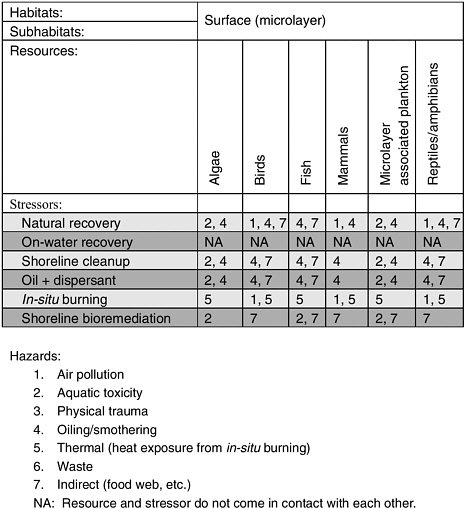
FIGURE 2-8 Sample stressor-hazard matrix for the surface microlayer habitat used in the Texas ERA.
SOURCE: Kraly et al., 2001; courtesy of the American Petroleum Institute.
Phase 2: Analysis In the analysis phase, the degree of exposure for each response option on each segment of the environment is first examined, followed by a comparative analysis of the individual response option impacts. This analysis is accomplished by construction of a matrix with potential stressors listed on the vertical axis and habitats and resources listed across the horizontal axis. The objective is to score the potential severity of impact posed by each stressor on each resource and habitat.
Several supporting pieces of information are necessary to facilitate completion of this scoring matrix (Figure 2-8):
-
The trajectory model provides an indicator of which habitats will be impacted and to what degree by various stressors.
-
Scientific literature provides for estimates of potential acute and chronic impacts of oil and different response methods (e.g., on-water mechanical recovery, dispersants, in-situ burning, shoreline cleanup) on individual resources and habitats.
-
Assessor discussion allows development of estimates regarding the potential effects of dispersed oil in the water column. In some regions, specific tables, like the one below, were used to provide guidelines in assessing dispersed oil toxicity (Table 2-3).
-
A risk square provides a method of scoring and evaluating relative resource concern.
TABLE 2-3 Workshop Consensus on Exposure Concentration Thresholds of Concern for Dispersed Oil in the Water Column in the Texas Ecological Risk Assessment (ERA)
Each axis of the square can be used to describe risk. Figure 2-9 provides a simplified risk square, with the x-axis representing rates of “recovery” and ranges from reversible to irreversible while the y-axis evaluates “magnitude” and ranges from severe to trivial. In its simplest form, a risk matrix is divided into four cells. Each cell is assigned an alphanumeric value to represent relative impacts. Thus a “1A” represents an irreversible and severe effect, while a “2B” represents a reversible and trivial effect. Most regions develop more expansive risk matrices to increase the level of sensitivity of evaluation of the two primary parameters—severity of exposure versus length of recovery for a specific resource. Severity of exposure includes level of effect, ranging from community level effects at the high level to the loss of a few individuals at the low level. Recovery includes both time and function expressed as lost services. Figure 2-10 is an example of such an expanded matrix.
The actual analysis involves assigning scores from the risk square to each sub-habitat block of the risk matrix. Often workshop participants are divided into three groups. Working separately, each group scores impacts of each stressor on the environment. Group scores for each stressor are then scored in plenary sessions and combined into a single matrix, reflecting consensus of all participants. When the groups have significantly different conclusions, this comparison helps make sure that areas of confusion or limited data are identified and addressed.
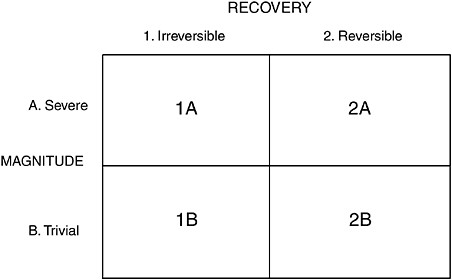
FIGURE 2-9 Basic ecological risk matrix design.
SOURCE: Kraly et al., 2001; courtesy of the American Petroleum Institute.
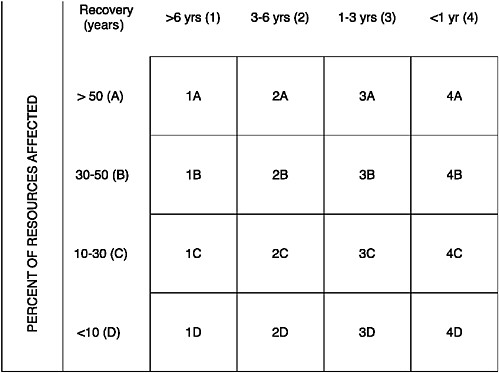
FIGURE 2-10 Expanded matrix for a hypothetical spill.
SOURCE: Kraly et al., 2001; courtesy of the American Petroleum Institute.
Phase 3: Risk Characterizations The final phase of the ERA involves interpreting the data and analysis results. In Phase 2, resources/habitat impacts are scored on a stressor-by-stressor basis working horizontally across the matrix. The result is a snapshot of each stressor in isolation and provides no insight regarding the relative merits of any one stressor compared to any others. In Phase 3, the participants begin to examine the matrix vertically, comparing relative impacts of each stressor on a given segment of the environment, allowing determination of which response option or combination of options should provide optimum protection of the environment as a whole.
The first step in risk characterization revisits the risk square to determine whether individual scores represent a high, medium, or low threat to the environment. For convenience in reading the final characterization matrix, the high, medium, and low determinations are represented by different colors, as shown in Figure 2-11. Clear cells represent a “minimal” level of concern; light gray cells represent a “moderate” level of concern; and dark gray cells represent a “high” level of concern.
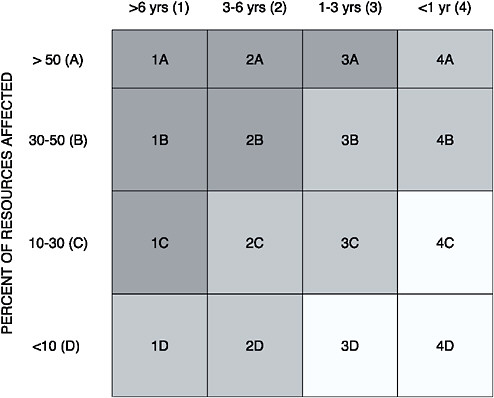
FIGURE 2-11 Final definition of levels of concern. Note: clear cells represent a “minimal” level of concern; light gray cells represent a “moderate” level of concern; and dark gray cells represent a “high” level of concern.
SOURCE: Kraly et al., 2001; courtesy of the American Petroleum Institute.
Once the high, medium, and low threat scores are determined, the scores in the completed risk matrix are then colored. This provides a visual display for assessors to use in reaching consensus on optimizing response. Figure 2-12 is a sample scenario summary score sheet from an ERA conducted in Texas (Kraly et al., 2001).
The ERA workshops for dispersant decisionmaking have been useful tools to bring stakeholders together to discuss the trade-offs of dispersant use in specific settings. Lessons learned from past workshops include: the difficulty of dealing with uncertainty; limited ability to use toxicological data to quantify impacts; the lack of quantitative data on the benefits of reduced shoreline oiling; the constraints posed by utilizing a specific model scenario and limited ability to extrapolate results to other scenarios; the sensitivity of the process to strong opinions by a few participants,
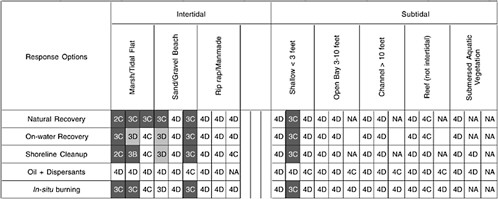
FIGURE 2-12 Sample form summary score sheet for a hypothetical 500 barrel (roughly 21,000 gallons, 71.4 tonnes) spill used during an ERA for Texas. Note: clear cells represent a “minimal” level of concern; light gray cells are intermediate between “minimal” and “moderate,” and dark gray cells represent a “moderate” level of concern.
SOURCE: Modified from Kraly et al., 2001; courtesy of the American Petroleum Institute.
often those with either the time or the money to participate; and the importance of participation by all stakeholders.
Real-Time Decisionmaking
Carrying out some type of risk assessment prior to a spill, such as the one discussed above, allows stakeholders to explore a finite set of scenarios, raise general and specific questions about dispersant use, understand the various concerns held by both the public and specific decisionmakers, and gain valuable experience working together to reach a consensus decision. An ERA may support development of guidelines or policies about where or when dispersants may be used (such as the designation of pre-approval zones), but because actual spill conditions will likely deviate in some way from the finite set of scenarios used, it cannot, in all instances preclude real-time decisionmaking. However, the awareness and understanding that a specific group of decisionmakers share by participating in a risk assessment process greatly facilitate real-time decisionmaking.
IDENTIFYING INFORMATION NEEDED TO SUPPORT EFFECTIVE DECISIONMAKING
As depicted in Figure 2-4, the availability of different pieces of information (about the environment, spilled oil or refined product, and response assets available) plays a role in the overall decision to apply dispersants. By understanding why this information is needed, how it is currently provided, and how well it meets the needs of the decisionmaker, one can gain a greater understanding of the current limitations in the decision-making process and how these limitations are addressed. If, as discussed earlier, the greater availability of dispersants, equipment, and personnel needed to respond to spills in pre-approved areas leads to greater consideration of their use in spills closer to shore, it is quite likely that current or readily available spill-specific information may prove to be inadequate. In an effort to set the stage for the subsequent chapters that examine current understanding of various technical aspects of spill research, each of the major decision points depicted in Figure 2-4 will be reviewed.
D.1 Will Mechanical Response Be Sufficient?
Current federal regulations specify that mechanical response is the primary option to be considered in response to a spill in U.S. waters. Thus, the U.S. Coast Guard has established minimum capabilities required to
respond to spills in U.S. waters. Although mechanical response techniques have the advantage of removing spilled oil from the environment, their ability to do so is somewhat limited. Under ideal conditions, some portion of the spill cannot be recovered and under adverse environmental conditions (e.g., high sea state), the effectiveness of mechanical response can be very low. Often timing is a critical consideration; hence, oil spill trajectory analyses (generally provided by the National Oceanic and Atmospheric Administration’s [NOAA] Office of Response and Restoration) are used to identify where the surface slick will move and how fast. Maps (Environmental Sensitivity Index maps provided by NOAA’s Office of Response and Restoration) showing the distribution of sensitive habitats or species are used to document the resources at risk. When mechanical response is unlikely to sufficiently reduce impacts from a spill, the use of alternative response techniques (e.g., dispersant application) is considered.
Some information needed to support analysis of the potential effectiveness of mechanical response is readily available. For example, when a spill occurs beyond the operational limits of vessels or in conditions that exceed safe or effective operation of those vessels, mechanical response is not feasible. Because conditions change through both time and space, a forecast of conditions is also required. In the majority of instances, however, there is an adequate understanding of the future location and conditions along the surface slick’s projected trajectory to allow decisionmakers to make reasonable inferences about the effectiveness of mechanical response in the hours following a spill.
D.2 Is the Spilled Oil or Refined Product Known to Be Dispersible?
Several aspects of a given crude oil or refined product may make it difficult to disperse under even ideal conditions. As will be discussed more fully in Chapter 3, the chemical composition of crude oil or refined product dictates a number of rheological properties (e.g., viscosity, pour point) that determine whether a specific dispersant will be under ideal conditions. Much of the work to date to understand the effectiveness of dispersants has involved laboratory tests designed to measure the effectiveness of a specific dispersant formulation in dispersing crude oils or petroleum compounds. Thus, some general but informal guidance has been developed that may help a decisionmaker (or those charged with providing technical assistance) reject dispersant application as a response to spills of certain types of crude oil or refined products (e.g., heavy oils). Again, as will be discussed at some length in Chapters 3 and 4, these rheological properties change through time as the spilled material weathers, requiring decisionmakers to constantly monitor the character of the sur-
face oil and continuously reassess the decision to apply, or continue to apply, dispersant.
Product testing required by EPA for dispersant products provides an indication of how well a specific formulation will disperse one of two specific oils (e.g., Prudhoe Bay or South Louisiana Crude) under laboratory conditions. Thus, for the majority of spills in U.S. waters, once the nature of the spilled oil or refined product is accurately known, some reasonable conclusions can be drawn regarding its dispersibility. Under ideal conditions, some uncertainty remains regarding how effective a given dispersant formulation may be in some environmental conditions (e.g., cold temperatures; see discussion D.4 below).
D.3 Are Sufficient Chemical Response Assets (i.e., Dispersant, Equipment, and Trained Personnel) Available to Treat the Spill?
The size and location of a spill will dictate the platforms needed (e.g., aircraft, boats) to effectively treat the spill. There are various tools, such as NOAA’s Dispersant Mission Planner, to help define requirements. The proposed U.S. Coast Guard rulemaking would set minimum capabilities for spill responders to be able to treat spills in U.S. waters with chemical dispersants in pre-authorized zones. Once in place, these rules would increase the likelihood that sufficient physical assets would be available to treat a spill, though there will always be a need for trained personnel. With such a narrow window of opportunity, there is little time to make adjustments, particularly in nearshore settings with lots of restrictions.
The proposed U.S. Coast Guard rulemaking would establish mandatory capabilities to apply dispersants in preauthorized zones within 12 hours of the initial discovery of the discharge within 50 nm of shore. As discussed previously, while these rules are specifically directed to enhance spill response in preauthorized zones (generally 3 to 50 m [roughly 5 to 92 km] offshore), they will have the secondary impact of making dispersants more widely available for use on spills in nearshore waters. Thus, once these rules are in place, there should exist a capability to treat the vast majority of spills in U.S. waters. If and when dispersant application capabilities are required, it will be necessary to implement methods and procedures to ensure the readiness of response equipment and supplies for dispersant use, similar to the requirements for mechanical response equipment. In the Notice to Public Rulemaking, the U.S. Coast Guard recommended the development of American Society for Testing and Materials (ASTM) standards for testing of dispersant application equipment. ASTM Standard Guides have been prepared for design of boom and nozzle systems (ASTM, 1992), calibration of boom and nozzle systems (ASTM, 1993), and maintenance, storage, and use these systems during spill response
(ASTM, 1996); however, standard guides should be developed for ensuring that dispersant stockpiles meet minimum efficacy standards.
D.4 Are the Environmental Conditions Conducive to the Successful Application of Dispersant and Its Effectiveness?
Water temperature, wind velocity, wave height, and other environmental factors play key roles in determining whether dispersant can be applied safely and effectively. Just as these environmental factors define a safe and effective operational window for mechanical response techniques, they also define an operational window for dispersant application. Generally, these operational windows are often dissimilar and sensitive to different environmental parameters. For example, booming and skimming (standard mechanical response techniques) work well in calm conditions and weak currents, whereas dispersants require some minimum wave energy to disperse the surface slick and entrain individual oil droplets. There are guidelines for minimum/maximum conditions for wind speed, sea state, and temperature, and conditions often change during the actual application (Fingas and Ka’aihue, 2004a). Thus, decisionmakers should continuously monitor the character of the surface slick and on-site conditions and frequently reassess the decision to apply, or continue to apply, dispersant.
Existing capabilities to characterize and predict evolving environmental conditions beyond sea state and weather are limited. Unlike surface slicks that are affected primarily by surface winds, the nature and trajectory of subsurface dispersed oil plumes are more sensitive to currents. Even wave height, a critical component for predicting dispersant effectiveness, may be difficult to predict more than a few hours in advance.
D.5 Will the Effective Use of Dispersants Reduce the Impacts of the Spill to Shoreline and Water Surface Resources without Significantly Increasing Impacts to Water-Column and Benthic Resources?
As discussed throughout Chapters 3, 4, and 5, there are still many uncertainties about the fate of dispersed oil droplets and the many different factors and processes that control that fate in different biophysical settings. Understanding the relative risk posed to various portions of the ecosystem at a spill, however, requires an adequate understanding of the physical and toxicological effects that dispersed oil may have on many different components of that ecosystem. In open, offshore waters, physical mixing processes tend to rapidly dilute a plume of dispersed oil droplets, reducing the potential for significant impacts on organisms in the water column or associated with the seafloor. The effective use of dispers-
ants, therefore, reduces the threat posed by a surface slick to organisms on the surface or, eventually, nearer to shore by altering the fate of that oil. As a consequence, a more limited and less robust set of information is needed to support the decision to use dispersants in such offshore conditions.
Use of dispersant in treating nearshore spills, however, raises many questions that are difficult to answer with the current understanding of the dispersed oil fate and effects. As pointed out in the previous discussion of environmental risk assessment, decisions regarding the use of dispersants in the nearshore settings often involve trade-offs and, therefore, call for more diverse and robust information (e.g., toxicological and population-level information about a particular species). As a consequence, questions about the fate and possible effect of dispersed oil or refined products make up a significant portion of the discussion in Chapters 4 and 5. Environmental monitoring of the operations usually focuses on preventing the direct application of dispersants onto wildlife or sensitive habitats. Additional monitoring is used in post-dispersant evaluations and model validation.
The models most commonly used to support real-time decision-making were designed to predict the trajectory of a surface slick, not a three-dimensional dispersed plume. Such models, which are in active use in the North Sea (Reed et al., 1999) and under development in the United States, are particularly sensitive to the quality of information about the subsurface current structure. In addition, current information is insufficient to evaluate dissolved components (e.g., toxic compounds) or concentrations of dispersed droplets for their impacts on nearshore environments. Ironically, as the effectiveness of dispersant increases, so does the potential threat to organisms exposed to the dispersed plume, due to the increased concentration of dissolved compounds and dispersed droplets in the water column. In open deep water, it may be reasonable to assume rapid dilution of the plume would take place. It is a generally held view, however, that such dilution should not be expected in shallower waters; hence a general avoidance of the use of dispersants in shallower waters exists. In addition, the current catalog of maps indicating the location and type of species or habitat that may be at risk from surface slicks is more adequate for areas along the shoreline. Information about the relative abundance of species in the water column or on the seafloor is inherently more difficult to obtain and tends to vary over shorter time scales. Greater capabilities to predict the trajectory of subsurface plumes of dispersed oil and the distribution of water-column and benthic species are needed, especially in shallower water where the impact of a dispersed oil plume may be more significant.
Overall
As the ability to apply dispersant to a variety of nearshore spills increases, the pressure to consider dispersant use in these waters will likely also increase. Consequently, the need for adequate and timely information to support decisions about dispersant use will become even greater. The remaining chapters examine the existing and needed capabilities to understand and predict the impacts of dispersed oil and recommend steps that should be taken to expand capabilities where needed.


