
3
The Globalization of Science and Engineering
The exchange of people and ideas across borders, accelerated in the last 2 decades by perestroika and the emergence of East Asia as a world economic power, has transformed institutions and lands once isolated. Most countries today send bright young people to study abroad.1 Many of them stay and contribute in lasting ways to their adopted countries. Whether they stay or return home or move on to a third country, these international scholars become part of a rich global network of researchers, practitioners, and educators that provides cultural support for students and scholars whatever their origins.
Since World War II, the United States has been the most popular destination for science and engineering (S&E) graduate students and postdoctoral scholars choosing to study abroad. This nation of about 6 percent of the world’s population has been producing over 20 percent of the S&E PhD degrees (see Figure 3-1).2 Given the fast-rising global tide of S&E infrastructure and training, however, it would be surprising if the current US leadership did not begin to change into a more global network of scientific and economic strength. Indeed, there is considerable evidence that that process has begun.
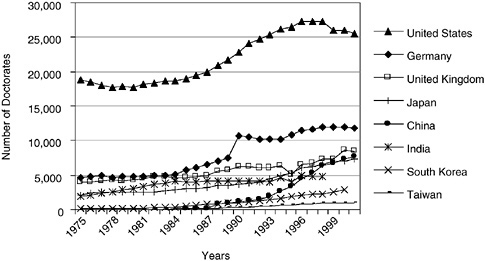
FIGURE 3-1 S&E doctorate production by country, 1975-2001.
SOURCE: National Science Board. 2004. Science and Engineering Indicators 2004 (NSB 04-1). Arlington, VA: National Science Foundation, Table 5-30.
This chapter will examine the current strengths of the US S&E educational system and S&E enterprise and how they are now challenged by the increasingly global competition for S&E talent.
RELATIVE POSITION OF THE US SCIENCE AND ENGINEERING ENTERPRISE
By virtually all indicators, the United States leads the world in S&E capacity. The strength of the US S&E enterprise rests on many advantages, including the diversity and stability of its S&E institutions, the strong tradition of public and private support for advanced education and research and development, the quality of its personnel, the prevalence of English as the language of S&E,3 a relatively open society in which talented people of any background have opportunities to succeed, and the United States’ global leadership in providing postdoctoral opportunities.4 A recent comparison
found that 38 of the world’s 50 leading research universities were in the United States.5
The strength of the US S&E enterprise is unlikely to falter in the near future, but over the longer term the United States faces challenges in maintaining its leadership. The investment of the United States in S&E education and research takes place in a global environment where other countries compete to produce, retain, and recruit the best S&E talent to strengthen their own research and teaching institutions. During spring 2004, a series of reports and popular articles were published on perceived symptoms of decline in the relative strength of the United States. For example, the New York Times reported that “the United States has started to lose its worldwide dominance in critical areas of science and innovation,” referring to a decline in the US share of indicators, such as prizes, patents, and numbers of journal papers produced by US citizens and cited by others.6
Authorship Trends
Articles and citations are indicators commonly used to assess a country’s scientific output. Articles published in internationally recognized journals constitute the key output of scientific research, whereas citations (the number of times an article has been cited) provide a measure of the research’s influence. The United States heads the list of nations in the volume of articles published and in citations,7 accounting for about one-third of all articles in 2001.8 However, its premier position has eroded over the last 15 years as other countries’ publications and citations have grown. From 1988 to 2001, world article output increased by almost 40 percent.9 Most of the increase can be attributed to growth in article output from Western Europe, Japan, and several emerging East Asian S&T centers (South Korea, Singapore, Taiwan, and China), while the US article output has remained essentially constant since 1992 (Figure 3-2). Since 1997, the European
|
5 |
Shanghai’s Jiao Tong University Institute of Higher Education, Academic Ranking of World Universities, 2004, http://ed.sjtu.edu.cn/rank/2004/2004Main.htm. The ranking emphasizes prizes, publications, and citations attributed to faculty and staff, as well as the size of institutions. The Times Higher Education supplement also provides international comparisons of universities. |
|
6 |
William J. Broad. 2004. “U.S. is losing its dominance in the sciences.” New York Times (May 3). Journal publications are a key indicator for basic research, and patents are of high significance to the pharmaceutical industry. |
|
7 |
David A. King. 2004. “The scientific impact of nations.” Nature. 430:311-316. King counted internationally co-authored papers more than once (that is, for each country represented in the author list). |
|
8 |
National Science Board (NSB) 2004. Science & Engineering Indicators. 2004 (NSB 04-1). Arlington, VA: National Science Foundation, Chapter 5. |
|
9 |
NSB. 2004. Ibid. |
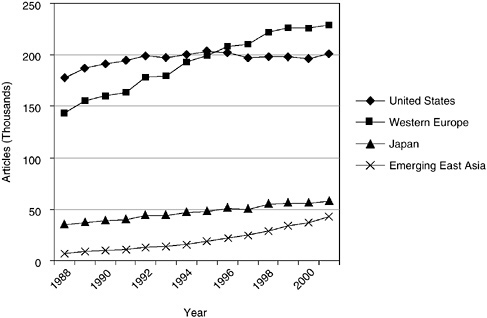
FIGURE 3-2 International authorship trends.
SOURCE: National Science Board. 2004. Science and Engineering Indicators 2004 (NSB 04-1). Arlington, VA: National Science Foundation, Table 5-30. Note that internationally co-authored articles were counted more than once, for each country represented on the author list.
Union (EU) 15 countries have published more papers than the United States, and the gap in citations has been closing steadily.10 Since 1993, the EU has matched the United States in citations in the physical sciences, engineering, and mathematics but still lags in the life sciences.11 The reason for this development remains unknown, but it is more likely due to an increase in the quality and quantity of research abroad than to a decrease in the quantity of US publications.
International collaboration, as assessed by the number of articles with institutional authors from more than one country, more than doubled from 1988 to 2001, leading to an increase from 8 percent to 18 percent of all S&E articles. Even though US institutions participate in most of those collaborations, the US share (but not number) of international papers has fallen since the late 1980s. Collaborative activities between other countries
generally grew more rapidly than those of the United States; this suggests that new centers of activity and collaboration are evolving outside the United States. For example, increased ties between the emerging Asian countries and Western European and other Asian countries have led to a decline in the US share of international publications. China, Russia, and several Eastern European countries are an exception to the general trend, with increased US participation in their international articles.12
What could be the reason for the substantial increase in international collaboration? Many countries have enhanced their scientific capacity and thereby enlarged their pool of potential collaborators by increasing public support for research and development.13 However, collaborations between the scientifically most advanced nations are also on the rise, so that cannot be the only reason. A recent study14 argues that collaborative networks have self-organizing features, a system steered more by individual scientists linking together for enhanced knowledge creation than by structural or policy-related factors. The advantages of collaborations leading to highly cited research articles motivate the urge to collaborate. Consequently, researchers compete with each other for collaborations with the most highly visible and productive scientists in their fields, in their own country or abroad. Facilitating global collaboration could have a considerable impact on knowledge creation and has been promoted, for example, by the EU Framework requirements.
RISING MOBILITY AND BRAIN DRAIN
Students have been leaving their home countries in search of academic opportunities abroad for thousands of years.15 For scientists and engineers, the trend gained importance with the rise of universities and the need for formal training unavailable at home. As early as the late 19th century, many Americans were drawn abroad to German universities to gain expertise in fast-growing new technical fields.16 In the following decades, that
trend gradually reversed as US universities gained technical strength and attracted both faculty and students. US universities also benefited from an influx of educated refugees fleeing war-torn Europe during and after World War II.
The globalization of S&E is facilitated by rising international mobility. Political instability, economic changes, and many other factors encourage students to travel abroad for their education, and for many the United States is the destination of choice. China implemented an opening-up policy in 1978 and began sending large numbers of students and scholars abroad to gain skills necessary for the country’s economic and social development.17 Oil profits in Nigeria and other counties support overseas education for thousands of students. In the wake of the Cold War, students and scholars from formerly Communist nations swelled the international flow. India liberalized its economy in 1991 and started encouraging students to go abroad for advanced education and training. Since 2001, the Indian government has been providing money (in FY2005, $5 billion) for “soft loans” to students who wish to travel abroad for their education, and the number of students going abroad increased by 7 percent.18 In 2002, India surpassed China as the major sender of graduate students to the United States.19
The United States has benefited from the inflow of talented students and scholars. Migrants to the United States tend to be more educated than the average person in the sending country, and the proportion of highly educated people who emigrate is high.20 Many people believe that emigra
|
|
studies adequate to the needs of a rising industrial nation, and was a standing challenge to create one. The efforts to fill this gap in American higher education were generously supported by America’s economic expansion, particularly by the private individuals who had acquired great wealth in the decades after the Civil War, many of whom had gained a vision of what might be done from their studies in the German universities.” |
|
17 |
Cui Ning. 2004. “Record number of scholars headed abroad.” China Daily (December 22). The China Scholarship Council provides information on student flows, state scholarships, financing, and exchange programs. See http://www.csc.edu.cn. |
|
18 |
R. A. Mashelkar, Director General of the Council of Scientific and Industrial Research, comments to committee, 30 November 2004. See also R. A. Mashelkar, 2005. “India’s R&D: Reaching for the top.” Science 307:1415-17. |
|
19 |
2004 Open Doors Report. New York: Institute for International Education. Available at http://www.iiebooks.org/opendoors2004.html. |
|
20 |
See discussion of emigration rates and brain drain in Thomas Straubhaar. 2000. International Mobility of the Highly Skilled: Brain Gain, Brain Drain, or Brain Exchange? (HWWA Discussion Paper 88). Hamburg Institute of International Economics. Available at http://opus.zbw-kiel.de/volltexte/2003/695. |
tion of the technically skilled—“brain drain”—is detrimental to the country of origin. Some effects on the sending country described by scholars are higher domestic wages, lost economies of scale, reduction in specialized skills, and slower resource reallocation to learning-intensive sectors.21 Others argue that the migration of scholars benefits both sending and receiving countries, providing access to leading research and training not available in the home country and creating transnational bridges to cutting-edge research.22 In general, the concept of “brain drain” may be too simplistic inasmuch as it ignores many benefits of emigration, including remittances, international collaborations, the return of skilled scientists and engineers, diaspora-facilitated international business, and a general investment in skills caused by the prospect of emigration.23 Some researchers argue that, as the R&D enterprise becomes more global, “brain drain” should be recast as “brain circulation”24 and include the broader topics of the international circulation of thinkers, knowledge workers, and rights to knowledge.25 Such a discussion would include issues of local resources; many countries lack the educational and technical infrastructure to support advanced education, so aspiring scientists and engineers have little choice but to seek at least part of their training abroad, and in many instances such travel is encouraged by governments.
|
21 |
Mihir A. Desai, Devesh Kapur, and John McHale. 2005. “The fiscal impact of the brain drain: Indian emigration to the U.S.” Journal of Development Economics (in press). |
|
22 |
Jin Xiaoming, Minister, Science and Technology Office, Embassy of the People’s Republic of China, comments to committee, 12 November 2004. See also Joint Japan/World Bank Graduate Scholarship Program Tracer Study IV. Washington, DC: World Bank. September 2004, available at http://www.worldbank.org/wbi/scholarships/. |
|
23 |
Devesh Kapur and John McHale. 2005. “Sojourns and software: Internationally mobile human capital and high-tech industry development in India, Ireland, and Israel.” In: From Underdogs to Tigers: the Rise and Growth of the Software Industry in Israel, Ireland and India, eds. A. Arora and A. Gambardella. Oxford, UK: Oxford University Press. |
|
24 |
OECD. 2002. International Mobility of the Highly Skilled (Policy Brief 92 2002 01 1P4). Washington, DC: OECD. Available at http://www.oecd.org/dataoecd/9/20/1950028.pdf. |
|
25 |
Bogumil Jewsiewicki. 2003. The Brain Drain in an Era of Liberalism. Ottawa, ON: Canadian Bureau for International Education. Using Québec as a case study, Jewsiewicki considers the individual’s right to choose his or her own career path and the rights of communities to protect their collective investment. He focuses on African and ex-Soviet-bloc academics who discuss their motivations for remaining in Canada. Also see Karine Tremblay. 2004. “Links between academic mobility and immigration.” Symposium on International Labour and Academic Mobility: Emerging Trends and Implications for Public Policy, Toronto, October 22. Tremblay notes that the percentage of foreign students on OECD campuses rose by 34.9 percent on average between 1998 and 2002 and by 50 percent or more in the Czech Republic, Iceland, Korea, New Zealand, Norway, Spain, and Sweden. In absolute terms, more than 450,000 new individuals crossed borders to study in an OECD country during this short period, raising the number of foreign students enrolled on OECD campuses to 1,781,000. |
Supporting the concept of brain circulation is the finding that ethnic networks developed in the United States by international students and scholars help to support knowledge transfer and economic development in both the United States and the sending country. An analysis of patent citations supports the existence of a diaspora effect. One study shows that as the numbers of Indian students and researchers in the United States has increased, the number of US patents issued to ethnic Indians has risen even faster, from 651 (0.9 percent of total) in 1976 to 5,334 (3.2 percent) in 2000.26 Not only are international researchers contributing to the US S&E enterprise, there is also knowledge diffusion through ethnic channels, with positive economic effects on the sending country.27
RISING GLOBAL CAPACITY FOR HIGHER EDUCATION
In concert with increased international mobility is an increased capacity on the part of countries other than the United States to provide higher education. As countries develop knowledge-based economies, they seek to reap more of the benefits of international educational activities, including strong positive effects on GDP growth.28 One strategy used by emerging economies, such as India and China, is to couple education-abroad programs with strategic investments in S&E infrastructure—in essence pushing students away to gain skills and creating jobs to draw them back.29 Other countries, particularly in Europe, are trying to retain their best students and also to increase quality and open international access to their own higher educational institutions. An additional element creating competition for US
|
26 |
Ajay Agrawal, Devesh Kapur, and John McHale. 2004. Defying distance: examining the influence of the diaspora on scientific knowledge flows. The Fourth Annual Roundtable on Engineering Entrepreneurship Research Conference (REER), December 3-5, 2004, Atlanta, GA. Available at http://mgt.gatech.edu/news_room/news/2004/reer/files/agrawal.pdf. |
|
27 |
William Kerr. 2004. Ethnic Scientific Communities and International Technology Diffusion. Working paper. Available at http://econ-www.mit.edu/faculty/download_pdf.php?id=994. |
|
28 |
The Conference Board of Canada. 1999. The Economic Implications of International Education for Canada and Nine Comparator Countries: A Comparison of International Education Activities and Economic Performance. Ottawa, ON: Department of Foreign Affairs and International Trade. Also see AnnaLee Saxenian. 1999. Silicon Valley’s New Immigrant Entrepreneurs. San Francisco: Public Policy Institute, p. 3. Available at http://www.ccisucsd.org/PUBLICATIONS/wrkg15.PDF. |
|
29 |
R. A. Mashelkar, Director General of the Council of Scientific and Industrial Research, comments to committee, November 30, 2004; Laudeline Auriol. 2004. “Why do we need indicators on careers of doctorate holders?” (DSTI/EAS/STP/NESTI/RD(2004)15). OECD Workshop on User Needs for Indicators on Careers of Doctorate Holders, September 27, 2004, Paris. Available at http://www.olis.oecd.org/olis/2004doc.nsf. |
institutions is the growth of US branch campuses in other countries. The focus of these campuses is generally on undergraduate and professional education, so their impact on the enrollment of international S&E graduate students is minor at this point.
Asia
Only recently has economic development in Asia been linked to higher education. Countries with the most economic success—Japan, South Korea, Singapore, Taiwan, and, more recently, China—have also invested heavily in literacy and in primary and secondary education. As literacy expanded and the middle class developed in the 1980s, demand for higher education increased.30 As economies have developed, Asian countries have started to invest in higher education and have increased their gross domestic expenditures on R&D (see Figure 3-3). Their investments are reflected by growth in numbers of researchers, papers listed in the Science Citation Index, patents awarded, and doctoral degrees awarded.31
In China, a key ingredient of the S&E enterprise has been the transfer of technical people.32 Most of the leading researchers and research managers in China have had experience studying in the United States. The Chinese Science Foundation is modeled on the US National Science Foundation, and peer-review standards and startup packages for junior faculty are also modeled on US standards.33 As evidence of the growing capacity of China to
|
30 |
Philip G. Altbach. 2004. “The past and future of Asian universities.” In: Asian Universities: Historical Perspectives and Contemporary Challenges, eds. P. G. Altbach and T. Umakoshi. Baltimore, MD: Johns Hopkins University Press, pp. 13-32. |
|
31 |
Diana Hicks. 2004. “Asian countries strengthen their research.” Issues in Science and Technology 20:75-78. Available at http://www.issues.org/issues/20.4/realnumbers.html. The author notes that the number of doctoral degrees awarded in China has increased 50-fold since 1986. “Although in many countries cultural and economic barriers still hamper scientific achievement, foreign science policy goals are clear. Thus, hurdles are likely to be overcome, and scientific progress is likely to accelerate. US scientists will face intensified competition for the best students, corporate research support, space to publish in the top journals, and patents. Inevitably, this will reduce the perceived achievements of younger generations of US scientists. Although they will work far harder than previous generations, they will not command the same dominating position in world science as did their predecessors.” |
|
32 |
Weifang Min. 2004. “Chinese higher education: The legacy of the past and the context of the future.” In: Asian Universities: Historical Perspectives and Contemporary Challenges, eds. P. G. Altbach and T. Umakoshi. Baltimore, MD: Johns Hopkins University Press, pp. 53-84; Denis Fred Simon, 2004. “Foreign R&D and the impact of globalization on China’s emerging technological trajectory.” Presentation at AAAS S&T Policy Forum, April 2004, Washington, DC. Available at http://www.aaas.org/spp/rd/simon404.pdf. |
|
33 |
Jin Xiaoming, Minister, Science and Technology Office, Embassy of the People’s Republic of China, comments to committee, November 12, 2004; Executive Summary, DTI Global Watch Stem Cell Mission, September 2004. Available at http://www.globalwatchonline.com/mission/tmsmrep.aspx#life. The DTI Global Watch Mission visited China, Singapore, and South Korea in September 2004 to evaluate scientific excellence and evaluate opportunities for scientific and commercial collaboration. |
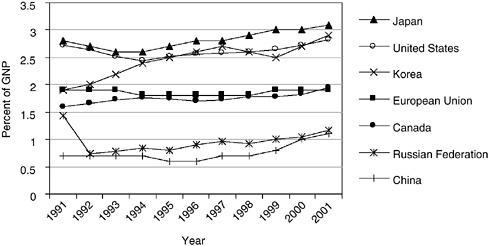
FIGURE 3-3 Expenditure for research and development as percentage of gross national product, 1991–2001.
SOURCE: OECD. 2002. Main Science and Technology Indicators. Paris: Organisation for Economic Co-operation and Development.
provide advanced S&E training, 7,300 doctoral degrees were awarded in China in 2000, a 50-fold increase since 1986.34 An estimated 58 percent of all degrees awarded in 2002 were in engineering and the physical sciences.35
China is also beginning to attract substantial numbers of international students to its own universities.36 For example, at universities in Shanghai,
|
34 |
Hicks. 2004. Ibid. |
|
35 |
“President’s science council says future health of technology sector is in jeopardy; decline of manufacturing could impact innovation ‘ecosystem’.” Manufacturing & Technology News, 10(18), October 3, 2003. Available at www.manufacturingnews.com/news/03/1003/art1.html. |
|
36 |
Urmi A. Goswani. 2005. “India fails to mature into learning hub.” Economic Times (January 13). Available at http://economictimes.indiatimes.com/articleshow/msid-98027,prtpage-1.cms; and Cui Ning. 2004. “Record number of scholars headed abroad.” China Daily (December 22). Ning reports that from 1978 to 2003, China received a total of 620,000 international students. In 2003, China received 78,000 students from 175 countries or regions, who studied primarily liberal arts, medical science, engineering, science, and agronomy. Most students come from the Republic of Korea, Japan, the United States, Viet Nam, and Indonesia. Available at http://www.chinadaily.com.cn/english/doc/2004-12/22/content_042422.htm. |
more than 19,000 overseas students enrolled in degree courses or short-term training from January to September 2004—a 40 percent increase over the previous year. Still not well developed are opportunities for postdoctoral training.37
There are indications that Chinese scholars who were trained in the United States are increasingly considering returning to their home country.38 A recent survey reported that more mainland Chinese who had studied S&E abroad planned to return home in anticipation of good career opportunities.39 If such plans materialize, they will represent a huge shift from the existing 96 percent stay rate among Chinese doctorate recipients in the United States.40 Similar shifts appear to be occurring in India and Taiwan as these countries build up their industrial and educational infrastructure.
Enthusiasm for S&E in Asia appears in many kinds of statistics. For example,
-
For the last three decades, about one-third of US college students have earned their first university degrees in S&E; corresponding recent figures are considerably higher for China (59 percent in 2001), South Korea (46 percent in 2002), and Japan (66 percent in 2001).41
-
Asian countries have designed policies and incentives intended to retain their highly trained personnel, bring them home after training, and otherwise benefit from the skills they acquire in other nations, chiefly the United States.42
|
37 |
“Focus on Asia-Pacific.” DTI Global Watch Magazine, November 2004; Executive Summary, DTI Global Watch Stem Cell Mission, September 2004. Available at http://www.globalwatchonline.com/mission/tmsmrep.aspx#life. |
|
38 |
Sam Dillon. 2004. “U.S. slips in attracting the best students.” New York Times (Dec. 21), p. A-1. |
|
39 |
The survey, conducted by the Chinese Youth Federation and two newspapers in Beijing, polled 3,097 people in October and November 2004. Available at http://www.straitstimes.com/sub/asia/story/0,5562,291279,00.html? |
|
40 |
Michael G. Finn. 2003. Stay Rates of Foreign Doctorate Recipients from US Universities, 2001. Oak Ridge, TN: ORISE. |
|
41 |
National Science Board. 2004. Science and Engineering Indicators 2004 (NSB 04-1). Arlington, VA: National Science Foundation, p. 2-35. The consistent trend masks considerable variation by field. See Fig. 2-11, available at http://www.nsf.gov/sbe/srs/seind04/c2/fig0211.htm. |
|
42 |
Jen Lin-Liu. 2002. “Brain gain in Taiwan.” The Chronicle of Higher Education (October 18); National Science Board. 2004. Science and Engineering Indicators 2004 (NSB 04-1). Arlington, VA: National Science Foundation, Chapter 4; Jin Xiaoming, minister, Science and Technology Office, Embassy of the People’s Republic of China, comments to committee, November 12, 2004; R. A. Mashelkar, director general, Council of Scientific and Industrial Research, New Delhi, comments to committee, November 30, 2004. |
-
India, through its National Policy on Education (1986) and the New Science and Technology Policy (2003), has focused on R&D and education in S&T. Between 1980 and 2000, Indian S&T doctorate-degree production increased from 2,973 to 5,725.43
-
China and South Korea are raising their overall S&E spending relative to that of Organisation for Economic Co-operation and Development (OECD) members (see Figure 3-3).
-
Asian countries—led by Japan, South Korea, and Taiwan—accounted for over 25 percent of high-technology exports in 2001, up from about 15 percent in 1990.44
Europe
The number of young Europeans attracted to careers in S&E is decreasing, and many of the students and researchers who do specialize in S&E emigrate to the United States.45 To counter that trend and build their S&E workforces, European nations have been working together to internationalize policies and enhance student mobility to “facilitate the creation of a genuine European scientific community.” In 1999, the Bologna Declaration laid out a system to harmonize undergraduate- and graduate-degree requirements among EU member countries. To make Europe the most competitive knowledge-based economy in the world, EU governments were urged to raise S&E spending to 3 percent of gross domestic product by 2010.46 The EU has enacted a “mobility plan” to improve research training, foster collaboration, and increase incentives for knowledge transfer
|
43 |
Laxman Prasad. 2004. Employment characteristics of PhD holders in the field of science and technology: Indian experience (DSTI/EAS/STP/NESTI/RD(2004)23). OECD Workshop on User Needs for Indicators on Careers of Doctorate Holders, September, 27, 2004, Paris. Available at http://www.olis.oecd.org/olis2004doc.nsf/. |
|
44 |
National Science Board. 2004. Science and Engineering Indicators 2004 (NSB 04-1). Arlington, VA: National Science Foundation, Figure 6-9. |
|
45 |
In 2000, the EU was ahead of the United States and Japan in the production of S&E graduates. As a proportion of PhDs per 1,000 population aged 25-34, the EU-15 had an average of 0.56, the United States had 0.48 and Japan had 0.24. However, the decline in the number along with the emigration of EU-15 S&E graduates is creating a restriction for European R&D. In the late 1990s, the European S&E workforce accounted for 5.4 per thousand workers, vs. 8.1 per thousand in the United States and 9.3 in Japan. European Commission. 2002. Towards a European Research Area. Science, Technology, and Innovation, Key Figures 2002. Brussels: European Commission, pp. 36-38. Available at ftp://ftp.cordis.lu/pub/indicators/docs/ind_kf2002.pdf. |
|
46 |
Robert M. May. 2004. “Raising Europe’s game.” Nature 430:831; and Philippe Busquin. 2004. “Investing in people.” Science 303:145. |
between academe and industry.47 Some examples are the Erasmus and Marie Curie Programmes, designed to create cross-border research opportunities for European and non-European undergraduates, graduate students, and postdoctoral scholars.48
Other EU countries, especially those with developed S&E capacity, have implemented strategies to facilitate retention and immigration of the technically skilled. Several OECD countries have relaxed their immigration laws to attract high-skilled students and workers. Some are increasing growth in their international-student populations and encouraging these students to apply for resident status.49 For example,
-
The United Kingdom has implemented a points-based Highly Skilled Migrant Programme on a pilot basis and since the middle 1990s has increased the number of work permits issued to skilled workers.50
-
In 2000, Germany introduced a “green card” program for information-technology (IT) specialists, with plans to issue 20,000 of these visas per year. The card authorizes a holder to engage in unrestricted employment in Germany for 5 years.51
-
The Irish government places potential immigrants who are skilled
|
47 |
Commission of the European Communities, 2001. A Mobility Strategy for the European Research Area (COM 2001 331 final). Communication from the Commission to the Council and the European Parliament, Brussels, June 20, 2001. Reasons cited by European-born scientists and engineers for wanting to work in the United States included broader work opportunities, better access to leading technologies, and higher salaries. Available at http://europa.eu.int/eur-lex/en/com/cnc/2001/com2001_0331en01.pdf. |
|
48 |
Mary Kavanaugh, counselor, science, technology, and education, European Union, Delegation of the European Commission, presentation to the committee, October 11, 2004. But see Maziar Nekovee, “Obstacles to mobility in Europe: Young mobile researchers meet EC policy-makers in Crete.” Science’s Next Wave, November 30, 2000. Available at http://nextwave.sciencemag.org/cgi/content/full/2000/11/02/13?ck=nck. |
|
49 |
Karine Tremblay. 2004. Links between academic mobility and immigration. Symposium on International Labour and Academic Mobility: Emerging Trends and Implications for Public Policy, Toronto, October 22. |
|
50 |
Devesh Kapur and John McHale. 2002. “Sojourns and software: Internationally mobile human capital and high-tech industry development in India, Ireland, and Israel.” In: From Underdogs to Tigers: the Rise and Growth of the Software Industry in Israel, Ireland and India. Oxford, UK: Oxford University Press. |
|
51 |
Green Card Germany Web site http://www.green-card-germany.com/; Robert Metzke, “WANTED: 75,000 IT Pros—Germany Considers Green Card Model.” Science’s Next Wave, March 3, 2000. Available at http://nextwave.sciencemag.org/cgi/content/full/2000/03/02/6; also see discussion of green cards and brain drain in Thomas Straubhaar. 2000. International Mobility of the Highly Skilled: Brain Gain, Brain Drain, or Brain Exchange (HWWA Discussion Paper 88). Hamburg: Institute of International Economics. Available at http://opus.zbw-kiel.de/volltexte/2003/695. |
-
workers in IT and biotechnology on a fast track to facilitate intracompany transfers.52
-
The European Science Foundation has developed a publication to bring together information on funding for new principal investigators.53
-
Several EU countries and the EU itself have launched programs to facilitate networking among students and researchers working abroad, providing contact information, collaborative possibilities, and funding and job opportunities in the EU. The Deutsche Akademischer Austausch Dienst (DAAD) has launched GAIN,54 the Italian Ministero degli Affari Esteri has launched DAVINCI,55 and the EU has its Researcher’s Mobility Portal.56
Barriers to mobility persist in some European countries, although they are being noted and criticized by those who favor freer flows of scientists and engineers. For example, 29 percent of foreign researchers surveyed recently in Italy reported “high difficulties” with visas, work permits, and other administrative paperwork. Likewise, the efforts of France to recruit highly skilled S&E talent are said to be held back by a “discouraging landscape of administrative convolution, heavy taxes, and inflexible labor legislation”.57 A recent report indicates that the EU is working to improve its procedures for the admission of third-country nationals to perform scientific research.58
GLOBAL COMPETITION FOR GRADUATE STUDENTS AND POSTDOCTORAL SCHOLARS
The United States is still by far the leading host country for international students, enrolling some 586,000 foreign-born graduate and under-
|
52 |
Expert Group on Future Skill Needs. 2004. A Model to Predict the Supply and Demand for Researchers and Research Personnel in Line with Ireland’s Strategy for Contributing to the European Research Area’s 3 percent Initiative. Dublin: Forfás. Available at http://egfsn.forfas.ie/press/reports/pdf/egfsn040906_research_skills_report.pdf. |
|
53 |
Dominique Martin-Rovet. 2003. Opportunities for Outstanding Young Scientists in Europe to Create an Independent Research Team. Strasbourg: European Science Foundation. |
|
54 |
German Academic International Network Web page, http://www.gain-network.org. |
|
55 |
Database accessible via the Internet and listing Italian researchers that are not residing in Italy webpage, http://www.esteri.it/davinci/index.asp?lang=eng. |
|
56 |
Researcher’s Mobility Portal Web page, http://europa.eu.int/eracareers/index_en.cfm. |
|
57 |
Commission of the European Communities; Snapshots ‘Brain drain study.’ Available at http://europa.eu.int/comm/research/era/pdf/indicators/snap6.pdf. |
|
58 |
Commission of the European Communities. 2004. On the Admission of Third-Country Nationals to Carry Out Scientific Research in the European Community (COM(2004) 178 final) Brussels: Commission of the European Communities. |
graduate students, more than one-fourth of the world’s total.59 US academic institutions and government laboratories have traditionally attracted high-caliber international graduate students and postdoctoral trainees by providing top-notch research facilities, generous graduate-student scholarships, and student and work visas.60
However, the United States must take into account the fact that there is increasing international competition to recruit the best students, particularly in countries where English is the dominant language.61 A National Science Board (NSB) task force noted that “global competition for S&E talent is intensifying, such that the United States may not be able to rely on the international S&E labor market to fill unmet skill needs.”62 The growth rate of the US S&E labor force would falter if the United States became less successful at attracting immigrant and temporary nonimmigrant scientists and engineers.63
How Can the United States Continue to Attract the Best Domestic and International Students and Scholars?
With the increasing competition among countries for international students, there is keen interest in why those students choose to study abroad
|
59 |
Simon Marginson. 2004. “Australian higher education: National and global markets.” In: Markets in Higher Education–Rhetoric or Reality? eds. P. Taxiera, B. Jongbloed, D. Dill, and A. Amaral. Dordrecht, The Netherlands: Kluwer, pp. 207-240. |
|
60 |
In a 2004 study of Deutsche Forschungsgemeinshaft (DFG) stipend holders, 72 percent used their award to do postdoctoral training abroad, and of these 66.3 percent went to the United States. Reasons given for choosing the United States included funding, access to equipment, ability to pursue cutting-edge research, research independence, career opportunities in academe and industry, and collaborative opportunities. Jurgen Enders and Alexis-Michel Mugabushaka. 2004. Wissenshaft und Karriere: Ehrfahrungen und Werdegange ehemahleiger Stipendiaten der DFG. Bonn: Forschungsgemeinshaft. Available at http://www.dfg.de/dfg_im_profil/zahlen_und_fakten/statistisches_berichtswesen/stip2004/. |
|
6 |
The Asia-Pacific nations include three of the four largest nations (China, India, and Indonesia) and 10 of the world’s 16 cities with populations over 10 million, representing huge concentrations of present and future demand for education. In 2002, almost half the 1.6 million international students worldwide were students from Asian-Pacific countries who invested in education in OECD nations. Majority-English-speaking language countries (MESLCs) enrolled 71.6 percent of all international students from Asia in 2001. OECD. 2003. Education at a Glance. Paris: OECD. It should be noted that there are different contexts for flows to non-MESLCs; for example, a different set of circumstances determine flows between French-speaking countries. See Todd Davis. 2003. Atlas of Student Mobility. New York: Institute of International Education. |
|
62 |
National Science Board. 2003. The Science and Engineering Workforce: Realizing America’s Potential (NSB 03-69). Arlington, VA: National Science Foundation. |
|
63 |
National Science Board. 2004. Science and Engineering Indicators 2004 (NSB 04-1). Arlington, VA: National Science Foundation, p. 3-39. |
and how they then choose destinations and institutions for study abroad.64 The decision of graduate students and postdoctoral scholars to go abroad for study is a combination of “push” and “pull” factors.65 Under conditions of increasing capacity among traditional sending countries, the ability of the United States to continue to attract the best students will increasingly depend on its pull factors,66 including quality, job opportunities, convenience, and perception of being a welcoming place.
Push factors are features of the home environment that are viewed by prospective students as unsatisfactory, such as
-
Limited economic wealth.
-
Low involvement in the world community.
-
Few world-class institutions.
-
Few doctoral and postdoctoral programs.
-
No availability of a particular specialty.
-
Limited access to funding, especially for junior investigators.
-
Poor career prospects.
-
Adverse social or political conditions.
Pull factors are desirable features of a destination country, such as
-
Better academic facilities.
-
Better financial support.
-
Prestige of a foreign degree.
-
Social links and personal recommendations.
-
Life in an ethnically diverse culture.
-
Better working conditions.
-
Better opportunities for employment.
-
Willingness of employers to hire well-qualified foreigners.
-
Higher salaries, including academic salaries.
An especially strong US pull factor for graduate students and postdoctoral scholars has been the large increase in research funds, due primarily to growth in the National Institutes of Health budget (see discussion in Chapter 2). Strong job prospects in this country are another strong pull factor.67 An indicator of job expectations for international graduate students who earned degrees in the United States is the stay rate. In 2001, the percentage of temporary residents who had received PhDs and remained in the United States ranged from 26 percent to 70 percent, depending on the field of the doctorate. This rate has been increasing in recent years68 (see Figure 1-19). Decisions to return and career outcomes for international graduate students and scholars have been the subject of recent studies.69
International and domestic students have different motivations and experience different opportunity costs in pursuing graduate education. Both experience the long time to degree and delayed entry into an independent position. However, especially for students from developing countries, a graduate degree confers a potential to gain employment in the United States that in most cases is otherwise unavailable.70 Domestic students are not restricted in entering the job market at an earlier stage, and many opt out of graduate education because they can obtain gainful employment without it. It is difficult to measure economic rewards in careers that require a long training period, but one study indicates that the lost earnings for those students who undergo graduate training in life sciences are about $25,000 per year of working life compared with other S&E fields and $62,000 per year of working life compared with professions that do not require as long a training period, such as law.71 Such professions are not easily accessible to international students.
Most postdoctoral scholars, regardless of residence, would prefer to stay in the United States after their training (see Figure 1-21). Similarly, as
|
67 |
Philip G. Altbach, “Higher education crosses borders: Can the United States remain the top destination for foreign students?” Change. March/April 2004. See also B. Bratsburg. 1995. “The incidence of non-return among foreign students in the United States.” Economics of Education Review 14(4):373-83. |
|
68 |
Finn. 2003. Ibid. |
|
69 |
Deepak Gupta. 2004. “The return choice and careers of foreign-born U.S. S&E Ph.D.s.” Doctoral dissertation. Berkeley: University of California; and DOE/NSF Nuclear Science Advisory Committee. 2004. A Status Report and Recommendations for the Beginning of the 21st Century. Washington, DC: Department of Energy and National Science Foundation. |
|
70 |
Barry R. Chiswick. 2000. Are Immigrants Favorably Self-Selected? An Economic Analysis (IZA DP No. 131). Hamburg: Forschungsinstitut zur Zukunft der Arbeit. |
|
71 |
Richard B. Freeman, Eric Weinstein, Elizabeth Marincola, Janet Rosenbaum, and Frank Solomon. 2001. Careers and Rewards in Biosciences. Washington, DC: American Society for Cell Biology. Available at http://www.ascb.org/publications/competition.html. |
many as one-third of European visitors to the United States on H-1b visas are thought to stay on permanently.72 Those rates can be altered by the innovative programs designed by sending countries to attract students home. For example, in some countries, educational loans are forgiven if the student returns to the home country; others designate a job for the returnee. The return rate is higher among postdoctoral scholars who had been awarded prestigious fellowships.73 Also affecting the return rate are the social ties that a student or scholar has with his or her home country; in many cases, students return home to rejoin family and renew social ties. Those who married while in the United States had a very low return rate.74
Declining Domestic Student Interest in Science and Engineering
The committee heard considerable discussion about an apparent decline in interest in S&E careers among US-born students. Graduate-student enrollments are counter-cyclical to economic cycles and show strong field differences (see Figures 1-1 and 1-2). In 2002, in a weak US economy, full-time enrollment in S&E graduate programs reached a new all-time high of 378,800; first-time enrollment also reached a new peak of 104,200. The number of postdoctoral appointments in S&E reached a total of 38,316, also an all-time high.75 Enrollment trends differ for domestic and international graduate students. Enrollment of US citizens and permanent residents increased more slowly during the 1980s than did enrollment of temporary visa holders and declined from 1994 to 2000. Enrollment in 2002 was 6 percent below the peak year of 1993—a year in which many Chinese students on temporary visas were converted to permanent residents under the Chinese Student Protection Act. The enrollment of S&E graduate students who were US citizens or permanent residents rose by 15,500 in 2002, second only to the 17,100 gain in 1992.76
|
72 |
Commission on the European Communities. 2004. Snapshot: Brain Drain Study. Available at http://europa.eu.int/comm/research/era/pdf/indicators/snap6.pdf. |
|
73 |
Jurgen Enders and Alexis-Michel Mugabushaka. 2004. Wissenshaft und Karriere: Ehrfahrungen und Werdegange ehemahliger Stipendiaten der DFG. Bonn: Deutsche Forschungsgemainshaft. The DFG reports return rates of 85 percent among its fellows. |
|
74 |
D. Gupta, M. Nerad, and V. Cerny. 2003. “International Ph.Ds: Exploring the decision to stay or return.” International Higher Education 31(Spring). |
|
75 |
Enrollment numbers include health-science fields; numbers of postdoctoral appointments include health-science fields but not postdoctoral scholars with MD degrees. |
|
76 |
Lori Thurgood. 2004. Graduate Enrollment in Science and Engineering Fields Reaches a New Peak; First-Time Enrollment of Foreign Students Declines (Info Brief 04-326). Arlington, VA: National Science Foundation. |
Among the factors that influence domestic-student interest in graduate work are
-
Faculty encouragement or discouragement of student interest.
-
Relative postdegree job uncertainty compared with business, law, and medical degree programs.77
-
Alternative employment opportunities available to bachelor’s-degree holders; these are influenced in part by the business cycle.
-
Decreased availability of tenure-track positions at universities.
-
Long times to degree, especially in biomedical fields, with an average time to degree of 7.5 years.78
-
The requirement of postdoctoral training
-
Long time to first job or scientific independence.
-
Relatively low stipends during years of graduate and postdoctoral work compared with salaries available in the private sector or in other professions.
The scarcity of permanent positions can be a large disincentive for undergraduates considering a research career and is cited as a major factor for domestic students choosing other fields of study.79 This issue is especially acute in fields where postdoctoral work is a job prerequisite and where academe is the predominant career choice of graduate students and postdoctoral scholars,80 although it is also an issue in fields such as nuclear physics where the predominant career choice is a research position at a
|
77 |
See Howard Garrison, Susan Gerbi, and Paul Kincade. 2003. “In an era of scientific opportunity, are there opportunities for biomedical scientists?” FASEB Journal 17:2169-73. It should also be noted that there is flagging student interest in S&E in Europe and Asia which may be tied to lack of jobs with remunerative opportunities comparable with those in finance and law (see Weifang Min. 2004. “Chinese higher education: The legacy of the past and the context of the future.” In: Asian Universities: Historical Perspectives and Contemporary Challenges, eds. P.G. Altbach and T. Umakoshi. Baltimore, MD: Johns Hopkins University Press, pp. 53-84). |
|
78 |
Doctorate Recipients from United States Universities: Summary Report 2003. The National Opinion Research Center (NORC) conducts the survey for NSF. Available at http://www.norc.uchicago.edu/issues/docdata.htm. |
|
79 |
E. Seymour and N. M. Hewitt. 1997. Talking About Leaving: Why Undergraduates Leave the Sciences. Nashville, TN: Westview Press; R. Freeman et al. 2001. “Competition and Careers in Biosciences.” Science. 294:2293-94. See also the discussion of the effects of lower wages on career decisions in physics in Richard Freeman. 2000. Labor Markets in Action: Essays in Empirical Economics. Cambridge, MA: Harvard University Press. |
|
80 |
National Research Council. 2005. Advancing the Nation’s Health Needs: NIH Research Training Programs. Washington DC: National Academies Press; and National Research Council. 2005. Bridges to Independence: Fostering the Independence of New Investigators in Biomedical Research. Washington, DC: The National Academies Press. |
national laboratory.81 Few career opportunities and a reduced “pull” for scientists and engineers are reflected in lower compensation rates all along the career path.
Studies have suggested ways to encourage US student interest in S&E, including more effective career counseling, closer involvement of the professional S&E communities, placement of limits on time to degree, and better career-data collection and dissemination.82 Such recommendations are likely to be effective to the extent that they take on high national priority in Congress, the Office of Science and Technology Policy, research-intensive federal agencies, and academic institutions.
The present committee was not charged with examining this issue in detail other than to determine whether large numbers of international graduate students and postdoctoral scholars discourage participation of US citizens, either by crowding out (see discussion in Chapter 1) or by creating a noninclusive environment. Relevant data were limited to conflicting anecdotal reports. Some US students reportedly are hesitant to join a graduate research group that consists largely of international students83—this is similar to the “tipping effect” seen in other circumstances.84 Other students regard such a situation as an opportunity to learn about new cultures and develop international collaborations.
Teaching Assistants
The presence of large numbers of international teaching assistants (ITAs) in US higher education has resulted in concerns about their adequate preparation and supervision. The majority of complaints refer to insufficient language and communication skills, as well as cultural differences.85
|
81 |
DOE/NSF Nuclear Science Advisory Committee. 2004. Education in Nuclear Science: A Status Report and Recommendations for the Beginning of the 21st Century. Washington, DC: Department of Energy and National Science Foundation. |
|
82 |
COSEPUP. 1995. Reshaping the Graduate Education of Scientists and Engineers., Washington DC: National Academy Press; COSEPUP. 2000. Enhancing the Postdoctoral Experience for Scientists and Engineers. Washington, DC: National Academy Press. |
|
83 |
Yudhijit Bhattacharjee. 2004. “Settling in on campus.” Science. 304:1282-1284. |
|
84 |
For more on tipping points, see, for example, Eleanor Wolf. 1969. “The tipping point in racially changing neighborhoods.” Journal of the American Institute of Planners 29:217-222; Reynolds Farley, Charlotte Steeh, Tara Jackson, Maria Krysan, and Keith Reeves. 1993. “Continuing racial residential segregation in detroit. ‘Chocolate City, Vanilla Suburbs revisited.’” Journal of Housing Research 4(1): 1-21; Philip Martin. 1999. “Immigration and farm labor: An overview.” Available at http://www.farmfoundatin.org/1999NPPECmartin.pdf. |
|
85 |
L. H. Jacobs and C. B. Friedman. 1988. “Student achievement under foreign teaching associates compared with native teaching associates.” Journal of Higher Education 59(3): 551-563; Joe Rominiecki. 2005. “North Dakota bill addresses student complaint: I can’t understand my prof.” Kansas City Infozine (February 12), http://www.infozine.com/news/stories/op/storiesView/sid/5826/; Scott Stossel. 1999. “Uncontrolled experiment: America’s dependency on foreign scientists.” New Republic (March 29). |
Research into the impact of ITAs on student performance, however, fails to provide a clear-cut picture. Some studies revealed an adverse effect of non-native English-speaking ITAs, but others indicated better student performance. For example, two recent publications examining the impact of ITAs on undergraduate economics instruction came to opposite conclusions.86 In the study that found students were less likely to drop sections led by ITAs, all ITAs had undergone substantive teacher training. Researchers who surveyed talented undergraduates who started out in S&E majors but switched to other fields found no evidence to support the idea that undergraduate attrition from S&E fields was significantly affected by alleged poor tutorial abilities of teaching assistants or linguistic, pedagogic, or social skills of foreign faculty or teaching assistants.87
Demographic Challenges
Demographic trends in the United States indicate challenges in maintaining excellence in the S&E workforce. The S&E workforce is aging; a large number of people who received their degrees in the late 1960s and early 1970s are nearing retirement. The rise of the average age of the S&E doctoral workforce is of concern, given historical evidence that many researchers are more productive in their younger years.88
Japan and the mature industrial nations of Europe, also facing the challenges of an aging and slow-growing population and declining interest in S&E careers among young people, have created programs designed to attract more women and foreign-born students. The United States is dissimilar in that its overall population is growing and its average age is increasing less rapidly than that of the populations of Europe and Japan.89 That may not provide immediate advantage, because the US college-age population will shift toward minority groups, especially Hispanics, blacks, and American Indians and Alaskan natives, whose current participation rates in S&E are half or less of those of white, non-Hispanic students.90
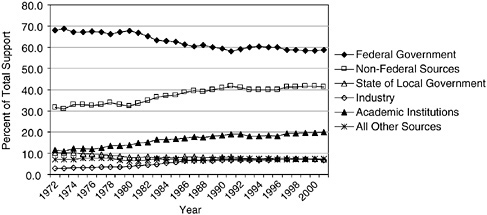
FIGURE 3-4 Percent distribution of US R&D funding, by sector.
SOURCE: National Science Foundation. 2003. Academic Research and Development Expenditures: Fiscal Year 2001 (NSF 03-316). Arlington, VA: National Science Foundation; NSF/SRS, WebCASPAR database system, http://caspar.nsf.gov.
There is some evidence that at least some groups of first-generation Americans may be more likely to enter S&E and this may ease the demographic shift.91
Levels of Public Funding
With the increase in international graduate-student enrollment has come a shift in how that research is funded. R&D funding has risen over the years, but the sectors providing the funding are altering their relative contributions. The proportion of funding for research provided by the federal government has declined from about 70 percent in the 1970s to 60 percent in the 1990s while the proportion provided by academic institutions, business, and nonprofits has increased (see Figure 3-4).
Although decreased availability or stagnation of federal academic research funds disproportionately affects temporary residents and can affect graduate-student enrollments92 (see Figure 3-5), the important role of the
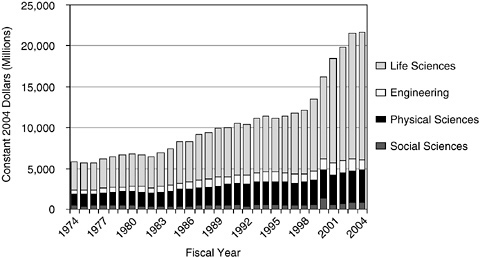
FIGURE 3-5 Federal funding for academic research, 1974-2004.
SOURCE: National Science Board. 2004. Science and Engineering Indicators 2004 (NSB 04-1). Arlington, VA: National Science Foundation.
states in funding academic research is frequently overlooked in Washington, DC. State funding has decreased as a percentage of university revenues, and higher education is receiving a decreasing percentage of state appropriations. Funding by state legislatures provides the teaching assistantships, scholarships, and other forms of aid on which graduate students depend.93 States commonly appropriate funds to universities per full-time student. As seen in Figure 3-6, the amount of funding per student has oscillated over time and currently is in decline. That means that public universities have less funding to support graduate students.
One might expect decreased state support for R&D to have an adverse effect on international enrollments at public universities, especially when such funding supports teaching-assistant positions. However, at least at the graduate level there seems to be no negative correlation. From 2000 to 2002, international graduate-student enrollment increased at public universities and decreased at private universities (see Figure 1-4).
The Entrepreneurial Approach to Higher Education
Some countries have begun to view higher education as a way to generate revenues. For example, after the introduction of market-oriented re-
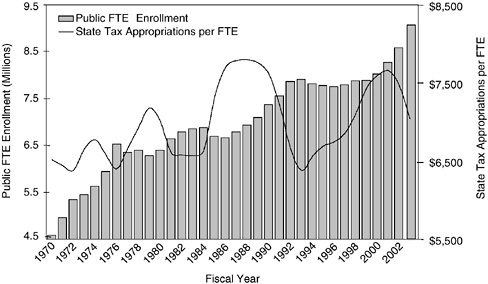
FIGURE 3-6 Enrollment and state tax appropriations per full-time equivalent student (FTE) in constant 2003 dollars.
SOURCE: Paul Lingenfelter. 2004. “The public interest in higher education accountability.” National Accountability Symposium, University of Texas, Austin TX, October 28, 2004. Available at http://www.utsystem.edu/cha/acctsymp2004/. Lingenfelter based his analyses on data from Grapevine and NCES Digest of Education Statistics. The enrollment and appropriations include both graduate and undergraduate education, but exclude medical education.
forms in Australia, the government reduced its per-student support of higher-education institutions. In an effort to maintain financial solvency, universities began to view education as an exportable economic product and to regard students—primarily undergraduates—as consumers. Those consumers are vigorously sought by marketers, advertisers, and salespeople as sources of revenue. A major strategy has been developing offshore programs of Australian universities, which increased from 25 in 1991 to almost 1,600 in 2003. By 2003, the nation was educating about 210,000 international students, or about 20 percent of the number of its own university-level students. Of the 210,000, 70,000 studied in their own countries94 through a combination of “offshore,” “transnational,” or collaborative mechanisms.
For a number of reasons, it is difficult to compare such entrepreneurial educational systems with higher education in the United States, the EU, or Japan. For example, Australia is recruiting tuition-paying undergraduates rather than subsidizing graduate students. For that reason, Australia’s international students are almost all in undergraduate or professional programs, and few of them do research; by one calculation, only about 3 percent were in the OECD “research” category in 2004.95 The entrepreneurial approach has also been criticized for failing to improve the research quality of faculty, and thus for causing an apparent decline in the quality of published research, and for placing proportionately less emphasis on teaching than on such activities as recruitment.96
INTEGRATING SCIENCE AND ENGINEERING POLICY WITH FOREIGN POLICY
An aspect of S&E strength deserving brief mention is the challenge in integrating scientific research and educational policies with foreign policy. A familiar, if only occasional, overlap between scientific and foreign policy has been seen in the realm of “big science” such as the multinational particle accelerators and detectors at CERN, large telescopes, and international ocean and geophysical projects. Negotiating big science is seldom easy, partly because of the obvious differences between the realms of science and large-scale political structures. Among the most obvious is that many intergovernment research activities are “top-down,” established and monitored by government officials, whereas most research collaborations are “bottom-up,” with scientists choosing partners and applying to government for research support. Traditional research linkages create what were long ago called “invisible colleges”97 of practitioners, below the radar of policymakers. As the globalization of S&E progresses, a better understanding of how to integrate top-down and bottom-up cooperation is needed if nations are to maximize the benefits of their investments in S&E.98 Scien-
tists and engineers trained to work between cultures may be increasingly important as these negotiations proceed, and US students may benefit from overseas postgraduate training and research experience.99
CONCLUSION
Many educational and employment sectors and government agencies have an investment in the activities of international graduate students and postdoctoral scholars, so it is not surprising that the United States has no single government strategy for addressing their activities. The research universities themselves have much to consider. In general, they have invested heavily in the practice of staffing their laboratories and classrooms with graduate students and postdoctoral scholars, about half of whom are temporary residents. As seen in Chapter 2, some of the current policies that most directly influence international flows of scientists and engineers are shaped by concerns over national security and stability considerations rather than by scientific issues: Will this student visitor cause any harm while in the United States? Will that exchange scholar develop or take home knowledge that can be used against US interests?
Clearly, the nation needs flexible policies to deal with international students and scholars, a population that, although small, appears to be highly productive and beneficial. However, to craft effective policies, the federal agencies require a better understanding of the impact of international scientists and engineers on US research and education, economic competitiveness, national security, foreign policy, and international relations.100 The most reasonable approach is likely to be evolutionary, as policymakers in government, academe, and industry grapple more directly with the questions and findings of the many sources cited in this report.
The primary focus should be on maintaining research excellence. The United States must encourage and attract the most talented people. While continuing to attract the best talent worldwide, the United States should make every effort to encourage domestic student interest in S&E programs and careers. That will require efforts on the part of the faculty to encourage students and the federal government to provide funding for such students to do graduate research.
|
|
and Public Policy 29(6):409-17; David King. 2004. “The scientific impact of nations.” Nature 430:311-16. |


