
Introduction
“For the government and private sector to work together on increasing homeland security, effective public-private partnerships and cooperative projects must occur.”
Making the Nation Safer: The Role of Science and Technology in Countering Terrorism
National Research Council, 2002
PUBLIC-PRIVATE PARTNERSHIPS IN THE WAR ON TERROR
The National Academies’ response to the threat of terrorism has been to bring the nation’s great strength in science and technology to bear on protecting the United States.1 In its June 2002 report, Making the Nation Safer: The Role of Science and Technology in Countering Terrorism, the National Academies recommended that effective public-private partnerships must occur for the government and private sector to work together on increasing homeland security.2 Following on this recommendation, the National Academies’ Committee on Government-Industry Partnerships for the Development of New Technologies, led by Gordon Moore, drew together the findings of its four-year study at its final conference to explore how partnerships can contribute to the nation’s present war on terror. This chapter introduces the main points of that conference. The conference proceedings are summarized in the next chapter.
Partnerships are cooperative relationships involving government, industry, laboratories, and (increasingly) universities organized to encourage innovation and commercialization. Partnerships come in many forms, including industry con-
|
Box A:
|
sortia, innovation awards, and university and laboratory-based science and technology clusters. The Committee found that such public-private partnerships, when properly crafted, can help usher in the development of new processes, products, and services. With well-managed partnerships, the government can realize missions in health, environmental protection, and national security, often leveraging lower cost or more effective technologies.3
Appropriately structured partnerships can also serve as a policy instrument that aligns the incentives of private firms to achieve national missions without compelling them to do so. As the 2002 National Academies report on countering terrorism notes, “A more effective approach is to give the private sector the widest possible latitude for innovation and, where appropriate, to design R&D strategies in which commercial uses of technologies rest on a common base of investment. Companies then have the potential to address vulnerabilities while increasing the robustness of public and private infrastructure against unintended and natural failures, improving the reliability of systems and quality of service, and in some cases, increasing productivity.”4
A Tested Policy Tool to Enhance National Security
This cooperative public-private approach is not new, as Dr. Moore concluded in his conference presentation, noting that partnerships have “helped us to meet some of our national missions; they’ve been used effectively since the founding of our country; and our studies have identified some useful features in producing results. The appropriate thing now is to apply what we’ve learned to meet the challenges posed by terrorism.” The examples below illustrate some key technologies that helped meet critical national missions that were fostered through public-private partnerships.
As the Committee’s Summary Report of its ten-volume study points out, public-private partnerships have long been employed as a policy tool to help protect U.S. national security. These investments have led, moreover, to major new industries, often contributing significantly to the nation’s economic prosperity. An illustrative list of technologies advanced through various partnership mechanisms includes:
-
Muskets: The federal government’s contract for the unprecedented concept of interchangeable musket parts was made to the inventor Eli Whitney in 1798. The ultimate success of this approach laid the foundation of the first ma-
-
chine tool industry,5 meeting both U.S. defense needs and contributing to American industrialization.
-
Telegraph: A similar award of $30,000 made by the Congress in 1842 enabled Samuel Morse to demonstrate the feasibility of the telegraph. His success transformed communications for military and civil needs in the decades that followed.6
-
Railroads: The federal government played an instrumental role in developing the U.S. railway network through the Pacific Railroad Act of 1862 and the Union Pacific Act of 1864.7 Private enterprise lacked the means to construct transcontinental railroads without the substantial federal support provided by these Acts. The railways transformed the American economy while also integrating the western territories with the East.
-
Aircraft: In 1903, the Wright Brothers, meeting the terms of an Army contract, demonstrated the feasibility of manned flight. Later, the National Advisory Committee for Aeronautics, formed in 1915, made major contributions to the development of the U.S. civil and military aircraft industry.8
-
Radio manufacturing: RCA, founded in 1919 on the initiative of the U.S. Navy, served both commercial and military needs for a U.S.-based radio industry.9
-
Computers: During the Second World War, U.S. investments resulted in the creation of the ENIAC, one of the earliest digital computers. In the postwar period, military investments and encouragement played an instrumental role in developing the fledgling American computer industry.10 Military needs and the private sector’s ability to meet them provided the foundation for the growth of the information economy.
-
Internet: Government investments, both civil and military, were crucial to the development of today’s Internet. These investments were made over a sustained period of time, in close cooperation with leading university researchers and the private sector, with the ultimate applications not clearly foreseen. While the military, economic, and social transformations resulting from these investments are still unfolding, the Internet demonstrated an immediate benefit during the attacks of 11 September 2001 by providing resilience and redundancy to the U.S. communication system.11
Indeed, as Dr. Moore observed in his conference presentation, partnerships are essential if the nation is to capitalize on its research portfolio in addressing the problem of terrorism. The United States, he said, had “the best and broadest science and technology in the world,” noting that the task ahead lay in applying this knowledge to the challenge of securing the nation against the threat of terrorism. He cited several areas where sufficient technical knowledge may be developed through public-private partnerships, including the development of new instrumentation to detect radiation at large distances and the rapid identification of bio-agents including vaccines, antibiotics, and anti-viral agents. “The solution,” he concluded, “requires partnerships—it requires the best minds, including the flexibility to include future technology; it needs an adequate budget, built with off-the-shelf software and hardware products; and it probably requires a short-term and long-term strategy that will be most effective in handling the security problems we have to anticipate.”
Some Characteristics of Successful Partnerships
How can we apply what we have learned about partnerships to meet the challenge posed by terrorism? The NRC Committee found that “properly constructed, operated, and evaluated partnerships can provide an effective means for accelerating the progress of technology from the laboratory to the market.”12 At the conference, Bill Spencer and Michael Borrus highlighted many of the specific features that the Committee found to be necessary for a successful partnership.13
-
Clear and measurable set of objectives: Bill Spencer noted that a partnership’s objectives should be established, measured, and reported on regularly. Referring to the experience of the Sematech semiconductor consortium, he noted that objectives should be focused as closely as possible on generic or precompetitive work, rather than on products closer to the commercial market.
-
Frequent, rigorous evaluation: Michael Borrus pointed out that regular, external, and objective assessments, with a willingness to stop failed projects, are necessary for a partnership to succeed.
-
Flexibility: Michael Borrus also noted that a willingness to adjust to new technologies and new market opportunities is necessary for a partnership’s suc-
-
cess. Indeed, this flexibility, according to Dr. Spencer, was instrumental in Sematech’s success.14
-
Quality industry-initiated leadership: Industry leadership and cost-sharing helps ensure that the industry partner is an active participant and has a stake in a positive outcome. Industry leadership provides the partnership with the technical expertise, experienced management, flexibility, and credibility needed for success. As Bill Spencer emphasized, partnerships need to be led by the “very best people in the industry involved.”
-
Adequate funding: As Michael Borrus observed, those projects that succeed tend to have funding commensurate with their goals; either too much or too little funding can impede progress.
NEW THREATS AND NEW RESPONSES
The role of partnerships in securing the nation against a variety of threats, ranging from economic terrorism and cyber-terrorism to bioterrorism was discussed at the conference.
Securing Ports and International Commerce
Steve Flynn of the Council on Foreign Relations described the vulnerabilities of the international container shipment system and discussed a possible partnership that could make international shipping both more secure and more efficient. Although container shipping is a cornerstone of today’s global economy, security is not built into this transportation system. Mr. Flynn noted that there are some 16 million cargo containers in use around the world, which are easy to purchase, fill with cargo, and—with minimum documentation—deliver to any container port in the world. An effort to stop and inspect all such containers in the United States would take about six months and effectively tie up global commerce—with potentially a much larger negative economic fallout than any particular terrorist strike itself.
An alternative approach is to implement a new system that reliably reports on the integrity of a given container and that tracks its movements to make sure that it has not been intercepted or tampered with. Such a system, which has been demonstrated to be technically feasible, could both improve security as well as make the world of supply chains and international logistics more efficient. Mr. Flynn advocated a public-private partnership mechanism that integrates available
technologies (e.g., satellite tracking) with operational realities best known to employees of port authorities, U.S. attorneys, and others working in the field. With support from Washington, such a partnership can address the urgent government mission of physically securing the nation while also safeguarding its economic foundations.
Enhancing Cyber Security
As with the case of container shipment, the software market has favored speed, ease of use, and low prices over security, according to Representative Sherwood Boehlert. This had led to inadequate technical knowledge about designing secure computers and computer networks, and a lack of wherewithal to proceed. This attitude has now begun to change, he noted, as cyber-security has become a hot topic on Capitol Hill, and elsewhere.
Mr. Boehlert noted that creative partnerships are needed to foster new ideas for cyber security. The government has to be involved, he said, because improving cyber security requires more basic research, and will require greater support for students in order to attract new people to the computer security field. Academia has to be involved because much of the expertise in this area resides in colleges and universities, which have the capacity to educate a cadre of computer security experts. Finally, industry has to be involved because private firms bring an essential perspective as to what is needed in this rapidly evolving field, and because advances in computer security must be able to succeed in the private marketplace if they are to have the desired impact. Congressman Boehlert predicted that new legislation—the Computer Security Research and Development Act—would create, to this end, new partnership programs at the National Science Foundation and the National Institute of Standards and Technology.
Preparing for Bioterrorism
Carole Heilman of the National Institutes of Health (NIH) and Gail Cassell of Eli Lilly addressed the unique challenges the nation faces in preparing for possible terrorist attacks that use biological agents. Dr. Heilman pointed out that the challenge is one of preparing for a threat that can take a range of forms, that affects a heterogeneous population in multiple ways, and that requires a rapid response. Similarly, Dr. Cassell noted the potential diversity of biological weapons, including a number of different viruses and bacterial agents, and many infectious agents. Responding to a threat of this complexity, she said, requires being prepared to develop and administer a broad-spectrum of therapies.
Developing effective vaccines is a long and tedious process, noted Dr. Heilman, because vaccines have difficult biologics and because regulatory hurdles slow the process of research. For NIH to develop an adequate portfolio and stock of vaccines for bio-defense, she said, public-private partnerships between NIH
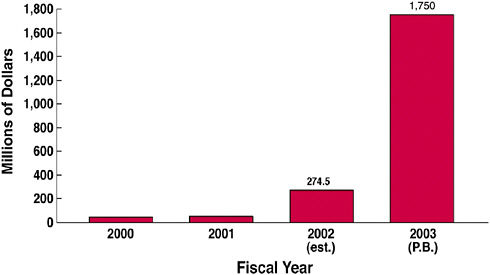
FIGURE 1 NIH biodefense research funding, FY 2000–2003.
and the private sector are both technically and financially necessary. Preparing an adequate bio-defense also requires the development of new anti-viral treatments and antibiotics, added Dr. Cassell. At present, health officials have at their disposal only a small number of anti-virals to naturally occurring viruses. The situation for antibiotics, is marginally better, she noted, but still worrisome given that only two new classes of antibiotics have been developed and introduced over the past thirty to forty years. Yet, private firms attempting to develop new anti-virals and antibiotics face not only daunting technical challenges, but also serious financial hurdles—especially given that the failure rate for drug discovery averages at about ninety percent, with failure rates for antibiotic drug discovery ranging even higher. Recognizing that these hurdles dampen private sector enthusiasm for drug discovery, noted Dr. Cassell, partnerships are needed to share the high financial risks and to pool dispersed knowledge about health risks.
Addressing the complex challenge of biodefense requires a major financial commitment. Dr. Heilman noted that Congress understands that a sustained high level of support is needed since homeland biodefense can only be realized through a long-term commitment of support. She also presented a graph (Figure 1) showing a six-fold increase in NIH’s biodefense budget.
PARTNERING MECHANISMS TO MEET NEW SECURITY CHALLENGES
For the current war on terrorism, partnerships have a demonstrated capacity to marshal the ingenuity of industry to meet new needs for national security.
Because they are flexible and can be organized on an ad hoc basis, partnerships can be an effective means to focus diverse expertise and innovative technologies to help counter new threats. Indeed, the National Academies 2002 report Making the Nation Safer identified several existing models for government-industry collaboration that could contribute to the war on terror, including the Advanced Technology Program (ATP) and the Small Business Research Innovation (SBIR) program.15 Existing programs with established selection procedures and mechanisms for granting and evaluation of awards offer major benefits in comparison to founding completely new programs; notably, they can “hit the ground running.”
Reflecting this reality, the roles that ATP and SBIR might play in developing technologies to counter terrorism were examined at the conference. In addition, the experience of the Sematech semiconductor consortium in providing best practice lessons for effective partnerships and in securing the nation’s capability in a key technology were reviewed.
The Advanced Technology Program
As Maryann Feldman of Johns Hopkins University noted, ATP was initiated as a means of funding high-risk R&D with broad commercial and societal benefits that would not be undertaken by a single company, either because the risk was too high or because a large enough share of the benefits of success would not accrue to the company for it to make the investment.
Specifically, ATP provides cost-shared funding to industry intended to accelerate the development and dissemination of high-risk technologies with the potential for broad-based economic benefits for the U.S. economy.16 ATP funding is directed to technical research (but not product development). Companies, whether singly or jointly, conceive, propose, and execute all projects, often in collaboration with universities and federal laboratories. The ATP shares the project costs for a limited time. Single-company awardees can receive up to $2 million for R&D activities for up to three years. Larger companies must contribute at least 60 percent of the total project cost. Joint ventures can receive funds for R&D activities for up to five years.17 Since 1992, ATP has obligated an estimated $270 million to companies and joint ventures pursuing promising commercial ventures that could be enlisted in the fight against terrorism, according to Arden
Bement, of the National Institute of Standards and Technology. These technologies, he said, underscore the dual nature of many of the technologies that are now needed.
Dr. Feldman suggested that because it is industry driven, with the ideas and half the funds coming from the private sector, ATP can have a positive impact on developing new technologies for the war on terror. Drawing on her empirical analyses of the program, she noted that ATP selects those projects that had greater potential to generate substantial public benefits—primarily riskier, early-stage projects and new partnerships. In addition, Dr. Feldman found that ATP increases private sector R&D in the kinds of activities it funds. Garnering an ATP award bestows a “halo effect” that makes it easier for participating firms to raise subsequent funding. In effect, an ATP award creates additional information for private investors in the risky market of early-stage finance. A further advantage is that ATP relies on commercial firms to propose projects. This bottom-up approach encourages the private sector to identify and invest in the kinds of applications that have the highest potential to bring new capabilities to bear on national security concerns.18
The Small Business Innovation Research Program
This early-stage technology development program can be a useful mechanism to draw ideas from small companies and university research and connect them to market needs and agency missions. Noting that the university community has shown strong interest in adapting their research to serve the needs of the nation in the wake of the September 11 attacks, Christina Gabriel of Carnegie Mellon University outlined initiatives that Carnegie Mellon was taking to facilitate innovation transfer. These initiatives include steps to streamline university procedures and strategies for setting up new companies. She emphasized, in this regard, the role that SBIR can play in facilitating technology transfer from the university to the market.
The SBIR program’s Phase I grants, normally limited to $100,000, are competitively awarded to small businesses. They can also be a source of funding for university faculty to conduct feasibility research intended to establish a research idea’s scientific and commercial promise. In addition, STTR provides awards to
researchers working with university researchers as sub-contractors.19 SBIR and, to a lesser extent, STTR are proven mechanisms enabling collaboration between university faculty and small technology companies. University faculties have successfully used SBIR to found and fund their spin off companies to develop and commercialize technology resulting from their academic research. Phase I winners also compete for Phase II grants, which are intended to develop the scientific and technical potential of the research idea. Phase II grants are larger—normally up to $750,000. SBIR also has a final Phase III where grant recipients are expected to obtain additional funds. In the Defense Department, this can be procurement funds. In other agencies, it is often private investors, or the capital markets, that help commercialize the technology—there is normally no SBIR funding for this stage.20
SBIR has already proven to be an effective tool to solicit ideas and technologies from small firms to help fight the war on terror. Carole Heilman of the National Institute for Allergies and Infectious Diseases highlighted the importance of SBIR grants to the small business community, which “really rallied after 9/11.” Within about a month, she said, the National Institute for Allergy and Infectious Diseases at NIH had put out a solicitation to the small business community, detailing what was needed to meet specific agency missions. This drew about three hundred responses within a month: “It was a phenomenal expression of interest and capability and good application, with extremely thoughtful approaches,” she said. The ability of the SBIR solicitation to draw on the ingenuity of the vibrant U.S. small business community is one of the strengths of the SBIR program approach.
Industry Consortia
New technologies in the war on terror can also be facilitated through the best-practice lessons gained from experience in consortium-based cooperation among firms. Kenneth Flamm of the University of Texas described some best practice lessons in assessing the contributions of the Sematech consortium, which he described as the highest profile government-industry consortium in the United
States.21 These best practices include the invention of the industry roadmap and the emphasis on industry leadership to direct the partnership and reach consensus on research priorities.
Dr. Flamm traced the origins of Sematech to the early 1980s when the U.S. semiconductor manufacturers had lost their lead in manufacturing.22 With Japan’s substantial investments (beginning in the 1950s) in semiconductor materials, equipment, and manufacturing technology paying off in the late 1970s and 1980s, U.S. firms found themselves falling behind in manufacturing yields and market share. In this environment, the idea of a government-industry partnership arose as a mechanism to sort through the challenges and proposed a unified strategy, he said.23
Dr. Flamm noted that Sematech’s designers decided to emphasize strategies that would improve the equipment and materials used by U.S. producers. Under the guidance of William Spencer, the consortium began to focus on reducing the time between new technology nodes and speeding up the flow of technology. It also developed a technology roadmap to provide coordination points for joint efforts in pre-competitive research. This roadmap, he said, has been judged a “hugely” important and innovative model for global technology formation, and has since been adopted internationally. Sematech itself is now an international consortium. One of its remarkable features, according to Flamm, is that companies that otherwise compete against one another in the marketplace voluntarily assemble every year to try jointly to identify technological obstacles and make plans to overcome them collectively. He suggests that “this is a new and totally unique phenomenon …” and perhaps “one of the lasting contributions of Sematech—a template for a new form of R&D collaboration.”24
|
21 |
In an industry R&D consortium, a certain portion and type of a participating company’s R&D is funneled into a separate organization where it is carried out collectively and where the research results are shared among the member firms. In a consortium, firms can lower R&D costs or increase R&D efficiency while continuing to compete privately through their own product related R&D programs. The role for government in this partnership is to legally enable the inter-firm cooperation and, where appropriate, contribute funding and/or research facilities to advance research on technologies of common interest. See National Research Council, Government-Industry Partnerships for the Development of New Technologies: Summary Report, op. cit. p. 10. |
|
22 |
See Jeffrey T. Macher, David C. Mowery, and David A. Hodges, “Semiconductors,” in National Research Council, U.S. Industry in 2000, David C. Mowery, ed., Washington, D.C.: National Academy Press, 1999. |
|
23 |
For a listing of events leading up to the decision to create Sematech, see Andrew A Procassini, Competitors in Alliance: Industrial Associations, Global Rivalries, and Business-Government Relations. Westport, CT: Quorum Books, 1995. For an overview of current programs to support the semiconductor industry in Japan, Taiwan, Europe, and the United States, see National Research Council, Securing the Future: Regional and National Programs to Support the Semiconductor Industry, C. Wessner, ed,, Washington, D.C.: The National Academies Press, 2003. |
|
24 |
See the presentation by Kenneth Flamm in Panel III of this volume. |
Dr. Flamm also referred to the widespread agreement that Sematech played a significant role in the resurgence of the U.S. semiconductor industry.25 While acknowledging that inadequate data collection makes it currently impossible to determine the extent to which Sematech was responsible for the resurgence, there is little doubt, he added, that the U.S. semiconductor industry did come back and that many U.S. firms are today on the leading edge of manufacturing. More telling, he said, was that Sematech is widely credited in Japan with considerable accomplishment, with the Japanese copying the structure of Sematech in their semiconductor strategy.26 Further, he noted, the success of the consortium is also revealed by the willingness of Sematech’s members to increase their funding for the consortium to about $140 million a year after the government subsidy disappeared.27
Moreover, the advance of productivity in the semiconductor industry, which accelerated dramatically after the major strategies of Sematech were installed, is linked to the simultaneous upsurge in U.S. productivity in the mid-1990s—a phenomenon documented by Dale Jorgenson.28 “There was a direct link, noted Dr. Flamm, between this improvement in the pace of introduction of semiconductor technology and the improvement in the aggregate macro-economic performance of the U.S. economy.”
While Sematech itself was designed to promote the competitiveness of a strategic U.S. industry through the joint development of new platform technologies, its best practice lessons are broadly relevant to the design of effective partnerships in the war on terror. Sematech demonstrated that industry roadmaps could help accelerate the rate of innovation by coordinating research among multiple actors and by setting the pace of market competition. And as Bill Spencer also noted at the conference, industry leadership, and cost sharing—important features of the Sematech model—provide the experience, expertise, and motivation required for partnerships to succeed.
PARTNERING FOR HOMELAND SECURITY—NEW CHALLENGES
Several conference participants highlighted key organizational, legal, and resource challenges facing the development of new public-private partnerships for homeland security.
S&T at the Department of Homeland Security
Congressman Boehlert noted that the new Department of Homeland Security (DHS) must be structured to draw together the science and technology expertise, funding, and policy attention needed to win the war on terror. Partnerships between government, industry, and academia will be necessary, he noted, because they can bring together the expertise needed to address the multiple dimensions of the homeland security threat.
In turn, William Bonvillian, of the Office of Senator Lieberman, outlined planned DHS steps to foster government-industry interaction. Among other initiatives, he noted, the new department is expected to:
-
Create the position of Undersecretary for Science and Technology to ensure high-level policy attention.
-
Establish federally funded research and development centers (FFRDC) to increase capacity in the area of risk assessment and risk management.
-
Develop a clearinghouse to manage, identify, and evaluate technological opportunities that might be relevant to the agency’s mission.
-
Create an entity to encourage and sponsor technology transition.
-
Create a DARPA-like entity to focus and accelerate research though government-industry partnerships and to leverage participation and cooperation across agencies.
Further to the last point, Larry Kerr of DHS added that the new agency plans to establish the Homeland Security Advanced Projects Agency (HSARPA) that would be “the systems equivalent of DARPA, but with many of the procurement issues and problems put aside.” HSARPA would help “couple the research and development and testing and evaluation enterprises with actual entities—whether they are in the private sector or in academia—and the actual end users.”
Addressing Liability, Regulation, and Intellectual Property Issues
Confusing liability, regulation, and intellectual property issues can be a serious impediment to effective public-private partnerships. Christina Gabriel of Carnegie Mellon University described how complex federal regulations (including new and changing rules on export controls), nonprofit tax law in some states,
liability concerns, and the fear of legal disputes can limit university-industry partnerships. Effective technology transfer, she noted, requires that both partners hold similar objectives, communicate regularly, and build a bond of trust.
Referring to partnerships in bio-medicine, Kathy Behrens of RS Investment Management noted that questions regarding liability and regulation contribute significantly to the cost and time of development of many therapeutic agents. Stressing the importance of good communication among partners, she suggested that these issues be addressed thoroughly during the design phase of any proposed partnership.
Gail Cassell observed that the question of liability is extraordinarily complex in relation to human health and bio-threat agents, both because of the animal model rule29 and the inability of firms to gather sufficient data to show safety and efficacy in humans. If anti-trust issues that preclude company consortia could be resolved, she noted, the resulting partnerships could provide working relationships that allow risks to be shared.
Responding to a question on whether product liability should be extended to cover software—an issue that potentially could impede partnerships for homeland security—Gordon Moore noted that the threat of excessive liability can slow innovation. He said that society had to decide on a balance that made sense. “Probably, liabilities will be pushed further than technical people would have wanted if they’d thought of it in the beginning,” he noted.
Finally, with regard to intellectual property, Stephen Merrill of the National Academies noted that HHS Secretary Thompson had raised the possibility of abrogating the Bayer patent on the antibiotic Cipro if that measure were necessary to obtain an adequate supply of the antibiotic for an emergency. At the time, he said, some warned that this comment could have a chilling effect on companies’ willingness to develop antibiotics, vaccines, and anti-virals. On this issue, Dr. Heilman said her work in the area of vaccines has shown that the government would have to set a policy environment that would not only nurture public-private partnerships but would provide strong intellectual property rights if firms are to be encouraged to undertake high-cost, high-risk, vaccine research.
Developing a Skilled Workforce
Workforce issues related to bio-defense remain a major concern, according to Carole Heilman. Not only are there insufficient numbers of people now trained in the microbiological and immunological sciences, but there are few incentives to attract them away from other important research. She estimated that there are
“maybe three people” in the United States with expertise in plague and anthrax. She also said that the nation lacked sufficient numbers of in vivo biologists—people trained in whole-body physiology. The need for experts in veterinary science is also a major issue, she said, not only to help establish infectivity models, but also address animal diseases and agro-terrorism.
To increase this small pool of expertise, she noted that the Department of Health and Human Services has established targets for training in bio-defense and intends to encourage partnering among the National Institutes of Health, regional public health service systems, and the Centers for Disease Control and Prevention.
The Environment for Innovation
Drawing together these concerns, Gordon Moore noted that “some deep partnerships between government and industry … are implicit rather than explicit.” Policies to promote education and training, and regulations, anti-trust laws, and intellectual property laws that govern how organizations behave, he said, help create an environment for innovation and value creation. The structures of taxation, fiscal policy, and monetary policy also frame the context for partnerships. Together, he noted, these rules have made the United States the most productive place in the world to create technological innovations and transfer their value through the marketplace.
PUTTING IT TOGETHER
The importance of a systems approach to harmonizing disparate technologies and social cultures together in the war on terror was an important undercurrent to the conference discussions. Christina Gabriel noted that in addition to a sound policy agenda, good goals, and quality leadership, a partnership program must also possess the right operational features. These would take into account how people in the program interact and what incentives invite people naturally to work toward the goals of the program. Relatedly, Ron Sega of the Department of Defense described how developing complex weapons systems required developing effective networks that incorporate different systems so that they can interface effectively.
Channeling the vast amount of information that government agencies and other organizations must deal with in addressing the terrorist threat is an enormous challenge, noted Anne Altman of IBM. She identified three facets of this challenge: The first, she said, was the need to develop an integrated information architecture. Success here depends largely on organizing information lines and applying a common information strategy across the missions of various agencies. The second challenge is to create partnerships to collect and manage information both within government and among academia, businesses, and citizen groups.
Partnerships need to draw on the combined expertise of government, business, academic institutions, and citizens, she noted, since each member of this partnership brings unique information and abilities for optimizing homeland defense decision making. Finally Dr. Altman identified a need to implement technologies and policies that ultimately enhance the government’s ability to partner and achieve its missions. “I think technology is key to cementing the partnership,” she said. “We believe that it is the underpinning of open, standards-based architecture, allowing communication between various systems.”
Integration will be a key challenge for the new Department of Homeland Security, whose six primary missions are to be accomplished by twenty-two constituent organizations. Jim Turner of the House Science Committee related the cautionary tale of the Department of Energy, which was created in 1977 in response to the Arab oil boycott. There was, he said, an “unnecessary amount of diversity in the agency,” which “threw a lot of disparate problems together.” As a result, “two things happened with DOE: From day one, the top management couldn’t think about R&D.” and second, “the DOE did not achieve the objective of weaning America from dependence on foreign oil.”
Mr. Turner noted, however, that there are significant differences today, which are cause for optimism for the future of DHS missions. The nation has had over 25 years of experience with successful partnerships, he said, including Sematech, ATP, and SBIR, and the benefit of review and analysis of their best practices. Research on public-private partnerships led by the National Academies, he concluded, will help us understand how partnerships work, and these lessons can contribute to the nation’s success in the war on terrorism.
This war on terrorism presents unique challenges. The strength of the United States in science and technology must be used to make the nation less vulnerable to future terrorist attacks and to reduce the risk and potential impact of such attacks. Speed is important. We need solutions to these vulnerabilities as soon as we can find them. This acceleration in the development of new technologies and new anti-terrorist products can best be done through partnerships between industry, government, and universities. The partnerships described here are much more effective than the “Silo” approaches to finding solutions. And they are also likely to prove to be much faster in mobilizing the strengths of the private sector to meet national needs.


