
1
Introduction, History, and Definition of Laboratories
|
Key Points
|
Science laboratories have been part of high school education for two centuries, yet a clear articulation of their role in student learning of science remains elusive. This report evaluates the evidence about the role of laboratories in helping students attain science learning goals and discusses factors that currently limit science learning in high school laboratories. In this chap-
ter, the committee presents its charge, reviews the history of science laboratories in U.S. high schools, defines laboratories, and outlines the organization of the report.
CHARGE TO THE COMMITTEE
In the National Science Foundation (NSF) Authorization Act of 2002 (P.L. 107-368, authorizing funding for fiscal years 2003-2007), Congress called on NSF to launch a secondary school systemic initiative. The initiative was to “promote scientific and technological literacy” and to “meet the mathematics and science needs of students at risk of not achieving State student academic achievement standards.” Congress directed NSF to provide grants for such activities as “laboratory improvement and provision of instrumentation as part of a comprehensive program to enhance the quality of mathematics, science, engineering, and technology instruction” (P.L. 107-368, Section 8-E). In response, NSF turned to the National Research Council (NRC) of the National Academies. NSF requested that the NRC
nominate a committee to review the status of and future directions for the role of high school science laboratories in promoting the teaching and learning of science for all students. This committee will guide the conduct of a study and author a consensus report that will provide guidance on the question of the role and purpose of high school science laboratories with an emphasis on future directions…. Among the questions that may guide these activities are:
-
What is the current state of science laboratories and what do we know about how they are used in high schools?
-
What examples or alternatives are there to traditional approaches to labs and what is the evidence base as to their effectiveness?
-
If labs in high school never existed (i.e., if they were to be planned and designed de novo), what would that experience look like now, given modern advances in the natural and learning sciences?
-
In what ways can the integration of technologies into the curriculum augment and extend a new vision of high school science labs? What is known about high school science labs based on principles of design?
-
How do the structures and policies of high schools (course scheduling, curricular design, textbook adoption, and resource deployment) influence the organization of science labs? What kinds of changes might be needed in the infrastructure of high schools to enhance the effectiveness of science labs?
-
What are the costs (e.g., financial, personnel, space, scheduling) associated with different models of high school science labs? How might a new vision of laboratory experiences for high school students influence those costs?
-
In what way does the growing interdisciplinary nature of the work of scientists help to shape discussions of laboratories as contexts in high school for science learning?
-
How do high school lab experiences align with both middle school and postsecondary education? How is the role of teaching labs changing in the nation’s colleges and universities? Would a redesign of high school science labs enhance or limit articulation between high school and college-level science education?
The NRC convened the Committee on High School Science Laboratories: Role and Vision to address this charge.
SCOPE OF THE STUDY
The committee carried out its charge through an iterative process of gathering information, deliberating on it, identifying gaps and questions, gathering further information to fill these gaps, and holding further discussions. In the search for relevant information, the committee held three public fact-finding meetings, reviewed published reports and unpublished research, searched the Internet, and commissioned experts to prepare and present papers. At a fourth, private meeting, the committee intensely analyzed and discussed its findings and conclusions over the course of three days. Although the committee considered information from a variety of sources, its final report gives most weight to research published in peer-reviewed journals and books.
At an early stage in its deliberations, the committee chose to focus primarily on “the role of high school laboratories in promoting the teaching and learning of science for all students.” The committee soon became frustrated by the limited research evidence on the role of laboratories in learning. To address one of many problems in the research evidence—a lack of agreement about what constitutes a laboratory and about the purposes of laboratory education—the committee commissioned a paper to analyze the alternative definitions and goals of laboratories.
The committee developed a concept map outlining the main themes of the study (see Figure 1-1) and organized the three fact-finding meetings to gather information on each of these themes. For example, reflecting the committee’s focus on student learning (“how students learn science” on the concept map), all three fact-finding meetings included researchers who had developed innovative approaches to high school science laboratories. We also commissioned two experts to present papers reviewing available research on the role of laboratories in students’ learning of science.
At the fact-finding meetings, some researchers presented evidence of student learning following exposure to sequences of instruction that included laboratory experiences; others provided data on how various technologies
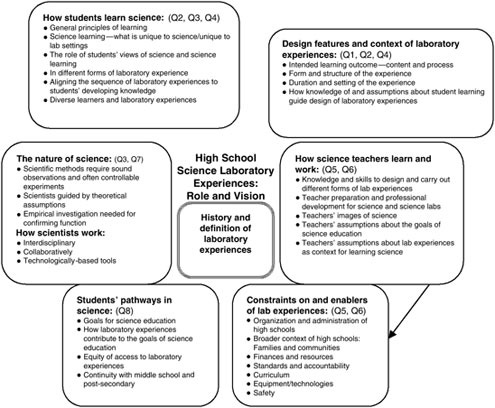
FIGURE 1-1 High school science laboratory experiences: Role and vision. Concept map with references to guiding questions in committee charge.
contribute to student learning in the laboratory. Responding to the congressional mandate to meet the mathematics and science needs of students at risk of not achieving state student academic achievement standards, the third fact-finding meeting included researchers who have studied laboratory teaching and learning among diverse students. Taken together, all of these activities enabled the committee to address questions 2, 3, and 4 of the charge.
The committee took several steps to ensure that the study reflected the current realities of science laboratories in U.S high schools, addressing the themes of “how science teachers learn and work” and “constraints and enablers of laboratory experiences” on the concept map. At the first fact-finding meeting, representatives of associations of scientists and science teachers described their efforts to help science teachers learn to lead effective labora-
tory activities. They noted constraints on laboratory learning, including poorly designed, overcrowded laboratory classrooms and inadequate preparation of science teachers. This first meeting also included a presentation about laboratory scheduling, supplies, and equipment drawn from a national survey of science teachers conducted in 2000. At the second fact-finding meeting, an architect spoke about the design of laboratory facilities, and a sociologist described how the organization of work and authority in schools may enable or constrain innovative approaches to laboratory teaching. Two meetings included panel discussions about laboratory teaching among groups of science teachers and school administrators. Through these presentations, review of additional literature, and internal discussions, the committee was able to respond to questions 1, 5, and 6 of the charge. The agendas for each fact-finding meeting, including the guiding questions that were sent to each presenter, appear in Appendix A.
The committee recognized that the question in its charge about the increasingly interdisciplinary nature of science (question 7) is important to the future of science and to high school science laboratories. In presentations and commissioned papers, several experts offered suggestions for how laboratory activities could be designed to more accurately reflect the work of scientists and to improve students’ understanding of the way scientists work today. Based on our analysis of this information, the committee partially addresses this question from the perspective of how scientists conduct their work (in this chapter). The committee also identifies design principles for laboratory activities that may increase students’ understanding of the nature of science (in Chapter 3). However, in order to maintain our focus on the key question of student learning in laboratories, the committee did not fully address question 7.
Another important question in the committee’s charge (question 8) addresses the alignment of laboratory learning in middle school, high school, and undergraduate science education. Within the short time frame of this study, the committee focused on identifying, assembling, and analyzing the limited research available on high school science laboratories and did not attempt to do the same analysis for middle school and undergraduate science laboratories. However, this report does discuss several studies of student laboratory learning in middle school (see Chapter 3) and describes undergraduate science laboratories briefly in its analysis of the preparation of high school science teachers (see in Chapter 5). The committee thinks questions about the alignment of laboratory learning merit more sustained attention than was possible in this study.
During the course of our deliberations, other important questions emerged. For example, it is apparent that the scientific community is engaged in an array of efforts to strengthen teaching and learning in high school science laboratories, but little information is available on the extent
of these efforts and on their effectiveness at enhancing student learning. As a result, we address the role of the scientific community in high school laboratories only briefly in Chapters 1 and 5. Another issue that arose over the course of this study is laboratory safety. We became convinced that laboratory safety is critical, but we did not fully analyze safety issues, which lay outside our charge. Finally, although engaging students in design or engineering laboratory activities appears to hold promising connections with science laboratory activities, the committee did not explore this possibility. Although all of these issues and questions are important, taking time and energy to address them would have deterred us from a central focus on the role of high school laboratories in promoting the teaching and learning of science for all students.
One important step in defining the scope of the study was to review the history of laboratories. Examining the history of laboratory education helped to illuminate persistent tensions, provided insight into approaches to be avoided in the future, and allowed the committee to more clearly frame key questions for the future.
HISTORY OF LABORATORY EDUCATION
The history of laboratories in U.S. high schools has been affected by changing views of the nature of science and by society’s changing goals for science education. Between 1850 and the present, educators, scientists, and the public have, at different times, placed more or less emphasis on three sometimes-competing goals for school science education: (1) a theoretical emphasis, stressing the structure of scientific disciplines, the benefits of basic scientific research, and the importance of preparing young people for higher education in science; (2) an applied or practical emphasis, stressing high school students’ ability to understand and apply the science and workings of everyday things; and (3) a liberal or contextual emphasis, stressing the historical development and cultural implications of science (Matthews, 1994). These changing goals have affected the nature and extent of laboratory education.
1850-1950
By the mid-19th century, British writers and philosophers had articulated a view of science as an inductive process (Mill, 1843; Whewell, 1840, 1858). They believed that scientists engaged in painstaking observation of nature to identify and accumulate facts, and only very cautiously did they draw conclusions from these facts to propose new theories. British and American scientists portrayed the newest scientific discoveries—such as the laws of thermodynamics and Darwin’s theory of evolution—to an increas-
ingly interested public as certain knowledge derived through well-established inductive methods. However, scientists and teachers made few efforts to teach students about these methods. High school and undergraduate science courses, like those in history and other subjects, were taught through lectures and textbooks, followed by rote memorization and recitation (Rudolph, 2005). Lecturers emphasized student knowledge of the facts, and science laboratories were not yet accepted as part of higher education. For example, when Benjamin Silliman set up the first chemistry laboratory at Yale in 1847, he paid rent to the college for use of the building and equipped it at his own expense (Whitman, 1898, p. 201). Few students were allowed into these laboratories, which were reserved for scientists’ research, although some apparatus from the laboratory was occasionally brought into the lecture room for demonstrations.
During the 1880s, the situation changed rapidly. Influenced by the example of chemist Justus von Liebig in Germany, leading American universities embraced the German model. In this model, laboratories played a central role as the setting for faculty research and for advanced scientific study by students. Johns Hopkins University established itself as a research institution with student laboratories. Other leading colleges and universities followed suit, and high schools—which were just being established as educational institutions—soon began to create student science laboratories as well.
The primary goal of these early high school laboratories was to prepare students for higher science education in college and university laboratories. The National Education Association produced an influential report noting the “absolute necessity of laboratory work” in the high school science curriculum (National Education Association, 1894) in order to prepare students for undergraduate science studies. As demand for secondary school teachers trained in laboratory methods grew, colleges and universities began offering summer laboratory courses for teachers. In 1895, a zoology professor at Brown University described “large and increasing attendance at our summer schools,” which focused on the dissection of cats and other animals (Bump, 1895, p. 260).
In these early years, American educators emphasized the theoretical, disciplinary goals of science education in order to prepare graduates for further science education. Because of this emphasis, high schools quickly embraced a detailed list of 40 physics experiments published by Harvard instructor Edwin Hall (Harvard University, 1889). The list outlined the experiments, procedures, and equipment necessary to successfully complete all 40 experiments as a condition of admission to study physics at Harvard. Scientific supply companies began selling complete sets of the required equipment to schools and successful completion of the exercises was soon required for admission to study physics at other colleges and universities (Rudolph, 2005).
At that time, most educators and scientists believed that participating in laboratory experiments would help students learn methods of accurate observation and inductive reasoning. However, the focus on prescribing specific experiments and procedures, illustrated by the embrace of the Harvard list, limited the effectiveness of early laboratory education. In the rush to specify laboratory experiments, procedures, and equipment, little attention had been paid to how students might learn from these experiences. Students were expected to simply absorb the methods of inductive reasoning by carrying out experiments according to prescribed procedures (Rudolph, 2005).
Between 1890 and 1910, as U.S. high schools expanded rapidly to absorb a huge influx of new students, a backlash began to develop against the prevailing approach to laboratory education. In a 1901 lecture at the New England Association of College and Secondary Schools, G. Stanley Hall, one of the first American psychologists, criticized high school physics education based on the Harvard list, saying that “boys of this age … want more dynamic physics” (Hall, 1901). Building on Hall’s critique, University of Chicago physicist Charles Mann and other members of the Central Association for Science and Mathematics Teaching launched a complete overhaul of high school physics teaching. Mann and others attacked the “dry bones” of the Harvard experiments, calling for a high school physics curriculum with more personal and social relevance to students. One described lab work as “at best a very artificial means of supplying experiences upon which to build physical concepts” (Woodhull, 1909). Other educators argued that science teaching could be improved by providing more historical perspective, and high schools began reducing the number of laboratory exercises.
By 1910, a clear tension had emerged between those emphasizing laboratory experiments and reformers favoring an emphasis on interesting, practical science content in high school science. However, the focus on content also led to problems, as students became overwhelmed with “interesting” facts. New York’s experience illustrates this tension. In 1890, the New York State Regents exam included questions asking students to design experiments (Champagne and Shiland, 2004). In 1905, the state introduced a new syllabus of physics topics. The content to be covered was so extensive that, over the course of a year, an average of half an hour could be devoted to each topic, virtually eliminating the possibility of including laboratory activities (Matthews, 1994). An outcry to return to more experimentation in science courses resulted, and in 1910 New York State instituted a requirement for 30 science laboratory sessions taking double periods in the syllabus for Regents science courses (courses preparing students for the New York State Regents examinations) (Champagne and Shiland, 2004).
In an influential speech to the American Association for the Advancement of Science (AAAS) in 1909, philosopher and educator John Dewey proposed a solution to the tension between advocates for more laboratory
experimentation and advocates for science education emphasizing practical content. While criticizing science teaching focused strictly on covering large amounts of known content, Dewey also pointed to the flaws in rigid laboratory exercises: “A student may acquire laboratory methods as so much isolated and final stuff, just as he may so acquire material from a textbook…. Many a student had acquired dexterity and skill in laboratory methods without it ever occurring to him that they have anything to do with constructing beliefs that are alone worthy of the title of knowledge” (Dewey, 1910b). Dewey believed that people should leave school with some understanding of the kinds of evidence required to substantiate scientific beliefs. However, he never explicitly described his view of the process by which scientists develop and substantiate such evidence.
In 1910, Dewey wrote a short textbook aimed at helping teachers deal with students as individuals despite rapidly growing enrollments. He analyzed what he called “a complete act of thought,” including five steps: (1) a felt difficulty, (2) its location and definition, (3) suggestion of possible solution, (4) development by reasoning of the bearing of the suggestion, and (5) further observation and experiment leading to its acceptance or rejection (Dewey, 1910a, pp. 68-78). Educators quickly misinterpreted these five steps as a description of the scientific method that could be applied to practical problems. In 1918, William Kilpatrick of Teachers College published a seminal article on the “project method,” which used Dewey’s five steps to address problems of everyday life. The article was eventually reprinted 60,000 times as reformers embraced the idea of engaging students with practical problems, while at the same time teaching them about what were seen as the methods of science (Rudolph, 2005).
During the 1920s, reform-minded teachers struggled to use the project method. Faced with ever-larger classes and state requirements for coverage of science content, they began to look for lists of specific projects that students could undertake, the procedures they could use, and the expected results. Soon, standardized lists of projects were published, and students who had previously been freed from rigid laboratory procedures were now engaged in rigid, specified projects, leading one writer to observe, “the project is little more than a new cloak for the inductive method” (Downing, 1919, p. 571).
Despite these unresolved tensions, laboratory education had become firmly established, and growing numbers of future high school teachers were instructed in teaching laboratory activities. For example, a 1925 textbook for preservice science teachers included a chapter titled “Place of Laboratory Work in the Teaching of Science” followed by three additional chapters on how to teach laboratory science (Brownell and Wade, 1925). Over the following decades, high school science education (including laboratory education) increasingly emphasized practical goals and the benefits of science in everyday life. During World War II, as scientists focused on federally funded
research programs aimed at defense and public health needs, high school science education also emphasized applications of scientific knowledge (Rudolph, 2002).
1950-1975
Changing Goals of Science Education
Following World War II, the flood of “baby boomers” strained the physical and financial resources of public schools. Requests for increased taxes and bond issues led to increasing questions about public schooling. Some academics and policy makers began to criticize the “life adjustment” high school curriculum, which had been designed to meet adolescents’ social, personal, and vocational needs. Instead, they called for a renewed emphasis on the academic disciplines. At the same time, the nation was shaken by the Soviet Union’s explosion of an atomic bomb and the communist takeover of China. By the early 1950s, some federal policy makers began to view a more rigorous, academic high school science curriculum as critical to respond to the Soviet threat.
In 1956, physicist Jerrold Zacharias received a small grant from NSF to establish the Physical Science Study Committee (PSSC) in order to develop a curriculum focusing on physics as a scientific discipline. When the Union of Soviet Socialist Republics launched the space satellite Sputnik the following year, those who had argued that U.S. science education was not rigorous enough appeared vindicated, and a new era of science education began.
Although most historians believe that the overriding goal of the post-Sputnik science education reforms was to create a new generation of U.S. scientists and engineers capable of defending the nation from the Soviet Union, the actual goals were more complex and varied (Rudolph, 2002). Clearly, Congress, the president, and NSF were focused on the goal of preparing more scientists and engineers, as reflected in NSF director Alan Waterman’s 1957 statement (National Science Foundation, 1957, pp. xv-xvi):
Our schools and colleges are badly in need of modern science laboratories and laboratory, demonstration, and research equipment. Most important of all, we need more trained scientists and engineers in many special fields, and especially very many more competent, fully trained teachers of science, notably in our secondary schools. Undoubtedly, by a determined campaign, we can accomplish these ends in our traditional way, but how soon? The process is usually a lengthy one, and there is no time to be lost. Therefore, the pressing question is how quickly can our people act to accomplish these things?
The scientists, however, had another agenda. Over the course of World War II, their research had become increasingly dependent on federal fund-
ing and influenced by federal needs. In physics, for example, federally funded efforts to develop nuclear weapons led research to focus increasingly at the atomic level. In order to maintain public funding while reducing unwanted public pressure on research directions, the scientists sought to use curriculum redesign as a way to build the public’s faith in the expertise of professional scientists (Rudolph, 2002). They wanted to emphasize the humanistic aspects of science, portraying science as an essential element in a broad liberal education. Some scientists sought to reach not only the select group who might become future scientists but also a slightly larger group of elite, mostly white male students who would be future leaders in government and business. They hoped to help these students appreciate the empirical grounding of scientific knowledge and to value and appreciate the role of science in society (Rudolph, 2002).
Changing Views of the Nature of Science
While this shift in the goals of science education was taking place, historians and philosophers were proposing new views of science. In 1958, British chemist Michael Polanyi questioned the ideal of scientific detachment and objectivity, arguing that scientific discovery relies on the personal participation and the creative, original thoughts of scientists (Polanyi, 1958). In the United States, geneticist and science educator Joseph Schwab suggested that scientific methods were specific to each discipline and that all scientific “inquiry” (his term for scientific research) was guided by the current theories and concepts within the discipline (Schwab, 1964). Publication of The Structure of Scientific Revolutions (Kuhn, 1962) a few years later fueled the debate about whether science was truly rational, and whether theory or observation was more important to the scientific enterprise. Over time, this debate subsided, as historians and philosophers of science came to focus on the process of scientific discovery. Increasingly, they recognized that this process involves deductive reasoning (developing inferences from known scientific principles and theories) as well as inductive reasoning (proceeding from particular observations to reach more general theories or conclusions).
Development of New Science Curricula
Although these changing views of the nature of science later led to changes in science education, they had little influence in the immediate aftermath of Sputnik. With NSF support, scientists led a flurry of curriculum development over the next three decades (Matthews, 1994). In addition to the physics text developed by the PSSC, the Biological Sciences Curriculum Study (BSCS) created biology curricula, the Chemical Education Materials group created chemistry materials, and groups of physicists created Intro-
ductory Physical Science and Project Physics. By 1975, NSF supported 28 science curriculum reform projects.
By 1977 over 60 percent of school districts had adopted at least one of the new curricula (Rudolph, 2002). The PSSC program employed high school teachers to train their peers in how to use the curriculum, reaching over half of all high school physics teachers by the late 1960s. However, due to implementation problems that we discuss further below, most schools soon shifted to other texts, and the federal goal of attracting a larger proportion of students to undergraduate science was not achieved (Linn, 1997).
Dissemination of the NSF-funded curriculum development efforts was limited by several weaknesses. Some curriculum developers tried to “teacher proof” their curricula, providing detailed texts, teacher guides, and filmstrips designed to ensure that students faithfully carried out the experiments as intended (Matthews, 1994). Physics teacher and curriculum developer Arnold Arons attributed the limited implementation of most of the NSF-funded curricula to lack of logistical support for science teachers and inadequate teacher training, since “curricular materials, however skilful and imaginative, cannot ‘teach themselves’” (Arons, 1983, p. 117). Case studies showed that schools were slow to change in response to the new curricula and highlighted the central role of the teacher in carrying them out (Stake and Easley, 1978). In his analysis of Project Physics, Welch concluded that the new curriculum accounted for only 5 percent of the variance in student achievement, while other factors, such as teacher effectiveness, student ability, and time on task, played a larger role (Welch, 1979).
Despite their limited diffusion, the new curricula pioneered important new approaches to science education, including elevating the role of laboratory activities in order to help students understand the nature of modern scientific research (Rudolph, 2002). For example, in the PSSC curriculum, Massachusetts Institute of Technology physicist Jerrold Zacharias coordinated laboratory activities with the textbook in order to deepen students’ understanding of the links between theory and experiments. As part of that curriculum, students experimented with a ripple tank, generating wave patterns in water in order to gain understanding of wave models of light. A new definition of the scientific laboratory informed these efforts. The PSSC text explained that a “laboratory” was a way of thinking about scientific investigations—an intellectual process rather than a building with specialized equipment (Rudolph, 2002, p. 131).
The new approach to using laboratory experiences was also apparent in the Science Curriculum Improvement Study. The study group drew on the developmental psychology of Jean Piaget to integrate laboratory experiences with other forms of instruction in a “learning cycle” (Atkin and Karplus, 1962). The learning cycle included (1) exploration of a concept, often through a laboratory experiment; (2) conceptual invention, in which the student or
TABLE 1-1 New Approaches Included in Post-Sputnik Science Curricula
|
|
New Post-Sputnik Curricula |
Traditional Science Curricula |
|
Time of development |
After 1955 |
Before 1955 |
|
Emphasis |
Nature, structure, processes of science |
Knowledge of scientific facts, laws, theories, applications |
|
Role of laboratories |
Integrated into the class routine |
Secondary applications of concepts previously covered |
|
Goals for students |
Higher cognitive skills, appreciation of science |
|
|
SOURCE: Shymansky, Kyle, and Alport (1983). Reprinted with permission of Wiley-Liss, Inc., a subsidiary of John Wiley & Sons, Inc. |
||
teacher (or both) derived the concept from the experimental data, usually during a classroom discussion; and (3) concept application in which the student applied the concept (Karplus and Their, 1967). Evaluations of the instructional materials, which were targeted to elementary school students, revealed that they were more successful than traditional forms of science instruction at enhancing students’ understanding of science concepts, their understanding of the processes of science, and their positive attitudes toward science (Abraham, 1998). Subsequently, the learning cycle approach was applied to development of science curricula for high school and undergraduate students. Research into these more recent curricula confirms that “merely providing students with hands-on laboratory experiences is not by itself enough” (Abraham, 1998, p. 520) to motivate and help them understand science concepts and the nature of science.
In sum, the new approach of integrating laboratory experiences represented a marked change from earlier science education. In contrast to earlier curricula, which included laboratory experiences as secondary applications of concepts previously addressed by the teacher, the new curricula integrated laboratory activities into class routines in order to emphasize the nature and processes of science (Shymansky, Kyle, and Alport, 1983; see Table 1-1). Large meta-analyses of evaluations of the post-Sputnik curricula (Shymansky et al., 1983; Shymansky, Hedges, and Woodworth, 1990) found they were more effective than the traditional curriculum in boosting students’ science achievement and interest in science. As we discuss in Chapter 3, current designs of science curricula that integrate laboratory experiences
into ongoing classroom instruction have proven effective in enhancing students’ science achievement and interest in science.
Discovery Learning and Inquiry
One offshoot of the curriculum development efforts in the 1960s and 1970s was the development of an approach to science learning termed “discovery learning.” In 1959, Harvard cognitive psychologist Jerome Bruner began to develop his ideas about discovery learning as director of an NRC committee convened to evaluate the new NSF-funded curricula. In a book drawing in part on that experience, Bruner suggested that young students are active problem solvers, ready and motivated to learn science by their natural interest in the material world (Bruner, 1960). He argued that children should not be taught isolated science facts, but rather should be helped to discover the structures, or underlying concepts and theories, of science. Bruner’s emphasis on helping students to understand the theoretical structures of the scientific disciplines became confounded with the idea of engaging students with the physical structures of natural phenomena in the laboratory (Matthews, 1994). Developers of NSF-funded curricula embraced this interpretation of Bruner’s ideas, as it leant support to their emphasis on laboratory activities.
On the basis of his observation that scientific knowledge was changing rapidly through large-scale research and development during this postwar period, Joseph Schwab advocated the closely related idea of an “inquiry approach” to science education (Rudolph, 2003). In a seminal article, Schwab argued against teaching science facts, which he termed a “rhetoric of conclusions” (Schwab, 1962, p. 25). Instead, he proposed that teachers engage students with materials that would motivate them to learn about natural phenomena through inquiry while also learning about some of the strengths and weaknesses of the processes of scientific inquiry. He developed a framework to describe the inquiry approach in a biology laboratory. At the highest level of inquiry, the student simply confronts the “raw phenomenon” (Schwab, 1962, p. 55) with no guidance. At the other end of the spectrum, biology students would experience low levels of inquiry, or none at all, if the laboratory manual provides the problem to be investigated, the methods to address the problem, and the solutions. When Herron applied Schwab’s framework to analyze the laboratory manuals included in the PSSC and the BSCS curricula, he found that most of the manuals provided extensive guidance to students and thus did not follow the inquiry approach (Herron, 1971).
The NRC defines inquiry somewhat differently in the National Science Education Standards. Rather than using “inquiry” as an indicator of the amount of guidance provided to students, the NRC described inquiry as
encompassing both “the diverse ways in which scientists study the natural world” (National Research Council, 1996, p. 23) and also students’ activities that support the learning of science concepts and the processes of science. In the NRC definition, student inquiry may include reading about known scientific theories and ideas, posing questions, planning investigations, making observations, using tools to gather and analyze data, proposing explanations, reviewing known theories and concepts in light of empirical data, and communicating the results. The Standards caution that emphasizing inquiry does not mean relying on a single approach to science teaching, suggesting that teachers use a variety of strategies, including reading, laboratory activities, and other approaches to help students learn science (National Research Council, 1996).
Diversity in Schools
During the 1950s, as some scientists developed new science curricula for teaching a small group of mostly white male students, other Americans were much more concerned about the weak quality of racially segregated schools for black children. In 1954, the Supreme Court ruled unanimously that the Topeka, Kansas Board of Education was in violation of the U.S. Constitution because it provided black students with “separate but equal” education. Schools in both the North and the South changed dramatically as formerly all-white schools were integrated. Following the example of the civil rights movement, in the 1970s and the 1980s the women’s liberation movement sought improved education and employment opportunities for girls and women, including opportunities in science. In response, some educators began to seek ways to improve science education for all students, regardless of their race or gender.
1975 to Present
By 1975, the United States had put a man on the moon, concerns about the “space race” had subsided, and substantial NSF funding for science education reform ended. These changes, together with increased concern for equity in science education, heralded a shift in society’s goals for science education. Science educators became less focused on the goal of disciplinary knowledge for science specialists and began to place greater emphasis on a liberal, humanistic view of science education.
Many of the tensions evident in the first 100 years of U.S. high school laboratories have continued over the past 30 years. Scientists, educators, and policy makers continue to disagree about the nature of science, the goals of science education, and the role of the curriculum and the teacher in student
learning. Within this larger dialogue, debate about the value of laboratory activities continues.
Changing Goals for Science Education
National reports issued during the 1980s and 1990s illustrate new views of the nature of science and increased emphasis on liberal goals for science education. In Science for All Americans, the AAAS advocated the achievement of scientific literacy by all U.S. high school students, in order to increase their awareness and understanding of science and the natural world and to develop their ability to think scientifically (American Association for the Advancement of Science, 1989). This seminal report described science as tentative (striving toward objectivity within the constraints of human fallibility) and as a social enterprise, while also discussing the durability of scientific theories, the importance of logical reasoning, and the lack of a single scientific method. In the ongoing debate about the coverage of science content, the AAAS took the position that “curricula must be changed to reduce the sheer amount of material covered” (American Association for the Advancement of Science, 1989, p. 5). Four years later, the AAAS published Benchmarks for Science Literacy, which identified expected competencies at each school grade level in each of the earlier report’s 10 areas of scientific literacy (American Association for the Advancement of Science, 1993).
The NRC’s National Science Education Standards (National Research Council, 1996) built on the AAAS reports, opening with the statement: “This nation has established as a goal that all students should achieve scientific literacy” (p. ix). The NRC proposed national science standards for high school students designed to help all students develop (1) abilities necessary to do scientific inquiry and (2) understandings about scientific inquiry (National Research Council, 1996, p. 173).
In the standards, the NRC suggested a new approach to laboratories that went beyond simply engaging students in experiments. The NRC explicitly recognized that laboratory investigations should be learning experiences, stating that high school students must “actively participate in scientific investigations, and … use the cognitive and manipulative skills associated with the formulation of scientific explanations” (National Research Council, 1996, p. 173).
According to the standards, regardless of the scientific investigation performed, students must use evidence, apply logic, and construct an argument for their proposed explanations. These standards emphasize the importance of creating scientific arguments and explanations for observations made in the laboratory.
While most educators, scientists, and policy makers now agree that scientific literacy for all students is the primary goal of high school science
education, the secondary goals of preparing the future scientific and technical workforce and including science as an essential part of a broad liberal education remain important. In 2004, the NSF National Science Board released a report describing a “troubling decline” in the number of U.S. citizens training to become scientists and engineers at a time when many current scientists and engineers are soon to retire. NSF called for improvements in science education to reverse these trends, which “threaten the economic welfare and security of our country” (National Science Foundation, 2004, p. 1). Another recent study found that secure, well-paying jobs that do not require postsecondary education nonetheless require abilities that may be developed in science laboratories. These include the ability to use inductive and deductive reasoning to arrive at valid conclusions; distinguish among facts and opinions; identify false premises in an argument; and use mathematics to solve problems (Achieve, 2004).
Achieving the goal of scientific literacy for all students, as well as motivating some students to study further in science, may require diverse approaches for the increasingly diverse body of science students, as we discuss in Chapter 2.
Changing Role of Teachers and Curriculum
Over the past 20 years, science educators have increasingly recognized the complementary roles of curriculum and teachers in helping students learn science. Both evaluations of NSF-funded curricula from the 1960s and more recent research on science learning have highlighted the important role of the teacher in helping students learn through laboratory activities. Cognitive psychologists and science educators have found that the teacher’s expectations, interventions, and actions can help students develop understanding of scientific concepts and ideas (Driver, 1995; Penner, Lehrer, and Schauble, 1998; Roth and Roychoudhury, 1993). In response to this growing awareness, some school districts and institutions of higher education have made efforts to improve laboratory education for current teachers as well as to improve the undergraduate education of future teachers (National Research Council, 2001).
In the early 1980s, NSF began again to fund the development of laboratory-centered high school science curricula. Today, several publishers offer comprehensive packages developed with NSF support, including textbooks, teacher guides, and laboratory materials (and, in some cases, videos and web sites). In 2001, one earth science curriculum, five physical science curricula, five life science curricula, and six integrated science curricula were available for sale, while several others in various science disciplines were still under development (Biological Sciences Curriculum Study, 2001). In contrast to the curriculum development approach of the 1960s, teachers have played an important role in developing and field-testing these newer
curricula and in designing the teacher professional development courses that accompany most of them. However, as in the 1960s and 1970s, only a few of these NSF-funded curricula have been widely adopted. Private publishers have also developed a multitude of new textbooks, laboratory manuals, and laboratory equipment kits in response to the national education standards and the growing national concern about scientific literacy. Nevertheless, most schools today use science curricula that have not been developed, field-tested, or refined on the basis of specific education research (see Chapter 2).
CURRENT DEBATES
Clearly, the United States needs high school graduates with scientific literacy—both to meet the economy’s need for skilled workers and future scientists and to develop the scientific habits of mind that can help citizens in their everyday lives. Science is also important as part of a liberal high school education that conveys an important aspect of modern culture. However, the value of laboratory experiences in meeting these national goals has not been clearly established.
Researchers agree neither on the desired learning outcomes of laboratory experiences nor on whether those outcomes are attained. For example, on the basis of a 1978 review of over 80 studies, Bates concluded that there was no conclusive answer to the question, “What does the laboratory accomplish that could not be accomplished as well by less expensive and less time-consuming alternatives?” (Bates, 1978, p. 75). Some experts have suggested that the only contribution of laboratories lies in helping students develop skills in manipulating equipment and acquiring a feel for phenomena but that laboratories cannot help students understand science concepts (Woolnough, 1983; Klopfer, 1990). Others, however, argue that laboratory experiences have the potential to help students understand complex science concepts, but the potential has not been realized (Tobin, 1990; Gunstone and Champagne, 1990).
These debates in the research are reflected in practice. On one hand, most states and school districts continue to invest in laboratory facilities and equipment, many undergraduate institutions require completion of laboratory courses to qualify for admission, and some states require completion of science laboratory courses as a condition of high school graduation. On the other hand, in early 2004, the California Department of Education considered draft criteria for the evaluation of science instructional materials that reflected skepticism about the value of laboratory experiences or other hands-on learning activities. The proposed criteria would have required materials to demonstrate that the state science standards could be comprehensively covered with hands-on activities composing no more than 20 to 25 percent
of instructional time (Linn, 2004). However, in response to opposition, the criteria were changed to require that the instructional materials would comprehensively cover the California science standards with “hands-on activities composing at least 20 to 25 percent of the science instructional program” (California Department of Education, 2004, p. 4, italics added).
The growing variety in laboratory experiences—which may be designed to achieve a variety of different learning outcomes—poses a challenge to resolving these debates. In a recent review of the literature, Hofstein and Lunetta (2004, p. 46) call attention to this variety:
The assumption that laboratory experiences help students understand materials, phenomena, concepts, models and relationships, almost independent of the nature of the laboratory experience, continues to be widespread in spite of sparse data from carefully designed and conducted studies.
As a first step toward understanding the nature of the laboratory experience, the committee developed a definition and a typology of high school science laboratory experiences.
DEFINITION OF LABORATORY EXPERIENCES
Rapid developments in science, technology, and cognitive research have made the traditional definition of science laboratories—as rooms in which students use special equipment to carry out well-defined procedures—obsolete. The committee gathered information on a wide variety of approaches to laboratory education, arriving at the term “laboratory experiences” to describe teaching and learning that may take place in a laboratory room or in other settings:
Laboratory experiences provide opportunities for students to interact directly with the material world (or with data drawn from the material world), using the tools, data collection techniques, models, and theories of science.
This definition includes the following student activities:
-
Physical manipulation of the real-world substances or systems under investigation. This may include such activities as chemistry experiments, plant or animal dissections in biology, and investigation of rocks or minerals for identification in earth science.
-
Interaction with simulations. Physical models have been used throughout the history of science teaching (Lunetta, 1998). Today, students can work
-
with computerized models, or simulations, representing aspects of natural phenomena that cannot be observed directly, because they are very large, very small, very slow, very fast, or very complex. Using simulations, students may model the interaction of molecules in chemistry or manipulate models of cells, animal or plant systems, wave motion, weather patterns, or geological formations.
-
Interaction with data drawn from the real world. Students may interact with real-world data that are obtained and represented in a variety of forms. For example, they may study photographs to examine characteristics of the moon or other heavenly bodies or analyze emission and absorption spectra in the light from stars. Data may be incorporated in films, DVDs, computer programs, or other formats.
-
Access to large databases. In many fields of science, researchers have arranged for empirical data to be normalized and aggregated—for example, genome databases, astronomy image collections, databases of climatic events over long time periods, biological field observations. With the help of the Internet, some students sitting in science class can now access these authentic and timely scientific data. Students can manipulate and analyze these data drawn from the real world in new forms of laboratory experiences (Bell, 2005).
-
Remote access to scientific instruments and observations. A few classrooms around the nation experience laboratory activities enabled by Internet links to remote instruments. Some students and teachers study insects by accessing and controlling an environmental scanning electron microscope (Thakkar et al., 2000), while others control automated telescopes (Gould, 2004).
Although we include all of these types of direct and indirect interaction with the material world in this definition, it does not include student manipulation or analysis of data created by a teacher to replace or substitute for direct interaction with the material world. For example, if a physics teacher presented students with a constructed data set on the weight and required pulling force for boxes pulled across desks with different surfaces, asking the students to analyze these data, the students’ problem-solving activity would not constitute a laboratory experience according to the committee’s definition.
Previous Definitions of Laboratories
In developing its definition, the committee reviewed previous definitions of student laboratories. Hegarty-Hazel (1990, p. 4) defined laboratory work as:
a form of practical work taking place in a purposely assigned environment where students engage in planned learning experiences … [and] interact
with materials to observe and understand phenomena (Some forms of practical work such as field trips are thus excluded).
Lunetta defined laboratories as “experiences in school settings in which students interact with materials to observe and understand the natural world” (Lunetta, 1998, p. 249). However, these definitions include only students’ direct interactions with natural phenomena, whereas we include both such direct interactions and also student interactions with data drawn from the material world. In addition, these earlier definitions confine laboratory experiences to schools or other “purposely assigned environments,” but our definition encompasses student observation and manipulation of natural phenomena in a variety of settings, including science museums and science centers, school gardens, local streams, or nearby geological formations. The committee’s definition also includes students who work as interns in research laboratories, after school or during the summer months. All of these experiences, as well as those that take place in traditional school science laboratories, are included in our definition of laboratory experiences.
Variety in Laboratory Experiences
Both the preceding review of the history of laboratories and the committee’s review of the evidence of student learning in laboratories reveal the limitations of engaging students in replicating the work of scientists. It has become increasingly clear that it is not realistic to expect students to arrive at accepted scientific concepts and ideas by simply experiencing some aspects of scientific research (Millar, 2004). While recognizing these limitations, the committee thinks that laboratory experiences should at least partially reflect the range of activities involved in real scientific research. Providing students with opportunities to participate in a range of scientific activities represents a step toward achieving the learning goals of laboratories identified in Chapter 3.1
Historians and philosophers of science now recognize that the well-ordered scientific method taught in many high school classes does not exist. Scientists’ empirical research in the laboratory or the field is one part of a larger process that may include reading and attending conferences to stay abreast of current developments in the discipline and to present work in progress. As Schwab recognized (1964), the “structure” of current theories and concepts in a discipline acts as a guide to further empirical research. The work of scientists may include formulating research questions, generat-
|
1 |
The goals of laboratory learning are unlikely to be reached, regardless of what type of laboratory experience is provided, unless the experience is well integrated into a coherent stream of science instruction, incorporates other design elements, and is led by a knowledgeable teacher, as discussed in Chapters 3 and 4. |
ing alternative hypotheses, designing and conducting investigations, and building and revising models to explain the results of their investigations. The process of evaluating and revising models may generate new questions and new investigations (see Table 1-2). Recent studies of science indicate that scientists’ interactions with their peers, particularly their response to questions from other scientists, as well as their use of analogies in formulating hypotheses and solving problems, and their responses to unexplained results, all influence their success in making discoveries (Dunbar, 2000). Some scientists concentrate their efforts on developing theory, reading, or conducting thought experiments, while others specialize in direct interactions with the material world (Bell, 2005).
Student laboratory experiences that reflect these aspects of the work of scientists would include learning about the most current concepts and theories through reading, lectures, or discussions; formulating questions; designing and carrying out investigations; creating and revising explanatory models; and presenting their evolving ideas and scientific arguments to others for discussion and evaluation (see Table 1-3).
Currently, however, most high schools provide a narrow range of laboratory activities, engaging students primarily in using tools to make observations and gather data, often in order to verify established scientific knowledge. Students rarely have opportunities to formulate research questions or to build and revise explanatory models (see Chapter 4).
ORGANIZATION OF THE REPORT
The ability of high school science laboratories to help improve all citizens’ understanding and appreciation of science and prepare the next generation of scientists and engineers is affected by the context in which laboratory experiences take place. Laboratory experiences do not take place in isolation, but are part of the larger fabric of students’ experiences during their high school years. Following this introduction, Chapter 2 describes recent trends in U.S. science education and policies influencing science education, including laboratory experiences. In Chapter 3 we turn to a review of available evidence on student learning in laboratories and identify principles for design of effective laboratory learning environments. Chapter 4 describes current laboratory experiences in U.S. high schools, and Chapter 5 discusses teacher and school readiness for laboratory experiences. In Chapter 6, we describe the current state of laboratory facilities, equipment, and safety. Finally, in Chapter 7, we present our conclusions and an agenda designed to help laboratory experiences fulfill their potential role in the high school science curriculum.
TABLE 1-2 A Typology of Scientists’ Activities
|
Type of Activity |
Explanation |
|
Posing a research question |
One of the most difficult steps in science is to define a research question. A researchable question may arise out of analysis of data collected, or be based on already known scientific theories and laws, or both. While the initial question is important as a goal to guide the study, flexibility is also valuable. Scientists who respond to unexpected results (that do not fit current theories about the phenomena) by conducting further research to try to explain them are more likely to make discoveries than scientists whose goal is to find evidence consistent with their current knowledge (Dunbar, 1993, 2000; Merton and Barber, 2004). |
|
Formulating hypotheses |
Scientists sometimes generate one or more competing hypotheses related to a research question. However, not all scientific research is hypothesis-driven. The human genome project is an example of bulk data collection not driven by a hypothesis (Davies, 2001). |
|
Designing investigations |
Scientists design investigations—which may involve experimental or observational methods—to answer their research questions. Investigations may be designed to test one or more competing hypotheses. |
|
Making observations, gathering, and analyzing data |
Observing natural phenomena is often an essential part of a research project. Scientists use a variety of tools and procedures to make observations and gather data, searching for patterns and possible cause-and-effect relationships that may be studied further. Observations may be guided by theory, may be designed to test a hypothesis, or may explore unknown phenomena (Duschl, 2004). |
|
Building or revising scientific models |
Although modeling scientific phenomena has always been a central practice of science, it has only been recognized as a driving force in generating scientific knowledge over the past 50 years (Duschl, 2004). Scientists draw on their imagination and existing knowledge as they interpret data in order to develop explanatory models or theories (Driver et al., 1996). These models serve as tentative explanations for observations, subject to revision based on further observations or further study of known scientific principles or theories. |
|
Evaluating, testing or verifying models |
One of the defining characteristics of science is that the evidence, methods, and assumptions used to arrive at a proposed discovery are described and publicly disclosed so that other scientists can judge their validity (Hull, 1988; Longino, 1990, 1994). In one recent example, astronomers at the Green Bank radio telescope in West Virginia identified glycoaldehyde, a building block of DNA and RNA, in an extremely cold area of the Milky Way (Hollis et al., 2004). The discovery of this substance in an area of the galaxy where comets form suggests the possibility that the ingredients necessary to create life might have been carried to Earth by a comet billions of years ago. In a news report of the discovery, the director of the Arizona Radio Observatory, who had criticized the Green Bank astronomers for not being thorough enough, said her students had replicated the Green Bank observations (Gugliotta, 2004, p. A7). |
TABLE 1-3 A Typology of School Laboratory Experiences
|
Type of Laboratory Experience |
Description |
|
Posing a research question |
Formulating a testable question can be a great challenge for high school students. Some laboratory experiences may engage students in formulating and assessing the importance of alternative questions. |
|
Using laboratory tools and procedures |
Some laboratory experiences may be designed primarily to develop students’ skills in making measurements and safely and correctly handling materials and equipment (Lunetta, 1998). These “prelab” exercises can help reduce errors and increase safety in subsequent laboratory experiences (Millar, 2004). |
|
Formulating hypotheses |
Like formulating a research question, formulating alternative hypotheses is challenging for high school students. However, some new curricula have led to improvement in formulating hypotheses (see Chapter 3). |
|
Designing investigations |
Laboratory experiences integrated with other forms of instruction and explicitly designed with this goal in mind can help students learn to design investigations (White and Frederiksen, 1998). |
|
Making observations, gathering, and analyzing data |
Science teachers may engage students in laboratory activities that involve observing phenomena and in gathering, recording, and analyzing data in search of possible patterns or explanations. |
|
Building or revising models |
Laboratory experiences may engage students in interpreting data that they gather directly from the material world or data drawn from large scientific data sets in order to create, test, and refine models. Scientific modeling is a core element in several innovative laboratory-centered science curricula that appear to enhance student learning (Bell, 2005). |
|
Evaluating, testing, or verifying explanatory models (including known scientific theories and models) |
Laboratory experiences may be designed to engage students in verifying scientific ideas that they have learned about through reading, lectures, or work with computer simulations. Such experiences can help students to understand accepted scientific concepts through their own direct experiences (Millar, 2004). However, verification laboratory activities are quite different from the activities of scientists who rigorously test a proposed scientific theory or discovery in order to defend, refute, or revise it. |
SUMMARY
Since the late 19th century, high school students in the United States have carried out laboratory investigations as part of their science classes. Since that time, changes in science, education, and American society have influenced the role of laboratory experiences in the high school science curriculum. At the turn of the 20th century, high school science laboratory experiences were designed primarily to prepare a select group of young people for further scientific study at research universities. During the period between World War I and World War II, many high schools emphasized the more practical aspects of science, engaging students in laboratory projects related to daily life. In the 1950s and 1960s, science curricula were redesigned to integrate laboratory experiences into classroom instruction, with the goal of increasing public appreciation of science.
Policy makers, scientists, and educators agree that high school graduates today, more than ever, need a basic understanding of science and technology to function effectively in an increasingly complex, technological society. They seek to help students understand the nature of science and to develop both the inductive and deductive reasoning skills that scientists apply in their work. However, researchers and educators do not agree on how to define high school science laboratories or on their purposes, hampering the accumulation of evidence that might guide improvements in laboratory education. Gaps in the research and in capturing the knowledge of expert science teachers make it difficult to reach precise conclusions on the best approaches to laboratory teaching and learning.
In order to provide a focus for the study, the committee defines laboratory experiences as follows: laboratory experiences provide opportunities for students to interact directly with the material world (or with data drawn from the material world), using the tools, data collection techniques, models, and theories of science. This definition includes a variety of types of laboratory experiences, reflecting the range of activities that scientists engage in. The following chapters discuss the educational context; laboratory experiences and student learning; current laboratory experiences, teacher and school readiness, facilities, equipment, and safety; and laboratory experiences for the 21st century.
REFERENCES
Abraham, M.R. (1998). The learning cycle approach as a strategy for instruction in science. In B.J. Fraser and K.G. Tobin (Eds.), International handbook of science education. London, England: Kluwer Academic.
Achieve. (2004). Ready or not: Creating a high school diploma that counts. (The American Diploma Project.) Washington, DC: Author.
American Association for the Advancement of Science. (1989). Science for all Americans. Washington, DC: Author.
American Association for the Advancement of Science. (1993). Benchmarks for science literacy. Washington, DC: Author.
Arons, A. (1983). Achieving wider scientific literacy. Daedalus, 112(2), 91-122.
Atkin, J.M., and Karplus, R. (1962). Discovery or invention? The Science Teacher, 29, 45-51.
Bates, G.R. (1978). The role of the laboratory in science teaching. School Science and Mathematics, 83, 165-169.
Bell, P. (2005). The school science laboratory: Considerations of learning, technology, and scientific practice. Paper prepared for the Committee on High School Science Laboratories: Role and Vision. Available at: http://www7.nationalacademies.org/bose/July_12-13_2004_High_School_Labs_Meeting_Agenda.html.
Biological Sciences Curriculum Study. (2001). Profiles in science: A guide to NSF-funded high school instructional materials. Colorado Springs, CO: Author. Available at: http://www.bscs.org/page.asp?id=Professional_Development|Resources|Profiles_In_Science [accessed Sept. 2004].
Brownell, H., and Wade, F.B. (1925). The teaching of science and the science teacher. New York: Century Company.
Bruner, J.S. (1960). The process of education. New York: Vintage.
Bump, H.C. (1895). Laboratory teaching of large classes—Zoology. [Letter to the editor]. Science, New Series, 1(10), 260.
California Department of Education. (2004). Criteria for evaluating instructional materials in science, kindergarten through grade eight. Available at: http://www.cde.ca.gov/ci/sc/cf/documents/scicriteria04.pdf [accessed Nov. 2004].
Champagne, A., and Shiland, T. (2004). Large-scale assessment and the high school science laboratory. Presentation to the Committee on High School Science Laboratories: Role and Vision, June 3-4, National Research Council, Washington, DC. Available at: http://www7.nationalacademies.org/bose/June_3-4_2004_High_School_Labs_Meeting_Agenda.html [accessed Jan. 2004].
Davies, K. (2001). Cracking the genome: Inside the race to unlock human DNA. New York: Free Press.
Dewey, J. (1910a). How we think. Boston, MA: D.C. Heath.
Dewey, J. (1910b). Science as subject-matter and method. Science, New Series, 31, 122, 125.
Downing, E.R. (1919). The scientific method and the problems of school science. School and Society, 10, 571.
Driver, R. (1995). Constructivist approaches to science teaching. In L.P. Steffe and J. Gale (Eds.), Constructivism in education (pp. 385-400). Hillsdale, NJ: Lawrence Erlbaum.
Driver, R., Leach, J., Millar, R., and Scott, P. (1996). Young people’s images of science. Buckingham, U.K.: Open University Press.
Dunbar, K. (1993). Concept discovery in a scientific domain. Cognitive Science, 17, 397-434.
Dunbar, K. (2000). How scientists think in the real world: Implications for science education. Journal of Applied Developmental Psychology 21(1), 49-58.
Duschl, R. (2004). The HS lab experience: Reconsidering the role of evidence, explanation, and the language of science. Paper prepared for the Committee on High School Science Laboratories: Role and Vision, July 12-13, National Research Council, Washington, DC. Available at: http://www7.nationalacademies.org/bose/July_12-13_2004_High_School_Labs_Meeting_Agenda.html [accessed Nov. 2004].
Gould, R. (2004). About micro observatory. Cambridge, MA: Harvard University. Available at: http://mo-www.harvard.edu/MicroObservatory/ [accessed Sept. 2004].
Gugliotta, G. (2004). Space sugar a clue to life’s origins. The Washington Post, September 27.
Gunstone, R.F., and Champagne, A.B. (1990). Promoting conceptual change in the laboratory. In E. Hegarty-Hazel (Ed.), The student laboratory and the science curriculum (pp. 159-182). London, England: Routledge.
Hall, G.S. (1901). How far is the present high-school and early college training adapted to the nature and needs of adolescents? School Review, 9, 652.
Harvard University. (1889). Descriptive list of elementary physical experiments intended for use in preparing students for Harvard College. Cambridge, MA: Author.
Hegarty-Hazel, E. (1990). Overview. In E. Hegarty-Hazel (Ed.), The student laboratory and the science curriculum. London, England: Routledge.
Herron, M.D. (1971). The nature of scientific enquiry. School Review, 79, 171-212.
Hilosky, A., Sutman, F., and Schmuckler, J. (1998). Is laboratory-based instruction in beginning college-level chemistry worth the effort and expense? Journal of Chemical Education, 75(1), 103.
Hofstein, A., and Lunetta, V.N. (2004). The laboratory in science education: Foundations for the twenty-first century. Science Education, 88, 28-54.
Hollis, J.M., Jewell, P.R., Lovas, F.J., and Remijan, J. (2004, September 20). Green Bank telescope observations of interstellar glycolaldehyde: Low-temperature sugar. Astrophysical Journal, 613, L45-L48.
Hull, D. (1988). Science as a process. Chicago: University of Chicago Press.
Karplus, R., and Their, H.D. (1967). A new look at elementary school science. Chicago: Rand McNally.
Klopfer, L.E. (1990). Learning scientific enquiry in the student laboratory. In E. Hegarty-Hazel (Ed.), The student laboratory and the science curriculum (pp. 95-118). London, England: Routledge.
Kuhn, T.S. (1962). The structure of scientific revolutions. Chicago: University of Chicago Press.
Linn, M. (2004). High school science laboratories: How can technology contribute? Presentation to the Committee on High School Science Laboratories: Role and Vision. June 3-4, National Research Council, Washington, DC. Available at: http://www7.nationalacademies.org/bose/June_3-4_2004_High_School_Labs_Meeting_Agenda.html [accessed April 2005].
Linn, M.C. (1997). The role of the laboratory in science learning. Elementary School Journal, 97(4), 401-417.
Longino, H. (1990). Science as social knowledge. Princeton, NJ: Princeton University Press.
Longino, H. (1994). The fate of knowledge in social theories of science. In F.F. Schmitt (Ed.), Socializing epistemology: The social dimensions of knowledge (pp. 135-158). Lanham, MD: Rowman and Littlefield.
Lunetta, V. (1998). The school science laboratory: Historical perspectives and contexts for contemporary teaching. In B.J. Fraser and K.G. Tobin (Eds.), International handbook of science education (pp. 249-262). London, England: Kluwer Academic.
Matthews, M.R. (1994). Science teaching: The role of history and philosophy of science. New York: Routledge.
Merton, R.K., and Barber, E. (2004). The travels and adventures of serendipity. Princeton, NJ: Princeton University Press.
Mill, J.S. (1963). System of logic, ratiocinative and inductive. In J.M. Robson (Ed.), Collected works of John Stuart Mill. Toronto: University of Toronto Press (Original work published 1843).
Millar, R. (2004). The role of practical work in the teaching and learning of science. Paper prepared for the Committee on High School Science Laboratories: Role and Vision, June 3-4, National Research Council, Washington, DC. Available at: http://www7.nationalacademies.org/bose/June3-4_2004_High_School_Labs_Meeting_Agenda.html [accessed April 2005].
National Education Association. (1894). Report of the Committee of Ten on secondary school studies. New York: American Book Company.
National Research Council. (1996). National science education standards. National Committee on Science Education Standards and Assessment, Center for Science, Mathematics, and Engineering Education. Washington, DC: National Academy Press.
National Research Council. (2001). Educating teachers of science, mathematics, and technology: New practices for the new millennium. Committee on Science and Mathematics Teacher Preparation, Center for Education. Washington, DC: National Academy Press.
National Science Foundation. (1957). Annual report. Available at: http://www.nsf.gov/pubs/1957/annualreports/start.htm [accessed Nov. 2004].
National Science Foundation. (2004). An emerging and critical problem of the science and engineering workforce. Washington, DC: Author. Available at: http://www.nsf.gov/sbe/srs/nsb0407/start.htm [accessed Sept. 2003].
Penner, D.E., Lehrer, R., and Schauble, L. (1998). From physical models to biomechanics: A design based modeling approach. Journal of the Learning Sciences, 7, 429-449.
Polanyi, M. (1958). Personal knowledge: Towards a post-critical philosophy. London, England: Routledge.
Roth, W.M., and Roychoudhury, A. (1993). The development of science process skills in authentic contexts. Journal of Research in Science Teaching, 30, 127-152.
Rudolph, J.L. (2002). Scientists in the classroom: The cold war reconstruction of American science education. New York: Palgrave.
Rudolph, J.L. (2003). Portraying epistemology: School science in historical context. Science Education, 87, 64-79.
Rudolph, J.L. (2005). Epistemology for the masses: The origins of the “scientific method” in American schools. History of Education Quarterly, 45(2), 341-376.
Schwab, J.J. (1962). The teaching of science as enquiry. In P.F. Brandwein (Ed.), The teaching of science (pp. 1-103). Cambridge, MA: Harvard University Press.
Schwab, J.J. (1964). The structure of the natural sciences. In G.W. Ford and L. Pugno (Eds.), The structure of knowledge and the curriculum (pp. 31-49). Chicago: Rand McNally.
Shymansky, J.A., Hedges, L.B., and Woodworth, G. (1990). A re-assessment of the effects of inquiry-based science curriculum of the sixties on student achievement. Journal of Research in Science Teaching, 20, 387-404.
Shymansky, J.A., Kyle, W.C., and Alport, J.M. (1983). The effects of new science curricula on student performance. Journal of Research in Science Teaching, 20, 387-404.
Stake, R.E., and Easley, J.A. (1978). Case studies in science education. Center for Instructional Research and Curriculum Evaluation and Committee on Culture and Cognition. Urbana: University of Illinois at Urbana-Champagne.
Thakkar, U., Carragher, B., Carroll, L., Conway, C., Grosser, B., Kisseberth, N., Potter, C.S., Robinson, S., Sinn-Hanlon, J., Stone, D., and Weber, D. (2000). Formative evaluation of Bugscope: A sustainable world wide laboratory for K-12. Paper prepared for the annual meeting of the American Educational Research Association, Special Interest Group on Advanced Technologies for Learning, April 24-28, New Orleans, LA. Available at: http://bugscope.beckman.uiuc.edu/publications/index.htm#papers [accessed May 2005].
Tobin, K. 1990. Research on science laboratory activities: In pursuit of better questions and answers to improve learning. School Science and Mathematics, 90(5), 403-418.
Welch, W.W. (1979). Twenty years of science education development: A look back. Review of Research in Education, 7, 282-306.
Whewell, W. (1840). Philosophy of the inductive sciences, founded upon their history. London, England: John W. Parker.
Whewell, W. (1858). The history of the inductive sciences, from the earliest to the present time (3rd edition). New York: Appleton.
White, B.Y., and Frederiksen, J.R. (1998). Inquiry, modeling, and metacognition: Making science accessible to all students. Cognition and Instruction, 16(1), 3-118.
Whitman, F.P. (1898). The beginnings of laboratory teaching in America. Science, New Series, 8(190), 201-206.
Woodhull, J.F. (1909). How the public will solve the problems of science teaching. School Science and Mathematics, 9, 276.
Woolnough, B.E. (1983). Exercises, investigations and experiences. Physics Education, 18, 60-63.


