

6
Uncertain Destinies
As a result of rising immigration from Latin America since 1970 and a swelling second generation, the Hispanic population approached 40 million in 2003, surpassing African Americans as the largest U.S. minority group.1 Hispanics’ high rates of immigration and above-average fertility are projected to continue, making them one of the fastest-growing segments of the U.S. population for the foreseeable future. According to current projections, Hispanics, or people of Hispanic descent, will number about 85 million in 2030—representing almost 1 in 4 U.S. residents.2
More than population growth and absolute size, the generational transition now under way will decide the course of Hispanic integration during the 21st century. The proportion of Hispanics who are first-generation immigrants will shrink as demographic growth shifts, once again, from immigration to fertility, accelerating the generational transition. Given the assumptions discussed in Chapter 2, by 2030 just under 1 in 3 Hispanics will be second generation, and a comparable share will be third or higher generation. Although this represents a modest increase since 2000, when just over 1 in 4 Hispanics were second generation, the generational change is profound for two reasons. First, the numbers involved are significant—26 million versus 10 million. Second, the age structure involved is dramatically different (see Figure 6-1).
For the nation, the youthful Hispanic population represents a significant demographic dividend not available to other industrialized countries
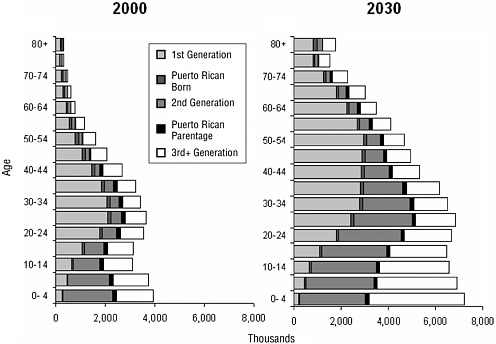
FIGURE 6-1 Hispanic generations by age, 2000 and 2030.
SOURCE: Passel (2004).
that are experiencing population aging (see Chapter 4). This dividend will only be realized, however, if the high school and college graduation gaps between Hispanics and other groups are eliminated or at least significantly narrowed. With a median age of 12.6 in 2000, the majority of the Hispanic second generation is now of school age; by 2030, the majority of the Hispanic second generation will be in the labor force, with a median age of 24.3 Because most young people have completed their formal schooling by this age, the long-term economic future of Hispanics depends crucially on the educational progress of the second generation, both in absolute terms and relative to other groups they will compete with in the labor, housing, and consumer markets.
Certain aspects of Hispanics’ social and economic future can be predicted with some confidence by extrapolating the likely consequences from well-defined trends. Given the considerable uncertainty regarding the future course of immigration and intermarriage, the vitality of the U.S. economy, geopolitical relations with our southern neighbors, and political mobilization initiatives, other conclusions are necessarily tentative. Despite many
uncertainties, current trends suggest numerous opportunities, and some risks, for the U.S. Hispanic population and the nation as a whole. The main body of this chapter discusses the main opportunities and risks, extrapolating from recent trends and identifying strategies to deal with likely risks. First, however, we summarize what is known about Hispanic identity, assimilation, and socioeconomic mobility.
DIVERSITY, IDENTITY, AND ASSIMILATION
Hispanicity as a Panethnic Identity
Despite their growing national visibility and regional dispersal, Hispanics are not easily classified racially or ethnically. Moreover, categorization will be even more difficult in the future as intermarriage blurs ethnic, racial, and cultural differences. Since 1970, the Hispanic population has become appreciably more diverse in nationality, social class, legal status, and generation, challenging the cohesion of Hispanicity as a cultural identity. Four mechanisms are particularly important for understanding the construction and persistence of Hispanicity as a panethnic identity: the extent to which Hispanics accept and self-identify using panethnic labels, trends in intermarriage, the extent of Spanish-language use, and the proliferation of panethnic labels through the media and official classification schemes.
Although acceptance of panethnic labels has increased, the majority of Hispanic adults continue to prefer identity labels linked to their country of origin. Over time, however, those country-specific labels give some way to panethnic labels as generational transitions erode homeland traditions. Moreover, while only about one in four second-generation Hispanic youths adopts a panethnic identity, they are much more likely than their parents to accept Hispanic or Latino as a racial identity. Thus, both ethnicity and race will likely remain salient markers of Hispanic identity for the foreseeable future.
Depending on how the children of ethnically mixed couples define themselves in ethnic terms and, in particular, whether socially successfully Hispanics are more or less likely to acknowledge their ethnic heritage, intermarriage trends also will affect the future size and social contours of the Hispanic population. Recent intermarriage trends point to a softening of some group boundaries. Because there are few three-generation studies of Hispanics, it is difficult to say whether the most successful individuals and families opt out of Hispanic ethnicity. Although empirical evidence is
both spotty and mixed, it appears that beyond the second generation, more successful Hispanics are less likely to self-identify or to be identified by others as Hispanic.4 This highly tentative inference is consistent with patterns of language shift.
Spanish-language use can reinforce Hispanicity as a panethnic identity in the face of rising intermarriage among Latin American nationalities, but two offsetting forces ultimately will decide what the shift away from the Spanish language portends for the persistence of Hispanicity. First, continued immigration from Latin America will slow the rate of language shift, but how much, in what ways, and for what groups will depend on settlement patterns of the foreign born. Second, the geographic dispersal of Hispanics may accelerate the process of linguistic assimilation, which may also dilute the development of a panethnic identity if accompanied by higher rates of intermarriage with non-Hispanics.
Currently, about 28 million U.S. residents—mainly Hispanic—identify as Spanish speakers. Ironically, both their geographic concentration and their residential dispersal generate anxiety that the United States is becoming a linguistically bifurcated nation. Such anxiety is unfounded because, by all indications, Hispanics are following the linguistic paths of prior immigrants in their increasing reliance on English across generations and over time. The proliferation of Spanish in neighborhoods densely populated by immigrants belies the rapid linguistic assimilation evident between the first and second generation, which is nearly complete by the third. This rapid shift to English indicates fluidity in the boundary between Hispanics and non-Hispanics. As a transitional phase of inevitable language shift, bilingualism is not incompatible with English proficiency, which is a requirement for economic mobility, political integration, and social success.
How best to ensure proficiency in English remains highly controversial because there is no consensus on how best to teach non-English-speaking students across the grade spectrum. Many schools serving large Hispanic student populations have instituted programs in bilingual education or in English as a second language to bridge initial language barriers. While well-implemented programs have been shown to reap significant educational gains, program quality varies greatly across schools and districts. For many students, participation in bilingual education courses not only interferes with English mastery, but at times actually contributes to academic failure.5
Finally, two institutions play a role in maintaining and reinforcing Hispanicity as a coherent ethnic identity—the media and government. Media references to “the Hispanic market” and advertising agencies’ refer-
ences to “Hispanic consumers” convey Hispanicity as a monolithic identity, defined through contrast with non-Hispanics. Yet apart from Spanish-language programming and publications for the Spanish-dominant population—mainly recent immigrants—there is no agreement about whether the Hispanic market differs sufficiently from other consumer segments to require specialized expertise.6 Social reality is more complex than is usually conveyed in advertising and standard business models. Most simply, Hispanics may have nonethnic consumer tastes (and non-Hispanics may be attracted to Hispanic food and culture). The crux of the debate is whether growing numbers justify special marketing strategies for Hispanics, other than Spanish-language messages to reach new arrivals.7
Traditional Hispanic advertising agencies focus on the Spanish-language marketplace, but Hispanic-centric agencies approach marketing strategies within a multicultural framework that acknowledges both the population’s complexity and the fluidity of its Spanish-language usage. Continued demographic growth coupled with unprecedented geographic dispersal might increase the need for multicultural marketing strategies, at least temporarily, but the long-term demand for Spanish-language outlets will depend on the future course of immigration and the rate of linguistic assimilation across generations.8 Less debatable is the increased purchasing power of Hispanics as their numbers grow and as greater numbers ascend to the middle class.9
Government institutions also encourage a slow shift toward panethnic over national-origin identities through the use of the terms “Hispanic” and “Latino” in their data collection activities. The absence of questions about national origin or options to report national origin as an ethnic identity reduces the salience of a national identity relative to panethnic identities for some Hispanics, particularly those from nations with low representation in the United States, such as Uruguay and Bolivia.
It remains unclear whether Hispanicity is a transitory identity of largely symbolic consequence among the culturally assimilated and socially integrated, or whether it will become an enduring marker of minority group status defined by economic disadvantage and buttressed by cultural differences.10 The answer surely depends on the reception and assimilation of future arrivals; on the social mobility experienced by the second and subsequent generations; and on the economic opportunities afforded by a globalized economy. On all fronts, there are encouraging signs and abundant opportunities, but also some downside risks.
Sociocultural Transformation
Through their large numbers, through intermarriage and through language assimilation Hispanics are increasingly becoming interwoven into the American sociocultural fabric. Their assimilation is a reciprocal process. Even as new immigrants and established Hispanic residents adapt to American society and institutions, Hispanics are transforming the United States socially and culturally.
One unique role Hispanics play in social transformation involves racial identities. Because large numbers of African, indigenous, and European populations have coexisted in Latin America since the colonial period, social understandings of race in that region differ from the black–white color divide that historically characterized the United States. Although racial differences are an important dimension of Latin American stratification systems, race does not generally create the deep schisms found in mainstream U.S. society. Thus, as growing numbers of Hispanics self-identify in racial terms, especially young people born in the United States, they transform traditional racial classification schemes. Hispanics also may soften racial boundaries by infusing Latin American meanings of race into the black–white racial divide. This latter possibility is highly tentative at this time, however; the dimensions of racial identity will depend in part on Hispanics’ continued geographic dispersal to areas historically segregated along racial lines and future patterns of intermarriage.
Settlement patterns that concentrated Mexicans in the southwest, Puerto Ricans in the northeast, and Cubans in south Florida also are being transformed by Hispanics’ geographic dispersal in response to employment demand in construction, domestic maintenance and repair services, nondurable manufacturing, and personal and household services. Whether Hispanics’ geographic dispersal fosters a greater sense of belonging, results in higher levels of acceptance, and accelerates socioeconomic integration is not clear. Escalating hostility toward Hispanic migrants in new suburban destinations, vigilante activity along the U.S. border, proposed federal legislation to prohibit states from issuing driver’s licenses to undocumented immigrants, and the targeted deportation of undocumented Hispanic workers in the name of fighting terrorism challenge the integration prospects of recent Hispanic immigrants. The geographic dispersal of the Hispanic population also challenges health care delivery systems and providers unaccustomed to caring for diverse groups of patients, especially as language barriers undermine providers’ ability to deliver culturally competent care to the foreign born.
Over generations, the comingling of different Latin American immigrant populations in multiethnic cities could consolidate panethnic Hispanic identity as a racial category, as now experienced by second-generation youth living in Miami and San Diego. Alternatively, cultural diversity accentuated by the dispersal of recent immigrants could repeat the residential segregation patterns that characterize the traditional gateway cities. Which scenarios play out and where they do so hinges on whether Hispanic immigrants settle among blacks, whites, and Asians in their new destinations and, especially, on whether their geographic dispersal sharpens class divisions and increases social isolation. The relative recentness of the Hispanic scattering precludes long-term forecasting.
Finally, Hispanics take part in social transformation through their political participation and civic engagement. Although references to “the” Hispanic vote are a misconception, average differences in voting behaviors and political attitudes between Hispanics and whites are discernible. For example, because Hispanics express higher levels of trust in government than do whites, they also are more supportive of taxation for collective goods, such as education, public services, and social security. Moreover, differences in these political attitudes across national-origin groups are relatively small.
A distinctive, and discouraging, feature of Hispanics’ political behavior is their low participation, evident across a range of electoral, civic, and organizational activities. Particularly noteworthy are their lower rates of voter turnout compared with blacks and whites, even among registered voters. Young age structure, low education, and high poverty levels largely explain the low voting rates and low rates of office holding, but the net result is relatively little political influence, particularly noticeable in areas of high Hispanic concentration. That electoral participation and civic engagement of the foreign born rise with time spent in the United States and also across generations imply that Hispanics will have increased political influence as the second generation comes of age. This outcome, however, rests on making educational investments in the young to socialize them politically and prevent pervasive civic disengagement.
The Costs of Assimilation
At the same time that Americanization facilitates social and economic mobility, it also exacts cultural costs. One cost is the erosion of Hispanics’ traditional strong commitment to family life, even at the expense of
individual well-being. Familism declines across Hispanic generations, especially among Mexicans and Puerto Ricans, the two groups with the greatest generational depth; other groups will likely follow suit. While new family forms could emerge in which family support remains high, it is more likely that acculturation will weaken familism by fostering the individualism that drives many changes in family behavior. The decline of familism and the shift to nuclear family forms will likely erode the protective functions of extended families and kin networks for future generations. Second and later generations face a higher risk of divorce, and youths reared in single-parent families must contend with the myriad deleterious consequences of parent absence.
Acculturation is also associated with worsening health for Hispanics—as it is for all immigrant groups. This trend poses special risks for the Hispanic population because the phenomenon is experienced most extensively by the swelling second generation. In general, U.S.-born Hispanics report the poorest health and the highest levels of risk behaviors; among those born abroad, negative health outcomes and the propensity to engage in risky behaviors increase with length of residence in the United States.
The worsening health status of Hispanic children and adolescents is of particular concern for three major reasons: their large numbers and rapid growth; their lower insurance coverage levels; and the fact that several health indicators—particularly obesity and the resulting abnormalities of glucose metabolism—point to vulnerabilities that will pose formidable health challenges in the future. If unchecked, these trends portend high rates of premature morbidity and mortality as Hispanic youth, particularly those born in the United States, reach adulthood. Averting those health risks will require strategies that both target obesity among Hispanic youths and attempt to preserve the positive health behaviors of Hispanic immigrants.
Trends in Hispanics’ utilization of quality health care services also raise several issues for policy makers, health care providers, and the health care system in general. Continued immigration of Hispanics from Mexico and from Central and South America, coupled with their dispersal to new areas unaccustomed to providing care for diverse populations, will challenge providers responsible for delivering health care to low-income Hispanics, and to recent immigrants in particular. Current trends in employer-sponsored health insurance also signal rising numbers of uninsured Hispanic adults and youths over the next few years. Expansion of federally subsidized programs, such as Medicaid and SCHIP, appears unlikely in an era of
unprecedented federal budget deficits, which magnifies the health risks facing Hispanics in the years ahead. Because the carrying capacity of the health care safety net differs across communities and according to local economic conditions, its ability to meet the challenge of providing health care for uninsured Hispanics is highly uncertain.
SOCIOECONOMIC MOBILITY
The importance of education for Hispanics’ economic success, social integration, and political participation cannot be overstated. Despite continued temporal and intergenerational gains in educational attainment, Hispanic students lag well behind both whites and blacks in years of school completed, but especially in their representation among the college educated. They face multiple risks in U.S. schools that stem from their delayed acquisition of preschool literacy; their parents’ limited familiarity with the U.S. education system; and, for large numbers of second-generation youths, delayed exposure to English. Failure to master English before leaving school represents a formidable risk because English proficiency is absolutely necessary for success in the labor market, and it is vital both for navigating health care systems and for meaningful civic engagement. Closing the gap in Hispanics’ education would require placing students in high-quality scholastic programs, reinforced by early intervention initiatives, strong dropout prevention efforts, and strategies that promote college attendance and graduation.
Hispanics’ low levels of formal schooling and proficiency in English jeopardize their labor market prospects, as reflected in their employment rates, occupational standing, and earnings. Hispanic workers with less than a high school education are relegated to unstable, low-paying jobs that offer few or no social benefits and usually undesirable working conditions. Low education levels and limited English proficiency also explain most of the earnings deficits between native- and foreign-born Hispanics.
Two key findings consistently emerge with respect to Hispanics’ labor market position. First, Hispanics’ lower average schooling levels are the major source of their labor market inequalities with other groups. Unlike African Americans, for whom discrimination contributes to racial disparities in earnings, Hispanics reap earnings comparable to whites for each year of education attained. Second, most of the generational progress in Hispanics’ earnings occurs between the first and second generations, with less clear-cut outcomes thereafter.11
The slow growth in the rate at which Hispanics graduate from college is cause for concern because the best-paying jobs now require a college education. In 1999, nearly 6 of 10 jobs required college-level skills, including many that had not required college training in the past.12 In 1959, only one in four managers and business professionals (such as insurance and real estate agents) held college degrees; by 1997 more than half did so. In such fast-growing occupations as health services, nearly three in four jobs now require some college education. In 1997 two-thirds of office workers had some college education, and almost one-third had college degrees.13 These trends bode ill for Hispanics as the college graduation gap widens.
Temporal and intergenerational trends in earnings, household income, and home ownership point to the gradual rise of Hispanics, especially the U.S. born, to the middle class. Still, partly because of the weak economic position of immigrants and partly because of persisting education gaps among the native born, Hispanics as a group are losing economic ground relative to whites. The increased generational gaps in wage growth and annual earnings can be traced to two sources: differences in levels of human capital (e.g., schooling, English-language proficiency, and accumulated work experience) and differences in returns to human capital, that is, how groups are compensated for their education, language skills, and workforce experience.
The coming of age of the second generation should improve Hispanics’ overall economic well-being because later generations earn higher incomes. Assuming no deterioration in real income, declines in fertility rates would also raise per capita income while lowering poverty rates. However, trends in divorce and family formation could slow households’ economic mobility because female-headed households have much lower incomes than those of married couples. If the growth of mother-only families continues its current path, future improvements in Hispanics’ economic well-being would not be predicted. It is too soon to know or forecast the long-term effects of welfare reform on Hispanics—especially on groups that rely most heavily on public benefits, such as Dominicans and Puerto Ricans. It is also too early to tell whether the dispersion of Hispanics from California, Texas, and New York to other parts of the country will enable their children to break the chain of poor schools–poor jobs–poverty. Experiences to date provide a mixed picture at best, but one thing is certain: high-quality education promises the burgeoning second generation the opportunity of narrowing income gaps and providing the nation with a demographic dividend.
What can be stated conclusively, therefore, is that lower levels of schooling, English proficiency, and work experience remain a serious impediment to Hispanics’ labor market success and, consequently, their ascent to the middle class. In 2000, for example, the 2-year average educational gap between all Hispanics and whites cost about $100 billion in lost earnings.14 Given the growth in the Hispanic populations that is projected to occur over the next 30 years, the cost of this education gap could rise to $212 billion in current dollars by 2030, taking into account the generational shift.
Unlike labor market disparities produced by discrimination, educational inequities can often be addressed directly through policy instruments. Closing Hispanics’ human capital gaps relative to whites would require early and sustained intervention at all levels of the educational system. The benefits of education are crucial for Hispanic youths, and they are also important for the nation. The temporal coincidence of a large Hispanic second generation and an aging white majority represents an opportunity to attenuate the consequences of the nation’s rising burden of old-age dependency. However, this opportunity will be short-lived because continued declines in Latin American fertility will not only alleviate labor pressures south of the border, but also shrink the migrant labor streams on which the U.S. economy has come to depend.15
As growing numbers of Hispanics join the labor force and replace white retirees, Hispanic workers should be able to attenuate labor shortages such as those experienced by other Western, industrialized countries. To mitigate the effects of the aging U.S. population on social security funds and Medicare, however, the productivity of young workers must be sufficient to compensate for a shrinking workforce.16
AN UNCERTAIN FUTURE
Because of their large numbers, relative youthfulness, and geographic dispersal, Hispanics can be expected to affect American society in profound ways even as they experience considerable transformation as a people. The shape their future will take remains highly uncertain, however. Much depends on whether newcomers from Latin America and long-established Hispanic residents join the ranks of the middle class and experience the social mobility that has characterized European immigrants, whether growing numbers of foreign-born Hispanics become citizens and come to express a political voice, whether the obesity among Hispanic children and
adolescents and its attendant health consequences are averted, and whether Hispanics’ geographic dispersal accelerates their spatial and social integration. Also uncertain is whether the demographic dividend afforded by the Hispanic age bulge will be realized.
The effects of Hispanics on U.S. schools, health care systems, labor markets, and political organizations are occurring even as their own ethnic contours are being reshaped by immigration, intermarriage, new settlement patterns, language shift, and the adoption of collective panethnic identities, as well as by changing definitions of race and emergent racial identities. Because Hispanics’ collective and ethnic-specific experiences differ in notable ways from those of African Americans, and because U.S. economic conditions and opportunity structures today differ greatly from those encountered by European immigrants at the turn of the 20th century, the experiences of those groups are not a reliable indicator of how Hispanics will affect the American future.
The Hispanic future will also be shaped by uncertainty about the long-term competitiveness of the U.S. economy as China and India become major players on the international scene, about changes in geopolitical and economic ties with our southern neighbors, and about possibilities for resolving the status of the 8.5 million Hispanics who live and work without the guarantees of legal status. Until the question of legal status is resolved, the social prospects of undocumented immigrants’ U.S.-born children will be limited. Although the Supreme Court ruled that no child can be denied access to public education, irrespective of his or her legal status, this ruling does not apply to higher education, which is becoming ever more critical for labor market success.17
During the first quarter of the 21st century, the Hispanic age bulge will offer a unique opportunity to improve the common good by attenuating the social and economic costs of an aging majority population while enhancing national productivity and global competitiveness. Realizing this potential will require educational investments that position future entrants into the labor force to compete for high-paying jobs in a service and information economy. Many other benefits—civic integration, adoption of positive health behaviors, wealth accumulation, and social mobility—will follow, though often at the price of cultural distinctiveness.
The opportunity costs of not closing the Hispanic–white education gap are considerable. The most significant medium-term cost is the relegation of adult Hispanic workers to unstable, low-paying jobs at the lowest rungs of the occupational ladder. A longer-term consequence is the
intergenerational perpetuation of disadvantage among Hispanics that would result from limiting the opportunities of future generations—a demographic penalty exemplified by the high incarceration rates among U.S.-born Hispanic youth with less than a high school education compared with their foreign-born counterparts.18
Notwithstanding uncertainty about future immigration flows and macroeconomic conditions, what is certain is that the current educational profile of Hispanics will undermine their long-term economic, social, and physical well-being and diminish their prospects for social integration and civic engagement. Given the projected growth of the Hispanic population over the next quarter century, compromising the future economic prospects of Hispanics by underinvesting in their education will likely compromise the nation’s future as well.


