

3
Defining Hispanicity: E Pluribus Unum or E Pluribus Plures?
As immigrants, Hispanics are likely to experience the same social transitions as other immigrant groups. With time, most immigrant communities become ethnic groups, and within three generations (i.e., the grandchildren of the immigrants), most expressions of ethnicity, including language, are rendered symbolic as a result of improved socioeconomic status, residence in neighborhoods that are outside of ethnic enclaves, and intermarriage. There are signs that similar processes are occurring among Hispanic communities. However, it is uncertain whether “Hispanic” will evolve to become a symbolic identity for people of Latin American descent who become part of the American mainstream. There are risks that Hispanicity could be an enduring marker of ethnic and minority group status.
As detailed below, the panethnic term “Hispanic” became official government terminology in the mid-1970s.1 The term gained popular currency after being used in the 1980 census and all subsequent census schedules. It was joined by “Latino”—most popular in California during the 1980s and 1990s—in census 2000.2 Often used interchangeably, both terms are widely debated. Nor is there consensus on their usage, although there are clear preferences. Given a choice, migrants from Latin America overwhelmingly prefer to self-identify by country of origin, but if required to choose between the two panethnic terms, they prefer “Hispanic” to “Latino” by a margin of 3 to 1.3 It is worth noting that Hispanics are “Hispanic” only in the United States; in their home countries, the term neither resonates nor is used.
Of greater significance are the meanings signified by both “Hispanic” and “Latino”—terms that mask the enormous diversity of this eclectic population. As noted in Chapter 2, while united by a common ancestral language, Hispanics diverge in a number of respects. These include national origin, social history, legal status, shades of skin color, socioeconomic status, religion, and political views—just about every element that has bound other immigrant groups in the United States.4 Because nearly half of all Hispanics living in the United States today were born abroad, the Spanish language has proliferated in places where large numbers have settled. Acting as a kind of cultural mortar, the universality of the language has created an illusion of ethnic unity among Hispanics that is belied by their diversity: there is no monolithic Hispanic population with a common history or common problems.
Moreover, it is unclear at this point how enduring Hispanic identity will prove to be beyond the third generation. The extent to which U.S.-born children or grandchildren of recent immigrants from Latin America will consider themselves Hispanic is an open question. Longitudinal studies suggest that only about a quarter of second-generation Hispanics tend to adopt a panethnic identity, although members of this group are much more likely than their parents to accept Hispanic or Latino as a racial (as opposed to ethnic) self-identifier.
ORIGINS OF HISPANIC IDENTITY
Whether the handiwork of legislators or the invention of academics, classification systems create and shape ethnic and racial boundaries. In the aftermath of the Civil Rights movement of the 1960s, new social legislation—in particular, grant-in-aid programs that allocated federal dollars on the basis of population formulas—called for more accurate counts of people of Spanish origin.5 In response, the word “Hispanic” was adopted by the federal government to denote those who traced their ancestry to Spain, Mexico, and the Spanish-speaking countries of the Caribbean and Central and South America. In 1976, Congress enacted Public Law 94-311, which both defined (and thus created) the Hispanic population and mandated the collection, analysis, and publication of data on that population.
Laws require implementation guidelines. One such guideline, Directive 15, issued in 1977 by the Office of Management and Budget (OMB), standardized the collection and reporting of “racial” and “ethnic” statistics, including data on persons of Spanish/Hispanic origin. Directive 15 not
only authorized the term “Hispanic” for official use, but also specified a minimal classification of four “social races,” later revised to five—White, Black or African American, Asian, American Indian or Alaska Native, and Native Hawaiian or Other Pacific Islander—and two ethnic backgrounds—“of Hispanic origin” and “not of Hispanic origin.”6 Because the government routinely uses the terms “Hispanic” and “Latino” equivalently alongside such racial categories as “Asian,” “Black,” and “non-Hispanic White” and tabulates data accordingly, the former have de facto become racial terms. Furthermore, the media and standardized tests and application forms of various types use the terms “Hispanic” and “Latino,” reifying them as a racial category.
Before Directive 15, and dating back to 1850, the census category analogous to today’s “Hispanic” was “Mexican origin.” The U.S. census relied on several different indicators to identify persons of Mexican origin in those early decennial counts, such as country of birth (or parent’s birth) and mother tongue. A century later, in the 1950s, the Census Bureau used Spanish surname to identify people of Mexican origin in five southwestern states, and first published information on persons of Puerto Rican birth or parentage who resided on the mainland. High rates of intermarriage and geographic mobility gradually undermined the usefulness of Spanish surname and language for enumerating Mexicans and Puerto Ricans. So, too, did the large numbers of Filipino immigrants, whose Spanish surnames hampered application of the Census Bureau’s algorithm for identifying persons of Mexican ancestry living in the southwest. The changing composition of expanding migration flows from Latin America also warranted a more inclusive identifier that could accommodate all Spanish-speaking nationalities.
In the late 1960s, the U.S. Inter-Agency Committee on Mexican American Affairs, a federal task force established to ensure that Mexican Americans received a fair share of government services and programs, challenged the Census Bureau’s plans for the 1970 census. The committee maintained that the traditional practice of relying on surnames, mother tongue, and birthplace produced a significant undercount of the population.7 Not only did this vocal political constituency apply pressure on the Bureau to revise how it enumerated people of Hispanic origin, but more important, it triggered a systematic review of methods used to count all minority populations and to produce racial and ethnic statistics. Despite the Census Bureau’s staunch objection to using subjective self-report questions to measure ethnicity, the 1970 census was the first to use a subjective identification
question to enumerate the Spanish-origin—now Hispanic/Latino—population on the 5 percent sample questionnaire.
Of course, as suggested above, there is no archetypal Hispanic—not now and not in 1970. Many factors—intermarriage between Hispanics and non-Hispanics; generational variations; legal status; and often marked differences in levels of assimilation, educational attainment, and physical appearance—all contribute to a rather loose definition of the term “Hispanic.” As noted, moreover, the criteria and labels used to classify people from Spanish-speaking America are themselves in flux—from “Spanish surname” and “Spanish heritage” to “Hispanic” and “Latino”—mirroring the many ways Hispanicity can be expressed in panethnic terms: as a distinctive racial identity, as an artifact of identity politics, and as a set of lived experiences. Moreover, the labels “Hispanic” and “Latino” are both celebrated (as in Hispanic Heritage Month) and stigmatized as a result of negative social connotations, especially those associated with legal status.
Whether the broad labels “Hispanic” and “Latino” ever acquire true panethnic status will depend largely on whether cross-cultural solidarity, mutual interests, and political cohesion materialize. It is ironic that one presumption of similarity—origin in a Spanish-speaking country—is now a key source of differentiation among Hispanic groups. As discussed in Chapter 2, larger numbers of new immigrants from Central and South America and the Dominican Republic are altering the U.S. Hispanic mosaic—still dominated by Mexicans but increasingly less so by Puerto Ricans and Cubans.
THE SHIFTING CONCEPT OF RACE
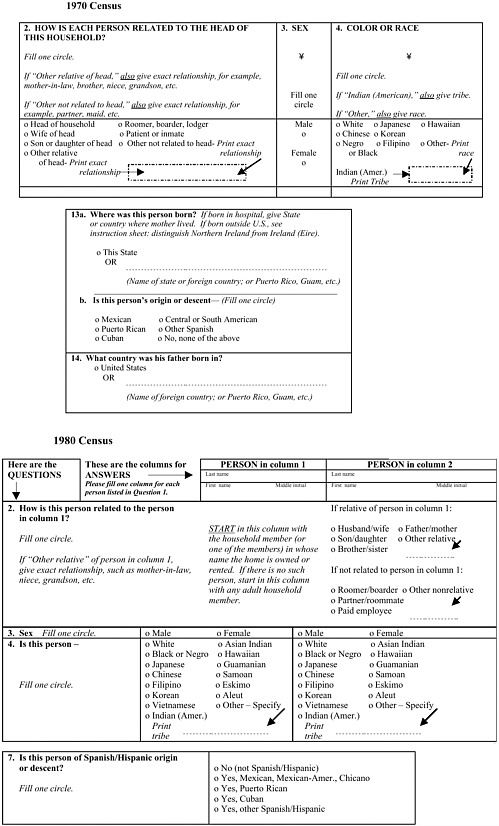
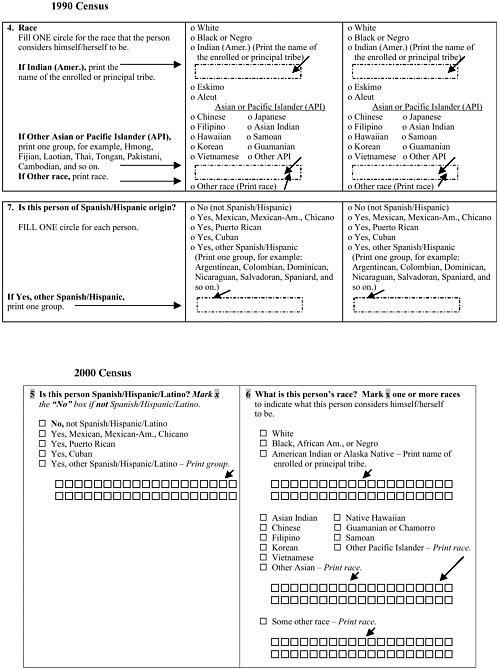
All U.S. censuses since 1790 have included questions about race; as the first decennial census to implement OMB Directive 15, however, the 1980 census short form asked all U.S. residents to indicate whether they were “of Spanish/Hispanic origin or descent.”8 In the 1980 and 1990 census questionnaires, the race question preceded the Hispanic origin item, which offered four main options:
-
Mexican, Mexican American, Chicano
-
Puerto Rican
-
Cuban
-
Other Spanish/Hispanic
Respondents selecting the last option were asked further to specify their “otherness,” giving examples such as Argentinean, Colombian, Dominican, Nicaraguan, and Salvadoran. Census 2000 added the term “Latino” alongside “Spanish” and “Hispanic,” but placed the Spanish/Hispanic/Latino item before the race question (see Figure 3-1).
Racial and ethnic classifications aim to reflect current social realities, but for Hispanics the Census Bureau’s questions about race appeared to be curious at best. Not only did the 1980 census short form not use the word “race” to distinguish blacks, whites, Asians, and Native Americans (as stipulated by Directive 15), but as noted, the placement of the Hispanic origin and race questions differed from that used in 2000 (see Figure 3-1).9 Race has a different meaning in Latin America, where Africans, indigenous peoples, and Europeans have long coexisted in large numbers.10 For people of the Americas, whose concepts of race transcend the classic black–white divide, racial classification in the 1980 census (which included six Asian nationalities along with Samoan, Guamanian, and Hawaiian as separate “races”) led to widespread confusion. A large number of Hispanics and others did not recognize the intended distinction between the racial and ethnic categories, including many newcomers unaccustomed to racial categories.
In 1980, more than one in three Hispanics self-identified as “some other race”; this figure was more than 40 percent in 1990.11 As a result of political pressures to acknowledge the nation’s increasing racial complexity and in an effort to adhere to OMB’s directive that Hispanics could be of any race, census 2000 instructed respondents to answer both the “race” and “Hispanic origin” questions. It also permitted them to mark multiple race categories.12 Unlike the 1980 and 1990 schedules, however, census 2000 provided no examples of Spanish-speaking nationalities, while continuing to list Asian nationalities as separate races. Not surprisingly, close to half of all Hispanics self-identified as “some other race” in census 2000. Dominicans (58 percent) were most likely to do so, while Cubans (7 percent) were least likely.13 By contrast, only 3 percent of non-Hispanics classified themselves as “some other race.”
The ethnic labels “Hispanic” and “Latino” are used so frequently alongside racial labels such as “Asian” and “black” that many Hispanics are beginning to view themselves as a separate race. Their choice of “some other race” on census forms reflects more than four centuries of mestizaje, or racial miscegenation, in Latin America and the Caribbean, as well as the differing conceptions of race noted above.14 Hispanics may also mark “some
other race” simply because they do not see themselves as fitting under any of the categories provided by the Census Bureau. In census 2000, Hispanics were more than three times as likely as non-Hispanics to claim an admixture of “two or more races,” with most specifying “white” plus another race. Thus, their rejection of the OMB racial classification by checking “some other race” on the census questionnaire reflected their lived experience rather than a statistical artifact or measurement error.
The national differences among Hispanics discussed earlier add complexity to these racial contours. In the 2000 census, for example, four in five Cubans self-identified racially as white, but only one in five Dominicans did so; only 8 percent of Dominicans considered themselves black, as did less than 1 percent of Mexicans, Salvadorans, Guatemalans, Colombians, Peruvians, and Ecuadorians. Yet more than half of Dominicans, Salvadorans, and Guatemalans considered themselves “another race,” as did roughly half of all Mexicans, Peruvians, Ecuadorians, and Puerto Ricans and just about a quarter of Colombians.
There are signs that the children of Latin American immigrants are even more likely than their parents to consider themselves “another race”—not black, white, Asian, or American Indian—which attests to a fluidity of racial identity that contrasts sharply with the historical black-white divide.15 In the mid-1990s, more than 5,000 second-generation youths from south Florida and southern California representing 77 different nationalities, including all of the main Spanish-speaking countries of Latin America, were given the option to identify themselves racially as white, black, Asian, multiracial, or other.16 More than three in four selected multiracial or other (the majority choosing other). Of those who chose other as their race, 41 percent indicated Hispanic or Latino, and another 20 percent cited their nationality (e.g., Mexican).17
In contrast, the children of Haitians, Jamaicans, and other West Indians tended to identify themselves racially as did their parents—most of whom self-identified as black. The same was true for Europeans and Canadians, the majority of whom labeled themselves white, and for Asian-origin youth, who generally identified as “Asian,” as did their parents. Those of Latin American origin displayed by far the widest parent–child disparities in racial identity. Overall, about 60 percent of Latin American parents designated themselves as white, but only 20 percent of their own children did so. By nationality, the figures for parents versus children were 93 and 41 percent for Cubans; 85 and 24 percent for Colombians; approximately 67 and 20
percent for Salvadorans, Guatemalans, and Nicaraguans; and about 31 and 14 percent for Dominicans.
Hispanics’ generational self-identity shift from white to multiracial is unprecedented. Among earlier immigrants, particularly those from southern and Eastern Europe, social acceptance and cultural assimilation often involved shifting racially from nonwhite to white. The generational shift among Hispanics reveals how, with time, the classification scheme proposed by Directive 15 has expanded the meaning of the labels “Hispanic” and “Latino,” transforming them into ethnic identities that also have a racial component.
Children of immigrants exposed to American culture and its definitions of race during their formative years and later classified as Hispanic or Latino at school internalize the belief that they are members of a racial minority. They render their Hispanicity racial by expressing their national origin in those terms. This has far-reaching consequences for the contours of minority group boundaries and potentially, therefore, for intergroup relations. The situation illustrates the arbitrary nature of racial constructs—indeed, the ease with which an “ethnic” category developed for administrative purposes becomes a potent marker of social difference. It also implies that Hispanics are blurring former black-white racial boundaries, although the implications for the country’s racial hierarchy are as yet unclear.18
Hispanicity, then, is both imagined and real: imagined because it is a social construct invented by the federal government for the purpose of bureaucratic accounting, and real because it has been rendered so by its use. Through their broad popular usage, the ethnoracial labels “Hispanic” and “Latino” are increasingly being accepted by immigrants and their U.S.-born children as referring to their own identities. The extent of the impact of these labels as markers of differences in status remains an open question, to be settled by the second and later generations.
ESPAÑOL OR ENGLISH?
English is the door to the American dream. Not until one masters el inglés are the fruits of that dream attainable.19
Unlike the European immigrants who crossed the Atlantic en masse from the 1880s to the 1920s and those from Asia who did so after legal barriers had been removed in the late 1960s, immigrants from Mexico, most of Central and South America, and the Spanish-speaking Caribbean
speak a common language: Spanish. This fact—not place, not race, not citizenship—is the single greatest difference between Hispanics and non-Hispanics in the United States. As a core issue in the Hispanic experience, language raises important questions about divided national loyalties and the cohesion of Hispanicity as a panethnic identity; about social integration and labor market prospects in an English-dominant society; and, more generally, about the terms of belonging in U.S. society. In this context, and independent from discussions of educational policy, bilingualism is an essential dimension of language shift with major implications for social integration.20
Altogether, more than 28 million U.S. residents ages 5 and older spoke Spanish at home in 2000—about 10 million more than the total number of persons who spoke all other languages combined. To a casual observer, particularly in areas where Hispanics are highly concentrated, the ubiquity of Spanish—on storefronts, on election ballots, and in airports, for example—signals the emergence of a bilingual nation by default, if not by design. Although this may be the case on the streets of America, in fact the pervasiveness of Spanish-language use at home is a transitory phenomenon that largely reflects immigration patterns. It is true that the vast majority of Hispanics born abroad—93 percent—speak some Spanish at home, compared with only 63 percent of those native born. What those figures fail to convey, however, is that among remaining bilinguals Spanish fluency erodes rapidly over time and across generations.
Unlike foreign-born young people, who have an opportunity to improve their linguistic skills as they progress through U.S. schools, relatively few adults who immigrate pursue their education beyond age 25. This reduces the labor market prospects of foreign-born, working-age Hispanics compared with whites or blacks, who are largely proficient in English. Only one-third of foreign-born working-age Hispanics are fluent in English, compared with about 88 percent of their U.S.-born counterparts and virtually all non-Hispanic blacks and whites. Men and women are about equally proficient in English, but notable differences occur across Hispanic subgroups. Roughly a quarter of Mexican immigrants claim fluency in English, compared with half of Cubans born abroad and even larger shares of island-born Puerto Ricans. These differences reflect mainly length of U.S. residence and to a lesser extent educational levels. Variation in English fluency is minimal among U.S.-born Hispanics, with proficiency levels hovering around 90 percent for the three largest subgroups—Mexicans, Puerto Ricans, and Cubans (see Figure 3-2).
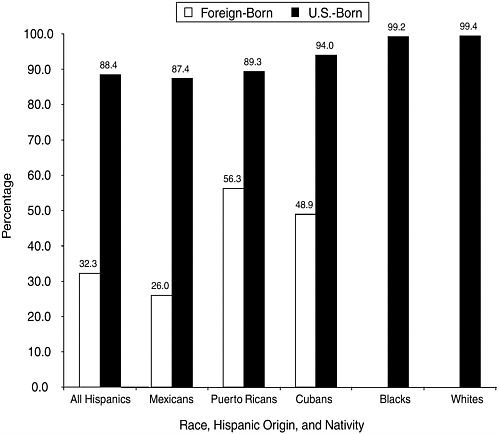
FIGURE 3-2 Percentage of working-age adults who speak English very well by race, Hispanic origin, and nativity.
NOTE: The samples include individuals ages 25 to 59. In these tabulations, persons who speak only English are presumed to speak English “very well.”
SOURCE: 2000 census, 5 percent samples, Public Use Microdata Samples (PUMS).
The degree of Spanish retention among foreign-born Hispanics remains a subject of considerable controversy because of the presumption that bilingualism retards the acquisition of English-language skills. The loyalty that many Spanish speakers (especially Mexicans) feel toward their native tongue diminishes across generations, especially beyond the second. A recent national survey of Hispanic immigrants revealed that 72 percent were Spanish dominant, 25 percent were bilingual, and a mere 4 percent were English dominant. By the second generation, only 7 percent of adult Hispanics were Spanish dominant, and about 47 percent each were bilingual or English dominant. Among the third and later generations, not
only did Spanish dominance disappear, but fewer than one-quarter were bilingual.21 Similarly, a rare multigenerational study of Mexican-origin couples in Los Angeles conducted in the mid-1970s found that among first-generation (immigrant) women, 84 percent used only Spanish at home, 14 percent used both languages, and a mere 2 percent used only English. By the third generation, there was a complete reversal of these shares, with 4 percent speaking only Spanish at home, 12 percent using both languages, and 84 percent speaking only English.22
Of the three main factors that shape English fluency among the foreign born—length of time in the United States, age at arrival in the United States, and educational attainment—the latter two are the most decisive. The younger the immigrant at the time of arrival and the more educated, the greater is the facility in acquiring English-language skills.23 For working-age adults, particularly those with low levels of completed schooling, the propensity to learn English is much lower, sometimes for lack of access to a supportive language program. Nevertheless, there are strong indications that Hispanics are shifting from Spanish to English at an increasingly rapid pace. The most compelling evidence is from data that record changes in language preferences over time. The Children of Immigrants Longitudinal Study (CILS), which collected data over a 10-year period for first- and second-generation Hispanic youths as they made their transition to adulthood, showed rapid linguistic assimilation, even among the groups most likely to retain Spanish: Mexicans living along the U.S.-Mexican border and Cubans residing in Miami, the most bilingual major city in the country.24
In focus group sessions commissioned by the panel and conducted over several months, participants emphasized repeatedly how they wanted their children to be able to speak Spanish, even if they themselves lacked facility with the language. Third-generation Hispanics, in particular, stressed the importance of repairing the breaks in the cultural chain that occurred when their own parents failed to keep the Spanish language alive at home. The following comments made to the panel were typical:
You don’t need to speak Spanish to be considered a “white-washed Hispanic,” or at least I am, because I don’t speak Spanish. What I speak, I learned in school, and I don’t speak it well. My parents are fluent. I’m white-washed because I’m losing the culture. (third-generation Hispanic, Houston)
My mom made the decision not to teach me Spanish because she wanted me to learn English well. Now my Dad’s mad at her because I don’t speak any Spanish. I think they spoke Spanish amongst each other when they didn’t
want me to know what they were talking about. Being around it, you learn. I don’t speak it but I understand it. So, they know better. (third-generation Hispanic, Houston)
“Spanglish”—a creative if jumbled blending of Spanish and English spoken widely among U.S. Hispanics both at home and abroad—may be an important part of the process by which Hispanicity is forged in the context of cultural shift (see the example in Box 3-1). Widely regarded as the tongue of the uneducated, Spanglish is the quintessential hybrid—“the verbal encounter between Anglo and Hispano civilizations.”25 It is spoken testimony to attempted communication between immigrant populations and mainstream America that preserves as much of the native tongue as is practicable. According to Stavans, “This delicious—and delirious—mishmash is what Latino identity is about: the verbal mestizaje that results from a transient people, un pueblo en movimiento.”26 The evolution of the language itself is a powerful symbol of hybrid identities that cut across national, racial, and social boundaries.
|
BOX 3-1 They want me pa’las quotas, so the place might say “chicanos are also part of our diverse population.” Pero pa’que, profe? I don’t feel bien. I’m just a strange animal brought in a cage to be displayed pa’que los gringos no sientan culpa.27 |
In sum, rapid linguistic assimilation among youths from all Hispanic subgroups and social classes points to a clear and inevitable decline in their use of, preference for, and therefore fluency in Spanish. Hence like other immigrant groups, the majority of third-generation Hispanics—the grandchildren of the present wave of immigrants—will be English monolinguals. The only prominent exceptions to this trend are Dominicans, who maintain very close contact with their homeland.28
Despite the high level of immigration during the 1980s and 1990s, the shift to English may actually be occurring at a more accelerated rate today than was true in the past. The experience of Mexican youths is most telling
on this point: in 1990, already about two-thirds of third-generation children spoke only English at home; a decade later, the equivalent figure was about 71 percent.29 Arguably, the atrophy of these children’s ability to maintain fluency in the language of their immigrant grandparents represents a significant loss of valuable bilingual resources, both for individuals and for the United States in a global economy. Increased awareness of the value of this linguistic and cultural resource could retard the process of language loss by promoting bilingualism with strong English proficiency, but not without explicit recognition that proficiency in two languages is an asset.30 Whether this opportunity will be seized is uncertain, but current trends are not encouraging.
CONCLUSION
How immigrant and minority groups self identify—and are identified—is a gauge of their integration in U.S. society. Hispanicity as an identity has its roots in U.S. laws and regulations, embodied in questions included on the U.S. census since 1970 on the long form and since 1980 on the short form. The term “Hispanic,” however, is deceptive because it masks the great diversity among the Hispanic population and implies a monolithic group that does not exist. Whether it evolves into an enduring panethnic identity will partly depend on whether social and political cohesion evolves among Hispanic subgroups. A better understanding of Hispanics’ intergenerational change awaits the inclusion of questions on parental birthplace in the U.S. census and other major data sources with sufficiently large samples (see Box 3-2).
For the government’s purposes, Hispanic is considered an ethnic identity (“Hispanics may be of any race”). But socially, and in popular use, there are signs that Hispanic connotes both an ethnic and a racial identity, particularly among second and later generation Hispanics.
Whether “Hispanic” will evolve to become a symbolic identity or whether it will be an enduring marker of ethnic and minority group status is highly uncertain. If Hispanics successfully integrate into the societal mainstream, as earlier immigrant groups have done, then the former is likely to be true. Language trends suggest that this integration is taking place. But other crucial indicators of social integration are less clear. The next chapter continues the examination of integration, turning to the social, economic, and political contexts in which it is taking place.
|
BOX 3-2 Before 1970 knowledge about the Hispanic population was largely regional in scope because of the Census Bureau’s reliance on objective indicators, such as Spanish surname, birthplace, parents’ birthplace, and mother tongue to identify people of Spanish ancestry or descent. The Spanish origin item, first introduced in the 1969 Current Population Survey (CPS) on an experimental basis and then included in the 5 percent schedule of the 1970 census, allowed for the enumeration of the Hispanic population on a national basis. Although the 1980 census improved the Hispanic enumeration by including the Spanish origin item on the 100 percent schedule, the replacement of the parents’ birthplace item, which was used to represent generational status from 1870 to 1970, with a question about ancestry compromised the ability to portray intergenerational changes. Consequently, the measurement of Hispanics’ intergenerational progress has been limited to surveys with detailed information about generational status. There is a pressing need for additional data on parental birthplace to provide information about the generational status of Hispanics (and other groups) and enable the tracking of intergenerational mobility. Neither the census, which is the primary source for information on the foreign born in the United States, nor the American Community Survey (ACS), intended to replace the census long form, asks this question.31 The annual CPS, conducted by the Census Bureau for the Bureau of Labor Statistics, does include questions about parental nativity. The responses to these questions yield valuable information for the study of immigrants and their children. However, the CPS is based on a sample rather than a full enumeration—hence it generates “estimates” rather than enumerated generational composition. The CPS is also hampered by small sample sizes. When the available data are broken down by national origin and generational cohort, cell sizes do not permit reliable analyses, even if multiple years of the survey are merged.32 In the CPS, “third generation” includes a substantial share of persons of fourth, fifth, and higher-order generational status. These problems can be remedied by adding questions about parental nativity to the census and the ACS and other major data sources. There is also a need for samples that are large enough to enable the study of national-origin groups by generation, with appropriate controls on salient variables. Having Spanish-language versions of survey instruments will avoid the exclusion of participation on the basis of language. |


