
Creating an Infrastructure for Managing Spent Nuclear Fuel*
K. G. Kudinov
Mining-Chemical Complex, Federal State Unitary Enterprise
INTERNATIONAL SPENT NUCLEAR FUEL MANAGEMENT TODAY
At the end of 1998 there were 434 nuclear power reactors in operation worldwide. According to International Atomic Energy Agency (IAEA) estimates, about 225,000 metric tons of spent fuel had been removed from reactors by 2000, of which 75,000 metric tons are to be reprocessed and 150,000 metric tons are destined for storage. Some 10,000 metric tons of spent fuel are removed from reactors worldwide each year.
Spent fuel reprocessing plants exist in only a few countries: France (1600 metric tons per year), Great Britain (1200 tons per year), Russia (400 tons per year), and Japan (100 tons per year, with a plant capable of processing 800 tons per year currently under construction). Some of the countries involved in nuclear power production need services for the temporary or long-term storage of spent fuel due to the lack of their own storage facilities. Experts believe that the market for spent fuel storage and reprocessing services totals some $160 billion.
A total of eight nuclear power plant units with water-moderated water-cooled reactors (VVER-1000) are currently operating in Russia (at the Balakovo, Kalinin, Novovoronezh, and Rostov plants). Plans had called for spent fuel from the VVER-1000 reactors to be stored and reprocessed at the RT-2 plant (at the Mining-Chemical Complex, Federal State Unitary Enterprise in the city of Zheleznogorsk, Krasnoyarsk Krai). The first part of the plant—a wet (water-cooled) repository complex with a designed capacity of 6000 metric tons—went
into operation in 1985. Since 1992, construction of the plant’s reprocessing complex has been on hold due to a lack of funds. The repository has been accepting spent fuel since 1985 from three Russian power plants (seven units), and four Ukrainian plants (11 units): South Ukrainian, Zaporozhye, Khmelnitsky, and Rovno. The amount of spent fuel received annually totals 250 to 350 metric tons. In 2001–2002, 82 metric tons of spent fuel was received from the Kozloduy nuclear power plant in Bulgaria (two units). The total amounts of spent fuel received annually are about 140 metric tons from Russian nuclear power plants, 220 metric tons from Ukraine, and 40 tons from Bulgaria.
The importance of issues related to spent fuel management is also confirmed by the fact that the international conference “Irradiated Nuclear Fuel Management 2002: Russian New Initiatives” was the first such conference ever held in Russia. In his speech at this conference First Deputy Minister Mikhail I. Solonin noted that “the development of the nuclear power industry is being hindered by the lack of clear-cut and broadly understandable solutions with regard to the safe management of spent nuclear fuel and radioactive wastes.” Solonin proposed the creation of major international complexes for spent fuel storage and reprocessing and possibly for the manufacturing of new fuel and the recycling of radioactive wastes, with these complexes to be located at Minatom enterprises with the technologies and most importantly the experience required in this regard. I would like to emphasize this initiative and propose that the Mining-Chemical Complex be considered as a candidate for this type of operation.
According to the Strategy for the Development of the Nuclear Power Industry in Russia in the First Half of the Twenty-First Century, construction of the RT-2 plant is planned for the period 2020 through 2025, which is just prior to the wide-scale development of nuclear power production using fast neutron reactors (2030).
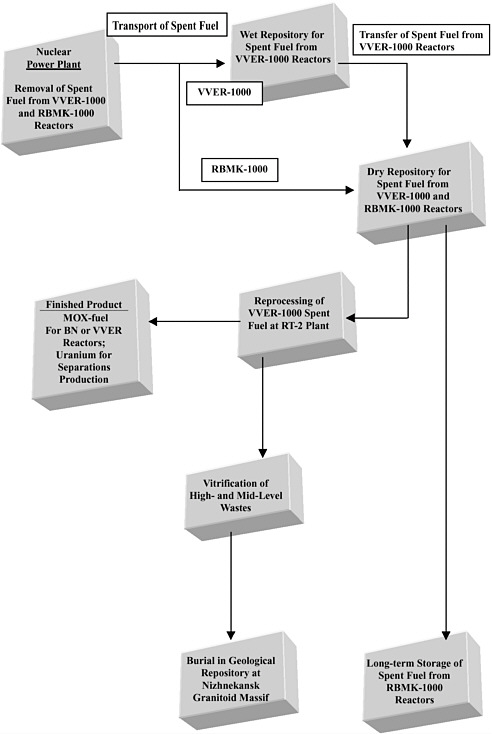
In accord with the closed nuclear fuel cycle concept that has been adopted in Russia, the basic stages of the nuclear waste management process are illustrated in Figure 1.
I will now discuss in greater detail the various stages involved in the transport and storage of spent nuclear fuel as carried out in practice at the Mining-Chemical Complex.
TRANSPORT OF SPENT NUCLEAR FUEL
One important element of spent fuel management is its safe shipment from the nuclear power plant to the site for its long-term storage and/or radiochemical reprocessing. In transporting spent fuel (irradiated fuel rods) care must be taken to ensure the nuclear and radiation safety and physical security of the shipment and to protect it against any damage in case of an accident. All transport casks are certified and meet Russian safety standards as well as IAEA requirements for use in normal operating conditions as well as emergency situations.
The Mining-Chemical Complex has three types of transport casks available for shipping spent fuel:
-
TUK-10V (capacity: 6 fuel rods), 7 units
-
TUK 13/V (capacity: 12 fuel rods), 5 units
-
TUK 13/1V (capacity: 12 fuel rods), 11 units
The complex also has the following transport containers for casks and auxiliary train cars: TK-10, 7 units; TK-13, 12 units; TK-13T, 2 units; TK-13M, 2 units; TK-VS, 4 units.
There have been no incidents or occurrences involving the transport of spent nuclear fuel since the system has been in operation. More than 700 train car trips have been completed to date, with the distance traveled by the freight containers totaling more than 2 million km for the TUK-10Vs and more than 4 million km each for the TUK-13/Vs and TUK-13/1Vs.
The time required to complete a shipment averages 50 days. The special trains spend 12 to 16 days in actual transit, and it takes one or two days to load and unload each container.
The transport casks have an operating lifespan of 20 years, and many of these units will soon be reaching the end of this period. It is essential to extend the operating period of existing casks or manufacture new ones with increased carrying capacity. In order to reduce costs for building new casks and freight containers, a standardized radiation-shielded transport container should be developed for shipping various types of spent fuel, as well as a standardized transport container for carrying casks in various modes of transportation. Firms should be selected to manufacture casks and transport containers on the basis of a competitive bidding system.
These objectives are included in the draft of the Program for the Handling of Irradiated Fuel Rods from Nuclear Reactors During Shipment for 2003 to 2015 (PROYAT-2003), which was developed by the All-Russian Design and Scientific Research Institute for Comprehensive Energy Technology (VNIPIET) and is currently being prepared for adoption.
CURRENTLY OPERATING WET REPOSITORY
This storage facility went into operation in December 1985. Its planned capacity is 6000 metric tons. As of January 1, 2003, it had received 3500 metric tons of spent fuel from VVER-1000 reactors, including approximately 1500 tons from Ukraine and 82 tons from Bulgaria, with the remaining 1920 tons coming from Russia.
In order to increase the capacity of the facility and improve the safety of spent fuel storage, various organizational and technical measures and other work
are being carried out in accordance with the Plan of Measures for the Construction of the Unit Linking Building 1 with Building 2 at the RT-2 Plant and for the Construction of the Dry Storage Facility at the Mining-Chemical Complex as approved by the Minister. After this work is completed, the capacity of the facility will be increased to 8600 metric tons.
Plans call for spent fuel (irradiated fuel rods) to be stored at the wet facility for 30 years, after which the material is to be either sent to the regeneration plants (RT-1 and RT-2) for reprocessing or transferred for longer-term storage at the dry facility.
DRY SPENT FUEL STORAGE FACILITY
The task of building a dry spent fuel storage facility with a designed capacity of at least 6000 metric tons as the second component of the RT-2 plant was first put forth in the state environmental impact review that modified the design plans for the RT-2 plant (Ministry of Natural Resources Order No. 364, dated June 14, 1996).
At its October 1996 meeting to review the course of implementation of Russian Federation Presidential Decree No. 72, dated January 25, 1995 (On State Support for the Restructuring and Conversion of the Atomic Industry in the City of Zheleznogorsk, Krasnoyarsk Krai), the Minatom board assigned specific tasks to Minatom subunits involved in creating the dry storage facility for spent fuel from high-power channel reactors (RBMK) and VVER-1000 reactors. Based on this decision by the Minatom board, VNIPIET in 1999 prepared an investment study for a standard dry reinforced concrete-type facility with a designed capacity of 33,000 metric tons, of which 24,000 tons was to come from RBMK-type reactors and 9000 tons from VVER-1000s. Total construction costs were estimated at 10 billion rubles. The investment study passed all required expert reviews. Taking foreign experience into account, various options were subsequently worked out for the construction of other types of dry facilities, namely, those involving storage in vertical boreholes, vaults, and casks.
In 2001 VNIPIET, its Krasnoyarsk branch, and the Mining-Chemical Complex proposed that the unfinished buildings of the RT-2 plant (buildings 2, 3, 3A, and 3B) be used in the creation of a dry spent fuel storage facility. Visual and instrument studies of these buildings were conducted, and the results confirmed that using the structures for this purpose was possible. This option will make it possible to accelerate and reduce the cost of construction.
The Minatom Scientific-Technical Council and the ministry’s board have approved the vault option for the dry spent fuel facility. The design for the vault-based dry facility was developed by VNIPIET in December 2002.
Taking into account the complex situation with regard to RBMK spent fuel, the Minatom board decided at its June 2002 meeting that the initial complex of
the facility should be created by 2005, primarily to handle RBMK-1000 wastes, and the board also supported the proposal to use buildings 2, 3, 3A, and 3B of the RT-2 plant in the construction of the dry facility.
According to the Plan of Measures for the Construction of the Unit Linking Building 1 with Building 2 at the RT-2 Plant and for the Construction of the Dry Storage Facility at the Mining-Chemical Complex, which was approved by the minister in July 2002, construction of the initial complex of the dry repository will begin in 2003, with the facility to go into operation in 2005.
The total costs for the construction of the dry facility, including the value-added tax, will be 16.6 billion rubles at price levels of the first quarter of 2003 (432.1 million rubles in 1991 prices), of which the costs for the initial complex are estimated at 8.12 billion rubles in first-quarter-2003 prices.
The designed capacity of the facility for spent fuel from RBMK-1000 and VVER-1000 reactors totals 37,785 metric tons (26,510 tons for RMBK-1000 fuel and 11,275 tons for VVER-1000 fuel). The capacity of the initial complex of the repository is 8862 metric tons.
With the aim of getting the facility into operation more quickly, a startup unit with a calculated capacity of about 5100 metric tons of RBMK-1000 fuel has been identified for completion as part of the initial complex at the dry facility. VNIPIET has been assigned the task of completing the design for the startup unit in March 2003.
At the recommendation of the Rosenergoatom firm, the revised design must also include a cask site for the storage of reinforced concrete containers of spent fuel. According to the investment study prepared in 1999, plans call for this cask site to be big enough to hold 121 TUK-104 reinforced concrete transport packaging units. At the time when the investment study was undergoing review and revision, the cask site was eliminated, and therefore the project was never started.
DRY STORAGE FACILITY OBJECTIVES FOR 2003
The following tasks relating to the dry storage facility are to be accomplished during 2003:
-
successfully pass expert review of the vault option for the dry facility
-
carry out preparatory work at the site (work is under way to dismantle the existing structural elements of the buildings of the RT-2 plant)
-
obtain a license from the Russian State Atomic Energy Inspectorate (Gosatomnadzor) for placement and construction of the dry facility
At the demand of the Krasnoyarsk Krai Environmental Protection Committee, phase one of the environmental impact assessment of the RT-2 plant will also be submitted for expert review along with the design for the dry facility.
PROSPECTS FOR EXPANDING THE MARKET FOR SPENT FUEL-RELATED SERVICES
As previously noted the Mining-Chemical Complex is currently accepting spent fuel from nuclear power plants in Russia, Ukraine, and Bulgaria for temporary technical storage and subsequent reprocessing. The package of “nuclear” laws passed by the State Duma of the Russian Federation in July 2001 (Federal Laws No. 92-FL, 93-FL, and 94-FL) allow the complex to accept spent fuel from other countries. Besides the countries listed above, there are others that could be potential shippers of spent fuel. However, for the above-mentioned laws to really work requires that the Government of the Russian Federation pass a number of regulatory acts or governmental resolutions, something that has not yet been fully achieved.
The dry facility is also a prerequisite for the receipt of foreign spent fuel, but in the initial phase the spent fuel could be accepted at the existing wet facility or temporarily stored in containers until the dry facility is completed. The Mining-Chemical Complex and Minatom are losing substantial amounts of hard currency due to the inability to carry out such operations. The funds required for the construction of the facility for foreign spent fuel or the cask site should be obtained as an advance payment from the prospective suppliers of spent fuel, without the need to use any Russian funds for this purpose.
It should be noted that the number of potential clients wishing to send spent fuel for temporary storage and subsequent reprocessing is substantially greater than the number of clients requiring only temporary storage, so one would hope for the spent fuel reprocessing complex to be completed more quickly.


