
Creation of Underground Laboratories at the Mining-Chemical Complex and at Mayak to Study the Suitability of Sites for Underground Isolation of Radioactive Wastes
Tatyana A. Gupalo
Federal State Unitary Enterprise, All-Russian Scientific Research and Design Institute of Industrial Technology, Moscow
In selecting spent fuel storage sites, one must take into consideration the two possible means of further disposition that would be used, namely direct burial or reprocessing of spent fuel with subsequent burial of the output wastes.
Since the early 1970s, the Russian Ministry of Atomic Energy (Minatom) has been studying various sites and geologic formations to determine their suitability for use in the construction of underground radioactive waste isolation facilities. Underground facilities for the isolation of radioactive wastes and spent nuclear fuel differ substantially from other general industrial and power industry structures in the following ways:
-
Rock formations provide reliable isolation over prolonged periods of time (during which long-lived radionuclides require isolation).
-
Safety may be demonstrated on the basis of modern sanitary requirements, state standards, and construction norms and rules governing site selection, construction, operation, and maintenance of the underground facility.
All scientific research and prospecting efforts should be directed toward obtaining reliable data for design documents that will pass expert reviews at the regional, national, and international levels.
Figure 1 depicts a model of the life cycle of an underground isolation facility. The model also illustrates the application of the concept by which requirements for matrix materials, engineered barriers, and the geological formation itself must be based on the quantity and radionuclide content of the material to be stored. The region, district, and specific site for the facility are selected in accordance with established geological and environmental criteria.
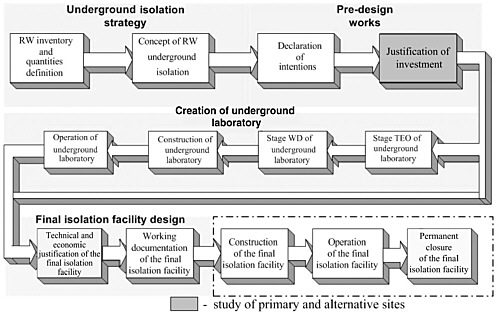
FIGURE 1 Model of the life cycle of a radioactive waste (RW) storage facility.
In geological engineering research it is necessary to take into account the entire range of legislation concerning the problem of managing radioactive wastes and spent nuclear fuel, as well as existing regulatory documents used in obtaining initial data for the design and construction of special underground structures. As shown in Table 1 the legislative and regulatory base for the creation of underground radioactive waste storage facilities includes the following related groups of documents:
-
documents regulating activities at the federal level
-
regulatory documents defining activities at all stages of prospecting, design, construction, and operation of the storage facility
The most important point in the process is the selection of the site where the underground facility will be constructed. A model for the selection of a promising site on the basis of programs was developed in accordance with the requirements of regulatory documents and with the correlation of the scope of research with the various design stages.
According to the regional approach that has been developed in Russia with regard to the selection of geologic sites for permanent isolation, it is most expedient to have the burial sites near the waste sources. Purposeful research for the high-level waste geological isolation has been done in the two areas where the Mayak Production Association (Chelyabinsk Oblast) and the Mining-Chemical
TABLE 1 List of the Basic Relevant Laws and Regulatory Documents Used in Creating Underground Radioactive Waste Storage Facilities at Russian Industrial Sites
|
Name of Document |
Number, Date of Passage |
|
|
Federal Laws |
||
|
1. |
Law of the Russian Socialist Federal Soviet Republic on Environmental Protection |
No. 2060-1, February 19, 1991 |
|
2. |
Law of the Russian Federation on Environmental Impact Review |
No. 174-FZ, November 23, 1995 |
|
3. |
Law of the Russian Federation on the Use of Atomic Energy, including amendments and additions of February 10, 1997 |
No. 170-FZ, November 21, 1995 |
|
4. |
Law of the Russian Federation on Radiation Safety for the Population |
No. 3-FZ, January 9, 1996 |
|
5. |
Law of the Russian Federation on Amending Article 13 of the Federal Law on Environmental Impact Review |
No. 65-FZ, April 15, 1998 |
|
6. |
Law of the Russian Federation on Making Additions to Article 50 of the Law of the Russian Socialist Federal Soviet Republic on Environmental Protection |
No. 93-FZ, June 6, 2001 |
|
7. |
Law of the Russian Federation on Making Additions to the Federal Law on the Use of Atomic Energy |
No. 94-FZ, July 10, 2001 |
|
8. |
Law of the Russian Federation on the Management of Radioactive Wastes |
Bill submitted for consideration by the State Duma |
|
Presidential Decrees |
||
|
1. |
On the State Strategy of the Russian Federation for Protecting the Environment and Ensuring its Sustainable Development |
No. 236, February 4, 1994 |
|
Resolutions of the Government of the Russian Federation |
||
|
1. |
On Rules for Making Decisions on the Location and Construction of Nuclear Facilities, Radiation Sources, and Storage Points |
No. 306, March 14, 1997 |
|
2. |
On Ratification of the Regulations on the Licensing of Activities Related to the Use of Atomic Energy |
No. 865, July 14, 1997 |
|
3. |
On Ratification of the Regulations on Procedures for Conducting State Environmental Impact Reviews |
No. 689, July 11, 1998 |
|
4. |
On Ratification of the Regulations for the Licensing of Activities Related to Environmental Protection |
No. 168, February 26, 1996 |
|
5. |
On Ratification of the Rules for Making Decisions on the Location and Construction of Nuclear Facilities, Radiation Sources, and Storage Points |
No. 306, March 14, 1997 |
Complex (Krasnoyarsk Krai) are located. There is a borehole polygon for liquid radioactive waste disposal in the reservoir beds at the Siberian Chemical Combine.
In the late 1970s in connection with the start of operations at the RT-1 Plant at Mayak in Chelyabinsk and the startup of the facility for steam reforming and vitrification, comprehensive research efforts were initiated for the first time in Russia to assess the suitability of promising sites for the burial of radioactive wastes nearby Mayak. As a result of this work, analyses were conducted on complexes of metamorphic and volcanic rocks and a number of intrusive formations both within the boundaries of the industrial zone at the complex and in adjoining areas. Further investigation at the site was justified.
Thanks to the joint research efforts of Minatom enterprises, Russian Academy of Sciences institutes, and geological organizations of the region, the structure, mineral and chemical composition, and tectonic disturbance of the geologic environment near Mayak were studied in detail. Volcanogenic rocks—tuffs and lava breccia porphyrites with negligible water permeability and high mechanical resistance and thermal conductivity—were found to be the most suitable for burial site purposes. Comprehensives studies of the geologic and hydrogeologic characteristics of these rocks at the Mayak industrial zone have been under way for more than 20 years. As a result of this work, which involved the drilling of 12 deep boreholes and more than 100 near-surface boreholes, scientists have carried out a wide range of experimental filtration work and field geophysics and thermophysics research. The lithological-petrographic composition and physical-mechanical, thermophysical, filtration, and other properties of various types of rock have also been determined under laboratory conditions. In the rock formation being studied several zones have been defined by depth with regard to their fracture toughness. The upper zone of high fracture toughness1 is found down to a depth of 35 to 40 meters. The zone of weak fracture toughness, which lies from 40 to 100 meters below the surface, is characterized by unequal distribution of the network of open fractures. Below the depth of 200 meters, one finds monolithic rock, marked in some places by solitary cracks as well as sections having increased fracture toughness of up to 2.5 meters and a hydraulic conductivity of 10−3 to 10−4 meters per day.
After the results of all research studies were analyzed, two sites were selected as top priorities. On the basis of their hydrogeochemical characteristics, hydrodynamic subzones are being defined in these sites, with these subzones being characterized by the intensity of their water exchange processes and the depth of circulation of natural underground water.
Many years of research aimed at developing a preliminary basis for assessing the suitability of the sites under study for the underground isolation of radioactive wastes have confirmed that the sites are in fact promising.
A second Russian geological isolation site is the Nizhnekansk granitoid massif, one of the largest massifs in central Siberia with an area of more than
1500 square kilometers. It is composed of various types of magmatic and metamorphic rock, among which biotite granites, granodiorites, and gneisses are most common.
A rating system taking into account a set of geologic, technical-economic, engineering, and other criteria was applied to five sites selected by researchers from several organizations (Minatom, the Russian Academy of Sciences, and local geological organizations),2 and as a result the two most promising sites were selected: the first,Verkhneitatsky and the second,Yeniseisky.
Engineering-geological and hydrogeological models of the sites were constructed, and forecast calculations were made of the velocity and filtration time for the various fracture toughness zones from the proposed depths for underground isolation to the surface zones for the dispersion of underground water.
In 2001 the Declaration of Intentions to Construct an Underground Laboratory was prepared and adopted in Krasnoyarsk Krai, with the above sites proposed as options.
In 2002 research at the Yeniseisky site was focused on evaluating the geological structure, degree of tectonic violation, and hydrogeologic conditions for identifying homogeneous and lightly violated blocks of native rock suitable for the construction of an underground laboratory and later a facility for the underground isolation of radioactive wastes.
Geological engineering studies were carried out on a site-specific basis and included the neotectonic mapping of 1008 square kilometers, regularly scheduled hydrological and meteorological observations, route mapping studies of 370 linear kilometers, helium surveys of 259 points, field analytical chemical studies of 85 samples, and emanation surveys of 1067 points.
In the course of geophysical work at the site, studies were conducted on five survey lines (each one 10 kilometers long) and three profiles (each one 7 kilometers long) using the following methods: magnetic surveying, electrical surveying using the audiomagnetotelluric sounding, multiparameter probe, and volatile enriched zone methods (130, 967, and 130 kilometers, respectively), seismic research (70 square kilometers), topographic-geodesic studies (70 kilometers), profile gravitation prospecting (70 kilometers), lab-based determinations of density and magnetic properties (118 samples), and preparation and description of polished core samples. Three boreholes have been drilled, each one 100 meters in depth.
Of all the promising sites in the Nizhnekansk granitoid massif, the Yeniseisky site, which has an area of 70 square kilometers, is the closest to the Mining-Chemical Complex (about 10 km away), the source of the wastes proposed for isolation. Its geologic structure is similar to the comprehensively studied massif of metamorphic rock in which the underground industrial facilities of the Mining-Chemical Complex are located (see Figure 2).
In the many years that the facility has been in operation, research has been conducted on the changes in the condition of the rock massif as a result of
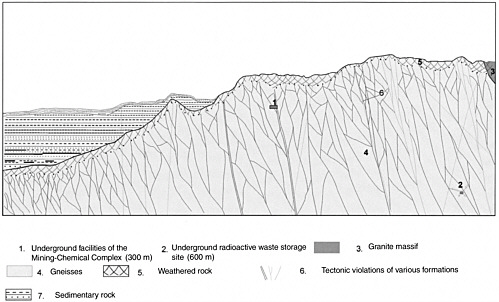
natural (underground pressure, moisture, geodynamics) or industrial (for example, temperature fields) factors. Full results have been obtained through large-scale measurements of the parameters of various physical processes (geomechanical, hydrogeological, geochemical) underway in the rock massif as a result of 40 years of heat field effects. The correlations between rock condition parameters that have been found may be used as initial data in designing underground isolation facilities at the Nizhnekansk granitoid massif as well as similar facilities in any rock massif. (Prediction of the rock mass properties changes due to the natural and engineered load actions over an extended period of time.)
In order to facilitate the creation of long-range predictions a system of models for heat and mass transfer in a heterogeneous, weakly penetrable rock massif has been developed and tested. This system makes it possible to take into account the structural-tectonic characteristics of the site, the heterogeneity of the environment with regard to its heat properties, processes of underground water filtration by fatigue toughness rate, and changes of rock properties over time and space as a result of industrial and natural impacts.
The models also make it possible to predict the distance that the maximum permissible concentrations of any radionuclides will migrate as well as the heat field front, taking into account the rates of leaching from the matrices and of dissolution of radionuclides in underground water for redox conditions in the engineered barrier system and fracturing zones of the rock massif, the constructive features of underground objects, the sizes and properties of engineering barriers, the location of geologic violations,3 and many other factors.
The unique underground facilities of the Mining-Chemical Complex currently provide an opportunity for the practical study of geophysical and geochemical processes that will occur in a rock massif during the construction, operation, and decommissioning of an underground isolation facility.
The experimental work currently being conducted is aimed at increasing our knowledge of hydrodynamic and geomigration parameters. Studies have been initiated in tectonic violation zones (crush and shear zones). Separate experiments have been set up in water-saturated and dry (but water-permeable) zones prone to crack formation. Periodic studies are also conducted regarding the mineralization of crack-vein waters in comparison with the mineralization of rain and melted snow.
Using a lab setup for studying the filtration of radioactive solutions through core models located in the underground conditions of the central factory laboratory, experiments are being conducted on various types of rocks, vitrified wastes, and real radioactive solutions at temperatures of up to 300°C4 and pressures of up to 30 MPa. This makes it possible to simulate the behavior of a multibarrier isolation system under deep burial conditions.
In conjunction with experimental filtration work continuing at 20 boreholes, hydrodynamic and geomigration investigations have been conducted under natural conditions typical of a fracture-prone rock massif. As a result of the experi-
ments under natural conditions, coefficients for diffusion and sorption and desorption rates have been obtained for complex radioactive solutions formed in the rock environment.
An analysis of the many years of field research regarding physical processes that determine the safety of underground isolation has made it possible to propose a new approach for determining the suitability of geologic sites for the long-term underground storage and burial of radioactive wastes and spent nuclear fuel, an approach based on the use of criteria for determining the risk that radionuclides exceeding maximum permissible concentration levels will migrate into the active water exchange zone. The new approach enables comparison of geological sites based on the prediction of their isolation characteristics dynamics during the required period of the radioactive waste isolation, according to the radioactive waste quantity and composition and the enclosing rock massif behavior. The experience of the organization that engaged in rock massif status investigations for more than 40 years for the ecologically dangerous Minatom facility placement is at the heart of this approach.
NOTES


