
Feasibility of Transmutation of Radioactive Elements
Sekazi K. Mtingwa
Massachusetts Institute of Technology
North Carolina A&T State University
One of the most formidable obstacles to exploiting the full potential of nuclear energy is the long-term disposal of highly radioactive waste that is generated by the burning of fuel in nuclear reactors. There is a hope by many that much of the highly radioactive waste can be transmuted to a form that poses much less of a hazard to the environment. To develop such a transmutation technology, the U.S. Department of Energy (DOE) has instituted several additional programs.
In October 1999 DOE’s Office of Civilian Radioactive Waste Management submitted a Report to Congress called “A Roadmap for Developing Accelerator Transmutation of Waste (ATW) Technology.”1 At the time it seemed feasible to use accelerator-generated spallation neutrons to transmute high-level radioactive waste. In the report DOE identified a host of technical issues for the ATW Program, proposed a program and schedule to resolve those issues, estimated the cost of such a program, proposed international collaborations, and assessed the impact of ATW technology on spent fuel from civilian nuclear reactors.
At about the same time DOE established the Accelerator Transmutation of Waste Subcommittee under its Nuclear Energy Research Advisory Committee (NERAC), the top advisory panel to the secretary of energy on matters related to nuclear energy, science, and technology. DOE charged the ATW Subcommittee with reviewing its overall ATW Program and making recommendations on future ATW research and development (R&D). Soon after the establishment of the ATW Subcommittee, DOE merged its ATW Program with its Accelerator Production of Tritium Program, calling the new program the Advanced Accelerator Applications Program. Guided by the recommendations of its ATW Subcommittee, DOE decided that fast neutrons from the fleet of next-generation
nuclear reactors, called Generation IV (GEN-IV) reactors, might be preferable to accelerator-generated spallation neutrons for transmuting radioactive waste. Consistent with its recommendation, the ATW Subcommittee changed its name to the Advanced Nuclear Transformation Technology (ANTT) Subcommittee, thereby de-emphasizing the role of accelerators in the U.S. transmutation program.
Most recently DOE decided that its GEN-IV and transmutation programs needed more coordination to maintain consistency between the two sets of technologies. To promote this coordination Congress established a new program in 2003 called the Advanced Fuel Cycle Initiative (AFCI), under which DOE is charged with developing both advanced fuels for GEN-IV reactors and technologies for spent fuels reprocessing and transmutation.
Research on transmuting radioactive waste is in its infancy, and there is much to be done to make it a reality.
STATEMENT OF THE PROBLEM
The long-term storage, by which I mean the permanent burial, of highly radioactive waste from nuclear reactors is a major obstacle to exploiting fully the potential of nuclear energy. In the United States high-level waste from its roughly 100 civilian nuclear reactors is stored temporarily near the reactors at some 130 sites around the country until some long-term storage facility is commissioned. The most likely site for a permanent repository is Yucca Mountain in the state of Nevada, about 100 miles northwest of Las Vegas. The waste would be buried some 800 feet below the surface and about 1000 feet above the water table. The 5000-foot mountain is located in a desert region that receives about 6 inches of rainfall per year, most of which evaporates. Tentatively the spent fuel would be sealed inside containers made of a corrosion-resistant steel alloy containing nickel, chromium, molybdenum, and tungsten, and the spent fuel would be protected further by titanium drip shields.
The statement of the problem facing the long-term storage of high-level waste from nuclear reactors is as follows:
To be licensed by the U.S. Nuclear Regulatory Commission as a permanent repository for high-level waste from nuclear reactors, the containers to be used to encase the reactor waste at Yucca Mountain must be corrosion-resistant and leak-proof for 10,000 years.2
If the reactor waste is not transmuted, it will be highly radioactive for about hundreds of thousands of years.
In case of waste leakage after 10,000 years can we trust the geologic integrity of the site to prevent the waste from diffusing into the water table or other parts of the environment?
The goal of the U.S. transmutation program is to solve this problem by reducing the radioactivity of the high-level waste, in a period not to exceed 10,000 years,
to a level less than that of the natural uranium ore from which the original fuel was made.3
To better understand the composition of waste from reactors, I show in Figure 1 a rough breakdown of the constituents of spent fuel from a typical civilian reactor in the United States.
A more detailed breakdown of the composition of 1 metric ton of pressurized water reactor (PWR) fuel (approximately 2 fuel assemblies) at 50 MWd/kg burn-up after cooling for 10 years is in Table 1.
As for the principal contributors to the radioactivity of PWR spent fuel at 50 MWd/kg burn-up, 10 years’ cooling, we have the data in Table 2.
If it proves to be feasible, transmutation could have a major benefit for the size and cost of Yucca Mountain and future repositories. Transmutation means the transformation of one atom into another by changing its nuclear structure. In the present context this means bombarding a highly radioactive atom with neutrons, preferably fast neutrons, from either a fast nuclear reactor or spallation
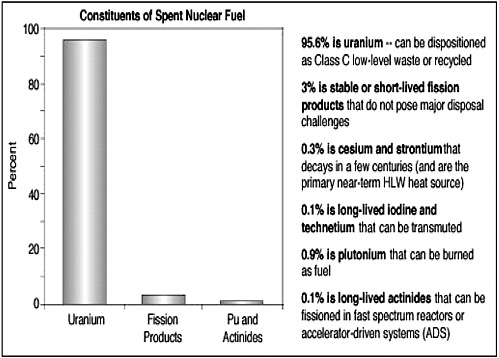
FIGURE 1 Constituents of spent fuel from a typical U.S. nuclear reactor. SOURCE: U.S. Department of Energy. Report to Congress on Advanced Fuel Cycle Initiative: The Future Path for Advanced Spent Fuel Treatment and Transmutation Research. Washington, D.C.: U.S. Department of Energy, Office of Nuclear Energy, Science, and Technology, January 2003, p. II-2.
TABLE 1 Detailed Composition of 1 Metric Ton of Spent Nuclear Fuel
|
|
Fission Products |
|
|
10.1 kg lanthanides |
|
955.4 kg U |
1.5 kg 137Cs |
|
8.5 kg Pu (5.1 kg 239Pu) |
0.7 kg 90Sr |
|
0.5 kg 237Np |
0.2 kg 129I |
|
1.6 kg Am |
0.8 kg 99Tc |
|
0.02 kg Cm |
0.006 kg 79Se |
|
34.8 kg fission products |
0.3 kg 135Cs |
|
|
3.4 kg Mo isotopes |
|
2.2 kg Ru isotopes |
|
|
0.4 kg Rh isotopes |
|
|
1.4 kg Pd isotopes |
|
|
SOURCE: James Laidler. Development of Separations Technologies Under the Advanced Fuel Cycle Initiative. Report to the ANTT Subcommittee. December 2002. |
|
neutrons created by bombarding protons from a high-energy accelerator on a suitable target. Two examples of transmutation are shown in Figure 2.
In addition to transmuting the highly radioactive constituents of spent fuel, there is the possibility of separating out the uranium to sufficient purity that it could be disposed of as Class C low-level waste or reused in reactors. The potential benefits of transmutation and such uranium separation can be seen in Figure 3, which displays a graph of the accumulation over time of civilian spent fuel in the United States both with and without transmutation and uranium separation.
Currently there are about 44,000 metric tons of spent nuclear fuel residing at commercial nuclear power plants in the United States, with some 2000 metric tons being generated each year. The statutory limit for Yucca Mountain is 63,000 tons, and the United States should reach that limit by the year 2015. After 2015 either Yucca Mountain will have to be expanded greatly or a new repository will have to be constructed. If transmutation and uranium separation prove implementable on a commercial scale, the quantity of waste sent to the repository could be stabilized at a level that would eliminate the need for a significant expansion of Yucca Mountain or even a second repository.
The significant cost benefits derived from reprocessing the spent fuel going into Yucca Mountain are shown in the DOE estimates in Table 3.
With the separation of uranium and transmutation of other highly radioactive components of the spent fuel, mainly the transuranics, a second repository
TABLE 2 Principal Contributors to the Radioactivity of PWR Spent Fuel
|
Isotope |
Sievert/Metric Ton (1 sievert = 100 rem) |
|
U-236 |
6.0E + 02 |
|
U-238 |
5.0E + 02 |
|
Np-237 |
3.0E + 03 |
|
Pu-238 |
3.5E + 07 |
|
Pu-239 |
2.8E + 06 |
|
Pu-241 |
2.0E + 07 |
|
Pu-242 |
2.0E + 04 |
|
Am-241 |
1.9E + 07 |
|
Am-243 |
7.7E + 05 |
|
Cm-244 |
4.9E + 07 |
|
Sr-90 |
9.2E + 07 |
|
Cs-134 |
1.4E + 07 |
|
Cs-137 |
6.3E + 07 |
|
Y-90 |
8.9E + 06 |
|
Ce-144 |
3.7E + 04 |
|
Pr-144 |
3.5E + 02 |
|
Pm-147 |
6.6E + 04 |
|
Sm-151 |
5.0E + 03 |
|
Eu-154 |
8.7E + 05 |
|
Eu-155 |
1.5E + 04 |
|
Ru-106 |
2.0E + 05 |
|
SOURCE: James Laidler. Development of Separations Technologies Under the Advanced Fuel Cycle Initiative. Report to the ANTT Subcommittee. December 2002. |
|
would not be needed. With no reprocessing, a second repository is estimated to cost $35 billion. The total savings for disposal from separation of uranium and transmutation is estimated at about $53 billion.
In addition to the significant cost savings for the first repository and the elimination of the need for a second repository, uranium separation and transmutation could serve the worthwhile goal of reducing the time required for the radiotoxicity of the waste in the repository to settle to the level of natural uranium, and this reduction would be from about 300,000 years to several hundred years, as shown in Figure 4.
I have discussed some of the main problems facing the long-term storage of spent nuclear fuel and have suggested that if they could be implemented on a commercial scale, transmutation and uranium separation would have major benefits for the cost and size of the first repository, and even eliminate the need for future repositories.
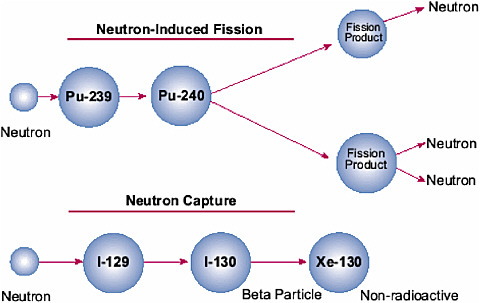
FIGURE 2 Examples of transmutation. SOURCE: U.S. Department of Energy. A Report to Congress: A Roadmap for Developing Accelerator Transmutation of Waste (ATW) Technology, DOE/RW-0519. Washington, D.C.: U.S. Department of Energy, Office of Civilian Radioactive Waste Management, October 1999, pp. 1–4.
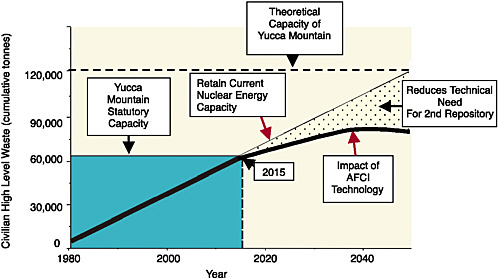
FIGURE 3 Civilian spent fuel accumulation in the United States both with and without transmutation and uranium separation under the AFCI Program. SOURCE: U.S. Department of Energy. Report to Congress on Advanced Fuel Cycle Initiative: The Future Path for Advanced Spent Fuel Treatment and Transmutation Research. Washington, D.C.: U.S. Department of Energy, 2003, pp. I-3, II-4.
TABLE 3 Disposal Cost Benefits Derived from Reprocessing Spent Fuel (in billions of U.S. dollars)
|
Cost Element |
No Reprocessing |
Reprocessing in 2010 |
|
Site characterization |
6.7 |
6.7 |
|
Surface facilities |
7.7 |
5.0 |
|
Subsurface facilities |
9.0 |
5.8 |
|
Waste pkg/drip shield |
13.4 |
5.5 |
|
Performance confirmation |
2.3 |
2.3 |
|
Management |
3.1 |
3.1 |
|
Waste acceptance and transport |
6.0 |
3.0 |
|
Nevada transport |
0.8 |
0.8 |
|
Program integration |
4.3 |
4.3 |
|
Site characterization |
4.6 |
3.5 |
|
TOTAL |
57.9 |
40.0 |
|
SOURCE: James Laidler. Development of Separations Technologies Under the Advanced Fuel Cycle Initiative. Report to the ANTT Subcommittee. December 2002. |
||
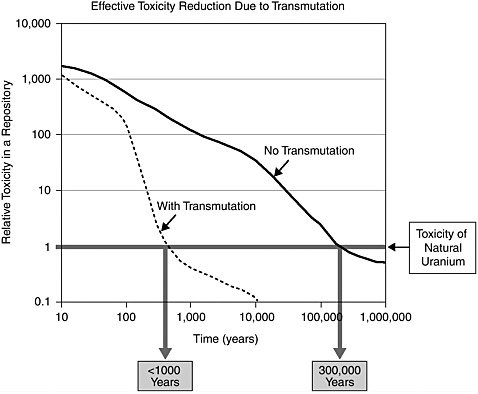
FIGURE 4 Radiotoxicity relative to natural uranium versus time, with and without uranium separation and transmutation. SOURCE: U.S. Department of Energy. Report to Congress on Advanced Fuel Cycle Initiative: The Future Path for Advanced Spent Fuel Treatment and Transmutation Research. Washington, D.C.: U.S. Department of Energy, 2003, p. III-2.
CRITERIA SET FOR THE U.S. TRANSMUTATION PROGRAM
NERAC is the highest panel of experts that provides advice to the U.S. secretary of energy on issues pertaining to civilian nuclear energy, science, and technology. In 1999 NERAC established the ATW Subcommittee to provide advice on the accelerator transmutation of high-level waste from civilian nuclear reactors. Accelerator-induced transmutation has a unique set of problems, such as accelerator reliability and the uncertain problems of coupling an accelerator to the remaining transmutation complex. Given the formidable time and expense to develop this accelerator-based technology, and given the ability of fast reactors (such as those already contemplated for the next generation of nuclear reactors called GEN-IV) to do the same job, the subcommittee early in its deliberations decided to change its name to the Advanced Nuclear Transformation Technology (ANTT) Subcommittee and recommended that DOE not emphasize the use of accelerators for transmutation but place more emphasis on the use of fast reactors.
The current membership of ANTT is as follows:
-
Burton Richter, Chair, Nobel Laureate, Stanford Linear Accelerator Center
-
Darleane Hoffman, University of California, Berkeley
-
Sekazi Mtingwa, Massachusetts Institute of Technology and North Carolina A&T State University
-
Ronald Omberg, Pacific Northwest National Laboratory
-
Joy Rempe, Idaho National Engineering and Environmental Laboratory
In order to maintain the focus and effectively evaluate the U.S. transmutation research and development program, the ANTT Subcommittee has established the following four criteria to be met by any transmutation and separations technology:
-
Reduce the long-term radiological impact of spent nuclear fuel. The minimum goal should be the reduction of the radiological impact of spent fuel to below that of the ore from which it came in a time period equal to or less than the Nuclear Regulatory Commission’s licensing period, now set at 10,000 years. To accomplish this goal the maximum allowable amounts of plutonium and higher actinides in the final waste stream must be severely limited.4
-
Provide substantial benefits to the repository, making it simpler and cheaper. Given that the legislated limit is 63,000 tons for the capacity of the first repository using only the once-through fuel cycle in the United States, and given that the existing U.S. reactors will produce this amount by the year 2015, the first repository is in dire need of any help that it can derive from transmutation and separations technology. The situation is especially critical when one consid-
-
ers that the quantity of spent fuel will double the 63,000 ton statutory limit of Yucca Mountain in about 50 years, and even sooner if nuclear power expands. Luckily it appears that uranium separation and the transmutation of long-lived elements in the waste could reduce the mass going to the repository by a factor of about 20 and the volume by a factor of about 4.
-
Reduce the proliferation risk. Without spent fuel processing and transmutation, even at a constant level of nuclear power, the world’s plutonium inventory will continue to increase. With the transmutation of plutonium, the inventory could be stabilized at an equilibrium level lower than what exists now, and it could be put in an isotopic form less amenable to terrorists and more difficult to use for the creation of weapons of mass destruction. A big challenge is that the decrease in quantity of plutonium to the repository is accompanied by an increased availability of plutonium in the system from material in process.
-
Improve the long-term prospects of nuclear power. Having the first and third criteria certainly helps in satisfying this criterion, since any long-term prospects for nuclear power hinges on proving to the public that the proliferation risk and radiological impact of spent fuel can be minimized. The economic benefits of transmutation and uranium separation are only now beginning to be analyzed, and the early numbers are encouraging. It appears that transmutation and uranium separation could save tens of billions of U.S. dollars on repository costs and even eliminate the need for additional repositories.
To date, the above ANTT criteria have served the U.S. transmutation program well in maintaining its focus.
GENERATION IV ACTIVITIES
The grand purpose of the GEN-IV Program is to identify and down-select the most promising technologies for sustaining, and even increasing, nuclear energy production for the rest of the twenty-first century. This truly has been a coordinated international effort. In 2001 the United States and eight other countries established an international working group called the Generation IV International Forum (GIF) in order to create a common, international nuclear research and development agenda for the next generation of nuclear reactors. The current membership includes 10 countries: Argentina, Brazil, Canada, France, Japan, Republic of South Africa, Republic of Korea, Switzerland, United Kingdom, and the United States. Working with GIF, another DOE NERAC Subcommittee, called the GEN-IV NERAC Subcommittee (GRNS), cochaired by Professor Neil Todreas of the Massachusetts Institute of Technology and Salomon Levy of Levy & Associates, produced the Generation IV Technology Roadmap, which has identified six nuclear reactor technologies that should receive highest priority for future consideration. The main goals of the GEN-IV Program are the following:5
-
provide sustainable energy generation that meets clean air objectives
-
minimize and efficiently manage GEN-IV nuclear waste in order to protect the public health and the environment
-
ascertain the economic competitiveness of GEN-IV nuclear reactors versus other energy-producing technologies
-
ensure the high level of safety and reliability for GEN-IV systems
-
maximize the proliferation resistance of weapons-usable material, as well as protect such materials from theft by terrorists
The down-selected reactor technologies that GIF has assigned the highest priority are the following:
-
very-high temperature reactor (VHTR)
-
supercritical water-cooled reactor (SCWR)
-
sodium-cooled fast reactor (SFR)
-
gas-cooled fast reactor (GFR)
-
lead-bismuth-cooled fast reactor (LFR)
-
molten salt reactor (MSR)
While the international community will study all six concepts, DOE’s GEN-IV program will place highest priority on the first four. As of May 2003 the VHTR is of highest priority because of its hydrogen-generating capability, SCWR is next, and the SFR and GFR seem to be a distant third. As for compatibility with transmutation, the VHTR and SCWR are not capable of adequately burning the minor actinides in the recycled fuel and the GFR is of limited capability. In its most recent report to NERAC and DOE the ANTT Subcommittee emphasized the importance for DOE to continue research and development on the SFR, because it is the most compatible of the four for performing a final burn of the minor actinides.6
THE ADVANCED FUEL CYCLE INITIATIVE
In order to improve the coordination of the GEN-IV and transmutation research and development programs so that technologies considered for next-generation reactors are compatible with the transmutation option, the U.S. Congress established a new program in 2003 called the Advanced Fuel Cycle Initiative (AFCI), under which DOE is charged with developing both advanced fuels for GEN-IV reactors and technologies for waste transmutation.
To ensure a high level of coordination DOE has appointed Ralph Bennett of the Idaho National Engineering and Environmental Laboratory to serve as the national technical director of systems analysis for the AFCI. The program has been divided into the following three subprograms, with the corresponding director and sample responsibilities:
-
fuels development—Kemal Pasamehmetoglu, Los Alamos National Laboratory; fuel forms: oxide, nitride, metal, dispersion, ceramic, coated particles; fabrication techniques
-
separations technologies—James Laidler, Argonne National Laboratory; advanced aqueous chemical fuel treatments; pyroprocessing; waste forms; group separations
-
transmutation technologies—Michael Cappiello, Los Alamos National Laboratory; materials; physics; targets; accelerator-driven systems (ADS)
Responding to the advice of the ANTT Subcommittee, DOE has set the following overall waste treatment goals for the AFCI:
-
reduce the radiotoxicity of high-level nuclear waste to that of natural uranium ore within 1000 years
-
reduce high-level nuclear wastes: mass by a factor of 20 and volume by a factor of 4
-
reduce the civilian inventories of plutonium in forms that are conducive to weapons proliferation and terrorist activities
-
reduce the cost of geologic waste disposal, with a possible net savings over $35 billion during the period 2007–2040
The AFCI is divided into two broad initiatives, called Series One and Series Two.
AFCI SERIES ONE PROGRAM
The mission of the AFCI Series One Program is as follows:
-
Develop technologies applicable to current and near-term reactors.
-
Address the intermediate-term goals for separations, transmutation, and GEN-IV fuels technologies. Among other things, this goal will address the reduction in cost of spent nuclear fuel disposal by decreasing the mass and volume of high-level waste to the repository. This goal will also address the reduction of the long-term proliferation threat posed by plutonium contained in spent fuel.
-
Make policy recommendations to the U.S. Congress by the period 2007–2010 about the need for a second repository.
-
Research the extraction of unspent energy from the reactor waste. The transmutation of plutonium and the minor actinides could provide a 25 percent increase in the energy extracted from reactor fuel compared to the current once-through cycle used in the United States.
-
Continue with the development of the Uranium Extraction (UREX) and UREX+ separations technologies. In the late 1940s the United States developed an aqueous chemical treatment technology called Plutonium-Uranium Extrac-
-
tion (PUREX), and currently this technology is in use in France, Russia, and the United Kingdom. In the PUREX process spent fuel is dissolved in acid and fed through a solvent extraction process, separating both uranium and plutonium. Although separating out the uranium has a definite benefit for a repository, a major problem with PUREX is that the plutonium is partitioned out, which poses a proliferation risk. Recently DOE has pursued a different aqueous chemical treatment technology called UREX, which enhances the proliferation resistance of the spent fuel by separating out the uranium, while at the same time, keeping the plutonium combined with other radioactive species. In an even more advanced process called UREX+, selected actinides and fission products can be separated out in various combinations after the uranium has been removed; for example, mixtures of plutonium and certain of the minor actinides could be partitioned together to enhance the proliferation resistance of the plutonium-containing material. Also, long-lived fission products, such as iodine-129 and technetium-99, could be incorporated into targets for destruction in reactors.
In August 2002 a DOE team under the leadership of James Laidler of Argonne National Laboratory performed experiments at the Savannah River Technology Center and demonstrated that UREX could recover nearly all the uranium at 99.999 percent purity from spent light water reactor (LWR) fuel, thus yielding a level of contamination below Nuclea r Regulatory Commission criteria for disposal as Class C low-level waste.7 Flowsheets for UREX, UREX+, and related processes are shown in Figures 5–8.
The new UREX/UREX+ technology could play an important role in reducing the cost of the first repository by separating out the uranium and disposing of it as Class C low-level waste and by rendering the reprocessed spent nuclear fuel proliferation-resistant by keeping the plutonium mixed with other radioactive elements. An important goal of the AFCI Series One Program will be both laboratory-scale and engineering-scale demonstrations of UREX/UREX+.
The AFCI Series One Program will pursue laboratory and engineering-scale demonstrations of pyrochemical dry treatment (PYROX) technology using spent LWR fuel, including actinide recovery. The program will also pursue the demonstration of large-scale metal waste form technologies, treatment facility designs, and cost estimates.
AFCI SERIES TWO PROGRAM
The main focus of the AFCI Series Two Program is on the fuel cycle technology associated with the next generation of nuclear reactors, especially the fast neutron spectrum reactors. On the advice of the ANTT Subcommittee8 DOE has divided Series Two into Phases I, II, and III, and there is some overlap with AFCI Series One.
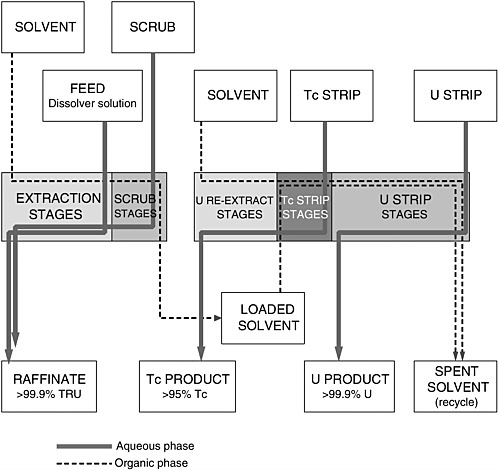
FIGURE 5 UREX process flowsheet. SOURCE: James Laidler. Development of Separations Technologies Under the Advanced Fuel Cycle Initiative. Report to the ANTT Subcommittee. December 2002.
Phase I: Basic Technology Evaluation
DOE considers Phase I to be essentially completed as of the year 2002 and mainly involves an initial evaluation of promising fuel and fuel processing technologies. Major Phase I accomplishments are as follows:
-
treatment of spent fuel to demonstrate the feasibility of extracting uranium to high purity; the initial success of the UREX process in AFCI Series One should allow UREX to be a viable option for the front-end fuels treatment for transmuting Series Two fuels
-
successful manufacture of transmutation fuels containing various combinations of plutonium and the minor actinides in preparation for irradiation testing in 2003
-
construction and commissioning of a lead-bismuth materials loop at Los Alamos National Laboratory to investigate materials behavior in a high-temperature liquid metal environment
-
completion of studies that analyzed several transmutation systems to determine which have the highest potential to reduce the radiotoxicity of spent nuclear fuel
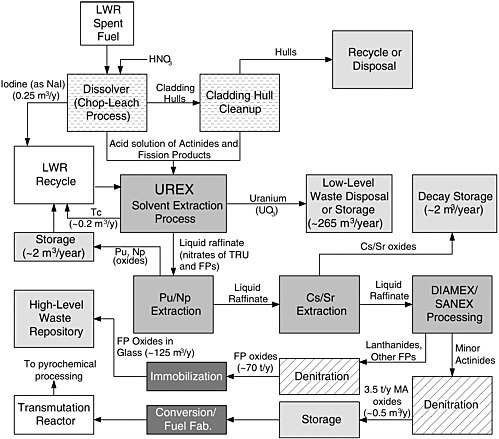
FIGURE 6 UREX+ process flowsheet. (Storage volumes based on 2000 tons spent nuclear fuel per year, 10-year cooling; 2210 m3 per year if disposed directly in a geologic repository). SOURCE: James Laidler. Development of Separations Technologies Under the Advanced Fuel Cycle Initiative. Report to the ANTT Subcommittee. December 2002.
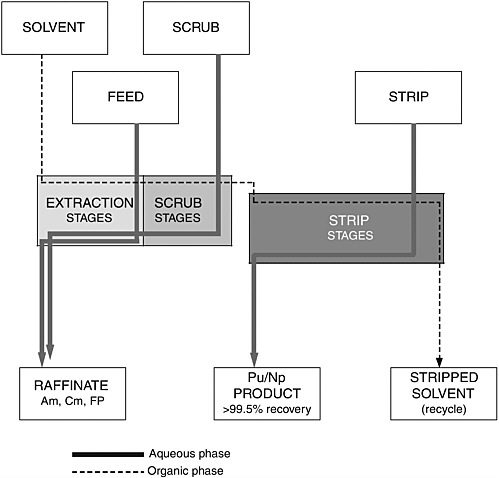
FIGURE 7 Pu/Np extraction flowsheet. SOURCE: James Laidler. Development of Separations Technologies Under the Advanced Fuel Cycle Initiative. Report to the ANTT Subcommittee. December 2002.
Phase II: Proof of Principle
Under Phase II of the AFCI Program, which is considered the proof-of-principle phase, the following activities will be pursued:
-
The most promising technologies from Phase I, such as UREX/UREX+, will be identified for focused research and development. While many experts believe that UREX/UREX+ can be implemented on a commercial scale, dry processes like pyroprocessing may have advantages in handling large concentrations of transuranics. Some believe that pyroprocessing may be more efficient and proliferation-resistant. These advantages must be verified for implementation at a commercial scale and will be pursued in Phase II.
-
Laboratory and larger-scale testing will be done to clarify various technology options, thereby providing important information needed to choose the best path forward for Phase III.
-
More work will be pursued on the development and demonstration of advanced proliferation-resistant treatment technologies.
-
The development and testing of advanced transmutation fuels will receive greater study, especially since there is little work to date on making minor actinide fuels. Irradiation tests of fuel forms, especially those containing mixtures of plutonium with the minor actinides, will be performed at the advanced test reactor, a 250 MW light water reactor located at the Idaho National Engineering and Environmental Laboratory. An international collaboration to test minor actinide fuel forms is being planned for experiments at PHENIX, a fast
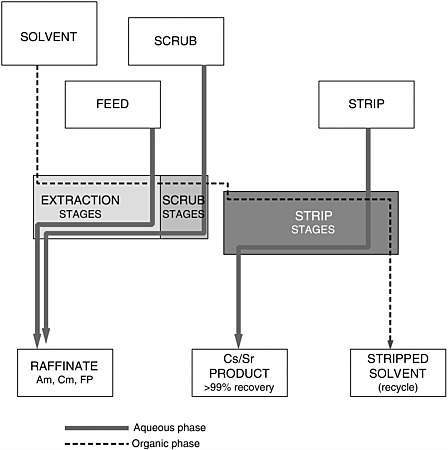
FIGURE 8 Cs/Sr extraction flowsheet. SOURCE: James Laidler. Development of Separations Technologies Under the Advanced Fuel Cycle Initiative. Report to the ANTT Subcommittee. December 2002.
-
spectrum reactor located in France. Another goal for Phase II is to use experimental data to compile a fuels handbook of the physical, chemical, and thermal properties of the transmutation fuel forms.
-
Preliminary technology will be developed for an ADS. DOE has retreated from pursuing the large-scale deployment of ADS complexes as the primary means of transmutation and has decided to concentrate on the use of fast reactors for that purpose. It has been estimated that the cost of implementing an accelerator-only approach could be as high as $280 billion.9 If a suitable fast reactor is constructed among the GEN-IV fleet of future reactors, the large-scale use of ADS technology should not be necessary. There is some interest in studying the smaller-scale use of a centralized ADS facility for a final burn of the transuranics before disposition in a repository. An example of an ADS concept is depicted in Figure 9.
Phase II may be the most important part of the overall AFCI Program, since the efficacy of the chosen technologies will have to be proven, at least at a level with potential scalability. Important results from Phase II should include the final selection and demonstration of optimal fuel forms and advanced fuels treatment processes, the selection of an ideal ADS target material, and a comprehensive assessment of the costs and benefits of each down-selected technology.
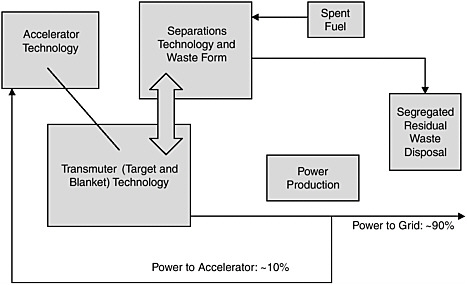
FIGURE 9 Components of an accelerator-driven system. SOURCE: U.S. Department of Energy. A Report to Congress: A Roadmap for Developing Accelerator Transmutation of Waste (ATW) Technology, DOE/RW-0519. Washington, D.C.: U.S. Department of Energy, Office of Civilian Radioactive Waste Management, October 1999, p. E-3.
This work should focus the AFCI research and development as it proceeds into Phase III.
Phase III: Proof of Performance
In this final phase of the AFCI Program the research and development will proceed to a full-scale proof-of-performance demonstration of separations and transmutation technologies down-selected from Phase II. It is during this stage of AFCI that full-scale prototypes of the technologies will be constructed and tested. If the tests prove successful, the next stage will be the commercial-scale implementation of the next-generation technologies.
To ensure the success of the AFCI Program it will be crucial to organize international collaborations to study the many unsolved issues.
INTERNATIONAL COLLABORATIONS
Focusing on reactor concepts, the Generation IV international community has proceeded much more swiftly to initiate international partnerships than has the transmutation world community. The formation of GIF is an excellent example of the kind of world cooperation that is essential in order to tackle the many difficult issues surrounding next-generation reactors and the permanent disposal of reactor wastes. It will be a big step forward when Russia joins the GIF partnership.
Notwithstanding the worldwide cooperation on GEN-IV issues and the importance of coordinating those efforts with separations and transmutation activities, there is minimal international cooperation on fuel separations and transmutation R&D. Keeping the transmutation program alive in the United States has not been easy, and the situation is not significantly better in other countries; this creates a dire need to form a Generation IV International Forum on Transmutation and Separations (GIFTS). Already there are the seeds of some limited partnerships. In the United States, DOE is fortunate to have received important transmutation research data from France and Switzerland that would have cost over $100 million to duplicate in the United States. Another seed of international collaborations is MEGAPIE, which seeks to demonstrate the safe operation of a liquid-metal lead-bismuth spallation target at a beam power of 1 MW in the SINQ target station of Switzerland’s Paul Scherrer Institut. Originally launched by Switzerland, France, and Germany, the project currently involves a number of other countries, including the United States. The TRIGA Accelerator Driven Experiment (TRADE) is to be performed in the 1 MW TRIGA reactor of the ENEA Casaccia Centre in Italy. We can see that the seeds are now planted for a bolder push for more international transmutation and separations collaborations.
It is clear that budgets are strained worldwide, and there seems to be a lack of adequate funding to explore transmutation and separations technologies fully;
for example, since it has been difficult in the United States to keep the transmutation program alive, work on such topics as minor actinide fuel forms has been hampered. At the same time Russia is independently pursuing similar investigations with limited funding.10 There is no better time than now to call for an international summit on separations and transmutation to share the research and development progress in countries actively pursuing this technology, gain a consensus on the important questions to be answered, and establish GIFTS to decide which international collaborations would be most meaningful.
FEASIBILITY OF TRANSMUTATION TECHNOLOGY
Saying that the transmutation of radioactive waste elements is feasible may be too strong a statement at the present time. A better statement would be that it seems plausible, and significantly more work is needed to further down-select competing technologies. The only way to move from plausibility to feasibility is to proceed along the lines of the U.S. AFCI Program through to the completion of Series Two/Phase II. Getting there will not be easy. There are many difficult problems that must be solved, and there is a need for a pooling of world resources through international collaborations. In the meantime there is the need for a close coordination between GIF and a GIFTS-type organization to ensure that GEN-IV and transmutation technologies are compatible by, for example, including a suitable fast reactor for burning the actinides in the fleet of future reactors. More work is needed on separations technologies, such as UREX/UREX+ and the complementary (or possibly superior) pyroprocessing techniques. On the physics front there is a critical need for such data as fast neutron cross-sections for plutonium and the minor actinides for input and checks on reactor simulation codes.
It is clear that if transmutation is to be realized, the effort will take over a decade of hard work. In the United States there is already a shortage of students pursuing nuclear engineering and radiochemistry. Although other countries may not be experiencing the same problem, as the United States produces a large fraction of the world’s researchers in these fields, it becomes a world problem. It is critical that appropriate attention and resources be focused to confront this problem head-on. There are many problems to be solved, but the future still seems bright for the possibility of a full commercial-scale demonstration of nuclear transmutation.
NOTES
|
|
Nuclear Transformation Technology Subcommittee of the Nuclear Energy Research Advisory Committee. April 2002. http://www.ne.doe.gov/nerac/ANTT2-02ReporttoNERAC1.pdf |
|
4. |
B. Richter, D. Hoffman, S. Mtingwa, R. Omberg, and J. Rempe. Report of the Advanced Nuclear Transformation Technology Subcommittee of the Nuclear Energy Research Advisory Committee. April 2002. http://www.ne.doe.gov/nerac/ANTT2-02ReporttoNERAC1.pdf |
|
5. |
R. Bennett. Systems Analysis Overview. Report to the ANTT Subcommittee. December 2002. |
|
6. |
B. Richter, D. Hoffman, S. Mtingwa, R. Omberg, and J. Rempe. Report of the Advanced Nuclear Transformation Technology Subcommittee of the Nuclear Energy Research Advisory Committee. January 2003. http://www.ne.doe.gov/nerac/antt14Jan_03.pdf |
|
7. |
J. Laidler. Development of Separations Technologies Under the Advanced Fuel Cycle Initiative. Report to the ANTT Subcommittee. December 2002. |
|
8. |
B. Richter, D. Hoffman, S. Mtingwa, R. Omberg, and J. Rempe. Report of the Advanced Nuclear Transformation Technology Subcommittee of the Nuclear Energy Research Advisory Committee. April 2002. http://www.ne.doe.gov/nerac/ANTT2-02ReporttoNERAC1.pdf |
|
9. |
U.S. Department of Energy. Report to Congress on Advanced Fuel Cycle Initiative: The Future Path for Advanced Spent Fuel Treatment and Transmutation Research. Washington, D.C.: U.S. Department of Energy, Office of Nuclear Energy, Science, and Technology, 2003, p. I-2. |
|
10. |
For example, see the talk at this workshop by V. Matveev et al. |


