
The High-Level Waste Disposal Technology Development Program in Korea
Jongwon Choi
Korea Atomic Energy Research Institute
Korea launched a long-term research and development program for high-level waste (HLW) disposal technology development in 1997. The main purpose of this program is to establish a reference HLW repository system by 2006. The disposal concept being conceived in this program is to encapsulate the intact spent fuel in corrosion-resistant containers and the packaged spent fuel is then to be disposed in a mined underground facility located at about 500 m below surface in a crystalline rock mass. No site for the underground repository has been specified in Korea, but a generic site with granitic rock is considered for this study. The waste packages containing spent fuel are placed in the boreholes drilled in the floor of deposition tunnels. Many different alternatives concerning the emplacement patterns of the container, waste packaging methods, as well as the distance between deposition holes and tunnels were proposed, as seen in most countries that have established their own disposal concepts for high-level waste.
From the comparison of the proposed alternatives1 the VSA concept, or vertical emplacement of separate packaging containers in separate areas, was suggested as the reference disposal concept and horizontal emplacement of containers in separate areas (the HAS concept) as an alternative concept. The reference concept accepts the separate-package method of the respective pressurized water reactor (PWR) and Canada deuterium uranium reactor (CANDU) fuel in different containers with consideration of the significantly different geometry and radiological characteristics of spent PWR and CANDU fuels generated from domestic nuclear power plants.
This paper addresses the preliminary conceptual design of the geological repository system based on the reference disposal concept suggested. The con-
ceptual design study includes the layout of the underground facilities, the engineered barrier system, and the dimensions of the major repository system components needed to support the reference repository system design. This study is not site specific, because there are no site characterization data requiring repository performance to a specific location. Many design parameters and criteria are necessarily general or assumed.
DESIGN BASES
These design bases provide the information that identifies the specific functions to be performed by the repository system, as well as the specific values or ranges of values chosen as controlling parameters to bound the design. As a general guideline for this study2 the conceptual repository will be located in granitic rock, the major rock type in Korea, at a depth nominally of 500 m between two large fault zones that extend from this depth to the surface. The rock quality varies from highly weathered surface deposits to competent rock at the repository horizon. For this conceptual design the distance between faults should be about 7 to 10 km. Therefore, the repository layout must be capable of fitting within these major structural features. The most stringent requirement for the base-case underground facility is that the temperature of the bentonite buffer material remains below 100°C throughout the lifetime of the repository.
The development of the underground repository system conceptual design requires specifications of (1) design constraints and criteria, (2) disposal canister design, and (3) waste form and throughput. Key design constraints are summarized in Box 1.
|
BOX 1
|
REPOSITORY SYSTEM DESIGN
The major factors that influenced the base-case conceptual study include waste package size and weight, waste package thermal output, waste package receipt and emplacement rate(s), vertical borehole emplacement, and geologic setting of the proposed repository in terms of rock type, water conditions, topography, and rock quality.
Underground Facilities
The conceptual repository layout builds on the information and key constraints that define the emplacement tunnel dimensions and borehole separation distances, borehole layouts, and waste-receipt schedules. Figure 1 shows the isometric view of the various underground openings, including the disposal area, the service shaft complex, and the ventilation exhaust shaft complex. The entire facility is assumed to be constructed using drill and blast techniques. Drill and blast construction allows the flexibility of layout with the least amount of wasted space with excavations intersecting at right angles. The layout also assumes that the CANDU waste will be emplaced separately from the PWR waste. A separate CANDU emplacement area is identified at the lower left of the layout nearest the ventilation shaft complex.
As shown in the figure the base-case repository system includes two service mains that run the length of the repository from right to left connecting each shaft complex. The entire facility is bounded by a perimeter tunnel that functions for ventilation and access/operations. The disposal area consists of 8 disposal panels. Based on a 40-m emplacement tunnel spacing, each panel consists normally of 42 emplacement tunnels (for PWR) and includes 2 panel tunnels that are used for ventilation and to access the emplacement tunnels during concurrent construction and operation. The CANDU panel, located at the lower left, consists of 38 emplacement tunnels. Each emplacement tunnel is 250 m long. This includes a 6-m end standoff and a 12-m standoff at the entrance for placement of a bulkhead. This allows for the emplacement of 11,375 PWR containers and 2926 CANDU containers within 302 PWR and 34 CANDU emplacement tunnels at 6-m and 3-m spacing (to ensure that neither the maximum container surface temperature nor the maximum buffer temperature of 100°C is exceeded). There is an expansion area on the right side of the repository, which provides a 20 percent increase in the potential emplacement area (84 emplacement tunnels). The tentatively recommended dimensions of the emplacement tunnel and the borehole are shown in Figure 2. Regarding the proper configuration of the spent fuel containers satisfying the technical and safety criteria, the entire underground facility requires an area of about 4 km2.
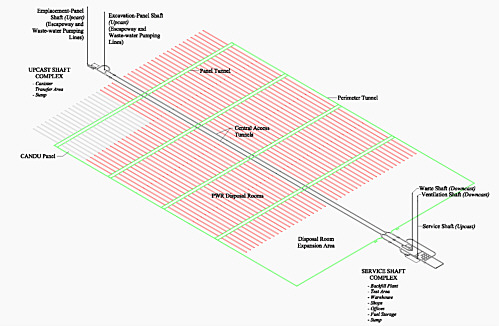
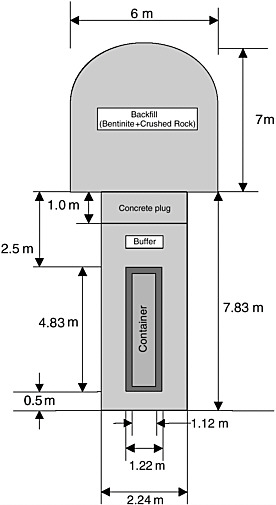
FIGURE 2 Engineered barrier design concept for the reference repository.
Engineered Barrier System
For this preliminary concept the repository containment concept of an engineered barrier system provides the primary containment and is protected by the natural barrier (that is, the geological formation) system. The engineered barrier system is composed of the waste types, the surrounding waste package, other engineered items in the underground facility, and buffer and backfill material. Design features of the engineered barrier system are the waste type, the waste canister package, and a bentonite buffer. Figure 2 shows the reference waste package and engineered barrier system concept applied for this study.
The reference spent PWR and CANDU fuels are defined in terms of initial enrichment, burn-up rates, dimension, gross weight, etc.3 As a basis for the design, spent fuel inventories are estimated to be 36,000 tHM, based on the long-term National Nuclear Energy Plan. PWR fuel comprises approximately 20,000 tHM (55 percent of the total inventory to be disposed) of the projected spent fuel inventory. The reference PWR spent fuel has the average burn-up of 45,000 MWd/tHM (initial enrichment of 4 percent by weight) and is cooled for 40 years after irradiation before the encapsulation and disposal. PWR assembly weight and dimensions are 665 kg and 21.4 cm2 (cross-section) × 453 cm (length), respectively. The spent CANDU fuel inventories are approximately 16,000 tHM, 45 percent of the total inventory to be disposed. The reference CANDU fuel has an average burn-up of 7500 MWd/tHM and the fuel dimensions are 10 cm (diameter) × 49.5 cm (length).
Because of the significantly different properties of both fuel types and the retrieval potential of PWR fuel for reuse, the reference container in which the spent PWR and CANDU fuels are separately encapsulated is illustrated in Figure 3. The overall sizes and component materials of the containers for both spent fuels are designed to be exactly identical to make the encapsulation and handling processes in the repository simple. The container being studied consists of two major components: a massive cast insert and a corrosion-resistant outer shell. The insert provides mechanical strength and radiation shielding, and it keeps the fuel assemblies in a fixed configuration. For the insert, carbon steel is considered for the design basis material. For the complete isolation of waste for a long time, high-nickel alloy (alloy 22), stainless steel, and copper are considered as the candidate corrosion-resistant materials for the outer shell. As shown in Figure 3, the outer shell contains fuel storage baskets (4 square tubes for spent PWR fuel and 33 circular tubes for spent CANDU fuel), and the void space between the fuel storage basket and the outer shell is filled with carbon steel called the cast insert. The loading capacity of the container was determined from the thermal analysis to confirm that the maximum thermal load on the container satisfies the thermal constraint of the bentonite buffer surrounding the container. The temperature at the buffer should be lower than 100°C to keep the physical and chemical properties of bentonite. Four spent PWR fuel assemblies and 297 CANDU fuel bundles are loaded in each container. The heat load from the PWR and CANDU containers are about 1.54 kW and 0.68 kW, respectively. The dimensions of the container were determined from the mechanical structural analysis under the expected mechanical loads in underground repository conditions.4 The spent fuel received at the encapsulation facility, located on the same site as the underground repository, is transferred by a remote-handling system to the hot cell for the packaging process where the spent fuel is inserted into the disposal containers. In the packaging process each spent fuel assembly or bundle is identified to comply with safeguard requirements. The total number of contain-
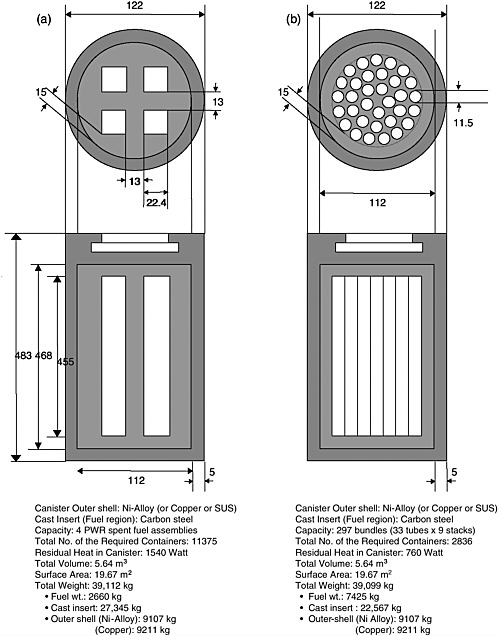
ers to dispose of the 36,000 tHM of spent fuel is 11,375 containers for PWR fuel and 2529 containers for CANDU fuel. The detailed encapsulation process will be designed further regarding the technical feasibility of the fabrication and the cost aspects.
Bentonite is under consideration as the buffer material because of its low permeability, high sorption capacity, self-sealing characteristics, and durability. The need for, extent, and required performance of seals in the underground facilities and access shafts and ramps for the repository must be developed as a result of performance assessments of the system. The disposal concept being considered at present includes borehole emplacement in the floors and subsequent backfilling of the emplacement tunnels. The base-case repository may include backfilling, particularly of the emplacement tunnels, immediately after waste emplacement or 50- to 100-year monitored retrieval operations. Because the backfilling is intended to provide additional support for the closure of underground openings, the backfill timing and method are important parameters in terms of disposal safety, cost, and political issues, for example, retrieval for reuse or change of safety constraints. The backfill composition will be also determined through more detailed performance assessments and engineering trade-off studies.
Operation, Decommissioning, and Closure Concepts
The surface-waste-handling facilities are designed to receive spent fuel from the transportation system, unload the spent fuel into a storage facility, repackage the spent fuel into disposal containers, and transport the disposal canisters to the entrance of the repository for emplacement. The base-case design allows for two separate process lines: one for CANDU fuel and one for PWR fuel. The CANDU and PWR waste will arrive at the Spent Fuel Receiving and Packaging Building (SFRPB) in transportation casks. Although both waste types will be handled and packaged at the SFRPB, because of the great variation in size, radiation levels, and packaging processes of the two waste forms, CANDU and PWR fuel will be handled and packaged using different equipment. The CANDU and PWR fuel will share storage facilities.
For transfer to the repository a disposal container of about 40 tons will be loaded into a shielded flask in the packaging plant and transferred underground using the waste-handling shaft. At the underground facility the disposal container is handled in a shielded flask for radiation protection during the transportation and emplacement processes. Prior to the receipt of the container, the compacted bentonite buffer with a density of 1.8 g/cm3 is placed in the deposition hole. This compacted buffer is in the form of ready-made blocks to provide the hole with a diameter of 124 cm. After container emplacement, the gap between the container and buffer is filled with bentonite powder. Once the container has been lowered from the shielded flask into the prepared borehole, the empty flask
is returned to the surface. Additional buffer material is placed over the container up to the emplacement tunnel floor. Although all emplacement work in an emplacement tunnel is completed, the emplacement tunnel may be kept open without backfill during the operation period of 50 to 100 years for monitored retrieval operation. After the designed monitored-retrieval operation, all access and deposition tunnels will be backfilled with a mixture of crushed rock and bentonite and an especially designed concrete bulkhead is constructed at the tunnel entrance to complete sealing for repository closure.
The monitored retrieval operation program will monitor for unexpected radioactivity and provide warning for the underground and surface facilities. These monitoring systems should sample the air at locations throughout the repository for radionuclides and provide an alarm to allow for control measures to be initiated. Control of inadvertent radionuclide release is, under normal operating conditions, achieved by the use and activation of the high-efficiency particulate air (HEPA) filtration system located at the surface facilities of the upcast emplacement shaft. Decommissioning and closure time and processes of the base-case repository will be studied further with cost and safety analyses
ACKNOWLEDGMENTS
This project has been carried out under the Nuclear Research and Development Program of the Ministry of Science and Technology of Korea.
NOTES


