
Experience of Japan*
Koji Nagano
Central Research Institute of Electric Power Industry (CRIEPI)
After years of nuclear energy production and use, growing pressure from spent nuclear fuel accumulation is receiving serious attention in Japan in order for the nuclear power plants to keep operating without an overflow of built-in storage pools. There are other key constraints with spent nuclear fuel management, such as the schedule of Japan’s first spent nuclear fuel reprocessing plant construction and operation.
A series of accidents and scandals in nuclear facilities, such as a sodium leak at the Monju fast reactor, an asphalt explosion at the PNC1 Tokai reprocessing plant, and the latest criticality accident at the JCO uranium conversion plant, have made the public increasingly suspicious and distrustful of the nuclear power establishment as a whole. This has been further exacerbated by two recent occurrences: the scandal of maintenance information concealment revealed by an employee of the maintenance contractor for Tokyo Electric Power Company (TEPCo) in August 2002, and the invalidation judgment by the Nagoya High Court concerning a construction permit for Monju, a prototype fast breeder reactor, in January 2003. We should clearly recognize such conceptual gaps between the nuclear power establishment and the general public as a crucial constraint that influences nuclear technology development. This paper does not discuss that area, but such reorganization of nuclear governance should be based on open public participation.
These conceptual gaps may cast various uncertainties; on the one hand, plutonium use in light water reactors (LWR) has virtually ceased, which has an
indirect implication for spent nuclear fuel reprocessing and related management of its residues. Direct impacts increase difficulties of siting new nuclear facilities, including not only power plants but even nuclear fuel cycle facilities, namely final repositories of high-level radioactive waste (HLW). Both direct and indirect impacts give clear rise to the role and importance of storage of spent nuclear fuel.
In the next section recent efforts at managing spent nuclear fuel in Japan are reviewed. The paper also discusses the implications for the temporal and geographical aspects of the process.
CURRENT STATUS OF SPENT NUCLEAR FUEL MANAGEMENT IN JAPAN
Present Status of Spent Nuclear Fuel Management
Table 1 shows the recent status of spent nuclear fuel accumulation at all the nuclear power stations (NPSs) as of March 2001, reflecting changes 6 months
TABLE 1 Spent Nuclear Fuel Stored at NPSs in Japan (in metric tons of uranium)
|
Utility Company |
NPS |
Loading in Core |
Fuel per Batch |
SF in Store |
Storage Capacity |
|
Hokkaido |
TOMARI |
100 |
30 |
250(+10) |
420 |
|
Tohoku |
Onagawa |
160 |
40 |
200(+10) |
370 |
|
Tokyo |
Fukushima-1 |
580 |
150 |
1140(+40) |
2100 |
|
|
Fukushima-2 |
520 |
140 |
1280(+30) |
1360 |
|
|
Kashiwazaki-Kariwa |
960 |
250 |
1470(+100) |
1890 |
|
Chubu |
Hamaoka |
420 |
110 |
730(+10) |
860 |
|
Hokuriku |
Shika |
60 |
20 |
50(+20) |
100 |
|
Kansai |
Mihama |
160 |
50 |
280 |
300 |
|
|
Takahama |
290 |
100 |
850(+50) |
1100 |
|
|
Ohi |
360 |
120 |
740(+70) |
1370(+530)a |
|
Chugoku |
Shimane |
170 |
40 |
340(+70) |
440 |
|
Shikoku |
Ikata |
170 |
60 |
330 |
980(+450)b |
|
Kyushu |
Genkai |
270 |
100 |
420 |
1060 |
|
|
Sendai |
140 |
50 |
580(+10) |
900(+200)c |
|
JAPCo |
Tsuruga |
140 |
40 |
440(+10) |
870 |
|
|
Tokai-2 |
130 |
30 |
220 |
260 |
|
Total |
4630 |
1330 |
9290(+380) |
14,380(+1190) |
|
|
aRe-racking of Units 3 and 4. bRe-racking of Unit 3. cRe-racking of Units 1 and 2. SOURCE: Federation of Electric Power Companies (FEPC) (http://www.fepc.or.jp). Changes in parentheses are from September 2000. |
|||||
after September 2000. Japan’s current nuclear power generation, with a total capacity of 45.9 GWe with 53 reactor units (see Figure 1), discharges about 900 MTU (metric tons of uranium) of spent nuclear fuel per year. This spent nuclear fuel discharge accumulates primarily in the built-in reactor pools at those power reactor units. As spent nuclear fuel accumulation approaches the capacities of those reactor pools, some nuclear power stations are forced to supplement at-reactor (AR) storage capacity in order to avoid an overflow of the reactor pools. At TEPCo’s Fukushima Daiichi NPS, a 1120 MTU water pool storage facility was implemented in 1997, as well as an auxiliary dry metal cask storage capability. At Japan Atomic Power Company’s Tokai Daini NPS a dry metal cask storage device with a capacity of 260 MTU (24 casks) was constructed. Several other stations have added storage capacity by re-racking storage pools, some of which are found in Table 1.
It is clear that opportunities for enhancing existing AR storage capacity is almost exhausted, which strongly suggests urgent needs for away from reactor (AFR) storage measures. In November 2000 Mutsu City in Aomori Prefecture
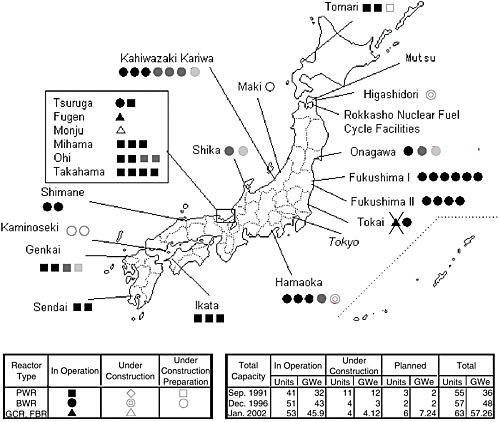
FIGURE 1 Nuclear power stations in Japan as of January 2002, with changes since 1991. (Tokai NPS Unit 1 was shut down on March 31, 1998.)
announced an invitation to TEPCo for site investigation for AFR storage in its territory. TEPCo, responded immediately and initiated a feasibility study. The report was submitted to the city on April 3, 2003. On request from the city a supplementary business plan was submitted on April 10, 2003. Its details will be touched upon in a subsequent section.
Institutional Developments in Spent Nuclear Fuel Management2
Spent nuclear fuel storage was first mentioned in the 1987 Long-Term Program for Development and Utilization of Nuclear Energy, which is regularly revised and published by the Atomic Energy Commission of Japan as the fundamental nuclear policy document in Japan. In the 1994 Long-Term Program for Research, Development, and Utilization of Nuclear Energy a special section was added for future methods of spent nuclear fuel storage, as well as ways to manage spent mixed oxide (MOX) fuel.
The Steering Committee for Nuclear Energy under the Council for the Comprehensive Energy Policy for then-Ministry of International Trade and Industry, which is the primary engine to formulate Japan’s energy policy, published an interim report on spent nuclear fuel storage in January 1997, which urged preparedness for possible prolongation of spent nuclear fuel storage, and actual deployment of AFR storage in about 2010. The cabinet supported the report in February 1997.
In order to plan steps to realize conceptual views provided in the interim report the Working Group for Spent Nuclear Fuel Storage Measures was formed with representatives from the government and major electric power companies (EPCos). The working group, after a series of intensive discussion during March 1997–March 1998, submitted its final report, revealing the concept of storage of recyclable fuel resources, as well as possible regulatory schemes for storage service providers and the related legal framework. The Steering Committee for Nuclear Energy published another report in June 1998, which was primarily an endorsement of the working group’s report, with an emphasis on legal procedure and site selection principles.
One should not overlook the fact that it was emphasized in both of these reports that because spent nuclear fuel storage is a safe and static process, virtually any business venture may be able to enter into the market of storage services, as long as it meets relevant regulatory principles. While this statement was intended partly for better public acceptance, it is still worth paying attention to the fact that such a competitive atmosphere was already anticipated positively by those representatives from the government and the power utility industry.
The law for regulation of nuclear power reactors and other nuclear-related operations (the Regulation Law, hereafter) was amended in June 1999, as a follow-up to the interim report. In this amendment, “operation of storage for recyclable fuel resources” was identified and introduced,3 which opened up ways
for new business ventures to be allowed this service provider operation. Related regulatory schemes, such as safety design criteria of facilities, are under preparation accordingly.
The latest Long-term Program for Research, Development, and Utilization published in December 2000 simply followed up the series of arguments and discussions described above.
Future Prospects of Spent Nuclear Fuel Management
Future prospects of spent nuclear fuel management, namely, the demand for additional storage measures, are influenced largely by the following factors:
-
the JNFL (Japan Nuclear Fuel Limited) reprocessing plant of 800 MTU/year design capacity, currently under construction in Rokkasho-mura of Aomori Prefecture
-
one-time full-core discharge upon decommissioning of reactor units foreseen beginning in 2010, with built-in storage pools also dismantled at a certain stage of decommissioning
Even if the Rokkasho reprocessing plant is successfully operated at its design capacity, it cannot take in the whole discharge of Japan’s NPSs every year, nor the past discharges. While the government’s official views are shown in Figure 2 and Table 2, these underlying assumptions, especially the schedule of the reprocessing plant, are already obsolete, since the JNFL Rokkasho reprocessing has been rescheduled to start its operation in July 2005. This clearly illustrates the importance of repeating projections whenever there are any changes in the above-mentioned factors.
In the long run it is obvious that large-scale storage devices are needed. This is particularly true after 2010, when the first commercial LWR plant reaches the end of its 40-year lifetime. After that, a series of LWR plants will be shut down, which means, on the one hand, a large amount of one-time discharge of spent nuclear fuel, and on the other hand, a loss of the storage capacity of the reactor pools.
Based on the existing amount of spent nuclear fuel stocks, Nagano (2002a,c; 2003a) projected spent nuclear fuel balances in Japan up to the year 2050, using an integrated tool SFTRACE (spent fuel storage, transportation and cost evaluation system). The results are shown in Table 3. As a result the Japanese nuclear industry should prepare a storage capacity at around 10,000 to 15,000 MTU in the medium term, for example, by 2030. Then, in the long-run, up to 2050, the storage needs would differ significantly, from a decrease to none to a continuous increase up to the level of 25,000 MTU.
Special attention should be given to the plutonium utilization in LWR plants. Spent MOX fuel will have to be stored, as the Rokkasho reprocessing plant is
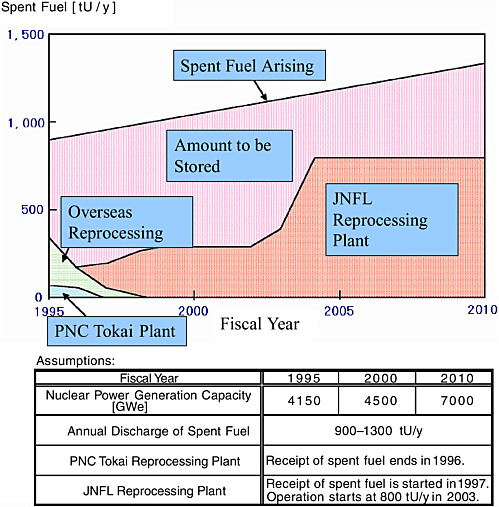
FIGURE 2 Prospects of spent nuclear fuel projected increase and management. SOURCE: Ministry of International Trade and Industry (MITI).
TABLE 2 The Official Perspective of Spent Nuclear Fuel Management
|
Spent Fuel |
1997–2010 (tU) |
2011–2020 (tU) |
|
Cumulative Projected Increase (a) |
15,200 |
16,000 |
|
Shipment to JNFL/Rokkasho Reprocessing Plant (b) |
5900 |
8000 |
|
Shipment to Overseas Reprocessors (c) |
70 |
— |
|
AR Storage Capacity (d) |
5300 |
4200 |
|
Requirements for AFR Storage (a-b-c-d) |
3900 |
3800 |
|
Cumulative AFR Requirements |
3900 |
7700 |
|
SOURCE: Agency of Natural Resources and Energy, On the Interim Storage of Spent Nuclear Fuel, 1999. |
||
TABLE 3 Projected Spent Nuclear Fuel Storage Needs in 2050 in Japan (in metric tons of uranium)
|
Simulation Cases |
Spent Low Burn-Up UO2 Fuel |
Spent High Burn-Up UO2 Fuel |
Spent MOX Fuel |
Total Amount to Manage (A) |
|
O |
0 |
39,000 |
10,000 |
49,000 |
|
N |
7,000 |
30,000 |
11,000 |
|
|
O+2Rep |
0 |
21,000 |
13,000 |
34,000 |
|
N+2Rep |
0 |
23,000 |
11,000 |
|
|
Assumptions for Projection Cases: Case O: No second reprocessing plant; the first reprocessing plant receives older spent fuel as prioritized. Case N: No second reprocessing plant; the first reprocessing plant receives newer spent fuel (higher burn-up) as prioritized. Case O+2Rep: The second reprocessing plant starts in 2030; no MOX fuel is reprocessed; older spent fuel prioritized. Case N+2Rep: The second reprocessing plant starts in 2030; spent MOX fuel and older spent fuel prioritized. |
||||
not licensed for the type of spent nuclear fuel with higher generation of heat and radiation. Significant uncertainty has been cast on MOX fuel utilization because of local opposition, which was vividly demonstrated by the negative results of the vote by Kariwa villagers4 on May 27, 2001. Up to now no MOX fuel has been loaded in any NPS unit in Japan.
As already mentioned, TEPCo announced its plan to install the Recyclable Fuel Reserve Center (Reserve Center) in Mutsu City. According to TEPCo’s business plan submitted on April 10, 2003, the facility will have a storage capacity of 5000–6000 MTU separated to two phases, around 3000 MTU each, all using the dry metal cask storage technique. Storage duration is set at a maximum of 50 years. The facility will be constructed and operated by a new private company to be established by TEPCo and other electric utility companies as they volunteer to join, but no utility has responded positively5 to TEPCo’s invitation up to now. The Reserve Center is expected to commence by 2010 and to accept spent nuclear fuel from those utility companies that joined the operating company.
The author draws attention to three points. (1) This facility’s capacity will satisfy roughly one-half of the necessity up to 2030, as discussed previously in this section, at about 10,000 MTU. Since there seem to exist initiatives undertaken by other utility companies, another facility of a similar scale will reach Japan’s management capability at a flexible enough level until 2030. (2) If it is a multiutility venture, it will be a centralized facility. In this case the issue is local acceptance of the receipt of fuel from other regions or other utility companies in the country, as well as the region’s utility. (3) Similar to the second point, this could become an important milestone for HLW repository siting. Except for the Rokkasho Fuel Cycle Center whose siting took place years ago,
|
Total AR Storage Capacity (B) |
Needs for Additional Storage (C = A − B) |
Second Reprocessing Plant to Commence in 2020 |
Range of Needs for Storage |
|
24,000–27,000 |
22,000–25,000 |
— |
0–25,000 |
|
|
7,000–10,000 |
Δ8,000 |
|
|
The total nuclear power generation capacity is 70 GWe in 2010 and 80 GWe in 2050, respectively. AR capacity is assumed at 300 MTU/GWe, slightly larger than the current average (270 MTU/GWe). The second reprocessing plant is assumed with capacity of 800 THM/year to commence in 2030. UO2 fuel for reload is of low burn-up (3300 MWd/MTU at average) until 1992, and thereafter of higher burn-up at 45,000 MWd/MTU. |
|||
this Mutsu initiative is almost the only example of new central nuclear facility siting. Nuclear Waste Management Organization (NUMO), the entity responsible for HLW disposal is promoting a stepwise siting processes, and now it is in its first stage of inviting local townships to nominate themselves as candidates for preliminary site investigation. Its schedule is to reach a final selection by about 2035. The Mutsu initiative may have two implications to this NUMO process; first, as already mentioned, to allow time for NUMO to exercise its plan, and second, to demonstrate successful experience of facility siting, with full transparency of all relevant information and a sufficient level of public participation.
Costs and Economics of Spent Nuclear Fuel Storage in Japan
Since spent nuclear fuel storage remains in a precommercial stage, we only have a few examples of cost analysis and little is known about possible market prices. Based on IAEA (1994), CRIEPI has conducted cost analyses of different spent nuclear fuel storage techniques by calculating the levelized unit cost of storage. The Net Present Value (NPV) of a project is a measure of the value of a project, defined as a sum of all the discounted cost streams associated with the project, that is,
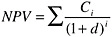
(1)
where Ci is the cost or expenditure in the i-th year, d is the discount rate, i is the year index. The levelized unit cost (LUC) of storage is the unit price of storage
service that equalizes the NPV of the cash flow of income and the NPV of the expenditure for the whole lifetime of the project, that is,
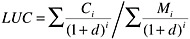
(2)
where Mi is the amount of spent nuclear fuel transported into the storage facility in the i-th year. Thus, the formula (2) is based on the assumption that the storage fee is paid upon receipt of spent nuclear fuel at a uniform unit price, which is LUC, namely,
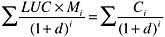
(3)
Figure 3 shows an example from Saegusa (1998), where a comparison among storage options is presented at 3000 MTU AFR storage under the Japanese circumstances. Although the water pool storage is a mature technology with plenty of experience from existing reactor pools, its economics may suffer from high capital investments as well as high operation and maintenance costs due to requirements for forced circulation and quality control of the cooling water. The metal cask has received the highest priority in implementing storage facilities in the short and medium terms, with its superb modularity and economics compared with the water pool. For a longer perspective, research is ongoing for other
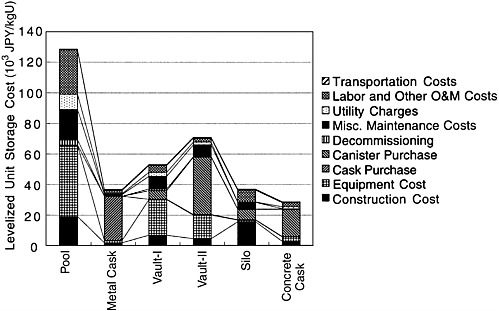
FIGURE 3 Comparison of levelized unit storage costs for AFR storage of 3000 MTU. SOURCE: Saegusa (1998).
dry storage technologies, aiming at better economic performances. Key issues of research include
-
long-term integrity of massive concrete structures
-
long-term integrity of thin metal canisters
-
safety standards in operation and maintenance, especially unloading and loading for transportation
The applications of similar methodology include Yamaji et al. (1987) and Nagano and Yamaji (1989) for comparison of pool and metal cask techniques, and Nagano et al. (1990) for AFR storage, though cost data used in those early studies are now obsolete. The latest example is Ito et al. (2000, 2001), whose main result is shown in Figure 4. Conclusions rather similar to those in Figure 3 are found, though cost data reflect further development and improvement during the period. Figure 5 shows the cost data used for the case of 5000 tU storage capacity in Figure 4, both by lump sum and NPV in the year of the facility’s commencement.
If we try to convert these results to cost value in terms of generated power, a simple formula is applied. Take 30,000 JPY/kgU as metal cask storage of 5000 MTU in Figure 4. At the average burn-up of 40 GWd/t, and a thermal efficiency of 35 percent, and neglecting the time difference between power production to storage, we will then obtain 30,000 [JPY/kgU]/336,000 [kWhe/kgU] = 0.09 [JPY/kWhe]. This can be compared to 5.9 JPY/kWhe, a widely cited number for standard nuclear power generation in Japan.
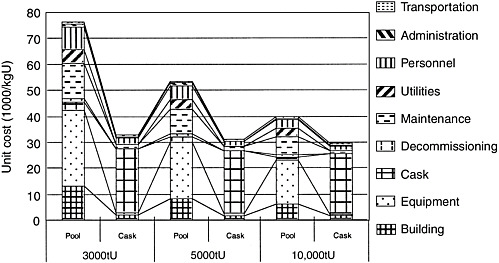
FIGURE 4 Comparison of unit AFR storage costs for a storage capacity of 3000–10,000 MTU. SOURCE: Ito et al. (2000, 2001).
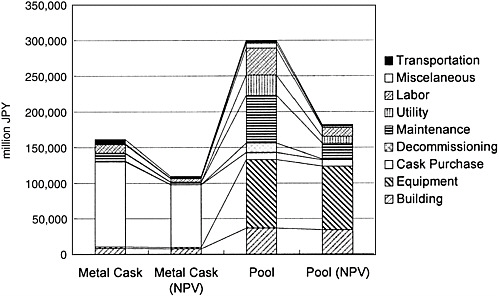
FIGURE 5 Cost data for 5000 tU storage facility. SOURCE: Ito et al. (2000).
CONCLUDING REMARKS
This paper discussed recent developments and the current status of spent nuclear fuel management in Japan. With the increasing pressure of spent nuclear fuel discharge from the power plants in operation and, by contrast, uncertainties in their processing and management services, spent nuclear fuel storage in the short and medium terms has been receiving the highest priority in nuclear policy formulation in Japan. Small-scale interim storage devices, as well as capacity expansion, for example, re-racking, and shared uses of existing devices, are being introduced at a number of power stations. Large-scale AFR storage of recyclable fuel resources is to be realized in the medium and long terms. Commercial operation of the storage of recyclable fuel resources concept may be in the off-ing, as the amendment to the law for regulation of nuclear power reactors and other nuclear-related activities has passed in the Diet. Most recently TEPCo submitted its Feasibility Study Report (FSR) to the candidate site, Mutsu City, on April 3, 2003, as well as its supplementary business plan on April 10, 2003. TEPCo’s Recyclable Fuel Reserve Center is expected to commence operation by the year 2010, and other power utility companies are expected to follow similar directions. In the Mutsu initiative the following three points should be heeded:
-
This facility’s capacity will satisfy roughly one-half the requirements up to 2030, as discussed in a previous section, at around 10,000 MTU.
-
If it is realized with a multiutility venture, it will be a centralized facility, and the issue of local acceptance must be carefully dealt with and overcome.
-
This could be an important milestone for HLW repository siting.
REFERENCES
Atomic Energy Commission, Japan. 2000. The Long-Term Program of Research, Development and Utilization of Nuclear Energy. Unofficial English translation version is available at: http://aec.jst.go.jp/jicst/NC/tyoki/siryo/tyoki_e/siryoe.htm
CRIEPI (Central Research Institute of Electric Power Industry). 2001. Demonstration Tests of Recycle Fuel Resources—Development of Concrete Modular Storage Technologies. Final Report for Fiscal 2000 submitted to the Government. [in Japanese]
CRIEPI. 2002. Demonstration Tests of Recycle Fuel Resources—Development of Concrete Modular Storage Technologies. Final Report for Fiscal 2001 submitted to the Government. [in Japanese]
IAEA (International Atomic Energy Agency). 1994. Cost Analysis Methodology of Spent Fuel Storage. Technical Reports Series No. 361. Vienna: IAEA.
Ito, C., T. Saegusa, and K. Nagano. 2000. Economical Evaluation on Spent Fuel Storage Technology away from Reactor. Research Report No. U99047. Tokyo: CRIEPI. [in Japanese]
Ito, C., T. Saegusa, and K. Nagano. 2001. Economical evaluation on spent fuel storage technology away from reactor. Journal of Nuclear Fuel Cycle and Environment 8(1). [in Japanese]
Nagano, K., and K. Yamaji. 1989. The Needs and Economics of Spent Fuel Storage in Japan. Proceedings for ASME/JSME/AESJ Joint International Waste Management Conference (JIWMC), Kyoto, Japan.
Nagano, K., T. Saegusa, C. Ito, et al. 1990. Economic Analysis of Spent Fuel Storage Technology in Japan. IAEA-SR-171/22. In Spent Nuclear Fuel Storage: Safety, Engineering and Environmental Aspects. IAEA Working Material No. IAEA-SR-171. Vienna: IAEA.
Nagano, K. 1998a. A Mathematical Analysis of Storage in the Fuel Cycle Back-End System. Denryoku-keizai Kenkyu (Economics and Public Utilities) 39:1–12. [in Japanese]
Nagano, K. 1998b. An Economic Analysis of Spent Fuel Management and Storage. Proceedings for PBNC-1998 International Conference. Banff, Canada.
Nagano, K. 1999. Interim Storage of Spent Fuel in Japan—Facts and Theoretical Prospects. Paper presented at Workshop on Interim Storage of Spent Nuclear Fuel and Management of Excess Fissile Material, Harvard University, February 18–19, 1999.
Nagano, K. 2002a. A strategic consideration on nuclear fuel cycle with spent nuclear fuel management as its core. Journal of Nuclear Fuel Cycle and Environment 8(2). [in Japanese]
Nagano, K. 2002b. A Systems Analysis of Spent Fuel Management in Japan. Paper presented at PBNC-2002 International Conference, October 21–25, 2002, Shenzhen, China. [To be published]
Nagano, K. 2002c. A Systems Analysis of Spent Nuclear Fuel Management and Storage. Doctoral thesis, Univ. of Tokyo.
Nagano, K. 2003a. Systems analysis of spent fuel management in Japan I. Projection of material balances and storage needs. Journal of Nuclear Science and Technology 40(4):173–181.
Nagano, K. 2003b. Systems analysis of spent fuel management in Japan II. Methodologies for economic analyses of spent fuel storage. Journal of Nuclear Science and Technology 40(4): 182–191.
OECD/NEA (Organisation for Economic Co-operation and Development/Nuclear Energy Agency). 1985. The Economics of Nuclear Fuel Cycle. Paris: OECD.
OECD/NEA. 1989. Plutonium Fuel: An Assessment. Paris: OECD.
OECD/NEA. 1994. The Economics of Nuclear Fuel Cycle. Paris: OECD.
Saegusa, T. 1998. Activities and future issues on research of spent nuclear fuel storage in Japan. Nuclear Eye 44(4):14–19. [in Japanese]
Saegusa, T. et al. 1999. Dry Storage Technologies for High Burnup and MOX Spent Nuclear Fuels. Summary Report No. U27. Tokyo: CRIEPI.
Steering Committee for Nuclear Energy. 1998. Towards Realization of Storage of Recycle Fuel Resources. Interim Report to the Council for Comprehensive Energy Policy, June 1998. [in Japanese]
Yamaji, K., K. Nagano, and T. Saegusa. 1987. Comparative Economic Evaluation of Spent Nuclear Fuel Storage Technologies. Research Report L87001. Tokyo: CRIEPI. [in Japanese]
NOTES


