
7
Factors Influencing Exposure to Harmful Biological Agents in Indoor Environments
Exposure assessment, an important part of the decision-making process for the cleanup of a facility that is contaminated with biological weapons, is discussed throughout this report. In this chapter, the committee focuses on the ways that an agent can spread within a facility. Chapter 9 discusses ways to measure the amount of an agent and the extent of contamination. Chapter 9 also provides an overview of how sampling can be used to assess the effectiveness of decontamination.
An important step in the aftermath of the release of a harmful biological agent is to identify how extensively that agent might have spread within a facility. Many areas could be contaminated indirectly because of the way air circulates within the building and at its periphery. Biological agents, such as Bacillus anthracis spores, can behave as particulate solids or as droplets, thus allowing for extensive modeling. However, because those agents are living organisms, their characteristics can vary as can the effects they have within a population. An agent used in an attack could change over time as it is suspended into the air, settles onto surfaces, and is resuspended and its properties could alter under different environmental conditions. Some airborne agents (those without fast settling velocities) will be distributed and diluted by mechanical ventilation systems. Some will attach to surfaces, but later could be reaerosolized or resuspended.
Contaminants move in air in response to pressure gradients. Mechanical air-handling systems in many buildings use fans to create pressure gradients that move air through ducts, plenums, and exhaust shafts. The pressure gradients, the buoyancy of heated air, and wind flow around a structure allow for the infiltration or exfiltration of air, which provides conditioned air to the occupied areas or
removes odors, smoke, or airborne chemical compounds from bathrooms, kitchens, or laboratories. “Ventilation and air distribution are critical with respect to the issues [chemical, biological and radiological] agents entering buildings, their movement within buildings and their subsequent removal” (Persily, 2004).
Several factors determine exposure to biological and chemical agents released indoors, including the dynamic movement of agents throughout indoor environments. The concentrations will depend on the amount of agent generated, its chemical and physical properties, and how and where it is introduced. How an agent is consequently distributed depends on many factors of the built environment, including the air ventilation system and the characteristics of the interior surfaces.
Occupant behavior also can affect the distribution of pollutants. The actual exposure and dose will depend on gender, age, metabolic activity, clothing, behavior, and susceptibility, among other demographic and personal factors. The U.S. Environmental Protection Agency (EPA) published the Exposures Factors Handbook (1997), which provides values, distributions, and ranges for many physical and human factors that are applied to quantitative risk assessment. This section discusses a few of the factors that determine indoor concentration and exposures to potential biological and chemical agents. See http://www.epa.gov/ncea/pdfs/efh for more details.
EXPOSURE
Exposure to a contaminant is defined as an event or series of events that occur when there is contact at a boundary between a human and the environment with a contaminant of a specific concentration for an interval of time (NRC, 1999). Exposure is measured in units of concentration (ppm [parts per million], mass per volume) and time. Dose is the amount of a contaminant that is deposited or absorbed in the body over a unit of time. The dose of an airborne allergen or pathogen can be further defined as the amount deposited (delivered) to a specific sites such as the upper airways.
Epidemiology, controlled-exposure studies, and environmental assessments are used to determine the concentration of a contaminant in air, food, soil, dust, and water or on surfaces as a surrogate for exposure and for dose. It is important to distinguish surrogates from actual, measured exposure or doses because, in the context of biological and chemical assessments, measurements are not likely to be available. In some cases, only the presence of a substance in the air or on surfaces will be detected. Even with concentration data, the variability in actual inhalation or deposition exposures and variations in susceptibility within a heterogeneous population make estimates of risk inherently uncertain.
Consider the following example as another potential pathway leading to B. anthracis exposure: Assume that B. anthracis has been released in a small car-
peted room (5 × 3 × 2.5 m) that contains a table (1 × 2 m). Assume that 0.001 g of the material settles uniformly on horizontal surfaces. Wipe samples yield 35 ng cm−2 from the table and 3 ng cm−2 from the carpet. Uptake to a person who places a palm on those surfaces can be estimated by a simple formula:

C is the concentration on the surface, A is the area of skin in contact with the surface, and R is the removal efficiency of the skin.
To determine the actual concentration that is estimated from the wipe samples, it is necessary to know how much actually adheres to the material used to wipe surface. Depending on the methods used and the nature of the surfaces, the sticking coefficient typically is less than 1. In this example, the coefficient for the table is 0.5, for the carpet it is 0.1. So the equation is

Rwipe is the collection (removal) efficiency of the wipe method for that contaminant and surface material.
Continuing with the example, the area of an adult palm is 150 cm2 and the removal efficiency is estimated at 10%. The removal efficiency varies with the properties of the surface, the contaminant, and the skin and with pressure applied to the surface. For this example, the 10% might represent the area of the palm that actually touched the surface with 100% transfer. It is possible to estimate skin surface area for parts of the human body and to calculate values for soil or dust dermal uptake (EPA, 1997). The EPA Exposure Factors Handbook (1997) also discusses dermal transfer and gives an adherence rate of 0.2 mg cm−2 with a 95th percentile of 1.0 mg cm−2 for adults. Dermal loading can vary substantially for different activities and among people. Variations in the matrix of the contaminant, the amount of soiling on the skin, and the chemical and physical properties of the contaminant further complicate estimation of dermal loadings.
If only the finger tips touch the contaminated surface (15 cm2), then about 0.001 milligrams (mg) of B. anthracis might be transferred. If there are 109 spores mg−1 of B. anthracis, perhaps as many as 1 million spores could be transferred to the hand. The transfer would be less from touching a flocked or fleeced surface. To render the example applicable to chemical contaminants, an additional factor for biological uptake through the skin would be included. Absorption rates (mg cm−2 h−1) are available for several industrial chemicals in either the liquid or vapor phase.
More exposure can occur through the resuspension of spores. In our scenario, 1 mg of B. anthracis is uniformly distributed in a 5 × 3 × 2.5 m room with 1 air change h−1, and exposure after vigorous activity can be determined. Vigorous activity over an hour might result in a spore concentration of 0.3 × 10⁻¹⁴ g cm−3 as derived by:

Consider a normal, nonexertion breathing volume of 5 L min−1 (10 breaths per minute × 0.5 liters per breath). Over an hour an adult would breathe in 300,000 cm3 of air containing 0.003 spores cm−3 or about 1000 spores, if all the area were disturbed. Note that deposition in the lungs is not 100% for spores that are in the size range of 1-3 µm. From this simple example, one can see that the activity rates, the area disturbed, and the surface loadings are directly proportional to the concentrations, whereas the volume of the room and the air change rates are inversely related to concentration. Thus, increasing the flow of noncontaminated air, either by air cleaning or with fresh, will reduce concentrations.
SOURCES
There are many ways to release biological or chemical agents. Pathogens, spores, or chemicals can be sprayed from devices that create small droplets in a fog or mist or larger droplets. Such devices include pressure washers and pesticide application equipment. Hazardous agents might be contained in pressurized canisters that when punctured or pressed release their contents quickly. If the device is equipped with a valve or critical-flow orifice, the release can be prolonged. Exposure to weaponized B. anthracis from envelopes can also occur, as in the 2001 attacks. Secondary suspension of spores can occur as the spores are dispersed from surfaces by air currents or physical forces. The amount of resuspended material depends on a complex interaction of surface factors (tile, carpet), agent (static charges, surface coatings), and environmental conditions (humidity, air velocity).
Models for instantaneous or prolonged releases in a variety of scenarios and from many devices are available. Compliance with the regulatory requirements of the Comprehensive Environmental Reponse, Compensation and Liability Act (the Superfund law), the Clean Air Act Amendments, and the Federal Insecticide, Fungicide, and Rodenticide Act have led to the development of models that predict the near-field concentrations, surface deposition, and uptake of potentially hazardous materials. Those models are relevant to most scenarios that involve biological and chemical release, dispersion, and transport. However, the models are limited by the lack of attention to dissemination of infectious pathogens from humans or the activity of contaminants released indoors. Computational fluid dynamics (CFD) models are useful tools for predicting the general behavior of gases and aerosols released indoors.
Airborne infection risk depends on the emission rate of respirable or inspirable (but nonrespirable) particles of the pathogen, which could escape from
an envelope, be released by a mechanical device, or be transmitted in the expired breath of an infected person. Infection risk also depends on the rate of pathogen dispersion and removal from the indoor space, the location of susceptible persons relative to the emission points, and the pathogen’s inhalation dose–response function. Other factors include breathing rate, particle deposition fraction in the respiratory tract, and the airborne or surface pathogen die-off rate attributable to environmental stressors. The pathogen emission rate must be estimated for the infectious host (number of cough h−1), the pathogen concentration in respiratory fluid (number of pathogens mL−1), and the respirable or inspirable particle volume per expiratory event (mL cough−1). The fate and transport of emitted respiratory fluid particles could be approximately modeled with CFD but there are no models for predicting the viability of pathogens on surfaces or the potential for contact routes of infection. The Markov chain construct offers a different approach for predicting secondary infections for various combinations of ventilation system configuration and operation and occupancy. That construct seeks the conditional probability for new secondary infections based on the current state of infections and system configurations.
Models for common respiratory illnesses—influenza or colds in airplanes, schools, and nursing homes—could serve as a valuable tool for predicting the effects of exposure to infectious biological agents that could be released by terrorists. Those standard epidemiological models also could be used to assess the risks of emerging diseases transmitted through airborne viruses or bacteria. Examples of those models are available from the web site of the National Institute of General Medical Sciences (http://www.nigms.nih.gov/research/midas.html). The study of secondary cases of severe acute respiratory syndrome (SARS) in the Amoy Garden apartment complex in Hong Kong (Yu et al., 2004) illustrates the use of CFD modeling and explains building dynamics as they influenced the spread of the SARS virus both within the building containing the incident case and between adjacent buildings.
BUILDING DESIGN AND OPERATIONS
When people are exposed to a biological agent indoors, the exposure depends not only on the amount of agent released, which determines the strength of the source, but on how air moves through the building, the rate of exchange between indoor and outdoor air, and the rate at which the agent is removed from indoor air by air filters or surface deposition. The exchange of indoor with outdoor air is referred to as ventilation. The concentration of a contaminant inside a building or in an area within a building depends on the rate at which the contaminant is generated and then removed, whether by ventilation, air cleaning, or other processes such as chemical reactions or adsorption onto surfaces. The relationships among those factors can be studied with a mass balance model, which assumes that the air in a building is well mixed. Although that is not necessarily
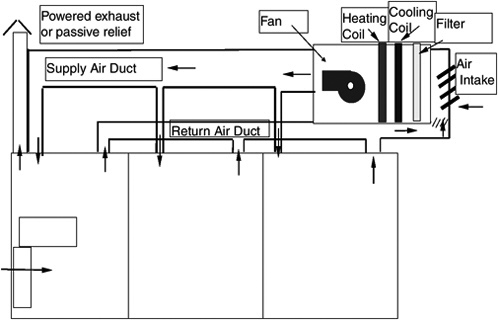
FIGURE 7-1 Typical air-handling unit. Arrows indicate airflow. SOURCE: Adapted from EPA, 1994.
the case, it provides a mechanism for analysis. Concentrations in a space increase with the amount generated, decrease with an increase in ventilation, and decrease in proportion to the amount of contaminant that is cleaned or removed from the air. Cleaning or removal might occur because of an active air-cleaning device, because of the naturally occurring deposition of particles onto surfaces, or because of a gradual loss of viability. Although this section of the report describes air-handling systems to illustrate air transport, transport by attachment to clothing for later transfer to other surfaces and possible resuspension is germane to assessing the full extent of biological contamination.
Relevant issues to consider in evaluating air flow and exchange include the type of ventilation in the building of concern. Buildings can be ventilated using natural or mechanical methods. Air can be supplied naturally through windows, louvers, and leak in building envelopes or mechanically through a heating, ventilating, and air conditioning (HVAC) system that usually includes fans, duct work, and a system for delivering air throughout a building (Figure 7-1).
In most houses, ventilation occurs by a natural exchange of indoor and outdoor air, at a rate of approximately 1 full air exchange every 2 hours. Commercial and public buildings generally have mechanical HVAC systems that move air through buildings to provide temperature control and ventilation at a rate of 2 or more per hour, although the amount of fresh air in the exchange can range from none at all to 100% depending on the system used. Minimum settings
are prescribed to meet ventilation codes. Variations in surfaces and their characteristics in buildings and microenvironments also should be considered. For example, most HVAC systems have air-cleaning filters that typically remove large particles but those are less efficient for particles smaller than 1 µm.
HEATING, VENTILATING, AND AIR CONDITIONING SYSTEMS
In modern public and commercial buildings, which often have sealed windows, some ventilation with outside air is required to provide a safe, functional, and comfortable environment for occupants. Mechanical ventilation systems are used to control contaminant concentrations in many indoor environments and to maintain a comfortable temperature and humidity. Such systems are often used in hospitals; larger office buildings; and in public gathering areas such as theaters, hotels, schools, restaurants, department stores, and airports. Mechanical systems control indoor temperature and humidity and dilute contaminants (Bearg, 2001). The systems also can be used to maintain necessary pressure differentials between areas, to extract and exhaust air from specific spaces, or to clean the air with filters, catalytic converters, and various sorbent beds. The efficiencies and costs for ventilation systems vary depending on specific requirements and settings (Liddament, 2001).
TRANSPORT AND FATE OF HARMFUL BIOLOGICAL AGENTS
In still air, a discharged agent—if it is larger than a few micrometers—might settle out quickly. If the particles are small enough to be suspended in the air, however, the agent might stay in a high concentration as it undergoes dispersion by diffusion. Bulk movement will be influenced by buoyancy (thermally driven movement). If the room air is not still, because the building has a mechanical air-handling system, or because people move about within the space, there will be some mixing that breaks up and disperses “pockets” of suspended agents throughout the air space. As the agent spreads and ages, its characteristics change as a result of coagulation, deactivation (by desiccation or oxidation), and surface deposition. This, along with ventilation and air cleaning, generally will lead to reduced concentrations.
The distribution of an agent within a building depends on the chemical and physical characteristics of spaces and on the characteristics of the agent. The characteristics of the HVAC system (open or ductwork) and the types of surfaces (paint, vinyl, tile, wood, masonry, carpet) will affect transport and fate. Encapsulated agents might be impervious to the environmental conditions found inside buildings. The viability of agents contained in liquid droplets will be influenced by building climate and surface conditions. As a consequence, the extent of the initial threat and the subsequent scope of required decontamination will differ from one building to another.
Although interactions in the air and at surfaces modify the concentration, concentrations within the original space will depend strongly on an exchange with less-contaminated air under most circumstances. Mechanically delivered air disperses constituents through mixing (turbulence) and dilutes them by supplying less-contaminated air and by forcing removal. Generally, mechanical mixing is more effective at reducing concentrations from a point source of contamination in a room than is diffusion alone in still air. Air exchange and surface removal processes act together to lower concentrations.
The concentration of an indoor contaminant in a building, or in a space within a building, depends on the rate at which the contaminant is generated and its rate of removal, whether by ventilation; air cleaning; or another process such as chemical reaction, adsorption, or deposition. Those relationships, defined as mass balance, imply that concentrations of a biological or chemical agent in a space will increase with the amount released, decrease by the amount of air exchanged in the space (presuming the ventilating air is cleaner), and decrease as a result of air cleaning and other removal or deactivation processes. The cleaning or removal might be accomplished by an active device or by inactive deposition of particles to surfaces; adsorption of gases onto materials; or disinfection as a result of exposure to ultraviolet light, desiccation, oxidation, or chemical reaction.
The committee was asked to consider actions that could be pursued in the aftermath of an act of bioterrorism. Understanding how biological and chemical agents are transported, dispersed, deposited, and removed is directly related to choosing a particular mode of action after such an event. The physics of those processes depends on agent characteristics (Riley et al., 2002).
DEPOSITION
Particles can settle onto horizontal and vertical fixed surfaces, clothing, and skin. Deposition to vertical surfaces is more relevant for particles that are smaller than 1 µm in diameter. Brownian diffusion is the predominant removal pathway, but the rate of movement through the boundary layer is also influenced by thermal and electrostatic forces. Mechanical mixing of room air can enhance deposition by reducing the depth of the boundary layer. Once small particles adhere to a surface, van der Waals forces are usually strong enough to prevent their resuspension by air currents. Particles can be dislodged from vertical surfaces by contact adhesion or by mechanical force. Deposition to horizontal surfaces depends both on Brownian motion diffusion and on gravitational settling. Larger particles settle faster.
Figure 7-2 shows the expected patterns for indoor particle deposition. Larger particles have higher deposition velocities. The figure shows that deposition of combustion products and photochemically produced particles smaller than 0.1 µm is independent of surface orientation. As gravitational forces dominate diffusion for larger particles, there is more deposition on floors than onto walls or
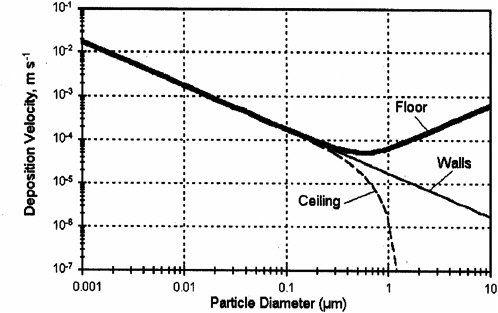
FIGURE 7-2 Idealized patterns of particle deposition indoors. SOURCE: EPA, 1997 (Adapted from Nazaroff and Cass, 1989).
ceilings. Deposition can be enhanced with mechanical mixing (caused, for example, by fans) and by electrostatically charging the particles. Electrostatic precipitators distribute charged ions that attach to airborne particles and increase their attraction to surfaces. The committee heard reports that B. anthracis spores were regularly detected in the wipe samples from computer screens at the National Broadcasting Company (NBC) office in New York City. Enhanced deposition occurs on TV and CRT displays and other charged surfaces.
RESUSPENSION
Resuspension and subsequent cleanup of biological and chemical agents deposited on surfaces are of primary concern for this report. The 2001 anthrax illnesses resulted from direct airborne exposures and from secondary exposure routes. Spores deposited on surfaces can be resuspended into the air and inhaled or can be reattached on other surfaces. B. anthracis spores were found in the air ducts and filters and on floors, desks, and other surfaces some distance from the initial point of release. They were found on surfaces in the apartment of an NBC employee who had been exposed at work. Those observations do not, in themselves, confirm that spores were resuspended, but the evidence is that resuspension of spores in surface resulted in the deposition of the spores on clothing.
Research on the resuspension of particles and radioactive material has been in progress for decades. A Los Alamos report by J.W. Healy (1971), Surface
Contamination: Decision Levels, examined radioactive particles resuspended from surfaces during various activities. The author estimates the resuspension rate of 5 × 10⁻³ h−1 for vigorous activities, such as cleaning, running, or active play on the floor. For moderate, slower foot traffic and occasional movement, the resuspension rate is estimated at 0.0001 h−1. Observations taken over a full day, in a typical house where some portions of the day are more active than others, lead to a rate estimate of 3 × 10⁻⁴ to 5 × 10⁻⁴ h−1. The Los Alamos study showed that material in dust on the floor can be transferred to clothing. Copper oxide particles were dispersed on the floor. Recovering mass from adhesive tape patches on various portions of a person’s body showed average transfer of 22% h−1 from the floor. Frictional charge separation caused by walking on a surface can increase deposition to clothing.
More recently, several researchers (Ferro et al., 2004; Long et al., 2000; Rodes et al., 2001; Thatcher and Layton, 1995) have examined resuspension of particles, given different scenarios, in home and laboratory experiments. The activities studied included walking on hard and carpeted surfaces, vacuuming, and dusting. Thatcher and Layton (1995) measured indoor and outdoor particle concentrations in six size ranges for a detailed set of measurements in a single home where a family of four went about normal activities. The researchers used the mass balance method to estimate the amount resuspended indoors. Ferro and colleagues (2004) reported particulate matter (PM) concentrations generated for PM2.5, PM5, and PM10, (the subscripts indicate the maximum diameters of the particles in micrometers) for staged activities such as dancing, vacuuming, shaking blankets, walking on hard floors, and walking on rugs. According to Ferro (2001), “PM is defined as any substance larger than a molecule, either solid or liquid, which exists in atmosphere, and includes things such as soot, pollen, and sea spray. Next to second-hand cigarette smoke and cooking emissions, house dust resuspended by indoor human activity is the largest source of PM that we breath.” Figure 7-3 shows how various activities affect PM5 concentrations.
Rodes and colleagues (2001) reported particle measurements in different size classes for laboratory and home studies of subjects walking. Particles smaller than 1 µm were not readily dislodged from carpet fibers. As shown in Figure 7-4, more resuspension occurs with 3-15 µm particles.
Those studies also observed that resuspension rates are higher when the activities occur on carpet than they are for activities on bare floors. Higher dust loadings on carpets and possibly the mechanical forces of fiber recoil are likely explanations. In general, the experiments and modeling support the hypothesis that resuspension from activities involving carpet is 10 times higher than for activities on hard surfaces.
In the Exposure Factors Handbook (EPA, 1997), resuspension values derived from Thatcher and Layton (1995) are reproduced here (Table 7-1).
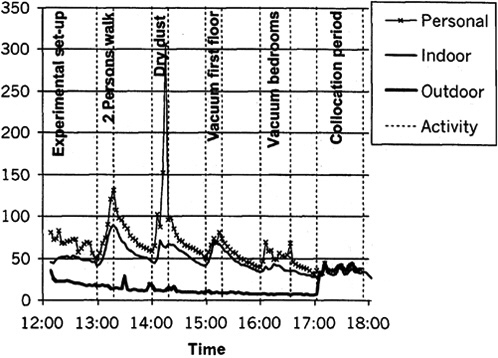
FIGURE 7-3 Personal, indoor, and outdoor PM5 estimated mass concentration (µg m−3) time series. SOURCE: Ferro et al., 2004.
PREPARING AND OPERATING BUILDINGS FOR A BIOTERRORISM ATTACK AND SUBSEQUENT OPERATION
Although HVAC systems are primarily designed for general ventilation, they can be considered part of the control strategy that might be adopted in the event of an act of bioterrorism. The proper use of HVAC systems for those cases will require a detailed understanding of the infectious or toxicological properties of biological agents, air distribution patterns, air-cleaning or extraction techniques, and the requirements for ongoing operation and maintenance (Ludwig, 2001). But even a properly designed and maintained HVAC system can actually exacerbate exposure by distributing the agent throughout a building during direct recirculation or transfer through poor pressure control. In most cases, it is unrealistic to plan for a risk reduction strategy that relies on reducing the concentration of the contaminant in the air supply. Although outside air dampers could be opened, supply fans generally are not large enough to provide the volume of air that would be effective. A typical HVAC system provides one complete air change every 8-15 minutes. An exhaust system also could be necessary to remove excess outside air from the building. Additional research by structural engineers
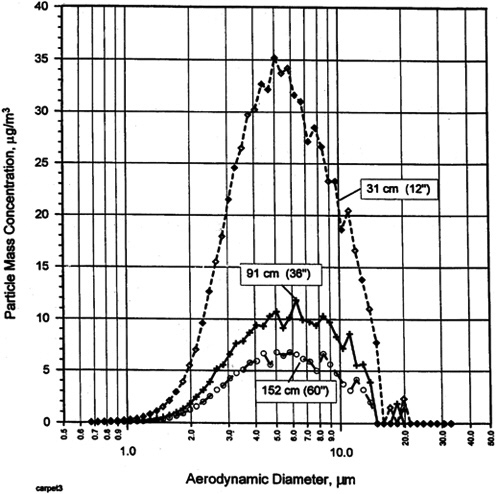
FIGURE 7-4 Computed house dust concentrations at three elevations above medium pile carpeting during walking events. SOURCE: Rodes et al., 1999.
and HVAC specialists might improve the knowledge base, allowing for greater certainty in decision making that is designed to minimize risk.
How a building facility manager might respond to a biological attack will depend on several factors. It might not be possible to determine, as it was for the Hart Senate Office Building and NBC, that the agent was distributed indoors. Attacks could involve external releases or introduction of the contaminant into garages, elevator shafts, loading docks, or air intakes. If a biological release occurs outdoors, the recommendation is to keep the air pressure of the building sufficiently positive to reduce infiltration. Exhaust fans could be shut off. Outside air dampers might be closed to the minimum setting so they continue to provide
TABLE 7-1 Particle Deposition and Resuspension During Normal Activities
|
Size Range, µm |
Deposition Rate, h−1 |
Resuspension Rate, h−1 |
|
0.3-0.5 |
Not measured |
9.9 5 10−7 |
|
0.6-1 |
Not measured |
4.4 5 10−7 |
|
1-5 |
0.5 |
1.8 5 10−5 |
|
5-10 |
1.4 |
8.3 5 10−5 |
|
10-25 |
2.4 |
3.8 5 10−4 |
|
>25 |
4.1 |
3.4 5 10−5 |
|
SOURCE: Adapted from EPA, 1997, Table 17-26. Online: http://www.epa.gov/ncea/pdfs/efh/sect17.pdf. |
||
sufficient intake to maintain pressure inside the building. It is important that filters in air-handling units remove particles that are in the size ranges of suspected weaponized agents, although filtration systems currently installed in most buildings are not likely to be effective against chemical, biological, or radiological agents.
The response to an internal release obviously would depend on the properties of the agent and location of the release, among other factors. If the specific location is determined promptly, specific rooms or areas might be isolated by depressurization in much the same way that hospitals prevent the spread of tuberculosis. Critical areas, such as loading docks, mail rooms, lobbies, restrooms, and garages, could be maintained at negative pressures to the adjacent areas.
Many buildings use zoning systems for air handling. Sections of a floor or a few floors might share a common air-handling unit. In those buildings, it should be possible to isolate floors or areas to create a containment for the contaminant.
Building ventilation strategies, in theory, might mitigate the consequences of an attack and limit the need for remediation. However, most buildings currently are not configured to implement such strategies in any emergency other than a fire. It will be some time before reliable and cost-effective sensors for biological contaminants or other toxic agents can be integrated into HVAC controls. The American Society of Heating, Refrigerating, and Air-Conditioning Engineers (ASHRAE) has made recommendations that can be implemented immediately (ASHRAE, 2003).
The basic tenets of the ASHRAE recommendations were reported by Persily (2004) and are summarized in Box 7-1.
FINDINGS AND RECOMMENDATIONS
Finding 7-1
Biological agents can spread beyond their point of initial release in air-handling systems, through the reaerosolization of contaminants from floors and other sur-
|
BOX 7-1
SOURCE: Additional information can be found on the Lawrence Berkeley National Laboratory website (www.lbl.gov). |
faces by foot traffic or air currents, and by adhesion to people or their clothing. Those factors can result in widespread dispersal of biological contaminants within a building and into transportation and transit vehicles, homes, and other sites.
Recommendation 7-1
An extensive survey should be done to determine the extent to which biological contamination has spread. (Further guidance on surveying and sampling can be found in Chapter 9.)
Finding 7-2
Indoor air-handling systems can redistribute biological agents by carrying airborne contaminants throughout buildings and outdoors. However, if appropriate actions are taken, air-handling systems also can be used to confine contaminants and reduce the effects of contamination.
Recommendation 7-2
Building operators should act now to gain a thorough understanding of how air flow occurs in their buildings under normal operating conditions. They also should examine the potential adverse or beneficial effects of a shutdown on the spread of airborne contaminants so that appropriate actions could be taken to minimize the dispersal of contaminants if the release of a biological agent is identified.
Finding 7-3
Architects, construction engineers, ventilation engineers, facility operators, and other professionals involved with building design, construction, and operation have an inadequate understanding of how the built environment affects occupants.
Recommendation 7-3
The professions related to the building industry and facility management should be better educated on the nature of their vulnerability to weaponized agents so they will be prepared to respond to an act of bioterrorism. Professional societies (such as the Building Owners & Managers Association, and the International Facility Management Association), state and federal agencies, and academic institutions should fund and participate in efforts to increase understanding of those issues through education and training.
REFERENCES
ASHRAE. 2003. Risk Management Guidance for Health Safety and Environmental Security Under Extraordinary Incidents. Report of the Presidential Ad Hoc Committee for Building Health and Safety Under Extraordinary Incidents. Washington, DC: American Society of Heating, Refrigeration, and Air-Conditioning Engineers, Inc.
Bearg, D.W. 2001. HVAC systems. Ch. 7 in Indoor Air Quality Handbook. J.D. Spengler, J.F. McCarthy, and J.M. Samet, eds. McGraw-Hill, Inc.
EPA (U.S. Environmental Protection Agency). 1994. Orientation to Indoor Air Quality. Washington, DC: Environmental Protection Agency.
EPA. 1997. Exposures Factors Handbook. Washington, DC: Office of Research and Development. EPA/600/P-95/002Fa.
Ferro, A.R. 2001. Breathing House Dust is Nothing to Sneeze At. [Online] Available at: http://www.stanford.edu/group/i-rite/statements/2001/ferro.hml (accessed on April 24, 2005).
Ferro, A.R., R.J. Kopperud, and L.M. Hildemann. 2004. Source strengths for indoor human activities that resuspend particulate matter. Environmental Science and Technology 38(6): 1759-1764.
Healy, J.W. 1971. Surface Contamination: Decision Levels. Los Alamos, New Mexico: Los Alamos Scientific Laboratory. LA-4558-MS.
Liddament, M.W. 2001. Occupant Impact on Ventilation. Air Infiltration and Ventilation Center. Technical Note 53.
Long, C., H. Suh, H.H. Koutrakis, and P. Koutrakis. 2000. Characterization of indoor particle sources using continuous mass and size monitors. Journal of Air and Waste Management Association 50: 1236-1250.
Ludwig, J.F. 2001. HVAC subsystems. Ch. 9 in Indoor Air Quality Handbook. J.D. Spengler, J.F. McCarthy, and J.M. Samet, eds. McGraw-Hill, Inc.
Nazaroff, W.W., and G.R. Cass. 1989. Mass-transport aspects of pollutant removal at indoor surfaces. Environment International 15: 567-584.
NRC (National Research Council). 1999. Research Priorities for Airborne Particulate Matter: II. Evaluating Research Progress and Updating the Portfolio. Washington, DC: National Academy Press.
Persily, A. 2004. Building ventilation and pressurization as a security tool. ASHRAE Journal 46(9): 18-24.
Riley, W.J., T.E. McKone, A.C. Lai, and W.W. Nazaroff. 2002. Indoor particulate matter of outdoor origin: importance of size-dependent removal mechanisms. Environmental Science Technology 36(2): 200-207.
Rodes, C.E., J.R. Newsome, R.W. Vanderpool, and J.D. Antley. 1999. Experimental Methodologies and Preliminary Mass Transfer Factor Data for Estimation of Dermal Exposures to Particles. Washington, DC: U.S. Environmental Protection Agency.
Rodes, C.E., P.A. Lawless, G.F. Evans, L.S. Sheldon, R.W. Williams, A.F. Vette, J.P. Creason, and D. Walsh. 2001. The relationships between personal PM exposures for elderly populations and indoor and outdoor concentrations for three retirement center scenarios. Journal of Exposure Analysis and Environmental Epidemiology 11(2): 103-115.
Thatcher, T.L., and D.W. Layton. 1995. Deposition, resuspension and penetration of particles within a residence. Atmosphere and Environment 29(13): 35-46.
Yu, I.T., Y. Li, T.W. Wong, W. Tam, A.T. Chan, J.H. Lee, D.Y. Leung, and T. Ho. 2004. Evidence of airborne transmission of the severe acute respiratory syndrome virus. New England Journal of Medicine 350(17): 1731-1739.


