
10
Decontamination Practices and Principles
PROCESSES FOR DECONTAMINATION OF HARMFUL BIOLOGICAL AGENTS AND OTHER RESPONSE OPTIONS
Four key phases—assessment, planning, decontamination, and verification—can be identified in the response to an act of bioterrorism. Depending on the circumstances, those phases might vary in length, and they can comprise simple or complex tasks.
The first task within the assessment phase, after biological contamination has been discovered, is to map the contaminated area. The second step is to identify the agent’s physical and biological properties: was it spread as a liquid or powder? Has it been physically treated to increase its virulence or ability to be resuspended in the air? Has it been genetically engineered to resist drug treatment? Answering those questions is likely to require extensive sampling of the contaminated area.
Proper planning—the second phase—is crucial to the success of decontamination, and time spent there will be amply rewarded later. Several important decisions must be made and major tasks accomplished before decontamination can begin:
-
The decontamination method must be selected.
-
Verification methods must be chosen.
-
The scientific criteria for success must be defined.
-
Personnel from companies or government agencies with the proper expertise to plan and execute the decontamination must be identified or hired.
-
A mechanism for community liaison and involvement must be established.
-
Technical questions—simple and complex—about a variety of issues, such as what to do with wastewater from worker decontamination baths and where to place testing apparatus during the decontamination process, must be answered.
The actual decontamination operation of a building is likely to be conducted in a few days, although the schedule depends on the size of the project and its complexity. Temperature, relative humidity, concentration of decontamination agent, and contact time typically must be measured and recorded during decontamination. The success of the operation, however, and the avoidance of major technical or public relations problems, will largely depend on the quality of the planning.
Two strategies can be used to verify successful decontamination. If the contaminant has been physically removed, for example by high efficiency particulate air (HEPA) vacuuming, verification will need to rely on the second method. If the contaminant has been left in place but inactivated, then environmental sampling after the decontamination is the most direct testing method. Direct validation of procedures that remove the contaminant is difficult. Direct validation is the demonstration that signatures of the original organism are still present—as determined by antibody binding or DNA hybridization assays—but that the samples are culture negative. The presence of actual target organisms in a place where samples are collected cannot be confirmed in the absence of such data. A culture test, in the absence of signature validation, cannot defend against the challenge that a collection was culture negative only because the collection process missed the target organisms. Results can be compared with those obtained before the procedure and against the standard specified as being “clean enough” to warrant a halt to further decontamination. A detailed sampling plan should be in place beforehand, including specific locations to be sampled, so that results will be useful and significant once they are known.
A second strategy for validation is the use of surrogate organisms, or spore strips with defined numbers of spores on each strip. The test strips are placed in various locations before remediation and tested for viability afterward. That validation is best suited for fumigants and not appropriate for liquid preparations (Box 10-1).
Although the committee was not asked to recommend specific methods for decontamination, the four steps listed here are so intertwined that the committee could not reasonably deal with assessment, planning, and verification without also considering decontamination. Moreover, the committee hopes that this report will be helpful to any facility manager who must cope with biological contamination. The discussion of decontamination methods presented here should provide a summary of the issues involved in choosing an approach.
Decontamination methods can be classified into three categories—vapor-phase treatment, reactive-solution treatment, and physical decontamination. Many
|
BOX 10-1 A question that must be addressed is, “What level of killing efficiency is sufficient?” As with many real-life issues, the answer to this important question depends on many factors. For example, let’s say a 100,000 sq. ft. building is contaminated with 1 gram of anthrax. If 1 × 10¹² spores were uniformly spread over all surfaces, there might be 1 × 10⁶ to 1 × 10⁷ spores/sq. ft. Decontamination verified with spore strips might establish a 1 × 10⁶ kill rate. Confirming that all potentially viable spores had been removed would be impossible unless more sensitive spore strips were used. A spore per square foot might still be present. Furthermore, spores do not have uniform susceptibility to a decontaminating agent and their susceptibility varies depending on the surface dryness, spore wall thickness, and exposed surface area (clumping, imbedded in other material). In addition, surface sampling in buildings that were subject to a B. anthracis attack clearly show non-uniformity in the distribution of spores. Therefore, using a simple “bright line” of six log kill efficiency may not be applicable in all situations. 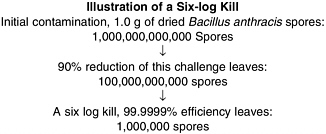 With an estimate of 10,000 spores per lethal dose, that leaves 100 lethal doses. Clearly the level of remediation required is a function of the initial concentration. This demonstrates the importance of identifying the source term and conducting initial gross decontamination prior to fumigant operations. |
methods have been developed in each category, but not all are suitable for use in large facilities such as office buildings or airports. Some of the latest technologies are described in the following section.
DECONTAMINATION OF HARMFUL BIOLOGICAL AGENTS BY CHEMICAL AND PHYSICAL METHODS
Decontamination of buildings and their contents requires the inactivation or removal of biological agents. Decontamination of an entire building presents complex problems because some components or contents of a building could be resistant to treatment with specific chemical decontaminants whereas others might
be especially susceptible to treatment. The design and construction of a building also can influence the efficacy of the effort. If the contaminant is a particulate substance, and the decontamination method does not contact all contaminated surfaces, the potential for subsequent release of untreated contaminants will remain even after the building reopens. Any chemical decontaminant must penetrate and permeate every part of a contaminated building. Hence, gas phase decontamination of buildings would seem to be the best method. Because of the extent of the potential loading of infectious particulates on objects in an office building, there also might be a need to decontaminate surfaces by treating them with liquid formulations of decontaminants, such as sodium hypochlorite (household bleach) solutions or one of the newly developed compounds designed for direct contact use. Another preferred method of gross decontamination is vacuum cleaning with HEPA filtration to reduce the particulate load sufficiently to allow effective remediation by a fumigant. HEPA vacuuming, combined with a vaccination program for facility occupants, has been proposed as an alternative to fumigation for facilities in which there is a stable population (Weis et al., 2002). More research in this area is warranted. Although HEPA filtration also could work in some circumstances, it is not likely to be completely effective in a large public building, such as an airport, because of the large open indoor spaces.
The next two sections discuss two types of the various decontamination methods: vapor phase and reactive solution treatments. For each type, selected treatments are described in detail as examples. Other aqueous-based, exposed-surface decontamination reagents, such peroxyacetic acid, peroxyacetic acid/hydrogen peroxide, calcium hypochlorite, and Vikon S, are available and discussed in “Biological Restoration Plan for Major International Airports,” (LLNL, 2005).
Vapor Phase Treatments
Chlorine Dioxide
Chlorine dioxide (ClO2) is a gas at room temperature that is a reaction product of sodium hypochlorite, hydrochloric acid, and sodium chlorite or of sodium chlorite and chlorine. ClO2 is an oxidizing agent that reacts with a wide range of materials. It is used to bleach pulp for paper, and it is coming into more wide use as a disinfectant in water treatment. It has been used to sterilize surfaces in food production facilities. Delivery methods include ClO2-generating systems that pump polymer bags full of the gas to sterilize the contents has been used as an industrial surface sterilizer (Barrett et al., 2002), and it was used to disinfect a large office building contaminated with Bacilus. anthracis spores (USPS, 2002a,b). ClO2 disrupts proteins and interferes with protein synthesis in bacteria, and it inactivates the outer protein structures of viruses. Its use as a decontaminant is a mature technology and is available for small to large-scale applications.
Sterilizing entire office buildings with ClO2 is complicated. Several develop-
ment issues were discovered when ClO2 was used in remediating the Hart Senate Office Building and the Curseen-Morris Mail Processing and Distribution Center (formerly known as the Brentwood postal facility) in Washington, D.C., in the wake of the 2001 B. anthracis attack. Even though the gas is short-lived, care must be taken to neutralize any residual gas before treated facilities can be reopened. Because of its reactivity, the residual gaseous material could be entrained in a wastewater stream and disposed of as liquid waste.
ClO2 can be generated onsite for specific applications. According to the testimony to the Committee on Science of the U.S. House of Representatives (Nov. 8, 2001) of Charles Haas—L.D. Betz Chair Professor of Environmental Engineering at Drexel University—the generating system used affects the purity of the ClO2 gas (Haas, 2001). Current applications of ClO2 for building remediation require 75% relative humidity and an exposure of 9000 ppmv hr-1. This is the equivalent of a 10-h exposure with 900 ppmv of the gas.
Industrial uses of ClO2 include microbial control in food processing, food equipment sanitization, and wastewater and drinking-water treatment. It also has been used to sanitize air ducts and to sanitize and disinfect hospitals. Building sterilization with ClO2 (or any other appropriate gas) will be a specialty requirement best handled by approved vendors familiar with the hazards of its use. The experience at the Curseen-Morris Mail Processing and Distribution Center showed that sterilization of mail would require large volumes of the gas, so the cost for long-term use would be prohibitive.
The U.S. Food and Drug Administration has approved the use of ClO2 as a disinfectant in the food service industry and as a surface sterilant for processed foods. The U.S. Environmental Protection Agency (EPA) has approved its use in water. The decontamination of the Hart Senate Office Building and the Curseen-Morris Mail Processing and Distribution Center apparently was successful, but the use of ClO2 was permitted only by a special exemption granted by EPA. Evaluation of the lessons from those incidents is an important part of the consideration for its future use in facility decontamination and for its ultimate approval for such use “routinely” by EPA. The Occupational Safety and Health Administration (OSHA) sets maximum allowable concentrations for ClO2 exposure in workers; EPA and state regulatory agencies will regulate its release into the open air. Short-term environmental effects are possible if the gas escapes containment during use in a facility. ClO2 is an irritant to the eyes, lungs, and skin, and concentrations in excess of 5 ppm are considered immediately dangerous to life and health. Adequate removal of ClO2 must be ensured before facilities can be reoccupied.
A major operational effect of the decontamination of buildings by gas phase sterilants is the required shutdown of the facility. Facilities must remain closed until both decontamination of the biological agent and the complete removal of the ClO2 have been demonstrated. Additional operational issues could become obvious from the experience the Hart Senate Office Building and at the Curseen-
Morris Mail Processing and Distribution Center. Careful documentation and evaluation of those experiences will provide important information about the use of ClO2. The concerns of nearby residents and business operators also can dramatically influence the application of ClO2 at a given site.
Because ClO2 was used to decontaminate the affected buildings, there are precedents and data to lead the future applications of this technology to facility decontamination.
Ethylene Oxide
Ethylene oxide (EtO) is a sterilant gas that can be delivered from bulk sterilizers (similar to autoclaves) or in prepared packages that contain measured volumes. EtO has for many years been used to sterilize medical equipment and heatlabile materials. It also is used widely as a fumigant for delicate or rare objects and books. EtO alkylates proteins in bacteria and viruses to disrupt protein functions and inactivate cells. Its use as a sterilant is a mature technology that is currently available through a variety of vendors. Large-scale facility decontamination could be difficult because of the need to remove residual EtO after decontamination is complete. Significant permitting and emissions requirements will affect its implementation. A long lead time will be needed before this technology can be implemented to decontaminate office buildings. There could be specific small-scale applications (using ethylene oxide retorts) for the decontamination of small, irreplaceable items, such as letters or other documents, electronic media, and photographs that have a “shelf-life” of utility in a business application or that are essential to the business.
Industrial uses of EtO include sterilization of hospital equipment and supplies, especially items that cannot be subjected to heat or pressure, such as fiberoptic scopes. Gas purity is not an issue because that would be the responsibility of the vendor. Although approved by the Food and Drug Administration for use in sterilization of medical equipment, its use as a facility decontaminant would be a new application and thus subject to evaluation for the specific requirements. EPA also could have to set guidelines for the use of EtO in the quantities expected to be necessary for building decontamination. Although it is likely to perform acceptably in a building environment, the concomitant health risks could prove insurmountable. EtO is an irritant to the eyes, lungs, and skin. Women exposed to low concentrations could be at risk of reproductive effects. Use of EtO in bulk quantities also will trigger air quality permit requirements, including those of the Clean Air Act. And because of fire and explosion hazards and the potential carcinogenicity of the compound, there could be even more severe regulatory constraints on its use. The costs associated with all aspects of the use of EtO will be high, especially considering the large quantities required for bulk decontamination.
EtO seems less practical as a vapor phase decontaminant than ClO2. There is already a precedent for successful use of ClO2 and the risks associated with EtO are significant. In addition, because EtO alkylates protein substituents and DNA bases, it is classified as a carcinogen and long-term medical monitoring of potentially exposed people would be required.
Methyl Bromide
Methyl bromide (MeBr) is a colorless, gaseous pesticide primarily used for soil fumigation, postharvest protection, and quarantine treatments (USPS, 2002a,b). It is also used to control insects, nematodes, weeds, and pathogens in more than 100 crops, in forest and ornamental nurseries, and in wood products. Annually, 6% of the MeBr used in the United States is for fumigating warehouses, food-processing plants, museums, antiques, and commercial vehicles. For insect control, large buildings are sealed to prevent the fumigant from escaping. MeBr is an EPA-registered pesticide that has been proven effective in fumigating large buildings, including those in urban settings, such as flour mills infested with insects. MeBr is effective against higher organisms, but it has not been used against bacteria. Because it has been identified as an ozone-depleting chemical, and its use in the United States will be phased out by 2006, its applicability is limited even if it were proven effective against bacteria and viruses. Because of its toxicity, storage of the quantities needed to decontaminate a building of any size would create a potential hazard.
There are no documented cases of the efficacy of MeBr for eradicating B. anthracis. Where MeBr was used to decontaminate harvesting equipment of karnal bunt (a fungal disease of wheat), only 90% of the fungal spores were eliminated. Its efficacy against fungal spores depended on the life cycle of the spores, and it was most effective against germinating spores. It is also an effective nematocide. Preliminary efficacy trials have been conducted at the University of Florida on B. anthracis surrogates.
MeBr vapor is toxic to humans; inhalation causes dizziness, headache, nausea, vomiting, abdominal pain, mental confusion, tremors, convulsions, pulmonary edema, and eventually coma. Death from respiratory or circulatory collapse can occur. Human exposure to this compound is clearly not acceptable, although it is inexpensive and is widely available. As the date approaches for its phase-out, costs likely will increase and availability will become less certain. EPA could allow emergency use as a fumigant on a case-by-case basis, but inventory of the gas could then become problematic.
If a facility were to be decontaminated with MeBr, the building would not be able to reopen until it could be demonstrated that the biological agent and all residual MeBr gas were completely removed.
Ozone
Ozone (O3) is a powerful, naturally occurring oxidizing agent with a long history of safe use in the disinfection of municipal water, process water, bottled drinking-water, and water in swimming pools (USPS, 2002a,b). Recent applications include treatment of wastewater, water theme parks, and home spas. Ozone is formed by high-energy-induced disproportionation of oxygen (O2). In nature, ozone is formed by ultraviolet irradiation and lightning discharges; commercial generators use high electrical voltage to form ozone. Studies on the sporicidal action of ozone indicate that spores of Bacillus spp. are more susceptible to ozone than to hydrogen peroxide, and at 10,000-fold lower concentration (Weis et al., 2002). The outer spore coat layers have been shown by electron microscopy to be the probable site of action of ozone.
The U.S. Department of Energy (DOE) Idaho National Engineering and Environmental Laboratory (INEEL) is collaborating with the O3zone Company (a potato-harvesting-equipment maker) to determine the efficacy of destroying B. anthracis with ozone (INEEL, 2002). O3zone’s technology generates ozone gas by a high-energy electrical current that breaks oxygen molecules into separate atoms. INEEL reported that “simulated anthrax spores” exposed to a high concentration of ozone (10,000 ppm) for about an hour were completely neutralized (Eng, 2002). A research group at San Diego State University was awarded a National Science Foundation research grant in April 2002 to study the effectiveness of ozone for killing B. anthracis (Hoskins, 2002).
According to EPA, ozone has been used extensively for water purification, but ozone chemistry in water is not the same as that in air. High concentrations of ozone in air are sometimes used for chemical or biological decontamination of unoccupied spaces and to deodorize spaces during restoration after a fire. However, little is known about the chemical by-products of those processes. Vendors claim that ozone kills mold spores, but there is no definitive information about its efficacy against B. anthracis. There are numerous vendors of ozone generators.
OSHA limits human exposure to ozone in air to 0.1 ppm for continuous exposure during an 8-h period and to 0.3 ppm for a 15-minute period. At 1 ppm, ozone is irritating to the eyes and throat. Unstable in water, ozone decomposes to oxygen (its half-life in solution is about 20 minutes). Thus, maintaining effective concentrations of ozone in water is difficult. However, ozone is an effective disinfectant of water and could be an effective gaseous sterilant. Ozone is 1.5 times more powerful as an oxidizing agent than is chlorine and 3000 times more powerful than hypochlorous acid. Its antimicrobial action occurs 4-5 times faster than is possible with chlorine. There have been some reports that indicate ozone’s sporicidal activity of ozone; however, its effect on Bacillus spp. spores varies with the strain. Ozone could harm or destroy many items found in a contaminated building because it is a strong oxidant. EPA approval presumably would be required for its use.
If a facility were to be decontaminated with ozone, the building cannot be reopened until it could be demonstrated that the biological agent and all residual ozone were completely removed. Building decontamination with ozone does not appear practical because of the lack of demonstrated effectiveness against B. anthracis spores and because of the damage it could cause to objects inside a contaminated building.
Paraformaldehyde
Paraformaldehyde, or polymerized formaldehyde, is obtained by concentrating formaldehyde solution. Heating paraformaldehyde powder depolymerizes it to produce formaldehyde gas. Formaldehyde gas is widely used as a fumigant in the poultry industry. As a fumigant, paraformaldehyde kills all microbial forms of life. Past uses of paraformaldehyde include surface sterilization and detoxification (USPS, 2002a,b). It is known to eliminate B. anthracis and other infectious agents and toxins. After treatment, the gas is rapidly dissipated by aeration.
Paraformaldehyde is used throughout the world in hospitals, biomedical facilities, veterinary settings, pharmaceutical manufacture, research organizations, and universities. For sterilization, formaldehyde gas exposure for 16 h at a concentration of 1.0 mg L-1 at 75% ± 5% relative humidity, and ambient temperature of 75 ± 5 °F is recommended. Information about effectiveness available from the presentation made by Manuel S. Barbeito to the House of Representatives (Barbeito, 2001), and in fact sheets developed by Timothy P. Gouger (U.S. Army Corps of Engineers) and Manuel S. Barbeito (biological safety consultant, Frederick, Maryland, and former Industrial Health and Safety Directorate, U.S. Army, Fort Detrick, Maryland). Formaldehyde gas has been used to decontaminate numerous Biosafety 3 and 4 Laboratories before maintenance, renovations, or changes in research programs. Paraformaldehyde also was used in 1989 to decontaminate a textile mill in Pennsylvania (Phillip Brachman, Emory University, 2004, personal communication).
Paraformaldehyde has been used to eliminate infectious pathogens. In experiments performed by Taylor, Barbeito, and Gremillon, formaldehyde gas treatment was completely successful in sterilizing laboratory facilities, materials, and equipment known to be contaminated with several organisms, including Clostridium botulinum. There were no problems with repolymerization or other residues when the concentration and humidity were controlled. Mechanical, electronic, and optical equipment showed no visible or operational effects as a result of treatment.
There are toxicity issues with regard to human exposure. Due to the suspected carcinogenic and toxic nature of paraformaldehyde, any building treated with paraformaldehyde must have formaldehyde gas neutralized with ammonium biocarbonate and be properly ventilated, or have a specially designed ventilation system. The EPA classifies formaldehyde as “Group B1,” that is, a probable
human carcinogen of medium carcinogenic hazard. Breathing in contaminated air can be extremely irritating to the eyes, skin, and mucus membranes of the upper respiratory tract and can cause nausea and vomiting. Pulmonary edema and allergic respiratory and skin reactions have also been reported. Buildings decontaminated with formaldehyde gas would be subject to air quality monitoring requirements. Paraformaldehyde fumigation may not be viable for building decontamination because of concerns about its potential carcinogenicity unless the EPA grants special waivers or additional research allays these concerns.
Although there are contradictory opinions regarding the harmful nature of paraformaldehyde towards humans, paraformaldehyde is widely used in the decontamination of microbial and tissue culture hoods at the National Institutes of Health, the U.S. Army Medical Research Institute for Infectious Disease (USAMRIID), and many other locations through out the world. The effect of paraformaldehyde on humans should be further assessed due to the historical efficacy of this chemical in killing bacterial spores.
Vapor Phase Hydrogen Peroxide
Hydrogen peroxide (H2O2) is an oxidizing agent used in industry for pulp, textile, and environmental applications. It is typically provided as concentrated solutions of 30% for industrial applications; dilute solutions (3 to 10%) are commonly used in medical practice as cleansers for minor cuts. Hydrogen peroxide, its superoxide ion radical, and its hydroxyl radical are intermediate products in the reduction of oxygen in water. The hydroxyl radical is said to be the strongest oxidant known, and it is by this mechanism that hydrogen peroxide is believed to kill bacteria. The hydroxyl radical attacks membrane lipids, DNA, and other essential cell components. Vaporized hydrogen peroxide, a low-temperature sterilant, is created by a machine—a “generator”—and is often used as an antimicrobial pesticide (described below) for decontaminating sealed enclosures such as scientific workstations, isolators, pass-through rooms, medical and diagnostic devices, and for other biological safety applications.
Vapor phase H2O2 generators are used to sterilize medical devices and equipment and have application in barrier isolators used in pharmaceutical manufacturing environments, for product sterility testing. The largest volume thus treated to date is 950 m3. It is not clear if this technology can be scaled up effectively to treat typical buildings and this is a potential research area. There are some concerns about detonation of vapor phase H2O2, but this area requires extensive investigation. Vendors claim that vapor phase H2O2 has been proven to be effective in biosafety cabinets, isolators, rooms and suites of rooms up to 950 m3 in size, but this has yet to be substantiated in the open literature. There are several sizes of H2O2 vapor generators for various sized spaces. Some spaces can be decontaminated with fully automatic control.
Vapor phase H2O2 was successfully used for building remediation at the
Sterling, Virginia mail sorting facility, but has not been approved by the EPA for treating large volumes of air. Unlike chlorine dioxide which requires high humidity, vapor phase H2O2 requires relatively low humidity prior to initiation of fumigation activities. Due to the relatively large size of the postal facility, the area was sectioned prior to the application of H2O2 for decontamination.
Reactive Solution Treatments
L-Gel (Oxone)
L-Gel is a decontamination method developed at the Lawrence Livermore National Laboratory that uses a single reagent as its primary active ingredient (Barrett et al., 2002; O’Connor et al., 2001; Raber, 2002). The reactive agent is Oxone [potassium peroxymonosulfate] (DuPont, 1998). This is combined with a silica-based gelling agent. This gelling agent makes the compound thixotropic, allowing the reactive component to remain in contact with vertical surfaces and ceilings. It does not harm carpet materials or painted surfaces. A potential drawback is that its formulation will prevent its penetration into fissures and other places that particulate contaminants may have reached. As a surface decontaminant, L-Gel has been demonstrated to be effective on test batches of actual materials that might be found in an office environment. However, publication on its effectiveness for an office environment that contains a wider variety of materials has not yet been found. Some analytical data have been presented (see O’Connor et al., 2001; Raber, 2002; Raber et al., 2001).
Sandia Decontamination Formulations
Aqueous-based decontamination formulations were developed by researchers at the DOE’s Sandia National Laboratories. The researchers hoped to find a universal decontaminant for neutralizing both chemical and biological agents. The formulation, whose main active ingredient is hydrogen peroxide, can be used as foams, liquid sprays, or fogs (Modec, 2002). DF-100, more commonly referred to as “Sandia Foam,” is now available commercially.
DOE funded the development of the foam as part of its larger Chemical and Biological Nonproliferation Program. The word “foam” is a misnomer because the chemical can be supplied or created as a foam, liquid, or aerosol. Sandia Foam is currently being marketed under the trade name, EasyDECON™, by EnviroFoam Technologies, one of the two current suppliers. How the foam kills spores (bacteria in a rugged, dormant state) is not well understood. It is thought the surfactants perforate the spore’s protein armor and allow the oxidizing agents to attack the genetic material inside.
Tests conducted at Sandia showed that the foam destroyed simulants of VX, mustard, Soman, and anthrax (Modec, 2002). Sandia states that the foam is non-
toxic and noncorrosive. Respiratory protection may be required if workplace exposure limits are exceeded. The manufacturer claims that the foam reduces environmental hazards to the point where the effluent may be disposed of “down the drain.” The foam is nonflammable and advertised as a dual-use fire-fighting foam and chemical and biological decontaminant. However, the high-expansion Aqueous Film-Forming Foam—a fire-fighting foam—must be stored and treated as hazardous material.
In October 2000, Sandia was funded by DOE to develop an enhanced version of DF-100 to optimize performance for military and civilian first responders (Modec, 2005). This resulted in the new decon formulation, DF-200 (Modec, 2002). Based on test data, a 99.99999% kill of anthrax stimulant is achieved after 30 minutes exposure. This compares with a 99.99% kill for DF-100 in the same time period. Modec, Inc. has been licensed by Sandia to produce DF-200 commercially. Modec sells this product as MDF-200 and commercial production began in December 2001.
Decon Green
Decon Green is a decontamination solution developed by the U.S. Army to detoxify chemical and biological warfare agents (Haley, 2004; Wagner, 2004). The primary ingredients are propylene carbonate, hydrogen peroxide, and Triton X-100, which are mixed together at time of use. Additional ingredients include sodium molybdate and sodium carbonate. Tests have demonstrated that the solution can decontaminate surfaces contaminated with up to 2.5 × 10⁸B. anthracis spores after a 15-minute contact time.
Hypochlorite Solutions
Hypochlorite is the reactive component of chlorine bleach and is an effective decontamination solution (Barrett et al., 2002). Hypochlorite is an oxidizing agent and can react directly with the proteins and membranes of living organisms.
The primary disadvantage of chlorine solutions is their corrosiveness and the mildly reactive residues left after the liquid evaporates. Calcium hypochlorite is a powerful oxidizing agent, and it is highly corrosive. The corrosiveness increases as the temperature rises. Therefore, calcium hypochlorite should not be used to decontaminate sensitive electrical or electronic equipment on aircraft, weapons materials, navigation instruments, or similar equipment. This is especially true where steam is used. Sodium hypochlorite is the commonly available solution known as household bleach. It is also highly corrosive. Synonyms for calcium hypochlorite include Losantin, hypochlorous acid, calcium salt, BK powder, HyChlor, chlorinated lime, lime chloride, chloride of lime, calcium oxychloride, HTH, mildew remover X-14, perchloron, and pittchlor. Synonyms for sodium
hypochlorite include Clorox, bleach, liquid bleach, sodium oxychloride, Javex, antiformin, showchlon, chlorox, B-K, Carrel-dakin solution, Chloros, Dakin’s solution, hychlorite, Javelle water, Mera Industries 2MOm3B, Milton, modified Dakin’s solution, Piochlor, and 13% active chlorine.
EXAMPLES OF DECONTAMINATION: HART SENATE OFFICE BUILDING AND AMERICAN MEDIA INTERNATIONAL BUILDING
When the use of high containment laboratories for biological warfare research was terminated at Fort Detrick, Maryland, in 1969, paraformaldehyde was used extensively for decontamination of more than 100 buildings. The facilities were decontaminated at least twice. The first decontamination focused on the primary locations where pathogens were used. Then the entire building was decontaminated in a coordinated effort that included decontamination of all spaces within the walls of each building (for example, attic spaces, utility rooms, offices, restrooms, walk in incubators, refrigerators, change rooms, elevators, filter plenums, entire effluent drain system, and other utility lines).
In the recent “bioterror” incidents, chlorine dioxide was the method of decontamination when the Hart Building was exposed to anthrax spores. After the realization that anthrax was the contaminant, a “screening/sampling” effort began almost immediately. This effort was intended to map the extent of contamination. Screening sampling was followed by thorough “characterization sampling,” which was intended to identify all areas that would require decontamination and to help identify the best decontamination method to use. That process identified ClO2 as the best option, followed by formaldehyde gas. Rather than fumigate the entire building with ClO2, which would have been very difficult, areas known to be heavily contaminated were fumigated first, followed by treatments of other areas as needed (Box 10-2).
Test runs on the ability of ClO2 to kill anthrax surrogate spores were conducted and they showed that ClO2 effectively kills such spores at 75°C, 75% relative humidity, using a total exposure of at least 750 parts per million (by volume) for 12 hours (9,000 ppmv-hours). These tests also confirmed that the use of “test strips” containing surrogate spores is a valid way to verify the degree of decontamination achieved.
A decontamination plan should have the following elements:
-
Pre-decontamination assessment to determine both “hot spots” and spatial distribution of organisms.
-
Placement of test strips with the appropriate organisms in locations testing positive in pre-assessment phase.
-
Locate test strips in areas (surfaces) where human contact is likely (i.e., desk surfaces) and where resuspension is possible (i.e., corridors, office entries).
|
BOX 10-2 (Schaudies and Robinson, 2003) This report provides a scientific analysis of chlorine dioxide gas testing and remediation efforts conducted or sponsored by the US Environmental Protection Agency (USEPA) in the Washington, DC, area in response to the anthrax attacks in October 2001. Commissioned by the USEPA Region III during the response phase to these attacks, this report summarizes and evaluates the available data from tests conducted by USEPA at a trailer test facility at the USPS Brentwood Processing and Distribution Center (hereafter referred to as the Brentwood PandDC), from the fumigation of the Daschle suite and part of the heating, ventilation, and air conditioning (HVAC) system of the Hart Senate Office Building (HSOB), from additional USEPA trailer tests in Beltsville, Maryland, and from USEPA-sponsored tests at the U.S. Army Dugway Proving Ground, Utah. Finally, this report offers key findings derived from all of these data concerning the effectiveness of chlorine dioxide gas for inactivating Bacillus anthracis spores under laboratory and field conditions. The introduction of B. anthracis spores into the US Mail distribution system in the fall of 2001 presented a host of challenges to many government and civilian institutions. Envelopes containing approximately one to two grams of dry, weaponized B. anthracis spores resulted in contamination of multiple buildings in the Capitol Hill area. Levels of contamination ranged from ‘just detectable’ levels to visible powder on the floor in Senator Daschle’s suite. The facts that 1 gram contains as many as 1012 spores and an infective inhaled dose may range from less than 10 spores to tens of thousands of spores presented some unique challenges for the cleanup operations. The USEPA assumed overall responsibility for the remediation of buildings and artifacts within the Capitol Hill region. Localized small-scale remediation efforts were performed by high efficiency particulate air (HEPA) vacuuming, decontamination foam, and chlorine dioxide dissolved in water. Large-scale remediation was conducted by fumigating with chlorine dioxide gas in specific locations in the HSOB. This effort represented the first time chlorine dioxide gas was used for the destruction of B. anthracis spores outside of a laboratory and for decontamination on this scale. Chlorine dioxide gas was selected for fumigation of the Daschle suite and a section of the HVAC system in the HSOB after careful consideration of several gaseous or vaporized alternative chemicals, including paraformaldehyde (heated into formaldehyde gas), ozone, ethylene oxide, and hydrogen peroxide vapor. While these alternative chemical decontaminants were all known to have potential effectiveness against B. anthracis spores, an interagency committee of advisors selected chlorine dioxide gas based on an objective evaluation using specific criteria that are described in paragraph 2.1.4. Prior to the remediation of the HSOB, USEPA conducted a series of fumigations with chlorine dioxide gas in a trailer located at the Brentwood PDandC, which has been subsequently renamed the “Joseph Curseen-Thomas Morris PandDC.” |
|
The purpose of this testing was to determine the most effective combination of gas concentration, temperature, relative humidity, and contact time for fumigation of the HSOB Daschle suite and HVAC system. After the building remediation efforts were completed, USEPA conducted additional tests in a trailer at Beltsville, Maryland, and funded another study at the U.S. Army Dugway Proving Ground, Utah, on the efficacy of chlorine dioxide gas on live B. anthracis and several surrogate Bacillus species. This report provides a scientific analysis of the results of all of the tests that were conducted or sponsored by USEPA to determine the most effective conditions for using chlorine dioxide gas to inactivate B. anthracis spores. Finally, the authors wish to note that the historic, successful remediation of the HSOB is a tribute to the professionalism, dedication and hard efforts of all of the members of the remediation team led by the Capitol Police Board (CPB), the USEPA, Department of Defense, other federal agencies, and the Incident Commander, along with many local government fire and rescue teams. Key Findings
|
|
-
Select test strips with sufficient detection limits to quantify a minimum of 1 × 10⁶ logs kill effectiveness.
-
Topical decontamination and cleaning of areas known to be the primary site of heavy contamination or secondary accumulation sites, such as ventilation ducts, filters, and computer screens.
-
Post-decontamination, the building should be reassessed to determine if primary agent is still present. Surface wipe sampling and/or vacuum sampling should target previously determined hot spots or areas of accumulation. Aggressive sampling might be considered prior to clearing the building for occupancy. Aggressive sampling might include mixing fans and mechanical agitation of upholstered/carpeted surfaces.
Significant improvements have been made in building remediation technologies since the decontamination of the Hart Senate Office Building. One clear example of the progress is the successful remediation of the American Media Incorporated building in Boca Raton, Florida, in July 2004. Below is a summary of laboratory validation of those operational events (Box 10-3).
|
BOX 10-3 The building that housed American Media Inc. headquarters in 2001, located at 5401 Broken Sound Blvd. in Boca Raton, Florida, was fumigated on July 11th, 2004 with chlorine dioxide gas in order to destroy the remaining Bacillus anthracis spores. The building was under operational control of BioOne Corporation for the entire remediation process. Extensive surface sampling with microbial culture indicated that the building had extensive contamination with some bacterial colony counts following analysis reported as “too numerous to count.” During fumigation operations temperature, relative humidity (RH) and ClO2 levels were co-monitored at 27 locations in the facility. Target temperature of 75 °F was maintained throughout all locations. RH of 75% was established prior to fumigation but was not maintained during the process; however, no locations fell below 65% RH. The minimum acceptable CT values were 9,000 ppmv-hours; this value was exceeded at all 27 locations. The building achieved an average cumulative CT of 13,775 ppmv-hours with individual locations ranging from 12,617 to 15,764 ppmv-hours. The building was functionally separated into 162 separate 100 sq ft grids for the biological indicator (BI) placement. Two thousand (2000) biological indicator spore strips located throughout the facility and exposed during fumigation showed a 100 percent kill rate. BI Sampling Program Components
The culture results for all of the 2000 spore strips are presented in the table below. None of the indicator strips were culture positive. All of the negative control strips were culture negative and all of the positive culture strips were culture positive. |
|
BII Overall Building Spore Strip Results
In addition to spore strip samples, 952 surface samples were collected from every area of the facility. All surface samples were analyzed by culture methodology at the New Jersey Department of Health and Senior Services State Laboratory in Trenton, New Jersey and found to be negative for B. anthracis growth. Following completion of surface sampling, aggressive air samples were collected at focused building locations using three sample methodologies; Dry Filter Units, High Volume Samplers, and Anderson Cascade Impaction Samplers. The focused air samples were all found to be negative for B. anthracis growth at the New Jersey State Laboratory. Following completion of focused air sampling; building-wide stratified aggressive air sampling was conducted utilizing Dry Filter Units positioned such that the intakes were located within the ceiling plenums directly in front of the air handler return ducts that serviced each building zone. Air volumes equivalent to 55 percent of total building volume were sampled during this event. All stratified air samples were found to be negative for B. anthracis growth at the New Jersey State Laboratory. Thus, the “no growth” standard for all environmental samples was achieved as a result of the fumigation. |
FINDINGS AND RECOMMENDATIONS
Finding 10-1
Paraformaldehyde gas was the preferred decontaminant for buildings at the U.S. Army facility in Fort Detrick, which was home of the U.S. Army Medical Research Institute for Infectious Diseases. EPA has ruled out the use of paraformaldehyde for cleanup after a bioterrorist attack because of concerns about the health effects of the gas.
Recommendation 10-1
The committee recommends that the National Cancer Institute lead an interagency task force to reevaluate the possible carcinogenic effects of paraformaldehyde.
Finding 10-2
ClO2 has been used successfully for decontamination of several buildings: the Hart Senate Office Building, the Brentwood postal facility, and the American Media Inc., building.
Recommendation 10-2
For now, and given its successful application after the 2001 attacks, ClO2 should be considered the standard for decontaminating buildings—pending further guidance and information from federal agencies. Research leading to the development of new methods and processes should be expected to demonstrate that any new methods have the potential to be at least as effective, safe, and cost-effective as ClO2 for decontamination.
Finding 10-3
Adequate training of the decontamination team is essential for effective remediation and validation.
Recommendation 10-3
EPA and the CDC should establish standards for remediation and validation of contaminated buildings and for the training of remediation teams.
Finding 10-4
The federal sterilization standard of a 6-log kill—the reduction of the amount of live contaminant by six orders of magnitude—was applied in the Hart Senate Office Building remediation. However, given that 1 g of dried B. anthracis can contain up to 1012 spores, the current standard could leave a large number of viable organisms.
Recommendation 10-4
Current and emerging decontamination techniques should be thoroughly evaluated to ascertain the achievable efficiencies of kill.
REFERENCES
Barbeito, M.S. 2001. Feasibility to Decontaminate Facilities Contaminated With or Suspected of Being Contaminated with Bacillus anthracis. Testimony Before Committee on Science, U.S. House of Representatives, Washington, DC: November 8, 2001.
Barrett, J.A., W.M. Jackson, I.A. Baig, A.L. Coverstone, C.E. Harfield, R.D. Arcilesi, J. Butler, W. Burton, and C.W. Williams, Jr. 2002. Wide Area Decontamination: CB Decontamination Technologies, Equipment, and Projects. Final Report. Edgewood, Maryland: Chemical Warfare/Chemical Biological Defense Information Analysis Center.
DuPont. 1998. DuPont Oxone Monopersulfate Compound Technical Information. [Online] Available at: www.dupont.com/oxone/techinfo/.
Eng, P. 2002. Zapping Anthrax Mail with Ozone. [Online] Available at: www.newmedicine.org/Zapping_anthrax.htm.
Haas, C.N. 2001. Decontamination Using Chlorine Dioxide. Testimony Before Committee on Science, U.S. House of Representatives, Washington, DC: November 8, 2001.
Haley, M.V., C.W. Kurnas, R.T. Checkai, S.D. Turley, M.A. Osborn, and D.T. Burton. 2004. Toxicity of hydrogen peroxide-based decontamination solution (Decon Green) in water and soil extracts. 24th Army Science Conference Proceeding: Orlando, Florida. [Online] Available at: www.asc2004.com/Manuscripts/sessionO/OS-12.pdf.
Hoskins, A. 2002. SDSU Researcher Gets National Science Foundation Grant to Study Ozone’s Effectiveness Against Anthrax. [Online] Available at: http://advancement.sdsu.edu/marcomm/news/releases/spring2002/pr042402.html.
INEEL (Idaho National Engineering and Environmental Laboratory). 2002. Potato Technology May Help Move Mail. DOE News Desk. [Online] Available at: http://newsdesk.inel.gov/contextnews.cfm?ID=275.
LLNL (Lawrence Livermore National Laboratory). 2005. Biological Restoration Plan for Major International Airports. Livermore, California: Lawrence Livermore National Laboratory.
Modec, Inc. 2002. MDF-200—An Enhanced Formulation for Decontamination and Mitigation of CBW Agents and Biological Pathogens. [Online] Available at: http://www.deconsolutions.com/pdf_files/DF-200%20Performance%20Data%20-Live%20Agent.pdf.
Modec, Inc. 2005. Sandia Decon Formulations for Mitigation and Decontamination of Chemical and Biological Warfare Agents, Chemical Toxins, and Biological Pathogens. [Online] Available at: http://www.deconsolutions.com/pdf_Files/MDF-200%20Data%20Sheet.pdf.
O’Connor, L., B. Harper, and L. Larsen. 2001. A Comparison of Decontamination Technologies for Biological Agent on Selected Commercial Surface Materials—Summary Report. Aberdeen, Maryland: U.S. Army Soldier and Biological Chemical Command.
Raber, E. 2002. L-Gel decontaminates better than bleach. Science and Technology Review March 2002:10-16. Also [Online] Available at: www.llnl.gov/str/March02/Raber.html.
Raber, E., A. Jin, K. Noonan, R.R. McGuire, and R.D. Kirvel. 2001. Decontamination issues for chemical and biological warfare agents: how clean is clean enough. International Journal of Environmental Research and Public Health 11(2): 128-148.
Schaudies, R.P. and D.A. Robinson. 2003. Analysis of Chlorine Dioxide Remediation of Washington, D.C. Bacillus anthracis Contamination. McLean, VA: Science Applications International Corporation.
USPS (United States Postal Service). 2002a. U.S. Postal Service Emergency Preparedness Plan for Protecting Employees and Postal Customers from Exposure to Biohazardous Materials and for Ensuring Mail Security Against Bioterror Attacks. Washington, DC: United States Postal Service. Also [Online] Available at: www.usps.com/news/2002/epp/emerprepplan.pdf.
USPS (United States Postal Service). 2002b. Appendix A-H of U.S. Postal Service Emergency Preparedness Plan for Protecting Employees and Postal Customers From Exposure to Biohazardous Materials and for Ensuring Mail Security Against Bioterror Attacks. Washington, D.C.: United States Postal Service. Also [Online] Available at: www.usps.com/news/2002/epp/emerprepplan_ap.pdf.
Wagner, G.W., R.J. O’Connor, J.L. Edwards, and C.A.S. Brevett. 2004. Degradation and decontamination of VX in concrete. 24th Army Science Conference Proceedings: Orlando, Florida. [Online] Available at: www.asc2004.com/Manuscripts/sessionO/OS-03.pdf.
Weis, C.P, A.J. Intrepido, A.K. Miller, P.G. Cowin, M.A. Durno, J.S. Gebhardt, and R. Bull. 2002. Secondary aerosolization of viable Bacillus anthracis spores in a contaminated US Senate Office. Journal of the American Medical Association 288(28): 2853-2858.


