
11
Safe Reoccupation of a Facility
Certifying that a building is safe for reoccupation is a complex process that involves decision making on several factors, including sampling procedures and decontamination methods. The process must consider quantitative risk assessments (Chapter 4) and the perspectives of stakeholders, users, and the public (Chapter 3). An official declaration that a building is safe for reoccupation is meaningless if the occupants and other stakeholders do not perceive it as safe. Without the involvement of the wider community, a technically perfect cleanup will be just that, and the building could remain unoccupied if public standards and criteria for assessing cleanup effectiveness differ from those accepted by the scientific community. Conversely, the expert appraisal of a building as not yet safe for occupation may be out of step with the ideas of building owners and users who are eager to reoccupy a structure.
In this chapter, the committee uses a flow chart to illustrate the critical steps in the decision-making process (Figure 11-1) for reopening a contaminated facility. The committee discussed the relevant standards and policies involved in decision making:
-
A standard was used where the committee recognized that a basis or principle to which everybody should adhere should be developed to ensure national conformity of approach in the scientific and technical methods used and measurement of specific parameters upon which decisions about further action would be taken.
-
A policy was used where the committee recommended that a general course or principle of action or approach be adopted throughout the country that
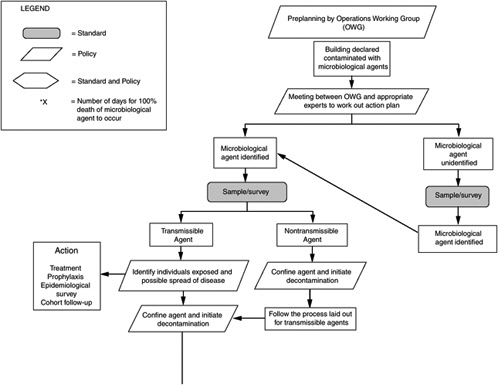
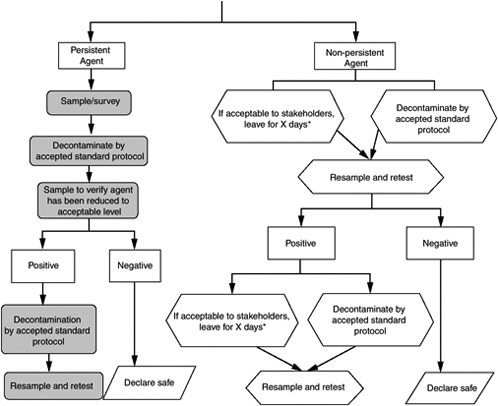
FIGURE 11-1 Flow chart illustrating the standard and policy guidance that could speed up and reduce cost of recovery from a bioterrorist attack. The flow chart is designed to address a biological weapon attack and has not considered combinations of biological and chemical or biological and radiological attacks.
-
would be applicable to all similar situations, regardless of how those situations might differ in detail.
Figure 11-1 ties together elements discussed in previous chapters of this report. This chapter underscores the value of planning in advance of a biological attack.
The cleanup response will depend on the biological agent and on its formulation. For instance, discovery of contamination, as evidenced by reports of infection, will lead to a response that depends first on the agent. If, like smallpox, the agent is transmissible, then the approach to decontamination will depend on whether the agent was transmitted as droplets from an infected individual or as a stable, lyophilized preparation. The latter will require intensive decontamination. If a liquid preparation is spilled, quick surface decontamination with liquid bleach of the affected area could suffice, pending subsequent sampling. Chronic exposure to Bacillus anthracis in wool mills led to relatively low rates of infection. Therefore, the physical properties of the particular agent preparation involved should be a major consideration with respect to the extent of decontamination.
PLANNING FOR BIOLOGICAL AGENT ATTACK
Decision making on the safe reoccupation of a building will be a simpler process if adequate contingency planning takes place before an attack. This section describes prudent steps that building managers should consider beforehand so that they will be prepared in the event of an act of bioterrorism. The planning should be designed to improve the timing and quality of decision making for safe reoccupation of a building. The application of these principles to a specific situation, an airport, is presented in Chapter 12.
Building owners, their facility managers, human resource personnel, and safety and health personnel (if present) should take primary responsibility for ensuring an emergency response plan is developed and practiced. Guidance and supporting assessment tools are available from authoritative sources (see Box 11-1). A well-reasoned process for confronting the immediate effects of a biological attack is likely to have a constructive effect on later efforts to return a building to use. Swift and effective containment of the biological agent in the initial response can limit the area of the physical environment that will require extensive decontamination. As Chapter 4 underscored, occupants and other stakeholders’ confidence in the initial public health response after the 2001 attacks had long-term, positive consequences.
Owners of buildings should assume leadership for organizing a group concerned with preparedness; for simplicity, we refer to such a group as the Operations Working Group (OWG), which would likely have members who represent tenants, employees, and systems operation. Depending on the organization and the circumstances, security experts, union representatives, and other representatives of affected populations might also be included. In addition, experts in risk
|
Box 11-1 Lawrence Berkeley National Laboratory’s Indoor Environment Department (LBNLIED) provides guidance on how to assess the vulnerability of buildings and airports. Its website, http://securebuildings.lbl.gov, gives step-by-step advice for planning and the actions to take during an event (LBNLIED, 2004). The site gives access to training materials, dispersion models, and links to other reputable sources:
The National Response Plan, developed by the U.S. Department of Homeland Security, describes incident management approaches and how responsibilities would be distributed among federal agencies, state and local governments, and private citizens in a given set of scenarios. This plan is available online: http://www.dhs.gov/dhspublic/interapp/editorial/editorial_0566.xml |
communication and health and safety would likely be useful additions to the group. The OWG would be charged with preparedness in the following areas:
-
Building security and threat vulnerability assessment
-
Building operations and systems and protocols for event response
-
Occupant information and practice response
-
Integration with local emergency and medical response services
The OWG has several purposes:
-
Gather relevant information and documentation about building design and operation that can be used for initial containment and subsequent decontamination.
-
Convene representatives of interested and affected parties to promote transparent decision making during the decontamination and reoccupation.
-
Act as the point of contact for local emergency, public health, and medical responders.
-
Communicate decisions and their rationale to building users and the public.
The OWG should begin by ensuring that current, accurate blueprints of the building or facility are available and accessible in an emergency. It should collect relevant information and initiate any studies necessary to gain an understanding of the building’s air-handling system (Chapter 6). Knowledge of building design and operation will help the group determine the distribution of contamination and therefore the extent of cleanup required. That, in turn, will expedite the process of cleaning up the building to declare it safe.
The OWG should plan a public information initiative to explain the contamination issue, including its plan for gathering a contact list of all people in the building at a time they might have been exposed to a contaminant. The group also should communicate to building users in advance of any contamination event how decontamination would be organized in the event of an act of terrorism. A useful resource on this topic is the 1989 National Research Council Report Improving Risk Communication.
Decisions about decontamination and subsequent reoccupation should be made based on the best available scientific and technical information and should consider stakeholders’ concerns. The critical assets of the OWG would be its firsthand understanding and experience with the facility in question and its grasp of local stakeholder concerns. The group might not, however, have the breadth of scientific and technical expertise appropriate to environmental sampling and decontamination challenges. It is not feasible for every building, organization, or institution to have a risk analysis specialist, an expert in biological weapons their effects, an expert in risk communication, an expert in public health, and scientists familiar with the latest sampling and decontamination technologies. Therefore, a more coordinated solution is needed so that the basics can be prepared by those experts.
The coordinated solution would distill lessons from previous cleanup efforts (for example, asbestos sampling and remediation and the cases presented in Chapters 2 and 3) and it would have the latest information on detection, sampling, and decontamination of biological weapons. That relevant information would be collected by those with access to the appropriate government agencies and it would include data on different potential approaches to detection and sampling (Chapter 8). The experts should thoroughly understand how inappropriate sampling techniques can result in false positives that lead to unnecessary cleanup efforts, or false negatives that can give the impression that a facility is cleaner (and therefore safer) than it actually is. An effective sampling protocol will increase confidence in the sampling data. Likewise, appropriate decontami-
nation methods should be used for each specific agent (Chapter 9). Effective sampling and decontamination will increase confidence in the cleanup process, which in turn will increase public confidence in the declaration of a building as safe. The group of experts should meet often to keep abreast of developing technologies and communicate that information to the relevant stakeholders. The outcome of the expert meeting would be a coordinated solution that is a one-stop location for information on cleanup.
The role of communicating the information is crucial and it will be important to ensure efficient, effective distribution of information in the event of an attack. The relevant agencies might prepare a series of documents or consider running a formal training program in various locations around the country. With a comprehensive understanding of the information, the local group can evaluate how it might need modification to account for specific circumstances, including the best ways to educate, inform, and involve local stakeholders.
The expert body also would need to be available to work with the OWG for the affected facility in the event of an incident. The two groups should collectively possess the breadth of technical expertise and localized facility knowledge so that affected people would be confident that decisions are based on the best scientific and technical information and that the concerns of all relevant stakeholders are considered. Planning, as described above, will facilitate decision making and allow quick response in the event of an attack. The biological attack response plan should be communicated to all stakeholders.
While the creation of a coordinated solution is pending, the OWG should identify the medical, public health, and law enforcement officials who should be notified in the event of an attack and compile contact information for the appropriate government agencies (the Centers for Disease Control and Prevention, the Environmental Protection Agency). Table 11-1 summarizes the actions and research that should be undertaken by different entities to hasten recovery from a biological attack.
BUILDING DECLARED CONTAMINATED
In the event of a bioterrorism attack, the OWG should call upon the expert group immediately. An attack could be overt or covert, and in the case of an overt attack, the perpetrator might announce the agent used as a way to increase the public anxiety. Such an announcement would provide the expert group with a starting point for assessing the nature and extent of contamination. The expert group would work with the OWG to begin sampling and surveying immediately, using the procedures outlined in the planning document. In the case of a covert attack, more extensive sampling and surveying, possibly combined with epidemiological investigations, could be necessary before the scope of the problem becomes clear (Chapter 5).
Table 11-1 Anticipating Acts of Bioterrorism
|
Actors |
Immediate Action |
Short-Term Plan |
Long-Term Plan |
|
Researchers |
|
|
|
|
Federal government |
|
|
|
|
Building owners, managers |
|
|
|
|
Operations Working Groups |
|
|
|
Once the agent is identified, the initial decisions about decontamination will be made based on whether the agent persists in the environment, thus representing a continuing hazard to users of the space. The archetype agent is a spore of B. anthracis, and so in its deliberations the committee often referred to one phrase “tending to the B. anthracis archetype” to describe any agent that persists in the environment for longer than a few days. Although a nonpersistent organism will perish with time, some decontamination of the building could nonetheless be required. Unlike chemical and radiological contamination, biological contamination does not have a defined half-life. Genetic variations, physical alterations of the preparation, and environmental factors can increase or decrease the ability of a microorganism to survive for a significant period.
A second characteristic to consider is the extent to which the disease caused by the agent is transmissible from person to person. From a public health perspective, a transmissible agent with low persistence in the environment would represent a higher-order hazard to the community than would a nontransmissible agent. Each infected individual could spread the disease, potentially jeopardizing the community at large long after the original agent source is contained or removed. Public health officials would need to work in the community to identify people who might have been exposed and in need of treatment and those who might have spread the disease to others. The transmissibility of an agent does not affect decisions about decontamination and declaration of a building being safe, because the goal of decontamination is to ensure that the risk of being infected by the agent is minimal. Hence, building owners and managers should plan to decontaminate the facility until no organisms are found, regardless of the organisms’ transmissibility.
An initial determination must answer two questions: Does the agent fit the B. anthracis archetype for stability, and is it transmissible between humans? In terms of the complexity of response and recovery, the worst-case scenario would be a persistent transmissible agent and the best-case scenario would be a nonpersistent, nontransmissible agent. Contamination with a transmissible persistent
|
BOX 11-2
|
agent would require extensive risk communication, careful epidemiological monitoring, and methodical decontamination. A persistent agent also poses another risk to the wider community through cross-contamination via fomites (inanimate objects that can carry disease-causing organisms), such as clothing and shoes.
Once the persistence and transmissibility of the agent are confirmed, the focus should shift to sampling and surveying, so that the extent of contamination can be estimated. Based on the sampling data, which reflect the potential spread of the agent in the building (Chapter 6), and the persistence and transmissibility of the organism, the expert group and the OWG would then determine the extent of decontamination required. Appropriate methods should be employed for the specific agent involved in the incident (Chapter 8). An evaluation of the efficacy of decontamination approaches for different agents is beyond the charge given to this committee. After decontamination, the building should be sampled and surveyed again for residual contamination. The number of samples needed to ensure safety would depend on the “source term” (the initial amount of contaminant deposited), the detection limit and efficacy of the sampling method, and the size of the facility (Chapter 8). If samples are positive, the building would need to be decontaminated again. The number of positive samples after decontamination compared with the initial estimate of organisms present will provide an estimate of the effectiveness of the decontamination procedure.
After the decontamination, the expert group and the OWG will face the critical decision of determining whether the building is safe for reoccupation. Although post-decontamination testing might not reveal signs of live harmful biological agents, the building cannot be guaranteed 100% free of the agent, because proving the absence of an agent is impossible. Therefore, risk assessment is needed to provide information on the probability that residual organisms remain in the building and the likelihood that residual organisms would lead to the infection of a human occupant (Chapter 4). If a vaccine exists that might be offered to potential occupants, the risk assessment should be done two ways, considering vaccinated and unvaccinated people. Sound policy advice on safe reoccupation should be based on consideration of and balance among the following points.
-
What is the detection limit for the viable agent of concern? How efficient are the sampling techniques and protocols? How sensitive is the technology for detecting viable agents and how confident are we that the approach used is representative of the overall contamination situation?
As discussed extensively in Chapter 9, a sampling protocol with a high detection limit and high efficiency increases the confidence that the results are representative of the overall contamination situation.
-
What is known about the dose–response relationship for the agent of concern?
Unlike radiological and chemical contamination, there is no documented threshold dose below which microorganisms have been proved to have no effect.
-
Although the probability of small doses of microorganism causing an infection could be low, one inhaled or ingested microorganism could potentially multiply within the body and lead to illness (Chapter 7). Hence, zero risk of infection cannot be guaranteed even after the best decontamination effort. Similarly, because of the complex interactions between microorganisms and humans, and because of the wide variability within both populations, it is impossible to calculate a specific number that can be labeled as the infectious dose for a generalized situation. However, we can establish dose–response curves that reflect the best available information on reactions to various amounts of agent. Those curves can be used in risk assessment.
-
Is there an appropriate “background” concentration of the agent that has previously been found to be safe for buildings of the type under consideration?
The concept of natural background might not be particularly useful for determining the safe presence of an organism after an attack. Although B. anthracis occurs naturally in soil, spores specifically prepared for use as weapons do not occur naturally in buildings. In addition, the virulence of formulated biological agents can differ from their natural forms, further decreasing the applicability of the concept of a background concentration (Chapter 2). Another consideration involves the variations in susceptibility found within the human population.
The decision that it is safe to reoccupy a facility hinges on the balance between detection limits and acceptable risk. Risk analysis informs us of the probability of having any residual organisms in the building and of those residual organisms causing an infection in a human occupant, based on the detection limit, sampling efficiency, and dose–response data (Chapter 4). Stakeholders, building managers, and decision makers would need to work together to identify acceptable risk. If the risks are below that threshold, in the opinion of the expert group and the OWG, then the building can be declared safe for reoccupation. However, if the risks cannot be determined with confidence—because of high uncertainties associated with sampling or decontamination methods—the two groups could determine that the best choice would be to proceed with further decontamination to increase the probability of the building’s safety for public use.
FINDINGS AND RECOMMENDATIONS
Finding 11-1
Effective response to and recovery from a biological attack requires expertise and input from scientists, public health experts, building engineers, and stakeholders. The response and recovery could be expedited substantially with adequate planning that involves the appropriate scientific expertise and all stakeholders. Although building owners and managers could begin the preplanning that involves the building structure and operations, technical and scientific planning involves expertise that is scattered across government agencies.
Recommendation 11-1
Owners and managers of high-value facilities should start planning now. A prompt, well-organized response will be needed to minimize the time a facility is out of commission. The committee recommends that the National Response Plan (specifically its Biological Incident Annex) or some other suitable federal document be expanded to provide more scientific and technical information on biological weapons, decontamination, sampling and surveying, epidemiology, and forensics. The document should describe how a team charged with collecting pertinent information for response to and recovery from a biological attack would operate in the context of a contamination event, which agencies would be responsible for which responsibilities, and who would be responsible for convening the members. The committee recognizes that the formation of such a team might take time and therefore outlines the following immediate, short-term, and long-term goals for building managers and the government to consider:
-
Immediate goal. Building managers and owners should convene Operations Working Groups that include all relevant stakeholders to devise a response and recovery plan in the event of a biological attack. Because the group would not have all the necessary scientific and technical expertise, the Operations Working Groups should identify the appropriate government agencies and officials to contact in the event of an attack.
-
Short-term goal. The federal government should identify a mechanism by which groups of experts would be assembled with the appropriate technical and scientific expertise to assist building owners and managers in the event of a biological attack. Those teams of experts would work with Operations Working Groups in the event of an attack to devise the best course of action for response and recovery. It might be modeled after the new central service recently announced by the United Kingdom’s minister of the environment, which will “provide advice and guidance to responsible authorities during their contingency planning,” among other functions (Department of Environment Food and Rural Affairs News Release of January 25, 2005).
-
Long-term goal. The federal government should devise a mechanism by which it, and other relevant actors, would be kept abreast of developments and new technologies in surveillance, sampling, and decontamination and iteratively revise standards and policies for decontamination. That mechanism should ensure that updates would get to building managers and owners.
REFERENCES
LBNLIED (Lawrence Berkeley National Laboratory Indoor Environment Department). 2004. Advice for safeguarding buildings against chemical or biological attack. [Online] Available at: http://securebuildings.lbl.gov (accessed May 2, 2005).
NRC (National Research Council). 1989. Improving Risk Communication. Washington, DC: National Academy Press.


