
5
Benefits from Improved Loss Estimation Models
Loss estimation models combine seismic hazard and vulnerability models with inventories of the built environment to estimate the extent of likely damage and the socioeconomic consequences from a range of seismic events. Most of those models are contained in commercial software packages that have been developed by firms specializing in the development and marketing of proprietary models to end users (e.g., the insurance industry). Models in this category include those developed by AIR Worldwide, EQECAT, Risk Management Solutions, and URS. In addition, there are publicly available models, the most widely known and used being the HAZUS model (developed by the Federal Emergency Management Agency [FEMA] and the National Institute of Building Sciences [NIBS]). HAZUS is a standardized, nationally applicable earthquake loss estimation methodology—implemented using PC-based geographic information system (GIS) software—that is intended to be used as a tool for estimating future earthquake losses for the purposes of risk mitigation, emergency preparedness, and disaster recovery.
All the loss estimation models share a common structure. They are based on an estimate of the frequency and severity of the earthquake hazard, coupled with engineering estimates of the damage and loss that would result from events of varying magnitude, applied to the built inventory in a particular region. The inventory typically includes buildings and their contents as well as infrastructure (e.g., roads, bridges, utilities). The output from the models typically includes the amount of expected damage to the built environment, economic costs of that damage
(including business interruption costs), and estimates of injuries and deaths. Example outputs are summarized in Table 5.1 for the two most common loss estimation model applications—for insurance (based on proprietary commercial models), response planning, and mitigation (based on publicly available models).
USES OF LOSS ESTIMATION MODELS
Loss estimation models are used by insurers and reinsurers, government agencies, private businesses, the engineering community, and others. Different groups often use the same models and input data but run their analyses for different purposes. Government agencies use loss estimation models during the period immediately after a disaster to help prioritize the allocation of limited resources. Immediately after an earthquake occurs, emergency managers often run a loss model to gauge the scope of the disaster; identify potentially hard-hit areas and localities that may require specialized response (e.g., search and rescue); select locations for staging of emergency resources, shelters, and aid centers (e.g., undamaged areas in close proximity to damaged areas); and accelerate mutual aid requests (see Chapter 7). In non-emergency circumstances, these same loss estimation models are used by emergency managers for exercises to enhance their response plans, by urban and regional planners to identify high-risk areas and to design land-use policies to help mitigate potential losses, and by utilities and public works departments to assess potential infrastructure damage for consideration in their capital improvement plans.
TABLE 5.1 Example Outputs from Loss Estimation Models
|
Loss Estimation Models for Insurance |
Loss Estimation Models for Response Planning and Mitigation (e.g., HAZUS) |
|
|
Similarly, private businesses use loss estimation models in the development of emergency as well as business continuity plans, to facilitate site selection for hazard mitigation and for risk management and insurance decisions. For example, Charles Schwab & Co. in San Francisco has used HAZUS output to develop earthquake planning scenarios—for use in exercises and training—to validate its business continuity plans and to develop products to improve employee awareness.
Insurance and reinsurance companies use loss estimation models to manage and price catastrophe risk. Setting premiums for non-catastrophe coverage is normally based on the loss patterns experienced in the recent past either by the individual insurer or by a group of insurers. The insurance company adjusts the historical information for anticipated changes and uses the results to predict claim costs for the period in which the premiums will be used. Because of the infrequency of catastrophic events, the use of historical information alone provides an inaccurate measure of catastrophic risk. This was never more evident than when both Hurricane Andrew and the Northridge earthquake greatly exceeded insurers and reinsurers estimates of potential losses. Loss estimation models allow the use of all potential events over a long period of time to better estimate the average and long-term impact and to develop worst-case scenarios. This information then allows insurers and reinsurers to better manage the amount of risk they assume—and to better price that risk—to keep the likelihood of a catastrophic loss at an acceptable level.
Engineering professionals use loss estimation models for a variety of purposes, ranging from assessing the effects of proposed mitigation measures on expected building damage during future earthquakes, to helping manage portfolio risk for corporate clients. Standardized loss estimation models can be used for pre- and post-mitigation assessment of potential earthquake damage and loss to individual facilities, portfolios of properties, and geographic regions. The results of such assessments provide critical data for decisions related to individual upgrade design options, proposed mitigation legislation, and future changes to design and construction codes. Many engineering professionals routinely use loss estimation models to help corporate and institutional building owners assess and manage the seismic risk associated with portfolios and individual properties. Decisions concerning how to most cost-effectively reduce (through mitigation), transfer (through insurance), or eliminate (through disposition) seismic risk to a given facility require an accurate assessment of potential earthquake-related losses.
UNCERTAINTY IN LOSS ESTIMATION MODELS
There is inherent uncertainty resulting from the representation of natural processes by computer algorithms. There is additional uncertainty associated specifically with loss estimation models in three primary areas: (1) uncertainty in estimating the likelihood and distribution of ground-motion intensity and ground failure caused by potential earthquakes; (2) uncertainty concerning damage to the built environment caused by the predicted ground motion intensity and ground failure; and (3) uncertainty in the social and economic losses associated with the predicted damage. In the earthquake loss estimation process, these uncertainties tend to be cumulative, often resulting in mean loss estimates with an uncertainty range of at least 2 to 3 times the mean. The problem is exacerbated by the fact that different results are produced by the different private and public loss estimation models—the range of possible results from using multiple models can typically increase the uncertainty of the mean value from a factor of 2 to 3 to more than 4 or 5.
The uncertainty in loss estimation models, including the lack of consistency among the various private and public models, has several impacts on the utility and credibility of the results they produce:
-
Uncertainty reduces the credibility of the models with interested parties, particularly when the output contradicts the parties’ subjective views of reality.
-
Uncertainty decreases the utility of the models for planning purposes, especially when predicted losses from a credible scenario earthquake range from moderate to catastrophic.
-
Uncertainty impacts land-use requirements, building code requirements, and building design standards. In some instances, it may lead to unnecessary costs if buildings are designed and built to an unnecessarily strict standard (see Chapter 6). In other instances, buildings are built to inadequate standards due to a lack of credibility associated with the estimates.
-
Uncertainty increases the amount of risk associated with the modeled events. For example, insurers, reinsurers, and others assuming financial risk associated with modeled events may demand a higher risk premium as a result of the increased likelihood of unexpected outcomes arising out of uncertainty.
-
The high cost of earthquake insurance, resulting in part from the uncertainty associated with estimates of seismic risk, limits the amount of earthquake insurance purchased today. As a result, most homes and businesses in the United States are not insured for earthquake loss, which negatively impacts post-event recovery and increases the demand for government disaster relief.
The primary source of uncertainty in loss estimation models is the lack of accurate input data. This includes not only the data used by the models—such as information about seismic sources, strong ground motion characteristics, local soil conditions, and inventories of the built environment—but also the data used to develop the models driving the loss estimation, such as the relationship between building damage and strong ground motion, and the effects of local soil conditions on the ground shaking intensity. Several studies focusing on sensitivity analysis have illustrated the relative influence on the final loss estimates of the uncertainty associated with each input variable (e.g., Box 5.1). These studies have helped to pinpoint where the additional investment in gathering more accurate data—for inputs to the loss estimation models and for the development of the models themselves—will prove most cost-effective for reducing the uncertainty in the final results and thus improving their credibility and utility.
MONITORING FOR IMPROVED LOSS ESTIMATION MODELS
Improved seismic monitoring is a key element in efforts to reduce uncertainty in loss estimation models resulting from the lack of accurate input data—it will improve loss estimation models in a number of ways:
-
Improved seismic monitoring will provide a more complete description of seismic events. This will lead to a better understanding of how different types of faults behave, as well as how seismic energy is transmitted from the source and distributed throughout the impacted region (see Box 5.2).
-
Improved seismic monitoring will provide data to improve the models used for estimating how local site conditions contribute to damage, in terms of shaking-induced ground failure and changes in severity of ground motion caused by particular soil types.
-
Improved seismic monitoring will increase our understanding of how the built environment is impacted by different levels of seismic activity, primarily by providing the data necessary to develop models that more accurately predict how structures perform during earthquake shaking.
Although some of this information will be captured only in the event of a moderate to large seismic event, there is value to be derived from the improved monitoring of frequent small events, especially in regions of low to moderate seismicity. This “routine” information is valuable for providing a better understanding of how, where, and how frequently seismic events occur, and how the ground motion level attenuates away from the
|
BOX 5.1 A sensitivity study conducted by Porter et al. (2002) used a tornado diagram (Figure 5.1) to illustrate the impact of the uncertainty in each input variable on the final damage factor for the analyzed building. All input parameters are set to their best-estimate value except for one, which is set to its low (10th percentile) and high (90th percentile) values. The resulting damage factors (ratio of loss to replacement value) are represented by the ends of the horizontal bars. It is important to note that the three most sensitive parameters are those related to earthquake ground motion. Assembly capacity refers to the fragility curves (damage models) of the various components of the building that provide estimates of damage as a function of input ground motion; Sa is the spectral acceleration of the input ground motion used in the analysis; and ground motion record is the specific earthquake record and scaling factor used in the analysis. The remaining parameters—unit cost, damping, f-d multiplier, mass, and O&P—are related to the repair cost and structural characteristics of the building and are shown to have a smaller influence on the damage factor estimate. 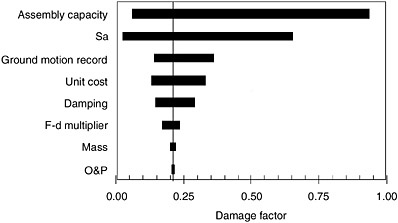 FIGURE 5.1 Results of a sensitivity study describing the relationship between building loss estimates and a number of variables. SOURCE: Porter et al. (2002). |
|
BOX 5.2 The results from loss estimation models are highly sensitive to the input distribution of ground shaking. Figure 5.2 is a scenario ShakeMap showing the distribution of shaking intensity in the northern California region for a hypothetical Mw 7.0 event in the Santa Cruz Mountains. The shaking intensity is symmetrical about the scenario fault rupture, and attenuates evenly with increasing distance from the fault. Loss estimates produced using this scenario shaking distribution are used for earthquake response planning, and—in the absence of seismic monitoring instruments to capture shaking data during an actual event in this region—these estimates would be used for real-time post-earthquake response. Figure 5.2 can be compared to Figure 5.3, showing the ShakeMap for the shaking intensity in northern California recorded in the 1989 Mw 6.9 Loma Prieta earthquake, with an epicenter in the same vicinity as that shown in Figure 5.2. Figure 5.3 shows that the recorded motion is not distributed symmetrically about the epicenter and the motion is significantly higher throughout the region. Loss estimates (and the post-earthquake response decisions based on those estimates) produced from the recorded shaking distribution shown in Figure 5.3 would be drastically different from those produced from the hypothetical shaking distribution shown in Figure 5.2. In fact, using HAZUS-99 (Service Release 2.0), the losses for Santa Cruz County (located in the epicentral region of the earthquakes shown in Figures 5.2 and 5.3) are significantly lower for the scenario (Figure 5.2) than the actual event (Figure 5.3). Tables 5.2 and 5.3 summarize the differences in direct building economic losses and casualties, respectively. Improved seismic monitoring will help improve loss estimation models by providing a more realistic distribution of ground shaking in actual events, and by providing data to develop models that more accurately predict regional distributions of ground shaking for scenario events. |
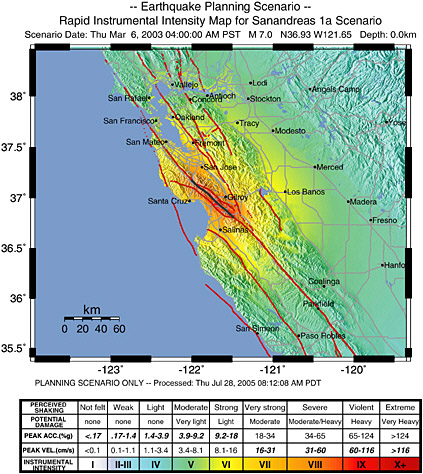 FIGURE 5.2 Scenario ShakeMap for a Mw 7.0 earthquake on the San Andreas Fault in the Santa Cruz Mountains. SOURCE: USGS internet output. See http://quake.usgs.gov/research/strongmotion/effects/shake/SanAndreas_1a_se/intensity.html. |
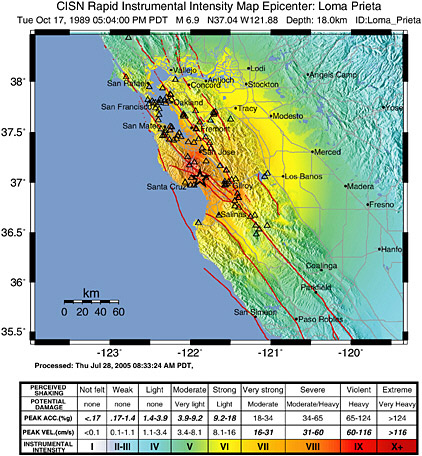 FIGURE 5.3 Actual ShakeMap for the Mw 6.9 1989 Loma Prieta earthquake. SOURCE: USGS internet output. See http://earthquake.usgs.gov/shakemap/nc/shake/Loma_Prieta/intensity.html. |
earthquake source—the primary sources of uncertainty in the loss estimation process.
In summary, improved seismic monitoring will increase the volume and quality of data available for use in loss estimation models, thereby reducing the uncertainty currently associated with such models. As a consequence, the output of loss estimation models will be more accurate and more acceptable to interested parties (including agency staff, industry managers, homeowners, etc.); be more usable for emergency planning and regulatory purposes; result in better building design, mitigation, and zoning; and result in increases in the amount of pre-event financing and pooling of the earthquake hazard, thereby reducing economic volatility and the crisis nature of post-event recovery.


