
3
Getting to 2020: Guiding Strategies
Our goal to ensure effective engineering education should be pursued within the context of a comprehensive examination of all relevant aspects of the interrelated system of systems of engineering education, engineering practice, the K-12 feeder system, and the global economic system. Engineering education must be realigned to promote attainment of the characteristics desired in practicing engineers, and this must be done in the context of an increased emphasis on the research base underlying conduct of engineering practice and engineering education. This will require that action be taken by key stakeholders, particularly engineering faculty and the engineering professional societies.
ENGAGE IN A COMPREHENSIVE EFFORT
Too many efforts at reform attempt to look at single elements of complex interconnected systems. We believe that entire systems must be considered, even if a narrower focus is ultimately taken. Thus, within the context of professional engineering practice, one must consider a system that includes at least the following elements:
-
the application of engineering processes to define and solve problems using scientific, technical, and professional knowledge bases;
-
engagement of the engineer and professionals from different disciplines in team-based problem-solving processes;
-
the tools used by the engineer and other technical professionals;
-
interaction of the engineer with the customer and engineering managers to set agreed-upon goals; and
-
the economic, political, ethical, and social constraints as boundary conditions that define the possible range of solutions for engineering problems and demand the interaction of engineers with the public.
Similarly, one must consider the several elements of the engineering education system, to include:
-
the teaching, learning, and assessment processes that move a student from one state of knowledge and professional preparation to another state;
-
students and teachers/faculty as the primary actors within the learning process;
-
curricula, laboratories, instructional technologies, and other tools for teaching and learning;
-
the goals and objectives of teachers/faculty, departments, colleges, accreditors, employers, and other stakeholders of engineering education;
-
the external environment that shapes the overall demand for engineering education (e.g., the business cycle and technological progress); and
-
a process for revising goals and objectives as technological advances and other changes occur.
Our goal is to reengineer engineering education. This reengineering focuses not on the enterprise’s organization, but on its products and services—in the present case, what higher education would define as its outcomes. Reengineering involves asking the questions: How can we make our processes more effective, more quality conscious, more flexible, simpler, and less expensive? It begins by identifying the desired outcome, product, or service, and then designing backward, using as design criteria what the outcome is supposed to look like and the nature of the processes used to produce it. Quality is measured in terms of both
the product (Did we meet our specifications?) and the process (Is it simple, integrated, efficient?). The desired outcomes should include an enhanced educational experience for engineering students, opportunities to pursue engineering as a liberal education, and, in the systems context, program changes and/or efforts by engineering educators that engage and support K-12 faculty, enhance public understanding of engineering, foster technological literacy of the public, and elevate the stature of the profession.
Two recent efforts at comprehensive innovation in engineering education are those launched by the National Science Foundation (NSF) Engineering Education Coalitions (EECs; SRI International, 2000) and the revision of the Engineering Accreditation Criteria by ABET, Inc. (ABET, 2004b). The EECs addressed program structure, curricular content, and pedagogy. Formal evaluations of the various coalitions have been mixed to negative in their judgments of their impact and effectiveness, noting in particular the difficulty of achieving large-scale adoption of the new educational materials developed by the EECs. In a sobering observation, given the desire to impact the education of the engineer of 2020, Froyd (see paper in Appendix A) suggests that it might take several decades for an EEC approach to succeed. On the other hand, comments from many participants in the EECs have been much more positive regarding their impact, noting that the EECs catalyzed a number of systemic changes including the early introduction of engineering and engineering design into the freshman/sophomore curriculum at many institutions and the adoption of continual assessment programs at the course, department, and college levels. They also lead to increased involvement of engineering faculty in the education of freshman and sophomore students; the use, for engineering faculty, of new pedagogical modes; and the introduction of programs such as reverse engineering or dissection.
With regard to ABET, it is noted that, in addition to addressing the traditional educational topics, the revised criteria place particular emphasis on the stakeholder goals and objectives as reflected in the institutional mission. ABET (2004a) also has recently begun exploring the role of accreditation in preparing engineers for working in diverse environments. However, ABET prohibits the accreditation of both a baccalaureate degree and a master’s degree in engineering programs with the same name. ABET should revisit this prohibition.
CONSIDER THE LINKAGES
The nature of engineering practice (e.g., the limited contact of most engineers with the public), the credentials required of engineering practitioners, and the structure and rigor of an engineering education vis-à-vis other baccalaureate or professional education programs all play a role in how the public perceives the status (or perceived status) of the engineering profession and individual engineers. In thinking about changes in engineering education, one should think about optimization in a systems sense, to include, for example, how the changes can enhance the stature of the profession.
Science had its origins in the work of scholars supported by wealthy patrons and in the personal work of wealthy aristocrats who looked to the stars to understand the origins of the universe and life or who were intrigued to understand the natural physical, chemical, or biological world around them. Engineering had its origins in the trades, in the effort to make and implement something useful, first for military purposes and later for civil purposes. The artifacts created, deployed, and repaired were made by craftsmen in military armories or tradesmen for the public, and the knowledge to do so was passed from generation to generation by an apprentice system. The forebears of the professional engineering societies were guilds designed to support and preserve this labor system. Although the artifacts produced, such as steam engines, rapidly became more complex than the output of the simple trades and required “engineers” to design and produce them, in some respects it has never been possible to dispel the notion that an engineer is but a highly trained tradesman. Indeed, today there are highly skilled technicians that maintain boilers, sanitation systems, and so on, who are commonly referred to as engineers and have no need of the science and mathematics education of the current engineering baccalaureate degree.
Formal engineering education eventually replaced the apprentice system and, early on, was based on engineering practice. With the increasing complexity of engineering problems, the basis of engineering education shifted to the fundamentals of science and mathematics (in the middle of the twentieth century in the United States). This led to engineers who were more capable and flexible and more able to bring better products to market more quickly, thereby immeasurably improving the standard of engineering practice. As time has progressed, however, a disconnect between engineers in practice and engineers in aca-
deme has developed and grown. The great majority of engineering faculty, for example, have no industry experience. Industry representatives point to this disconnect as the reason that engineering students are not adequately prepared, in their view, to enter today’s workforce.
It is noteworthy that, for over a century, engineering has adhered to the notion that four years of education is all that is needed to become an engineer. Perhaps reflecting its apprenticeship origins, engineering education appears designed to get graduates into gainful employment, primarily in industry, as fast as possible.1 Other professions have recognized the inadequacy of this approach (see Figure 3-1). Indeed, because of the educational practice in those professions, there is a perception that one becomes a “professional” following two, three, or more years of education beyond the baccalaureate degree, which is the degree most engineers hold. Thus, it is not so surprising, perhaps, that engineers do not feel that the public values their “professional” status. To this point, data collected for the American Association of Engineering Societies by Harris Interactive (NAE, 2002, p. 11) indicate that scientists continue to be held in higher regard than engineers. In a survey, 55 percent of respondents indicated that scientists had “very great prestige,” whereas 34 percent indicated the same for engineers. This level of appreciation for engineers was constant from 1977 to 1998, a performance that Harris rated as “consistently mediocre.” Engineers in academe enjoy the personal and professional prestige of their academic environment (in the same 1998 Harris Poll, educators labeled as “teachers” rated at 53 percent), so the prestige of the engineering profession may have a less visceral concern for them, but they can and should play a role in designing an engineering education infrastructure that will enhance the prestige of the profession.
The professional engineering societies addressed this problem early on by creating “professional” engineers who are licensed by examination. This was largely the outgrowth of civil engineering and reflects a need for the public to know whether an engineer they are dealing with on a project is competent. However, with the rise of large corporations, who felt capable of judging competence for themselves and who were
|
1 |
The data show that almost 85 percent of baccalaureate recipients are employed by private, for-profit firms. See Table 4 in http://www.nsf.gov/sbe/srs/infbrief/nsf04316/start.htm. |
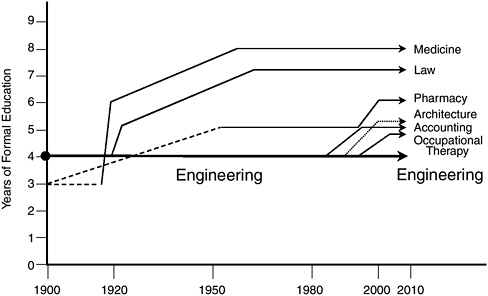
FIGURE 3-1 Years of formal postsecondary education required to begin practicing in different fields. SOURCE: Russell et al. (2001).
more than willing to employ unlicensed engineers and train them in the specific needs of their business, the bachelor’s degree became and remains the overwhelmingly dominant ticket for practicing engineering.
It is unreasonable to expect that corporations will require more than a four-year engineering degree for entry-level employment, and thus it is unreasonable to expect that engineering schools will only graduate five-year (or more) degree students. If, as in the past, some schools move to a mandatory five-year program, students will flock to those schools that do not. Similarly, it is unreasonable to expect that professional licensure requirements will change in some way to become attractive to most baccalaureate engineers. Thus, other things being equal, we believe that engineering schools and professional societies need to look to other ways that reinvention of engineering education can enhance the perception of engineering as a profession. A possible alternative is the master’s degree, in particular, one that can be designed to be accredited and universally recognized and promoted by both schools and societies as a “professional” degree, perhaps along the lines of a more technology-based MBA. That degree will clearly have to provide value in the marketplace if large numbers of engineers are likely to commit to the time and expense to acquire it.
FOCUS ON LEVERS FOR CHANGE
A factor underlying the systems of engineering practice and engineering education is that the engineering profession has a trans-organizational character. That is, practicing engineers seek to maintain a professional identity that they can carry with them, irrespective of who is their current employer. Membership in professional societies and adherence to professional codes of ethics codified by such societies provide a means to achieve these ends. Professional societies are seen as the primary avenues through which engineers support their identities as professionals, identify opportunities for continuing professional education, and collectively communicate their views on issues affecting their profession to the policy community (Denning, 2001). Professional societies are also key portals through which knowledge is diffused to members of a profession (Hall, 2003). It is through this close connection to their members that professional societies can play an important role in advising on changes in the engineering education system.
Engineering faculty, of course, will be on the front line of any change, and encouraging and enlisting their support for engineering education innovations is essential. Providing incentives for their support is challenged by the present faculty reward system, which bases decisions for tenure primarily on excellence in research. The nation has benefited enormously from the efforts of research universities, through their research faculty and Ph.D. programs, but this has not necessarily translated into excellence in undergraduate education. In a 1998 study, fully 98 percent of students switching from engineering to another major cited poor teaching as a major reason for their departure; 81 percent cited inadequate advising (Adelman, 1998). Thus, increased attention to teaching, to how students learn, and to student mentoring is important for enriching the undergraduate experience. To effect such changes, one must engage engineering faculty leaders, including deans, department chairs, and individual faculty in consideration of how to reward attention to and excellence in such activities.
The other major players in the engineering education system are, of course, the students, who are the “consumers” seeking preparation to enter the profession and, in some sense, are the “products” of the educational system. As consumers, students should be participants in the educational processes. Much has been written about the responsibility that students need to take for their own education and careers. Efforts to help them do so, however, frequently devolve to attempts to “fix” their
skills and habits so that they can work within existing systems rather than fixing the systems. Students have a role to play, but fixing the system is not a problem solely, or even primarily, within their domain to correct.
In addition to engaging these “direct” levers for change, the impact of the Engineer of 2020 initiative will also depend on how well it engages the perspectives, imagination, and energies of the broader spectrum of persons who can help in designing, implementing, and assessing systemic change to create an American engineering enterprise in 2020 that will truly serve the interests of society. These include young people who are the rising engineering leaders; those responsible for career development in industry and government; practitioners from multiple disciplines and fields of inquiry beyond engineering; experts in learning theory and colleagues from the learning sciences; those with professional expertise in fields of ethics, communication, and leadership theory; iconoclasts within and beyond engineering, skeptical about the potential of technologies; and those pioneers already mounting programs to change the profession, the practice of engineering, and the environment in which students discover the essence of engineering and are motivated to become engineers.
PURSUE STUDENT-CENTERED EDUCATION
One should address how students learn as well as what they learn in order to ensure that student learning outcomes focus on the performance characteristics needed in future engineers. Two major tasks define this focus: (1) better alignment of engineering curricula and the nature of academic experiences with the challenges and opportunities graduates will face in the workplace and (2) better alignment of faculty skill sets with those needed to deliver the desired curriculum in light of the different learning styles of students.
Engineering professional societies have recognized this challenge and are actively engaged in efforts to create better alignment between academic experiences and anticipated future workplace requirements. For example, various engineering societies are revisiting the bodies of knowledge that should be expected of professionals in their disciplines, including civil (ASCE, 2004) and chemical engineering (Lidtke et al., 2004), computer engineering (IEEE, 2004), and mechanical engineering (Laity, 2004). Engineering professional societies and university fac-
ulty also have come together recently to improve the quality and effectiveness of instruction and student learning. The American Institute of Chemical Engineers, the American Society of Civil Engineers, the American Society of Mechanical Engineers, and the Institute of Electrical and Electronics Engineers are collaborating to offer “Excellence in Engineering Education” teaching workshops for engineering faculty.2
DEVELOP A RESEARCH BASE
The National Science Board has observed that
The organizational structures and processes for educating, maintaining skills, and employing science and engineering talent in the workforce are diverse and their interrelationships complex and dynamic. As a result, production and employment of scientists and engineers are not well understood as a system. (NSB, 2003, p. 26)
Moreover, the system is evolving. Rosalyn Williams, historian of science and technology, has asserted that engineering is undergoing a transformative evolution as a profession. The most fundamental engineering processes remain the same (design, development, and so on), but the domains of application are rapidly expanding. We need to develop enhanced understanding of models of engineering practice in this evolving environment (Williams, 2003). The medical community offers an example of the development of such models (Council on Graduate Medical Education, 1999) and nascent efforts exist in the engineering community (see, e.g., description of a seminar sponsored by the University of Western Australia Faculty of Engineering, Computing and Mathematics3 and Auyang [2004]). Although progress is being made, much remains to be done in developing the research base underlying best practices in engineering education (Wankat et al., 2002) and faculty professional practice generally (Arreola et al., 2003).4
|
2 |
ExcEED Teaching Workshops for Engineering Faculty. Available online at http://www.asme.org/education/prodev/teach/. |
|
3 |
Professional Engineering Skills Research. Available online at http://www.mech.uwa.edu.au/jpt/pes.html. |
|
4 |
Beyond characterizing the system, a key challenge is to understand the roles of the various stakeholders. See Siller and Johnson (2004). |
The growing body of research about how students learn can serve as a guide and check at each stage of the work of transforming the undergraduate learning environment. Past attempts toward reforming engineering education—whether in individual courses or programs or on individual campuses—have been informed primarily by the opinions and experiences of those leading these efforts. What “works” has been intuitively felt, rather than based on a body of carefully gathered data that provide evidence of which approaches work for which students in which learning environments. Without such data, engineers, and their colleagues in the scientific community, have found it difficult to evaluate claims, for example, about the effectiveness of emerging pedagogies or the impact of information technologies on strengthening student learning. Unlike the technical community, wherein data-driven results from one lab have widespread impact on the work of peers, many educational reformers have not incorporated research on learning into their work.
The publication of How People Learn by the National Research Council (NRC, 1999) was a seminal event in the educational community. It outlined clearly the advances in understanding learning theory achieved by researchers in the learning sciences. Engineering educators should be guided by these findings in order to design and conduct educational research to address critical issues related to broadening participation, improving retention of majors, creating courses for non-majors, and designing an alternative engineering degree for those students interested in careers and public service opportunities outside traditional engineering employment. By focusing on research on learning, we will be able to understand:
-
how to serve students with different learning styles;
-
why specific approaches and pedagogies work, for example, how research as undergraduates serves learning goals such as personal development, knowledge synthesis, development of skills such as data collection and interpretation, design and hypothesizing, information literacy/computer literacy, and teamwork;
-
how to help students clarify, refine, and confirm their career goals and enhance their preparation for career/graduate school, if appropriate;
-
how to help them become responsible lifelong learners;
-
how information technology can support student learning; and
-
how they can best learn the specific skills required for the practice of engineering in the twenty-first century.
COMMUNICATE, COMMUNICATE, COMMUNICATE
A strategy for realigning engineering education must be developed within the contexts of understanding the elements of engineering and recognizing the importance of constant communication with the public and engineering community stakeholders on the goals of education reinvention and the value of success. Communications across the engineering education establishment, which is both a community of common interests and a community of competitors, have been spotty at best, and communications between engineering schools and the public have been lacking as well. The engineering community has shown much interest in enhancing public awareness of engineering and has pursued a wide variety of approaches, including those that communicate to the public the ubiquity of “engineering systems,” the role of engineers in the realization of those systems, and the education requirements for such work (NAE, 2002; Constable and Somerville, 2003), but such efforts have not been particularly successful (NAE, 2002). Thus, as noted earlier, the public has little understanding of the nature and value of an engineering education and how changes might make it a more attractive option for their sons and daughters. Communications at both levels must be enhanced as a key element in promoting systemic change of engineering education.
Surveys of precollege students have consistently shown great interest in meaningful career fields tied to “helping others” (Taylor Research & Consulting Group, 2004). Thus, it would be particularly helpful if the engineering community could successfully communicate the social context of engineering—how engineering has made enormous contributions to our quality of life—and the social responsibilities of engineers beyond just taking care to exercise their skills responsibly. Several authors have suggested altering engineering education to explicitly make such connections (COSEPUP, 1995; Schacterle, 1997; Winchester, 1997; Barke et al., 2001). One indication of the failure of the engineering community to communicate this message is provided in Table 3-1, which shows that only 35 percent of college students believe an engineering career is “worth the extra effort.” It is both perplexing and disappointing that college students, who presumably have or should have a
TABLE 3-1 Student Perceptions of Professional Careers
|
Professions |
High Opinion, % |
Careers “worth the extra effort,” % |
||
|
High School Students |
College Students |
High School Students |
College Students |
|
|
Doctors |
78 |
85 |
90 |
92 |
|
Lawyers |
45 |
38 |
71 |
77 |
|
Teachers |
66 |
83 |
70 |
81 |
|
Engineers |
58 |
72 |
68 |
35 |
|
Accountants/CPA |
30 |
36 |
40 |
47 |
|
SOURCE: Taylor Research & Consulting Group (2000). |
||||
better understanding of the nature of engineering than high school students, have a higher opinion of engineers than high school students have, but are much less likely to believe an engineering career is worth the extra effort.
It is also important for the engineering community to better communicate, in an increasingly technological society, the value of engineering training for a variety of tasks/challenges not typically considered within the boundaries of “traditional” engineering. NSF (1998) data show that there are 2.2 million people with degrees in engineering, and of those, 1.0 million indicate that their principal occupation is not engineering. The value of a broad engineering education, to include, for example, business and communications expertise, for those who aspire to management can be deduced from the NSF data in Figure 3-2, which show that, “among master’s-level engineering graduates in the private for-profit sector (where most engineering graduates work), those who have combined their engineering degree(s) with a degree outside science or engineering are more likely to become senior managers (someone responsible for leading others in management) at some point in their career” (NSF, 1998).
Similarly, it is important to help the public understand the breadth of engineering as well as its depth. Many consider engineering to involve, among other things, the application of scientific principles to the solution of human challenges. For a long time the scientific principles of interest were those of the physical sciences. Recent advances in the
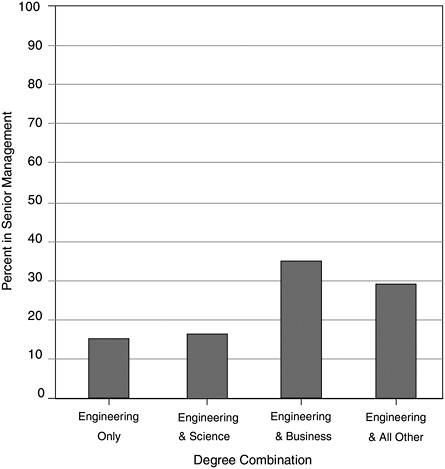
FIGURE 3-2 Likelihood of being in senior management of master’s level engineering graduates in the private sector, by degree combination, 1995.
NOTE: Master’s degrees may be in any field, any degree combinations imply neither order of degree fields nor number of degrees earned. In this figure, social sciences are included in “other.”
SOURCE: NSF (1998).
fields of information technology and the life sciences have led to increasing exploration of engineering as an application of these separate, yet related, sciences. Engineering education options open to students are thus expanding, and communicating the nature of those options is essential to attracting the most talented students.
REFERENCES
ABET, Inc. 2004a. Proceedings of the 2004 ABET Annual Meeting: Competing in a Diverse World. Baltimore, Md.
ABET, Inc. 2004b. Sustaining the Change. Available online at http://www.abet.org/Linked%20Documents-UPDATE/White%20Papers/Sustaining%20the%20Change-Web.pdf. Accessed May 19, 2005.
Adelman, C. 1998. Women and Men of the Engineering Path: A Model for Analysis of Undergraduate Careers. Washington, D.C.: U.S. Department of Education.
Arreola, R., M. Theall, and L. Aleamoni. 2003. Beyond Scholarship: Recognizing the Multiple Roles of the Professoriate. Presented at the 2003 American Educational Research Association convention. Available online at http://www.cedanet.com/meta/Beyond%20Scholarship.pdf. Accessed April 19, 2005.
ASCE (American Society of Civil Engineers). 2004. Civil Engineering Body of Knowledge for the 21st Century. Reston, Va. Available online at http://www.asce.org/professional/educ/bodyofknowledge.cfm. Accessed April 3, 2005.
Auyang, S. 2004. Engineering: An Endless Frontier. Cambridge, Mass.: Harvard University Press. Web site supplement available online at http://www.creatingtechnology.org/eng.htm. Accessed July 7, 2005.
Barke, R., E. O. Lane, and K. Knoespel. 2001. Shaping the Future of American University Education. Prepared for the 4th POSTI International Conference, Europe’s 21st Century Politics for Sustainable Technological Innovation: The Role of Higher Education in Science, Technology, and Society, May 20-21, Oslo, Norway. Available online at http://www.esst.uio.no/posti/workshops/barke.pdf. Accessed July 8, 2005.
Constable, G., and B. Somerville. 2003. A Century of Innovation: Twenty Engineering Achievements That Transformed Our Lives. Washington, D.C.: Joseph Henry Press.
COSEPUP (Committee on Science, Engineering, and Public Policy). 1995. Reshaping the Graduate Education of Scientists and Engineers. Washington, D.C.: National Academy Press. Available online at http://books.nap.edu/books/0309052858/html/4.html#pagetop. Accessed July 8, 2005.
Council on Graduate Medical Education. 1999. Physician Education for a Changing Healthcare Environment. Washington, D.C.: U.S. Department of Health and Human Services, Health Resources and Services Administration. Available online at http://cogme.gov/13.pdf. Accessed July 7, 2005.
Denning, P. 2001. “When IT Becomes a Profession.” Pp. 295-325 in The Invisible Future. New York: McGraw-Hill. Available online at http://cne.gmu.edu/pjd/PUBS/WhenITProf.pdf. Accessed May 4, 2005.
Hall, P. 2003. “A Historical Overview of Philanthropy, Voluntary Associations, and Nonprofit Organizations in the United States, 1600-2000.” In W. W. Powell and R. Steinberg, eds., The Nonprofit Sector: A Research Handbook—Second Edition. New Haven, Conn.: Yale University Press. Available online at http://ksghome.harvard.edu/~phall/Powell%20Essay-Final%20-%20rev.pdf. Accessed April 19, 2005.
IEEE (Institute of Electrical and Electronics Engineers). 2004. A Report on the Model Curriculum for Computer Engineering, Session F3B. Frontiers in Education 34th Annual Conference. Available online at http://fie.engrng.pitt.edu/fie2004/papers/1189.pdf/. Accessed April 19, 2005.
Laity, W. 2004. A Vision for the Future of Mechanical Engineering Education. Available online at http://www.asme.org/education/enged/pdf/vision.pdf. Accessed April 18, 2005.
Lidtke, D., R. Seagrave, and S. Walesh. 2004. Defining the body of knowledge. ABET Communications Link (Fall/Winter 2004): 20–22. Available online at http://www.abet.org/Linked%20Documents-UPDATE/Newsletters/Fall-Winter-2004.pdf. Accessed May 19, 2005.
NAE (National Academy of Engineering). 2002. Raising Public Awareness of Engineering. Washington, D.C.: The National Academies Press.
NRC (National Research Council). 1999. How People Learn: Brain, Mind, Experience, and School. Washington, D.C.: National Academy Press.
NSB (National Science Board). 2003. The Science and Engineering Workforce: Realizing America’s Potential. Report 03-69. Arlington, Va.: National Science Foundation. Available online at http://www.nsf.gov/nsb/documents/2003/nsb0369/nsb0369.pdf. Accessed July 8, 2005.
NSF (National Science Foundation). 1998. Degrees and Occupations in Engineering: How Much Do They Diverge? Science and Engineering Statistics Issue Brief NSF 99-318. Available online at http://www.nsf.gov/statistics/issuebrf/ib99318.htm. Accessed July 8, 2005.
Russell, J. S., B. Stouffer, and S. G. Walesh. 2001. Business Case for the Master’s Degree: The Financial Side of the Equation. Pp. 49-58 in Proceedings of the Third National Education Congress, Civil Engineering Education Issues, D. E. Hancher, ed. Reston, Va.: American Society of Civil Engineers.
Schacterle, L. 1997. A Liberal Education for the 2000’s. Presented at the ASEE/IEEE Frontiers in Education Conference. Available online at http://fie.engrng.pitt.edu/fie97/papers/1463.pdf. Accessed May 4, 2005.
Siller, T. J., and G. R. Johnson. 2004. Constituent Influences on Engineering Curricula. Proceedings of the 2004 American Society for Engineering Education Annual Conference & Exposition. Washington, D.C.: American Society for Engineering Education. Available online at http://www.asee.org/acPapers/2004-1680_Final.pdf. Accessed July 7, 2005.
SRI International. 2000. Progress of the Engineering Education Coalitions. Prepared for the National Science Foundation. Available online at http://www.nsf.gov/pubs/2000/nsf00116/nsf00116.doc. Accessed July 8, 2005.
Taylor Research & Consulting Group (2004). Student and Academic Research Study: Final Quantitative Study. New York: American Institute of Public Accountants. Available online at http://www.aicpa.org/members/div/career/edu/taylor.htm. Accessed July 8, 2005.
Wankat, P. C., R. M. Felder, K. A. Smith, and F. S. Oreovicz. 2002. The Engineering Approach to the Scholarship of Teaching and Learning. Pp. 217-237 in Disciplinary Styles in the Scholarship of Teaching and Learning: Exploring Common Ground , M. T. Huber and S. Morreale, eds. Washington, D.C.: American Association for Higher Education. Available online at http://www.ncsu.edu/felder-public/papers/Scholarship_chapter.pdf. Accessed July 8, 2005.
Williams, R. 2003. Education for the Profession Formerly Known as Engineering. The Chronicle of Higher Education, Volume 49, Issue 20, p. B12, January 24, 2003. Available online (subscription required) at http://chronicle.com/weekly/v49/i20/20b01201.htm. Accessed July 7, 2005.
Winchester, I. 1997. Engineering as a Liberal Art. Presentation to the Schulich School of Engineering, University of Calgary. Available online at http://www.eng.ucalgary.ca/dean_series/libart1.htm. Accessed July 8, 2005.


