
4
Guideposts to the Future
There are a variety of mechanisms and specific programs that have been investigated and/or developed to affect changes in education in general, and engineering education in particular. Some examples of these are discussed below.
COLLABORATIONS
The difficulty of effecting change duly noted, there are, perhaps, some advantages now over past attempts to transform undergraduate engineering. For example, there is a wide range of collaborations already in place—some sponsored by federal agencies such as the National Science Foundation (NSF); others sparked by industry, foundations, and/or professional associations; and others engaging global partners. These collaborations demonstrate that there are effective means for building the kinds of formal and informal relationships needed to effect systemic change. From these collaborations, we can learn about the processes of collective goal setting; of designing, implementing, and assessing curricular and pedagogical approaches; and of using technologies to enhance learning. There are also lessons learned about how to, or how not to, adapt innovations and reforms in different settings, on campuses with different missions and circumstances. The experiences of departments and institutions involved in the NSF-funded Engineering Coalitions, the most recent Grand Challenges effort, and in the
Whitaker Foundation-funded development of biomedical engineering programs, as well as efforts on individual campuses exploring the wide range of experimentation enabled by ABET and its accreditation criteria, must be captured, distilled, and disseminated as “lessons learned” to the broader community. Where those efforts have had mostly local impact, the challenge is to promulgate their successes to other locales and, where appropriate, to coalesce their efforts on a national scale.
The Engineer of 2020 initiative does not assume that there is one right way to transform the learning environment; we recognize that we must understand and capitalize on the treasure that is the diversity of American higher education. Through this initiative, by 2020, engineering programs across the country might be designed for specific areas of distinction, perhaps serving the regional industrial community, perhaps linking to institutional objectives to infuse a global dimension into the undergraduate learning environment, perhaps focusing on a particular thrust within engineering, and/or spotlighting the development of leaders for the engineering profession. We recognize that support will be needed at the local level for adapting the work of others; that campus leaders must exercise leadership to shape an agenda for action that makes sense for them, given their mission, circumstances, and vision of the future. Success will require asking the right questions at each stage of the process and continually revisiting those questions in the context of the answers returned—creating, articulating, and driving a vision to implementation.
TECHNOLOGIES FOR COLLABORATION
In addition to the experience of many active collaborations, another significant advantage over past efforts is in the electronic technologies that enable sharing of ideas, materials, and other resources relating to the transformation of individual courses or labs, departments, programs, or institutions. It will be important to approach this sharing of information systematically, integrating the identification, analysis, and dissemination of appropriate data and best practices into each stage of course, curriculum, and laboratory transformation.
RELATED EFFORTS
A fortuitous leverage point for realizing our goals to reengineer undergraduate engineering by 2020 is that the engineering community can learn from the experiences of individuals and institutions working to transform undergraduate programs, within and beyond STEM (science, technology, engineering, and mathematics). Leaders in other sectors, professions, and disciplines are similarly examining societal and educational trends that affect learning in their fields. The undergraduate physics community, for one, has worked for decades to establish goals for student learning and to develop inventories that monitor progress toward realizing those goals in individual classes, programs, and departments.1 So, collaborations within a campus—across disciplinary boundaries, engaging pedagogical pioneers—extend opportunities for sharing best practices beyond the community of engineering educators, for learning what works, for example, in building interdisciplinary teams, in serving students from groups currently underrepresented in the study and practice of STEM fields, and in bringing real-world concerns into a discovery-based learning environment.
STEM fields are all dealing with the same trends that are redefining the undergraduate learning environment, including:
-
the awareness that exposure to science, mathematics, technology, and engineering during their undergraduate career is good preparation for a “wide variety of societal roles; and that the nation will depend increasingly on a citizenry with a solid base of scientific and technical understanding” (Center for Science, Mathematics, and Engineering Education, 1996, p. 4);
-
the momentum toward integrating research and education so that all students have access to discovery-based, problem-solving learning experiences;
-
the dissolution of boundaries between disciplines such that “imagination, diversity, and the capacity to adapt quickly have become essential qualities for both institutions and individuals, not only to facilitate research, but also to ensure the immediate and broad-based application of research results related to the environment. To meet these complex challenges as well as urgent human needs, we need to … frame integrated interdisciplinary research questions and activities and to merge data, approaches, and ideas across spatial, temporal, and societal scales” (AC-ERE, 2003);
-
the efforts of the learning sciences community and researchers in specific disciplines exploring how people learn that are providing a solid theoretical foundation for designing, implementing, and assessing new approaches to transform undergraduate education—course by course and program by program, as well as at the institution-wide level—to enhance student learning (NRC, 1999);
-
external pressures for accountability that call for greater stewardship over the quality and character of learning—requiring a clearly defined mission, explicit educational goals, and documented progress toward meeting those goals (ABET, 2005, p. 1);
-
student demographics, with greater diversity from the perspectives of academic preparation, career aspirations, and ethnic background that require approaches to learning, teaching, and research designed intentionally to respect (and celebrate) this diversity;
-
faculty demographics—a pattern of heavy retirements now underway and anticipated in the immediate future affords an opportunity to reconsider preparation of incoming faculty, including consideration of what kinds of skills they will need and what rewards and incentives will be offered for their scholarly efforts;
-
economic pressures to use resources as efficiently as possible to serve agreed-upon priorities; and
-
opportunities afforded by new technologies to transform the learning environment:
Powerful new technologies now under development by U.S. businesses, universities, and government promise to transform virtually every industry and many human endeavors. These technologies could possibly also be harnessed to transform education and training in ways previously unimaginable. Rapid advancements in the years ahead could enable new learning environments using simulations, visualizations, immersive environments, game playing, intelligent tutors and avatars, networks of learning, reusable building blocks of content, and more. The technologies that are coming could create rich and compelling learning opportunities that meet all learners’ needs, and provide knowledge and training when and where it is needed, while boosting the productivity of learning and lowering its cost. (Evans, 2002, p. ii)
SPECIFIC PROGRAMS AND MECHANISMS
The discussions presented under this heading are intended to present some examples of efforts to improve engineering education, not a comprehensive review. In the context of thinking of engineering as a system of systems, it provides examples related to K-12 preparation, increasing retention in engineering programs, attracting students from underrepresented groups, entrepreneurship, technology-enabled learning, program flexibility, reconsidering what an “engineering education” means, and preparation of engineering faculty. Although most of these examples deal with the “efficiency” and “throughput” of engineering education, these approaches also serve to develop skills that industry has repeatedly stated are necessary for performing well.
The K-12 System and Engineering Education
Several individuals commented at the summit that the current K-12 system does not provide a sufficiently rigorous education to large numbers of students, particularly in the inner-city schools, to allow them to enter and succeed in an engineering program. As a community, engineering educators are working to assist the K-12 community to understand the engineering profession and how engineering activities can invigorate the teaching of mathematics and science in the K-12
classrooms. Many programs are actively engaging K-12 districts and faculty across the country; however, there are several that stand out with respect to their growth in number of schools, connection to state education standards, and support from stakeholders. Following is a brief description of some of these notable programs:
Project Lead the Way (PLTW) was initiated by Richard Blais in the 1980s while he was chairman of the technology department of an up-state New York school district. Partnerships with private philanthropy and the Rochester Institute of Technology (the program’s first national training center) allowed the program to grow into a national organization with 22 institutions of higher education supporting schools in over 40 states that institute some or all of PLTW’s middle school and high school curricula of hands-on, problem-based, technology-driven learning.2
The Infinity Project was developed in the late 1990s by a national team of engineering educators led by Geoffrey Orsak at Southern Methodist University that had as its goal to help “students see the real value of math and science and its varied applications to high-tech engineering.”3 With strong support from Texas Instruments and state and national government, the Infinity curriculum has demonstrated tremendous growth in Texas high schools and is in place in 80 schools in 21 other states.4 Precourse and postcourse surveys of student attitudes have shown a significant growth in student interest in pursuing an engineering degree, with nearly 80 percent of students indicating a “very strong interest” in pursuing engineering.5
Massachusetts K-12 Engineering Standards were instituted in 2001 and provide K-12 educators with guidelines for age-appropriate inquiry-based learning. The frameworks also provide students with an introduction into the ways in which engineering/technology is related to, but substantially different from, the field of science—“Technology/engineering seeks different ends from those of science.” The outcomes of science
can be defined simplistically as observation, experimentation, and documentation that allows for generalized statements concerning patterns in nature. Conversely, “engineering strives to design and manufacture useful devices or materials, defined as technologies, whose purpose is to increase our efficacy in the world and/or our enjoyment of it” (Massachusetts Department of Education, 2001, p. 3).
NSF is supporting the development of the National Science Digital Library (NSDL) to provide “educational resources for science, technology, engineering and mathematics education.”6 One of the collections being funded through the NSDL program is called TeachEngineering.com. This collaboration consists of engineering educators at several Research-Extensive7 institutions that were previously awarded grants in NSF’s Graduate Teaching Fellows in K-12 Education program.8 The project brings together the knowledge and content created by these separate efforts, gives the content materials a “common look and feel,” and provides a system architecture that allows K-12 teachers to search the collection in a variety of ways (subject matter, content domain, grade level, national standards, and selected state standards). The goal of TeachEngineering is to rapidly build on the number of curricular units in the collection and to map all content to standards of all 50 states.9
These efforts and others represent real progress in changing the public understanding of engineering and should, over time, begin to enhance the recruitment of students into engineering who are knowledgeable of the field and prepared academically for its rigors. The goal for higher education is to connect these students to a curriculum that is challenging, exciting, and relevant to student interests. Summit attendees advocated for a curriculum designed around grand challenges that would serve to engage and inspire students in a way that makes the engineer’s contribution to society more explicit.
|
6 |
|
|
7 |
These institutions typically offer a wide range of baccalaureate programs, and they are committed to graduate education through the doctorate. During the period studied, they awarded 50 or more doctoral degrees per year across at least 15 disciplines. From http://www.carnegiefoundation.org/Classification/CIHE2000/defNotes/Definitions.htm. |
|
8 |
A description and solicitation are available online at http://www.nsf.gov/funding/pgm_summ.jsp?pims_id=5472&from=fund. |
|
9 |
Jacquelyn Sullivan, Lead Principal Investigator of TeachEngineering.com, personal communication, January 4, 2005. |
Retention
The ABET EC2000 criteria (ABET, 2005) and the Engineer of 2020 Phase I Report (NAE, 2004) reflect a desire to produce engineers with technical competence and a broader array of “professional skills” than the traditional curriculum seeks to develop. At the same time, engineering educators and American industry have been working to create systems that lead to improved retention of students and broader participation of women and minorities. Fortunately, these goals are not incompatible with one another, and institutions have experimented with a variety of approaches to realign the traditional curriculum and to enhance student support mechanisms to meet them. Some notable examples are briefly described below.
Only 40 to 60 percent of entering engineering students persist to an engineering degree, and women and minorities are at the low end of that range. These retention rates represent an unacceptable systemic failure to support student learning in the field. (See Bennett Stewart’s comments in Appendix B; also see Seymour and Hewitt, 1997.) To address this issue, it is becoming increasingly recognized that it is important to introduce engineering activities, including team-based design projects and community service projects, early in the undergraduate experience alongside basic science and math courses, so that students begin to develop an understanding of the essence of engineering as early as possible. For example, the impact on retention of a First Year Engineering Projects (FYEP) course was documented by Knight et al. (2003) of the University of Colorado at Boulder and is summarized in Figure 4-1.
One of the earliest curricular interventions to introduce engineering activities at the beginning of the curriculum was led by Eli Fromm of Drexel University. Working with a team that encompassed faculty members from across the entire institution, the new college of engineering curriculum was “organized into four interwoven sequences replacing and/or integrating material from 37 existing courses in the university’s traditional lower division curriculum” (Fromm, 2002). These vertically integrated sequences, which included substantial early engineering laboratory experiences, resulted in improved retention (21 percent increase) of students in the trial cohort and an even greater increase in the rate of on-time graduation (50 percent increase). The Drexel curricular approach was successfully replicated by the Gateway Coalition members during the 1990s.
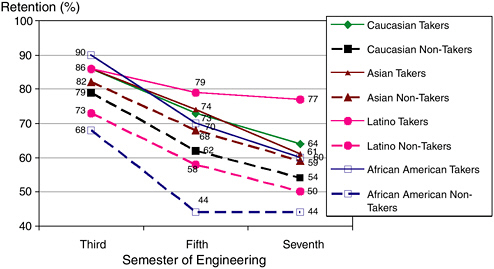
FIGURE 4-1 Long-term retention rates of students taking freshman design course (“Takers”) compared to students that did not (“Non-Takers”). The data total 2,581 students with 1,035 students who took the FYEP course and 1,546 students who did not take the course. The sample includes 2,057 men and 524 women with 2,063 Caucasian students (80%), 190 Asian students (7.4%), 160 Latino students (6.2%), and 35 African American students (1.4%). SOURCE: Knight et al. (2003).
An example of a scheme for introducing design activities is illustrated by the curriculum of Olin College of Engineering (see paper by Kerns et al. in Appendix A), which was developed by the faculty with feedback from a cohort of 30 students who were part of Olin’s initial class. The system that Olin’s faculty developed includes roughly 20 percent design activities in the first year, with the design tasks constructed in such a way that deep content knowledge of materials/engineering principles is less necessary than use of tools (software packages, rapid prototyping equipment) and the application of creativity. By the final year, students are engaged in design activities roughly 80 percent of the time, and greater content knowledge is expected. Note that these design experiences are in both team and individual settings and that students are often responsible for self-directed learning—and teaching their fellow students—in areas that will support a more effective and innovative design solution.
A separate approach to introducing design into the curriculum is modeled by what is known as “service learning” or “experiential learning.” The Engineering Projects in Community Service (EPICS) pro-
gram at Purdue has shown tremendous success in its 10 years of existence. EPICS projects are designed to engage students from engineering and other disciplines in activities to support community-based organizations that serve community needs in social services, education, and the environment. These projects, which can begin in the freshman year and may continue to graduation, allow students to design, build, deploy, and maintain engineered solutions in response to customer needs. By engaging with the community, students quickly understand how engineers contribute to society and learn how the scientific and technical courses they are taking contribute to innovative solutions to real-world challenges. In the process, students strengthen skills related to customer relations, problem analysis and definition, communication, teamwork, and designing/building/testing their solutions.10 Industry has recognized the promise of the EPICS approach by supporting new EPICS programs at seven institutions nationally, and members of the NSF-sponsored Corporate and Foundation Alliance have partnered with the NSF Division of Engineering Education and Centers to foster the spread of service learning as a means to broaden participation and increase retention.11
Specifically regarding the low retention rates (and low enrollment) of women in engineering programs, the NSF Women’s Experiences in College Engineering Project conducted extensive data-gathering surveys of students, administrators, and faculty to determine the program components and support mechanisms that produce higher retention rates. Early exposure to the design, build, and test process that marks the practice of engineering was found to be important. Additionally, those who persist in engineering point to such positive factors as Women in Engineering programs, woman-only courses that teach skills such as tool use and computer graphics that help bridge some skill gaps, and advisors—particularly in freshman and sophomore years—who help to provide information, encouragement, and a welcoming environment (Goodman et al., 2002).
Diversity
In her comments at the summit, Shirley Ann Jackson stressed the need to broaden the participation of underrepresented minorities in engineering and cited a BEST (2004) report that examined programs across the country that have been working to increase diversity in STEM fields and recognized that there were common characteristics at successful institutions. These characteristics are summarized in Table 4-1.
A particular example of a program to increase diversity is one developed by the Georgia Institute of Technology (May and Chubin, 2003). In cooperation with historically black colleges and universities (HBCU) in the Atlanta area, Georgia Tech has created a dual-degree engineering program that is graduating 30 to 40 African American engineers per year out of a total of about 130 African American engineering graduates each year (best in the United States for a non-HBCU). Another program is the partnership between the University of California at Los Angeles (UCLA) and the Hewlett-Packard (HP) Company to deploy
TABLE 4-1 Design Principles to Expand Higher Education Capacity
|
Principle |
Evidence |
|
Institutional leadership |
Commitment to inclusiveness across the campus community |
|
Targeted recruitment |
Investing in and executing a feeder system, K-12 |
|
Engaged faculty |
Developing student talent as a rewarded faculty outcome |
|
Personal attention |
Addressing, through mentoring and tutoring, the learning needs of each student |
|
Peer support |
Providing student interaction opportunities that build support across cohorts and allegiance to institution, discipline, and profession |
|
Enriched research |
Providing beyond-the-classroom hands-on opportunities and summer internships that connect experience to the world of work |
|
Bridging to the next level |
Building institutional relationships that help students and faculty to envision pathways to milestones and career development |
|
Continuous evaluation |
Ongoing monitoring of process and outcomes that guide program adjustments to heighten impact |
the Diversity in Education Initiative in the city of Los Angeles.12 Led by the staff of the Center for Excellence in Engineering and Diversity, UCLA faculty engaged with the K-12 system in urban Los Angeles to build capacity of math and science educators in order to better prepare a greater number of minority students. The top students from these school districts are eligible for 1 of 10 HP scholarships that provide the students with tuition money, computer equipment, summer internships, and an industry mentor. The program has experienced great success in the early years with marked increases in advanced placement course enrollments in high school, a greater number of engineering/computer science–ready high school graduates, and higher retention for the HP scholars in engineering and computer science majors.
Skill Development—Preparing for Rapid Technological Change
In addition to developing the FYEP courses, Jacquelyn Sullivan and L. E. Carlson have utilized the Integrated Teaching and Learning Laboratory at the University of Colorado at Boulder to develop a course called “Innovation and Invention” that introduces students to entrepreneurial pursuits while building strong interdisciplinary and team skills. As Nicholas Donofrio described while addressing the summit, “Invention alone does not guarantee value. That’s where innovation comes in. It is the application of invention—the fusion of new developments and new approaches to solve real problems.” These types of entrepreneurial courses were widely supported by industry representatives at the 2020 Summit, and the entrepreneurial/innovator role was viewed as a unique American strength that should be supported in view of increasing global competition. Recognizing that “inventors frequently depend on a mix of deep theoretical understanding of materials and processes and hands-on experiential knowledge of how things work in the physical and social worlds,” courses such as Innovation and Invention begin to develop the boundary-broaching skills that typically mark the innovator (Committee for Study of Invention, 2004). Other professional skills that are realized in a course of this type relate to communication skills because students must present and defend product design features and work closely with peers (from engineering, business, and other domains) and advisors.
Technology-Enabled Learning—Modularity and Lifelong Learning
The use of information technology-enabled learning (TEL) is in its early stages (see Falkenburg’s paper in Appendix A). An example of TEL is the Laboratory for Innovative Technology and Engineering Education (LITEE) project headquartered at Auburn University. LITEE educators have worked with industry partners to develop a series of case studies—delivered through CD-ROM “textbooks,” which include video and audio clips, data sets, photographs, drawings, and animations that the students choose how to unpack—that deal with current issues related to design for safety, B2B e-commerce, new product research and design, and the impact of engineering analysis on economic outcomes.13 Rigorous evaluation of the LITEE project has shown how these technology-enabled cases positively influence persistence in engineering, development of higher order cognitive skills, improved communication and teamwork skills, and a better understanding of the practice of engineering.
One of the discussion threads of the summit breakouts dealt with the short “shelf life” of knowledge in today’s world (and what shelf life might be in 2020). It was asserted that students need to develop the skills and attitudes that foster lifelong learning and that technology advances that allow distance and asynchronous learning could be key enablers to support that learning. The Massachusetts Institute of Technology Open Courseware initiative is probably among the best-known efforts with respect to providing access to engineering content, and the leadership of the institution should be commended for this bold initiative. However, content is only a small part of the technology-enabled/lifelong-learning puzzle. Research on Web-mediated learning must continue so that we can better understand how to utilize the electronic multimedia approaches to teaching and learning with respect to engineering content knowledge.
|
13 |
See http://www.auburn.edu/research/litee/casestudy/index.html. Accessed July 9, 2005. |
Program Flexibility
Reports from the National Center for Educational Statistics (Adelman, 1999) and the American Association of Colleges and Universities (AAC&U, 2002) document the rising numbers of students who already attend more than one institution during the course of their undergraduate studies—a course-taking strategy sometimes referred to as “swirling.” We simply note that there are many commendable examples of articulation agreements that are arranged between two-year and four-year institutions that facilitate the transition across that interface.
Summit participants did question what needs to occur to construct an even more flexible degree path for students, for example, for a student to concurrently enroll in calculus courses online from a for-profit provider, to take physics at the local community college, to take management courses at a liberal arts college and engineering courses at a research institution. Such an education path would clearly represent a challenge of integration, and research and development of robust assessment tools would be necessary to ensure degree quality.
An Alternative Engineering Degree
In one of the Summit breakout groups, the central topic of discussion was the concept of engineering becoming a “liberal arts degree” for the twenty-first century. The traditional liberal arts degree was characterized as providing the knowledge, skills, and breadth of thinking necessary to perform in leadership roles in government, industry, and, more broadly, all aspects of society. As our everyday life becomes more driven by technology and the panoply of decisions that we must make regarding the use (or rejection) of technological solutions, understanding of the “engineering approach” should likewise become more valued to all well-informed citizens. In that regard, Summit participants from Lafayette College and Princeton University discussed how their institutions have developed bachelor of arts degrees for engineering that are intended to appeal to a broader (or alternative) set of students than the bachelor of science (B.S.) degree. In the case of Lafayette, the curriculum for the first-year bachelor of arts (B.A.) student matches that of the B.S. student; in succeeding years, the B.A. student chooses from a broader set of electives in economics, management, and the liberal arts. The faculty views the B.A. in engineering as the liberal arts degree for
the technological age—preparing students for careers in manufacturing, management, finance, or government.14 Other institutions, for example, Columbia University in New York, have created “3/2 Plans” that combine three years of study in the liberal arts and two years of engineering study that result in students earning two degrees (a B.A. in liberal arts and a B.S. in engineering).15
Downey and Lucena (1998) contend that there can be multiple engineering tracks that serve different end purposes for different students. For example, there can be an engineering sciences track, an engineering management track, a public policy track, and an engineering design track. These multiple tracks could serve as a recruiting tool and strengthen the baccalaureate engineering degree into what Carmi and Aung (1993) refer to as the “optimum launch pad to challenging and rewarding professions—engineering first and foremost, but also medicine, law and business.”
We recognize that not every institution with an engineering program will be able to or will want to create these different tracks; however, graduates from such programs could provide an infusion of engineering awareness and habits of mind that would serve to strengthen technological literacy in both the public and private sectors.
Faculty Development
The examples described above cannot be successfully adapted and adopted (nor, for that matter, will new approaches be developed) if future faculty are not exposed to the challenges of teaching during their postgraduate studies, or if current faculty are not actively encouraged and supported to develop their skills as teachers. There has been substantial activity in faculty development in areas of pedagogy and assessment, such as in NSF’s Preparing Future Faculty program that funded work by the Council of Graduate Schools and the AAC&U. The goal of these programs is to better prepare graduate students for the role of educator that they will be expected to fill following their advanced degree. NSF and other agencies also fund a variety of faculty development
workshops that have demonstrated success. The Carnegie Foundation for the Advancement of Teaching is in the process of evaluating the preparation of engineering faculty as one part of their Preparation for the Professions Program (see paper by Sheppard, Sullivan, and Colby in Appendix A; see also Davidson and Ambrose, 1994). In the study, investigators have identified three “signature pedagogies” in engineering and will seek to determine “their power in fostering a particular kind of learning, their limitations, and creative approaches to overcoming those limitations.” However, Summit participants voiced the desire for a more uniform approach to developing faculty skills in areas of curriculum development, material development, and pedagogical skills.
The Higher Education Centers for Learning and Teaching may begin to address that desire. Funded by NSF, these centers are engaged in research to develop a better understanding of effective teaching and learning in STEM fields. The centers are intended to provide a broader education research base and to apply that research in order to provide current and future faculty with the sorts of content knowledge and pedagogical skills that lead to improved student learning in STEM disciplines. The collaborative effort known as the Center for the Integration of Research, Teaching, and Learning, located at the University of Wisconsin at Madison (partnering with faculty members at Michigan State University and Pennsylvania State University), seeks to have a national impact by focusing on the roughly 100 research institutions that supply the large majority of faculty to the nearly 4,000 institutions of higher education with STEM programs.16 The Center for the Advancement of Engineering Education (CAEE)—a collaboration among researchers at the Colorado School of Mines, Howard University, University of Minnesota, Stanford University, and University of Washington (lead)—focuses on the advancement of scholarship in engineering learning and teaching with a goal to inform the practice of engineering teaching. The CAEE effort will also work to “strengthen the research and leadership skills of the engineering faculty and graduate student community.”17
REFERENCES
AAC&U (American Association of Colleges and Universities). 2002. Greater Expectations: A New Vision for Learning as a Nation Goes to College. National Panel Report. Washington, D.C.: AAC&U. Available online at http://www.greaterexpectations.org/pdf/GEX.FINAL.pdf. Accessed July 9, 2005.
ABET, Inc. 2005. Criteria for Accrediting Engineering Programs. Available online at http://www.abet.org/Linked%20Documents-UPDATE/Criteria%20and%20PP/05-06EAC%20Criteria.pdf. Accessed July 12, 2005.
AC-ERE (Advisory Committee for Environmental Research and Education). 2003. Complex Environmental Systems: Synthesis for Earth, Life and Society in the 21st Century. Arlington, Va.: National Science Foundation. Available online at http://www.nsf.gov/geo/ere/ereweb/ac-ere/acere_synthesis_rpt_full.pdf. Accessed July 8, 2005.
Adelman, C. 1999. Answers in the Tool Box: Academic Integrity, Attendance Patterns, and Bachelor’s Degree Attainment. Jessup, Md.: Education Publications Center, U.S. Department of Education.
BEST (Building Engineering and Science Talent). 2004. A Bridge for All: Higher Education Design Principles to Broaden Participation in Science, Technology, Engineering and Mathematics. San Diego, Calif.: BEST. Available online at http://www.bestworkforce.org/PDFdocs/BEST_BridgeforAll_HighEdFINAL.pdf. Accessed July 9, 2005.
Carmi, S., and W. Aung. 1993. Launching leaders. ASEE Prism 2(March):44.
Center for Science, Mathematics, and Engineering Education. 1996. From Analysis to Action: Undergraduate Education in Science, Mathematics, Engineering, and Technology. Washington, D.C.: National Academy Press.
Committee for Study of Invention. 2004. Invention: Enhancing Inventiveness for Quality of Life, Competitiveness, and Sustainability. Report of the Committee for Study of Invention, sponsored by the Lemelson-MIT Program and the National Science Foundation. Available online at http://web.mit.edu/invent/n-pressreleases/downloads/report_web.pdf. Accessed February 4, 2005.
Davidson, C. I., and S. A. Ambrose. 1994. The New Professor’s Handbook: A Guide to Teaching and Research in Engineering and Science. Bolton, Mass.: Anker.
Downey, G., and J. Lucena. 1998. Engineering Selves: Hiring in to a Contested Field of Engineering Education. Pp. 117–142 in Cyborgs & Citadels: Anthropological Interventions in Emerging Sciences and Technologies, G. Downey and J. Dumit, eds. Santa Fe, N.Mex.: School of American Research Press.
Evans, D. L. 2002. In Visions 2020: Transforming Education and Training Through Advanced Technologies. Washington, D.C.: Interagency Working Group on Advanced Technology for Education and Training, National Science and Technology Council. Available online at http://www.visions2020.gov/reports/TechPolicy/2020Visions.pdf. Accessed July 8, 2005.
Fromm, E. 2002. The Changing Engineering Education Paradigm. Bernard M. Gordon Lecture, National Academy of Engineering, October 6. Available online at http://www.nae.edu/NAE/awardscom.nsf/weblinks/LRAO-5EQTF5?OpenDocument. Accessed July 12, 2005.
Goodman, I. F., C. M. Cunningham, C. Lachapelle, M. Thompson, K. Bittinger, R. T. Brennan, and M. Delci. 2002. Final Report of the Women’s Experiences in College Engineering (WECE) Project. Cambridge, Mass.: Goodman Research Group, Inc. Available online at http://www.grginc.com/WECE_FINAL_REPORT.pdf. Accessed July 9, 2005.
Hestenes, D., M. Wells, and G. Swackhamer. 1992. Force concept inventory. The Physics Teacher 30:141–158.
Knight, D. W., L. E. Carlson, and J. F. Sullivan. 2003. Staying in engineering: Impact of a hands-on, team based, First-Year Projects course on student retention. In Proceedings of the 2003 American Society for Engineering Education Annual Conference & Exposition. Washington, D.C.: American Society for Engineering Education. Available online at http://itll.colorado.edu/ITLL/Templates/ITLInTheMedia/Papers/ASEE%2003%20Retention%20GEEN%201400%20Proceedings.pdf. Accessed May 4, 2005.
Massachusetts Department of Education. May 2001. Science and Technology/Engineering Curriculum Framework. Malden, Mass.
May, G. S., and D. E. Chubin. 2003. A retrospective on undergraduate engineering success for underrepresented minority students. Journal of Engineering Education 92(1):33.
NAE (National Academy of Engineering). 2004. The Engineer of 2020: Visions of Engineering in the New Century. Washington, D.C.: The National Academies Press.
NRC (National Research Council). 1999. How People Learn: Brain, Mind, Experience, and School. Washington, D.C.: National Academy Press.
Seymour, E., and Hewitt, N. M. 1997. Talking About Leaving: Why Undergraduates Leave the Sciences. Boulder, Colo.: Westview Press.


