
4
Unmanned Aerial Vehicles: Capabilities and Potential
INTRODUCTION
The recent wars in Afghanistan and Iraq have shown that improved acquisition and rapid dissemination of intelligence, surveillance, and reconnaissance (ISR) information were important contributors to success in these campaigns. More specifically, it is well recognized that these campaigns benefited significantly from the ISR contributions of unmanned aerial vehicles (UAVs).
As with the evolution of most new military concepts, the path to acceptance of UAVs and recognition of their worth has been protracted and strewn with obstacles. The use of unmanned aircraft, as target vehicles and air-to-surface weapons, dates back to World War II. Camera-equipped Ryan Firebee drones enjoyed great success during the Vietnam War, flying some 3,400 sorties over heavily defended North Vietnam; among these were a few missions launched from aircraft carriers. But despite the promise of early experiments and operational deployments, the U.S. military has until recently been slow to invest in UAV development and reluctant to incorporate unmanned systems into the regular force structure. Looking back, it appears that earlier introduction of UAVs was impeded by several factors—such as immature technologies and a general lack of recognition by advocates that unmanned systems demand aerospace-quality treatment in design and manufacture.
Over the past several years however, a confluence of recognized needs and technological advances has brought about a marked change in the perceived military value of UAVs. These needs and advances include the following:
-
The emergence of the requirement for continuous, or “persistent,” surveillance;
-
A strong desire to minimize casualties to or capture of aircrews;
-
Dramatic increases in computer processing power and associated software advances;
-
Advanced sensor technologies that make possible high resolution with much-reduced sensor size and weight;
-
Improved communications, image-processing, and image-exploitation capabilities;
-
Increased recognition by UAV advocates in industry and government that aerospace-quality expertise is essential because a model-airplane, “hobby-shop” approach to development will not yield reliable and militarily useful unmanned air systems;
-
Advances in the efficiencies and reductions in size and weight of propulsion systems; and
-
The availability of robust, long-endurance UAV platforms resulting from visionary investments by the Defense Advanced Research Projects Agency (DARPA).
In addition, and perhaps most importantly, the generally high marks accorded to UAVs—to the Predator (Figure 4.1) and the Hunter in the 1999 air war against Serbia, the Predator and Global Hawk (Figure 4.2) during Afghanistan operations, and UAVs in general in Operation Iraqi Freedom—have dramatically altered perceptions of the overall importance of UAVs in combat.
In response to emerging operational needs, the Air Force has committed to increased production rates for the Predator and Global Hawk, the Army is fielding its Shadow 200 tactical system (Figure 4.3) in increasing numbers, and the Army has selected the Fire Scout (Figure 4.4) as a key element of its Future Combat System (FCS). For its part, the Navy has committed to acquire a few Global Hawks for experimentation and has plans to make both high-altitude, long-endurance (HALE) and ship-based tactical ISR UAV systems operational by the end of this decade. In addition, DARPA, the Air Force Office of Scientific Research (AFOSR), and the Office of Naval Research (ONR) are pursuing a number of UAV Advanced Technology Demonstrations (ATDs) in concert with the military Services—these involve fighter-like air vehicles for lethal missions (the Joint Unmanned Combat Air System (J-UCAS)1) (Figure 4.5), rotorcraft for attack and long-endurance ISR
|
1 |
The J-UCAS program combines the efforts that were previously known as the DARPA/U.S. Air Force (USAF) Uninhabited Combat Air Vehicle (UCAV) and the DARPA/U.S. Navy (USN) Naval Uninhabited Combat Air Vehicle (UCAV-N) programs. The J-UCAS program is a joint DARPA/Air Force/Navy effort to demonstrate the technical feasibility, military utility, and operational value for weaponized unmanned aerial vehicles to prosecute 21st-century combat missions, including suppression of enemy air defense, surveillance, and precision strike. Additional information is available at the Web site <http://www.darpa.mil/j-ucas/>. Last accessed on April 5, 2004. |
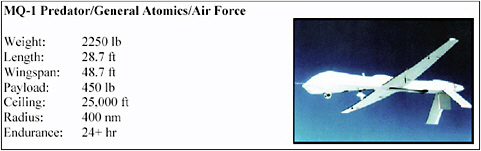
FIGURE 4.1 MQ-1 Predator. SOURCE: Office of the Secretary of Defense. 2002. Unmanned Aerial Vehicles Roadmap 2002-2027, Department of Defense, Washington, D.C., December, p. 6.
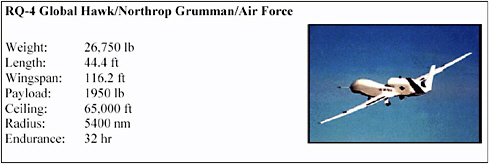
FIGURE 4.2 RQ-4 Global Hawk. SOURCE: Office of the Secretary of Defense. 2002. Unmanned Aerial Vehicles Roadmap 2002-2027, Department of Defense, Washington, D.C., December, p. 8.
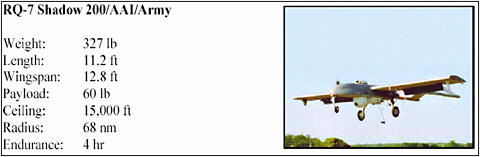
FIGURE 4.3 RQ-7 Shadow. SOURCE: Office of the Secretary of Defense. 2002. Unmanned Aerial Vehicles Roadmap 2002-2027, Department of Defense, Washington, D.C., December, p. 8.
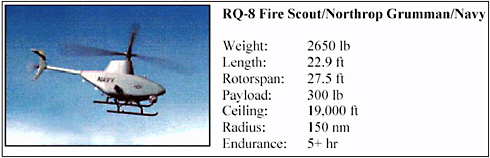
FIGURE 4.4 RQ-8 Fire Scout. SOURCE: Office of the Secretary of Defense. 2002. Unmanned Aerial Vehicles Roadmap 2002-2027, Department of Defense, Washington, D.C., December, p. 9.
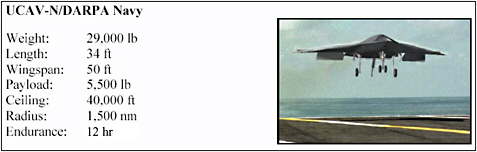
FIGURE 4.5 UCAV-N. SOURCE: Office of the Secretary of Defense. 2002. Unmanned Aerial Vehicles Roadmap 2002-2027, Department of Defense, Washington, D.C., p. 12.
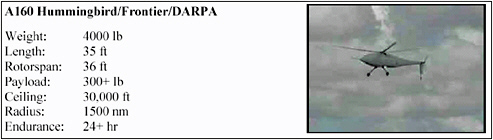
FIGURE 4.6 A-160 Hummingbird. SOURCE: Office of the Secretary of Defense. 2002. Unmanned Aerial Vehicles Roadmap 2002-2027, Department of Defense, Washington, D.C., December, p. 18.
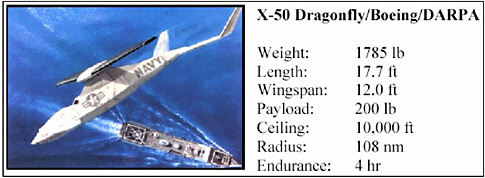
FIGURE 4.7 X-50 Dragonfly. SOURCE: Office of the Secretary of Defense. 2002. Unmanned Aerial Vehicles Roadmap 2002-2027, Department of Defense, Washington, D.C., December, p. 18.
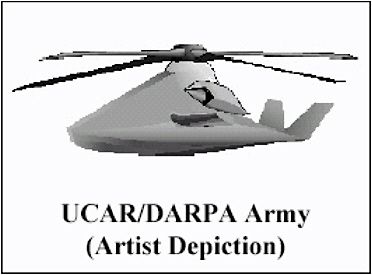
FIGURE 4.8 UCAR. SOURCE: Office of the Secretary of Defense. 2002. Unmanned Aerial Vehicles Roadmap 2002-2027, Department of Defense, Washington, D.C., December, p. 13.
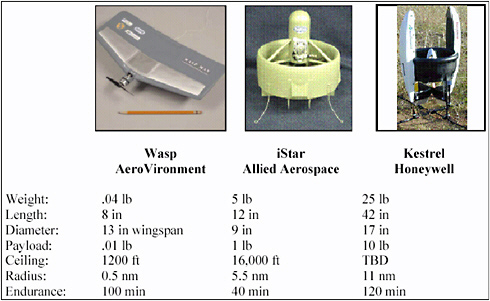
FIGURE 4.9 Micro UAVs. SOURCE: Office of the Secretary of Defense. 2002. Unmanned Aerial Vehicles Roadmap 2002-2027, Department of Defense, Washington, D.C., December, p. 19.
(the A-160 Hummingbird) (Figure 4.6), the X-50 Dragonfly canard rotor wing (CRW) (Figure 4.7), unmanned combat armed rotorcraft (UCAR) (Figure 4.8), and small or micro-UAVs (Figure 4.9) for urban combat.
The remainder of this chapter discusses the naval UAV operational missions, the potential of UAVs for naval operations, related technology issues and needs, and the findings and recommendations of the committee. The UAV systems directly related to the recommendations of this study fall into three operational categories: (1) intelligence, surveillance, and reconnaissance; (2) strike (i.e., uninhabited combat air vehicles (UCAVs)); and (3) combat support. UAVs not related to the recommendations but still of current or potential interest for naval operations are described in Appendix C, in the section entitled “Other Unmanned Aerial Vehicle Programs.” Readers interested in broader and more detailed coverage are referred to the current Department of Defense (DOD) UAV Roadmap.2
OPERATIONAL CATEGORIES OF NAVAL UNMANNED AERIAL VEHICLE MISSIONS
The introduction of UAVs into the battlespace enables impressive new operational capabilities for naval forces across the operational mission spectrum. These capabilities can be categorized in the three broad mission-area types enumerated above: (1) ISR, (2) strike, and (3) combat support. The categories are discussed in the following subsections.
Intelligence, Surveillance, and Reconnaissance
“ISR” is the term commonly used to characterize operational missions that employ sensors rather than weapons. This broad operational category is often further subdivided, depending on the intended use of the data gathered by the mission—for example, theater ISR, tactical ISR, and human-portable or small-unit ISR. Some of the unique challenges associated with ISR UAV operations in support of naval operations are elaborated on in the next major section.
Strike
In its broad sense, “strike” refers to operational missions that put weapons rather than sensors on target. This category is further subdivided as follows:
-
Strike, consisting of all types of air-to-ground missions intended to put weapons on target, but not in close proximity to ground combatants;
-
Suppression/destruction of enemy air defense (SEAD/DEAD), preemptive or reactive; and
-
Close air support (CAS), consisting of air-to-ground strikes in support of and in close proximity to troops in combat.
The current UAV focus in the strike mission area is on the use of armed UCAVs, primarily for SEAD and DEAD. In addition, UCAVs can make a large number of potentially significant contributions, from straightforward extensions of manned aircraft strike missions (e.g., fixed-target strikes) to missions based on completely new concepts (e.g., forward-pass CAS missions that are directly controlled by ground-based forward observers or forward air controllers). These concepts are discussed later in the chapter, and in the subsection entitled “Recommendations Concerning Unmanned Aerial Vehicles,” the committee addresses Navy and Marine Corps efforts to explore and experiment with some of these new technologies and concepts of operations (CONOPS).
Many targets in a deep-strike mission may be well defended. In the future, given the availability of high-technology weapons systems and network technology on the open market, it is likely that the integrated air defenses of U.S.
adversaries will be very capable. UAVs will need low signatures to survive, but stealth alone is unlikely to protect an air vehicle that loiters for a significant period of time in view of networked air defenses. To protect UAVs on such missions, the UAVs may have to be employed in numbers and individually pass in and out of view of air defenses, or they themselves may need to be capable of attacking opposing defenses. Furthermore, UAVs may have to employ self-defense measures normally employed on manned aircraft, such as deploying decoys, launching antiradiation weapons to attack enemy air defense radars, or engaging incoming surface-to-air missiles with air-to-air weapons. The next major section discusses how the suppression of enemy air defense through electronic warfare can also improve the survivability of air platforms.
Combat Support
“Combat support” encompasses operational missions that support combat operations, including jamming and other forms of electronic attack, communications relay, logistics resupply, and decoy. The current UAV focus in this mission area is on the use of HALE and tactical UAVs (TUAVs) for communications relay. Some consideration has also been given to using UAVs and UCAVs for jamming and electronic attack. Combat support is another mission area that will benefit from innovative exploration and experimentation with UAVs, as discussed further in following sections.
THE POTENTIAL OF UNMANNED AERIAL VEHICLES FOR NAVAL OPERATIONS
Unmanned aerial vehicles capitalize on many of the advantages that have made manned aircraft so vital to military operations. They operate in a medium that allows easy movement in three dimensions and which is penetrable by a broad variety of sensing and communications techniques. Operation at altitude provides direct lines of sight for sensors and facilitates weapons delivery. The characteristics of the atmosphere and the range of UAV operating altitudes allow direct communication with other aircraft, satellites, and other elements located over large areas of Earth’s surface. Their global reach and speed of movement, relative to surface modes, allow UAVs to serve as sensor and weapons platforms, extending awareness and influence in a timely fashion over broad areas.
Also, as a result of the enormous investments previously made in manned aircraft, UAV developments have many highly mature technology bases to draw from, including those of aerodynamics, propulsion, structures, materials, systems, maintenance, logistics, and operations. Although there are unique technical challenges associated with UAVs, the great majority of experience gained over decades of manned aircraft development applies to UAVs.
Furthermore, UAVs avoid many of the difficulties that are inherent in manned aircraft. Those difficulties include, for example, operational and physical issues associated with manned aircraft operations above altitudes of approximately 50,000 ft, which are orders of magnitude more complex than for operations at lower altitudes. Pressure suits are required for the crew, crew acclimatization is required pre- and postmission, and limitations are placed on individual flight rates. In particular, Air Force U-2 pilots who fly high-altitude missions for more than 12 hours are typically grounded for 24 to 48 hours before they can fly their next mission. Other advantages accruing to UAVs because of being unmanned include the lack of weight, size, orientation, maneuver or environmental penalties, or restrictions that would otherwise be imposed by crew requirements.
In addition UAVs (singly and in combination) enable new capabilities that translate into significant operational benefits for naval forces. Listed below are those that the committee considers to be the most compelling. They are grouped in three broad capability categories: (1) increased operational flexibility, (2) new operational capabilities, and (3) reduced cost, as discussed in the following subsections.
Increased Operational Flexibility
Persistent Air Operations
UAVs can stay on station in or near the combat area far beyond the capabilities of manned systems. Although there are practical and theoretical limits (see Appendix B), by employing a small number of vehicles, these impressive capabilities enable near-continuous surveillance for essentially indefinite periods of time. As demonstrated in Afghanistan and Iraq, the operational flexibility is further enhanced when both ISR and strike are integrated into one air vehicle such as the Predator.
Deck-Cycle Flexibility
The benefits of long endurance translate into more than the amount of time on station over the combat area. A long-endurance capability can also allow naval air assets to fly minimum-impact defensive missions during periods when carriers are otherwise not conducting regular air operations. In this context, minimum impact means that the assets can be kept airborne with minimum impact on deck crew and support personnel readiness.
Time Line Flexibility
Long-endurance platform capabilities can also be used to give naval forces an ability to execute complex ISR and strike operations many hours into a flight
that would otherwise strain the capabilities of traditional aircrews. For example, a set of armed strike UCAVs could stay on combat air patrol continuously, ready to execute a complex, precisely timed multivehicle strike. In addition, technology is now available that would allow these kinds of missions to be replanned and initiated within seconds. Such technologies were developed by DARPA’s Joint Forces Air Component Commander (JFACC) Program and its subsequently established Mixed Initiative Control of Automa-teams (MICA) Program.
Reach-Back and Other Forms of Virtual Support
Recent events have clearly demonstrated the significant operational benefit of forward-deploying theater-level UAVs while physically locating mission-control and data-exploitation elements elsewhere. This arrangement allows some key functions such as ISR product analysis and exploitation to be performed remotely, thereby reducing deployment requirements and allowing tasks to be performed by civilian specialists outside the combat zone.
Distributed Control
Although both manned and unmanned air operations can be coordinated among multiple users, the physical removal of the operator from the air vehicle also allows direct control to be shared among multiple users or even Services. The user with the best situation awareness or the most immediate need could assume direct control as needed. For example, a SEAL (sea, air, land) team could (1) transmit target coordinates by data link to a UCAV flying in support of its mission, (2) quickly confirm receipt of correct target coordinates, (3) command weapon release, and (4) hand off the UCAV to another user. This concept of direct control by local users has the potential to substantially reduce the time lines for air-to-ground coordination and target prosecution.3
New Concept of “Joint”
The concept of virtual support of naval forces could logically include taking operational control (versus tasking) of UAVs operated by other DOD organizations and government agencies. For example, the Air Force currently operates the land-based Predator and Global Hawk high-altitude, long-endurance ISR systems. The Navy’s Broad Area Maritime Surveillance (BAMS) initiative envi-
sions the use of a similar land-based system to meet next-generation, organic naval forces ISR requirements. Conceivably, one system type (with some sensor development) could meet both requirements. Although this would increase current levels of inter-Service dependence, the committee sees no reason why a single fleet of HALE UAVs would not be able to serve both Services’ land-based UAV ISR requirements.
New Operational Capabilities
The Navy and Marine Corps need to consider innovative concepts in order to exploit the potential that UAVs offer. This endeavor will involve pursuing advanced development in concept areas such as those discussed below and leveraging the efforts of other military Services, DARPA, and other innovative institutions.
Operations in Dirty Environments
Even though returning a UAV from a contaminated environment will challenge ship- and land-based operations and support personnel, UAVs and UCAVs still have an advantage in that they can be more tightly sealed and do not have to be opened up to change out the crew and decontaminate the cockpit.
Aerial Refueling for Selected Future UAV Systems
Aircraft that use consumable fuel are inherently limited in their endurance on station because of the finite quantity of fuel that they can carry. A well-developed approach to avoid this fundamental limitation and extend the endurance of consumable-fuel aircraft is that of aerial refueling. Aerial refueling is a common practice with manned aircraft; it allows the long-distance ferry flight of aircraft with inherently limited range and increases their endurance on station. Predator-class and smaller UAVs fly too slowly to refuel with either the Air Force or Navy refueling infrastructure. The only refueling infrastructure currently applicable is the C-130 used for refueling helicopters. Through its Automated Aerial Refueling Program, the Air Force Research Laboratory (AFRL) is evaluating aerial refueling as part of its UCAV program. This effort will address many of the fundamental issues associated with autonomous or teleoperated refueling. However, the Air Force approach to refueling uses an operator-controlled boom, differing from the Navy approach of a “probe and drogue” in which the pilot of the receiving aircraft controls the approach and connection to the tanker aircraft. Concepts now exist for stabilizing or actively controlling the position of the drogue relative to the probe. Aerial refueling is part of the Joint Unmanned Combat Air System (J-UCAS). The Navy could foster the development of technologies suitable for UAV aerial refueling—UAVs could operate both as a tanker and as a receiver aircraft.
J-UCAS as Combat Air Patrol and Airborne Early Warning Platform
The primary airborne early warning (AEW) of low-flying aircraft or antiship missiles and radar surveillance for combat air patrol (CAP) are provided by ship-based radar and airborne surveillance aircraft such as the E-2C. The use of radar surveillance exacerbates the patrol aircraft’s vulnerability to enemy fire because the radar transmitter signal gives away its presence and current location and can be exploited by a radio-frequency homing missile. This vulnerability can be eliminated by using a bistatic arrangement in which only the radar receiver is on the patrol aircraft. The radar transmitter is kept out of harm’s way in a safe, rearward “sanctuary” location. The penalty for this arrangement is an increased Reynolds number loss on the transmitter leg of the radar signal path. However, because the airborne platform is thus made more “stealthy,” some of this loss can be compensated for by moving the platform closer to the surveillance area and so reducing the Reynolds number loss on the receiver leg.
UAVs could play a natural role in this arrangement by carrying the receiver antenna and being placed forward, closer to likely axes of threat approach, with the manned aircraft transmitting from a position closer to the fleet or away from the combat area. This arrangement would maintain the performance of the radar system while keeping the manned aircraft farther from hazardous areas.
An alternate UCAV CAP approach would use long-endurance, low-signature UCAVs to loiter far forward, ready to respond to approaching air threats. Such a CAP UCAV could be directed by ship- or other aircraft-based sensors or by its own sensors, and it could provide rapid reaction to threats at some distance from the ships or facilities being protected.
J-UCAS as Close Air Support Platform
As demonstrated in recent operations in Iraq and Afghanistan, armed loitering Predator UAVs are excellent platforms for providing precisely delivered air support for ground operations. Another effective platform for supporting ground operations was a loitering B-52 with independently targetable Global Positioning System (GPS)-guided weapons. A logical extension of these lessons learned would be to employ a J-UCAS as a stealthy, forward-deployed, loitering platform in support of ground operations, but under the direct control of the Marine Corps forward air controllers. In this concept, the forward observers would provide target coordinates by data link directly to the UCAV fire-control computer, which would respond with the coordinates as received. Upon confirmation that the weapon was correctly targeted, the forward air controller could authorize the weapon release. This form of direct Marine-to-machine interface would significantly reduce the time normally required to coordinate an air-to-ground CAS strike as well as reducing the potential for friendly-fire incidents.
Very Small UAV Systems
DARPA is currently sponsoring exploratory development in micro-UAVs, with characteristic dimensions of 6 in. These UAVs are intended to be easily transported by an individual soldier or Marine (for example, in a fatigue shirt pocket). The mission of such UAVs would be to extend the value of organic air vehicles to the individual. In the future, even smaller UAVs might be possible, perhaps extending into the regime of medium-sized flying insects. These smaller UAVs would extend the “eyes” of the soldier into confined spaces while avoiding surface obstacles that would impede the movement of ground vehicles. Such small UAVs could find application in urban environments and in tunnels and caves. One application of small, disposable UAVs is that of being piggybacked with a weapon in order to do bomb damage assessment right after bombing. Continued research to understand the low Reynolds number physics of these mini- and microvehicles is warranted, in particular on those with complex, biomimetic components.
UAVs That Deploy Unattended Ground Sensors or Smaller Sensor and Attack Systems
UAVs as currently envisioned and realized would often be deployed in a combat arena and equipped with remote sensors to acquire ISR data. However, in some cases there may be information that can only be acquired or is best acquired by in situ sensors. Examples include the sensing of chemical or biological agents in advance of moving ground forces into an area, or the emplacement of unattended ground sensors for long-duration monitoring of an area of interest. In other cases, there may be a favorable trade-off between the smaller size of sensor aperture and less power required by a smaller platform placed closer to the ground than would be prudent with a larger UAV. Some relevant work has been done on enabling technologies, including, for example, the Predator, which has carried and released the Finder, a small UAV. There has been extensive work on air-dropped, unattended ground sensors, and some work has been done on miniature, GPS-guided, payload delivery systems.
Aerial Release and Redocking for Offboard Sensor Platforms and Other Applications
An extension of using UAVs to deploy unattended ground sensors or smaller sensor and attack systems would be to allow the redocking of a smaller air vehicle to the carrier aircraft (either manned or unmanned). This process would allow the retrieval of sensors, samples, or other high-value systems. Although there are undoubtedly many approaches to aerial release and redocking, one possible technique could combine a capability for autonomous probe-and-drogue aerial refuel-
ing, as discussed earlier, with the current techniques for deploying and retrieving towed aerial gunnery targets.
Extreme-Endurance Systems
As discussed earlier, aerial refueling can extend the endurance of an aircraft to the endurance limits of the crew, but unmanned aircraft remove this crew limit on endurance. Therefore, extreme-endurance UAVs could be realized by multiple cycles of aerial refueling. However, other approaches to extreme endurance are also possible. For example, HALE vehicles, lighter-than-air vehicles, or solar-powered aircraft based on earlier development work funded by DARPA and the Missile Defense Agency (MDA) and subsequently further developed by the National Aeronautics and Space Administration (NASA)4 can fly for extended periods of time. This type of UAV has demonstrated flight near 100,000 ft. Endurance is limited to about 12 hours because of a lack of suitable onboard energy-storage systems. However, the addition of pressurized gaseous hydrogen/ air fuel cell systems can extend endurance initially to 30 hours, and eventually to 2 weeks, with cryogenic hydrogen storage. Further extensions in endurance would be possible with a regenerative fuel cell system now being researched, making possible continuous flight for months or even longer.
Advanced Sensors Combined with UAVs
The application of advanced sensor techniques combined with UAVs could provide new mission capabilities or enhance current ones. For example, the problem of sensing and identifying vehicles under camouflage or under a tree canopy is not satisfactorily solved. Advanced optical techniques combined with a small, offboard sensor UAV flying just above the tree canopy or a small UAV flying under the tree canopy could substantially improve this capability. Another useful capability would be that of tracking vehicles for extended periods after they are initially identified as being of interest. A micro-UAV or small UAV might be able to affix passive radio-frequency (RF) tags to vehicles for subsequent tracking or attack.
Optionally Piloted Air Vehicles
Optionally piloted air vehicles are designed to be flown by a pilot onboard, to be teleoperated by an operator on the ground, or to fly autonomously. There are
|
4 |
For additional information, see the Web site <http://www.dfrc.nasa.gov/Newsroom/ResearchUpdate/Helios/index.html>. Last accessed on April 5, 2004. |
few examples of this type of aircraft, but it would have some advantages, including the option of being operated as a piloted aircraft for ferry missions, payload operator training, and low-risk missions. The optionally piloted air vehicle could be operated without a pilot for high-risk or long-endurance missions.
Reduction of Costs
High-Risk Strike Mission—Reusable Platform
The inherent benefit of using unmanned vehicles (e.g., cruise missiles) in high-threat environments, without risk of loss or capture of crews, is well recognized. However, the ability to accomplish this class of missions using reusable platforms (UAV and UCAV) has significant potential benefits. Even though reusable air vehicles need to be launched, recovered, and serviced between missions, it is likely that such operations can be sustained at much lower cost than that for expendable strike systems such as cruise missiles. The main elements contributing to AV systems costs are operations and support, training, and system development and procurement.
Operations and Support
Although early expectations were that UAVs would return cost savings across all life-cycle cost elements, experience has shown that the greatest potential savings will be in operations and support (O&S) costs. As indicated by the examples in Table 4.1, the single largest contributor to O&S costs of any manned system typically is driven by the number of direct and indirect personnel required to support and operate it. UAVs have potential, albeit yet unrealized, to reduce those costs. The mechanisms for achieving this potential, however, are often more operational than technical. For example, reach-back (i.e., relying on personnel based away from the operational theater) can reduce the number of forward-deployed personnel. Changing the way in which operator proficiency is qualified and maintained, as discussed below, is another method for reducing O&S costs. Technical solutions for reducing personnel-related O&S costs include employing greater levels of autonomy to reduce overall personnel requirements. It is important that naval leadership emphasize advances in both operational and technical areas to ensure that the O&S cost-saving potential of UAV operations is realized.
Training
Whether for manned or unmanned air vehicles, O&S costs are typically driven by peacetime requirements for flight training hours. The DOD’s 2002 UAV Roadmap, for example, estimates that 50 to 90 percent of total flying hours
TABLE 4.1 Primary Operations and Support Cost Drivers—Manned Aircraft Examples
|
Primary Cost Drivers |
Percentage of Total |
|
USAF F-16 C/D Active ACC, PACAF, and USAFEa |
|
|
Mission personnel plus personnel-related indirect costs |
39.6 |
|
Depot-level repairables (DLRs) |
32.9 |
|
Petroleum, oil, and lubricants/energy consumption |
09.8 |
|
Depot repairs other than DLRs |
08.4 |
|
Consumable supplies |
04.6 |
|
USN F-18C Active Less Fleet Reserve Squadron Training Costsb |
|
|
Organizational personnel costs |
26.3 |
|
Aviation DLR costs |
22.8 |
|
Fuel costs |
15.1 |
|
Intermediate costs |
07.1 |
|
Depot support costs |
05.9 |
|
aSee <http://www.safaq.rtoc.hq.af.mil/f-16.cfm>. Last accessed on March 31, 2004. bInformation from <http://www.navyvamosc.com/>. Last accessed on April 7, 2004. NOTE: C/D, version or model of F-16; ACC, Air Combat Command; PACAF, Pacific Air Force; USAFE, U.S. Air Force in Europe. |
|
are on peacetime training sorties and that this is an area in which UAVs can achieve savings in comparison with manned systems. One reason for such savings, for example, is that UAVs are more automated than manned aircraft are, and the training-hour requirements are correspondingly less. An experienced USAF Predator operator is required to fly 18 training sorties per year to maintain required proficiency, whereas an experienced USAF U-2 pilot is required to fly more than four times as many training sorties.
Another potential area for training-hour reduction is to rely more on simulation for UAV flight training. The remote operating environment and displays/ cues involved in UAV operation are easy to replicate in simulation, and actual flight-hour requirements could be reduced even further by employing such aids. One area, however, that will not be as amenable as other UAV operations are is that of carrier operations. Even with automation, it is likely that operator proficiency will continue to rely heavily on actual flight operations rather than on simulation to develop and maintain operator and deck crew skills, particularly for launch and recovery.
System Development and Procurement
Because UAV development is still in its infancy, there has been little opportunity to benefit from what could be a significant downstream cost saving derived from compatibility and reuse of common development items such as communica-
tions, control stations, and payloads. Even though efforts to standardize control stations and communications across naval UAV systems have not yet achieved unqualified success, the overall concept still has considerable merit. In the future, however, trends indicate that the commonality approach will change from its current focus on hardware and software to focusing on common and open architectures and combinations of the two.
TECHNOLOGY ISSUES AND NEEDS
Despite unmanned aerial vehicles’ impressive range of capabilities and potential benefits for naval operations, some important capabilities must be addressed if the full potential of these vehicles is to be realized in a timely fashion. Some of these needed capabilities are current impediments to timely progress, while others simply reflect current levels of maturity.
Fundamental Unmanned Aerial Vehicle Issues
Communications and Bandwidth
By their very nature, UAV operations depend on secure, reliable, and available communications. Although autonomy and other technology developments can minimize communications bandwidth requirements, regular downlink communication is still required for sensor data and information on vehicle status, position, and system health. Although continued system and technology development is expected to make progress in this area, the dependency itself will not go away. Continued attention to this subject, therefore, is essential (see Chapter 7, the section entitled “Unmanned Aerial Vehicle Communications,” and Appendix B).
Positive Automatic Target Recognition
Current UAV CONOPS typically depend on RF-based synthetic aperture radar (SAR) sensors with or without ground moving target indicator (GMTI) capabilities to provide overall battlefield situation awareness. Under current rules of engagement, however, target identification using electro-optical/infrared (EO/ IR) sensors is generally required in order to have positive target identification prior to authorizing a lethal attack. As a consequence, during periods of poor or reduced visibility or low cloud ceilings, operational tempo suffers. Considerable benefits could accrue, therefore, from systems or technologies that enable the equivalent of EO/IR-based levels of target-recognition confidence using weather-penetrating, RF-based sensors. This is a very fruitful area for research and technology development, and an initiative in this area is recommended. (See Chapter 7 for additional relevant discussion.)
Operations with Manned Air Vehicles
After almost 100 years of operation, military and civil airspace regulations and procedures are well established. However, their current methods of operation are not compatible with the usual operational procedures for UAVs. In civil airspace, the pilot in the aircraft has ultimate responsibility for safe operation of the aircraft and for maintaining safe separation from other traffic. Since UAVs have no pilots in the cockpit, they are having problems fitting into national (military and civilian) and international airspace operating environments. The issues involved are far too complex to address in this study, but it is likely that technology (e.g., automatic collision-avoidance systems) can resolve most of the issues. The eventual solution must be a combination of technology and operational procedures. Fortunately, a number of excellent initiatives are addressing the issue. For example, the UAV National Industry Team (UNITE)5 is working in conjunction with the DOD, NASA, and the Federal Aviation Administration on UAV-related issues such as certification of UAVs and free access to the national airspace.
Contingency Planning
One of the most important functions of a manned aircraft pilot is to deal with contingencies, including, when possible, safe recovery of the aircraft from an emergency. The issue of contingency planning to avoid or deal with emergencies is fundamental to all air vehicle operations, but it is substantially more complicated for UAVs, and as a consequence can benefit from further technology and capability development. Once again, these issues are being addressed by industry/government groups, but until the issues are resolved—the UAVs will need a perception subsystem to detect other aircraft, a planning subsystem to coordinate flight paths, and so on—UAV contingency-planning considerations will constrain how and where UAVs are allowed to fly.
Intelligent Autonomy Technology—Key to Advanced Autonomous Operations
As UAV operations become more routine and better integrated with those of other aircraft, UAVs will need to fly as part of coordinated operations and in shared airspace. This environment will require autonomous systems for detecting other aircraft, coordinating flight paths to optimize area operations globally and to avoid conflicts. Examples of operations include those in civil airspace, potentially with nonparticipating aircraft in the area (for example, “see and avoid” visual flight rules traffic); takeoff and landing operations at land bases or from
|
5 |
For additional information, see the Web site <http://www.unitealliance.com/faq.html>. Last accessed on April 1, 2004. |
carriers, possibly in a mix of UAV and manned aircraft; and in combat operations, cooperative flight with mixed types of UAVs and manned aircraft. Each of these situations would require the UAV to have a level of awareness of other aircraft and the ability to plan and execute flight paths and maneuvers in a complex environment. While in principle it is possible to provide a synthetic environment to a ground-based operator, with a level of awareness similar to that of a pilot in the aircraft, this approach is costly, requires substantial and perhaps unsustainable communications bandwidth, and would defeat the long-term goal of having one operator control multiple UAVs. The most desirable approach would be autonomous UAV systems to manage conflict and collision avoidance and to plan flight paths in cooperation with other air vehicles and elements in the operational environment.
A Systems Approach to Facilitate Autonomous Flight Operations
Current sensor systems for UAVs have been, in general, developed separately and not as part of the overall system. A more systems-oriented approach can provide improved performance not currently possible. In general, sensors are installed in a UAV for self-awareness and for mission performance (e.g., the ISR mission). UAV systems, sensors, and software, conceived and developed as a unified system along with the vehicle design, can allow optimum mission performance. In the hierarchy of levels of autonomy, current UAVs tend to have somewhat limited autonomy; however, they will become more valuable in the future as their levels of autonomy increase. Higher levels of autonomy will provide benefits of reduced operational manning, increased vehicle self-awareness to improve reliability and reduce maintenance, and increased operational capability.
Mission-Dependent Autonomy Management
UAV flexibility and utility would be substantially enhanced by the capability of operating at various levels of autonomy, depending on mission needs. The key to achieving this capability is the development of mission-management software that can perform a mission at various levels of autonomy and interact with the vehicle-management software module and the weapons system-management software module the way that a pilot responds to and tasks those systems today to perform a mission. The vehicle-management module monitors and controls the vehicle’s systems in response to commands from the mission module. The weapons system module monitors and controls the defensive and offensive systems and weapons, responds to tasking from the mission module, and tasks the vehicle module as required to complete the assigned mission task. The piece in need of development is the mission module that emulates the mission commander at whatever level of authority (autonomy) has been granted.
Autoland Systems
UAVs have developed a reputation for having a higher loss rate than that of piloted aircraft. A relatively high proportion of the losses occurs during the landing of teleoperated UAVs. Reliable autoland systems have the potential to substantially reduce losses. Although teleoperated conventional runway landing can be quite challenging, landing a UAV on a deck in even moderate sea states can be beyond the capability of a human operator. Autoland systems being developed by several manufacturers and government agencies will be an important addition to current and future UAV systems. For example, the Navy’s Joint Precision Approach and Landing System (JPALS)6 seeks to improve the capability and reliability of the current Automated Carrier Landing System (ACLS) to a level of performance necessary to safely land UAVs, such as the J-UCAS, aboard carriers.
Among the driving factors in carrier integration of UAVs are launch and recovery. The current ACLS is woefully inadequate for UAV employment. The ACLS specification requires less than 1 failure per 100 recoveries, which is adequate when a pilot can override the automated system, but it is orders-of-magnitude higher than tolerable for UAV operations. The current actual ACLS failure rate for UAVs can be on the order of 1 in 3.7 The JPALS now under development has the potential to meet the requirement for ultrareliable recovery. Its error rate is specified to be 1 in 10 million. Successful fielding of JPALS appears to be a prerequisite for UAV carrier operations. However, JPALS’s heavy dependence on GPS is a source of concern. A limited alternate capability based on short-range laser or microwave RF systems would be prudent for cases when GPS is unavailable, if only for a short time. Other alternatives should be pursued.
Data Links and Special Communications Antennas
UAVs would benefit from the development of improved data communications systems to increase data transmission rates and increase the signal flexibility of antennas. Current UAVs such as the Global Hawk and the Predator make significant vehicle configuration compromises in order to incorporate high-gain satellite communications (SATCOM) dish antennas. Further development and incorporation of conformal active-array antennas would benefit the performance of UAVs by avoiding design compromises for large-dish-type SATCOM anten-
|
6 |
For additional information, see the Web site <http://www.hanscom.af.mil/esc-ga/Products/jpals.htm>. Last accessed on April 1, 2004. |
|
7 |
Glen Colby, JPALS Chief Engineer, “UCAV-N, Naval Unmanned Combat Air Vehicle, Carrier Integration Challenges, Automatic/Autonomous Flight Operations,” presentation to the committee, April 24, 2003. |
nas. The use of this class of antennas could allow rapid-beam steering for burst communications with a series of different platforms and therefore facilitate the UAV role as a communications hub in a battlespace network, assist with cooperative operations, and perhaps reduce the likelihood of jamming or interference.
Imagery Processing, Exploitation, and Dissemination Software
A significant mission for UAVs is as one of the military assets for providing timely ISR, particularly persistent ISR. Current airborne and space-based ISR platforms provide an almost overwhelming stream of data. UAVs will introduce additional airborne sensor platforms, and persistent UAV platforms will vastly increase the quantity of data available. However, for this data to be useful, they must be interpreted and analyzed, and important components of the data must be forwarded in a useful form to the end users. This step is now largely accomplished by trained human operators (available in limited numbers) communicating over data links with modest capacity. Intelligent software agents could accomplish some portion of the data exploitation process to relieve the burden on a limited number of analysts and perhaps reduce the quantity of data to be transmitted by eliminating unneeded data (i.e., portions of images that contain no objects of interest or that have not changed from the last image).
Fuel-Efficient, Small-Turbine, and Heavy-Fuel Internal Combustion Engines
The military is switching to less volatile, heavy fuels for all vehicle types in order to reduce logistical complexity and cost and to increase safety. This change results in powering virtually all military vehicles with either turbine or compression-ignition (diesel) engines. Notable exceptions are certain small and medium-sized UAVs that, to achieve low specific fuel consumption (SFC) and long endurance, use aviation gasoline or similar volatile fuel. Although many engine options exist for spark-ignition engines for small aircraft applications, there are few flight-weight diesel engines. This class of UAVs needs heavy-fuel turbines and compression-ignition engines with improved SFC to improve operating characteristics and to better fit in the military logistical system. The development of diesel engines suitable for use in fixed- and rotary-winged UAVs is an area needing attention.
Improved Survivability
Although unmanned, UAVs still represent valuable assets that must be sufficiently inexpensive and plentiful to be considered “attritable” (or dispensable) or else they must be able to survive if their missions require them to operate in hostile areas. Including survivability features in a UAV will generally increase the cost of an individual aircraft. However, survivability could both reduce the
overall cost of UAV systems (including the cost of replacing UAVs lost through attrition) and increase their availability during operational campaigns. This trade-off needs to be considered in light of the cost and intended mission of the UAV system.
Many targets in a deep-strike mission may be well defended. In the future, given the availability of high-technology weapons systems and network technology on the open market, it is likely that integrated air defenses of adversaries will be very capable. UAVs will need low signatures to survive, but stealth alone is unlikely to protect an air vehicle that loiters for a significant period of time in view of netted air defenses. Threat-detection-and-response considerations may include provisions for threat cueing by offboard sensors or systems, onboard threat-detection systems, threat-avoidance maneuver algorithms, and active self-defense measures normally employed on manned aircraft. That is, UAVs may need to deploy decoys, launch antiradiation weapons to attack enemy air defense radars, and engage incoming surface-to-air missiles with air-to-air weapons.
In addition to developing methods of employment that minimize the exposure of UAVs to threats, technologies need to be considered from the outset of the design process and applied to UAVs to improve their tolerance to damage and their ability to avoid damage. These protections are provided in manned aircraft by liberal use of redundancy to eliminate critical single-point failures and by incorporating damage tolerance and hardening in the basic design as well as threat-detection and defensive systems. Damage-tolerance considerations include redundancy in structural load paths and features to limit the propagation of damage, aerodynamic designs allowing continued controlled flight with damage to or loss of some airframe elements, and control systems capable of recognizing the loss of control surfaces/actuators or changes to the aerodynamic configuration of the vehicle, compensating or reconfiguring to allow continued flight.
These survivability features need to be incorporated as appropriate, on the basis of trade-off studies of UAV cost, criticality of function, and anticipated threat environment. Such features have been developed in manned aircraft and would be straightforward to adapt to UAVs.
Other Issues Related to Unmanned Aerial Vehicles
Reliability
The history of UAV development includes failed programs that overemphasized low cost at the expense of reliability. In these cost-driven programs, fundamental reliability-driven design philosophies and processes based on years of experience with manned aircraft were not followed. Some low-cost UAVs did not even use qualified aerospace components, and hence these UAVs experienced high in-flight failure rates. These low-cost-driven designs had little or no redundancy, even for flight-critical systems. The end result was high crash rates, in some cases resulting in program cancellation. Fortunately, however, this was
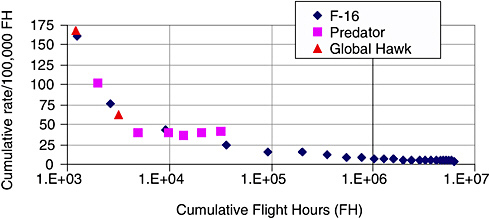
FIGURE 4.10 Class A mishap rate comparison. Predator and Global Hawk Class A accident rates are comparable with those of manned fighters (F-16 during its early development through initial operational deployment) at equivalent cumulative flight hours. SOURCE: Air Force Safety Center, online at <http://afsafety.af.mil/>. Last accessed on March 31, 2004.
not the case for all UAVs. For example, the BQM-34 (Firebee high-speed target drone) family of UAVs was based on traditional aerospace-quality design processes and as a consequence experienced much higher levels of reliability.
Contemporary UAV design philosophy has been much more attentive to reliability and redundancy requirements, and in-flight failures and subsequent mishap rates have moderated. This change can be seen from Figure 4.10, in which cumulative Class A mishap rates for the Predator and Global Hawk are compared with those of an F-16 at the same number of cumulative flight hours. This plot shows that the mishap rates for these UAVs are comparable with those of the F-16 during its early development through initial operational deployment. Therefore, as the Predator and Global Hawk mature and accumulate operational flight hours and experience, they may be able to approach comparable levels of flight safety. Continued emphasis in this area, however, will be essential if the real potential is to be realized.
Program Cost
The costs of system development and procurement are two of the four elements of the life-cycle cost of UAVs. A number of studies, including the DOD’s 2002 UAV Roadmap,8 have shown that for UAVs of capability and complexity
comparable with that of manned aircraft, manned versus unmanned development and acquisition costs are essentially comparable. While this may be attributable to the fact that the industry is much lower on the learning curve with UAVs compared with manned aircraft, early expectations that UAVs could be developed and procured at significantly lower cost than their manned equivalents have not materialized. However, even with UAV experience being relatively immature compared with that of manned aircraft, it has become increasingly clear that the program cost drivers for manned and unmanned aircraft are identical—requirements and requirement stability. Thus, UAV developers need to continue pursuit of UAVs as a lower-cost alternative. In fact, as UAV systems mature, there will be opportunities to significantly reduce overall development and acquisition costs in the future.
Opportunities for Future Program Cost Savings
Because of the fundamentally distributed nature of UAV systems, there will be opportunities for developers of future UAVs to take advantage of existing system components, as opposed to developing new elements that could be optimum for the new applications but at higher development and acquisition cost. In order to achieve this goal, however, it will be essential that naval UAV system architectures be designed to standardized interface requirements at a minimum.
Culture Acceptance
The last but perhaps most important issue affecting UAV deployment in support of naval operations is cultural acceptance. This well-known issue does not need to be further elaborated here, except to note that success breeds success. UAV program decisions, therefore, need to be constantly evaluated from the perspective of their long-term program impact. Shortsighted decisions that adversely affect UAV system reliability, maintainability, and safety could have detrimental effects that extend beyond an individual program. For example, UAV lessons learned have shown that the selection of remotely piloted takeoff and landing can minimize early development cost but result in substantially higher attrition and overall life-cycle costs compared with those for automated takeoff and landing.
CONCLUSIONS AND RECOMMENDATIONS
Conclusions and recommendations based on the preceding UAV background and discussion are presented in the following subsections.
Conclusions Concerning Unmanned Aerial Vehicles
UAVs Have Come of Age
In assessing the UAV situation today, the committee believes that the United States has made considerable progress over the past 3 to 4 years in moving to exploit the potential offered by unmanned air systems. Little doubt remains as to the operational utility and military worth of UAVs. They have proven themselves in combat, and warfighters want them, particularly since UAVs are now seen as essential to realizing the all-important persistent surveillance of the battlespace. UAVs have indeed come of age at last and are destined to play an increasingly important role in future years for ISR, strike, and other key military missions. Also, it appears that UAVs have strong support in the Office of the Secretary of Defense, among the unified combatant commanders, and with members of Congress. Accordingly, the Naval Services need to capitalize on the current positive climate and move out with dispatch to exploit the momentum that has been established.
Navy and Marine Corps Behind Other Military Services in Fielding Modern UAV Systems
Despite recent advances, UAVs are still not widely distributed across the military Services or firmly integrated into Service force structures. Also, funding support is at times tenuous. Overall, the pace of introduction of UAVs has been slow to date; indeed, as of early summer 2003, only 130 UAVs of Pioneer/ Shadow-size or larger were operational throughout the DOD, with the Navy and Marine Corps significantly behind the other Services in numbers and in fielding modern systems.
There are manifold reasons for this slow pace of introduction and utilization of UAVs, with some key areas as follows:
-
Culture and policy. The culture of any large institution of long standing almost always militates against ready acceptance of new concepts or, in the case of the military, against new weapons systems. The Navy is not immune to the effects of this phenomenon.
-
Competition with legacy and other new systems for funds. As a relatively new type of military weapon system, UAVs are in competition for funds with older systems or even with other new systems that are viewed as frontline main-stays of a Service’s force structure. The Navy, for example, has a number of high-cost platforms—aircraft, submarines, aircraft carriers, surface combatants, amphibious ships—all of which are seen as key elements that make up the “core” of the Service. Replacing aging ships and aircraft, provisioning them with weapons, and paying for operations and maintenance constitute a heavy financial burden.
-
In such an environment, it is often the case that a new kind of system, such as UAVs, remains at the bottom of the priority list.
-
The program start-stop-start syndrome. The unfortunate practice of starting a military program and then, when production is about to commence, canceling it in favor of a supposedly more promising system, has plagued the UAV world for years. Each such sequence adds years of delay in equipping the operating forces with UAVs. Past program examples include the Navy/Marine Corps Amber, the Hunter Short-Range UAV, the Mid-Range UAV, and the first joint tactical unmanned aerial vehicle (TUAV) program. And currently, production and fleet introduction of the already-developed Fire Scout are in jeopardy.
-
Greater than expected costs, high accident rates, unreliable systems, and combat survivability concerns. A reason often given in the past for a military Service’s not making a strong commitment to UAVs is that these new systems cost more than anticipated, suffer from high accident rates because of subsystem unreliability and operator error, and lack the combat survivability features of manned aircraft. These concerns are valid, but all are solvable if the requisite attention is paid to them.
-
Reluctance of one military Service to use the UAV system of another. Although this problem may smack of the “not invented here” syndrome, it is an understandable characteristic of some validity. A commander feels most secure in owning and completely controlling a system that is fundamental to accomplishing the command’s mission. But there are obvious cost and operational advantages for the DOD if multi-Service use can be achieved—overall system development costs are reduced, and UAV force levels can be increased more rapidly. Here, “use” is defined in two ways: (1) one Service acquires and operates a system developed by another Service, and (2) in the case of ISR, one Service merely makes use of the information generated by the UAV system of another Service.
-
Radio-frequency bandwidth constraints and lack of interoperability. The committee believes that radio-frequency bandwidth capacity limitations, interoperability problems, and imagery processing/exploitation issues are near the top of the list of impediments to a more rapid near-term introduction and utilization of UAV systems. Each of the military Services suffers from these constraints to varying degrees, with the Navy’s ships at sea and the Army and Marine Corps units at battalion level and below being the most adversely affected.
Both the Army and Air Force are now operating modern UAVs, and the two Services have systems in series production as well. The Navy, on the other hand, has no UAVs in regular production and none in its operating forces. The Marines have some 22 aging Pioneers, a small tactical system developed in the 1980s, and operated them with mixed effectiveness during Operations Desert Storm and Iraqi Freedom as well as during the Kosovo campaigns. Additionally, the Marine
Corps has begun to introduce the small, human-portable Dragon Eye system to serve units at battalion level and below. But in the aggregate, the Naval Services, which once led the Department of Defense in developing and fielding UAVs, are now lagging the other Services in gaining operational experience, developing operational concepts, and exploiting the transformational warfighting potential offered by these unmanned air systems. Absent a dramatically increased involvement with UAVs, the Navy and Marine Corps run the risk of falling farther behind, not fully exploiting the benefits offered by Army and Air Force systems, and lagging in efforts to shape the direction that new UAVs systems will take in the future.
Importance of Accelerating the Fielding of UAVs
The committee found that operational experience with the Predator, Global Hawk, Hunter, and special-purpose UAV systems during recent conflicts demonstrated that, once employed by warfighters, the value of UAVs becomes immediately evident, ideas for new operational concepts are spawned, a constituency is formed, and strong advocacy begins to build. Hence, an important strategy to increase involvement by the Naval Services with UAVs is to accelerate the introduction or exploitation of those systems that are in production or have completed development and are judged to have significant operational utility. To this end, the committee concludes the following:
-
Requirements generation is best approached from the perspective of mission needs and effects versus that of platform ownership or base location,
-
Procurement or employment of UAVs developed by the Air Force and Army is an essential ingredient of plans to introduce UAV systems capabilities more rapidly into the Naval Services, and
-
Essential enhancements to command, control, and communications (C3) and information-exploitation systems need to be made concurrent with accelerating the introduction of already-developed UAV systems into the fleet and Fleet Marine Force.
Naval UAV Roadmap Lacking in Detail and Not Sufficiently Forward Looking
The Navy and Marine Corps have a naval UAV roadmap9 in place. However, the roadmap has been slow to evolve and, in addition, it does not address advanced technology needs or issues between the two Services regarding the use of tactical UAVs.
Navy’s Views on Its UAV Future. The Navy views its future use of UAVs to be in primarily three categories:
-
Long-dwell standoff ISR as exemplified by the Broad Area Maritime Surveillance (BAMS) concept and the Global Hawk Maritime Demonstration (GHMD);
-
The carrier-based, penetrating surveillance and suppression of enemy air defense (SEAD)/strike J-UCAS; and
-
Ship-based tactical surveillance and targeting, which call for a vertical-takeoff-and-landing (VTOL) system that can operate from a variety of types of ships.
In reviewing the Navy’s progress toward realizing this three-category future for UAVs, the committee noted that the DARPA/Navy UCAV-N ATD has transitioned into a combined effort with the Air Force along the lines of the Joint Strike Fighter program. The committee endorses the J-UCAS program as presently planned and urges that Service leadership strongly support this promising initiative.
Long-Dwell Standoff ISR System. The road ahead seems unclear for the long-dwell standoff ISR system. To begin with, the committee noted the near-concurrency of the GHMD and contract award for the BAMS UAV, and thus it remains concerned that lessons from the Global Hawk demonstration might not be reflected in the BAMS program. The BAMS development also appears to be a technically challenging and lengthy process, and HALE UAV support to naval forces will not be available to the fleet until 2009 at the earliest, unless provided by the Air Force. Further, this development is to take place concurrently with spiral development improvements to the Air Force Global Hawk system. That system, like the Navy BAMS, will require considerable research, development, testing, and evaluation investment.
This concurrency offers the potential for a joint program with the Air Force for the acquisition and operation of a common system that would meet both overland and maritime needs. The potential exists for reduced development costs to the Navy and to the DOD overall, as well as the opportunity for greater operational flexibility for regional combatant commanders. Part of such an approach would also be to increase the annual Global Hawk production rate, with a resultant reduction in air vehicle unit production costs for both Services. A similar opportunity for a joint development and operations arrangement with the Air Force would exist if Predator B were selected for the Navy BAMS mission.
Ship-Based Tactical Unmanned Aerial Vehicles. At present the Navy has no ship-based TUAV capability, and there is no formal acquisition program for
TUAVs in the Future Years Defense Program (FYDP). There are, however, plans that link the Fire Scout VTUAV (vertical-takeoff-and-landing TUAV) with the nascent Littoral Combat Ship (LCS) as the latter begins to enter operational service after 2007. Here the committee is concerned that the introduction of a sea-based tactical surveillance and targeting capability in the fleet, which could begin with the Fire Scout as early as 2005, now appears to be tied to the development of a new ship class not scheduled for initial operating capability until after 2007.
The committee also notes that the current plan for the Fire Scout does not include ships other than the LCS. Thus, Navy ships at sea, including those in Expeditionary Strike Groups (ESGs) and embarked Marine Air Ground Task Forces (MAGTFs), will continue to lack organic ISR UAV capability at least through this decade, and will have to depend wholly on imagery garnered from limited, manned fighter reconnaissance systems, national overhead systems, and Air Force ISR systems such as the Global Hawk, Predator, U-2, Rivet Joint, P-3 Antisurface Warfare Improvement Program (AIP), and Joint Surveillance Target Attack Radar System (JSTARS). Equally important, naval forces at sea will be denied the opportunity of working directly with a modern ISR UAV system to gain operational experience, develop employment concepts, and formulate operational requirements for future systems. It therefore appears to the committee that the Naval Services will continue to suffer from a serious ISR deficit at least through 2010, during which time the Army and Air Force will continue to develop operational concepts and gain valuable experience that will lead to improved UAV systems in the future.
Marine Corps’s Views on Its UAV Future. The Marine Corps envisions three levels of UAV support for its warfighters operating from the sea or ashore in Marine Air Ground Task Forces, which range in size and capability depending on the mission (MAGTFs might consist of Marine Expeditionary Units (Special Operations Capable), Marine Expeditionary Brigades, or Marine Expeditionary Forces). At the theater level, the MAGTFs will rely on national systems as well as on information derived from the Global Hawk and Predator, currently Air Force assets. In addition, they will require data and imagery from other ISR platforms such as the U-2, JSTARS, Rivet Joint, and the P-3 AIP, as available.
At the tactical level, the Marine Corps plan is for MAGTFs to continue relying on the Pioneer for operations ashore until it is replaced by a tactical UAV system suitable for use from both sea and land bases. This future system will operate from amphibious assault ships (LHD (amphibious assault ship, multipurpose), LHA (amphibious assault ship, general purpose), and LPD (amphibious transport dock)-17 classes) within the ESG or from a future class of sea base ships, and also from land when operationally required. If a need for TUAV support arises in circumstances in which no organic TUAV assets are available to the MAGTF but the Marines are operating in the vicinity of the Army, the plan is
to coordinate support from Army UAV systems such as the Hunter and Shadow 200, as was done successfully during Operation Iraqi Freedom.
At the lower tactical-unit level (battalion, company, or platoon), the Marine Corps’s tactical UAV need is to be satisfied by the human-portable Dragon Eye UAV system. The Dragon Eye was employed on a limited basis in the recent drive on Baghdad, with reasonable results for a system still under development.
Navy and Marine Corps Views on TUAVs. Navy and Marine Corps views on UAVs diverge over the issue of tactical UAVs. Responding to an earlier Naval Services’ requirement, the Fire Scout VTUAV was developed and is now completing acceptance tests. While the Fire Scout’s performance exceeds the original joint requirement, the Marine Corps now believes that the system does not meet the needs of its future vision of deep-penetration, Ship-to-Objective Maneuver tactics, which will capitalize on the high-speed V-22 Osprey tilt-rotor troop transport. The Marine Corps, therefore, is looking at the U.S. Coast Guard Eagle Eye tilt-rotor development as well as at other systems as potential candidates for their combination of VTOL capabilities and high cruise speed. While somewhat slower than the V-22 Osprey, the Eagle Eye is nevertheless considerably faster than the Fire Scout.
The Fire Scout and Eagle Eye offer the same endurance and similar sensors, and each is limited to a line-of-sight communications range. Hence, other than speed, the principal difference between the two VTUAVs is readiness for production. The Fire Scout is a fully developed system ready for production; units could be in the fleet within 20 months of a production go-ahead. The Eagle Eye, on the other hand, is a developmental system, and the Coast Guard schedule shows the system reaching initial operating capability late in 2007.
Current Marine Corps thinking on what constitutes a suitable VTOL tactical UAV points to a system more closely matching the V-22 Osprey in speed, with range out to 200 nautical miles. This higher performance is desired in order to facilitate surveillance and screening operations out in front of the V-22 Osprey, and with the control of the UAV being exercised from the Osprey. Such a requirement would call for a VTOL air vehicle larger than the current Eagle Eye, one likely equipped with SATCOM as well as sensors other than EO/IR, and possibly with weapons. Hence, if selected by the Marine Corps, a tilt-rotor-like VTOL UAV will realistically be viewed as the first of a line of high-speed unmanned rotorcraft, likely employing tilt-rotor or tilt-wing technology. To date this emerging Marine Corps VTOL UAV need has yet to be defined with any precision, including conduct of the required detailed Analysis of Alternatives.
The Navy, for its part, is sensitive to the needs of the Marine Corps and indeed has indicated preliminarily that in a few years’ time, it may wish to revisit the sea-based tactical UAV requirement together with the Marine Corps. Further, the two Services agree that, from an affordability and operational flexibility perspective, a single ship-and-shore-suitable tactical UAV system, meeting both Navy and Marine Corps needs, is the correct path for the future.
Introduction of Ship-Capable TUAVs Without Further Delay. The committee believes that ship-capable TUAVs need to be introduced into the Naval Services without further delay. And since the Fire Scout is the only such system currently available, the Navy can therefore move immediately to acquire a small force of Fire Scouts to develop operational concepts and tactics, help formulate requirements for future systems, and provide a sea-based ISR UAV contingency response resource. Further, to facilitate an accelerated introduction of the Fire Scout into the fleet in 2005, a VTUAV tactical development squadron should be formed by the Navy and the Marine Corps, and the Coast Guard invited to participate. Since the Army has selected the Fire Scout for its Future Combat System, the Army needs to be invited to participate as well.
A small procurement of the only sea-based tactical UAV currently available, the Fire Scout, would not in any way preclude the Navy and Marine Corps from later selecting the Eagle Eye, a growth tilt-rotor variant, or other suitable VTOL system as the principal sea-based tactical UAV of the future. But to delay now would risk lengthening the sizable current ship-based ISR UAV gap. Notwithstanding what the choice for a future sea-based tactical UAV may be, the experience gained near term with the Fire Scout and its ground station, modern sensor and data link, ship-deck retrieval system, and its automatic landing capability would be directly transferable to any subsequent future system. There appears to be little or no planning for UAVs or other kinds of unmanned systems onboard the LCS, especially in terms of the logistics requirements needed to support those vehicles. Also, the current TUAV requirements for the future destroyer (DD(X)) program exceed those capabilities of the current Fire Scout.
Finally, the committee concludes that the Naval Services should begin the selection of a growth VTUAV capability, which may include a tilt-rotor variant, or other suitable VTOL systems under development by DARPA (e.g., A-160 Hummingbird, unmanned combat armed rotorcraft, or canard rotor wing), as the principal, sea-based tactical UAV of the future.
Recommendations Concerning Unmanned Aerial Vehicles
Recommendation: The Navy and Marine Corps should aggressively exploit the considerable warfighting benefits offered by autonomous vehicles (AVs) by acquiring operational experience with current systems and using lessons learned from that experience to develop future AV technologies, operational requirements, and systems concepts. Specifically:
Accelerate the Introduction of Unmanned Aerial Vehicles. The Navy and Marine Corps should accelerate the introduction, or fully exploit the capabilities, of those unmanned aerial vehicle (UAV) systems of all of the military Services that are now in production or through development and judged to have significant operational utility, such as the Global Hawk, Predator, Shadow 200, Fire Scout,
and Dragon Eye. Concurrently, the two Services should move vigorously to eliminate or significantly mitigate deficiencies in the equipment and infrastructure of command, control, and communications (C3) and imagery-exploitation systems that limit the use of the aforementioned UAV systems. It is important for the naval operational community to develop the operational concepts and create the operational pull necessary to accelerate UAV introduction.
Develop a Long-Dwell, Standoff Intelligence, Surveillance, and Reconnaissance Unmanned Aerial Vehicle System. The Navy should aggressively pursue the development and fielding of a long-dwell, standoff intelligence, surveillance, and reconnaissance (ISR) UAV system along the general lines of the Broad Area Maritime Surveillance (BAMS) concept and should formally join with the Air Force to develop, procure, and operate a common high-altitude, long-endurance UAV system suitable for both overland ISR and BAMS maritime missions. In their joint approach, the two Services should increase the system production rate above that now planned in order to realize operational and cost benefits. They should also explore the potential for a joint arrangement with the Department of Homeland Security and its agencies. The current EA-6B (Prowler aircraft) program should be considered as an initial Memorandum of Agreement model.
Evaluate a Vertical-Takeoff-and-Landing Tactical Unmanned Aerial Vehicle (VTUAV) System on an Accelerated Basis. The Assistant Secretary of the Navy (Research, Development, and Acquisition) should support a limited procurement of Fire Scout systems to provide the fleet in the near term with a modern, automated, ship-based, vertical-takeoff-and-landing UAV for developing operational concepts and requirements for a future naval VTUAV system and to serve as a contingency response resource. To facilitate the accelerated introduction of the Fire Scout into the fleet in 2005, a VTUAV tactical development squadron should be formed by the Navy and the Marine Corps, and the Coast Guard should be invited to participate. Since the Army has selected the Fire Scout for its Future Combat System, the Army should be invited to participate as well.
Develop Future Sea-Based Tactical Unmanned Aerial Vehicle Requirements. The Navy and Marine Corps should jointly develop requirements for a future sea-based tactical UAV system that will meet the needs of the Marine Corps’s Ship-to-Objective Maneuver concept afloat and ashore and is suitable for employment on a variety of ship types—the Littoral Combat Ship (LCS) and future destroyer (DD(X)) as well as current surface combatants and amphibious ships. The requirements should reflect lessons gleaned from future Fire Scout operations as well as developments of the Coast Guard’s Eagle Eye, the Defense Advanced Research Projects Agency/Army A-160 long-endurance helicopter, and other advanced vertical-takeoff-and-landing concepts. In addition, those requirements
should flow down to address the maintenance concepts and logistics needs of UAVs, as well as those of other unmanned systems, onboard various future ship types, including the LCS, DD(X), amphibious ships, and the ships of the Maritime Prepositioning Force (Future), which will form the core of the new Sea Basing concept.
Revisit and Strengthen the Unmanned Aerial Vehicle (UAV) Roadmap. The Chief of Naval Operations (CNO) and the Commandant of the Marine Corps (CMC) should assign responsibility for the review and revision of the naval UAV Roadmap to establish a clear plan to address advanced technology needs and the timely introduction of new UAV capabilities and to resolve tactical UAV issues between the two Services.
Establish a Joint Services Unmanned Aerial Vehicle Forum. The CNO and the CMC should together recommend to the Commander, Joint Forces Command, that a joint-Services annual forum be established. The forum should encourage interaction between UAV developers and operators of all of the military Services, resolve interoperability issues, and identify new warfighting capabilities for UAVs that may be applicable in urban and littoral warfare environments. A key task should be pinpointing missions that might be executed more effectively and economically by UAVs and formulating system requirements to meet those needs. Where appropriate, and in situations in which needs cannot be met by other means, the forum should recommend what new UAV developments need to be initiated. The forum should also foster experimentation and should formulate and recommend operational and technical experiments involving UAV systems, including collaborations of UAVs with manned vehicles.
Foster Flight of Unmanned Aerial Vehicles in Controlled Airspace. In concert with the other military Services, the Secretary of the Navy should work to ensure that the Department of Defense is actively supporting initiatives that will lead to safe, unrestricted flight by UAVs in the U.S. National Airspace System, in international controlled airspace, and in combat theaters.
Recommendation: The Assistant Secretary of the Navy for Research, Development, and Acquisition (ASN(RD&A)) and the Chief of Naval Research (CNR) should direct the Navy and Marine Corps Systems Commands, the Office of Naval Research (ONR), and the Marine Corps Warfighting Laboratory (MCWL) to partner with the operational community and monitor the concepts and development of critical autonomous vehicle-related technologies considered essential to the accomplishment of future naval missions. The progress of these developments should be tracked year to year. Specifically:
Pursue New Unmanned Aerial Vehicle Concepts and Technology Developments. The ASN(RD&A) should ensure that the respective Services monitor
promising new unmanned aerial vehicle (UAV) concepts and developments, including the Defense Advanced Research Projects Agency (DARPA)/Air Force/ Navy Joint Unmanned Combat Air System (J-UCAS), the A-160 Hummingbird, Eagle Eye, X-50 Dragonfly canard rotor wing, unmanned combat armed rotorcraft, organic aerial vehicles, and micro-UAVs. Particular attention should be paid to the DARPA/Army/Special Operations Command A-160 long-endurance rotorcraft program and the Coast Guard’s Eagle Eye tilt-rotor development, since these systems offer promise as potential long-dwell intelligence, surveillance, and reconnaissance (ISR) and short-range tactical UAVs, respectively, as well as the DARPA/Air Force/Navy J-UCAS Advanced Technology Demonstration that is developing a stealthy, long-endurance, carrier-based, unmanned combat armed rotorcraft suitable for ISR, suppression of enemy air defense, and strike missions.
The ASN(RD&A) and the CNR should ensure that the Naval Air Systems Command, ONR, and MCWL, in coordination with the Army, Air Force, and DARPA, monitor the need for, progress, and development of technologies that would help realize more effective UAV systems to accomplish future naval missions. At a minimum, the following technologies should be considered in this context:
-
Dependable and secure communications, including bandwidth and latency;
-
Positive automatic target-recognition and image-processing software;
-
Automated contingency planning;
-
Intelligent autonomy;
-
Systems-oriented flight operations;
-
Autoland systems;
-
Fuel-efficient, small-turbine, and heavy-fuel internal combustion engines; and
-
Survivability features.
In addition, a number of advanced UAV concepts should be continually evaluated, including the following:
-
Operations in dirty environments;
-
Autonomous aerial refueling;
-
J-UCAS for combat air patrol, airborne early warning, and close air support;
-
Very small UAVs;
-
Deployment of ground sensors from UAVs;
-
Aerial release and redocking of UAVs;
-
Extreme-endurance systems;
-
Advanced sensor combined with UAVs; and
-
Optionally piloted air vehicles.


