
9
Transition Process and Time Line
As stated in Chapter 8, the committee concluded that rapidly expanding knowledge of Mars, significant technology advances in microbiology, and a growing awareness of the expanding limits of Earth life together require a transition in NASA’s approach to preventing the forward contamination of Mars. This chapter outlines an approach and schedule for this transition.
APPROACH
Achieving a comprehensive revision of Mars planetary protection policy and protocols pertaining to forward contamination of Mars depends on meeting four objectives: (1) assessment of spacecraft contaminants, (2) definition and development of revised requirements for reduction of bioburden, (3) improvement of bioburden reduction techniques, and (4) validation of and transition to new standards and techniques. In Chapter 8 the committee also recommends planetary protection categories and bioburden reduction requirements that NASA should implement as interim requirements (recommendations 12 to 17). Those interim requirements represent updates to bioburden reduction measures reflecting recent scientific understanding about Mars and microbiology; they should be applied concurrently until these four objectives are fully implemented. The relationships among the current approach to planetary protection, programmatic support, needed research and reconnaissance, interim requirements, and transition to a new approach are summarized in Figure 9.1
Each of the four objectives to be met in completing a revision of current Mars forward contamination protocols is described below.
Objective 1: Assessment of Spacecraft Contaminants
The purpose of assessing spacecraft contaminants is to determine which microbes present in the construction, testing, and launch of Mars missions actually threaten either to compromise Mars science or to contaminate the Mars environment. Such an assessment requires (1) assaying to determine the exact nature of the bioburden acquired in flight system development, assembly, and test facilities and (2) determining what fraction of this bioburden could actually threaten to contaminate the Mars environment or confound planned life-detection measurements. Identifying the microbial content of the bioburden—including both the surficial and the embedded
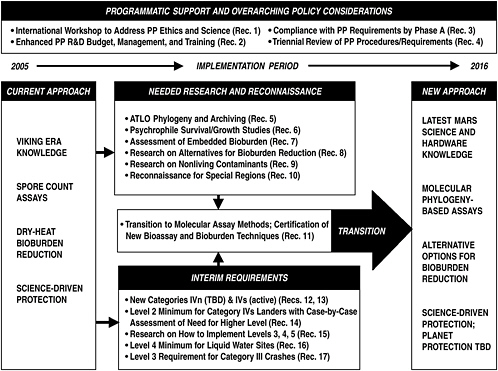
FIGURE 9.1 Proposed framework for a transition from the current approach to a new approach to Mars planetary protection (PP), along with the programmatic support and global policy considerations required to make the transition.
bioburden of all materials in Mars flight systems, as well as in the facilities within which the systems are assembled, tested, and ultimately launched—is necessary to assess which species are capable of surviving interplanetary transit and then growing in the Mars environment. Knowing which species are dead, or will die en route to Mars, is equally important. (Committee recommendations 1, 2, 5, 6, 7, and 10 pertain to objective 1.)
Objective 2: Definition and Development of Revised Requirements for Reduction of Bioburden
Characterization of the bioburden on spacecraft (objective 1) and the ability to target those microbial populations of greatest concern for contaminating Mars enable objective 2, review and revision of existing bioburden reduction standards in NASA’s requirements documents. Revised requirements will set limits on microbes based on understanding of the likelihood that these populations will either contaminate the Mars environment through growth or will confound life-detection measurements by their mere existence (dead or alive) on the spacecraft or in contact with the Mars environment. (Committee recommendations 1, 2, 8, 10, and 11 pertain to objective 2.)
Objective 3: Improvement of Bioburden Reduction Techniques
Alternatives are needed for bioburden reduction methods that more effectively reduce or eliminate species-specific bioburdens, or that place less stress on spacecraft and instrument components. Knowing what bioburden must be reduced and where is necessary to determining when and how bioburden reduction can be accomplished and maintained throughout all the physical systems associated with developing the flight system. However, to evaluate the effectiveness of objective 3, the process of improving bioburden reduction methods and testing alternatives can begin simultaneously with pursuit of objective 1, thus possibly reducing the time for transitioning to new methods. Perhaps the most likely microbial threats to Mars can be eliminated with bioburden reduction processes that are less stringent and possibly less costly than current practices—for example, processes such as lower-temperature heat sterilization. Knowledge of materials’ ability to tolerate alternative sterilization techniques was critical during development of the Viking heat sterilization process and will be similarly important in ongoing research efforts, given the availability of new spacecraft materials (plastics, composites, metals, etc.), as will additional information on exactly what is to be sterilized. (Committee recommendations 1, 2, 5, 6, 7, 8, 10, 11, and 15 pertain to objective 3.)
Objective 4: Validation of and Transition to New Standards and Techniques
Changes to policy and procedures for planetary protection proposed in response to the committee’s recommendations must be validated during a period of demonstration and testing before existing bioburden reduction requirements are replaced. Validation would also involve presentation of new requirements to COSPAR for acceptance. Once validated and certified, new approaches could then be applied with the confidence that they would work as expected, and old approaches could be phased out. Data obtained during this period of comparison could also be used to reassess the potential contamination that may already exist on Mars as a result of previous missions. A validation period could easily involve several Mars missions spanning several launch opportunities (i.e., more than 5 years), although the committee recommends that the implementation be fully operational by 2016. (Committee recommendations 1 through 11 and 15 pertain to objective 4.)
IMPLEMENTATION TIME LINE
Given the rapid advances in in situ science instrument capabilities and the possibility of contamination in a Mars environment potentially richer in water than previously believed, it is important to review and adjust Mars forward contamination requirements and procedures expeditiously. That said, the earliest chance to alter Mars planetary protection procedures and begin to demonstrate, verify, and validate new methods from the ground up would likely be on the next new (not yet in development) flight project, that is, the 2011 Mars Scout mission. Development of the next program-directed mission, possibly a Mars Sample Return mission to be flown in 2013, will probably also begin at the same time as development of the 2011 Mars Scout mission, because the sample return mission is expected to be more complex and to require more development time before launch. Hence, there will be an opportunity during FY 2008, when development of both the 2011 and 2013 Mars missions is expected to begin, to test and demonstrate the effectiveness of new bioburden reduction requirements and procedures being researched and developed in conjunction with objectives 1 and 3. A new, completely validated set of protocols for planetary protection employing advanced bioassay and bioburden reduction methods would more realistically be implemented on a mission developed for launch early in 2016. A transition to use of such protocols would have to be initiated no later than the beginning of FY 2012.
A proposed schedule based on these considerations, along with the development periods for all current and planned missions through the 2016 launch, is depicted in Figure 9.2.1 Note that the planned JPL Planetary
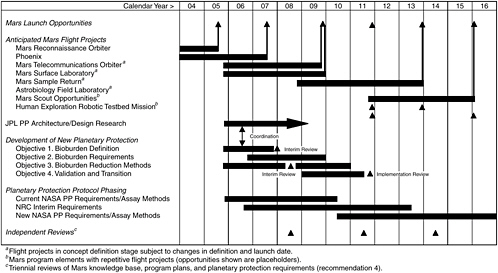
FIGURE 9.2 Proposed schedule for the revision of Mars planetary protection requirements. PP, planetary protection. NOTE: Launch schedule for future missions is based on information provided in Mars Science Program Synthesis Group, Mars Exploration Strategy 2009-2020. Jet Propulsion Laboratory, JPL 400-1131, 2004.
Protection Architecture/Design Research study represented in the center of Figure 9.2 shares several of the objectives of the approach outlined here.2 Coordination of the plan and schedule proposed in Figure 9.2 with the planned JPL effort is clearly warranted. At NASA’s discretion, this existing work might even be integrated with the approach and schedule suggested in this report.
Because the results of each objective discussed above feed into and affect subsequent objectives, periodic review of research progress by an independent panel is advisable (Recommendation 4). The results of research on characterizing bioburden, defining requirements, and developing techniques for reduction of bioburden must be verified, validated, and certified before new methods can be adopted as standard techniques. The committee recognizes, as a separate matter, the importance of maintaining a dialogue and interface with COSPAR and other entities to ensure concurrence on a process that would clearly change how NASA complies with globally acceptable planetary protection protocol.
This approach to modernizing Mars planetary protection clearly illustrates that changing NASA’s approach so that it embraces advances in microbiology along with current understanding of Mars cannot be done quickly. Even an aggressive plan such as the one outlined here will take the better part of a decade to complete and fully apply to the Mars Exploration Program.3 There is thus every reason to begin the pertinent work as quickly as possible.


