
G
Spacecraft Propellant and By-Products as Potential Contaminants
An important concern with respect to potential contamination is the release of propulsion exhaust products into the atmosphere and onto the surface of Mars, a process that necessarily occurs during any Mars entry, atmospheric flight/descent, and landing. The amount of exhaust products emitted can range from as little as a few kilograms (Pathfinder) to more than 30 metric tons (estimated for a human ascent stage). Two concerns arise: (1) Would contamination caused by the exhaust products of propulsion confound the measurement capabilities of a mission’s science payload? (2) Could this contamination sufficiently affect the global environment to irreversibly alter or mask important atmospheric markers of natural conditions?
PROPULSION-RELATED CONTAMINATION—BACKGROUND
Over the 32-year period from 1971 through 2003, 16 landers were launched to Mars, 8 by NASA, 7 by the Soviet Union, and 1 by ESA. Of these landers, 12 entered the Mars atmosphere, and 6 landed successfully and sent back data (see Table 1.1). The most successful landers include Viking 1 and 2 (1975 launch), Pathfinder (1996), and the Mars Exploration Rovers (MERs A/B) Spirit and Opportunity (2003). All of these landers used some form of retrorocket propulsion to reduce or cancel their surface impact velocity. Viking used a liquid monopropellant to achieve a soft landing, and Pathfinder and the MERs used solid rocket motors to reduce their impact velocity to levels that could tolerate the use of airbags.
The first and only known assessment of landing site contamination from rocket exhaust gases was performed experimentally, during the development of the Viking lander, in a specially designed test chamber using a full-scale, one-third model of the Viking lander, including a lander segment of one descent engine and one landing leg (Husted et al., 1977). The rocket exhaust gas testing was conducted in a Mars environment test chamber and simulated the actual descent motion of the vehicle and its landing on a simulated soil surface. Sample test cups holding soil samples were placed in strategic locations in the test chamber soil to collect any contamination from the rocket exhaust gas. Both of the test samples and the chamber gas were analyzed for contamination that may have resulted from the firing of the descent engine during multiple test runs. During the assessment, engineers changed the descent engine nozzle design (which was subsequently used on the Viking landers) to diffuse the exhaust and reduce soil erosion as the lander approached the surface. The results of chemical analysis of the soil samples showed measurable amounts of hydrogen cyanide (HCN), which were traced to aniline impurities in the Mil-Spec fuel. Switching to a purified hydrazine fuel eliminated the unwanted HCN, and that fuel has since been
the standard for all subsequent Mars soft landers to date, although tests also showed that the purified hydrazine would contaminate Mars landing sites with ammonia (50 to 500 ppm), N2 (5 to 50 ppm), and possibly a small amount of water (quantity not measured). The large amounts of ammonia trapped in the soil would make interpretation of organic analyses more difficult.1 The results of the rocket exhaust assessment also led to the conclusion that, for the Viking mission, the combined effects of plume gases, surface heating, surface erosion, and gas composition resulting from the use of retrorockets would not interfere with the planned biology investigation (Husted et al., 1977).
The rocket exhaust study conducted for the Viking mission also addressed gas dissipation from the soil after landing (actually release and diffusion), because measuring the chemical composition of the atmosphere (especially the presence of less abundant species to accuracies of 100 ppm) was another mission objective. The Viking Molecular Team set as criterion that exhaust gas contamination at a concentration above 10 ppm be permitted to exist for no more than 2 days after landing. That period was considered to be sufficient for diffusion of the plume gases (actually calculated to be 2.7 days, but any minor wind or air movement will decrease the amount of time) (Husted et al., 1977).
No subsequent comprehensive analyses for retrorocket contamination have been performed. The Viking assessment results have served as the ad hoc basis for all subsequent NASA Mars soft-lander missions, that is, Mars Polar Lander, Mars ’01 (not flown), and Phoenix (in development). Furthermore, the use of solid retrorockets on Pathfinder and MER A/B, which emit very different exhaust products (including aluminum oxide and carbonaceous compounds from pyrolysis of the ethylene propolyne diene monomer rubber case insulation), has not been assessed as a potential source of contamination because those landers came to rest quite a distance from the location of the terminal retrorocket burn.
POTENTIAL CONTAMINANTS FROM FUTURE MISSIONS
NASA’s Mars Exploration Program has planned a series of landing missions that will follow the Phoenix Lander mission in 2007 (see Chapter 3). The Mars Science Laboratory (MSL) mission in 2009 will be a nuclear-powered rover with an order-of-magnitude more payload (50 kg, 10 instruments) and enhanced capability as compared with the MERs. MSL will employ a unique “sky-crane” landing system that will allow it to lower the rover on a tether to the surface while hovering on retrorockets and then fly away from the landing site (see Figure G.1). Follow-on landers such as the Astrobiology Field Laboratory and Mars Sample Return (MSR) missions will most likely use this sky-crane landing system. The sky crane is expected to use hydrazine retrorockets as did Viking, but it may have throttled engines rather than pulsed engines, which would reduce potential disturbances of soil.2 Nonetheless, the sky crane will require larger loads of hydrazine propellant for their payloads (200 kg compared with 85 kg for Viking) and will at least temporarily contaminate the atmosphere surrounding the landing site.
The first stage of the planned Mars Ascent Vehicle (MAV) of MSR missions poses another possibility for contamination of the rocket site and atmosphere. Current designs use a solid motor first stage that ignites at the surface and burns to an altitude of approximately 15 km. Whether or not the resultant contamination would be tolerable, given that the sample would already have been collected, would likely depend on whether any subsequent surface investigations were planned to be conducted after the ascent stage launch and on the nature of the atmospheric contamination by the rocket during launch.
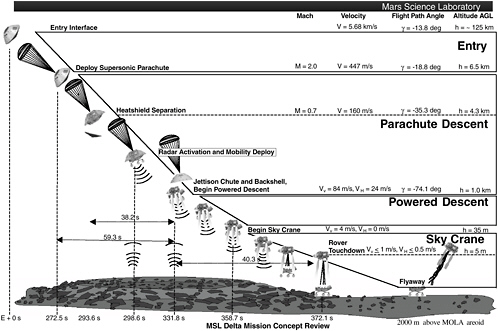
FIGURE G.1 Mars Science Laboratory nominal entry, descent, and landing using a sky crane for terminal descent. SOURCE: Mars Science Laboratory Project Office, Jet Propulsion Laboratory, July 2004.
Finally, various concepts for future missions within the Mars Exploration Program include significantly more capable long-range exploration missions involving, for example, robotic outposts with reusable regional transport systems (e.g., Mars airplanes) and human missions to Mars (see Chapter 2). For such missions, a much more capable propulsion system is desired in order to have manageable propellant loads. One system that appears favorable and within technology development capabilities would use liquid oxygen (LOX)-methane (CH4) propellants in a cryogenic system that could double the payload launched from Mars (using the same propellant mass) as compared with the payload mass that can be launched by using hydrazine propellant. The LOX/CH4 system is also of interest because the propellant can be manufactured in situ in Mars’s atmosphere (by electrolysis of constituents there with hydrogen feedstock). Exhaust products from this system are primarily CO, CO2, and H2O, gases that in reasonable quantities will not be considered contaminants of the Mars atmosphere. However, accidental release of the produced methane fuel might be another matter (e.g., confounding local atmospheric trace gas measurements), especially given the quantities of propellants required for human missions (e.g., >6 metric tons of methane for a Mars ascent stage for humans; MSFC, 1991).
Table G.1 presents a brief summary of the amount and types of exhaust products that could result from the use of particular propellants for future lander missions to Mars. As is apparent from these data, the combination propellants (involving use of more than one kind of propellant) all emit water and various other compounds, usually including carbon monoxide and carbon dioxide. The committee is not aware of any analyses or planned studies of the potential for contamination by exhaust products that might be associated with the types of future missions discussed for NASA’s Mars Exploration Program.
TABLE G.1 Examples of Possible Amounts and Composition of Mars Surface Mission Propellant Exhaust Products
|
Missions > |
Phoenix |
MSL |
MSR Lander |
MSR MAV |
Mars Airplane |
Ascent Stage for Humans |
|
Propellants > |
N2H4 |
N2H4 |
N2H4/N2O4 |
NH4ClO/Al/HTPB |
MMH/N2O4 |
CH4/O2 |
|
Typical > Propellant > Masses (kg) > |
35 |
250 |
250 |
160 |
40 |
30000 |
|
Exhaust Products (kg) |
||||||
|
H |
|
|
|
0 |
|
2 |
|
H2 |
2 |
17 |
7 |
3 |
1 |
122 |
|
HO |
|
|
|
0 |
|
26 |
|
H2O |
|
|
90 |
15 |
9 |
13533 |
|
O |
|
|
|
|
|
0 |
|
O2 |
|
|
|
|
|
5 |
|
N2 |
21 |
152 |
153 |
14 |
17 |
|
|
NH3 |
11 |
81 |
0 |
|
|
|
|
CO |
|
|
|
31 |
3 |
2762 |
|
CO2 |
|
|
|
7 |
10 |
13551 |
|
Cl |
|
|
|
0 |
|
|
|
ClH |
|
|
|
35 |
|
|
|
Al2O3 |
|
|
|
54 |
|
|
|
SOURCE: Data provided by J. Niehoff and G. Chew of SAIC using the Air Force Chemical Equilibrium Specific Impulse Code, a rocket exhaust products chemical equilibrium code, August 2004. |
||||||
REFERENCES
Husted, R.R., I.D. Smith, and P.V. Fennessey. 1977. Site Alteration Effects from Rocket Exhaust Impingement During a Simulated Viking Mars Landing. NASA CR-2814. NASA, Washington, D.C., March.
MSFC (Marshall Space Flight Center) Technical Study Team. 1991. Mars Transportation System. Doc. No. 5-130-0-5. MSFC, Huntsville, Ala., March.


