
1
A Vision for Russia’s Future
A concerted global effort is needed to combat naturally occurring and intentionally introduced infectious diseases that can cause severe illnesses, disability, and death. In recent years, West Nile encephalitis, severe acute respiratory syndrome (SARS), monkey pox, and avian influenza have been but the latest diseases that have dramatically raised U.S. and international concerns over the need to strengthen both early warning and response systems throughout the world. At the same time, criminal elements have contaminated the U.S. postal system with anthrax spores, underscoring the reality of bioterrorism. Thus, we cannot delay in taking bold steps to minimize the threats from pathogenic microbes and ensure that these resilient, dangerous foes do not overwhelm public health systems, disrupt food supplies, devastate economies, or create uncontrollable anxieties among populations.
Russia, with its vast ecological diversity and a large, well-trained scientific workforce, should be a leader in efforts to prevent, detect, and respond to the emergence and resurgence of infectious diseases, at home and abroad.
In addition to the aforementioned threats, many other infectious agents pose serious problems in Russia. The rapid growth in HIV/AIDS cases in Russia is of worldwide concern and could have a devastating effect on the population (see Box 1.1). Tuberculosis has also spread rapidly in recent years. Hepatitis A, B, and C and cholera challenge health authorities, and tick-borne encephalitis and other tick-borne diseases have changed the Russian tradition of walking in the forests. Influenza, chicken pox, and scarlet fever have had a negative economic effect in Russia. Plague, tularemia, and hemorrhagic fever are also frequently encountered. In the agriculture sector, brucellosis, rabies, and foot-and-mouth disease
|
BOX 1.1 An estimated 860,000 people were living with HIV in Russia at the end of 2003, fully 80 percent of them were between15-29 years of age and more than one-third of them were women. HIV prevalence is increasing steadily. Infection levels among pregnant women have risen from less than .01 percent in 1998 to .11 percent in 2003. At the heart of the country’s epidemic are the extraordinarily large numbers of young people who inject drugs and have active sex lives. In early 2004, more than 80 percent of all officially reported HIV cases were drug injectors. SOURCE: AIDS Epidemic Update, UNAIDS, and WHO (December 2004). |
are too often found on Russian farms (Onishchenko, 2002; Pokroksky, 2002:5; WHO, 2003).
RUSSIA’S UNIQUE CHARACTERISTICS
Although the public health situation in Russia is clearly similar to that in other industrialized nations, Russia faces several unique challenges in safeguarding public health and protecting its agriculture. The physical environment of Russia, in which diseases emerge and spread, geographically stretches across 12 time zones and 4 ecological zones, producing infectious agents that vary widely in type, frequency of occurrence, and persistence. Russia has densely populated industrial regions with well-established public health infrastructures, manufacturing centers in sparsely populated areas with limited support services, and vast agricultural regions. This diversity complicates the government’s ability to provide adequate protection from outbreaks of diseases across different regional settings.
Second, as Russia evolves from being a centrally managed but relatively prosperous nation to having a free market economy, social and economic upheavals continue to cause problems. Disruptions in living patterns and in the availability of health services have increased the susceptibility of large segments of the population to disease. Additionally, the sharp erosion of the technological base for the manufacture of drugs, vaccines, and medical devices has opened the door for a large influx of foreign products that now inhibit the recovery of a Russian pharmaceutical industry capable of producing cheaper and better products.
In recent years, the budget of the former Ministry of Health (now incorporated into the Ministry of Health and Social Development) has been slowly growing (see Figure 1.1), but it is still small relative to the needs of the population.
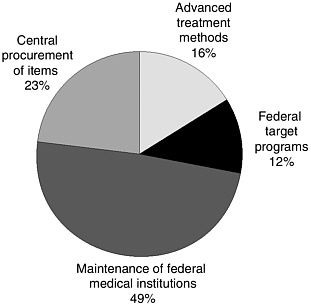
FIGURE 1.1 Allocation of federal budget to support Ministry of Health and Social Development, Russia. SOURCE: Ministry of Health and Social Development, 2004b.
Further, responses to concerns over bioterrorism are placing additional strains on the budget. Appendix G describes the strategy of health officials to combat bioterrorism, and Appendix H presents a broader Russian view of responses needed to address that threat.
GOALS FOR CONTROLLING INFECTIOUS DISEASES
Despite these difficulties, a realistic, ten-year goal for Russia is the evolution of a stronger, more flexible public health system that is increasingly integrated into the global community. This evolution will continue even as Russia responds to endemic and emerging diseases, including zoonotic diseases. For example, an enhanced public health system could contribute to more effective utilization of disease prevention measures and more effective control of arthropod vectors and animal populations that serve as reservoirs for human diseases. In time this should result in a significant reduction of vaccine-preventable and drug-curable infections in both humans and animals across Russia. On a broader scale, Russian achievements would make greater contributions to a more effective global approach to combating infectious diseases as improved and enhanced international cooperation develops.
To achieve this goal of a more robust public health system, the committee recommends strengthening Russian policies and programs by:
-
focusing on surveillance, laboratory diagnostics, and the development of counter-measures (e.g., drugs, vaccines) capable of addressing diseases in the broadest sense
-
improving capabilities to detect and diagnose new, reemerging, and antibiotic-resistant pathogens in both rural and urban settings and upgrading communication systems to provide timely and accurate information
-
enhancing disease surveillance, encompassing affected species of significance
-
monitoring food and water supplies for safety and potability
-
supporting well-focused research projects that strengthen the base of fundamental scientific knowledge
-
strengthening programs to facilitate the commercialization of scientific findings within a regulatory framework that supports public health and the protection of agriculture
-
developing an improved understanding of the relationships between infectious agents and important chronic diseases, a priority of growing international interest
-
supporting the emergence of a strong biotechnology sector that enhances efforts to combat infectious diseases affecting the Russian population
-
developing and implementing effective security procedures at the hundreds of facilities that can propagate, store, or distribute pathogens that, if diverted, could be used for bioterrorism; an important initial step is to conduct a careful nation-wide inventory of the many collections in Russia and consolidate collections where appropriate
-
promoting broad transparency of Russian research and health-prevention and control activities involving dangerous pathogens in order to reduce international apprehensions regarding the possible misuse of Russian research or unauthorized diversion of infectious agents, with comparable transparency also expected in other countries
-
recruiting, training, and retaining an expanded cadre of biomedical scientists, medical doctors, veterinarians, plant pathologists, epidemiologists, and other relevant specialists who are equipped with modern technology and positioned to deal with infectious disease threats.
As noted before, Russia has well-established institutions that are needed to support the achievement of these objectives. Even though many relevant scientific and operational capabilities have declined over the past decade, some institutions have maintained their long-standing ability to protect the health of the Russian population. The structure into which their institutes are integrated is
described below; it is the point of departure in responding to both current and future challenges.
-
The Ministry of Health and Social Development, Ministry of Agriculture, Ministry of Education and Science, Ministry of Economy, several other government bodies, and the State Duma develop government strategies, policies, and funding priorities for health-related and agriculture-related research programs. They also develop regulatory and inspection requirements, and promote the science and business environments in Russia.
-
A nationwide network of 2,300 State Sanitary Epidemiological Surveillance Centers monitors and reports disease trends and outbreaks. These centers, which have been under the direction of a special organization within the framework of the Ministry of Health and Social Development and its predecessors for many decades, are designed to provide a unified approach to monitoring and reporting.
-
Numerous agricultural institutes and related stations under the purview of the Ministry of Agriculture and the Academy of Agricultural Sciences monitor animal and crop diseases. They, too, should provide a unified approach to monitoring and reporting.
-
Numerous public sector research units that employ tens of thousands of scientists dedicated to fundamental and applied research are relevant to combating human and agricultural diseases. They are dispersed across various government bodies, within the frameworks of academies of sciences, and at centers associated with higher education institutions.
-
The Pharmaceutical Committee approves all drugs, vaccines, and other medical products for human use that are domestically produced or imported into Russia. An analogous committee approves agricultural products.
-
Laws have been enacted and dozens of committees have been established to address the biosafety aspects of genetically modifed organisms. Profitable commercial activities have not yet emerged, however.
-
Newly enacted laws provide the Russian Patent Agency with new authority to protect intellectual property as the court system begins to handle patent infringement cases.
-
Dozens of university-level educational institutions are dedicated to training specialists in medicine, biology, epidemiology, veterinary sciences, plant sciences, and other fields important for controlling infectious diseases.
Despite the existence of this complex structure, almost all of the above-mentioned institutions urgently require enhanced capabilities. New laws and regulations need further development and more effective enforcement. Even though the outstanding achievements of Russian leaders and specialists in bioscience and biotechnology are numerous, many institutions suffer not only from
|
BOX 1.2 “In Russia, copyright protection virtually does not work. In rare instances when researchers receive a worthwhile reward for a new drug, it is not a result of a legal mandate or requirement. It is the result of a personal agreement (not legally documented in any way) with the manager (owner) of the manufacturing company or as a result of the inventor’s leverage to control the production flow (in particular, when the inventor can terminate the production at his own volition).” SOURCE: Russian bioresearch manager (November 2004). |
financial difficulties but also from a legacy of favoritism and excessive central control that inhibit initiative and effectiveness. Some have serious shortages of qualified and motivated personnel. Others have shifted their attention from serving the needs of the public to the search for immediate commercial success. Still others have taken shortcuts, fulfilling their obligatory commitments in less than an adequate manner.
Many additional challenges remain. Much of the laboratory equipment for disease surveillance and related research is now obsolete. Russian specialists have been forced to become remarkably skilled in making the best of antiquated equipment. Enforcement of regulatory requirements covering the development and distribution of health-related products is often inconsistent. Sometimes enforcement is excessive, and sometimes it is non-existent. New intellectual property laws are only now being tested in the Russian courts and are frequently ignored (see Box 1.2). The Russian biotechnology industry is in its earliest stages of development, and few investors are prepared to enter an arena plagued with corruption, bureaucratic delays, and other obstacles. Finally, because of the depressed job market for scientists, only a low percentage of university biology graduates (less than one-third at some institutions) pursue scientific careers.
The remainder of this report suggests specific steps that can be taken by Russia, with support from international partners, to help transform the vision of today into the reality of tomorrow.


