
5
Pillar Four: The Human Resource Base
To be effective, the health, agricultural, and scientific infrastructures of any country must be built around capable and well-trained personnel. These professionals are called upon to perform diverse tasks such as identifying pathogens, engineering DNA, developing databases, reporting diseases, investigating epidemics and conducting epidemiological analyses, undertaking vaccination campaigns, inspecting restaurants and catering facilities, testing water systems, preparing patent applications, perfecting marketing tactics, and attracting venture capital. They also inform the public of health threats and recommend personal and community-based precautions during consultation sessions and through the media. But many complementary skills are also needed to safeguard public health.
In short, scientists are a key component, but not the only component, of the bioscience and biotechnology workforce; and the emphasis of this chapter is on scientists.
RETAINING SKILLED PROFESSIONALS
Soviet scientific and engineering capabilities were exceptionally strong. Indeed, the excellent undergraduate and graduate training at the university level was a tremendous asset during the Soviet era. Early in the post-Soviet transition, the Russian government had hoped to retain well-qualified professionals in their positions and to continue the tradition of high-quality education.
Yet with the economic decline in Russia and the widespread realization that sufficient salaries were essential to survive in a market economy, interest in science quickly declined, both among working scientists and among potential
new entrants who were completing their training at the university level. Engineers often fared better financially than scientists because they could use their skills to address maintenance and other related practical problems facing the population. Also, they seldom encountered the types of regulatory issues that increasingly encumbered biomedical researchers and scientific entrepreneurs.
As shown in Figure 5.1, many Russian specialists and graduating students with skills relevant to infectious diseases have been changing their career tracks. Also, some of the best science students and young researchers have been relocating abroad. An indication of the total number of postgraduate students who have skills relevant to infectious diseases is shown in Table 5.1. The pool appears to be substantial. But the available statistics do not indicate the number of these students who are seeking shelter from the military draft or who are simply interested in the
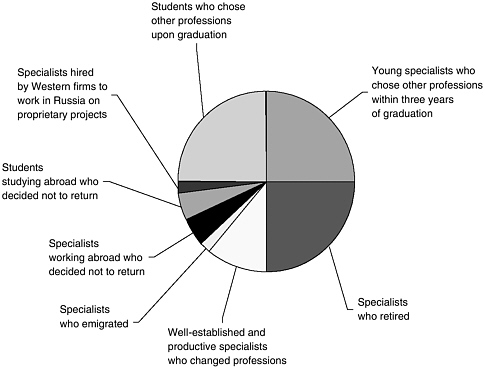
FIGURE 5.1 Loss of doctors, scientists, engineers, and students with skills relevant to infectious diseases who gave up their specialties in Russia in 2001.
NOTE: Estimates are based on available data published by the Russian government and on discussions with Russian authors of relevant statistical analyses, specialists of the Russian Academy of Sciences, and senior U.S. visa officials in Moscow. The annual loss of professionals and students has been estimated at 5,000 from a workforce of 100,000. SOURCE: Adapted from Schweitzer, 2001. Reprinted with permission of Cameron Publications Services.
TABLE 5.1 Postgraduate Studies in Five Fields Relevant to Infectious Diseases: Russia, 1999-2001
|
|
Enrollment |
Entrants |
Graduates |
||||||
|
1999 |
2000 |
2001 |
1999 |
2000 |
2001 |
1999 |
2000 |
2001 |
|
|
Biology |
4,955 |
5,589 |
5,917 |
1,674 |
1,913 |
2,006 |
1,119 |
1,354 |
1,338 |
|
Agriculture |
3,074 |
3,118 |
3,219 |
1,001 |
1,116 |
1,160 |
755 |
834 |
814 |
|
Medicine |
7,125 |
7,783 |
8,689 |
2,536 |
2,753 |
2,902 |
1,611 |
1,671 |
1,820 |
|
Pharmacy |
224 |
234 |
255 |
75 |
78 |
97 |
49 |
59 |
51 |
|
Veterinary |
918 |
954 |
998 |
331 |
324 |
344 |
173 |
213 |
237 |
|
SOURCE: Ministry of Industry, Science, and Technology, and Russian Academy of Sciences, 2003. |
|||||||||
prestige associated with a scientific degree, motivations that are strong in Russia. Further, the statistics do not distinguish between the outflow of specialists from different disciplines. For example, there is anecdotal information that suggests molecular biologists are more likely to give up their professions than medical doctors who have greater opportunities to supplement their core incomes. In short, there is a serious problem in retaining a balanced and highly motivated scientific workforce.
At present, senior officials of the Russian government and leaders of the scientific community are greatly concerned about the “lost generation” of scientists and engineers. This is a result of declining interest in science during the early and mid-1990s, a decline which is still evident. The problem is particularly acute in the biological sciences.1 For example, within the institutes of the Russian Academy of Medical Sciences, about 60 percent of researchers are over age 45; 25 percent are under 30; and only 15 percent are between 30 and 45. Research productivity of the older generation is gradually declining, and the younger generation is still developing its capabilities.2 Thus, expectations for the overall effectiveness of the workforce have often been unrealistic, given the low proportion of those researchers who are in the prime of their careers.
The slow development of management skills relevant to the demands of a market economy in Russia has also become a perennial concern (see, for example, Zinov, 2003:37). As noted in Chapter 4, successful entrepreneurship in the pharmaceutical/biotechnology sector is an important but scarce commodity. Many leaders of state-owned enterprises in the health and agricultural sectors have not adjusted well to the new market economy, and the number of successful directors of commercially viable small and medium-size enterprises associated with research institutes or operating independently is small.
Realizing profit from commercial endeavors in the biotechnology sector is complicated, as discussed in Chapter 4. Legal and economic skills are often more important than scientific skills. Although the Russian government and foreign organizations have tried repeatedly to establish effective management training programs in Russia, the most successful training has frequently been on-the-job training offered by Western companies with facilities in Russia. As for managers of research institutes, the gap between their limited knowledge of the market economy and authoritative insights of their Western counterparts is significant. But much of the Western experience is not directly transferable to the Russian environment.
As for university-level technical training, Moscow State University, Sechenov Moscow Medical Academy, and Russian State Medical University are usually identified as the preeminent educational institutions for preparing future biomedical personnel. The Skryabin Academy for Veterinary Sciences and Biotechnology in Moscow is ranked highly for training new specialists to study animal diseases. In plant protection, there is no easily identifiable leading educational institute. Overall, Russia has more than 50 university-level institutions in the biomedical field and more than 30 veterinary schools associated with agricultural universities. Also, schools of pharmacy, plant protection, food safety, and other relevant disciplines are located in the more than 100 universities that include science and medical specialties. (An extensive listing of the relevant university-level institutions is contained in Buga et al., 1994).
For decades, university-level education has been linked to activities at research institutes because few universities have strong research capabilities. But only a small fraction of science students are able to take advantage of these links. For example, at the Skryabin Academy only a half-dozen of the 400 faculty members have active research programs that involve students. A handful of additional students spend time at research institutes, usually as graduate or postgraduate students. Overall, the very limited opportunities for students to participate in research activities should be expanded as the need is great. A representative of the department of the Russian Academy of Medical Sciences responsible for research on infectious diseases reported to the committee that about 30 postgraduate students are accepted at the 12 institutes of the department each year, but at the same time 10–20 junior scientists leave Russia each year after defending their dissertations at these same institutes. Thus the influx of new talent is small by any measure.
A NEW GENERATION OF SCIENTIFIC LEADERS
Against this background, the committee gives high priority to the nurturing of a new generation of young scientists and leaders in the basic and applied sciences and technologies who will be essential in the advancement of infectious disease prevention and control. To this end, programs that encourage
postdoctoral scientists to remain in Russia as practicing scientists through mentoring programs that prepare them for positions of scientific leadership deserve strong support.
As we have seen, the incentives for outstanding young scientists to abandon their scientific careers for more lucrative professions such as banking and trading, or to go abroad in search of better working conditions, are strong. The gaps they leave behind will continue to disrupt research activities long into the future. In the absence of new research, financial, and housing incentives for young scientists to continue to pursue scientific careers in Russia, the outflow will be extensive.
The Russian government has taken a positive step on a limited scale with a portion of federal research grants designated for support of young scientists. Modest success in attracting outstanding young scientists has been noted during the past several years, particularly in the prestigious field of biotechnology. However, while a few institutes with interesting and promising programs are able to attract talented graduates despite low salaries and difficult living conditions, most institutes are not as successful.
Another approach that might have a significant influence on the situation is for both Russian and Western governments to provide financial support for those institute directors prepared to use their own resources on a matching basis to improve working conditions and create long-term career trajectories. Such an approach would help ensure that young talented scientists, when recruited, would be placed in positions where they have strong opportunities to obtain permanent employment status. A related innovation would be to establish a program of reentry grants of sufficient size to encourage young scientists to return to Russia upon completion of training abroad.
As a second initiative, the committee recommends expansion of programs to continually advance the professional skills of specialists in fields related to infectious diseases, and particularly skills in addressing multidisciplinary challenges. Advanced training could be offered at leading research institutes in Moscow and in other major cities on a more systematic basis than has been the case in recent years. Of particular interest would be advanced training at the two model surveillance centers recommended in Chapter 2. Many Russian specialists have fallen behind in their professional skills simply because they have not had modern equipment or broadband access to information on the Internet. At other times, they have been isolated from international developments, and their skill levels have suffered accordingly. Opportunities for young Russian specialists to have hands-on training experiences at international centers in Europe and the United States could also be of considerable importance.
Important steps in these directions are already being undertaken by the Russian biomedical community, and they should be supported. For example, special courses organized by the Ministry of Health and Social Development provide opportunities for hospital physicians concerned about infectious diseases and other ailments to extend their specializations under the supervision of leading
Russian experts. International scientific schools and seminars in the biomedical sciences are organized annually in Russia. In addition, many collaborating centers of the World Health Organization in Russia offer refresher training for specialists in relevant fields.
Four other approaches beyond these two recommendations are also worthy of consideration: (1) placing postgraduates in Russian and international companies to help implement applied research projects under the joint supervision of their professors and senior company personnel; (2) initiating two-way exchange programs of mid-career scientists between research institutes and biotechnology companies; (3) providing specially-designed business training courses for research managers that reflect both Western experience and Russian realities; and (4) supporting professional organizations working in bioscience and biotechnology such as the Society of Epidemiologists, Microbiologists, and Parasitologists; the Society of Virologists; the Society of Biotechnologists; and the Union of Biotechnical Industry Enterprises.
Such approaches have occasionally been attempted in Russia. For example, the agriculture-oriented firm NARVAC employs outstanding students on a regular basis and works closely with educational institutions. This approach provides a privately owned research-oriented company as a home base for rising biotechnology leaders.3
Finally, there are also special needs for basic and advanced training in epidemiology, which is a rapidly developing field worldwide. Russian colleagues report that 4,306 epidemiologists, 515 parasitologists, 4,585 bacteriologists, and 239 virologists were conducting work related to epidemiology in Russia in 2000. In recent years, the workforce has been relatively stable, and these figures probably have not changed significantly (Onishchenko, 2002). Russian colleagues therefore suggest that Russia may have sufficient numbers of specialists in these fields and that the emphasis should be on training to ensure quality and effectiveness. It also seems appropriate for the specialists to be encouraged to impart their scientific expertise to local medical personnel as well.
In conclusion, Russian science and technology have much to offer the world as has been demonstrated in recent years. Attracting and retaining highly trained and well-motivated personnel are the central ingredients of Russia’s expanded participation in international scientific activities and entry of its products into global markets. Yet as underscored previously, even if Russian scientists have concepts for new products, an entire team of factory managers and quality control specialists, accountants, and lawyers must lead the transformation of brilliant ideas into useful products. One way to promote this team concept might be to incorporate a component for improving the skills necessary to have more effective market-oriented teams into externally funded research and development projects.


