
5
Overall Assessment
This chapter presents an overall assessment of the FreedomCAR and Fuel Partnership, summarizing not only its main achievements thus far, but also the main barriers that remain before the goals of the program can be achieved. Many of these issues are discussed in the preceding chapters. The chapter ends with the committee’s observations on the adequacy, balance, and funding of the program.
The committee believes that research in support of the Partnership’s vision is justified by the potentially enormous beneficial impact for the nation. At this early stage, no insurmountable barriers to achievement of this vision have been identified, but several critical components of the program have been noted. Specific, quantitative technology and cost goals for 2010 and 2015 have been established by the technical teams. These goals bear on each important element of the program, and the current status of the program relative to these goals is discussed in the body of this report. In view of the large number of unknowns and the need for breakthroughs, the committee does not feel that it is appropriate or useful at this time to speculate on the probability of this program achieving its long-term vision according to its current plan. Funding levels and the consequent research results during the next few years should allow future reviews to make a more firmly based assessment.
MAJOR ACHIEVEMENTS AND TECHNICAL BARRIERS
Major Achievements
Identifying the major achievements associated with the FreedomCAR and Fuel Partnership is challenging, primarily owing to two factors that make this
program different from most other government-sponsored programs: (1) many of the technical activities are continuations of activities that began under the Partnership for a New Generation of Vehicles (PNGV) program (or, in some cases, even before the PNGV) and (2) the program is envisioned to be a multidecade program involving not only many technologies but technological challenges ranging from those that will probably be solved soon to those that may never be solved. Even so, there are many noteworthy achievements, both technical and nontechnical, that should be acknowledged.
Nontechnical Achievements
Nontechnical achievements are extremely important, because they provide the mechanisms for pursuing hopefully successful outcomes to the technical challenges. Among the more significant of the nontechnical achievements are these:
-
The overall strategy and implementation plan. The plan is well thought out and well executed.
-
Active and continuing participation by both energy companies and automobile manufacturers. Such participation is essential for any hope of identifying and solving the most critical problems and, ultimately, reaching the long-term goals.
-
The formation of numerous expert technical groups (technical teams). Experts from government and industry are working together to identify the needed research and help advance specific technologies.
-
The creation of a priority activity to minimize the potential negative impact of inconsistent, or nonexistent, codes and standards. This often-neglected activity is essential for the success of any pathway to the widespread production, transportation, storage, and utilization of hydrogen as a transportation fuel.
-
sive plan. The plan includes short-term, mid-term, and long-term goals as well as roadmaps—some complete, some still in draft form—for pursuing these goals.
-
The emergence of more comprehensive cost models. Cost is a barrier to the widespread acceptance of virtually every new technology being pursued, so realistic, viable cost models are extremely important.
-
The decision to create hydrogen storage centers of excellence that are expected to be working this year (2005).
-
The establishment of the International Partnership for the Hydrogen Economy. This partnership is a worldwide collaboration on hydrogen technologies involving 15 countries and the European Commission.
-
The convening of workshops to address essentially all of the more challenging technologies in the program.
-
The establishment of an independent hydrogen storage test facility at the Southwest Research Institute.
-
The initiation of basic research programs. Research has started on the direct production of hydrogen from biological systems and from solar energy, and work on high-temperature nuclear heat processes for hydrogen production is being expanded.
Technical Achievements
Modest evolutionary achievements are evident in every area of technology being pursued. The technology areas include those associated with the advanced internal combustion engine (ICE), hybrid electric vehicles (HEVs), and fuel cell vehicles, all of which loosely correlate with the short-term, mid-term, and long-term goals of the program. The achievements include these:
-
Gaining a better understanding of low-temperature combustion in ICEs and of the processes that produce emissions through sophisticated experimentation. This better understanding could lead to higher efficiency as well as lower NOx and particulate production for both advanced ICE and hybrid vehicles. Early tests at 20 percent power have shown NOx and soot reductions of 90 percent and 20 percent, respectively.
-
Developing effective computer codes for vehicle systems analysis. Clearly, the ability to perform virtual evaluations and comparisons is a desirable alternative to building and testing actual hardware and systems. Continuing improvement in modeling and systems analysis will benefit every aspect of the program.
-
The TIAX cost model shows the projected cost of compressed hydrogen automotive fuel cell systems (high-volume production) has been lowered from $275/kW (2002) to $175/kW (2004). Note, however, that the committee has not been able to validate these TIAX projections and that questions exist about the absolute values.
-
Lowering the projected cost of baseline 25-kW lithium ion battery systems from $1,750 and $70/kW (1999) to $1,200 and $48/kW (2003).
-
Advances in many of the longer-term technologies associated with fuel cell components, onboard hydrogen storage, and electrochemical energy storage. Unfortunately, none of these advances is a breakthrough, and breakthroughs are clearly needed at some point for these technologies to become viable.
Technical Barriers
Technical barriers are difficult to quantify. The program is very broad: Efforts range from hydrogen production and distribution to mass-produced, fuel-cell-powered vehicles. Further, the timescale for achieving various program goals
range from relatively near term to 20 years or more into the future. The truly formidable technical barriers are those associated with two long-term goals: the extensive use of hydrogen as a transportation fuel and making fuel cells a viable option for powering transportation systems. It should be noted that the long-term goals of the FreedomCAR and Fuel Partnership are “energy freedom,” “environmental freedom,” and “vehicle freedom” rather than hydrogen fuel and fuel cell power systems per se, but thus far, these are the only options being pursued to achieve those goals. The technical barriers arise in almost every aspect of achieving widespread distribution of affordable hydrogen and in almost every aspect of devising fuel cell technologies for eventual commercialization. However, impressive progress has already been made in these areas, and the timescale is such that much more progress can be expected.
Technical Barriers for Nearer-Term Goals
The nearer-term technical barriers are mainly those associated with improving ICE vehicles and greater market penetration for hybrid vehicles. Among the more significant of these barriers are the following:
-
Affordable lightweight, high-strength materials. There have been several candidates to replace steel. The continuous casting of aluminum sheet has not been commercialized, and the cost of carbon fibers for the reinforcement of composites remains unacceptably high.
-
Improvements in the thermal efficiency of ICEs, with concurrent reductions in emissions and particulates. Current experimental efforts are expanding our understanding of the low-temperature combustion processes applicable to both spark ignition and compression ignition engines, but the ultimate goals have not been met.
-
Lower cost, more compact electrochemical energy storage. Batteries are essential components of most hybrid vehicles and are likely to be for fuel cell vehicles as well. They add weight and increase costs relative to nonhybrid vehicles. Current efforts are directed primarily at lithium batteries, which seem to have the most promise for the needed advancements.
-
Lower cost, more compact electric drive motors and power electronics. Advances are needed to gain wider acceptance for hybrid vehicles and to hasten the deployment of fuel cell vehicles.
-
Hydrogen production technologies and infrastructure for potential transition to a widespread system featuring hydrogen as the fuel for transportation.
Technical Barriers for Longer-Term Goals
Although it is possible that other alternative fuels and energy conversion technologies might emerge, the present vision is to realize the widespread envi-
ronment-friendly production of affordable hydrogen for vehicles powered by affordable, driver-friendly fuel cell systems. The realization of the hydrogen vision appears to be necessary but not sufficient to ensure the emergence of mass-produced fuel cell vehicles. On the other hand, the hydrogen vision could conceivably be realized even if the goal of fuel-cell-powered vehicles is not, since hydrogen can be used to produce power in combustion engines. That makes the infeasibility of widespread and affordable hydrogen a primary (but certainly not the only) barrier to the success of fuel cell vehicles.
Barriers to Fuel Cells Other barriers to the successful deployment of fuel cell systems for transportation include cost and performance. The most recent cost projection, which assumes mass manufacture, is about $125/kW ($175/kW including compressed hydrogen storage), roughly four times the cost goal of $30/ kW (not including hydrogen storage) (TIAX, 2004). A number of areas are being pursued for potential cost savings, including the reduction or replacement of precious metal catalysts; less expensive, more durable membrane materials; and reductions in other material and production costs for membrane-electrode assemblies.
Performance barriers generally include factors that would result in operational behaviors inferior to competing ICE vehicles. Among these are start-up times of 1 minute instead of 30 s; possible damage when vehicles are parked at subfreezing (−40°C) temperatures; slow transition times from idle to full power; and unacceptably short expected operational life.
While overcoming the barriers associated with costs and performance is a formidable task, there is no reason to believe they cannot be overcome. Indeed, research activities are under way and progress has already been recorded in each area. Further, the program timescale is long enough that carefully considered approaches to resolving the various issues can be undertaken.
Barriers Associated with Hydrogen At this point, virtually everything associated with the production, distribution, and onboard storage of hydrogen for personal transportation use faces significant barriers. Since hydrogen does not exist naturally in significant concentrations on Earth, it must be produced by extraction from other substances containing hydrogen, such as (but not limited to) hydrocarbons (natural gas, petroleum, coal, etc.) and water. Typically, extraction ensures that the energy produced will be less than the energy value of the source material plus the energy required to produce it. Thus the cost of hydrogen at the fueling station is, and is likely to remain, a barrier. Many biological and electrochemical processes are being pursued to reduce costs, but the technologies are very immature and the probability of success is unknown. Also of great concern is the CO2 that would be produced when using fossil fuels, especially coal, as a feedstock.
Owing to hydrogen’s extremely low energy density, its distribution is difficult and expensive. In cryogenic liquid form (which requires more energy and is
even more expensive to produce than compressed gas), hydrogen requires nearly four times as many tanker trucks (assuming the same volume) or pipeline capacity as gasoline to transport the same energy value. Depending on pressure, the volume of compressed hydrogen gas needing to be transported could be 10 times as large. Thus, the transportation of hydrogen adds to the cost barrier posed by its production. Efforts are under way to make localized production a viable and lower-cost alternative to centralized production and long-distance transportation.
Onboard storage of hydrogen remains a significant barrier. Compressed gas at up to 350 bar (~5,000 psi) is routinely used for demonstration vehicles. However, this either limits vehicle range or requires much larger fuel storage tanks than does gasoline to achieve equivalent range. Higher pressure tanks have been developed, up to 700 bar (10,000 psi), which increases range, but at a cost. This cost includes heavier, more costly tanks and additional energy for compressing the hydrogen. Metal hydrides, carbon materials, and other possibilities for storing and releasing higher fractions of hydrogen are being investigated and could reduce the storage barrier.
As with fuel cells, the timescale for resolving the many issues surrounding the use of hydrogen as a transportation fuel covers many years. However, the inability to resolve these issues could prove to be the most difficult barrier facing fuel cell vehicles.
ADEQUACY, BALANCE, AND FUNDING OF THE PROGRAM
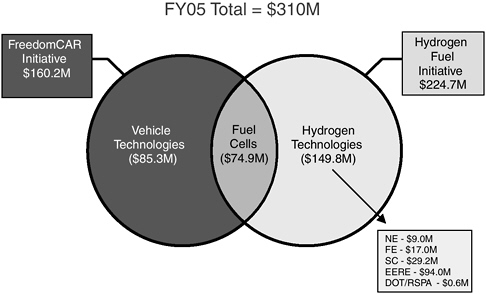
DOE’s total FY05 budget for hydrogen-related activities (hydrogen technology and fuel cells)—the Hydrogen Fuel Initiative—is about $225 million, while that for vehicle technologies—the FreedomCAR Initiative—is about $85 million. Thus, the total funding of relevance to the charter of the committee is about $310 million. This is depicted in Figure 5-1. The detailed allocation of these funds by major element in the hydrogen program is shown in Table 5-1.
This level of expenditure is consistent with the priorities and recommendations of The Hydrogen Economy (NRC/NAE, 2004) and is also consistent with the President’s commitment of $1.7 billion over 5 years (FY04-FY08) in his 2003 State of the Union message. The emphasis is on R&D activities related to fuel cell materials and components, hydrogen production and delivery technologies, and hydrogen storage materials. The budget also includes $29.2 million for basic science, which is consistent with The Hydrogen Economy, which recommended increased emphasis on the fundamental science related to hydrogen and fuel cell technologies. The Office of Science program just getting started was not reviewed in this study, but future reviews will assess its adequacy.
The FY05 funding for the DOE FreedomCAR and Vehicle Technologies (FCVT) program activity on related programs is $85.3 million (Figure 5-1) and is allocated as shown in Table 5-2. Funding is highest for hybrid and electric propulsion (ca. $40 million), reflecting their critical importance to both advanced
ICEs and fuel cell vehicles. The vehicle program also includes substantial funding for combustion and emissions control (ca. $19 million) and materials technologies (ca. $18.5 million). Education efforts include hydrogen education, which develops and distributes training materials to target audiences; the Graduate Automotive Technology Education (GATE) activity, creating GATE centers of excellence and multidisciplinary curricula and providing funds for research fellowships; and Challenge X, in which university teams partner with General Motors to integrate advanced vehicle technologies and appropriate fuels to minimize the use of petroleum.
The FCVT program is also responsible for the 21st Century Truck (21st CT) Partnership, a partnership similar to the FreedomCAR and Fuels Partnership but involving primarily heavy truck manufacturers. The budget for the 21st CT in FY05 is almost identical to the FCVT budget for FreedomCAR ($86 million versus $89.7 million), and the priority areas are similar, such that, overall, hybrid and electric propulsion received $45 million; advanced ICE/combustion and emissions, $54 million; and materials, $40 million.
The breakdown of the approximately $85 million for FY05 that comes from the FCVT program is national laboratories, 47 percent; industry, 40 percent; federal, 2 percent; consortia, 5 percent; universities, 4 percent; and automotive companies (OEMs), 2 percent. Funding for OEMs is exclusively for competitively selected combustion and emissions control R&D, where each OEM is part of a team that may include engineering companies, suppliers, and energy compa-
TABLE 5-1 DOE Funding for Hydrogen and Fuel Cell Technologies (thousands of dollars)
|
Program Area and Funding Source |
FY04 |
FY05 |
FY06 Request |
|
Fuel cell technology (Interior appropriations) |
|||
|
Transportation systems |
7,317 |
7,495 |
7,600 |
|
Distributed energy systems |
7,249 |
6,902 |
7,500 |
|
Fuel processor R&D |
14,442 |
9,721 |
9,900 |
|
Stack component R&D |
24,551 |
32,541 |
34,000 |
|
Technology validation |
9,828 |
17,750 |
24,000 |
|
Technical program management support |
395 |
535 |
600 |
|
Subtotal fuel cell |
63,782 |
74,944 |
83,600 |
|
Hydrogen technology (Energy and Water appropriations) |
|||
|
Production and delivery R&D (EE) |
10,083 |
14,218 |
32,173 |
|
Storage R&D (EE) |
13,174 |
23,654 |
29,890 |
|
Safety, codes and standards (EE) |
5,615 |
5,954 |
13,121 |
|
Infrastructure validation (EE) |
5,784 |
9,484 |
14,945 |
|
Systems analysis (EE) |
1,372 |
3,404 |
7,084 |
|
Education |
2,417 |
0 |
1,881 |
|
Earmarks (EE) |
41,967 |
37,292 |
0 |
|
Subtotal EERE hydrogen |
80,412 |
94,006 |
99,094 |
|
Total EERE hydrogen and fuel cells |
144,194 |
168,950 |
182,694 |
|
Nuclear energy (NE) |
6,201 |
8,929 |
20,000 |
|
Fossil energy (FE) |
4,879 |
17,085 |
22,000 |
|
Science (SC) |
0 |
29,183 |
32,500 |
|
Total DOE hydrogen program |
155,274 |
224,147 |
257,194 |
|
Total Department of Transportation |
555 |
549 |
2,350 |
|
Total Hydrogen Fuel Initiative |
155,829 |
224,696 |
259,554 |
|
SOURCE: Provided by DOE (on April 26, 2005) in response to a request from the committee. Note that “Interior appropriations” refers to the Congressional Subcommittee on Interior and Related Agencies. “EE” refers to the energy efficiency part of the Office of Energy Efficiency and Renewable Energy. |
|||
nies. The amount indicated for OEMs (2 percent) includes only the funding for automotive company tasks.
FY05 funding for the hydrogen program of about $225 million may be broken down as follows: national laboratories, 28 percent; industry, 32 percent; universities, 14 percent; automotive OEMs, 5 percent; energy companies, 2 percent; and congressional earmarks of 19 percent. The funding of automotive OEMs is for the vehicle learning demonstrations and includes only the demonstration associated with automotive company tasks. The learning demonstrations entail 50 percent private sector cost sharing, but the $225 million budget and the associated percentage breakdown includes only DOE funds.1
TABLE 5-2 DOE Funding Supporting FreedomCAR and Fuel Partnership Goals in the Office of FreedomCAR and Vehicle Technologies (thousands of dollars)
|
Program Area Request |
FY04 |
FY05 |
FY06 |
|
Vehicle systems |
3,659 |
4,486 |
4,800 |
|
Ancillary systems |
1,155 |
1,268 |
1,300 |
|
Simulation and validation |
2,504 |
3,218 |
3,500 |
|
Innovative concepts: Graduate Automotive Technology Education (GATE) |
494 |
493 |
500 |
|
Hybrid and electric propulsion |
38,538 |
39,885 |
43,335 |
|
Energy storage |
22,338 |
23,073 |
25,700 |
|
Advanced power electronics |
13,181 |
13,168 |
13,900 |
|
Subsystem integration and development |
3,019 |
3,644 |
3,735 |
|
Combustion and emissions control |
18,640 |
18,775 |
20,765 |
|
Materials technologies |
18,980 |
18,437 |
21,000 |
|
Propulsion materials |
2,766 |
1,972 |
2,000 |
|
Lightweight materials |
16,214 |
16,465 |
19,000 |
|
Fuels technologies |
4,104 |
1,367 |
7,000 |
|
Advanced petroleum-based fuels |
3,808 |
0 |
3,000 |
|
Non-petroleum-based fuels |
296 |
1,367 |
4,000 |
|
Technology introduction |
889 |
986 |
1,300 |
|
Technical/program management support |
854 |
853 |
1,200 |
|
Biennial peer review of FreedomCAR |
494 |
0 |
500 |
|
Total |
86,652 |
85,282 |
100,400 |
|
SOURCE: Provided by DOE (on April 26, 2005) in response to a request from the committee. Note that these appropriations are through the Congressional Subcommittee on Interior and Related Agencies. |
|||
While the committee endorses the overall size and relative allocation strategy in the hydrogen program budget, there are four areas of concern. First, as discussed in Chapter 2, congressionally directed activities (earmarks) account for 40 percent of the hydrogen technology budget (about $37 million out of $94 million) in FY05 and 16 percent of the total hydrogen budget. The earmarks divert funds from required R&D areas in the program, severely restricting the
ability of DOE to effectively manage the program, and have delayed several critical elements of the program, including hydrogen storage and safety.
The second area of concern is carbon sequestration. While large-scale carbon sequestration is not directly within the purview of this committee’s study, its feasibility will essentially determine the likelihood of sourcing hydrogen from coal and/or natural gas in a future carbon-constrained environment and consequently affects both the economics and the viability of hydrogen as a future fuel (energy carrier). DOE needs to assess the resources being devoted to this activity in the light of its criticality to the success of the program.
The third area of concern is the balance between basic research and applied development. As illustrated in Figure 5-2, 13 percent of hydrogen program spending is on basic research, with the remaining 87 percent devoted to applied R&D and demonstrations. To some extent, the latter activity will disclose areas requiring more fundamental research and drive the research agenda and funding, but the committee cautions against overemphasis on development (which is usually best performed by the private sector) at the expense of basic research.
The fourth area of concern is the process of innovation. Historically, in fields as disparate as microelectronics and medical devices, pathbreaking commercial innovations have come from start-up companies at least as often as from the industry incumbents. The FreedomCAR and Fuel Partnership should create opportunities for start-up companies to participate in the commercialization process, either independently or in partnership with one of the member companies. This would lead to a more balanced program than one relying on industry incumbents alone.
In summary, there are four areas of concern in the hydrogen program, namely congressional earmarks, carbon sequestration, spending that may be skewed too
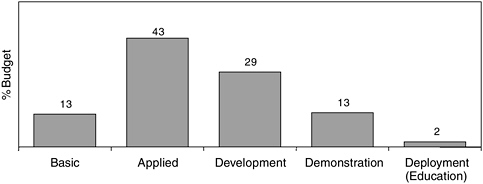
FIGURE 5-2 Distribution of funding for hydrogen technology and fuel cell activities for FY05 by RD&D category. Note that “education” supports technology transfer and adoption. SOURCE: R.F. Moorer, “FreedomCAR and Fuel Partnership peer review,” Presentation to the committee on November 17, 2004.
much toward development, and the process of innovation. The committee strongly supports the HEV and advanced ICE spending but, as noted under “Structural Materials,” it suggests that some of the materials spending ($19 million in FreedomCAR, $20 million in 21st CT) be reallocated to high-priority research areas.
Finally, the program involves both short-term goals that are related to hydrocarbon-fueled vehicles, used during a transition period, and much longer-term goals aimed at enabling “a clean and sustainable transportation energy future.” The committee considers the current split of funding between the long-term and shorter-term goals to be appropriate. Hydrogen-related activities absorb approximately 70 percent of the funds. The remaining funds support the development of transition technologies, where in many cases cost is the most significant barrier.
REFERENCE
NRC/NAE (National Research Council/National Academy of Engineering). 2004. The Hydrogen Economy: Opportunities, Costs, Barriers, and R&D Needs. Washington, D.C.: The National Academies Press.


