
Material Innovation and Artistic Invention: New Materials and New Colors in Renaissance Venetian Paintings
Barbara H. Berrie
National Gallery of Art, Washington, D.C.
and
Louisa C. Matthew
Department of Visual Arts, Union College, Schenectady, N.Y
Sixteenth-century Venetian painters have been regarded as “colorists” since their own time. The phrase “Venetian palette” is used today by art historians to describe the colors used by Renaissance painters of Venice, among whom Titian, Giovanni Bellini, and Tintoretto are the most famous. There is in fact little written consensus about how to define this so-called Venetian palette, but our knowledge is continually expanding thanks to scientific research on these artists’ paintings. One color has always been mentioned as being particularly Venetian: a rich deep orange, used generously by Venetian painters from about 1490. These artists used the arsenical sulfides yellow orpiment (As2S3) and orange realgar (As4S4) to achieve this color. Until the end of the fifteenth century this pair of minerals had been largely confined to the miniaturists’ palette, but they became so popular in sixteenth century Venetian painting that G. P. Lomazzo remarked in his 1584 treatise “burnt orpiment is the color of gold and it is the alchemy of the Venetian painters” [1]. Artists such as Giovanni Bellini used it abundantly in their paintings; for example, Bellini used it for Silenus’ robe in The Feast of the Gods (1514; reworked by Titian, 1524) (Figure 1). The analytical data we discuss here, while still fragmentary, points to a richness of materials and their innovative use by Venetian artists that is greater than imagined heretofore, and much more than simply the addition of the arsenical minerals.
Recently discovered evidence has established that professional color-sellers plied their trade in Venice from the end of the fifteenth century. It appears that they existed here as much as a century earlier than in any other Italian city. These color-sellers were neither apothecaries (“speziali”) nor general grocers from whom artists had purchased their painting supplies throughout the middle ages and
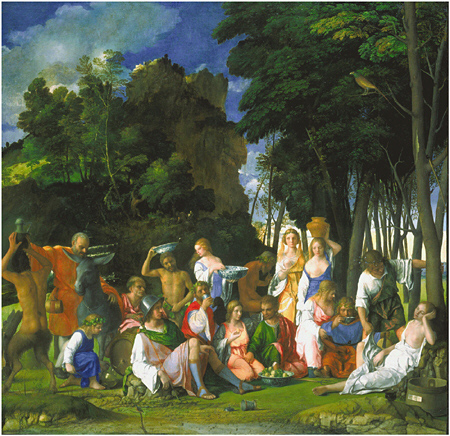
FIGURE 1 The Feast of the Gods, Giovanni Bellini and Titian, 1514/1529, oil on canvas, (National Gallery of Art, Washington, D.C. 1942.9.1).
early Renaissance. They were sources who specialized in materials used in the arts and trades that dealt with color and color manufacturing. Some of the most interesting and useful evidence for the existence of professional color-sellers takes the form of inventories of the contents of their shops. The earliest found so far dates to 1534 [2]. Another, longer inventory of a color-seller’s shop dated 1596 has been found and published [3]. Examination of the materials in the 1534 inventory and investigation of their uses, particularly in glass-making and ceramics, coupled with our new analyses, reveal relationships that encompass both tradition and innovation. There is evidence for more cross-fertilization of technological know-how and taste among artisan industries than previously supposed. In this paper we will show how the information from the inventories combined with new analytical data has been used to expand our knowledge and understanding of the materials used by painters in Venice and add to the complexity of the definition of the Venetian Renaissance palette.
The 1534 inventory lists 102 items; weights or amounts are given but no monetary values. Many of the materials on the inventory have an established connection with the easel painters’ art, including, for example, the pigments azurite, vermilion, lead white, and orpiment. Kermes and brazilwood, organic extracts which were used to make red dyes as well as red paints, are listed. Other items in the “vendecolore” shop that relate to the dyers’ craft include alum for mordanting dyes, galls (for making black dyes), and various resins.
The first printed book on dyeing on a commercial scale was published in Venice in 1548, titled The Plichto of Gioanventura Rosetti [4]. It was written not by a dyer but by a technologist, Gioanventura Rosetti, whose intention was to provide information on what might be termed “best practices” to benefit the Venetian Republic. The recipes in the Plichto contain many of the items on both the 1534 and the 1596 inventories, including some usually considered by historians as pigments, including orpiment, vermilion and azurite, which are described in one recipe as mineral dyes (Figure 2). The overlap between painters’ and dyers’ colorants continues to become more apparent.
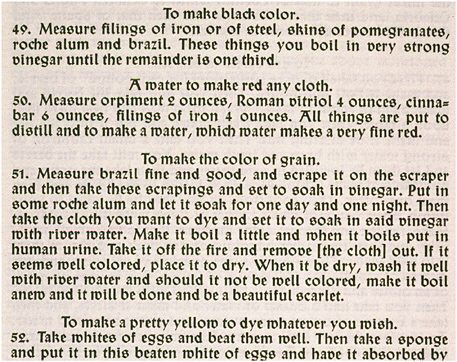
FIGURE 2 Extract from “The Plictho of Gioanventura Rossetti” first published in Venice in 1548. Translated by Sidney M. Edelstein and Hector C. Borghetty, The MIT Press (1969).
The Venetian glass industry, centered on Murano, one of the islands in the Venetian lagoon, was burgeoning in the late fifteenth century. By this time the glassmakers had produced a clear glass called “cristallo” after the rock crystal that had inspired its invention. Large quantities of clear and colored glass were produced for making a wide variety of objects, including tableware, goblets, glasses, and mosaic tesserae. Recipes for richly colored glass, both single-toned and multi-colored to imitate opal and chalcedony, were developed. Special, deeply-colored glass was produced for making false rubies, sapphires, and emeralds that were as intensely and beautifully colored as the real gems. In the first decades of the sixteenth century recipes for glassmaking were being compiled [5]. The Darduin manuscript provides important information on Renaissance glassmaking, and the work of the Florentine, Antonio Neri (died 1614), who wrote L’Arte Vetraria (1612), a compilation of recipes including many of sixteenth-century origin, is an invaluable source. [This recipe book was translated into English by Christopher Merrett in 1662.] For our knowledge of the Venetian glassmaking industry we also owe much to the work of the Muranese, Luigi Zecchin [6].
Materials necessary for glassmaking are found on the 1534 inventory. Recipes for glass indicate that tin and lead were required in large quantities; both of these are on the inventory. Other ingredients include tartar, mercuric chloride, borax, alum, salt, and “tuzia” (zinc oxide), as well as orpiment. These materials are also used by dyers and some by painters.
The wide range of materials available at the color-seller’s shop suggests that artisans from many trades that used color went there to obtain their raw materials. The variety available in this one place prompted us to consider whether there was more cross-fertilization among artisans than previously assumed and if we might find some evidence for this in the painting practice of the Venetian artists.
We reanalyzed samples from paintings in this light, looking for materials not previously recognized. Samples from several paintings by Venetian Renaissance artists were available from prior studies. They are preserved as cross-sections of the paintings mounted in bioplastic polyester/acrylate resin. For optical microscopy, a Leica DMRX polarizing light (PL) microscope was used with PL fluotar objectives. For fluorescence microscopy the light source was a mercury lamp (100W) and the D and I3 filter packs. Scanning electron microscopy (SEM) was undertaken using a JEOL 6300 equipped with an Oxford Instruments Tetra backscatter detector. For energy dispersive spectrometry (EDS) the SEM was fitted with an Oxford Si(Li) ATW detector (capable of detecting low-energy x-rays) with a resolution at the Mn kα line greater than 130 eV. The cross-sections were usually carbon-coated, but sometimes gold-palladium coatings were used. X-ray powder diffraction patterns were obtained using Philips XRG 3100 x-ray generator with a copper tube. Data were collected on photographic film in a Gandolfi camera (radius 57.3 mm). Line spacings were measured against a calibrated rule and relative intensities estimated by eye.
Samples from paintings by the Venetians Lorenzo Lotto (1480-1556) and Jacopo Tintoretto (1519-1594) were among the first to be re-examined. Although the samples are limited in number they already show that the range of materials used to make paint is wider than previously known.
Lotto was “rediscovered” in the late nineteenth century, but it took most of the twentieth century for him to become acknowledged as a Venetian painter. Recent research on his painting technique and color palette has helped define his place in the Renaissance [7, 8]. There is little documentary information on Lotto’s early career as an artist, but it is believed that he trained in Venice and spent his first years as an independent artist there. Later, he painted in Bergamo and the Marches. He traveled a good deal, usually within the economic and political orbit of the Venetian Republic, and he returned to the city itself for several periods. Our knowledge of Lotto’s working methods is augmented by the survival of one of his account books in which he documented commissions and expenditures during the years 1538 to 1556 [9]. One particularly valuable section of the account books is an appendix of spese per l’arte (expenditures for art), where he recorded the purchase of painting supplies, among which are notes on pigments he purchased in Venice.
Among Lotto’s paintings at the National Gallery of Art in Washington, D.C. is St. Catherine, signed and dated 1522 (Figure 3). St. Catherine’s dress is a glorious red, perhaps reminiscent of the color of expensive red cloth worn by some Venetian brides at this time. A cross-section from the sleeve (Figure 4) shows the complicated layering Lotto used to create this color. In the cross-section, we see, from the bottom, the preparatory layer of gesso (CaSO4.2H2O in glue), used to provide a smooth surface for painting, over which many layers of paint were applied. The first layers of paint are pinks prepared from a mixture of vermilion and lead white. Lying over these are layers of transparent red paint. From fluorescence microscopy (Figure 5) it can be discerned that what appears to be a thick homogeneous paint film is in fact many layers of thin glazes of paint; there appear to be at least six layers. The same painting technique was found in two versions of another composition painted by Lotto in the same year, The Virgin and Child with Saints Jerome and Nicholas of Tolentino [8]. It was shown, using high-performance liquid chromatography, that for the version at the National Gallery, London, Lotto used both madder and insect lakes. The fluorescence of the lakes in St. Catherine’s dress implies that he used two different lakes here also.
Digital dot maps of the distribution of the elements in a sample from St. Catherine obtained using SEM-EDS are shown in Figure 6. The lowest layer of paint contains mercury, confirming that Lotto used vermilion for mixing the light red underpaint. Aluminum is present throughout most of the upper layers of transparent paint glazes. This strongly suggests that the pigment is a dye laked on alumina, the traditional way to prepare insoluble pigments from dyes made from lakes. Unexpectedly, several of the layers of transparent paint contain small, rounded particles, ca. 4-8 microns in diameter. These particles appear to be very pure silica. It is difficult to obtain information on individual particles embedded
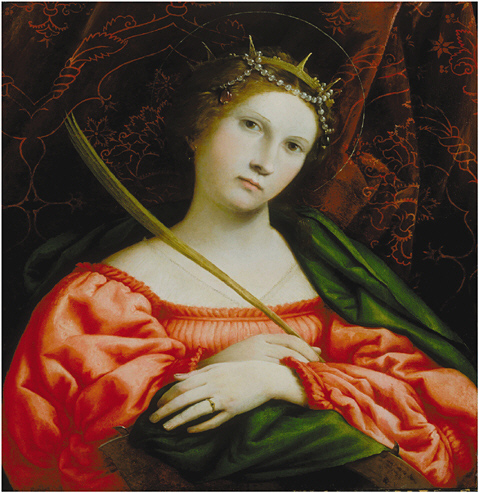
FIGURE 3 St. Catherine, Lorenzo Lotto, oil on panel, Samuel H. Kress Collection, 1939.1.117.
in paint, owing to the comparatively large interaction volume (the volume being analyzed) in a low-density matrix such as paint made using lake pigments. EDS spectra were obtained at 20 kV and 15 kV accelerating voltage; lowering the voltage was designed to decrease the analysis volume. The spectra (Figure 7) indicate a (rather) pure form of silica; only aluminum is present, and its origin is likely the surrounding particles of red lake. Only silicon and oxygen are significant elements in line scans through the particles. Elements that would indicate this material is a glass, for example, the fluxes sodium and potassium or the stabilizers, calcium and lead, are below detectable limits. Venetian glassmaking required pure silica, which was, in this period, provided by quartzite pebbles from the Ticino River.
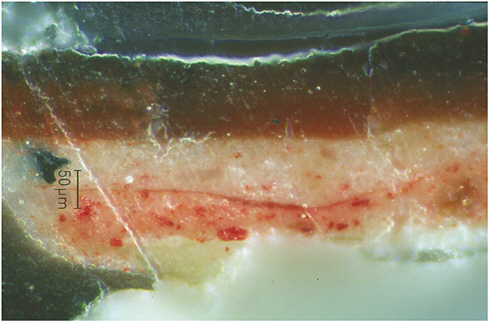
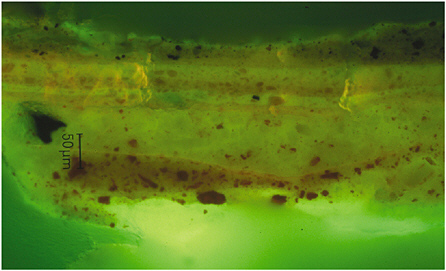
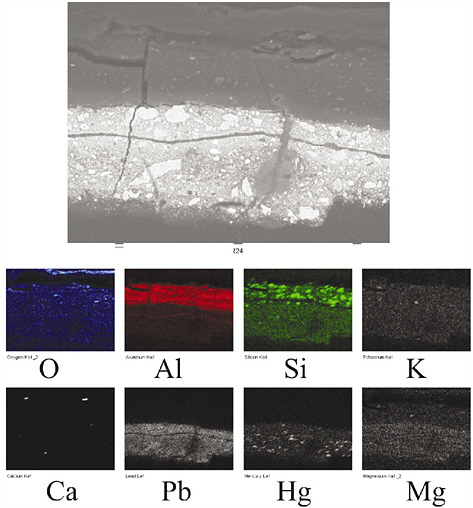
FIGURE 6 Digital dot maps of the cross-section shown in Figures 4 and 5.
Fifteenth and sixteenth century treatises suggested using crushed marble or crushed travertine as additives to give body to paints [10]. Glass has been described as a drier for paint in Renaissance treatises and has been found in some artists’ red lake paint [11]. However, the presence of silica is unexpected, and this occurrence appears to be the first finding of this material used by Italian Renaissance painters as an extender or an agent to give body in red lake paints. The major ingredient in Antonio Neri’s recipe for “cristallo” is pebbles “pounded small, serced as fine as flower” [12] (serce is probably a variant of sarce, to sieve through a cloth). This description corresponds to the material in Lotto’s red paint, which was a ground silica.
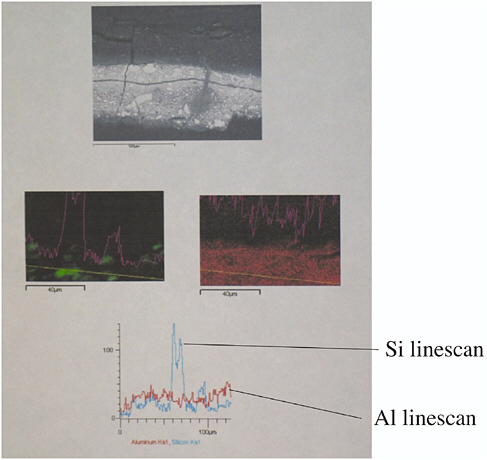
FIGURE 7 Energy dispersive spectrum of small rounded particles in the translucent red paint; obtained at 20 kV.
The artist Jacopo Robusti, called Tintoretto, worked in Venice a few decades later than Lorenzo Lotto. Tintoretto was born in that city in 1519; his father was a member of the “cittadini” class, involved in the dyeing profession. Tintoretto lived and worked in the city throughout his career, and rarely traveled. He established a family workshop that outlived him, and he worked for a wide variety of Venetian patrons. Arguably his most famous surviving work is a series of paintings executed for the Scuola Grande di San Rocco over several decades [13].
The painting Christ at the Sea of Galilee (Figure 8) is attributed to Tintoretto and dated to 1575/80. This picture presents complicated issues in understanding its structure and the artist’s painting technique since the canvas support was assembled from several pieces of fabric that had been used for painting images different from the one we see now. The infrared reflectogram of the painting
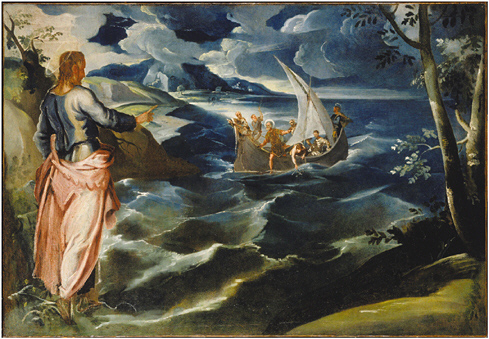
FIGURE 8 Christ at the Sea of Galilee, Jacopo Tintoretto 1575/1580, oil on canvas, Samuel H. Kress Collection,1952.5.27.
reveals that at some point the largest, central piece of canvas had been used to begin a portrait. The portrait had been sketched out using a wash of dark paint, clearly imaged in the infrared. The x-radiograph reveals that the canvas had also been used for a landscape that is of a different scale from both the portrait and the current image.
Tintoretto’s painting techniques have been well studied [14, 15]. An investigation into the materials used for the Gonzaga cycle (1577-1578) showed that the artist employed a diverse palette [16].
Here we restrict the discussion to two pigments found in Christ at the Sea of Galilee that have special relevance to the use of glassy materials for pigments. A cross-section obtained from the sea at the right-hand side of the boat is shown in Figure 9. The bottom layer of the section appears to relate to the landscape observable in the x-radiograph. The pigment is a green, transparent, glassy-appearing pigment. The particle shape and size is similar to that of the blue glass pigment smalt (a potassium silicate colored by small amounts of cobalt). Although the term “smalt” is used in English today to describe only a blue glass pigment, reading the contemporary documents shows that artists of the sixteenth century used this term to describe not only blue but also numerous other
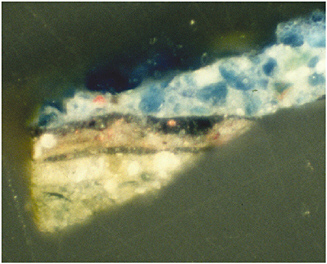
FIGURE 9 Cross section from the sea near the right hand side edge of the boat. The bottom layer contains a green glassy pigment.
colored glasses, including yellow, white, and green, at least some of which may have been used by painters [17, 18].
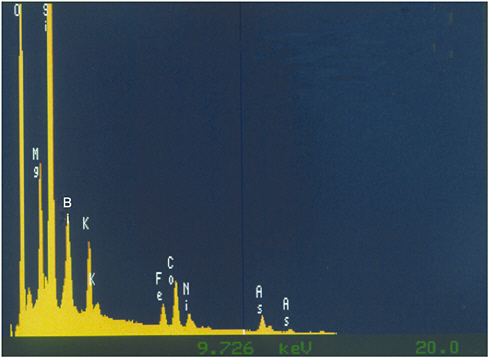
The backscatter image of this section is shown in Figure 10. The greenish pigment in the bottom layer appears dark gray, and therefore we can infer it is of low atomic weight. The EDS spectrum of the pigment shows that it has a composition very similar to blue smalt (Figure 11). An anonymous Venetian glassmaker’s recipe book dating to early-mid sixteenth century has recipes for green glass that have the same general composition as blue smalts: “Per fare smalto verde bellissimo. Prendi della zaffera e un po’ di manganese, pestati sottili e ben lavati e di questi prendi 2 libbre, aggiungi 3,5 libbre di pani cristallini e fa fondere in forno.” [To make a beautiful green glass. Take some zaffre (an impure cobalt ore), grind it fine and wash well and of this take 2 lbs, add 3.5 lbs of crystal frit (a potash glass) and melt in the furnace” [5].
This green smalt in Christ at the Sea of Galilee contains an impurity of bismuth. Bismuth has been found in late-fifteenth and early-sixteenth Venetian enamels and in fifteenth century cobalt blue enamels and smalt in a south German painting [19]. Bismuth is an impurity in the cobalt ore from Germany, and its presence in this pigment suggests that the source of the raw cobalt-containing material, “zaffera,” used for making this glass was from north of the Alps. The spectrum shows that the glass contains iron. Iron can give rise to a yellow glass. Therefore the green color of this pigment might arise from a mixture at the microscopic level of blue and yellow glasses.
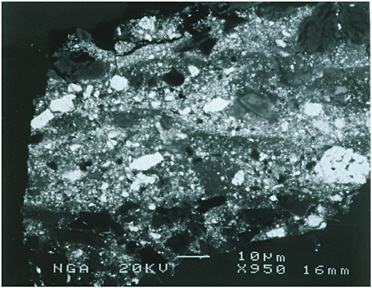
A yellow pigment is used widely in Christ at the Sea of Galilee. In a cross-section from Christ’s drapery it can be seen mixed with green earth for the sea painted under Christ’s red robe and as an intense yellow layer under the greenish paint of the sea. It was also used, well mixed with green earth and azurite, for the hills in the background. At first glance the pigment appears to be lead tin yellow type II (Pb(Sn,Si)O3). SEM-EDS clearly indicates that the colorant is an opaque yellow glass composed of particles of lead tin oxide suspended in a glassy matrix. X-ray powder diffraction (XRD) reveals that the yellow opacifier is similar but not identical to the material usually characterized in paintings. The XRD pattern of the pigment is given in Table 1. Although the pattern is very close to that published for PbSnO3, there are some subtle differences and additional lines not attributable to expected impurities. The compendia of recipes for making glass give several variations for the yellow colorant, which likely cause different hues. It would be interesting to compare the XRD pattern of the colorant and the composition of the glassy matrix of the pigment in this painting with those of enamels on metals and glazes on majolica and relate the results to the contemporary recipes. By comparing the details of these materials we may be able to shed further light on the variety of yellows that was available for the ceramic decorators and used by easel painters to increase the range of their palette. A recent paper differentiates between the production of lead tin yellow pigment and the “raw” material for the production of yellow glass [20]. This difference might be found among the materials used by Venetian artists and craftsmen. Thus the glassy matrix might be important, and this and other differences between glasses and pigments might be the source for the variety of materials and colors that painters used.
Many of the materials we find on the 1534 (and the 1596) inventory are materials used by dyers, glassmakers, and glass and maiolica painters. Some of these, including vermilion, kermes, brazilwood, orpiment, and lead white, are expected in paintings by Bellini, Giorgione, and Titian. The re-analysis of samples from pictures by these and other Venetian artists has begun to indicate that the palette they used was enriched by materials that until then had only been used by artisans and artists working in other media. Venetian painters (and others influenced by them) boldly incorporated into their work, to vivid effect, colorants not specifically designed for use in oil paint. We see that artists were using glassy materials and/or “smalti” more often and in greater diversity than we previously thought. Among these materials there appear to be frits and colorants designed for glass-painters and majolica decorators, in addition to the powdered glass, blue smalt and lead tin yellow type II, which have been identified previously.
The presence of the professional color-seller in Venice might have been the catalyst and the conduit for the transfer of materials among the arts and contributed to the emergence of the Venetian palette, a palette that cannot be precisely defined, but is characterized by its complexity and diversity of colorants.
TABLE 1 d-Spacings and Estimated Intensities of Lines in the Diffraction Pattern of the Glassy Yellow Pigment in Tintoretto’s Christ at the Sea of Galilee and patterns for PbSnO3 and SnO.
|
Yellow Pigment |
|
PbSnO3 ICDD 17-607 |
|
SnO ICDD 24-1342 |
|
|
d Angstroms |
I/Imax |
d |
I/Imax |
d |
I/Imax |
|
|
|
6.17 |
18 |
|
|
|
4.65 |
|
||||
|
4.5* |
|||||
|
4.32 |
|||||
|
4.20* |
|||||
|
3.93 |
|||||
|
3.63* |
|||||
|
3.50 |
w |
|
|||
|
3.30* |
|
||||
|
3.25 |
|
3.22 |
12 |
|
|
|
3.10 |
100 |
3.09 |
100 |
|
|
|
2.98 |
20 |
|
2.9 |
80 |
|
|
2.85 |
|
||||
|
2.77 |
20 |
|
2.78 |
80 |
|
|
2.69 |
80 |
|
|||
|
2.61* |
50 |
|
|
2.63 |
100 |
|
2.46 |
|
||||
|
2.45 |
|
2.45 |
12 |
|
|
|
2.30* |
|
||||
|
2.21 |
10 |
|
|
2.24 |
10 |
|
2.10 |
5 |
|
|
2.12 |
10 |
|
2.05 |
|
2.06 |
6 |
|
|
|
1.95 |
10 |
|
|
1.95 |
30 |
|
1.90 |
80 |
1.89 |
75 |
|
|
|
1.864 |
65 |
|
|
1.83 |
25 |
|
1.61 |
80 |
1.61 |
80 |
1.61 |
20 |
|
1.54 |
|
1.52 |
16 |
||
|
1.23 |
|
1.227 |
29 |
|
|
|
1.195 |
|
1.196 |
16 |
|
|
|
*These lines can be attributed to lead white (International Committee for Diffraction Data 13-131). |
|||||
ACKNOWLEDGEMENTS
We are grateful to the Center for Advanced Study in the Visual Arts (National Gallery of Art, Washington, D.C.) where we held a Samuel H. Kress Paired Fellowship. We benefited from discussions with members of the scientific research department of The National Gallery, London, and particularly acknowledge stimulating discussions with Jo Kirby-Atkinson.
REFERENCES
1. Lomazzo, G.P., Trattato dell’arte della pittura. 1590, Milan: Paolo Gottardo Ponto.
2. Matthew, L.C., ‘Vendecolori a Venezia’: the reconstruction of a profession. The Burlington Magazine, 2002. CXLIV (1196): pp. 680-686.
3. Krischel, R., Zur Geschichte des Venezianischen Pigmenthandels - Das Sortiment des Jacobus de Benedictus a Coloribus, in Sonderuch aus dem Wallraf - Richartz - Jahrbuch Band LXIII 2002. 2002, Cologne: Dumont Literatur und Kunst Verlag. pp. 93-158.
4. Rosetti, G., Plictho de l’arte de tentori. 1548. Translated by Sidney M. Edelstein and Hector C. Borghetty, 1969. Cambridge, Massachusetts: The M.I.T. Press.
5. Moretti, C. and T. Toninato, Ricette vetrarie del Rinascimento: Trascrizione da un manoscritto anonimo veneziano. 2001, Venice: Marsilio.
6. Zecchin, L., Vetro e Vetrai di Murano. Vol. 1-3. 1987-1989, Venice: Arsenale.
7. Lazzarini, L., et al., Pittura veneziana: materiali, techniche, restauri. Bollettino d’Arte, 1983. 5: pp. 133-166.
8. Dunkerton, J., N. Penny, and A. Roy, Two paintings by Lorenzo Lotto at the National Gallery. National Gallery Technical Bulletin, 1998. 19: pp. 52-63.
9. Lotto, L., (Libro di spese diverse [1538-1556] con aggiunta di lettere e d’altri documenti.), P. Zampetti, editor. 1969, Venice, Rome. See also Bensi, P., Studi di storia dell’arte, 5 1983-1985, 63.
10. Merrifield, M.P., Medieval and Renaissance Treatises on the Arts of Painting. 1999, Mineola, NY: Dover. p. clii.
11. The Painting Technique of Pietro Vanucci, Called Il Perugino Editors. B. G. Brunetti, C. Seccaroni, A. Sgamellotti, Nardini Editore, 2003. Papers from the conference, 14-15 April, 2003.
12. Merrett, C., The World’s Most Famous Book on Glassmaking ‘The Art of Glass’ by Antonio Neri, M. Cable, editor. 1662, Sheffield: The Society of Glass Technology reprint 2003. (Neri’s book had been first published in Italian in 1612.)
13. Krischel, R., Jacopo Tintoretto. 2000, Cologne: Könemann.
14. Plesters, J. and L. Lazzarini. Preliminary Observations of the Technique and Materials of Tintoretto in Conservation of Paintings and the Graphic Arts. 1972, Lisbon Congress: International Institute for Conservation.
15. Plesters, J. and L. Lazzarini. I materiali e la tecnica dei Tintoretto della scuola di San Rocco, in Jacopo Tintoretto nel quarto centenario della morte. 1994, Venice: Il Polygrafo.
16. Burmester, A. and C. Krekel, “Azurri oltramarini, lacche et altri colori fini”: the quest for the lost colours, in Tintoretto: The Gonzaga Cycle, C. Syre, editor. 2000, Munich: Hatje Cantz Publishers. pp. 193-211.
17. Venturi, A., I due Dossi documenti - prima serie. Archivio Storico dell’Arte Nuovi Documenti, 1892. Anno 5 (Fase VI): pp. 440-443.
18. S. Pezzella, Il trattato di Antonio da Pisa sulla fabricazione delle vetrate artitiche, 1976. Perguia: Umbria Editrice.
19. Darrah, J.A. Connections and Coincidences: Three Pigments. in Historical Painting Techniques, Materials, and Studio Practice. 1995, University of Leiden, the Netherlands: The Getty Conservation Institute.
20. Heck, M., T. Rehren, and P. Hoffmann, The Production of Lead-Tin Yellow at Merovingian Schleitheim (Switzerland). Archaeometry, 2003. 45(1): pp. 33-44.


