
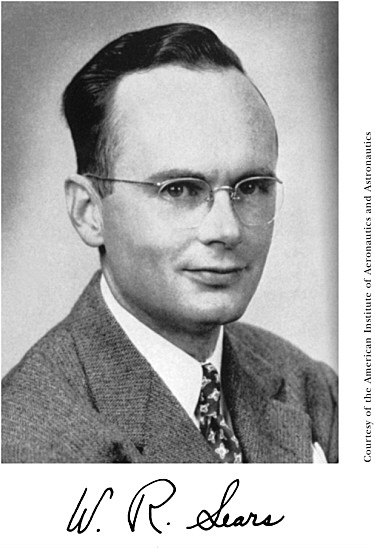
WILLIAM REES SEARS
March 1, 1913–October 12, 2002
BY NICHOLAS ROTT
WILLIAM (“BILL”) SEARS was born in Minneapolis, son of William and Gertrude Sears (née Rees). As described in his recollections, Bill’s youthful interests included music and literature, but by the time he was ready for college his talents in the mathematical and technical sciences determined his choice. He enrolled as a student in the University of Minnesota and earned his bachelor of aeronautical engineering degree in 1934. After that he moved for graduate studies to the California Institute of Technology in Pasadena, where he became a student of Theodore (“Todor”) von Kármán.
Bill Sears was deeply impressed by Kármán’s scientific powers and also by his warm and humane personality. Bill’s thesis on the theory of oscillating airfoils in an ideal flow, submitted in 1938, turned out to be a classic that summarized and enriched substantially all previous efforts in this important field. In 1940 Bill went on to publish a paper, based on the results of the von Kármán-Sears theory, that pioneered the application of operational methods for the solution of problems arising when an impulsive change occurs in the velocity and the shape of an airfoil (1940). Problems that were reduced to a search for the solution of an
integral equation were solved here, for the first time, by analytic continuation in a complex plane.
The student years brought Bill not only scientific fame but also extraordinary experience as a teaching assistant and associate. He adapted many of Kármán’s teaching methods, and married Kármán’s secretary, Mabel Rhodes, who became Bill’s steady companion in a long, happy, and brilliantly successful life.
Bill was appointed instructor in aeronautics in 1937, before he got his Ph.D. in 1938. He was appointed assistant professor of aeronautics in 1940. He left Caltech in 1941 because of the impending war.
In 1940 Bill received his pilot’s license, and flying became a hobby that led him during the years to the ownership of several types of private airplanes. By the time he retired from flying in 1990 he had logged 8,000 hours of airtime, both for business and for pleasure. On major expeditions he was regularly accompanied by Mabel, his trusted navigator.
In 1941, with the entry of the United States into World War II becoming more evident, Sears accepted the offer of Jack Northrop (a friend of von Kármán) to became chief of aerodynamics and flight testing for the Northrop Aircraft Corporation. His main responsibilities were the design of the P-61 (the Black Widow) and, in particular, the aerodynamics of the “Flying Wing.” His name is firmly connected with these projects in the history of aviation. In 1945 he also served in the Naval Reserve in Germany, debriefing German scientists and engineers. More details about this very interesting chapter in Bill’s life can be found in his autobiography, which was published in 1994, and in an article (obituary) written by Frank Marble of Caltech, published in Engineering and Science (vol. LXVI, Nov. 1, 2003).
The years of working for the Northrop Company did
not interrupt Sears’s involvement with the fundamental problems of aerodynamics theory. Within days after he left the company in 1946 his paper on compressible flow past bodies of revolution appeared in print. The question of how to generalize compressibility corrections known in two dimensions to three dimensions had haunted aerodynamicists for decades, and Bill’s contributions were essential in leading to the final correct solutions. They also led to the design of minimum wave drag projectile shapes known as the Sears-Haack bodies.
A new era in Bill’s life started when in 1946 he became the director of the newly created Graduate School of Aeronautical Engineering of Cornell University in Ithaca, New York. Because of his experiences at Caltech and in the industries of Southern California, he was able to assemble a faculty for this school that jump-started its national and international fame. His appointee in the field of general aerodynamics was Y. H. Kuo, who was a student of H. S. Tsien, an early and eminently successful student of von Kármán. The return of H. S. Tsien to China in 1955 was a big scientific and political event. His student Y. H. Kuo followed him in 1956.
With his extraordinary background both in academic achievements and in industry, Bill brought a revolution in teaching methods to Cornell. The students of the graduate school gathered weekly at a research conference under his guidance, where they reported mostly on what they had “just found.” Bill knew how to respond to such reports with gentle humor and how to move on to high-level technical discussions.
He also became a member of the editorial committee of the Journal of the Aeronautical Sciences for the field of aerodynamics. Under his leadership this journal became the top U.S. publication in its field. (He also headed the
meetings committee, which was responsible for the regular annual meetings in New York City.) He became editor in chief of the journal in 1955, and saw its name and scope changed from “Aeronautical” to “Aero/Space” in 1959.
If one searches for a theme in the most important aeronautics publications of this era, one would find it is the incorporation of solutions for compressibility problems that involve the third dimension in their boundaries. Typical is a paper of 1948 by Bill entitled “The Boundary Layer of Yawed Cylinders.” He occasionally mentioned jokingly that he had to share priority on this subject with Ludwig Prandtl and Robert T. Jones. Articles of this type in the journal had titles like “the theory of not-so-slender bodies and wings,” and were often authored by graduates from the Cornell school.
The most important theme in Bill’s research remained, however, in direct continuation of his thesis work with von Kármán, the incorporation of the time dependence in the description of the performance of airfoils. From the consideration of single airfoils he proceeded to the theory of airfoils in grid configurations, proceeding further from simple configurations to arrangements that are directly applicable to rotating machinery. Complicated phenomena like the rotating stall in axial compressors became thesis problems at the aero school, which maintained its top position in the aeronautical sciences. Graduating students stepped into leading positions in industry.
A further remarkable sign of the school’s prestige was that it hosted a great number of scholars who spent their sabbatical leaves in Ithaca. The international list included Itiro Tani from Japan and George Batchelor from England. Theodore von Kármán became a frequent visitor and spent a term at Cornell in 1952.
Interest in a new subject in aeronautics evolved in the
years leading to the Second World War, and it led after the war years to discussions on an international level. The original problem was to find a meaningful model for the flow past a slender and sharp-edged triangular (delta) wing, where vortex sheets originate at the edges. A successful model that emerged replaced a vortex sheet with a concentrated vortex singularity, which was tethered and fed by a thin sheet emerging at a sharp edge. Thanks to the superior guidance of Bill Sears, the most important U.S. contributions to solutions appeared in his journal.
The theme of Bill’s lectures and of his writings showed a growing interest in the fundamental problems of airfoils in real fluids, where the Kutta condition provides the critical link between the ideal and the real fluid. Bill’s paper, “Some Recent Developments in Airfoil Theory,” which summarized the state of the art, appeared in a special issue of his journal in 1956, in honor of von Kármán’s seventy-fifth birthday.
The launch of Sputnik in 1957 challenged the formerly undisputed leading role of the aeronautical sciences, and a new partnership with the aero/space sciences resulted. The change found Cornell well prepared. The first faculty of the aero school assembled by Bill Sears in 1947 already had a member who was a Columbia-educated physicist, Arthur Kantrowitz. He actually left Cornell in 1956 for a position in industry, but his student Edwin L. Resler, Jr., who was a research associate at the aero school from 1948 to 1951, received a doctorate from Cornell in 1951 and started teaching there in the same year as an assistant professor. Later in 1952 Resler moved to the University of Maryland but returned to Cornell in 1957. A close partnership developed between Bill Sears and Ed Resler, and a series of groundbreaking papers emerged from their collaboration. The authors finally agreed on the name “magneto-fluidynamics”
for the new field that they pioneered. They had the opportunity to reformulate classical aerodynamic theory to solutions that are applicable to plasmas (i.e., to conducting fluids).
In the meantime, Bill’s thoughts returned to the basic question of the efficiency of airfoils, and he developed a new idea that found its first written expression in a joint paper with his student Demetri P. Telionis in 1971. They maintained that a necessary prerequisite for the explanation of the time-dependent lift of airfoils was the understanding of the detailed structure of the flow connectivity (one could also say “topology”) in the separation and transition region of the laminar boundary layer. The original paper can be found reproduced in a volume edited by one of Bill’s outstanding students, Nelson H. Kemp (1927-1986), for the Cornell University Press. This volume also bears testimony to the details in the evolution of Bill’s ideas and to the struggles of an indomitable spirit. A second version of the Sears-Telionis paper is much more easily accessible (1975). Although the final steps needed to connect the ideas of separation and lift remained elusive, further efforts based on these ideas are still alive and well.
In 1974 Bill and Mabel Sears moved to Tucson, where Bill joined the Department of Aerospace and Mechanical Engineering of the University of Arizona. He brought along the high prestige of a well-established reputation and official (Air Force and Navy) support for a large-scale research project. The project aimed at accurate testing in the wind tunnel by use of adaptive walls. Their shapes were calculated assuming the model in a free atmosphere, and a method was outlined that led to theoretical solutions in iterative steps. The idea is recognized as an important step on the way toward totally numerical methods.
The lifestyle of the Sears family continued on an even
keel after the move. At the University of Arizona, Bill, who was an accomplished musician (percussionist, drummer, timpanist), played the recorder with the Collegium Musicum for 20 years. Flying remained the main hobby of the family.
Bill’s successor as head of the Cornell school, Ed Resler, initiated (with great help from the school’s administrative assistant Alice [“Toni”] Anthony) the establishment of the William R. Sears Distinguished Lecture. Beginning in 1985, this yearly event became an important scientific and social event for Cornell, and members of the Sears family flew to Ithaca for the occasion.
The collection and edition of the Sears papers remained a tradition in Cornell that survived after Bill’s move to Arizona. Actually, however, the celebration of “Fifty Years of Aerospace Engineering at Cornell” in the fall of 1996 was preceded by a symposium honoring W. R. Sears on his eightieth birthday on March 1, 1993, thanks to the organization by a colleague of Bill in Arizona, K.-Y. Fung (who later also returned to China). This collection of papers by admirers, friends, colleagues, and students is now also part of the Sears legacy. It can be found with the title Symposium on Aerodynamics & Aeroacoustics, published in 1993 by the World Scientific Publishing Co. of Singapore and New Jersey. Also included in this collection are evaluations of some early ideas of Bill Sears that he had while working for Jack Northrop.
The collected papers of W. R. Sears after 1973 were published by the Cornell University Press in 1997. They also contained—in the tradition established by the first publication—a short biographical sketch.
Bill’s retirement from flying in 1990 led ultimately to profound changes in the scheduling of his regular visits to Ithaca. He became ill in the fall of 2002 and died on October 12, 2002.
The personality of Bill Sears, and the guiding principles of his actions, remind his many admirers, friends, and colleagues of the heroic and idealistic characters of the American Revolution. Memorials in celebration of his life were held at Cornell and at the University of Arizona in Tucson. For the aero school in Ithaca (which merged in 1972 with the Sibley School of Mechanical and Aerospace Engineering), Director Sid Leibowitz decided to revive the tradition of the William R. Sears Distinguished Lectures at Cornell. In 2003 Mabel Sears from Tucson attended as honored guest, together with the Sears children, David (from Bethesda, Maryland), Susan (from Indianapolis), and several grandchildren. Mabel and the Sears children also initiated a series of Sears Memorial Lectures in Tucson, Arizona; the first was given in October 2003. On April 24, 2004, the Sears family reunion was repeated on the occasion of the Sears Distinguished Lecture at Cornell. On April 26 Mabel Sears died peacefully in her sleep at the age of 91, back in Ithaca, New York.
The autobiography of William Rees Sears, Stories from a 21st Century Life, was published in 1994 by Parabolic Press, Inc., of Stanford, California, and received favorable reviews of its literary contents. In particular, important parts of Bill’s actions as chairman of the NATO (AGARD) Fluid Dynamics Panel committee were reported by an eyewitness: Dr. William J. Rainbird, a panel member who originally hailed from New Zealand. He published his experiences in a paper that appeared in the Canadian Aeronautics and Space Journal in 1994.
The memories of the creative work of Bill Sears in the years 1941-1946 for the Northrop Company’s Lifting Wing are kept alive in the writings (mentioned earlier in this memoir) of Professor Frank E. Marble of the California Institute of Technology.
HONORS AND AWARDS
William R. Sears was the recipient of numerous honors and awards and was invited to present the most prestigious memorial lectures of the aeronautical sciences in the United States, in Britain, and worldwide. In particular, he delivered the Von Kármán Lecture of the American Institute of Aeronautics and Astronautics in 1968 and the Frederick W. Lanchester Memorial Lecture of the Royal Aeronautical Society of London in 1973. Invitations for lectures to be presented came from around the world: Israel, Japan, Italy, England, and the People’s Republic of China.
Sears became a member of the National Academy of Engineering in 1968 and of the National Academy of Sciences in 1974, the most prestigious scientific society of this country. Further honors included the Von Kármán Medal of the Advisory Group for Aeronautical Research and Development (AGARD) in 1977, the Prandtl Ring in 1974, and the Daniel Guggenheim Medal in 1996.
SELECTED BIBLIOGRAPHY
The following titles are taken from the first complete collection of the works of W. R. Sears, published by the Cornell University Press in two volumes, which appeared in 1973 and in 1996. The selective bibliography given here covers papers only up to 1977; it is otherwise rather complete for important contributions, except for papers on magneto-fluiddynamics.
1938 With T. von Kármán. Airfoil theory for non-uniform motion. J. Aeronaut. Sci. 5:379-390.
1939 With A. M. Kuethe. The growth of circulation of an airfoil flying through a gust. J. Aeronaut. Sci. 6:376-380.
1940 Operational methods in the theory of airfoils in non-uniform motion. J. Franklin Inst. 230:95-111.
1941 Some aspects of non-stationary airfoil theory and its practical application. J. Aeronaut. Sci. 8:104-108.
1947 On projectiles of minimum wave drag. Q. Appl. Math. 4:361-366.
1948 The boundary layer of yawed cylinders. J. Aeronaut. Sci. 15:49-52.
1949 With S. I. Pai. Some aeroelastic properties of swept wings. J. Aeronaut. Sci. 16:105-116.
1950 The linear perturbation theory for rotational flow. J. Math. Phys. 28:268-271.
Potential flow around a rotating cylindrical blade. J. Aeronaut. Sci. 17:183.
Transonic potential flow of a compressible fluid. J. Appl. Phys. 21:771-778.
With L. A. Fogarty. Potential flow around a rotating, advancing cylindrical blade. J. Aeronaut. Sci. 17:599.
1953 With M. C. Adams. Slender-body theory—Review and extension. J. Aeronaut. Sci. 20:85-98.
On axisymmetric flow in an axial-flow compressor stage. J. Appl. Mech. 20:1-6.
With N. H. Kemp. Aerodynamic interference between moving blade rows. J. Aeronaut. Sci. 20:585-598.
1955 Rotating stall in axial compressors. J. Appl. Math. Phys. (Zeitschrift fur Angewandte Mathematik und Physik [ZAMP]) 6:429-455.
1956 Some recent developments in airfoil theory. J. Aeronaut. Sci. 23:490-499.
With N. H. Kemp. On the wake energy of moving cascades. J. Appl. Mech. 23:2-7.
1957 On the stability of small gas bubbles moving uniformly in various liquids. (Dissertation of R. A. Hartunian.) J. Fluid Mech. 3:27-47.
1958 With E. L. Resler. The prospects for magneto-aerodynamics. J. Aeronaut. Sci. 25:235-247.
With E. L. Resler. Magneto-gasdynamic channel flow. J. Appl. Math. Phys. (ZAMP) 5-6:509-518.
1959 With E. L. Resler. Theory of thin airfoils in fluids of high conductivity. J. Fluid Mech. 5:257-273.
1963 With A. R. Seebass and S. G. Rubin. Magneto-fluid dynamic nozzle flow. In Proceedings of the Ninth International Symposium on Combustion. New York: Academic Press.
1972 With D. F. Telionis. Unsteady boundary-layer separation. In International Union for Applied and Theoretical Mechanics Symposium, May 1971, ed. I. E. Eichelbrenner. Quebec: Laval University Press.
1973 The far-field sound of rigid bodies in arbitrary motion. (Dissertation of F. Farassat.) In Proceedings of the Interagency Symposium on University Research in Transportation Noise. Stanford, Calif.: Stanford University Press.
1975 With D. F. Telionis. Boundary-layer separation in unsteady flow. SIAM J. Appl. Math. 28:215-235.
1977 A note on adaptive-wall wind tunnels. J. Appl. Math. Phys. (ZAMP) 28:915-927.


