
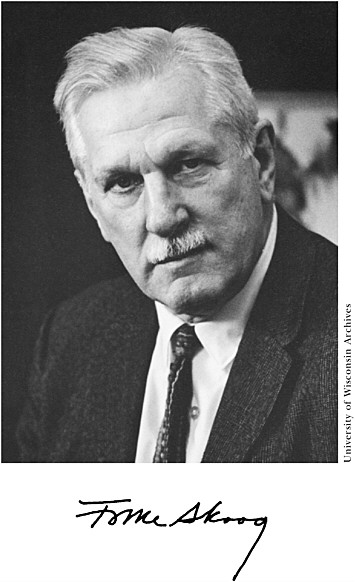
FOLKE KARL SKOOG
July 15, 1908–February 15, 2001
BY DONALD J. ARMSTRONG AND ELDON H. NEWCOMB
FOLKE KARL SKOOG WILL be remembered as one of the twentieth century’s major figures in plant biology. He was the last surviving member of the small group of investigators who began plant hormone research in this country, and his death in Madison, Wisconsin, at the age of 92 marked the end of an era. His personal contributions to the field of plant hormone research were monumental. Few single discoveries have had such a major impact on a field of plant science as did the isolation and identification of kinetin by Skoog and associates at the University of Wisconsin-Madison in 1955. This discovery was the founding event in the recognition of a major new class of plant hormones, the cytokinins, and it shaped and conditioned research in plant growth regulation for decades. Earlier Skoog had made several pioneering discoveries that helped to establish the general importance of auxin in plant growth regulation. During his multifaceted career he also investigated aspects of plant nutrition, advanced the science and art of plant tissue culture, and addressed a number of important questions in plant morphogenesis. His contributions to our understanding of the regulation of plant growth and development constitute a legacy that is rivaled by few others in the
field. This legacy should also include the names of the many people whose lives he influenced and enriched.
Folke Skoog was born in Halland, Sweden, on July 15, 1908. His father was trained as an agronomist, and Folke’s early years, when he was not in school in Uppsala, were spent on the large agricultural estate his father managed. Folke had a younger brother, Toord, who became a prominent reconstructive surgeon in Sweden. In 1925, at the age of 17, Folke came to the United States for what was originally intended as a one-year stay with an aunt residing in California. After enrolling in high school, he became interested in chemistry and decided to stay in the United States to pursue an undergraduate degree at the California Institute of Technology. Although he graduated from Caltech with a B.S. in chemistry in 1932, by that time his professional interests had shifted to plant biology. Nevertheless, his scientific thinking through the years was strongly influenced by this early training in the physical sciences.
The learning environment in which Skoog was immersed as an undergraduate at Caltech was truly remarkable. He had a chemistry course from Linus Pauling, physics from Robert Millikan, and philosophy from Bertrand Russell, but it was the association with a number of superb biologists that shaped his career. During his graduate student years at Caltech he was mentored by the geneticist Thomas Hunt Morgan, who had recently become head of the new Department of Biology; by Carl Lindegren, a graduate student who was later to become well known for his work on the genetics and biochemistry of Neurospora and yeast; and notably by Hermann Dolk, who had been induced to join Caltech to initiate research in the new field of plant hormones. Dolk was one of a number of gifted young scientists, including Robert Emerson, George Beadle, Kenneth Thimann, and Boris Ephrussi, who had been persuaded to
join Caltech by T. H. Morgan. Skoog began working with Dolk on the regulatory effects of auxin on plant growth, but Dolk was killed in an auto accident before the project was completed.
Following Dolk’s death, Skoog began working on auxin physiology and biochemistry with Kenneth Thimann, a young plant biochemist from England who was also to become renowned for his research on plant hormones. This early association with Thimann was the beginning of a close lifelong friendship between the two men. When Thimann left Caltech for a position at Harvard, Skoog finished his graduate work under the direction of Dolk’s successor, Frits Went, who through the discovery of auxin had launched the field of plant hormone research. During the years Skoog always remembered the kindness Went had shown him when he was a young graduate student trying to survive and carry on his studies during the Great Depression.
Skoog became a naturalized citizen of the United States in 1935. On receiving his Ph.D. in biology from Caltech in 1936, he was awarded a National Research Council Fellowship to work with Dennis Hoagland in the Division of Plant Nutrition at the University of California, Berkeley. In Hoagland’s laboratory Skoog worked most notably on the effects of zinc on auxin metabolism, an experience that provided him with bench knowledge of research on mineral nutrition, which he applied repeatedly in later years. At Berkeley he also investigated the regulation of bud dormancy in woody perennials under the direction of J. P. Bennett.
Skoog accepted a position with Thimann as a research associate and instructor at Harvard University in 1937. With the exception of a six-month sabbatical in 1938 as a visiting scientist at the Pineapple Research Station of the University of Hawaii, he continued at Harvard until 1941, when he
accepted a faculty position at Johns Hopkins University. At both Harvard and Johns Hopkins he focused on auxin metabolism and action and initiated experiments with plant tissue culture systems. While at Johns Hopkins, he contributed to the war effort by participating in a National Institutes of Health study of medical problems arising from the handling of TNT in munitions manufacture and developed assays to test the efficacy of various antifungal compounds. From 1944 to 1946 he served with the quartermaster general’s office in the Defense Department as a chemist and technical representative attached to the U.S. Army in Europe. At war’s end he was assigned to investigate Germany’s wartime research on the production and use of yeast as a food source.
Skoog returned to academic life in the United States at the end of 1946 with a brief stay in Carl Lindegren’s laboratory at Washington University in St. Louis. In 1947 he accepted a faculty position at the University of Wisconsin-Madison. There he began the work with tobacco tissue culture systems that led ultimately to the discovery of kinetin and the founding of the field of cytokinin research. He remained at the University of Wisconsin as a faculty member of the Department of Botany until his retirement in 1979.
During his career Skoog authored more than 170 scientific publications and trained more than 60 graduate students and more than 40 postdoctoral associates. His laboratory was always an international center of intellectual activity, attracting students, postdoctoral associates, and visiting scientists from around the world. Throughout his long and distinguished career he received numerous honors and awards, including the Stephen Hales Award of the American Society of Plant Physiologists in 1954 and the Award of Merit of the Botanical Society of America in 1956. He was elected to the National Academy of Sciences in 1956. He served on numerous national panels and study sections, and
as president of several professional societies, including the American Society of Plant Physiologists in 1957, the American Society of General Physiologists in 1957, the Society for Developmental Biology in 1970, and the International Plant Growth Substances Association from 1979 to 1982. Many other honors followed in later years, including memberships in foreign academies, several honorary degrees, and award of the National Medal of Science in 1991.
INVESTIGATIONS OF AUXIN METABOLISM AND PHYSIOLOGY
The Stephen Hales Prize was awarded to Skoog for “outstanding contributions to research in the physiology of auxins, the development of plant tissue cultures, and the physiology of fresh water algae.” The revolutionary discovery of kinetin was yet to come, but he had already made major contributions to research on the regulation of plant growth and development. As an undergraduate and graduate student working with Thimann at Caltech, he had shown that auxin activity could be extracted from plant sources other than the tips of coleoptiles, and that auxin applied to the cut surfaces of decapitated dicotyledonous seedlings could maintain apical dominance by substituting for the effect of the terminal bud in inhibiting the outgrowth of lateral buds. This result provided evidence that in addition to promoting elongation in cereal coleoptiles, auxin had more general effects, and also led eventually to recognition that this hormone was broadly involved in the regulation of plant growth and development.
At Harvard Skoog had worked with Thimann on the development of methods for the quantitative extraction and estimation of free and bound auxin levels in plant tissues. He demonstrated that cultured tissues from the plant tumors that arise spontaneously on certain hybrid tobacco plants (derived from Nicotiana langsdorfii x N. glauca) pro-
duced high levels of auxin in culture. Subsequently, at Johns Hopkins, following up on the observation of Philip White that cultured tissues derived from the Nicotiana tumors sometimes produced shoots when the tissues were grown submerged in liquid culture, Skoog demonstrated that addition of auxin to the culture medium completely suppressed shoot formation. Additionally, he was able to root some of the shoots that developed in culture, providing the earliest demonstration of the regeneration of a complete plant from a callus tissue.
DISCOVERY AND STRUCTURAL STUDIES OF CYTOKININS
In 1947, shortly after his arrival at the University of Wisconsin, Skoog developed a plant tissue culture system that he derived from stem tissues of Nicotiana tabacum cv Wisconsin #38. With Cheng Tsui he demonstrated that stem segments from this cultivar formed abundant callus tissue on a medium containing auxin; however, the callus tissue that formed on the segments could not be subcultured on the same medium. Moreover, if pith tissue from the center of the tobacco stem, instead of complete stem segments, was placed on the medium, no cell division or callus formation would occur. By the early 1950s Skoog’s laboratory had demonstrated that cell divisions could be induced in tobacco pith tissue and an indefinite proliferation of callus tissue could be achieved by adding certain complex natural products to the medium. Coconut milk, malt extract, and yeast extract each induced cell divisions in tobacco pith tissue when added separately to a medium containing auxin.
The isolation of the substance(s) in yeast extract responsible for stimulating cell division in plant tissues was undertaken by Skoog’s postdoctoral associate, Carlos Miller. Beginning with evidence that the active substance in yeast
extract had the properties of a purine, Miller found that an old commercial preparation of herring sperm DNA was highly active in promoting the cell division. Although new preparations of DNA were inactive, Miller soon found that cell division could be induced if the DNA preparations were autoclaved in weakly acid solutions. Late in 1954 Miller succeeded in purifying the responsible compound in these partially degraded DNA preparations. The compound was identified as 6-furfurylaminopurine (i.e., N6-furfuryladenine), and its structure was confirmed by synthesis in collaborative work with Frank Strong and his associates in the University of Wisconsin Department of Biochemistry. Although kinetin (the trivial name given to the compound) has never been shown to occur naturally, it was nevertheless the first example of a major new class of plant growth substances that came to be known as cytokinins. The first analog of kinetin (N6-benzyladenine) was quickly synthesized in Strong’s laboratory and proved to be even slightly more active in inducing cell division than kinetin itself. Another 40 compounds were subsequently synthesized by Strong and his associates and were tested in Skoog’s laboratory. Twenty-one of these brought about some degree of cell division in the tobacco pith bioassay system. The generic name “kinin,” originally proposed for this new class of plant growth regulators, was later changed to “cytokinins” to avoid confusing the plant compounds with the kinins that stimulate smooth muscle contraction in animals.
The discovery of kinetin sparked intensive efforts to isolate and identify a naturally occurring compound with equivalent activity in promoting cell division. It is illustrative of Skoog’s creative approach to problems that in the attempt to isolate a cell division factor from pea seeds, he arranged to obtain 2,000 gallons of blanch water from a nearby Green Giant cannery and had it transported to the university in a
milk truck and taken to dryness in the powdered milk facility in the university’s Dairy Department. However, success was finally achieved in 1964, when D. S. Letham in New Zealand and, independently, Carlos Miller at Indiana University, isolated from corn kernels a compound that possessed equivalent activity in promoting cell division. The compound, termed “zeatin,” proved to be N6-(trans-4-hydroxy-3-methyl-2-butenyl)adenine, a close relative of kinetin.
Discovery of the cytokinins led to a long and highly productive collaboration and friendship between Folke Skoog and Nelson J. Leonard, the eminent natural products chemist at the University of Illinois at Urbana. During many years Leonard’s group synthesized hundreds of possible cytokinins and antagonists that were then tested for cytokinin activity in Skoog’s laboratory in order to establish the principles governing the relationship between structure and activity. Several active compounds were isolated from the plant pathogen Corynebacterium fascians, one of which was identified as N6-(Δ2-isopentenyl)adenine. Much of the structure and activity work in Skoog’s laboratory was carried out by Ruth Yates Schmitz, one of Skoog’s first graduate students, who returned as a research associate in 1967 and remained until his retirement. Her careful work contributed to a steady stream of publications describing in detail the structure-activity relationships of cytokinin-active compounds and antagonists.
HORMONAL REGULATION OF PLANT MORPHOGENESIS
Through experimentation with tissue cultures Skoog and his associates established that contrary to the opinion prevailing at the time, plant growth and morphogenesis are controlled by complex interactions of multiple plant hormones in which both the relative and absolute amounts of these substances are important. This theme first emerged
in Skoog’s early work on the control of shoot formation in plant tumor cultures. As early as 1951 he and Tsui noted that although Sachs’s old concept of specific organ-forming substances had enjoyed a recent revival, “The results we have obtained are in disagreement with such concepts. On the contrary, our findings suggest that both organ formation and subsequent development are brought about by quantitative changes in amounts and interactions between nutrients and growth factors which are essential for growth of all cells, so that the pattern of development is determined by the relative supplies … of these materials at particular loci.”
After the discovery of kinetin Miller and Skoog showed that it was possible to control organ formation in tobacco tissue culture by manipulating the levels of auxin and cytokinin in the culture medium. Subsequent studies in the Skoog laboratory demonstrated that by appropriate sequential manipulations of the medium it was possible to control to a remarkable degree the formation of organs and the complete regeneration of whole tobacco plants from undifferentiated callus tissue. This result also proved to be applicable to a number of other tissue culture systems and finds important applications today in many of the strategies used in plant genetic engineering. Murashige and Skoog examined and optimized the inorganic nutrients required by tobacco tissue cultures. They showed that much of the growth stimulation observed when extracts from various natural sources are added to the culture medium are attributable to relatively nonspecific effects arising from the use of sub-optimal levels of inorganic nutrients. The Murashige and Skoog medium, published in 1962, is now a standard commercial product widely used for plant tissue culture.
Customarily a number of different systems and morphogenetic problems were under simultaneous investigation in
Skoog’s laboratory. During his career he worked with algae, mosses, ferns, bacteria, fungi, a variety of seed plants, and even some animal systems, in addition to the tobacco tissue culture system for which he is best known. The list of authors on his publications falls far short of reflecting all who were trained in his laboratory. For a variety of reasons a number of interesting studies by his students failed to result in manuscripts, many surviving only in thesis form, but all of the work was an important part of the internal heritage of the group and was discussed and passed on to newcomers as part of the intellectual framework upon which the group relied.
Skoog was one of the first to suggest that plant hormones might be affecting growth and morphogenesis by mechanisms associated with nucleic acid metabolism and protein synthesis, and during the 1950s he and his coworkers published a number of papers relating auxin and cytokinin to cell division, nucleic acid content, and DNA synthesis. When the cytokinin-active nucleoside N6-(Δ2-isopentenyl)adenosine was reported to occur in hydrolysates of yeast and calf liver tRNA and found adjacent to the anticodon in serine tRNA from yeast, he mobilized the laboratory to investigate. Bioassays of hydrolysates of tRNA prepared from a wide range of plant, animal, and microbial sources revealed that cytokinin-active nucleosides were almost universally present. In collaboration with Nelson Leonard the cytokinin-active constituents of a number of tRNA preparations were isolated and identified. The results, together with collaborative studies with several other laboratories and with the independent work of S. Nishimura in Japan, established that the distribution of cytokinin-active nucleosides with respect to individual tRNA species was related to the genetic code. Cytokinin-active nucleosides were found to be restricted to tRNA species that re-
sponded to codons beginning with U. Subsequent results with tRNA preparations from plants, yeast, and Drosophila established that the distribution of cytokinin-active nucleosides within the U group of tRNA species was more restricted in eukaryotes than in prokaryotes, but the cytokinin modification was always present in serine and leucine-tRNA species responding to U codons and always occurred adjacent to the anticodon. Although attempts to link these observations to the mechanism of hormonal action of cytokinins in plant systems were not successful, the work contributed substantially to our knowledge of the occurrence and distribution of hypermodified bases in tRNA molecules.
CONTRIBUTIONS TO THE UNIVERSITY OF WISCONSIN-MADISON COMMUNITY
At the University of Wisconsin the World War II years had left a depleted Botany Department no longer at the forefront of botanical research. Following the war, with the encouragement of the university administration, the department sought to appoint an outstanding young scientist who would provide leadership through a program of basic research in plant physiology and also establish strong ties between botany, located in the College of Letters and Science, and the numerous related departments in the College of Agriculture. Folke Skoog’s appointment as an associate professor in 1947 proved to be an ideal decision, as his impact on the Madison campus was immediate and huge. He quickly developed personal relationships with leading figures in both colleges, the Medical School, and the university administration, and provided advice and established numerous collaborations that often ranged considerably beyond his own primary research interests. It is no exaggeration to say that he was responsible for rejuvenating and
modernizing the Botany Department and giving it strong campus leadership in basic research in the plant sciences.
He contributed to the scientific life of the university in many ways, and sometimes on issues that required considerable courage. He was the initiator and prime mover in the establishment on the campus of the Biotron, one of the very few facilities in the country for the study of plants and animals under controlled conditions. Shortly after his arrival on campus he undertook the overall direction of a comprehensive long-term investigation of the nutritional requirements and possible methods of control of the noxious blooms of blue-green algae in the local lakes resulting from lake eutrophication. Under his supervision G. C. Gerloff and G. P. Fitzgerald successfully pursued algal studies from 1950 to 1957. One notable outcome of the work was the demonstration in 1954 by Holm-Hansen, Gerloff, and Skoog that cobalt is an essential element for the growth of blue-green algae.
It was also owing to his initiative and persistence that the highly successful Biocore program was established on the campus in the mid-1960s. In his passionate advocacy of the program he argued persuasively with numerous colleagues across the campus that biology majors would be much better educated if they first received an adequate background in physics and chemistry and then, building on this foundation, took courses in biology in a logical, structured sequence. The enduring success of this program on the Madison campus, for its initiation he was solely responsible, remains a lasting tribute to the soundness of his convictions and his leadership.
Shortly after his arrival in 1947 Skoog began to urge curricular reform in the Botany Department itself (e.g., in the approach and emphasis used in presenting the major introductory course in botany and in the course require-
ments for M.S. and Ph.D. candidates). He also took a strong stand regarding the kinds of faculty appointments and the criteria to be used in judging candidates. These vigorously argued proposals understandably did not sit well with several members of the old guard, who felt their disciplines threatened, and resulted literally in years of acrimonious staff meetings. Although Skoog in time came to feel that the internecine warfare was too hard on his health, and in the early 1960s permanently stopped attending staff meetings, in fact, he did achieve his objectives; all the positions he advocated were eventually adopted, resulting in a much stronger and more competitive department.
PERSONAL REMINISCENCES
Folke Skoog was 38 years old and already had an international reputation when he arrived on the Wisconsin campus in January 1947. As one of us (E.H.N.) well remembers, he was energetic, intense, and inquisitive, and showed a warm personal interest in virtually every student or associate who came his way, drawing us all into his circle of influence. If he hadn’t seen us for a day or two, he would look us over quizzically and ask how we were doing, and would often respond to our replies with lightning-quick witticisms, his good-humored banter conveying genuine interest in our well-being. He was remarkably accessible, especially in those early years, and totally devoid of airs. Although I was not his student, I felt welcome to drop by his office at any time and receive a sympathetic ear and perceptive advice. As an example of this accessibility, and incidentally of his mental powers, I recall visiting him in his office as a graduate student in 1948. I was taking a course entitled “The Characterization of Organic Compounds” at the time, and in response to his interest, showed him some of the more difficult textbook problems, where the structures of unknown compounds
had to be determined from their molecular formulas, solubilities, and reactions with reagents. Folke rose to the challenge and before long had worked out several of the identifications, although it had been at least 15 years since he had taken his courses in organic chemistry.
Folke was an active man possessed of a rather tall and athletic frame. In his youth in Sweden he had played soccer and a Scandinavian game similar to ice hockey. In college he became interested in track and enjoyed considerable success as a runner. At age 24 he represented Sweden in the 1932 summer Olympics, finishing sixth in his heat in the 1,500-meter race. In later years he claimed, with a twinkle of the eye, that he should have won, since he had beaten the winning time in trials. Nevertheless, he felt it was probably best that he had not won an Olympic medal; otherwise, he might have become a “track bum.” Amusing as well is a story he told of missing the question “Who is Babe Ruth?” on the Caltech entrance exam. Being a recent immigrant to the United States, he hadn’t known the answer at the time, but he thought this was “a good question, considering the number of bookworms who applied for admission.”
He retained his interest in track and other athletics throughout his life, and became a close follower of the football fortunes of the University of Wisconsin Badgers and the Green Bay Packers. In the late 1940s and for several years into the 1950s he regularly swam for some distance along the shore of Lake Mendota during the noon hour. For years he also participated vigorously in the football games at laboratory picnics. He took great pleasure in the laboratory’s social get-togethers, and entered into the sports and general badinage with zest, adding much to everyone’s fun. His recreational interests, especially in later years, also included regular poker sessions with a select group of university friends.
Humor was always close to the surface with Folke. His quick mind was never short of quips and humorous associations. As a native of Sweden, he had a particular fondness for obscure ethnic jokes about Norwegians, and he delighted in bringing these to the attention of Norwegian friends on campus. He was just as happy, however, to join in the laughter when the joke was on him, a situation his friends tried to achieve as often as possible.
As mentor, Folke Skoog on occasion could be an intimidating presence. One of us (D.J.A.) can testify from personal experience that it was always with some trepidation that a young graduate student or postdoctoral associate approached his office to report a disappointing result or some experiment gone awry. On these occasions he would listen carefully, with one hand on his chin, now and again commenting, “Is that so!” Finally, at the end of the recital the head would cock to one side, the reading glasses would come down on the nose, and for one long unnerving moment the intense blue eyes would peer at the uneasy student over the frames. Then, more often than not, a soft chuckle would emerge and he would lean back in his chair and offer some ambiguously reassuring comment, a favorite being ”Results always seem to follow the principle of maximum human unhappiness.”
The Skoog laboratory at Wisconsin was the site of continuous intellectual traffic, with most of the leading figures in plant physiology visiting at one time or another. They were always brought to the afternoon coffee breaks to meet and talk informally with everyone. These coffee breaks were social occasions that included also the personnel of the laboratories of Paul Allen, Jerry Gerloff, and one of us (E.H.N.). The Skoog group, usually comprising a dozen or so, had a distinctly international flavor, with students and postdoctoral associates from around the world. Each mem-
ber had a coffee mug emblazoned with a personal symbol. When the member left the group, the cup was “retired” by hanging it from one of the overhead pipes in the laboratory, so that in time, scores of colorful mugs dangled from above, nostalgic reminders of the group’s continuity.
The goal of the group’s weekly research meetings was always to dissect reports on original research or on the literature to examine closely what had been done and to ferret out the flaws. These sessions could be punishing experiences for the unprepared, and the training in evaluating the literature and one’s own experiments was invaluable. Folke himself was seldom one of the more aggressive participants, and he usually spoke in a low voice so that listeners had to strain to catch his words. But those who paid close attention were well rewarded; not only did he have a vast knowledge of the literature on plant growth substances but he was also exceedingly careful and rigorous in examining experimental data. With his standards and comments shaping and informing the discussions, it was a lively, exciting, and demanding environment in which to acquire a graduate education.
Folke Skoog was outspoken in defending his strongly held principles and opinions, and was widely known for his love of intellectual battle and his willingness to engage the opposition. Whether the topic was science, society, politics, or philosophy, he always brought a unique perspective and a penetrating analysis to the discussion. One could disagree with Folke’s position, yet appreciate that his reasoning illuminated and deepened the discussion. He disliked lavish praise and was never effusive in commenting on others, even those whom he held in the highest regard, but associates knew they could place great confidence in a few terse, commendatory words. He had little patience for those in the profession he regarded as pompous or too highly im-
pressed with their own stature, and he delighted in delivering a humorous or caustic remark that punctured the arguments of the pretentious. However, the repartee was almost always delivered in good humor.
Considering his own intellectual gifts, it might come as a surprise to those who did not know him well to learn that he was extraordinarily considerate of and patient toward the occasional student whose abilities were somewhat dubious, if he believed the aspirant was doing his or her best. The traits he absolutely would not tolerate were laziness of habit or carelessness in conducting research. He also frowned on any tendency to exaggerate claims of past accomplishments or the significance of research results. In such cases he could be blunt in assessing a student’s deficiencies in behavior and performance.
Owing to his personal magnetism and the challenging nature of his research projects, throughout his career Folke Skoog proved to be highly successful in persuading talented individuals from many different disciplines to collaborate with him. When asked late in life to what he attributed his success, he generously acknowledged this, and was also characteristically self-effacing: “My success, to the extent I may have had some, and considering only professional aspects, must be ascribed mainly to my opportunities to have had a large number of very capable people in different disciplines helping me.” In addition, he said modestly that he believed he had had “a fairly long nose in smelling out problems, and blind perseverance in trying to bring matters to a conclusion.”
Throughout his years at Wisconsin Folke was fortunate to have the quiet strength and affection of his wife, Birgit. Dealing with the sometimes raucous group of students, friends and associates that surrounded him could not always have been easy, and the patience and good humor with which
she dealt with this large and unconventional extended family and its somewhat eccentric head were admirable. Their daughter, Karin, occupied a special place in the lives of both, and in old age Folke took great interest and pride in the emerging intellects of his three grandsons. Though he suffered from vascular problems and was in poor health in his last years, he was sustained by Birgit’s care, and remained clear and sharp of mind to the end of his life.
Folke’s strength of intellect and character, his personal charm and special foibles, and the ongoing interest he showed in his friends created deep bonds of affection that linked him to his former students and endeared him to his many friends around the world. In the years after his retirement, many of these traveled to Madison to see him and Birgit, or phoned and wrote regularly. He was a remarkable person and an exceptional scientist who greatly enriched the lives of the many who were fortunate to be his friends.
PART OF THIS MEMOIR has been adapted from Folke K. Skoog: In Memory and Tribute by Donald J. Armstrong (J. Plant Growth Regul. 21[2002]:3-16). We thank Carlos Miller and Ruth Schmitz for their helpful comments on the memoir.
REFERENCE
Skoog, F. 1994. A personal history of cytokinin and plant hormone research. In Cytokinins: Chemistry, Activity and Function, eds. D. W. S. Mok and M. C. Mok, pp. 1-14. Boca Raton, Fla.: CRC Press.
SELECTED BIBLIOGRAPHY
1934 With K. V. Thimann. On the inhibition of bud development and other functions of growth substance in Vicia faba. Proc. R. Soc. B 114:317-339.
1935 The effect of x-irradiation on auxin and plant growth. J. Cell. Comp. Physiol. 7:227-270.
1937 A deseeded Avena test method for small amounts of auxin and auxin precursors. J. Gen. Physiol. 20:331-334.
1940 Relationships between zinc and auxin in the growth of higher plants. Am. J. Bot. 27:939-951.
1944 Growth and organ formation in tobacco tissue cultures. Am. J. Bot. 31:19-24.
1950 Chemical control of growth and organ formation in plant tissues. Ann. Biol. Paris 26:545-562.
1954 Substances involved in normal growth and differentiation of plants. “Abnormal and pathological plant growth.” Brookhaven Natl. Lab. Symp. Biol. 6:1-21.
With O. Holm-Hansen and G. C. Gerloff. Cobalt is an essential element for blue-green algae. Physiol. Plant. 7:665-667.
1956 With C. O. Miller, F. S. Okumura, M. von Saltza, and F. M. Strong. Isolation, structure and synthesis of kinetin, a substance promoting cell division. J. Am. Chem. Soc. 78:1375-1380.
1957 With C. O. Miller. Chemical regulation of growth and organ formation in plant tissues cultured in vitro. Symp. Soc. Exp. Biol. 11:118-131.
With K. Patau and N. K. Das. Induction of DNA synthesis by kinetin and indoleacetic acid in excised tobacco pith tissue. Physiol. Plant. 10:949-966.
1962 With T. Murashige. A revised medium for rapid growth and bioassays with tobacco tissue cultures. Physiol. Plant. 15:473-497.
1965 With E. M. Linsmaier. Organic growth factor requirements of tobacco tissue cultures. Physiol. Plant. 18:100-127.
1966 With D. J. Armstrong, J. D. Cherayil, A. F. Hampel, and R. M. Bock. Cytokinin activity: Localization in transfer RNA preparations. Science 154:1354-1356.
1967 With H. Q. Hamzi, A. M. Szweykowska, N. J. Leonard, K. L. Carraway, T. Fujii, J. P. Helgeson, and R. N. Loeppky. Cytokinins: Structure/activity relationships. Phytochemistry 6:1169-1192.
1968 With N. J. Leonard. Sources and structure/activity relationships of cytokinins. In Biochemistry and Physiology of Plant Growth Regulators, eds. F. Wightman and G. Setterfield, pp. 1-18. Ontario, Can.: Runge Press.
1969 With D. J. Armstrong, L. H. Kirkegaard, A. E. Hampel, R. M. Bock, I. Gillam, and G. M. Tener. Cytokinins: Distribution in species of yeast transfer RNA. Proc. Natl. Acad. Sci. U. S. A. 63:504-511.
1970 With D. J. Armstrong. Cytokinins. Annu. Rev. Plant Physiol. 21:359-384.
1971 With W. J. Burrows and N. J. Leonard. Isolation and identification of cytokinins located in the transfer nucleic acid of tobacco callus grown in the presence of 6-benzylaminopurine. Biochemistry 10:2189-2194.
1975 With R. Y. Schmitz, S. M. Hecht, and R. B. Frye. Anticytokinin activity of substituted pyrrolo-(2,3-d)pyrimidines. Proc. Natl. Acad. Sci. U. S. A. 72:3508-3512.
1979 With R. Mornet, J. B. Theiler, N. J. Leonard, R. Y. Schmitz, and H. F. Moore III. Active cytokinins photoaffinity-labeled to detect binding. Plant Physiol. 64:600-610.
1980 With N. Murai, M. E. Doyle, and R. S. Hanson. Relationships between cytokinin production, presence of plasmids and fasciation caused by strains of Corynebacterium fascians. Proc. Natl. Acad. Sci. U. S. A. 77:619-623.


