
4
Applications of Nuclear Power and Propulsion in Solar and Space Physics: Missions
MISSIONS ENABLED OR ENHANCED BY NUCLEAR POWER AND PROPULSION
Solar and space physics missions that can be enabled or enhanced by nuclear power and propulsion can be organized under four headings as follows:
-
Existing missions endorsed by the solar and space physics (SSP) decadal survey1 that are enhanced or enabled by nuclear-electric propulsion (NEP) technology;
-
Existing missions endorsed by the SSP decadal survey that are enhanced or enabled by radioisotope power system (RPS) technology;
-
Preliminary concepts for missions enhanced or enabled by NEP and RPS technologies; and
-
Cross-disciplinary opportunities that are compatible with missions of primary interest to the solar system exploration community.
Decadal Survey Missions Enhanced or Enabled by NEP
Because most of flight missions discussed in the SSP decadal survey are designed to operate in near-Earth space, nuclear technologies would not be particularly enhancing or enabling. Two of the missions are, however, worth considering for implementation using NEP technologies. They are as follows:
-
Interstellar Probe, a mission that would traverse the outer solar system and travel on into the vast expanse of gas, charged particles, dust, and magnetic fields that fills the volume of our galaxy. An enhanced version of this concept requiring NEP technologies is discussed below (see Interstellar Observatory).
-
Jupiter Polar Mission, a high-priority, medium-class mission that could be implemented using NEP but whose scope would have to be significantly enhanced beyond what was considered in the SSP decadal survey, a possibility discussed below (see Jupiter Magnetospheric Multiprobe).
Interstellar Probe/Interstellar Observatory
Interstellar Probe. A mission to explore the distant outer solar system and the interstellar medium has been studied by the science community (Table 4.1) and discussed in National Research Council (NRC) reports for more
than 25 years.2-5 The scientific objectives of such a mission have been articulated by a variety of panels and studies, most recently by NASA’s Interstellar Probe Science and Technology Definition Team (IPSTDT).6
The principal scientific goals of an interstellar probe are as follows:7
-
Explore the outer heliosphere and the nature of its boundaries;
-
Explore the outer solar system in search of clues to its origin;
-
Explore the interaction of the solar system with the interstellar medium; and
-
Explore the nature of the nearby interstellar medium.
Although an interstellar probe was rated as a high scientific priority by the SSP decadal survey, it was deferred
TABLE 4.1 Selected Studies of a Mission to the Interstellar Medium
from the final list of high-priority missions because its propulsion technology—a solar sail in the IPSTDT concept—was deemed not likely to become available in the coming decade.8 Of all the missions studied in the SSP decadal survey, an interstellar probe has the highest priority for implementation via the use of a nuclear-electric propulsion system. This mission embodies exploration and is designed to redefine the frontier of modern space science by conducting a comprehensive set of in situ and remote-sensing observations as it travels from near-Earth space to the heliosphere and beyond into the local interstellar medium (see Figure 4.1).
Interstellar Observatory. A nuclear-electric mission concept, the Interstellar Observatory is a significant enhancement of the interstellar probe in two major aspects:
-
The >100-kg instrument suite is substantially larger than the 25-kg payload defined in IPSTDT’s implementation of an interstellar probe. Individual instruments will be much more capable because of the larger mass, power, and data transmission rates available with an NEP mission. As a result, the wide range of plasma parameters (e.g., density, temperature, and magnetic fields) the spacecraft is expected to encounter as it traverses the boundaries of the heliosphere can, for example, be addressed by in situ instruments with a wide dynamic range or by multiple instruments as required. Also, because of the greater data rate, the NEP mission will be able to return three-dimensional distribution functions for the plasma ions and electrons, whereas only reduced datasets could be
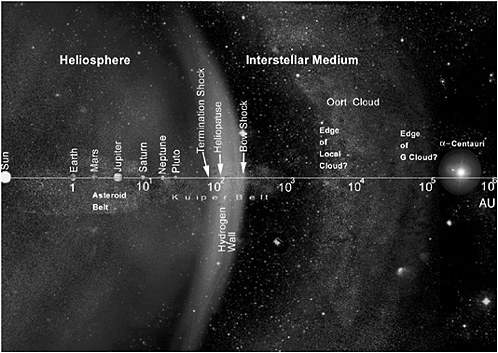
FIGURE 4.1 The scale of the local galactic neighborhood.
-
returned from a solar-sail mission. Similarly, spectrometers for ions, neutrals, and dust will have enhanced mass resolution.
-
The Interstellar Observatory utilizes multiple subsatellites, released sequentially deep in the outer heliosphere—possibly between 50 and 80 AU—to provide redundancy, the ability to observe spatial structures of the heliosphere, and mitigation of radiation and contamination issues associated with the nuclear reactor.
For additional information about the Interstellar Observatory concept and a detailed discussion of its scientific goals, see Box 4.1 and Appendix B.
The Interstellar Observatory would also have practical benefits. Galactic cosmic radiation is a ubiquitous hazard for all voyagers beyond near-Earth space. Outside the protective shield of Earth’s magnetic field and atmosphere, astronauts are fully exposed to galactic cosmic rays and, more insidiously, to secondary-radiation products whose effects can be amplified by the inappropriate choice of spacecraft shielding materials. Crew members can expect to accumulate more than half of their lifetime maximum allowable dose of radiation on a multiyear round-trip mission to Mars. It is well known that the flux of galactic cosmic rays waxes and wanes as the heliosphere responds to the Sun’s magnetic cycle. But researchers currently have no detailed understanding of how the conditions in the local interstellar medium control the structure and dynamics of the heliosphere or of how this structure, in turn, regulates the radiation environment of the inner solar system. Enhanced understanding gained from data obtained with the Interstellar Observatory will be important for developing appropriate strategies for mitigating galactic cosmic radiation hazards.
Galactic cosmic radiation also has implications for global sustainability. Substantial changes in conditions in the local interstellar medium might significantly affect Earth’s climate and the amount of radiation to which humans are exposed.9 Five or six known episodes of large increases in cosmic ray intensity over the last 1,000 years appear to be associated with changes in the level of solar activity (e.g., the Maunder minimum) and with changes in terrestrial climate.10,11 What is not known is whether these variations in cosmic radiation were caused by changes in the local interstellar medium.12 Knowledge gained from use of the Interstellar Observatory will enhance understanding of the effects of the local interstellar medium on heliospheric structure and its shielding of galactic cosmic rays. By extrapolating physical knowledge of the interstellar interaction into the distant past and future, it may be possible to address issues concerning global sustainability.
Comparison of the Two Concepts. The interstellar probe appears, at first sight, to have two advantages over the NEP mission:
-
With the interstellar probe as conceptualized by the 1999 IPSTDT, the trip time is likely to be shorter. Preliminary, low-fidelity, parametric studies undertaken by Project Prometheus indicate that an Interstellar Precursor mission equipped with a propulsion system derived from the Jupiter Icy Moons Orbiter (JIMO) (i.e., not the Interstellar Observatory described above) would take some 20 to 30 years to reach a point 200 AU from the Sun. The IPSTDT solar-sail-powered interstellar probe mission was designed to travel the same distance in about 15 years. It must be emphasized, however, that the flight time of the Interstellar Observatory NEP system is heavily dependent on the assumptions made about the propulsion system and, in particular, the mass-to-power ratio of the nuclear reactor and its associated power-conversion system. NASA’s parametric studies appear to have been based on conservative estimates of this key parameter. Similarly, techniques for reducing the flight time—e.g., Jupiter flybys—do not appear to have been considered.
-
The cost of the IPSTDT concept is likely to be much lower, although no reliable current cost information is available for the solar-sail mission, the JIMO-derived Interstellar Precursor mission, or the Interstellar Observatory. On the basis of an earlier Jet Propulsion Laboratory (JPL) study,13 the SSP decadal survey estimated the cost of the solar-sail interstellar probe at ~$500 million.14 Although NASA has released no cost estimates for JIMO, its cost has been crudely estimated at ~$10 billion.15 It is unlikely that either the cost of the Interstellar Precursor mission studied by Project Prometheus or the Interstellar Observatory discussed here will differ significantly from the cost of JIMO itself. It must be emphasized, however, that a simple cost comparison between the nuclear and non-nuclear options is complicated by the very different instrument complements and scientific capabilities of the
|
BOX 4.1 Mission Type: NEP-class Objectives:
Implementation:
|
-
various options. The preliminary nature of the cost estimates for an interstellar probe, the ill-defined nature and capabilities of the different nuclear and non-nuclear implementations of this mission, and the fact that both nuclear-electric propulsion and solar sails have yet to be demonstrated in space strongly suggest that nuclear as well as non-nuclear mission concepts should be held as options in detailed trade-off studies.
Decadal Survey Missions Enhanced or Enabled by RPS
The missions selected in the SSP decadal survey that might be enhanced or enabled by RPS technologies are as follows:
-
Solar Probe. A Science and Technology Definition Team established in 2003 is working to finalize the scientific objectives, spacecraft design, payload complement, and mission profile for the Solar Probe. The baseline launch date is October 2014.16 An assumption of the ongoing studies is that the Solar Probe will make use of three of the multi-mission radioisotope thermoelectric generators (MMRTGs) that are being designed for use on the
|
Payload:
Some Issues for Study:
|
-
Mars Science Laboratory in 2009. The Solar Coronal Cluster, a possible follow-on to the Solar Probe, is discussed in the next section.
-
Io Electrodynamics. This is one of the missions deferred in the SSP decadal survey’s list of priority missions for the coming decade, because it is a logical follow-on to the Jupiter Polar Mission.
-
Mars Aeronomy Probe. Designed to determine how Mars’s upper atmosphere is influenced by the solar wind, this high-priority mission was deferred by the SSP decadal survey for implementation in the coming decade. A solar-powered version has been thoroughly studied and can be readied for flight without much further development. The exact enhancing or enabling role of RPS technologies for this mission requires much more study and is not discussed further here.
-
Venus Aeronomy Probe. Designed to determine how Venus’s upper atmosphere is influenced by the solar wind, this high-priority mission was also deferred by the SSP decadal survey for implementation in the coming decade. The exact enhancing or enabling role of RPS technologies for this mission requires much more study and is not discussed further here.
Preliminary Concepts for Missions Enabled by NEP and RPS Technologies
What missions besides the Interstellar Probe/Interstellar Observatory might be uniquely enabled or greatly enhanced by nuclear power and propulsion technologies? The limited scope of this study precludes a definitive answer. Distinguishing whether or not a concept is uniquely enabled, enabled, significantly enhanced, or enhanced by nuclear systems will require extensive additional study. Rather, the committee has attempted to identify some preliminary concepts for missions that it believes are plausibly enhanced or enabled by the use of nuclear technologies.
To stimulate discussion in the solar and space physics community and, in particular, to further identify the technological challenges inherent in developing nuclear power and propulsion capabilities, the committee outlines three preliminary mission concepts in some detail. The scientific objectives of these concepts and the means by which they might be addressed in the context of missions utilizing nuclear power and propulsion systems are described in Boxes 4.2 through 4.4. The committee emphasizes that it does not give these missions any priority above any other missions considered here or elsewhere.
-
Solar Coronal Cluster. The Sun’s complex magnetic fields are highly dynamic. Large amounts of energy are stored in the strong magnetic fields, which periodically undergo massive reorganization, eject matter from the Sun, and create shock waves that propagate through the interplanetary medium. As these waves and their associated energetic-particle squalls sweep through the solar system, they cause large transient changes in the radiation environments of Earth, the Moon, Mars, and the other planets. These space weather events can expose astronauts and their robotic surrogates to radiation at doses that can prove fatal in a day or less.
The space weather for the entire solar system originates in the inner heliosphere—the completely unexplored region <0.3 AU from the Sun. The proposed Solar Probe, which the Solar Coronal Cluster is to follow, will penetrate this region. It is, however, limited to one or two fast flybys, spending only 10 days or so within 0.3 AU and less than 2 days within 0.1 AU (20 RSun).17
The Solar Coronal Cluster consists of a large, observatory-class spacecraft in a circular heliosynchronous orbit (~35 RSun), supported by three smaller spacecraft in elliptical orbits, that would provide comprehensive imaging and spectroscopy of an active region over a sufficiently long period to follow the region’s evolution over its entire life cycle. In situ instruments would be able to characterize and follow the evolution of the solar wind that originated from that region, including transients such as coronal mass ejections, since the interplanetary field would still be almost radial at 35 RSun. X-ray, gamma-ray, and neutron observations, both imaging and spectroscopy, would characterize the energetic electron and ion populations near the Sun, while other instruments would determine the characteristics of the energetic particles escaping from the region. See Box 4.2 for more details.
-
Solar System Disk Explorer. Recent observations of the radial distribution of Kuiper Belt objects (KBOs) imply an apparent “edge” of the solar system at 50 AU.18 The amount of material beyond 50 AU, as extrapolated from that contained within the planets, is well below the level that can be observed from Earth. This has raised many questions about the collisional evolution of the solar system. Because the present dust in the Kuiper Belt is thought to be the result of the collisions between KBOs, a study of the dust would complement the study of KBOs. More details about this mission are given in Box 4.3.
-
Jupiter Magnetosphere Multiprobe Mission. The relative importance of internal and external forcing—e.g., forcing driven by planetary rotation and by the solar wind, respectively—on astrophysical plasma and nebular systems is an important issue in space physics. In addition to its relevance to the three-dimensional structure and dynamics of planetary magnetospheres and the generation of auroras, the balance between external and internal forcings has practical significance. The dynamic radiation environment at other planets poses significant risks for future exploration and habitation. The Jupiter Magnetosphere Multiprobe Mission (see Box 4.4 for details) is designed to provide the most complete study of the largest and most complex radiation environment of any planet in the solar system. Similar missions can be envisioned for other planets with magnetospheres.
|
BOX 4.2 Mission Type: NEP-class Objective: Understand the connections between the Sun and the heliosphere and the origins of space weather by addressing the following issues:
Implementation:
Payload:
Some Issues for Study:
|
Cross-Disciplinary Missions Enabled by NEP Technologies
NEP-class missions to the magnetospheres of Saturn, Uranus, and Neptune would allow system-wide studies of these complex environments to a degree not possible with conventional power and propulsion. This enhanced capability is due, in large part, to the greater power, data volume, and payload mass afforded by nuclear-electric propulsion.
|
BOX 4.3 Mission Type: NEP-class Objectives: Study the collisional evolution of the solar system by conducting complementary observations of dust and Kuiper Belt objects in order to address the following issues:
Implementation:
|
Scale is an additional argument for including studies of planetary magnetospheres on NEP-class missions. While the exact cost of JIMO and possible follow-on missions is not clear at this time, most observers expect them to be much more expensive than flagship-class spacecraft such as Galileo and Cassini. To justify such investments in missions to the far-flung regions of the solar system, the science return from these efforts must be commensurate with their cost.
NEP-class missions break the mold of traditional missions to the outer planets. The additional payload resources allow for studies of fundamental physical processes usually restricted to near-Earth missions. There has been great progress made in the study of the magnetospheres of the outer planets by using more limited measurements and then drawing analogies with fully instrumented measurements at Earth. However, with exotic sources of plasma and different sources of energy in outer-planet magnetospheres, these terrestrial analogies might break down, and it is likely that there are processes with no known terrestrial counterpart.
Some solar system exploration missions involve the delivery of satellites or entry probes to bodies in the outer solar system including planets, their moons, and KBOs. A reactor-powered bus used for delivering such spacecraft
Payload:
Issues for Additional Study:
|
could, in such cases, also carry a package of particles and fields instrumentation designed for space physics studies in the outer heliosphere (see Box 6.4 for an example of such a mission). Upon completion of the initial delivery phase of the mission, the bus could be re-aimed toward a selected direction in the heliosphere, possibly using a gravity assist from a planetary flyby.
TECHNOLOGY ENHANCEMENTS AND ISSUES
Nuclear power and propulsion systems offer benefits but also raise new technological issues. Although nuclear systems potentially offer expanded capabilities in a variety of areas (see the section “Implementation and Techniques” in Chapter 3), their background radiation highlights the need for technology development in such areas as high-bandwidth communications, radiation-hardened components, and radiation-tolerant detectors. The technology enhancements and issues associated with the use of nuclear power and propulsion systems in solar and space physics missions can be summarized under the following headings (in no particular order):
|
BOX 4.4 Mission Type: NEP-class Objectives: Understand the dynamics of the jovian magnetosphere by addressing the following issues:1
Implementation:
Payload:
|
-
High-bandwidth communications;
-
Multiple-spacecraft systems;
-
Radiation-hardened components and radiation-tolerant detectors;
-
New classes of instrumentation;
-
Studies of trade-offs to assess alternative power and propulsion technologies; and
-
Radioisotope power systems and nuclear-propulsion technologies.
High-Bandwidth Communications
Limited telemetry resources have traditionally restricted the volume of data reported from space physics measurements, resulting in the loss of high-resolution spectral, temporal, and spatial information. Many future studies (e.g., rapid solar imaging and studies of the microphysics of plasma structures) will drive the need for data with higher temporal and spectral resolution than has typically been required in the past. The high-bandwidth communications capacity needed to transmit such large data streams to Earth might be achieved by increasing a spacecraft’s transmitting power via the use of nuclear systems. The demand for telemetry systems that can handle large data streams also drives expansion of the Deep Space Network.
Multiple-Spacecraft Systems
Nuclear power and propulsion technologies provide some interesting new options for implementing multiple-spacecraft missions. Important technological aspects of multiple-spacecraft scenarios include the following:
-
The control of formation flying;
-
The deployment of multiple subsatellites from a mother ship; and
-
The creation of distributed networks linking identical spacecraft so that the loss of any one satellite does not interrupt the flow of information among the remaining satellites or to ground stations.
The concept of a mother-craft carrying multiple smaller spacecraft may be particularly well suited to nuclear power and propulsion systems. The Interstellar Observatory (Box 4.1), the Solar Coronal Cluster (Box 4.2), the Solar System Disk Explorer (Box 4.3), and the Jupiter Magnetosphere Multiprobe Mission (Box 4.4) are good examples of missions utilizing multiple-spacecraft systems.
Technology issues associated with multiple-spacecraft systems include power distribution, communications, optimization of spacecraft trajectories, tracking, propulsion, and coordination of high-time-resolution observations. Development of technologies and the systems analysis framework associated with multiple-spacecraft scenarios would substantially enhance more routine implementation of multipoint measurements.
Radiation-Hardened Components and Radiation-Tolerant Detectors
A general concern for both near-Earth and deep-space missions is that spacecraft subsystems, especially radiation-hardened electronics, are becoming more expensive to acquire and qualify for flight. This concern is heightened for missions utilizing nuclear systems, because radiation backgrounds may be elevated. The impact on a mission of the unavailability of radiation-hardened components, particularly spacecraft processors, includes increased cost and risk, change of scope, and schedule delays.
For processors in particular, a promising emerging technology is field programmable gate arrays (FPGAs). These devices are inherently faster and more flexible, and can be configured to be more radiation hard, than traditional computer chips. The development of flight-qualified electronic components and, in particular, more capable and radiation-hardened FPGAs would enhance measurement capabilities and alleviate the issues associated with the paucity of flight processors.
Use of advanced nuclear power and propulsion systems on both long-duration missions and missions to planets with harsh radiation environments requires radiation-tolerant detectors that can maintain sensitivity and spectral response without substantial increases in noise over the lifetime of a mission. Issues associated with these detectors include detector annealing, permanent detector damage, and activation of detector material or nearby components. Developing new detector materials and detection concepts, and understanding detectors’ responses to and damage by radiation from advanced nuclear power and propulsion technologies, would enhance, and in some cases enable, the scientific return from missions in these radiation environments.
New Classes of Instrumentation
Exploitation of the emerging capabilities enabled by advanced nuclear power and propulsion systems for high-mass, high-power, and high-data-rate instrumentation suggests the need for a program equivalent to the High Capability Instruments for Planetary Exploration (HCIPE) program. Such a program could support the development of spacecraft-based instrument technologies with capabilities well beyond those of existing flight instruments. The primary goal of this program would be to develop a new generation of scientific instruments for solar and space physics exploration that could take advantage of the capabilities enabled by nuclear-electric power and propulsion. For example, an interstellar probe mission could benefit substantially from energetic neutral atom imagers with significantly higher sensitivity, angular resolution, and energy resolution than are currently available for flight. Other examples of instruments that could have increased capabilities with more resources than previously available include mass spectrometers, solar imagers, and active magnetospheric experiments. One such experiment, designed to study the motion of electrons trapped in a planetary magnetosphere, would be uniquely enabled by positron production, which is a unique property of operational nuclear reactors in a magnetospheric environment.19 The Jupiter Magnetosphere Multiprobe Mission (Box 4.4) and the Neptune-Triton System Explorer (Box 6.5) are both examples of concepts that could benefit from the inclusion of new types of active magnetospheric experiments.
Studies of Trade-offs to Assess Alternative Power and Propulsion Technologies
Although enhanced propulsion capabilities are necessary to send more massive payloads to their destinations more quickly, the most appropriate means to achieve that end for individual missions remains unclear. At this time, for example, it is not possible to say definitively whether NEP-enabled missions such as the elaborate Interstellar Observatory (Box 4.1) or the less-elaborate Titan Express/Interstellar Pioneer (Box 6.4) are more appropriate means of addressing the science goals for the study of the outer heliosphere than are the non-NEP interstellar probes discussed in the SSP decadal survey. Therefore, the development of alternative power and propulsion technologies should continue in parallel with the development of nuclear technologies until such time as even-handed studies of trade-offs are able to draw clear distinctions between missions that embody different power and propulsion approaches to meeting the same science goals. Breakthroughs in the development of, for example, solar-sail technology may enhance or enable several of the missions identified in the SSP decadal survey.
Radioisotope Power Systems and Nuclear Propulsion Technologies
The solar and space physics community would greatly value development of a wide range of RPS technologies, including lighter and more efficient devices that could enhance a diverse set of missions, including the subsatellites deployed by the NEP missions described in this chapter (see Boxes 4.1 through 4.4). Advanced nuclear propulsion technologies would be most beneficial if they greatly reduced transit times to mission targets and significantly increased science payload capacities and capability. For these reasons, Project Prometheus is encouraged by the committee to expand the scope of power and propulsion technologies it is studying.
CONCLUSIONS
The new paradigm in space exploration enabled by nuclear power and propulsion should be highlighted by missions that engage broad, high-impact, and programmatically cross-cutting scientific themes. The exploration of the outer solar system and the local interstellar medium appears to present a particular opportunity to use nuclear technologies. Granted the limited scope of this present study, nevertheless it appears that the Interstellar Observatory concept is extremely compelling in that it would redefine the modern frontier of space science and address important issues in planetary science, solar and space physics, and, potentially, astronomy and astrophysics.
Important scientific objectives are enabled by advanced nuclear power and propulsion technologies, but the concepts addressing these objectives need to be studied in much more detail before the priority of these missions
can be adjudicated. Ancillary developments in areas such as communications and spacecraft subsystems will be needed to allow full use of these technologies.
Although the solar and space physics community has made use of RPS in the past and will certainly utilize emerging RPS technologies, nuclear-electric propulsion enables a much different and larger class of missions. An appropriate strategy is to pursue nuclear propulsion technologies as long as they do not interfere with the current diversity of solar and space physics missions. Such diversity gives scientific breadth and depth to these pursuits and is essential for the long-term health and vitality of solar and space physics as a discipline.
REFERENCES
1. National Research Council, The Sun to the Earth—and Beyond: A Decadal Research Strategy in Solar and Space Physics, The National Academies Press, Washington, D.C., 2003.
2. Assembly of Mathematical and Physical Sciences, National Research Council, Astronomy and Astrophysics for the 1980’s, National Academy Press, Washington, D.C., 1982.
3. National Research Council, Space Science in the Twenty-First Century: Imperatives for the Decades 1995 to 2015—Solar and Space Physics, National Academy Press, Washington, D.C., 1988, pp. 41–43.
4. National Research Council, A Science Strategy for Space Physics, National Academy Press, Washington, D.C., 1995, pp. 3, 37, 66, and 74.
5. National Research Council, The Sun to the Earth—and Beyond: A Decadal Research Strategy in Solar and Space Physics, The National Academies Press, Washington, D.C., 2003.
6. Interstellar Probe Science and Technology Definition Team, NASA, Interstellar Probe: Exploring the Interstellar Medium and the Boundaries of the Heliosphere, Jet Propulsion Laboratory, Pasadena, Calif., 1999, available only online at <http://interstellar.jpl.nasa.gov/> last accessed February 2, 2006.
7. National Research Council, The Sun to the Earth—and Beyond: Panel Reports, The National Academies Press, Washington, D.C., 2003, pp. 36–38.
8. National Research Council, The Sun to the Earth—and Beyond: A Decadal Research Strategy in Solar and Space Physics, The National Academies Press, Washington, D.C., 2003, p. 78.
9. N.J. Shaviv, “The Spiral Structure of the Milky Way, Cosmic Rays, and Ice Age Epochs on Earth,” New Astronomy 8: 39–77, 2003.
10. G.M. Raisaisbeck, F. Yiou, M. Fruneau, J.M. Loiseaux, M. Lieuvin, J.C. Ravel, and C. Lorius, “Cosmogenic 10Be concentrations in Antarctic ice during the past 30,000 years,” Nature 292: 825–826, 1981.
11. J. Beer, U. Siegenthaler, and A. Blinov, “Temporal 10Be Variations in Ice; Information on Solar Activity and Geomagnetic Field Intensity,” pp. 297–313 in Secular Solar and Geomagnetic Variations in the Last 10,000 Years, F.R. Stephenson and A.W. Wolfendale, eds., Kluwer Academic Publishers, Dordrecht, the Netherlands, 1988.
12. National Research Council, The Astrophysical Context of Life, The National Academies Press, Washington, D.C., 2005, pp. 20–21.
13. S.A. Gavit, “Interstellar Probe Mission Architecture and Technology Report,” Internal document JPL-D-18410, Jet Propulsion Laboratory, Pasadena, Calif., 1999.
14. National Research Council, The Sun to the Earth—and Beyond: Panel Reports, The National Academies Press, Washington, D.C., 2003, p. 38.
15. Congressional Budget Office, A Budgetary Analysis of NASA’s New Vision for Space Exploration, Congress of the United States, Washington, D.C., 2004, p. 22.
16. For more details about Solar Probe see, for example <sec.gsfc.nasa.gov/solarprobe/solarprobe.htm>.
17. For more details on Solar Probe see, for example, Applied Physics Laboratory and Jet Propulsion Laboratory, Solar Probe: An Engineering Study, NASA-Goddard Spaceflight Center, Greenbelt, Md., 2002. Available at <http://solarprobe.gsfc.nasa.gov/solarprobe_apl_study.pdf> last accessed February 2, 2006.
18. See, for example, J.X. Luu and D.C. Jewitt, “Kuiper Belt Objects: Relics from the Accretion Disk of the Sun,” Annual Reviews of Astronomy and Astrophysics 40: 63–101, 2002.
19. See, for example, E.W. Hones, Jr., “On the Use of Positrons as Tracers to Study the Motions of Electrons Trapped in the Earth’s Magnetosphere,” Journal of Geophysical Research 69: 182–185, 1964.


