
3
New Chemistries and Processes That Lead to Commercially Viable Alternative Feedstocks to Fossil Fuels
Since 1850, there has been an evolution of both energy resources (Figure 3.1) as well as the source of feedstocks for the commodity chemical industry. In 1850, the predominant fuels were wood or other biomass depending upon location. During this time period, the chemical enterprise was relatively small. However, as the industrial revolution gained momentum, the need for new chemicals and new materials to meet the growing demands of industry and consumers increased. At the turn of the twentieth century, carbon-based chemical feedstocks were already primarily derived from coal. Over the course of the twentieth century, global political and economic forces initiated significant change. During that time, the United States, and subsequently the global chemical enterprise, moved farther away from renewable sources of carbon-based feedstock and became heavily dependent on fossil fuels—crude oil and natural gas—both as a feedstock for commodity chemicals and as a primary energy source.
As concerns about the fundamental nature of the crude oil supply and concerns about impacts on the environment and human health arose, there was a shift from crude oil (as a fundamental energy source) to natural gas (and to a limited extent, non-fossil sources such as nuclear, wind, solar, and biomass). Thus, today there is a multitude of fossil based fuels—coal, oil, and natural gas—used for energy, but overall energy consumption has also increased (Figure 3.2). There are also simultaneous demands on fossil fuels as energy resources and feedstock for the commodity based chemicals.
Thus, the chemical enterprise is faced with two fundamental ques-
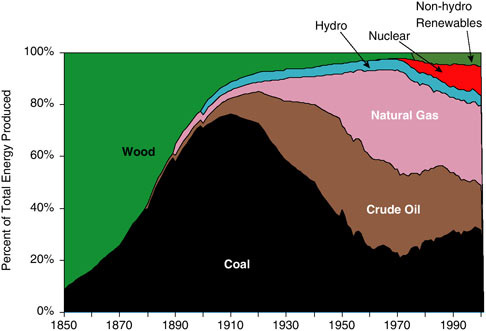
FIGURE 3.1 U.S. energy production by source—1850–2000.
SOURCE: U.S. Department of the Interior. 1975. 1850–1949, Energy Perspectives: A Presentation of Major Energy and Energy-Related Data; 1950–2000, Annual Energy Review 2000, Table 1.2.
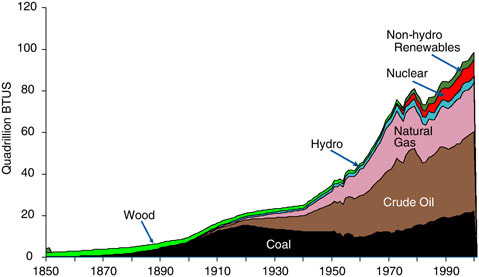
FIGURE 3.2 U.S. Energy consumption by source—1850–2000.
SOURCE: U.S. Department of the Interior. 1975. 1850–1949, Energy Perspectives: A Presentation of Major Energy and Energy-Related Data; 1950–2000, Annual Energy Review 2000, Table 1.3.
tions that drive the need for the development of the new chemistries and processes for a sustainable future:
-
Where is the fuel needed to support the energy demands of the economy and quality of life that the developed world currently enjoys (and the developing world—especially rapidly developing China and India1—is striving for) going to come from?
-
What feedstock sources are going to be used in the future to produce the basic chemical building blocks of the chemical enterprise (which are required for the production of materials and products consumers demand)?
Drivers for Change
The current prognosis for the fossil fuel economy in terms of global supply over the next 20 years is good. According to a recent analysis2 by the U.S. Energy Information Administration, “For the forecast period out to 2025, there is sufficient oil to meet worldwide demand. Peaking of world oil production is not anticipated until after 2030.” The EIA also estimates adequate supplies of natural gas over the next 60 years, and coal supplies for 100 years or more. However, this is an optimist picture, because it largely assumes a business-as-usual market environment, with no disruptions to these supplies from geopolitics, weather, or regulatory controls on using fossil fuels. The current challenge is about the amount of hydrocarbon that will be available over the next 20 years, and the sustainability of producing and transforming that hydrocarbon into useful feedstocks.
Fossil Fuel Quality and Security
Crude oil quality3 is changing significantly as is the political stability of the areas that have oil versus those who use oil (Table 3.1), presenting considerable challenges for U.S. national security. For example, the United States currently depends heavily on Middle Eastern nations for oil sup-
|
1 |
According to the U.S. Energy Information Administration, China is world’s second largest energy consumer (after the United States), and India is the world’s sixth. |
|
2 |
Energy Information Administration, International Energy Outlook 2005, DOE/EIA-0484(2005), p. 29 http://www.eia.doe.gov/oiaf/ieo/index.html. |
|
3 |
High quality (light sweet) crude oil is low in hydrogen sulfide and carbon dioxide and easier to refine, and provides high yields of high-value products such as gasoline, diesel fuel, heating oil, and jet fuel. |
TABLE 3.1 U.S. Dependence on Foreign Oil
|
Have Oil |
Percent |
Use Oil |
Percent |
|
Saudi Arabia |
26 |
U.S. |
26 |
|
Iraq |
11 |
Japan |
07 |
|
Kuwait |
10 |
China |
06 |
|
Iran |
09 |
Germany |
04 |
|
UAE |
08 |
Canada |
04 |
|
Venezuela |
06 |
Russia |
03 |
|
Russia |
05 |
Brazil |
03 |
|
Libya |
03 |
S. Korea |
03 |
|
Mexico |
03 |
France |
03 |
|
China |
03 |
India |
03 |
|
Nigeria |
02 |
Mexico |
03 |
|
U.S. |
02 |
Italy |
02 |
|
SOURCE: Energy Information Administration. 2001. International Energy Annual, Tables 11.4 and 11.10. |
|||
plies, but crude oils from these areas tend be lower quality than from North and South America or West Africa.4 Thus, one driver for change is to reduce the dependency on foreign sources of oil and ensure that there will not be a disruption in the energy supply.
Problems also arise from the basic economics and reliability of transforming fossil fuels into useable materials. As the quality of crude oil declines, and there is a shift from one fossil fuel to another—the regulatory and technical requirements for processing such as coking, hydrocracking, and sulfur removal increase and hence the cost associated with processing increases. This is then transferred throughout the economy to increased feedstock costs for commodity chemicals and an increase in transportation fuel costs. At some point, these resulting economic factors become the ultimate driver for change to alternative feedstocks. Although it is anticipated that the total amount of fossil fuels (coal, natural gas, and oil) available can support current and future needs for at least another hundred years (Chapter 4, Table 4.1), at some point there must be a shift from nonrenewable fossil fuels to renewable sources.
Resource Demands and Impacts
However, achieving sustainability is not just about addressing the supply of fossil fuels; it is also a matter of addressing the demand for their
|
4 |
For more information see the Energy Information Administration at: www.eia.doe.gov |
use and their full life cycle of impacts. Taking a look at the concept of the demise or “tragedy” of the commons,5 another fundamental driver for change emerges—reaching the production capacity of the planet because of the consequences of population growth. That is, given the current demands of 6 billion people on the planet, and a projected population of 9 billion in 2050 with its increased demands for consumer goods, the impacts of fossil fuels (mainly due to the combustion of hydrocarbons) on the environment and human health cannot continue regardless of there being adequate supplies.
In the past, the demand and use of fossil fuels were limited and the impact on the environment was not seen or detected. As the use increased, or the concentration of the use increased, there were significant impacts on the environment. Examples include smog, coal dust, and widespread environmental blight in cities and other congested areas that persisted until about 1970 with the passage and enforcement of legislation to protect the environment. Other impacts such as how wildlife became harmed by pesticide use, led Rachel Carson to write the book Silent Spring, which awakened the general public to the underlying issue of sustainability later articulated by Hardin. That is, how can resources (even renewable ones) continue to be utilized without fundamentally “trashing” the commons? This becomes a significant driver for the need to look for alternative sources of feedstocks and fuels.
OPPORTUNITIES FOR RESEARCH AND DEVELOPEMENT
Exploring alternative, sustainable feedstocks requires simultaneous consideration with development of alternative energy sources and future fuels, as well as continued improvements in the efficient use of current resources (see Chapter 4 for more detailed discussion of energy). As alternative, sustainable feedstocks and fuels are explored and new processes or technologies are developed, the impact on resources must be considered. First, from the perspective of the base materials used in the process—the alternative feedstock. Secondly, from the materials use of the process itself, such as what type of catalyst does this process require? What type of recycling is employed? What materials are needed, particularly if the process utilizes water? What is the impact on the recycled material? What wastes are generated from these processes? Are these wastes better or worse than the current processes? How are the wastes managed?
These considerations lead to a level of understanding that is essential for the future development of the chemical enterprise. The enterprise
needs to have tools and guidelines for the consideration of the risks and rewards. It needs to be able to adequately assess the various alternatives being proposed. There needs to be a means of providing a value assessment associated with the alternatives. Hence, the physical science professional is going to have to take a multi-disciplined approach in the evaluation of the potential gains or risks associated with the technology (see Chapter 5 for discussion of education needed to support sustainability goals).
Alternative Energy Sources
Energy is a key need in the development of future growth. This particular area and potential research applications have been previously addressed by others,6 and will also be addressed in Chapter 4; therefore it will not be discussed in much detail here. However, it is important to note that the chemical process industry (CPI) consumes about 7.7 percent of all the energy (fossil fuels, electricity, etc.) resources used in the United States.7 Of this, about 50 percent of the energy resources are used as chemical feedstocks, rather than consumed as energy. Because of the competing needs for feedstocks and fuels, it is thus a grand challenge for the chemical enterprise to lead the way in the development of future fuel alternatives. These alternatives could be in the development of hydrogen, landfill gas, and biomass8 fuel sources utilizing fuel cell, wind, solar heating, and photovoltaic technology.
Biomass is an especially promising avenue to pursue for the chemical industry. According to the U.S. DOE, biomass recently surpassed hydropower as the largest domestic source of renewable energy and currently provides over 3 percent of the total energy consumption of the United States. Current efforts to integrate production of fuels and feedstocks from biomass—biorefineries—show great promise for developing future fuels. This has been demonstrated by efforts of the DuPont-DOE Integrated Corn Biorefinery project, which not only uses the starch, but also the cellulose, the corn, and the corn stover to produce chemicals, bioethanol and power, and to feed the production of Dupont’s Sorona® polyester.
In addition to specific future fuel alternatives, the chemical enterprise should accelerate its efforts to examine the technologies needed to fully
integrate, or close the loop on, production activities—such as in the pulp and paper industry where waste products are utilized as fuel for the process—and thereby reducing current energy needs. These applications could be expanded and potentially integrated into additional processes.
Finally, the chemical enterprise should be a significant player in the development of enabling energy technologies. These include:
-
Energy storage materials and devices
-
Materials that improve energy efficiency
-
Biomass pretreatment processes
-
Fermentation processes
-
Separation processes
-
Water treatment processes
All of these enabling technologies are going to be required to bring the innovative technologies from the laboratory to a commercially viable alternative.
Alternative Feedstocks
Today’s economy relies on inexpensive access to chemicals and related materials—from basic and fine commodity chemical building blocks to finished products such as textiles, pharmaceuticals, and agricultural chemicals—which are largely derived from a fossil fuel based feedstock. It is thus essential that commercially viable alternative feedstocks and processes be developed.
Biologically Derived Basic Chemical Building Blocks
As pointed out by Stanley Bull in the workshop, and discussed briefly in the previously section, the growing need for sustainable energy can be met by improvements in capturing and utilizing renewable resources such as solar, wind, and geothermal, and biomass; however, biomass is the only renewable resource that produces carbon-based fuels and chemicals. It is important to note that biomass is not just derived from agricultural food and feed crops, it includes any plant-derived organic matter available on a renewable basis, including dedicated energy crops and trees, agricultural crop wastes and residues, wood wastes and residues, aquatic plants, animal wastes, municipal wastes, and other waste materials. According to a recent DOE-USDA analysis, by 2030,9 combined forest and
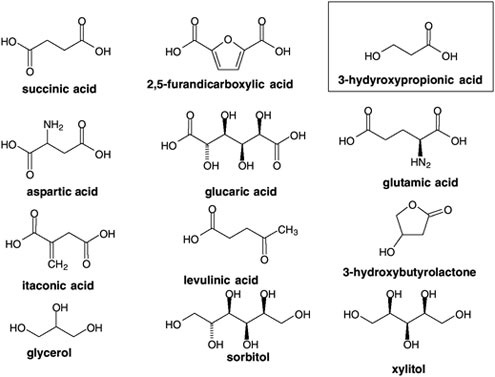
FIGURE 3.3 DOE biomass program “Top 12” sugar-based building block chemicals.
agriculture land resources alone have the potential of providing a sustainable supply of more than one-third of the nation’s current petroleum consumption. In addition, the U.S. Department of Energy (DOE) has identified twelve sugar-based chemical building blocks via biochemical or chemical conversion (Figure 3.3) as a starting point for the development of biomass as a feedstock for commodity chemicals.10 Such chemicals are seen as essential in the development of a commercially viable biomass generated feedstock. Much research is still needed to determine the means of producing these materials.
However, questions remain. What building block chemicals are currently available? Are these chemicals the right ones? Do they lead to what the chemical enterprise currently obtains from fossil fuel sources—basic aliphatic and aromatic building blocks—which feed into the products that consumers demand? A fundamental challenge for the sustainability effort
is the development of a catalog of biomass derived chemicals, which DOE has already begun to work on. Fundamental studies on biomass could provide such building blocks—lignin chemistries, a re-examination of cellulose chemistries, or other biomass-based chemistries that were historically viewed as uneconomic or difficult. This “catalog” of potential starting chemicals would provide the research community with starting points in the development of alternative pathways to achieve the desired end materials.
|
We [in biomass] need to be doing the same thing [as] the petroleum folks, and that is, get every value … of every product possible out of it. Stanley Bull, National Renewable Energy Laboratory |
Technologies for Converting Biomass into Chemical Feedstocks
While the “catalog” of potential starting chemicals is extremely important, the development of technologies to produce these chemicals is equally important. The chemical enterprise is going to have to address the pretreatment as well as the “breakdown” processes to take the starting biomass material (this could be switch grass, corn, grains, energy cane, water hyacinth, etc.) to the potential building blocks to develop the platform chemicals.
A common method of initial “breakdown” is a fermentation process. The development of specific organisms for the express purpose of producing a specific compound from the biomass is a viable avenue of research. The development of the specific organism—whether by directed evolution, gene splicing, or a traditional selective isolation—is a significant need to enable the technology. At the same time, the development of such organisms leads to a number of ethical and social issues surrounding the genetic modification. This is another area where the chemical enterprise is going to have to develop tools to deal with the potential risks associated with genetic modification and examine the social implications of the technology.
Fermentation processes are but one potential initial step. There could be other potential pathways to the building block chemicals; there could be direct extraction from the plant or biomass material, enzymatic reactions, etc. These other pathways also need directed research in order to achieve the platform chemicals.
Once the base chemicals have been obtained via what ever selected pathway, the chemical will then have to be separated from the complex
mixture. This identifies the need for better separation chemistries that will be required—particularly aqueous separations as well as concentrating techniques as it is anticipated that many of these platform chemicals will be produced in very dilute mixtures. The dilute mixtures also point to another significant research need—understanding of water chemistries. Water will be of significant concern in the production of platform chemicals from biomass—identification of sources, water quality, and the water treatment.
Fermentation processes imply the production of biomass as a waste product. Waste treatment, handling, and disposal are also going to be issues associated with the bio-production of platform chemicals. Hence, research opportunities abound related to the basic chemistries associated with fermentation, separations, water treatment, water chemistries, waste management, etc.
From this brief discussion of the various process chemistries, it should become evident that a life cycle analysis of the process from biomass through use and disposal is essential. The complex chemistries and potential side products of production need to be analyzed and considered as potential feedstocks for alternative processes. The fermentation liquor is going to be a complex mixture with potential chemistries that are not currently well understood by chemists.
The development of the building block chemical assumes that chemistries exist for such transformations to the ultimate production chemical. Since the fundamental platform chemicals may be significantly different than those obtained from the fossil fuel based starting materials, there needs to be a firm understanding of the steps to take the platform chemical to the production chemical. Thus, research in the areas of basic chemical transformations—such as oxidation, hydrogenation, and Fischer-Tropsch synthesis—is essential. Figure 3.4 illustrates how 3-hydroxypropionic acid (3-HP) derived from sugar (Figure 3.3) can be transformed into more useful chemicals with varying moieties.
Finally, since the handling of biomass materials is different than that of handling fossil fuels, one would anticipate that materials handling issues would also be a fruitful area of research. Mixing, solid handling, and heat transfer are areas where it is anticipated that new process chemistry and engineering technologies will have to be developed.
CONCLUSIONS AND RECOMMENDATIONS
In order to develop the required new commercially viable alternatives to fossil fuel feedstocks, attention must be given to a number of critical research areas. Many of these are already being addressed through increased federal funding or collaborative efforts between industry and
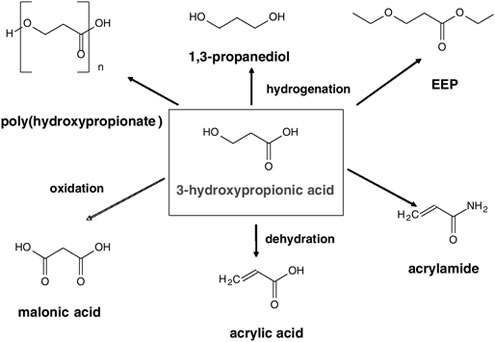
FIGURE 3.4 3-HP from sugar platform as a chemical building block.
government. All of these issues need to be tempered through the lens of life cycle analyzes as well as the ethical and social risk assessments. This is a new lens for the chemical enterprise, which means that there needs to be a fundamental change in thinking regarding how one approaches research—a need for sustainability literacy (see Chapter 5 for more discussion). Issues surrounding the biomass life cycle need to be considered—the seasonality of the growth cycle, the land nutrient cycle, and biomass waste (see Chapter 2). Taking such a holistic approach to the problem is a different viewpoint for the chemical enterprise.
Fundamentally, the underlying issue surrounding all of these research topics is that of functionality. At the consumer level, the fundamental need is functionality—transportation from point A to B, a pharmaceutical that treats a specific illness or pain, a material with specific properties, etc. The ultimate grand challenge is how to change the approach to research to provide for the desired functionality in a way that is sustainable.
The need for a “catalog” of biomass derived materials. A fundamental challenge for the sustainability effort is the development of a catalog of biomass derived chemicals, which DOE has already begun to work on. This would mean fundamental studies on biomass could provide such
building blocks—lignin chemistry, a re-examination of cellulose chemistries, or other biomass-based chemistries that were historically viewed as uneconomic or difficult. This “catalog” of potential starting chemicals would provide the research community with starting points in the development of alternative pathways to achieve the desired end materials.
Future fuel alternatives. Because of the competing needs for feedstocks and fuels, clearly, it is a grand challenge for the chemical enterprise to lead the way in the development of future fuel alternatives. These alternatives could be in the development of hydrogen, landfill gas, and biomass fuel sources utilizing fuel cell, wind, solar heating, and photovoltaic technology. A great example of such efforts includes the integration of producing fuels and feedstocks from biomass via biorefineries, such as the DuPont-DOE Integrated Corn Biorefinery project. Such efforts need to be emulated and expanded.
Integration of process chemistries. In addition to developing future fuel alternatives, the chemical enterprise should accelerate its efforts to examine the technologies needed to fully integrate production activities—thereby reducing current energy needs. Examples of where this is already taking place include smaller niche operations such as the pulp and paper industry where waste products are utilized as fuel for the process. These applications could be expanded and potentially integrated into additional processes.
Development of platform chemicals (sugar, lignin, etc.) from biomass that lead to basic building block chemicals. There needs to be an alternative means of producing the basic commodity chemicals such as simple aliphatics and aromatics since the chemistry will be quite different from transforming fossil fuel hydrocarbons. Much research is still needed to determine the means of producing these materials from sugars, starch, lignin, and cellulose. An example includes the efforts by the DOE, which identified sugar-based chemical building blocks via biochemical or chemical conversion as a starting point for the development of biomass as a feedstock for commodity chemicals. Such building block chemicals are seen as essential in the development of a commercially viable biomass generated feedstock.
Understanding of the basic chemical processes to transform the platform chemicals to the final production processes. While the “catalog” of potential starting chemicals is extremely important, the development of technologies to produce these chemicals is just as important. The chemical enterprise is going to have to address the pretreatment as well as the
“breakdown” processes to take the starting biomass material (this could be switch grass, corn, grains, energy cane, water hyacinth, etc.) to the potential building blocks to develop the platform chemicals.
Understanding the basic separation or extraction processes need to isolate the building block chemicals from biomass. Once the platform chemicals have been obtained via whatever selected pathway, the chemical will then have to be separated from the complex mixture. This identifies the need for better separation chemistries that will be required—particularly aqueous separations as well as concentrating techniques as it is anticipated that many of these platform chemicals will be produced in very dilute mixtures. The dilute mixtures also point to another significant research need—understanding of water chemistries. Water will be of significant concern in the production of platform chemicals from biomass—identification of sources, water quality, and the water treatment.


