
6
Conclusions and Recommendations
Based on the discussion provided in the previous chapters of this report, a set of grand challenges and accompanying research needs were identified and are summarized below. Although the Grand Challenges are numbered, they are all important in the context of this report and to the triple bottom line of the chemical industry now and in the future. However, Figure 6-1 illustrates how the different Grand Challenges (ovals) address the sustainability transition (large arrows) from the current paradigm to the ideal vision over the course of two critical time frames:
-
The next 20 years (2005–2025) of continued use of fossil fuels (especially oil) as the predominant source of energy and chemical feedstocks, where managing carbon, reducing the intense use of energy resources, and educational efforts to promote sustainability thinking will be critical; and
-
The next 20-100 years (2025–2105) in which the use of fossil fuels will be phased out, and where the ability to carry out green chemistry and engineering (built on fundamental understanding of the full life cycle impacts and toxicology of chemicals), and having access to alternative renewable sources of fuels and feedstocks will be critical.
GRAND CHALLENGES
The eight Grand Challenges below were chosen because they were considered to pose the greatest science and technical challenges for ad-
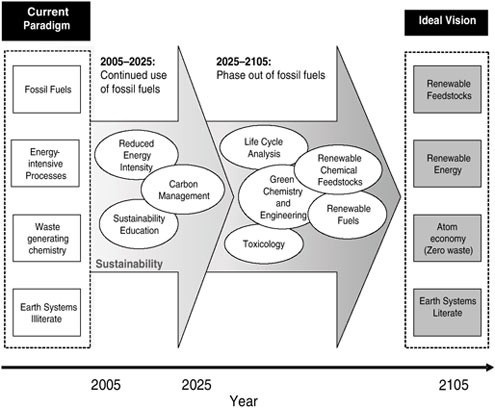
FIGURE 6-1 The Grand Challenges (ovals) for Sustainability (large arrows) address the transition from the current thinking to the ideal vision for the chemical industry over the next 100 years. See text for a more detailed description of figure and the Grand Challenges.
dressing sustainability—balanced economic, environmental, and societal progress—in the chemical industry over the next 100 years.
1. Green and Sustainable Chemistry and Engineering
It is a grand challenge for all chemists and chemical engineers to be involved in discovering ways to carry out more chemical transformations utilizing green and sustainable chemistry and engineering. This builds on the ultimate premise of green chemistry1,2 that it is better to prevent waste than to clean it up after it is formed, and its integration into processing and
other operations through green engineering.3 Achieving this grand challenge ideally provides production of both basic and fine chemicals in a less hazardous environment for humans and ecosystems, uses less energy, and lowers costs of production. Over the next twenty years this will involve replacing harmful solvents or improving catalytic selectivity and efficiency in chemical reactions that also provides cost savings. This area will grow in importance in the long term as fossil fuels are phased out of use and alternative and innovative approaches are required.
Research Needed:
While chemists can make most any molecule no matter how structurally complex, they need to develop with their engineering partners lower energy reaction pathways for current synthetic processes, and more environmentally benign solvent systems with higher yield efficiencies and less toxic waste.
2. Life Cycle Analysis
Today, there continue to be gaps in the way that chemistry and its impact on global systems is thought about. There is a need to understand the long-term impacts of chemicals in the environment—such as persistence, bioaccumulation, global warming potential, or ozone depletion—and to account for such properties within a large complex systems analysis. This involves having a keen understanding of the metabolism of chemical products—that is, their industrial ecology4—from the extraction of raw materials and creation of products, to their use and management of any resulting wastes. Life cycle analytical tools are especially needed for comparing the total environmental impact of products generated from different processing routes and under different operating conditions through the full life cycle. This is another area that is already being explored, but will play an increasingly significant role in the chemical industry in the longer term as fossil fuels are phased out of use and application of green chemistry and engineering practices become critical.
Research Needed:
Improvements are needed in the quantity and quality of data required for such comparisons and in the approach used to evaluate life cycle metrics. There needs to be an appropriate understanding of the methodology of life cycle analysis, the influence of the life cycle inventory data on the
analysis results, the interpretation of the results, and how the results will be used.
3. Toxicology
In order to successfully develop green and sustainable chemistry and engineering approaches, it is a grand challenge that chemists know the toxicological fate and effect of all chemical inputs and outputs of bond forming steps. Many data related to human and environmental toxicology of chemicals are either missing or questionable, which to a large extent affects the significance of some LCA studies, as well as the usefulness of material safety data sheets (MSDS) and other technical fact sheets. This is already an area of concern for the chemical industry, and will be increasingly important as fossil fuels are phased out of use and application of green chemistry and engineering practices become critical.
Research Needed:
Development of critical tools for improved understanding of structure-function relationships for chemicals and chemical mixtures in humans and the environment is needed. It would be tremendously useful to have a centralized repository for human health related data (issued from validated industrial, occupational, and community-generated resources) as well as ecotoxicity figures (for LCA studies) in the public domain at little or no cost to all interested parties. There is clearly a role for the associations within the chemical industry to assist in the funding and development of critical data related to the most pervasive and problematic chemicals in the industrial environment. Computational and genomic approaches to toxicology must be included in such efforts, such as those already underway at the U.S. Environmental Protection Agency and their partners at the National Institute of Environmental and Health Sciences and the Department of Energy.
4. Renewable Chemical Feedstocks
In order to provide desired chemical functionality in a way that is sustainable, another grand challenge for sustainability in the chemical industry is to derive chemicals from biomass. This includes any plant derived organic matter available on a renewable basis, including dedicated energy crops and trees, agricultural food and feed crops, agricultural crop wastes and residues, wood wastes and residues, aquatic plants, animal wastes, municipal wastes, and other waste materials.5 This is a long term challenge that will become increasingly important as fossil fuels are phased out over the next 100 years.
Research Needed:
There is a need to develop a catalog of biomass derived chemicals, building on what DOE has already begun.6 This “catalog” of potential starting chemicals would provide the research community with starting points in the development of alternative pathways to achieve the desired end materials.
This effort should involve studies on biomass that can provide current basic chemicals such as simple aliphatics and aromatics as well as fundamentally new compounds from platforms such as lignin, sugar, or cellulose. This should include a review of biomass-based chemistries that were historically viewed as uneconomic or difficult. It may also mean providing support for proven chemistries that need further research on applications and commercialization.
In developing biomass as a source of chemicals, improvements in processing are critically important. Pretreatment as well as the breakdown processes for transforming biomass material into useful chemicals must be addressed. This requires a better understanding of the basic chemical pathways involved in biomass conversion processes. While the catalog of potential starting chemicals is extremely important, the development of sustainable technologies to produce these chemicals is just as important (Grand Challenge 1).
Separation or extraction processes to isolate the basic chemicals from biomass are a very important part of processing (Grand Challenge 6). In particular, aqueous separations as well as concentrating techniques require attention because many biomass platform chemicals will likely be produced in very dilute and complex mixtures. As a result, the removal of water is a significant concern in the production of chemicals from biomass; identification of sources, and water treatment must all be addressed.
Overall, issues surrounding the biomass life cycle (Grand Challenge 2) need to be considered—the seasonality of the growth, the land nutrient cycle, and waste products. It is essential that a holistic approach to developing renewable chemical feedstocks be taken.
5. Renewable Fuels
The chemical process industry (CPI) consumes about 7.7 percent of all the energy (fossil fuels, electricity, etc.) resources used in the United States.7
|
6 |
U.S. DOE Biomass Program. August 2004. Top Value Added Chemicals from Biomass, Volume 1: Results from Screening for Potential Candidates from Sugars and Synthesis Gas. Report #35523. |
|
7 |
http://www.eere.energy.gov/industry/about/pdfs/chemicals_fy2004.pdf |
Of this, about 50 percent of the energy resources are used as chemical feedstocks, rather than consumed as energy. Because of the competing needs for feedstocks and fuels and the substantial use of energy by the CPI, it is a grand challenge for the chemical industry to lead the way in the development of future fuel alternatives derived from renewable sources such as biomass as well as landfill gas, wind, solar heating, and photovoltaic technology. This is another long term challenge that will become increasingly important as fossil fuels are phased out over the next 100 years.
Research Needed:
The only truly global sustainable source of energy is abundant, clean, and renewable solar energy. Unfortunately, it is intermittent and diffuse. To realize its potential, it must be captured, concentrated and stored or converted to other useful forms, and will require significant research advances including:
-
Reduction in the cost and the environmental impact of producing photovoltaic systems;
-
The ability to directly use solar energy for cost-effective splitting of water to produce hydrogen;
-
Improvements in heat transfer fluids that enable direct use of solar energy for meeting some of the heating requirements of the CPI; and
-
Advances in storage systems for electric power generated from solar energy.
Development of biomass derived fuels is also an important area of research that is intimately connected with biomass derived chemical feedstocks (Grand Challenge 4) and the energy intensity of the chemical processing (Grand Challenge 6).
6. Energy Intensity of Chemical Processing
Reducing the energy intensity of the CPI is another grand challenge for sustainability in the chemical industry. Continued reliance on fossil fuels can be anticipated, with eventual conversion from less abundant oil and natural gas to more abundant coal over the next 100 years. This makes the issue of carbon management extremely important (Grand Challenge 7), and presents a need for the CPI to transition to renewable sources of energy (Grand Challenge 5). However, it is clear that the continued development of more energy efficient technologies will be necessary whatever the source of energy being used by the CPI. Addressing this challenge will be critical during the continued use of fossil fuels as the predominant source of energy and chemical feedstocks over the next 20 years, and will continue to be important even when renewable energy resources are predominant.
Research Needed:
The energy efficiency of chemical separations is a key research component of this grand challenge. Finding effective alternatives to distillation are especially needed. While membrane separations, adsorption, and extractions tend to be less energy intensive, significant technical challenges must be overcome in the development of these alternatives in order to realize any significant reductions in the energy intensity of the CPI.
Biotechnological and other emerging technological solutions need to be explored to reduce the energy intensity of the CPI. In contrast to the typical catalysts in chemical reactions that require high temperatures and pressures while offering low selectivity, biocatalytic approaches8 and new developments in nanoscience have the ability to provide greater specific catalytic activity under mild reaction conditions. In the case of enzymes, such activity also occurs while being biodegradable and produced from renewable resources. These approaches present ways of creating innovative solutions to fuel growth for future generations, without harming the environment or human health. Research and development needs in these areas include reducing production costs, increasing stability, and discovering catalysts with greater specificity.
Fundamental understanding of the mechanisms of friction, lubrication, and wear of interacting surfaces—tribology—also presents a fruitful area of research for addressing energy loss in the CPI. According to some estimates,9one third of the world’s energy resources are consumed due to frictional losses. It has been estimated10 that the United States could save in excess of $16 billion per year from better tribological practices. Advances in nanoscience have led to new understanding of adhesion, friction, wear, and thin-flm lubrication at sliding surfaces taking place at the atomic and molecular scale.11 Further developments in micro/nanotribology has the potential to provide breakthrough technology for reducing the energy intensity of the CPI.
7. Separation, Sequestration, and Utilization of Carbon Dioxide
Developing technology and strategies to manage the resulting carbon dioxide (CO2) of current and future use of fossil fuels is a grand challenge for sustainability for not only the chemical industry but life in general. As
global industrial society continues to use fossil fuels for energy, there is general agreement among the scientific community that CO2 concentrations and global temperature will also increase.12 At the same time, current estimates for the energy required for CO2 recovery from flue gas by amine scrubbing, pressurization, and re-injection into geological formations varies from about 13-25 percent of the energy value of the original fuel that produced the CO2 (natural gas vs. pulverized coal).13 This is a very significant burden that needs to be reduced if effective CO2 management is to be employed on a widespread basis. Addressing this challenge will also be critical during the continued use of fossil fuels as the predominant source of energy and chemical feedstocks over the next 20 years, and will continue to be important as long as carbon based fuels are in use.
Research Needed:
Energy efficient technologies (Grand Challenge 5) need to be developed for CO2 separation from flue gas and the atmosphere.
Technologies for CO2 sequestration will need to address the technical feasibility of making carbonates from CO2 without excessive energy use and with a viable carbonate disposal plan; effectively utilizing CO2 in the production of cement; storage of compressed CO2 in geological formations; and whether or not CO2 can be successfully stored adjacent to the ocean floor.
Ways of utilizing CO2 as a feedstock need to continue to be explored. CO2 is considered to be a cheap, nontoxic, and renewable feedstock that can be used to produce entirely new materials and for new routes to existing chemicals such as urea, salicylic acid, cyclic carbonates, and polycarbonates.14 With further progress, utilizing CO2 for synthesis of chemicals could play a more significant role in managing global carbon emissions.
8. Sustainability Education
Progress on all other grand challenge areas discussed depends upon greater literacy in the triple bottom line15 from the perspective of business
and the sciences. There is a need to improve and accelerate sustainability education at every level—from informal education of consumers and citizens, to future scientists, practitioners of the field, and businesses that use and sell these products. Advances in chemistry and engineering must be accompanied by cross-disciplinary education in sustainability science and its application to the business community. This includes greater understanding of earth systems science and engineering, ecology, green chemistry, biogeochemistry, life cycle analysis, and toxicology. Exposure to these sustainability ideas through education and training underlies chemical industry adoption of practices that will enhance the nation’s economic strength and security, and position the industry advantageously as an innovative force for future prosperity. Addressing this challenge will be critical over the next 20 years as changes in thinking are needed to make the transition to more sustainable processes, products, and systems.
Research Needed:
Educators across disciplines need to be sensitized to the finite nature of the planet and its natural systems. Opportunities to align research and educational objectives such as the NSF Faculty Early Career Development (CAREER) program can be a powerful motivator for young faculty to pursue activities that promote a more sustainable chemical industry. Sustainability focused NSF IGERT-like training grants—which help establish innovative new models for graduate education and training and stimulate collaborative research that transcends traditional disciplinary boundaries—should also be encouraged. This would be an excellent way to provide incentives for faculty to change curricula while addressing the needs of graduate students entering this complex field.
Professional societies also play a significant role here by encouraging the integration of sustainability and green chemistry and engineering concepts into standardized testing, accreditation, and certification programs such as those developed by the ACS Committee on Professional Training or ABET (Accreditation Board for Engineering and Technology). Educational materials such as lab modules, LCA modules, and new textbooks that infuse sustainability and green chemistry concepts into the core material must be developed. If these efforts are not mirrored in fields that intersect with chemistry and that can amplify or discourage sustainability, the goals will be difficult to achieve. There is also a need to support pioneers who are interested in effecting change by offering incentives that encourage faculty to incorporate sustainability into their coursework and research, whether in chemistry, engineering, product development, process methods, or business education. An example of such an incentive is the National Science Foundation (NSF)—Course, Curriculum, and Laboratory Improvement (CCLI)—program.
Curricula are needed that incorporate sustainability concepts—earth systems science and engineering, ecology, green chemistry, biogeochemistry, life cycle analysis, toxicology—into secondary and tertiary education. Building on existing efforts and accelerating their delivery is needed. Although particular focus must be placed on training chemistry and chemical engineering students, sustainability concepts and practices should also be a part of the educational practices in professional schools such as medicine, law, and business. There should be special emphasis on management education where knowledge about sustainability as a design protocol and corporate strategic advantage could significantly accelerate application and knowledge of new products and technology in the business world. Sustainability concepts, science, systems analysis, new product development, emerging markets, full cost accounting, and valuation metrics need attention in business management to enable systematic implementation of sustainability practices. Ignoring management education creates a disconnection between chemistry and corporate leadership. Business managers and executives more broadly need customized curricula on sustainability ideas.
Business executives (including general managers, R&D managers, and financial managers) also need professional development in sustainability. R&D managers, in particular, need to first understand and then support innovations that avoid or reduce environmental and societal impact. Equally important is the communication of sustainability thinking to middle and upper level managers and executives in business management and incorporation of sustainability objectives in annual performance goals as well as corporate strategy.


