
9
Beyond Population Size: Examining Intricate Interactions Among Population Structure, Land Use, and Environment in Wolong Nature Reserve, China
Jianguo Liu, Li An, Sandra S. Batie, Scott L. Bearer, Xiaodong Chen, Richard E. Groop, Guangming He, Zai Liang, Marc A. Linderman, Angela G. Mertig, Zhiyun Ouyang, Jiaguo Qi, Hemin Zhan, and Shiqiang Zhou
INTRODUCTION
Human population growth influences long-term patterns of land use (Jolly and Torrey, 1993), which is a major force behind environmental changes. Many studies on human population and environment have been conducted at the aggregate level (Ehrlich and Holdren, 1971; Harrison, 1991; Thompson and Jones, 1999; Reid et al., 2000; McKee et al., 2004). For example, biodiversity loss is often related to aggregate variables, such as human population size and population density (Cincotta, Wisnewski, and Engelman, 2000). While these aggregate-level studies have generated important insights, there is an increasing recognition that focusing on aggregate variables, like population size or population growth, is not enough, because changes in population structure (e.g., age and arrangement of people into different households) are also important to the understanding of land use and environmental changes (e.g., Moran, Brondizio, and VanWey, Chapter 5; Pichon, 1997; Entwisle et al., 1998; Geoghegan et al., 2001; Perz, 2001; Fox et al., 2003). For example, age structure and sex structure affect patterns of land use and environmental conditions (Liu et al., 1999a; McCracken et al., 1999; Moran, Siqueira, and Brondizio, 2003). Also, because the household is a basic socioeconomic unit and each household occupies a specific land area, consumes natural resources, and produces wastes (e.g., CO2), it is essential to understand the effects of household dynamics on the environment (MacKellar et al., 1995; Liu et al., 2003b; Moran et al., Chapter 5; Walsh et al., Chapter 6). Household numbers have been increasing much faster than population size has world-
wide, and this trend is most likely to continue (Liu et al., 2003b). Even in areas with declining population size, household numbers are nevertheless increasing substantially. While population explosion (Ehrlich and Ehrlich, 1990) appears to be ebbing, household explosion is intensifying, elevating demands for household products and releasing more wastes, which in turn exert tremendous impacts on the environment, such as the loss and fragmentation of wildlife habitat.
Human impact on the environment is so widespread that it exists not only in nonprotected common property areas (e.g., Foster, Chapter 12; Matson et al., Chapter 10), but also in many of the world’s approximately 100,000 protected areas (accounting for approximately 12 percent of the Earth’s land surface) (World Conservation Union and World Commission on Protected Areas, 2003), which have been established to protect natural resources and biodiversity (Dompka, 1996; Liu, 2001). Although protected areas are believed to be the cornerstone of biological conservation (McNeely and Miller, 1983) and are often perceived as the safest preserves for nature (Armesto et al., 1998), human encroachments and threats are still very common (Dompka, 1996; Kramer et al., 1997; Liu et al., 2001). Although in some protected areas there are no local residents or land use has been restricted to designated zones, numbers of local residents have been increasing and human activities have been becoming more extensive in many protected areas. Understanding population-environment interactions in protected areas is critically important because such areas usually contain rich biodiversity that is vulnerable to human disturbances. Many ecological studies have been conducted in reserves (e.g., Schaller et al., 1985), but relatively few of those studies have explicitly investigated human dimensions, and even fewer studies have coupled ecological and human components (Hansen et al., 2002).
In this chapter, we use the Wolong Nature Reserve in China for the endangered giant panda to illustrate complex linkages among human population structure, land use, and panda habitat. We focus on two basic types of land use—agriculture and fuelwood collection. The former is the main source of human subsistence (food), whereas the latter provides energy for cooking and heating. Questions that we are particularly interested in are:
-
What are the reciprocal interactions among human population structure, land use, and panda habitat (e.g., how do changes in human population structure influence land use and panda habitat)?
-
How do human population structure, land use, and panda habitat as well as their interrelationships respond to changes in government policies?
STUDY AREA
Our field study was conducted in Wolong Nature Reserve (Plate 8), Sichuan Province, southwestern China (30°45′ to 31°25′ North, 102°52′ to 103°24′ East) (Schaller et al., 1985; Liu et al., 2001b). Wolong was established in 1975 as a nature reserve of 200,000 hectares (ha) (current size) and is one of the largest homes to the panda. It contains about 10 percent of the wild panda population (Zhang et al., 1997). Wolong is located between the Sichuan Basin and the Qinghai-Tibet Plateau. Its topography is very complex, with high mountains and deep valleys (elevation ranges from 1,200 to 6,525 m) (Plate 8), resulting in several climatic zones, rich habitat diversity (Schaller et al., 1985), over 2,200 animal and insect species, and about 4,000 plant species (Tan, Ouyang, and Zhang, 1995). Besides the giant panda, 12 other animal species and 47 plant species in the reserve also appear on China’s national protection list. Furthermore, Wolong is part of the international Man and Biosphere Reserve Network (He, Liang, and Yin, 1996) and lies in one of the global biodiversity hot spots (Myers et al., 2000).
Along with biodiversity, there are also more than 4,000 local residents in Wolong. Although human presence inside nature reserves may surprise many people in developed countries, it is very common in China (China’s National Committee on Man and Biosphere, 2000) because the vast majority of the reserves were established in the past two decades, and a large number of people had already settled in those areas before they were designated as reserves (Liu et al., 2003c). The Chinese government has tried to relocate residents from some reserves, including Wolong, but there have been many socioeconomic challenges to such relocations and the results were less than satisfactory. For example, some people who moved out of Wolong have returned to the reserve because they could not adapt to the new environment and encountered many difficulties in the new location. Local residents inside Wolong are almost exclusively farmers and are distributed in over 1,000 households. With so many people and households, human activities are diverse, including farming, fuelwood collection, house building, as well as road construction and maintenance. It is these activities that have direct impacts on the environment.
CONCEPTUAL FRAMEWORK
The interactions among human population, land use, and panda habitat are reciprocal, complex, and dynamic over time and across space and can be shaped by such contextual factors as government policies (Liu et al., 2003a, 2004) (Figure 9-1, Table 9-1). Other contextual factors include prices, technology, and institutions, but they are not considered in this chapter. Popula-
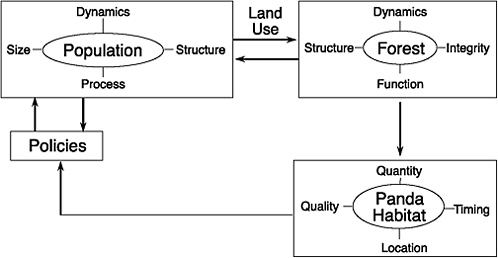
FIGURE 9-1 Conceptual framework.
SOURCE: Modified from Liu et al. (1999b).
tion factors include population size, process (e.g., birth, death, and migration), structure (e.g., age, sex, spatial distribution like household arrangement, socioeconomic conditions), and their changes over time.
Environmental factors consist of animals, plants, and physical and geographic conditions (Table 9-1). Here, we concentrate on panda habitat, the area that provides food and cover for pandas’ reproduction and other activities. Suitability of panda habitat is a function of abiotic and biotic factors, as well as human impacts (Liu et al., 1999b). The main abiotic factors include slope and elevation (Schaller et al., 1985; Liu et al., 1999b, 2001b). Pandas like flat areas or gentle slopes in which they can easily move around. Bamboo and forest cover are major biotic factors. The panda uses bamboo (an understory species) as staple food and forest canopy as cover (Schaller et al., 1985; Liu et al., 1999b; Bearer et al., no date).
Land use is a direct link between population and the environment; through land use, local residents influence forests directly and panda habitat indirectly (Figure 9-1). These influences are exerted through the flows of material and energy (e.g., labor) from the residential areas to the forested areas. Along with labor is the energy and time spent in the forest to collect and transport fuelwood. As a result of fuelwood collection for cooking food (for people and pigs) and heating, a large amount of panda habitat has been lost (Liu et al., 1999b).
Changes in forest cover also affect the panda’s food supply (Schaller et al., 1985) by altering the growth of understory bamboo (Table 9-1). Thus, changes in forest cover can have an important impact on panda habitat quantity, quality, location, and timing (i.e., when the habitat
TABLE 9-1 Major Variables in Each of the Components Illustrated in Plate 8
|
Human Component |
Forest Component |
Panda Habitat |
Policies |
|
Reserve Level: Number of people; Number of households; Average economic income; Percentage of ethnic groups; Population structure by age, sex, and education levels; Roads (locations, time of construction, type); Locations of trade centers, schools, administration buildings, and small hydro-power plants. |
Forest cover type; Canopy coverage; Species composition; Dominant tree species; Tree heights, Tree density, Tree diameters; Forest stand size, Stand age; Harvesting history; Mid-story coverage; Understory coverage, Bamboo height, Bamboo species, Bamboo density, bamboo coverage, bamboo conditions (flowering or not) |
Habitat type; Amount of habitat; Distribution of each habitat type; Habitat patch size; Habitat patch size distribution; Elevation, Aspect, Slope |
Regulations on Timber Harvest and Fuelwood Collection; Contract for Forest Protection; Forest Management Act; Wildlife Protection Act; Regulations on Nature Reserve Management in Sichuan Province; Natural Forest Conservation Program; Grain-to-Green Program; Hydro-power Plant Program; Master Plan of Wolong Nature Reserve; Master Plan on Ecotourism Development in Wolong Nature Reserve |
|
Household Level: Number of people in a household; Household location; Household income, Household expenses, Sources of income, Aspects of expenses; Locations of fuelwood collection, Amount of fuelwood consumption, Purposes of fuelwood consumption; Amount of electricity consumption, Electricity price, Electricity quality (outage and voltage); Number and types of livestock (e.g., chicken, cattle, pigs, sheep, yaks); Amount of cropland, Types of crops; Amount of cropland returned to forest land; Amount of subsidies received; Amount of forest assigned for monitoring. |
|||
|
Individual Level: Migration, Birth, Death; Marital status, Time of marriage, Education level, Age, Sex, Occupation; Attitudes, Perception, Concerns, Needs, Wants. |
becomes available) (Liu et al., 1999b). Because slopes in some regions of Wolong are too steep or elevations too high, about half of the reserve is not suitable for the panda even in the absence of human impacts (Liu et al., 1999b).
Government policies directly affect population and indirectly affect forest and panda habitat through flow of information (e.g., government regulations) and material (e.g., financial support) from upper level government agencies (China’s State Forestry Administration and Sichuan Province’s Department of Forestry) to the Wolong Nature Reserve Administration Bureau and ultimately to the local residents (Table 9-1). The effectiveness of policies, however, can be influenced by local residents. For example, local residents may not follow government policies because financial supports may not be high enough to meet their needs and wants, including electric appliances for cooking. In addition, the majority of local residents belong to minority ethnic groups (mainly Tibetans), who add another layer of complexity to government policies because minority ethnic groups receive some preferential treatments (e.g., exemption from China’s one-child policy). Deteriorated habitat conditions (Liu et al., 1999b, 2001a; Liu, 2001) have prompted the government to develop and implement more effective policies for conservation. Furthermore, population and land use may be constrained by feedback from the forest system. As forests used for fuelwood collection shrink and are more distant from households, fuelwood collection becomes more difficult (He et al., no date). After all the trees in a forest are harvested, local residents must adopt a different lifestyle without the use of fuelwood (Liu et al., 2004).
APPROACHES
Systems Approach: We consider ecological and demographic factors as well as socioeconomic and behavioral factors; factors inside the reserve and those outside the reserve; what happened in the past, what is happening now, and what may happen in the future. The reserve is an open system and has inflows (e.g., in-migration through marriage, organisms moving into the reserve, commercial or nonmarket products brought into the reserve) and outflows (e.g., out-migration through marriage or seeking higher education in cities, organisms moving out of the reserve, and local products purchased by tourists visiting the reserve). The interactions among various components of the reserve are accomplished by exchanging matter, energy, and information; they vary over time; and they are influenced by a combination of interacting factors.
Interdisciplinary Approach: To understand population, land use, and panda habitat as well as their interrelationships, we integrate ecology, conservation biology, forestry, demography, sociology, geography, economics,
behavioral science, and advanced technologies (remote sensing, geographic information systems, and systems modeling and simulation). These disciplines are complementary to each other and provide different perspectives, methods, and theories.
Collaborative Approach: Our international team consists of reserve managers and experts in the disciplines mentioned above. We have built close relationships among team members; have accumulated experience dealing with demographic, socioeconomic, behavioral, institutional, and ecological issues; have enjoyed good cooperation and support from local residents; and have become very familiar with the local conditions, as well as data collection methods and analytical tools.
Multiscale Approach: Our research and interactions among population, land use, and environment take place at several spatial, temporal, and organizational scales. Spatial scales range from plots or pixels (1 by 1 m, …, 80 by 80 m), patches (e.g., forest stand, agricultural land parcel), to the entire reserve landscape. The time span of our research is from daily to decadal. For population, the organizational scale ranges from individuals, households, villages, and townships to the entire reserve community.
Integrated Approach: We have developed and taken an integrated approach to data collection, management, analysis, and integration. Data were collected using various methods (Table 9-2), such as field studies, interviews, analysis of government statistics and documents, review of literature, remote sensing (satellite imagery and aerial photographs), and global positioning systems (GPS). To understand detailed forest structure and composition, we have taken random samples (plot sizes were from 1 by 1 to 60 by 60 m) in areas with different forest conditions (e.g., with and without fuelwood collection). We chose large plots for assessing conditions of large trees and forest canopy, and we sampled smaller plots for shrubs (5 by 5 m, three in each plot) and herbaceous plants (1 by 1 m) (Liu et al., 1999b). To measure spatial and temporal patterns of forest and panda habitat changes, we have acquired a number of remote sensing imagery (Table 9-2): Corona data from 1965; Landsat Multi-Spectral Scanner (MSS) data from 1974; Landsat Thematic Mapper (TM) data from 1987 and 1997; Landsat 7 (data from 1999, 2001, 2002); SPOT data from 1998 and 1999; and IKONOS data from 2000 (Liu et al., 2001b, 2003a; Linderman et al., 2004).
We began collecting socioeconomic, demographic, and behavioral data in 1996 (Liu et al., 1999b, 2001b; An et al., 2001, 2002; An, Mertig, and Liu, 2003; Tables 9-1 and 9-2), and the most recent survey was conducted in summer 2004. The surveys include household interviews regarding fuelwood consumption, socioeconomic conditions, and demographic conditions (For more detailed information on survey data, see Liu et al. (2003a). We also interviewed more than 300 people regarding their time allocation
TABLE 9-2 Major Variables According to Data Sources
|
Field Studies |
Interviews |
Government Agencies |
Remotely Sensed Data |
Estimated or Derived from Other Sources |
|
Forest types; Tree height, diameters, density; Stand age, size, and harvest history; Canopy coverage; Bamboo species, cover, height, and density; Panda feces distribution; Ground control points; Ground truthing plot data; Locations of human activities; Household locations; Road locations; Elevation, aspect, slope; Electricity price; Fuelwood log: species, length, weight, and diameter |
Attitudes, perceptions, concerns, needs, and wants; Amount of fuelwood consumed for different purposes (heating, cooking human food and fodders); Location of fuelwood collection; Origins of local residents; Number of people and relationships in a household; Age, sex, occupation, ethnic group, marital status, education level; Human activities; Livestock; Amount of cropland; Income sources and expenses |
Total number of people Total number of people died, Total number of born; Total number of households; Electricity prices; Age, sex, occupation, education level; Policies; Forest parcel maps for the natural forest conservation program; Amount of crop land returned to forest land |
Corona data from 1965; Landsat Multi-Spectral Scanner (MSS) data from 1974; Landsat Thematic Mapper (TM) data from 1987 and 1997; Landsat 7 (1999, 2001, 2002); SPOT data from 1998 and 1999; IKONOS data from 2000 |
Amount of panda habitat; Degree of forest and habitat fragmentation; Digital elevation models; Human population structure; Household locations; Locations of schools and major buildings; Distances between households and locations of fuelwood collection; Distances between household locations and panda habitat |
for different activities (e.g., fuelwood, agriculture, road construction, and herbal medicine collection). Sample size for particular portions of the data collection depended on specific research objectives, for example, for household fuelwood consumption, we surveyed 220 households (An et al., 2002). In our household surveys, we selected respondents using simple or stratified random designs (Liu et al., 2003a). We used face-to-face interviews with local residents because this method has proven to be the best and most feasible approach for Wolong (An et al., 2001) and almost everyone who was asked to be interviewed did participate in the interviews.
At the household level, we collected a variety of data, such as household size, structure, location, time of formation and dissolution (e.g., through divorce and marriage); amount of annual income; sources of income; amount of expenses; aspects of expenses (e.g., schooling); labor force; land area; area of the house; crop production; number of livestock (e.g., pigs); types of land use (e.g., fuelwood collection); and amount of electricity for cooking, heating, and electronic appliances (such as TVs and radios).
Individual information includes age; sex; marital status; time of marriage, separation or divorce if applicable; occupation; years of schooling; and attitudes towards out-migration and childbearing. Besides these first-hand data, we have also obtained some secondary data (Table 9-2), including those of Wolong Administration Bureau (e.g., annual population reports with records on birth, death, age, sex, in-migration, and out-migration), national population census data in 1982 (Wenchuan County, 1983), the 1996 Agricultural Census (Wolong Nature Reserve, 1996), and national population census data in 2000 (Wolong Nature Reserve, 2000). Population census data were collected based on a de jure approach, which counts people who are usually in a household.
Macro-level socioeconomic factors (contextual factors beyond the household level, such as roads, trade centers, administration buildings, bridges, dams, and schools) also influence population–land use–environment interactions because their relationships with households (e.g., households’ distances to major roads or trade centers) are different. The measurements include these factors’ locations and timing of occurrence. We obtained the information regarding the timing of occurrence from the records of the Wolong Administration Bureau, or by interviewing local residents, officials, and other stakeholders (Table 9-2). The locations of these factors were measured using GPS receivers, from remote sensing imagery (IKONOS), or from topographic maps (Liu et al., 2003a) (Table 9-1).
All the data were entered into and are managed in a relational database program (i.e., ACCESS) and geographic information systems (GIS, including both Arc/Info and ArcView) for analysis. Remotely sensed data were classified using ERDAS Imagine software or visual classification. We georeferenced the remotely sensed data using highly accurate data (1-5 m) from
GPS receivers (Trimble Pathfinder) and used data from ground-based observations for training and validating supervised classifications of the remotely sensed data (Table 9-2). The accuracy of classification ranged from 80 to 87 percent (Liu et al., 2001b). We analyzed various data using spatial statistics, GIS, and statistical packages such as SAS, SPSS, and LISREL (An et al., 2001, 2002, An, Mertig, and Liu, 2003), depending on types of data and questions.
We developed several systems simulation models to synthesize information from various sources (Liu et al., 1999b; An et al., 2001, 2005a, 2005b; Linderman et al., in press, 2005). The models fall into three major types: at the household level (An et al., 2001), at the reserve level (Liu et al., 1999b; Linderman et al., in press, 2005), and at the multiple levels ranging from individuals and households to the entire reserve (An et al., 2005a, 2005b). The household-level model integrates household demography (e.g., household size and age and schooling years of each family member), household economy (land use activities, income and expense sources, etc.), attitudes toward issues of interest (e.g., childbearing), and fuelwood consumption. The reserve-level models consider the collective impact of all households (Liu et al., 1999b; Linderman et al., in press, 2005). The multilevel model is agent-based, (treating individuals and households as agents and simulating the interactions among individuals and households, land use, and panda habitat at multiple levels (An et al., 2005a, 2005b). Both the reserve-level and multilevel models are linked with a GIS to project demographic and ecological consequences of policy scenarios in a spatially explicit manner.
Our models differ from those discussed in Fischer and O’Neill (Chapter 3) in several aspects. First, their models use aggregated population size rather than households. Second, our multilevel model and household-level model are process-based, whereas their models are regression-based. Third, their models treat population change as an exogenous variable to land use change and environmental impact. In our models, population (e.g., locations of new households) not only may affect the environment but also may be affected by the environment and policy changes.
FINDINGS
Population size in Wolong increased by over 70 percent and the number of households more than doubled (125 percent) between 1975 (the year the reserve of current size was established) and 1999 (Figure 9-2). As in many other places around the world (Liu et al., 2003b), the reason for this more rapid increase in household numbers is household division or the continued reduction in household size (the number of people in a household) (Figure 9-3) due to such factors as declines in multigeneration families, an increase in the divorce rate, and population aging. Land use deci-
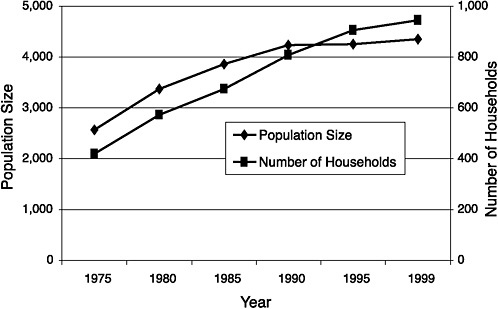
FIGURE 9-2 Dynamics of human population size and numbers of households.
sions are affected by the transition from fewer to more households. The increase in the number of households means more land is used for house construction as well as for farming, and more timber is needed for house construction and furniture. Also, as household size declines, the amount of fuelwood use per capita increases (Figure 9-4), the total amount of fuelwood
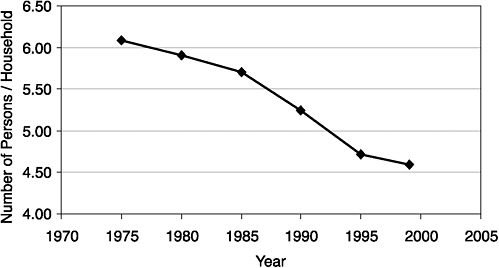
FIGURE 9-3 Change in average household size over time.
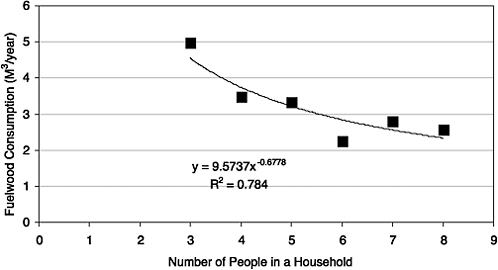
FIGURE 9-4 Average per capita use of fuelwood as a function of average household size.
consumption increases, and more forest needs to be harvested. As the demand for fuelwood increases and the forests near households become exhausted, people spend more time collecting fuelwood in areas farther away from their residences. The average distance between household locations and locations of fuelwood collection has increased, and the elevation of fuelwood collection has also increased over time (from the 1970s to the 1990s) (He et al., no date). Because those forested areas farther from the households and at higher elevations happen to be better panda habitat, fuelwood collection in those areas has done more damage to it.
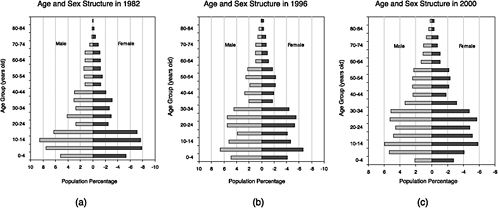
Population structure has changed dramatically (Figure 9-5). The rise in the proportions and numbers of adults, particularly males, increased the labor force involved in fuelwood collection and farming. Through interviews with 328 people in the reserve about their activities in 1997 (Liu et al., unpublished data), we found that the number of days that local residents participated in fuelwood collection increased with age, reached its peak in the age group of 25-59, and decreased sharply after age 60 (Figure 9-6a). Furthermore, men spent more time in collecting fuelwood than women (Figure 9-6b). Although farming (Figure 9-6c, 9-6d) showed similar general patterns to those of fuelwood collection, there are two major differences between fuelwood collection and farming labor forces. First, the average numbers of days that people participated in farming (Figure 9-6c) was much larger than those for fuelwood collection (Figure 9-6a) across age and gender groups. Second, on average, women spent 75 more days on
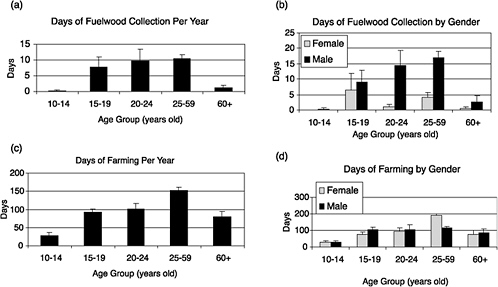
farming than men in the age group of 25-59, whereas in the other age groups, men spent equal or greater amounts of time in farming than women (Figure 9-6d).
Fuelwood consumption is influenced by household size as well as age structure (An et al., 2001) (Figure 9-7). On average, more fuelwood is needed in a large household because more food needs to be cooked for more people, although household size does not affect the amount of fuelwood needed for heating that much. However, households with one or more senior residents consume more fuelwood than those without seniors, because the heating season for the elderly is longer (starting earlier and ending later) (An et al., 2001).
Land use has contributed to the significant changes in panda habitat in Wolong. We found that forest cover in Wolong had been dramatically reduced from 1965 to 1997 (Liu et al., 2001b) and high-quality panda habitat has been lost more rapidly after the reserve’s establishment than before it was created (Liu et al., 2001b). Furthermore, fragmentation of high-quality habitat became more severe.
Our models, validated through comparisons between independent empirical data and model results (Liu et al., 1999b; An et al., 2001, 2005a, 2005b; Linderman et al., in press, 2005), helped us to gain better insights into the mechanisms of population–land use–habitat interactions and to understand the long-term consequences of altering various components.
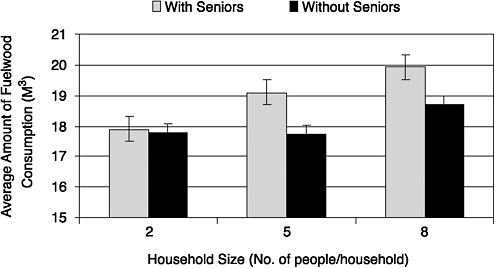
FIGURE 9-7 Fuelwood consumption as a function of age structure and household size.
SOURCE: An et al. (2001).
For example, if one of every five young people left the reserve, the population size would decline by more than 80 percent (from about 4,320 in 1997 to 760 in 2047) over a period of 50 years (Liu et al., 1999b). However, under the status quo, population size would increase by nearly 40 percent (to 5,960 in 2047). If fuelwood consumption were replaced by electricity, panda habitat would gradually recover (Liu et al., 1999b).
Government policies have profound impacts on population, land use, and forest and panda habitat. A sudden and unexpected increase of 65 households occurred in 2001, approximately three times higher than the average annual rate of household increase during the past 25 years (about 21 new households a year from 1975 to 1999, Figure 9-2). Based on our interviews with local residents (He et al., unpublished data), at least two-thirds of those new households were formed to take advantage of the subsidies from the Natural Forest Conservation Program, whose aim is to prevent natural forests from illegal harvesting. Households monitor forest parcels assigned by the government and receive subsidies from the government on a household basis. The subsidies provide significant household revenue, as it may account for about 20-25 percent of total annual income for most of the households involved (Sichuan Forestry Survey Institute and Wolong Nature Reserve, 2000). The impact of the Grain to Green Program on agriculture land use is another example. Its goal is to restore hillside agricultural land to forested area over a period of five to eight years. Farmers are given grain and cash subsidies according to the amount of cropland converted to forests. So far, trees or bamboo have been planted on approximately 450 ha of cropland since 2000 (Wolong Nature Reserve, 2000).
CONCLUDING REMARKS
Integrating natural and social sciences was essential for us to understand the patterns and mechanisms of changes in population, land use, and panda habitat as well as their interactions. Through this integration process we were able to determine the reasons for the unexpected higher rate of loss of high-quality panda habitat after the reserve was established (Liu et al., 2001b). Our integrated study enabled us to evaluate the reasons for policy failures and successes, develop recommendations for more feasible and effective policies, and assess long-term consequences of policy scenarios. The emigration policy serves as an example. In the past, the government tried to move local residents out of the reserve on a household basis to reduce population pressure on panda habitat (Liu et al., 1999b). However, the success of the program was very limited, despite economic incentives. We found that middle-aged and senior residents did not want to relocate because they were accustomed to the local conditions. However, young people were more than willing to relocate, especially if they could attain
higher education and find jobs elsewhere. Thus, relocating young people out of the reserve would be not only socially acceptable, but also more ecologically effective and economically efficient, compared with relocating senior and middle-aged people (Liu et al., 1999b, 2001b, 2003c). In addition to enhancing school education so that more children can go to college and find jobs elsewhere (Liu et al., 2003c ), perhaps there is something that Wolong can do to facilitate temporary labor migration of more young people. In fact, there is such a precedent, also in Sichuan Province. In Jintang County (about 60 kilometers from Chengdu, the capital of Sichuan Province, approximately 150 kilometers from Wolong), the county government has been actively involved in facilitating labor migration. They do so by helping migrants get jobs in specific destinations, running bus lines on frequently traveled routes for them, and protecting their labor rights in the places to which they travel (Jintang County Government, 2004). The experience of Jintang has been very successful.
Our research in the reserve has generated many ideas that have been applied and scaled up to the national and global levels. The understanding of interrelationships among population, land use, and panda habitat in Wolong (e.g., Liu et al., 2001a, 2001b) helped us to examine the status and challenges in designing and managing the entire nature reserve system (with a total of 1,757 reserves) in China (Liu et al., 2003c) as well as China’s environment in the context of globalization (Liu and Diamond, no date). It also enabled us to link wildlife management with global human health (Liu, 2003). The higher growth rate of household numbers versus population growth in Wolong prompted us to compare household growth and population growth at the global scale (Liu et al., 2003b).
While the benefits of integrating social and natural sciences are enormous, it is also challenging throughout the integration process (Liu, 2001). Our research indicates land use and panda habitat were affected not only by population size, but also by population structure. However, going beyond population size was more challenging than considering population size alone, because more detailed and more comprehensive data were needed, and more time and effort were also spent to analyze and interpret the data. Despite this challenge, population structure provides many unique insights and thus should be integrated into more studies at the local as well as national and global scales.
ACKNOWLEDGMENTS
We thank the logistic support of Michigan State University and Wolong Nature Reserve, especially the helpful assistance of Jayson Eageler, Jinyan Huang, Yingchun Tan, William W. Taylor, Julie Traver, and Jian Yang. Constructive comments and suggestions from Barbara Entwisle and Paul Stern as
well as two anonymous reviewers are greatly appreciated. We gratefully acknowledge the financial support from the National Science Foundation (CAREER Award and Biocomplexity Grant), the National Institute of Child Health and Human Development (R01 HD39789), the National Aeronautics and Space Administration, the American Association for the Advancement of Sciences, The John D. and Catherine T. MacArthur Foundation, the National Natural Science Foundation of China, the Ministry of Science and Technology of China (G2000046807), and China Bridges International.
REFERENCES
An, L., J. Liu, Z. Ouyang, M. Linderman, S. Zhou, and H. Zhang 2001 Simulating demographic and socioeconomic processes on household level and implications for giant panda habitats. Ecological Modeling 140:31-50.
An, L., F. Lupi, J. Liu, M. Linderman, and J. Huang 2002 Modeling the choice to switch from fuelwood to electricity. Ecological Economics 42:445-457.
An, L., A.G. Mertig, and J. Liu 2003 Adolescents leaving parental home—Psychosocial correlates and implications for conservation. Population and Environment 24:415-444.
An, L., G. He, Z. Liang, and J. Liu 2005a Impacts of demographic and socioeconomic factors on spatio-temporal dynamics of panda habitats. Submitted to Biodiversity and Conservation.
2005b Exploring complexity in a human-environment system: An agent-based spatial model for multidisciplinary and multi-scale integration. Submitted to Annals of Association of American Geographers.
Armesto, J.J, R Rozzi, C. Smith-Ramirez, and M.T.K. Arroyo 1998 Conservation targets in South American temperate forests. Science 282:1271-1272.
Bearer, S.L., J. Huang, M. Linderman, L. An, G. He, Z. Ouyang, and J. Liu no date Effects of Timber Harvesting and Fuelwood Collection on Giant Panda Habitat Use. Unpublished manuscript, Michigan State University, East Lansing.
China’s National Committee on Man and Biosphere 2000 Study of Sustainable Management Policies for China’s Nature Reserves (in Chinese). Beijing: Scientific and Technical Documents Publishing House.
Cincotta, R.P., J. Wisnewski, and R. Engelman 2000 Human population in the biodiversity hotspots. Nature 404:990-992.
Dompka, V., ed. 1996 Human Population, Biodiversity and Protected Areas: Science and Policy Issues. Washington, DC: American Association for the Advancement of Science.
Ehrlich, P.R., and A.H. Ehrlich 1990 The Population Explosion. New York: Simon and Schuster.
Ehrlich, P.R., and J.P. Holdren 1971 Impact of population growth. Science 171:1212-1216.
Entwisle, B., S.J. Walsh, R.R. Rindfuss, and A. Chamratrithrong 1998 Land use/land-cover and population dynamics, Nang Rong, Thailand. Pp. 121-144 in National Research Council, People and Pixels: Linking Remote Sensing and Social Science. Committee on the Human Dimensions of Global Change, D. Liverman, E.F. Moran, R.R. Rindfuss, and P.C. Stern, eds. Washington, DC: National Academy Press.
Fox, J., V. Mishra, R. Rindfuss, and S. Walsh 2003 People and the Environment: Approaches for Linking Household and Community Surveys to Remote Sensing and GIS. Boston, MA: Kluwer Academic Publishers.
Geoghegan, J., S.C. Villar, P. Klepeis, P.M. Mendoza, Y. Ogneva-Himmelberger, R.R. Chowdhury, B.L. Turner, and C. Vance 2001 Modeling tropical deforestation in the southern Yucatan peninsular region: Comparing survey and satellite data. Agriculture Ecosystems and Environment 85: 25-46.
Hansen, A.J., R. Rasker, B. Maxwell, J.J. Rotella, J.D. Johnson, A.W. Parmenter, L. Langner, W.B. Cohen, R.L. Lawrence, and M.P. Kraska 2002 Ecological causes and consequences of demographic change in the new west. Bioscience 52:151-162.
Harrison, S. 1991 Population growth, land use and deforestation in Costa Rica, 1950-1984. Interciencia 16.
He, G., M. Colunga, S. Bearer, L. An, M. Linderman, S. Zhou, J. Huang, S. Gage, Z. Ouyang, and J. Liu no date Spatial and Temporal Patterns of Fuelwood Collection in a Nature Reserve. Unpublished manuscript, Michigan State University, East Lansing.
He, N., C. Liang, and X. Yin 1996 Sustainable community development in Wolong Nature reserve. Ecological Economy 1:15-23.
Jintang County Government 2004 Document on Labor Exporting from Jintang County. Unpublished internal document.
Jolly, C.L., and B.B. Torrey 1993 Introduction. Pp. 1-14 in National Research Council, Population and Land Use in Developing Countries: Report of a Workshop. Committee on Population. C.L. Jolly and B.B. Torrey, eds. Washington, DC: National Academy Press.
Kramer, R.C., C. van Schaik, and J. Johnson, eds. 1997 Last Stand: Protected Areas and the Defense of Tropical Biodiversity. New York: Oxford University Press.
Linderman, M., J. Liu, J. Qi, L. An, Z. Ouyang, J. Yang, and Y. Tan 2004 Using artificial neural networks to map the spatial distribution of understory bamboo from remote sensing data. International Journal of Remote Sensing 25:1685-1700.
Linderman, M., L. An, S. Bearer, G. He, Z. Ouyang, and J. Liu 2005 The effects of understory bamboo on broad-scale estimates of giant panda habitat. Biological Conservation 121:383-390.
in press Modeling the spatio-temporal dynamics and interactions of households, landscape, and giant panda habitat. Ecological Modeling.
Liu, J. 2001 Integrating ecology with human demography, behavior, and socioeconomics: Needs and approaches. Ecological Modeling 140:1-8.
2003 SARS, wildlife, and human health. Science 302:53.
Liu, J., and J. Diamond no date China’s Environment in a Globalizing World. Submitted to Nature.
Liu, J., Z. Ouyang, Y. Tan, J. Yang, and S. Zhou 1999a Changes in human population structure and implications for biodiversity conservation. Population and Environment 21:45-58.
Liu, J., Z. Ouyang, W.W. Taylor, R. Groop, Y. Tan, and H. Zhang 1999b A framework for evaluating effects of human factors on wildlife habitat: The case of the giant pandas. Conservation Biology 13:1360-1370.
Liu, J., M. Linderman, Z. Ouyang, and L. An 2001a The pandas’ habitat at Wolong Nature Reserve—response. Science 293:603-604.
Liu, J., M. Linderman, Z. Ouyang, L. An, J. Yang, and H. Zhang 2001b Ecological degradation in protected areas: The case of Wolong Nature Reserve for giant pandas. Science 292:98-101.
Liu, J., L. An, S. Batie, R. Groop, Z. Liang, M. Linderman, A. Mertig, Z. Ouyang, and J. Qi 2003a Human impacts on land cover and panda habitat in Wolong Nature Reserve: Linking ecological, socioeconomic, demographic, and behavioral data. Pp. 241-263 in People and the Environment: Approaches for Linking Household and Community. Surveys to Remote Sensing and GIS, J. Fox, V. Mishra, R. Rindfuss, and S. Walsh, eds. Boston: Kluwer Academic Publishers.
Liu, J., G. Daily, P. Ehrlich, and G. Luck 2003b Effects of household dynamics on resource consumption and biodiversity. Nature 421:530-533.
Liu, J., Z. Ouyang, S.L. Pimm, P.H. Raven, X. Wang, H. Miao, and N. Han 2003c Protecting China’s biodiversity. Science 300:1240-1241.
Liu, J., Z. Ouyang, H. Zhang, M. Linderman, L. An, S. Bearer, and G. He 2004 A new paradigm for panda research and conservation: Integrating ecology with human demography, behavior, and socioeconomics. In Giant Panda: Conservation Priorities for the 21st Century, D. Lindburg and K. Baragona, eds. Berkeley, CA: University of California Press.
MacKellar, F.L., W. Lutz, C. Prinz, and A. Goujon 1995 Population, households, and CO2 emissions. Population and Development Review 21:849-865.
McCracken, S.D., E.S. Brondizio, D. Nelson, E.F. Moran, A.D. Siqueira, and C. Rodriguez-Pedraza 1999 Remote sensing and GIS at farm property level: Demography and deforestation in the Brazilian Amazon. Photogrammetric Engineering and Remote Sensing 65:1311-1320.
McKee, J.K., P.W. Sciulli, C.D. Fooce, and T.A. Waite 2004 Forecasting global biodiversity threats associated with human population growth. Biological Conservation 115:161-164.
McNeely, J.A., and K.R. Miller 1983 National Parks and Protected Areas. Bangkok, Thailand: United Nations Economic and Social Commission for Asia and the Pacific.
Moran, E.F., E. Brondizio, P. Mausel, and Y. Wu 1994 Integrating Amazonian vegetation, land-use, and satellite data. Bioscience 44:329-338.
Moran, E.F., A. Siqueira, and E. Brondizio 2003 Household demographic Structure and its relationship to the Amazon Basin. Pp. 1-30 in People and the Environment: Approaches to Linking Household and Community Surveys to Remote Sensing and GIS, J. Fox, V. Mishra, R. Rindfuss, and S. Walsh, eds. Boston: Kluwer Academic Publishers.
Myers, N., R.A. Mittermeier, C.G. Mittermeier, G.A.B. da Fonseca, and J. Kent 2000 Biodiversity hotspots for conservation priorities. Nature 403:853-858.
Perz, S.G. 2001 Household demographic factors as life cycle determinants of land use in the Amazon. Population Research and Policy Review 20:159-186.
Pichon, F.J. 1997 Settler households and land-use patterns in the Amazon frontier: Farm-level evidence from Ecuador. World Development 25:67-91.
Reid, R.S., R.L. Kruska, U. Deichmann, and P.K. Thornton 2000 Human population growth and the extinction of the tsetse fly. Agriculture, Ecosystem and Environment 77:227-236.
Schaller, G.B., J. Hu, W. Pan, and J. Zhu 1985 The Giant Pandas of Wolong. Chicago: University of Chicago Press.
Sichuan Forestry Survey Institute and Wolong Nature Reserve 2000 Forest Monitoring for Natural Forest Conservation Program in Wolong Nature Reserve. Chengdu.
Tan, Y., Z. Ouyang, and H. Zhang 1995 Spatial characteristics of biodiversity in Wolong Nature Reserve. China’s Biosphere Reserve 3:19-24.
Thompson, K., and A. Jones 1999 Human population density and prediction of local plant extinction in Britain. Conservation Biology 13:185-189.
Wenchuan County 1983 Statistics of Population Census of 1982. Sichuan Province, China.
Wolong Nature Reserve 1996 Agricultural Survey Data. Sichuan Province, China.
2000 2000 National Population Census. Sichuan Province, China.
World Conservation Union and World Commission on Protected Areas 2003 United Nations List of Protected Areas. Gland, Switzerland: UNEP World Conservation Monitoring Centre.
Zhang, H., D. Li, R. Wei, C. Tang, and J. Tu 1997 Advances in conservation and studies on reproductivity of giant pandas in Wolong. Sichuan Journal of Zoology 16:31-33.


