
10
People, Land Use, and Environment in the Yaqui Valley, Sonora, Mexico
Pamela Matson, Amy L. Luers, Karen C. Seto, Rosamond L. Naylor, and Ivan Ortiz-Monasterio
This chapter describes ongoing research that integrates social and natural science approaches to the study of interactions between development and environment in the Yaqui Valley region of southern Sonora, Mexico. While the focus of this project has evolved over the past 10 years, much of our research addresses three broad questions: (1) What drives land use and land management decisions? (2) What are the implications of these decisions for the people and ecosystems in the region, and for the regional and global environment? (3) What alternatives are available to the people of the region in order to harmonize development and environment? Our analysis draws from various disciplines, including agronomy, biogeochemistry, ecology, economics, geography, hydrology, international policy analysis, remote sensing science, and water resources engineering to address these questions at multiple points across the landscape.
In this chapter, we first present an introduction to the Yaqui Valley study region. We then outline several of the conceptual themes or frameworks that we have used to organize our study of the Yaqui system, all of which focus on the interaction of social and biophysical factors in the human-environment system. We briefly describe three broad studies—on agriculture–environment interactions, land use dynamics at the regional scale, and vulnerability—discussing the motivation for and results of the work as well as the multiple data sources and analytical techniques used in each. We include at the end of this section a brief discussion of the potential insights that could be gained from a more specific and focused analysis of human population dynamics. Finally, we discuss the lessons learned about integrative studies of the human-environment systems.
THE YAQUI VALLEY
The Yaqui Valley is located on the northwest coast of mainland Mexico in the state of Sonora (Plate 9). Situated on a coastal strip along the Gulf of California, the valley consists of an intensively managed agricultural region amidst a desert scrub forest and is bordered by estuarine ecosystems that provide critical habitat for migratory and resident water birds, marine mammals, fish, and shellfish populations (Flores-Verdugo, Gonzalez-Farias, and Zaragoza-Araujo, 1992). These coastal waters have long been an important center for both subsistence and the export fishing industry. The Yaqui Valley region is of vital economic importance to Mexico both in terms of its agricultural production and fish production. Today the Yaqui Valley consists of 225,000 hectares (ha) of irrigated wheat-based agriculture, and it is one of the country’s most productive breadbaskets (Naylor, Falcon, and Puente-González, 2001). Using a combination of irrigation, high fertilizer rates, and modern cultivars (Matson, Naylor, and Ortiz-Monasterio, 1998), valley farmers produce some of the highest wheat yields in the world (Food and Agriculture Organization, 1997). The region also maintains the most productive fisheries in Mexico, with sardines and shrimp among the most important species (CONAPESCA, 2002). In recent years the region has also developed the second-largest shrimp aquaculture industries in Mexico (CONAPESCA, 2002). However, in a world of globalized markets, reduced subsidies and price supports, drought, hurricanes, and other forces, many farmers and fishers in the region are concerned about maintaining production and household incomes.
Like many developing regions, the Yaqui Valley is undergoing rapid socioeconomic and ecological changes. Population growth, urbanization, agricultural intensification, expanded livestock operations, and coastal aquaculture development are just some of the major developments in the area.
People and Land: A Brief History
In the early 1900s the land in the Yaqui Valley was primarily under the control of large landholders (Lewis, 2002). However, the land tenure in the region began to change in the aftermath of the 1910 Mexican Revolution, when Article 27 of the Mexican Constitution established the ejido land reform program and declared all land ultimately the property of the nation. While private property was allowed in principle under the new system, Article 27 established a legal limit on private landholdings of 100 irrigated hectares or the “non-irrigated equivalent.”1 Furthermore, Article 27 man-
dated that the state reserved the right to expropriate private landholdings when they exceeded the legal limit and to reclaim ejido lands when they were improperly managed.
The first major land distribution in southern Sonora was in the 1930s under President Lazaro Cardenas. The Cardenas administration expropriated nearly 120,000 ha and distributed it to over 5,000 ejidatarios (collectives of peasants) (Hernandez, Quiñónez, and Naranjo, 1981). The vast majority of the redistributed land was managed collectively for grazing and rain-fed agriculture (Dabdoub, 1980). However, by the mid-1900s, land use and management began to rapidly change.
The Agriculture System
In the mid-twentieth century, the Mexican government and the international development community identified the Yaqui Valley as an appropriate center for agricultural development. In 1943, Normal Borlag, working for the Mexican government and the Rockefeller Foundation, launched a wheat research program that was the forerunner of the International Maize and Wheat Improvement Center (CIMMYT), located in Ciudad Obregon, which remains in the region today (Naylor et al., 2001). Later, a national agricultural experiment center (CIANO) was also established in the valley. Because the region is agroclimatically representative of 40 percent of the developing world’s wheat-growing areas, it was selected as an ideal place for the early wheat improvement program.
The climate of the region is semiarid, with variable precipitation rates averaging 317 mm yr-1, which made the development of irrigation reservoirs essential for agricultural intensification. By 1963, three dams had been constructed, supplying irrigation water to 233,000 ha (Naylor et al., 2001). However, the construction of these reservoirs did not eliminate the region’s sensitivity to climatic extremes. Prolonged droughts, such as the one that has persisted in the region since 1994, have led to dramatic declines in total reservoir volume, increases in well pumping, and reduced water allocations to farmers, resulting in less than 50,000 ha in production in 2003. Meanwhile, recent studies have pointed to the concerns that increasing temperatures resulting from global warming may lead to decreased wheat yields (e.g., Lobell et al., 2002).
The use of fertilizer nitrogen has increased markedly in the past three decades; between 1968 and 1995, fertilizer application rates for wheat production increased from 80 to 250 kg N ha–1. Today the most common agronomic practice for wheat production in the valley is a preplanting broadcast application of urea or injection of anhydrous ammonium (at the rate of 150-200 kg N ha–1), followed by irrigation (the preplanting irrigation is intended to aid in weed control by causing germination of weeds that can then be plowed under
prior to planting). As we discuss later, the causes and consequences of these management approaches have been one focus of our studies in the region.
As agricultural development and intensification have proceeded, concerns about the quality of agricultural soils have increased. Approximately one-third of the soils of the valley are thought to be vulnerable to salinization. Today, approximately 19,000 ha have salinity levels high enough to reduce productivity. Management approaches that reduce groundwater tables and improve drainage, along with the use of large amounts of relatively low-salt freshwater in irrigation, prevent much broader salinization problems. However, as the availability of high-quality freshwater from the reservoirs has declined drastically due to long-term drought, dependence on groundwater from wells has increased. In areas in which high salinity well water is present, vulnerability to salinization will increase.
Although agricultural management practices have changed during the past three decades, wheat has remained the dominant crop. Harvested winter wheat averaged 130,000 ha in the late 1970s, ranging up to 190,000 ha currently. Other crops, however, have increased or decreased in area planted over the same time frame. Planted hectares of cotton have declined since the 1950s, whereas alfalfa, garbanzo beans, vegetables, and fruit crops have increased (Naylor et al., 2001). The proportion of vegetables planted has increased eight-fold since the early 1980s, while the proportion of fruit trees has quadrupled in the past decade.
This growth in agriculture was accompanied by an increase in population in the region, at an annual rate of 7 percent between 1950 and 1960. Most of the growth in population in the region in recent years has occurred in the two major population centers, Ciudad Obregon (population approximately 250,000) and Navajoa (population approximately 100,000). While high growth in these urban centers continues, over the last two decades the populations in the rural areas have remained remarkably stable (Figure 10-1). We currently have very little information on the source of the increase, whether it is from immigration or internal growth. Nor can we say with complete certainty that the increase is a result of the government’s purposeful development of agriculture in the region (discussed below). It seems likely, however, that the development of the irrigation district, which provides water to both agricultural and nonagricultural (urban) users, as well as the influx of technological assistance in the form of national and international agricultural experiment stations, allowed the support of many more people than the arid region was earlier able to support.
Coastal Zone
Between 1940 and the 1970s, during the peak of agricultural intensification and expansion, land redistributions to ejidos were minimal, as gov-
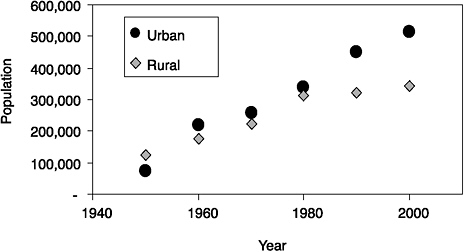
FIGURE 10-1 Population changes in the urban and rural sectors in the Yaqui region. Urban defined by the five largest cities in the region: Cuidad Obregon, Empalme, Guaymas, Huatabampo, and Navajoa (these are population centers that currently have populations of 25,000 or greater).
SOURCE: From Instituto Nacional de Estadistica, Geografía, y Informáticancy (INEGI) census years 1950-2000.
ernment support moved away from the ejido sector toward the private sector. Finally, in 1976, in response to continued peasant rebellions demanding land, the Luis Echeverria administration redistributed almost 100,000 ha to local peasants and formed 62 new ejidos in the region (Cristiani, 1984). Only about one-third of these lands was irrigated, and most of the other two-thirds was made up of near coastal lands that were seen to have little or no productive use at the time (Dabdoub, 1980). However, by the early to mid-1990s, with the rise of shrimp farming in the region, these coastal lands that were once seen as wastelands began to be perceived as potential gold mines.
Shrimp farming, part of the Blue Revolution (similar to the Green Revolution), was first introduced to the region as a government-supported program. In the late-1980s, the administration of President Carlos Salinas distributed over 5,000 ha of nonarable coastal lands in southern Sonora to approximately 2,000 new ejidatarios as part of a state program that provided technical and financial assistance to the ejido sector for shrimp farm development. Despite these initial efforts, the industry did not begin to grow rapidly until almost a decade later, when a series of policy reforms opened the region to private investors (Luers, 2003).
Recent Policy Changes
During the 1990s the use and management of lands in both the upland and coastal regions began to rapidly change, as did the individuals who operated the lands (as noted below, one important result has been the transfer of lands from the ejido to private sector). These changes were driven in large part by a series of legal, economic, and institutional reforms promulgated in the 1980s and 1990s by the Mexican government to integrate rural Mexico into the global economy. The most important of these policy reforms included (1) the development of a 15-year program of direct income payments to farmers (PROCAMPO), linked to the abolition of input subsidies and price supports; (2) the reduction in the government’s institutional involvement in agriculture, including privatizing the Mexican Fertilizer Company (FERTIMEX) and the reduction in government credit subsidies (BANRURAL); (3) the decentralization of operating authority and funding responsibilities for irrigation systems to local water user groups via the Water Laws of 1992 and 1994; (4) the amendment of Article 27 of the Constitution of Mexico, which made possible the legal sale, rental, and mortgage of previously inalienable ejido land (the amendment created a process that provided ejidos for the first time transferable titles to their land); (5) the adoption of the North American Free Trade Agreement (NAFTA), which led to large changes in prices of many agricultural inputs and outputs; (6) modifications to the fisheries law, which legalized the direct private investment in the shrimp industry and removed long-standing rules that restricted the capture and cultivation of shrimp to the ejido and cooperative sectors; and (7) modifications to the foreign investment laws, which allowed up to 100 percent foreign ownership of industries in Mexico. Many of these political-economic liberalization policies parallel those in Vietnam and China with similar impacts on land use (see Seto, Chapter 8).
Prior to these changes, the government was the primary investor in the nascent shrimp farming industry. In addition, government involvement in the Mexican agricultural sector provided price supports for agricultural products and input subsidies on water, credit, and fertilizer that by 1990 represented about 13 percent of the Mexican federal budget (Naylor et al., 2001). The planned reforms replaced these policies and, in effect, shifted responsibility for agriculture and aquaculture from government to the private and ejido sectors, leading to many changes regarding how and by whom land and water resources are being used. Prior to the reforms, in the Yaqui Valley region, 56 percent of the total agricultural area and 72 percent of producers were ejidatarios (Puente-González, 1999; Comisión Nacional del Agua, 1998), whereas 40 percent of the total aquaculture area was controlled by ejidos (Luers, 2003); however, changes in the ejido land reform program have led to the transfer of both ownership and manage-
ment of lands throughout the region from ejido back to the private sector (Lewis, 2002; Luers, 2003).
A focus of our research has been to understand how these and other policy reforms coupled with biophysical variability and change have influenced land use decisions, environmental conditions, and the sustainability and vulnerability of people and ecosystems in the region.
CONCEPTUAL THEMES AND RESEARCH FRAMEWORKS
Our research on the drivers and consequences of changes in land use and resource use has followed several related themes. In a sense, these themes track the evolutionary thinking and perspectives that our team experienced during 10 years of research in the valley. Indeed, the conceptual framework that we are applying now in most of our studies (described in the vulnerability section) is a product of our prior experience in the valley, as well as the experiences of our collaborators in other places. All of these themes deal with sustainability issues in one form or another; all of them address interactions in human-environment systems, although population dynamics have been very inadequately evaluated. In the following sections, we discuss research questions and results; research participants; approaches, methods, and data sources; and plans for continued research on (1) integrating ecological and economic perspectives in agriculture, (2) land use change and interactions on the landscape, and (3) vulnerability and resilience. Although work is ongoing in all three areas, we present them in the chronological order in which they were initiated. We conclude this section with a short discussion of critical aspects of these themes related to population dynamics, some of which we are currently exploring in our research.
Linking Ecological and Economic Perspectives in Intensive Agriculture
Beginning in 1993, we evaluated questions about nitrogen (N) fertilizer use and efficiency in the Yaqui Valley, asking how farmers managed fertilizer and why, what the consequences of their fertilizer practices were for crop yields and also for environmentally important losses of nitrate and trace gases, and what alternatives were available to them to reduce fertilizer losses to the environment. Our research was driven not only by broad issues related to agriculture and global environmental change, but also by concerns about plant nutrient use efficiency and farmer economic well-being. Three principal investigators—an economist, an agronomist, and a biogeochemist-ecologist—initiated the project.
Worldwide, inputs of nitrogen in agriculture have been increasing rapidly and represent an enormous change in the global nitrogen cycle (Vitousek and Matson, 1993; Vitousek et al., 1997). Production of fertilizer nitrogen and the planting of legume crops together fix more nitrogen
annually than is fixed by biological nitrogen fixation in all natural terrestrial ecosystems. These enhanced inputs of nitrogen are critical to crop yield, but they also affect losses of nitrogen from soils to freshwater and marine systems and greenhouse gases and air pollutants to the atmosphere. When we began our study, the consequences of fertilizer management for emission of trace gases and nitrate losses in developing world agricultural systems had not yet been evaluated; it was one of several outstanding questions related to global atmospheric change as defined by the international global change research community (the International Geosphere-Biosphere Program—Matson and Ojima, 1990). Had only a biogeochemist been involved in this work, the analysis might have stopped there. However, we also were motivated by the growing dialogue focused on reconciling the needs for food with the needs of the environment (Naylor and Matson, 1993; Conway, 1997), and, importantly, we were concerned about the welfare of the farmers and their crops in the Yaqui Valley. Ultimately, we wanted to understand how and why farmers made their fertilizer management decisions and to evaluate management alternatives in terms of their ability to reduce nitrogen losses and yet to be agronomically feasible and economically attractive. The combination of researchers allowed this integrated concern to be addressed.
Using daily to weekly sampling frequencies during the six-month wheat season in two consecutive years, we measured changes in soil nutrients, soil gas fluxes, and nitrate leaching prior to and following fertilizer additions in farmers’ fields and also in experimental plots (in a randomized block design with four-block replicates), in which fertilizer additions simulated farmers’ practice in comparison to alternatives. This biogeochemical research involved the use of gas chromatography, chemoluminescence detection, lysimetry, isotopic labeling, and many other lab and field analytical approaches, ultimately resulting in the analysis of more than 10,000 gas and soil samples. In sites using the farmers’ practice, gas fluxes were among the highest ever reported (Matson et al., 1998). We concluded that, if fluxes of nitrous oxide and nitric oxide in other intensive agricultural systems in the developing world are similarly high, agriculture is likely to be a more important source of atmosphere change than currently thought, and it will become even more critical in the future. We evaluated several alternative management practices that added less nitrogen fertilizer or added it later in the crop cycle, in closer synchrony with plant uptake. Although all of our alternatives resulted in some reduction in losses, the “best” alternative, which applied 20 percent less nitrogen per hectare and applied it during and after planting, lost less trace nitrogen gas over the entire cycle than the simulated farmers’ treatment lost in just the first month.
Fertilizer use and loss are but one component of farm budgets, and farmers typically focus not only on costs, but also on the balance between
costs and expected income under some degree of price and production uncertainty. For wheat farmers in the Yaqui Valley, yield of good-quality wheat provides the essential income. In our integrated analysis, when we measured yields and grain quality in the experimental plots and farmers’ fields using standard agronomic measurement approaches, we found that the more nitrogen-conserving alternatives were not significantly different from the farmers’ practice.
We carried out an economic analysis of farmers’ costs and returns for both 1994-1995 and 1995-1996 wheat seasons, using farm-based socioeconomic survey techniques. The surveys were conducted in person by our team members as well as by Mexican collaborators who had long histories of research with farmers in the Valley. Our surveys consisted of a random sample of 58 farmers in 1994-1995 and 31 farmers in 1995-1996, stratified by farm operating size and land tenure (private versus collective landholders). Farm owners or managers relied on recorded input, yield, and price data to answer questions. The survey results indicated that fertilization was the highest direct production cost in the Yaqui Valley farm budgets and the single most important cost component in the entire budget. Given the importance of fertilizer in the valley farm budgets, we evaluated the extent to which savings in terms of increased fertilizer efficiency represented a significant budgetary savings to the farmers. In contrasting the farmers’ practice with our “best” alternative in terms of reduced trace gas losses and total nitrogen losses, we found that the alternative resulted in a savings equivalent to 12-17 percent savings of after-tax profits from wheat farming in the valley.
We are currently working on social and private profitability in the valley, especially critical in the current policy and global market environment, and conducting similar farm-based surveys. This earlier work also led to a series of studies by Ortiz-Monasterio, in his role as an agronomist at CIMMYT on reliable nitrogen diagnostic tests and other metrics that provide information to farmers that they can use to reduce overfertilization. It also led to studies by David Lobell and Greg Asner (a Stanford Ph.D. student and research scientist at the Carnegie Institution, respectively) on new remote sensing–based techniques to estimate yield and the factors that regulate variation in yields over space and time at the regional scale. One Ph.D. thesis (Avalos Sartorio, 1997) and one undergraduate honors thesis (Harris, 1997) at Stanford originated from this area of research.
Land Use Decisions and the Provision of Ecosystem Services
Our early work on agriculture and environment in the Yaqui region demonstrated to us some of the tight linkages between the agricultural sector and other components of resource use and development in the valley. For example, it became clear that agricultural land use and management
decisions were highly related to the availability of water as well as input subsidies, and that policy changes that affected both needed to be evaluated. Likewise, we realized that fertilizer management decisions were likely to influence the marine systems adjacent to the valley. Starting in 1996, with an expanded team that included remote sensing scientists, geographers, and hydrologists as well as ecologists, economists, and agronomists, we evaluated the causes and consequences of land use change and land management decisions across the valley. Land use issues had become a central focus for many disciplines in the global change and geography research communities, and the mid-1990s were a period of intense analysis on drivers and consequences (for people and environment) of land use change (see Lambin, Geist, and Lepers, 2003, for a review). In our analysis of land use changes in the Yaqui Valley, we contributed to the body of research attempting to draw general understanding about land use dynamics. In doing so, we also joined the discussion and debate around the topic of agricultural intensification and its role in “sparing land for nature” (Waggoner, 1994). We hypothesized that the intensification of agriculture over the decades of the Green Revolution in the Yaqui Valley would be related to many off-site consequences, including those related to urbanization, nutrient transfers downwind and downstream, and extensive land use changes in surrounding areas.
Much of this research (funded by the National Aeronautics and Space Administration) used time-series remote sensing data to examine land cover changes inside and outside the intensive irrigation district. We accumulated information on such things as the valley-wide irrigation systems, land ownership, and population using municipal, state, and national databases, and we used a database of farm-scale and ejido-scale socioeconomic survey information from our own work (see the earlier section for details on typical survey sampling) and from the long-term CIMMYT surveys to track changes in agricultural yields, varieties, and fertilizer use over the past 40 years.
We found that intensive, irrigated agriculture increased in area by only 6.5 percent over the past 30 years, but that dramatic increases in wheat yields and fertilizer use, as well as rapid adoption of new varieties of wheat, characterized a rapidly changing agricultural region. During this period, land owners diversified by changing summer crops and increasing tree crops. In addition, during the decades of the 1980s, there was an estimated 15-fold increase in pigs and poultry in the valley. By 1996, production was approximately 350,000 head and 6 million birds (Naylor et al., 2001).
Some of these changes can be explained by policies put in place by the Mexican national government. In the 1970s and 1980s, a set of domestic policies that included price supports, input subsidies, and consumer subsidies, adding up to 18 percent of federal budget, supported intensification and livestock diversification (Naylor et al., 2001). According to our analy-
sis, approximately 33 percent of gross farm income came from subsidies in the 1980s and encouraged continued increase in inputs. During the 1990s, these and other subsidies changed with the suite of liberalization policies we have described. In 2000, price supports for wheat were reintroduced due to falling farm incomes and heightened competition from the United States, where farm supports are much higher. We are still trying to understand the consequences of these earlier and more recent and dramatic policy changes.
Other dramatic changes in cropping systems occurred during this time frame as well, not because of planned policy changes but due to unplanned shocks. Until 1993, the most consistent cropping pattern in the valley was wheat as the winter crop and soybeans as the summer crop. Between 1993 and 1996, whitefly outbreaks decreased soybean area from 69,000 ha in 1991 to 0 ha in 1996. One response by farmers was to increase the area of sorghum and summer maize, both of which receive much more nitrogen fertilizer than the previous soybean crops. As noted later, this unplanned change has consequences for off-site effects.
While the land area under intensive agriculture remained constant over our study period, intensification in the form of increasing fertilizer inputs influenced off-site ecosystems through their effects on nutrient use and loss. We estimated nitrogen loss from current fertilization practices in comparison with earlier practices (using the NLoSS simulation model developed by Bill Riley as part of our earlier project; Riley and Matson, 2000), and found that the typical farmer practice results in very large losses of nitrogen relative to losses of just 10 years ago. These losses influence the functioning of both the surface water systems draining the valley as well as the coastal ecosystems of the Sea of Cortez. Two Ph.D. dissertations in terrestrial biogeochemistry (Harrison, 2002; Harrison and Matson, in press) and marine biogeochemistry (Beman et al., 2005) and one undergraduate honors thesis (Rice, 1995) have focused on the processing of agricultural and urban effluents in the surface waters and coastal marine system adjacent to the valley. In addition, Esther Cruz from the Center for Conservation and Use of Natural Resources (CECARENA) in Guaymas, Mexico, and several Stanford professors in engineering and earth sciences have begun a focused study of estuarine and open ocean circulation, ultimately to be tied to ocean biogeochemical processes that link to activities on land.
Water resource issues related to the intensive and nonefficient use of water in irrigation also characterized the period of study. Although we have not examined the off-site consequences of water diversions from the Yaqui and other rivers, we recently have examined the components of decision making in the irrigation district that have led to severe overdraw of reservoir water during the recent five years of drought. An additional Ph.D. dissertation in water resource engineering and policy modeling (Addams, 2004), plus considerable research by collaborator Jose Luis Minjares in the
Mexican National Water Commission have detailed the structure, function, and constraints in the water sector, leading to policy changes in the way water allocation decisions are made.
In addition to the off-site biogeochemical and hydrologic consequences, we evaluated the extent to which land use changes in the surrounding natural coastal lands accompanied and could be related to intensification in the irrigation district. Our assessment of coastal land use dynamics was based on the analysis of satellite time-series data and formal interviews with ejido households and shrimp farm managers. Using a combination of supervised and unsupervised maximum likelihood classification, we produced thematic land use and land cover maps of subscenes from two mosaicked Landsat images from 1973 (MSS), 1992 (MSS), and 2001 (ETM) for change detection and modeling. In addition, we conducted 131 formal household interviews with 41 different coastal ejidos (controlling approximately 70 percent of coastal ejido land) and 88 formal interviews with private and ejido shrimp farms. We set out to conduct interviews in all the coastal ejidos and operating shrimp farms in our study region. However, we had to reduce the sample size slightly due to difficulties with locating households of members for several ejidos and making successful contacts with a few ejido farms. We conducted 2-5 household interviews in each ejido we included. One interview was with a member of the ejido governing committee, and the others were randomly selected.
Our results indicated a very rapid and relatively recent expansion of land use changes in the coastal zone, with coastal wetlands and mud flats being converted to aquaculture ponds at an increasing rate (Luers, 2003). Our analyses suggest that this expansion has been facilitated by reforms in the fisheries and foreign investment laws, changes in the rural credit system, and the constitutional reform of land tenure laws (Article 27), which allows ejidos for the first time to rent and sell their land (a significant share of which is coastal land) (Naylor et al., 2001; Lewis, 2002; Luers, 2003). These policy reforms and their impacts on coastal aquaculture development mirror similar processes and land use changes in the Red River Delta in Vietnam, discussed in this volume (Seto, Chapter 8).
Our surveys further suggest that a large part of the private shrimp farm development has been carried out by private agricultural farmers from the irrigation district who have had the capital or access to credit to allow them to diversify their production activities. Thus, agricultural intensification in the irrigation district and the expansion of aquaculture appear to be directly linked. Our findings highlight the importance of looking beyond simplistic single-cause explanations of land use and land cover dynamics and toward explanations that incorporate both endogenous and exogenous factors that lead to different opportunities and constraints on land use and land cover changes (Lambin et al., 2003).
Taken together, our analyses suggest managed and natural ecosystems in the Yaqui region are linked biogeochemically, hydrologically, ecologically, and economically (Matson et al., no date-a, no date-b). Decisions made in the intensive agricultural area affect off-site areas in a number of ways, many of which may negatively affect natural ecosystems and the services (clean water, healthy fisheries, conservation of species) that they provide.
Vulnerability and Resilience
As we studied a place undergoing rapid change through changes in national and international policies, the globalization of markets, and variations in climate (including drought), we identified dramatic differences in the way individuals could respond. This concern about vulnerability and response has likewise become a focal point in the international realm. As policy makers shift their attention from broad assessments of potential global change impacts to specific preventive and mitigative action, the global change research community is increasingly focusing on questions about the vulnerability and resilience of people and ecosystems to environmental change (Liverman, 1994; Dow, 1992; Cutter, 1996; Kelly and Adger, 2000; Bohle, 2001). This focus on vulnerability is particularly evident in the climate change assessments. The latest publications of the Intergovernmental Panel on Climate Change are dedicated to questions of vulnerability, which they define as “the degree to which a system is susceptible to, or unable to cope with, adverse effects of climate change, including climate variability and extremes” (Intergovernmental Panel on Climate Change, 2001).
Much of the vulnerability literature focuses on either the biophysical hazards or social aspects of vulnerability separately. However, in recent years, there have been efforts to integrate these approaches (Folke et al., 2002; Downing et al., 2000; Turner et al., 2003a). Members of the Yaqui Valley research team, working in collaboration with scientists from Clark University, Harvard University, and the Stockholm Environmental Institute, developed a conceptual framework for integrating social and biophysical processes to address questions of vulnerability (Turner et al., 2003a, 2003b). We extended this work to explore quantitative approaches of analyzing vulnerability in the Yaqui Valley (Luers et al., 2003).
In our multidimensional framework, vulnerability, defined as a function of exposure, sensitivity, and adaptive capacity, is manifested in the interactions of social and ecological systems (Figure 10-2). In our analysis of the agricultural region of the Yaqui Valley, we used this framework to identify the critical interactions and feedbacks that mediate the responses of
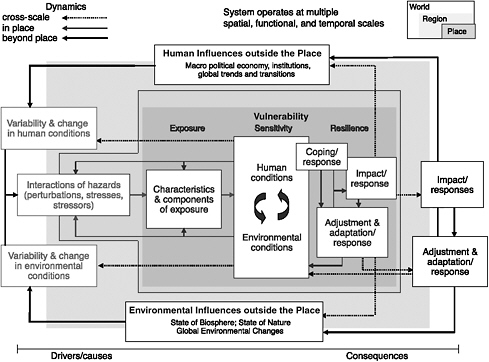
FIGURE 10-2 A framework for evaluating the vulnerability of a linked human-environmental system subjected to multiple and interacting forces. Compenents of the vulnerability framework are identified and inked to factors beyond the system of study and operating a various aptial scales. Temporal dimensions are omitted.
SOURCE: Turner et al. (2003a).
both social and biophysical parts of the system to external and internal stresses and shocks.
In the valley, the changes in the suite of national policies in the 1990s related to farm and fishing commodities (see above) are external forces that have removed significant financial support and exposed land owners and managers to the vagaries of the international market. Biological shocks such as whitefly invasion, continue to force farmers to respond through changes in management and in production patterns. Climate shocks and the ongoing drought are forcing farmers to consider alternate crops and changes in irrigation management, at the same time that policy changes with respect to water resource allocation are potentially opening new opportunities for efficient use of water. And on top of these changes themselves, the uncertainties associated with some of them (e.g., drought, commodity prices, exchange rates) have made planning and decision making very difficult (Naylor et al., 2001). The ability of farmers to respond to
these and other stresses is likely to depend on both their social and biophysical resources, as well as how those resources are changing in response to the stresses. If so, the vulnerability of farmers in the valley may be very heterogeneous, potentially leading to winners and losers. We have begun to explore these issues using various analytical techniques.
One approach we have taken is to estimate the vulnerability of selected outcome variables of concern (e.g., agricultural yield) to identified stresses (e.g., climate change) as a function of the state of the variables of concern relative to a threshold of damage, the sensitivity of the variables to the stresses, and the magnitude and frequency of the stressors to which the system is exposed. Our proposed metric of vulnerability is distinct from many previous efforts to quantify vulnerability, which have focused more generally on identifying sets of proxy vulnerability indicators for a place or population of interest (Downing et al., 2000).
We used this metric of vulnerability to begin to evaluate the relative vulnerability of wheat yields to temperature variability and change, as well as market fluctuations. The data on wheat yields for this analysis were based on yield estimates derived from Landsat Thematic Mapping (TM) and ETM+ data for four years, 1994, 2000, 2001, and 2002, as described in detail by Lobell et al. (2003). Building on this analysis, we developed a linear least-squares regression model of yield with average nighttime temperature for January-April (Luers et al., 2003) to define the sensitivity. We then calculated the vulnerability using a threshold value of 4 tons/ha, which is the approximate average minimum yield required for farmers to break even (i.e., zero net profit) based on average management practices.
Our analysis suggests a skewed distribution of vulnerability to temperature variability and change in the study region, with most farmers exhibiting low vulnerabilities and a few farmers with high vulnerability. In addition, our method revealed that valley farmers, without adaptations, are on average more vulnerable to a 10 percent decrease in wheat prices than a 1 degree (C) increase in average minimum temperature. Finally, we found that soils and management both contributed to relative vulnerabilities in the region; however, it appears that the some constraints imposed by poor soil types can be overcome by improved management practices.
A recent focus of our work in the valley has been to examine the relative vulnerability of farmers and their agricultural ecosystems to long-term drought. As noted earlier, Yaqui Valley agriculture relies on irrigation, with the water largely derived from surface reservoirs draining the Yaqui watershed, with an additional small contribution pumped from private and public wells in the valley. Now in its ninth year of drought, reservoir levels are at less than a third of their long-term values, and water allocations have been reduced throughout the valley, resulting in less than 20 percent of the valley’s agricultural area in production. Our research
team is exploring the social and biophysical factors that created the current crisis and the alternatives and constraints that the valley farmers face today.
Switching crops from wheat to less water-intensive crops like garbanzo and safflower is one alternative being considered (Naylor et al., 2001), although such changes are highly influenced by global markets and the skewed subsidy–price support environment that the farmers find themselves in, with wheat being more strongly supported than other crops. In addition, crop choice is influenced by the emergence of new diseases in the alternatives. An additional option that farmers are considering is increasing the pumping of water from aquifers. However, aquifer water is often too saline to apply directly to fields. Most wells pump water directly to canals, so that mixing with the less saline surface water reduces the salinity to acceptable levels. In the 2003-2004 crop cycle, most farmers did not have access to reservoir water and the very limited planted area received water directly from the wells to fields. If water from the reservoir continues to be limited, this practice will create salinity problems for at least some of the valley’s soils. However, analyses by team members suggest that the energy-related costs of pumping are themselves prohibitive, and thus groundwater, whatever its salinity, is not a profitable approach at this time (Addams, 2004).
Our analysis of the region’s vulnerability to drought draws on a combination of hydrologic modeling, remote sensing analysis, and household surveys. Lee Addams and Jose Luis Minjares from our team have developed a model of the water basin and water distribution system that we are using to assess alternative management plans. Meanwhile, David Lobell and Greg Asner are using Landsat TM and MODIS satellite images to assess the effect of water stress on yield for different crops under different management regimes. Farmers’ responses to the drought and reservoir draw-down are also being analyzed in a masters thesis (McCulloch, 2004). These studies are being coordinated with household interviews that focus on management practices, risk perception, and responses to the drought crisis. Of particular interest is how the prolonged drought will influence the relocation of people and resources in the region.
Population Dynamics in the Yaqui Valley: Critical Missing Pieces in the Analyses
As our work evolved over the past decade, it became increasingly clear that we needed an explicit focus on population dynamics if we were to succeed in understanding the social and human dynamics associated with land use in this region. We began to incorporate population data through two sources: census data and household surveys. Although the census data provide general information, such as age structure, gender, and household
size, they lack detailed household-level information about income, migration, and health of the population. What we do know from the census data is that urban populations are increasing and rural populations are remaining relatively stable at the municipality level. For example, the population of the municipality of Cajeme has increased by nearly seven-fold since 1950. Most of this increase has occurred in the city of Obregon, where the official population has increased from 31,000 in 1950 to 251,000 in 2000.
One of the current research activities is to examine demographic dynamics at the locality level by combining data from demographic surveys and census into a spatial context using a geographic information system. Our preliminary results indicate that there are huge variations in population structure and growth rates over space and time. Of the 31 localities in Cajeme for which we have a comprehensive data set spanning 1950 to 2000, 12 have experienced a decline in population since 1950. In the most extreme case, the locality of Daniel Leyva Higuera has seen a decline in population from 299 in 1950 to 6 in 2000. Yet this pattern of population decline is not limited to localities in Cajeme. Other such municipalities as Guaymas, Etchojoa, and Navajoa also have localities with shrinking populations. Thus, throughout the Yaqui Valley, larger towns are growing faster than smaller ones, and, in many cases, smaller localities are disappearing. We lack an understanding of why these changes are occurring and their direct role in land use changes in the Yaqui Valley. Our household surveys provided detailed information about household characteristics, but the surveys were designed to collect information about different sectors of the population (e.g., aquaculture households, farmers) and not of the entire population. We were unable to extrapolate our survey data to characterize household dynamics for the entire region.
A second missing piece of information that is critical to analyses of land use change is spatially disaggregated data on migration. These data can be obtained through household surveys or estimated via the “residual method,” whereby the rate of natural increase is estimated (births minus deaths) and then deducted from the total population increase. The result is then attributed to emigration or immigration. We hypothesize that many of the population changes have occurred in the region as a response to exogenous shocks. For example, it is likely that purposeful economic and technological development of the region during the early years of the Green Revolution encouraged in-migration. Over time, however, improving mechanization and increasing sizes of lands being managed by single owners may have resulted in surplus agricultural workers. Whether these workers migrated out of the region or were absorbed by local urban or rural economies is unclear from the available census data. Ciudad Obregon and Navajoa experienced significant economic and urban growth over the last three decades, but population data aggregated at the city level make it difficult to
answer questions about inter- and intracity socioeconomic differentiation and income and welfare dynamics. Furthermore, the census data classify population based on residence; a household is labeled rural if the home structure is located in a nonurban place. As it becomes more common for rural residents to work in the city, this urban-rural dichotomy may not be sufficient to fully describe the demographic characteristics of the area, nor for accounting for the role of population on land use change. How significant is rural nonfarm employment and incomes to rural households, and how has this contributed to out-migration? Likewise, have changes in Article 27 that allow ejido land to be rented and sold resulted in significant alteration of ownership patterns and out-migration, and, if so, what are the consequences for land uses?
Information on population and household dynamics are even more important in the study of vulnerability. Our conceptual vulnerability framework directs us to examine the access of individuals and groups to human and social resources as well as biophysical capital. We know that access to credit and information varies among communities and individuals (Naylor et al., 2001), but we can only surmise that differential access is influenced by population dynamics. Are different components of the population differentially at risk under external pressures resulting from policy changes or climate change? As the land tenure law changes lead to changes in ownership, will they decrease or increase the vulnerability of the ejido population? Does the level of education, household size, age structure, or other population variables influence the ability of people to respond to external stresses? How have neighborhoods and place-based community ties influenced information sharing and risk management?
While it is easy to state such questions, access to and development of appropriate data that allow their answers are more difficult. As we discuss later, such information is surprisingly unavailable at desired scales of analysis. Thus, it is apparent that addressing them will require focused on-the-ground research at a level that our team has not yet engaged in.
LESSONS LEARNED: CHALLENGES FOR INTEGRATING NATURAL AND SOCIAL SCIENCES
Our work in the Yaqui Valley incorporates multiple data sources and types, including social surveys, annual compendium, archival maps, remote sensing imagery, administrative boundaries, and soil, water, and plant data collected in situ and analyzed at multiple institutions. From our efforts to integrate these data emerged a number of challenges related to the scale, availability, compatibility, and integration of biophysical and social data. Likewise, our research integrates the perspectives and knowledge of many disciplines and ranges across a knowledge-action continuum. These inter-
actions have resulted in significant complexities in collaboration and funding issues. In the following sections, we discuss some of those challenges and how we addressed them.
Scale Issues
We encountered two specific scale-related issues related to the unit of analysis and temporal dynamics. One of the objectives of the Yaqui project as it has evolved today is to make the research results available to farmers and policy makers in order to influence and assist in decision making. Toward this end, our analysis must be conducted at a unit that is policy relevant. Where we have integrated remote sensing with household-level data, we have defined the “farm unit” as a Landsat TM pixel. Although the pixel does not correspond with either the operational or the management unit, it is the smallest observational scale and thus could be aggregated to correspond with the decision-making unit. Alternatively, the analysis could be conducted at the management unit and resampled to be consistent with the scale of the imagery. Which unit of analysis is most appropriate and how should the data be integrated?
In addition, we are studying farm management and land use change at the substate level, whereas most policy decisions are made at the federal or state level. Do environmental changes at the local level warrant policy action at the federal level? Similarly, are incentive structures set by federal and state policy compatible with the constraints and development goals of the southern Sonoran region? Scale issues in the policy domain pose particularly difficult problems in analyzing sustainability challenges.
A related issue is that of temporal dynamics. In a rapidly changing region like the Yaqui Valley, what is the temporal scale (study period) and temporal resolution (frequency of observation) required to capture land system dynamics? Data acquired in decadal cycles may not provide a complete picture of the fluctuations and interannual variability of the coupled human-environment system.
Availability of Biophysical Data
We have used a suite of field methods to monitor ecosystem dynamics and their responses to multiple external forcings. In part due to the composition of our research team and in part due to our research questions, one of the strengths of this project is the wealth of biophysical data collected over the life of the project. There have been significant challenges and difficulties with collecting biophysical data, including setting up and maintaining analytical instrumentation, transporting samples across international borders, and managing tremendous amounts of data being collected at fine
temporal resolution and analyzed at different places. The collaboration with CIMMYT researchers and the use of the CIMMYT labs in Ciudad Obregon considerably reduced these difficulties. Such research would not have been possible without a well-established and well-protected laboratory in situ, and without the relationships between principal investigator Ortiz-Monasterio and the local farmers who allowed us access to their fields.
Availability of Social Data
Social scientists have a long tradition of studying human behavior with the use of data on the individual or some aggregation thereof (e.g., household, administrative units, firms). Two methods to obtain these data include conducting a survey designed for the research project and using figures published by a government statistics bureau. We used both approaches in Yaqui and encountered different challenges in each case.
Over the course of our project, we carried out three farm-level surveys on general agricultural conditions, with each survey focused on a particular topic: nitrogen fertilizer applications (1994, 1996, 2001, 2003), farm management practices (1996, 2001, 2003), and land ownership and rental agreements (1999) (Naylor et al., 2001; Lewis, 2002; Lobell et al., 2005). Using structured and in-depth interviews, we developed a rich data set on farm characteristics, with much less information at the household level. A principal advantage with conducting surveys is the ability to acquire exact (or proxy) variables of interest (e.g., farm profits, household income, management practices). However, surveys are time- and labor-intensive, and their temporal and spatial extents are limited to the duration and budget, respectively, of the project. If the sample size is large or the distances between samples great, the cost of a survey can quickly become prohibitive. We greatly benefited from the longer term set of survey data acquired by economists at CIMMYT, in which they carried out valley-wide surveys of farmer practice and budgets starting in 1981.
We also used socioeconomic data from INEGI (Instituto Nacional de Estadística Geografía e Informática or the National Institute of Statistics, Geography, and Informatics) to provide a regular snapshot of demographic and economic trends. INEGI is an organization of the federal government of Mexico that is responsible for the collection of data on national accounts, prices, socioeconomics, and geography. Like most other government statistical bureaus, INEGI collects detailed census statistics every 10 years, as well as at higher temporal frequency for select data. These data are available at multiple spatial scales, subdivided along administrative units (e.g., state, municipality, and locality). However, while these data provide information for a large area over a long time period, they are not
available with enough temporal frequency to present a detailed picture of the dynamics of the system.
Compatibility and Integration of Biophysical and Social Data
Our experience in the Yaqui Valley has shown that both social and biophysical data need to be collected via fieldwork, and that only limited information about demographic dynamics can be obtained from such sources as statistical bureaus. Critical social data have been difficult to obtain because we rely on the availability of such data from INEGI. For example, human migration patterns at a fine spatially disaggregated level are wholly absent from their database. In order to collect these data, we will have to embark on extensive household surveys. However, integrating the socioeconomic and biophysical data will be challenging due to inconsistent data and a mismatch of temporal and spatial scales. While conceptually simple, the incompatibility of data makes integration a methodological challenge.
Understanding How the World Works Versus Solution-Oriented Research: Project Evolution
The long-term nature of this project allows us to think about project evolution and issues related to knowledge production and use. Our early interactions were among only three investigators—Matson (ecologist), Naylor (economist), and Ortiz-Monasterio (agronomist)—and their research groups. Our research was driven by broader issues related to agriculture and environmental change; our funding for the scientific work was from the U.S. Department of Agriculture, and for the economic analysis from the Ford Foundation and the Pew Charitable Trusts. The process of bringing our perspectives together in our research design was enlightening—and it is fair to say that the kinds of questions that we ultimately asked together, and the kinds of measurements that we made, were different from what any one of us would have made alone. In this first study, we did not involve stakeholders, although Ortiz-Monasterio’s close connection with farmers of the Yaqui Valley provided considerable real-life perspective to our work. Ultimately, that project expressed our desire to help farmers as well as the environment, and luckily our results indicated that win-win opportunities were possible with respect to fertilizer use. Even with win-win outcomes, however, adoption of new practices is not necessarily widespread (Manning, 2002). This first project, motivated by a simple but nonetheless integrative interest, was to date the most easily funded piece of Yaqui Valley research.
The perspective of concern for people and the environment established
in this first study laid the groundwork for all research to follow. It was impossible to work in the Yaqui region and ignore the broader set of issues that were influencing farmer decision making: resource availability, information availability, global markets, national and international agricultural policies, etc. Likewise, it was impossible to overlook the strong possibility that decisions made in isolation by farmers were not only influencing their well-being, but also were in fact influencing people and ecosystems far away, as well as the long-term sustainability of agriculture itself. We began to think of the Yaqui Valley as a microcosm for the developing world, and we began to use it as a place to pursue questions about land use change, and the responses of human-environment systems to interacting local, regional, and global forcings.
Not surprisingly, these new perspectives attracted and demanded new kinds of participants with different expertise. Moreover, the work from the first Yaqui studies provided a base from which graduate students and undergraduate honors students could launch their research; while some of these students remained quite disciplinary in their approach to their research, others completed truly interdisciplinary research and training and have carried that perspective and knowledge base to their subsequent positions. With the support of Stanford University seed money (from the Institute of International Studies Bechtel Initiative funds) and relatively small amounts from the Packard and MacArthur foundations, our research group rapidly grew to include agricultural policy, international development policy, mathematical modeling (engineering), and remote sensing, along with economics, agronomy, and biogeochemistry. With a grant from the National Aeronautics and Space Administration Land Use/Land Cover Change program, we focused on the history of land use in the area, and the consequences of landuse decisions for the broader region. As our group and resources grew, we also increased our connections with regional nongovernmental organizations and other researchers working in the broader Sea of Cortez area. Over time, influenced by our principal investigators’ interactions with the international global change research programs and the nascent international sustainability science community, we began to think about what it would take for this place to move toward sustainable resource use. With a grant from the Packard Foundation providing “matrix money” that allowed the coming together of many more researchers in the region, we expanded our project to include water resources, conservation, and marine researchers from Mexico. Importantly, we began to identify ways in which local stakeholders (including local farmers and the local research community) could be included, and we confirmed our role as one of information providers to the people of the area, as well as international researchers striving to identify generalizations in research tools and approaches that could be useful well beyond the Yaqui Valley.
Study of the Yaqui Valley has been useful in terms of identifying the dynamics of change in human-environment systems and providing tools and approaches that can help the people of the Yaqui Valley in decision making for human and environmental well-being. We did not intentionally design it to be thus, at least not in its early years. Had we done so, we probably would have included additional members of the research team, and certainly more local stakeholders. Still, thanks to the involvement of principal investigators who have practical, place-based interests, the research is probably more directly useful than many such studies by academic researchers might be. Our additional intent, however, is to contribute information and knowledge that is useful beyond the valley, in terms both of understanding global changes and developing sustainability approaches. Our best hopes for more general learning are through a comparative approach with other such case studies and through the development of tools and metrics, many of which use remote sensing and modeling, that can be applied in many places.
ACKNOWLEDGMENTS
The work of a great many researchers has made this paper possible. We thank Lee Addams, Toby Ahrens, Kevin Arrigo, Gregory Asner, David Battisti, Michael Beman, Kim Bonine, Esther Cruz, Robert Dunbar, Dagoberto Flores, Steve Gorelick, John Harrison, Peter Jewett, Jeff Koseff, Jessa Lewis, David Lobell, Ellen McCullough, José Luis Minjares, Stephen Monismith, Jane Panek, Bill Riley, and Peter Vitousek. We particularly thank Walter Falcon for his insight, advice, and assistance in all areas of this research, and Yaqui coordinator Ashley Dean, along with Mary Smith and Lori McVay, for facilitating the research of so many researchers in the valley and at Stanford.
REFERENCES
Addams, L. 2004 Water Policy Evaluation Through Combined Hydrological-Agronomic-Economic Modeling Framework: Yaqui Valley, Sonora, Mexico. Ph.D. dissertation thesis, Stanford University.
Avalos Sartorio, B. 1997 Modeling Nitrogen Fertilization Practices of Wheat Farmers in Mexico’s Yaqui Valley. Ph.D. dissertation, Stanford University.
Beman, M., K.R. Arrigo, and P.A. Matson 2005 Agricultural runoff fuels large phytoplankton blooms in vulnerable areas of the ocean. Nature 434(7030):211-213.
Blaikie, P., T. Cannon, I. Davis, and B. Wisner 1994 At Risk: Natural Hazards, People’s Vulnerability and Disaster. London, England: Routledge.
Bohle, H.G. 2001 Vulnerability and Criticality. Perspectives from social geography. IHDP Newsletter of the International Human Dimension Programme on Global Environmental Change 2:1-4.
Comisión Nacional del Agua (CNA) 1998 Clasificación de la Propiedad Agrícola de los Usuarios Ejidales y Números Ejidales en el Distrito de Riego No. 41, Río Yaqui, Sonora. Working Paper. Cd. Comisión Nacional del Agua, Obregón, Mexico.
CONAPESCA 2002 Comisión Nacional de Acuacultura y Pesca home page. Available: http://www.sagarpa.gob.mx/conapesca [accessed February 10, 2005].
Conway, G. 1997 The Doubly Green Revolution. Ithaca, NY: Cornell University Press.
Cristiani, B.C. 1984 Hoy Luchamos por la Tierra. Xochimilco, Mexico: Universidad Nacional Autonoma de Mexico.
Cutter, S. 1996 Vulnerability to environmental hazards. Progress in Human Geography 20(4):529-539.
Dabdoub, C. 1980 Breve Historia del Valle del Yaqui. Mexico City: Editores Asociades Mexicana, S.A.
Dow, K. 1992 Exploring differences in our common future(s): The meaning of vulnerability to global environmental change. Geoforum 23(3):417-436.
Downing, T.E., A.A. Alsthoorn, and R.S.J. Tol, eds. 1999 Climate, Change and Risk. London, England: Routledge.
Downing, T.E., with R. Butterfield, S. Cohen, S. Huq, R. Moss, A. Rahman, Y. Sokona, and L. Stephen 2000 Climate Change Vulnerability: Linking Impacts and Adaptation. Report to the Governing Council of the United National Environment Program. United Nations Environment Programme (UNEP), Nairobi and Environmental Change Institute, University of Oxford, Oxford.
Flores-Verdugo, F., F. Gonzalez-Farias, and U. Zaragoza-Araujo 1992 Mangrove ecosystems of the Pacific Coast of Mexico: Distribution, structure, litterfall, and detritus dynamics. Pp. 269-288 in Coastal Plant Communities of Latin America, U. Seeliger, ed. Boston, MA: Academic Press.
Folke, C., S. Carpenter, T. Elmquist, L. Gunderson, C.S. Holling, B. Walker, J. Bengtsson, F. Berkes, J. Colding, K. Danell, M. Falkenmark, L. Gordon, R. Kasperson, N. Kautsky, A. Kinzig, S. Levin, K.-G. Möler, F. Moberg, L. Ohlsson, P. Olsson, E. Ostrom, W. Reid, J. Rockström, H. Savenije, and U. Svedin 2002 Resilience and Sustainable Development. Scientific Background Paper commissioned by the Environmental Advisory Council of the Swedish Government. International Council for Science (ICSU) Series on Science and Sustainable Development No. 3. Available: http://www.icsu.org [accessed February 5, 2005].
Food and Agriculture Organization 1997 FAOSTAT. On-line and Multilingual Database Time-Series Records Covering International Statistics. Rome, Italy: Food and Agriculture Organization, United Nations. Available: http://www.apps.fao.org/.
Harris, J. 1997 Conservation Tillage: A Viable Solution for Sustainable Agriculture in the Yaqui Valley, Mexico. Senior honors thesis, Stanford University.
Harrison, J.A. 2002 Nitrogen Dynamics and Greenhouse Gas Production in Yaqui Valley Surface Drainage Waters. Ph.D. dissertation thesis, Stanford University.
Harrison, J.A., and P.A. Matson in press Patterns and controls of nitrous oxide (N2O) emissions from drainage waters of the Yaqui Valley, Sonora, Mexico. Global Biogeochemical Cycles.
Hernandez, G., R. Quiñónez, and V. Naranjo 1981 Ejido Collectivo, Revolution Verde, y La Lucha de Classes en el Sur de Sonora. Xochimilco, Mexico: Universidad Nacional Autonoma de Mexico.
Intergovernmental Panel on Climate Change (IPCC) 2001 Climate Change 2001: Impacts, Adaptation, and Vulnerability. Third Assessment Report of the IPCC, Cambridge, England: Cambridge University Press.
Kates, R.W., W.C. Clark, R. Corell, J.M. Hall, C.C. Jaeger, I. Lowe, J.J. McCarthy, H.J. Schellnhuber, B. Bolin, N.M. Dickson, S. Faucheux, G.C. Gallopin, A. Grübler, B. Huntley, J. Jäger, N.S. Jodha, R.E. Kasperson, A. Mabogunje, P. Matson, H. Mooney, B. Moore III, T. O’Riordan, and U. Svedin 2001 Environment and development: Sustainability science. Science 292(5517):641-642.
Kelly, P.M., and W.N. Adger 2000 Theory and practice in assessing vulnerability to climate change and facilitating adaptation. Climatic Change 47:325-352.
Lambin E.F., H. Geist, and E. Lepers 2003 Dynamics of land use and cover change in tropical regions. Annual Review of Environment and Resources 28:205-241.
Lewis, J. 2002 Agrarian change and privitization of ejido land in northern Mexico. Journal of Agrarian Change 2(3):402-420.
Liverman, D. 1994 Vulnerability to global environmental change. Pp. 201-216 in Global Environmental Risk, J.X. Kasperson and R.E. Kasperson, eds. Tokyo, Japan: United Nations University Press.
Lobell, D.B., and G.P. Asner 2003 Comparison of earth observing-1 ALI and Landsat ETM+ for crop identification and yield prediction in Mexico. IEEE Transactions on Geoscience and Remote Sensing 41(6):1277-1282.
Lobell, D.B., J.I. Ortiz-Monasterio, C.L. Addams, and G.P. Asner 2002 Soil, climate, and management impacts on regional wheat productivity in Mexico from remote sensing. Agricultural and Forest Meteorology 114:31-43.
Lobell, D.B., G.P. Asner, J.I. Ortiz-Monasterio, and Y. Benning 2003 Remote sensing of regional crop production in the Yaqui Valley, Mexico: Estimates and uncertainties. Agricultural, Ecosystems, and Environment 114:31-43.
Lobell, D.B., I. Ortiz-Monasterio, G.P. Asner, R.L. Naylor, and W.P. Falcon 2005 Combining field surveys, remote sensing, and regression trees to understand yield variations in an irrigated wheat landscape. Agronomy Journal 97:241-249.
Luers, A.L. 2003 From Theory to Practice; Vulnerability Analysis in the Yaqui Valley Region of Sonora, Mexico. Ph.D. dissertation thesis, Stanford University.
Luers, A.L., D.B. Lobell, L.S. Sklar, C.L. Addams, and P.A. Matson 2003 A method for quantifying vulnerability, applied to the agricultural system of the Yaqui Valley, Mexico. Global Environmental Change 13:255-267.
Manning, R. 2002 Agriculture versus biodiversity: Will market solutions suffice? Conservation in Practice 3(2):18-27.
Matson, P.A 2001 Environmental challenges for the 21st century: Interacting challenges and integrative solutions. Environmental Law Quarterly 27(4):1179-1190.
Matson, P.A., and D.S. Ojima, eds. 1990 Terrestrial Biosphere Exchange with Global Atmospheric Chemistry. (IGBP Report No. 13.) Stockholm, Sweden: International Geosphere-Biosphere Programme.
Matson, P.A., W.J. Parton, A.G. Power, and M. Swift 1997 Agricultural intensification and ecosystem properties. Science 277:504-509.
Matson, P.A., R.L. Naylor, and I. Ortiz-Monasterio 1998 Integration of environmental, agronomic, and economic aspects of fertilizer management. Science 280:112-115.
Matson, P.A., R.L. Naylor, I. Ortiz-Monasterio, W.P. Falcon, A. Luers, and G. Asner no date-a Agricultural Intensification in the Yaqui Valley, Sonora, Mexico: Does It Save Land for Nature? Unpublished paper, Stanford University.
Matson, P.A., R.L. Naylor, I. Ortiz-Monasterio, G. Asner, M. Beman, W.P. Falcon, J. Harrison, D. Lobell, A. Luers, K. Seto, and W. Riley no date-b Does Agricultural Intensification “Save Land For Nature”? Analysis from the Yaqui Valley, Sonora, Mexico. Unpublished paper, Stanford University.
McCullough, E. 2004 Coping with Drought: An Analysis of Crisis Responses in the Yaqui Valley. Masters Thesis, Stanford University.
Naylor, R., and P.A. Matson 1993 Food, conservation, and global environmental change: Is compromise possible? EOS Transactions 74(15):178-179.
Naylor, R.L., W.P. Falcon, and A. Puente-González 2001 Policy Reforms and Mexican Agriculture: Views from the Yaqui Valley. (CIMMYT Economics Program Paper No. 01-01.) Distrito Federal, Mexico: International Maize and Wheat Improvement Center.
Naylor, R.L., R. Goldburg, J. Primavera, N. Kautsky, M. Beveridge, J. Clay, C. Folke, J. Lubchenco, H. Mooney, and M. Troell 2000 Effect of aquaculture on world fish supplies. Nature 405:1017-1024.
Panek, J., P.A. Matson, I. Ortiz-Monasterio, and P. Brooks 2000 Distinguishing nitrification and denitrification sources of N2O in a Mexican wheat system using 15N as a tracer. Ecological Applications 10(2):506-514.
Perez, T., S.E. Trumbore, S.C. Tyler, P.A. Matson, I. Ortiz-Monasterio, T. Rahn, and D.W.T. Griffith 2001 Identifying the agricultural imprint on the global N2O budget using stable isotopes. Journal of Geophysical Research-Atmospheres 106(D9):9869-9878.
Puente-González, A. 1999 Agricultural, Financial, and Economic Data of Mexico and the Yaqui Valley. Working Paper. Center for Environmental Science and Policy, Stanford University.
Rice, E. 1995 Nitrate, Development, and Trade Liberalization: A Case Study of the Yaqui Valley, Mexico. Senior honors thesis, Stanford University.
Riley, W.J., and P.A. Matson 2000 NLOSS: A mechanistic model of denitrified N2O and N2 evolution from soil. Soil Science 165(3):237-249.
Riley, W.J., I. Ortiz-Monasterio, and P.A. Matson 2001 Nitrogen leaching and soil nitrate, nitrite, and ammonium levels under differing fertilizer management in an irrigated wheat system in northern Mexico. Nutrient Cycling in Agroecosystems 61:223-236.
Turner, B.L. II, R.E. Kasperson, P.A. Matson, J.J. McCarthy, R.W. Corell, L. Christensen, N. Eckley, J.X. Kasperson, A. Luers, M.L. Martello, C. Polsky, A. Pulsipher, and A. Schiller 2003a A framework for vulnerability analysis in sustainability science. Proceedings of the National Academy of Sciences 100(14):8074-8079.
Turner, B.L. II, P.A. Matson, J.J. McCarthy, R.W. Corell, L. Christensen, N. Eckley, G.K. Hovelsrud-Broda, J.X. Kasperson, R.E. Kasperson, A. Luers, M.L. Martello, S. Mathiesen, R. Naylor, C. Polsky, A. Pulsipher, A. Schiller, H. Selin, and N. Tyler 2003b Illustrating the coupled human-environment system for vulnerability analysis: Three case studies. Proceedings of the National Academy of Sciences 100(14):8080-8085.
Vitousek, P.M., and P.A. Matson 1993 Agriculture, the global nitrogen cycle, and trace gas flux. Pp. 193-208 in Biogeochemistry of Global Change: Radiatively Active Trace Gases, R. Oremland, ed. New York: Chapman and Hall.
Vitousek, P.M., J. Aber, R. Howarth, G.E. Likens, P. Matson, D. Schindler, W. Schlesinger, and G.D. Tilman 1997 Human alteration of the global nitrogen cycle: Causes and consequences. Ecological Applications 7(3):737-750.
Waggoner, P.E. 1994 How Much Land Can Ten Billion People Spare for Nature? (Report No. 121.) Ames, IA: Council for Agricultural Science and Technology. Available: http://www.formal.stanford.edu/jmc/nature/nature.html [accessed February 10, 2005].


