
12
A Review of 10 Years of Work on Economic Growth and Population Change in Rural India
Andrew Foster
INTRODUCTION
While there is an extensive literature in the field of natural resource economics arguing that population growth and economic development can adversely affect renewable environmental resources,1 there have been few comprehensive attempts to empirically explore these relationships at the scale of the country or over a sufficient interval of time so that these multifaceted interlinkages can play out. In this chapter I discuss one such study, an examination of forest change and its interaction with population and economic growth in India over a 30-year period, that I have undertaken with two collaborators, a number of research assistants, and with the input of experts from a variety of different fields. The project has evolved over almost a decade, requiring the development and adaptation of new methodologies, and has yielded a number of new insights into these relationships.
This chapter summarizes the project as a whole and assesses more general insights into population environment linkages that stem from this work. I have organized the chapter into five sections. The first section addresses the role of theory in this work and gives particular consideration to the issue of how one establishes the presence of environmental externalities to population growth. This section also highlights how the model
provides a framework for thinking about the different ways that population growth and technology change affect forest cover. This section is followed by a discussion of the key features of the data that have been used in the analysis and then a characterization of the primary results to date. Finally, I examine a central theme that has governed the work, the identification of the appropriate set of scales of analysis.
THEORY
While a variety of global economic forces affect the trends in deforestation in developing countries, recent research in development economics has emphasized the importance of local-level processes, such as agricultural encroachment and product extraction through firewood collection and animal grazing that are themselves importantly influenced by the fact that forest resources in most developing countries are not privately owned (e.g., Dasgupta, 1995; Filmer and Pritchett, 1986). The nonprivate ownership of forests lands, as well as of grazing and wastelands, has raised two questions: (1) whether there has been historically or currently is a “tragedy of the commons” (Hardin, 1968) that characterizes forest operations and (2) whether this tragedy is or is not exacerbated or a cause of excess population growth (Lee, 1991). Although, as popularly conceived, depletion of such resources is a straightforward consequence of rapid population growth, these studies suggest that traditionally many common property resources have been well managed by local institutions so that historically the effects of rapid population growth have been, in Jodha’s (1985:247) words, “mediated by institutional factors and often overshadowed by pressures arising from changing market conditions.”
In the substantial economic literature concerned with the question of the efficiency with which common areas, such as forest areas, are managed in developing countries, however, there is surprisingly little discussion of the process by which forest area is chosen. The primary difficulty with this literature, with its emphasis on the tree management, is that it neglects factors determining the demand for forest products inclusive of population growth and does not allow for the possibility that forest area will be importantly determined by the relative returns to forest and other uses of land. These omissions would seem difficult to justify in terms of current patterns of forestation and deforestation in both developed and developing countries. In particular, growth in forests in the developed world in recent years can be attributed in part to investment decisions on the part of private owners in certain regions (such as the northwest United States) and to decreases in the returns to agriculture in others (such as New England) that reflect the changing costs of labor, an important input in forest extraction, and changes in the demand for forest products (Sedjo, 1995). An investiga-
tion of the determinants of deforestation thus needs to pay attention to the markets for land, labor, and forest products as well as to land management practices.
The initial motivation of our forest study was to examine the extent to which forest resources are efficiently managed and to consider potential implications of failures in the management of forest resources for population change. At the heart of the issue is a long-standing debate regarding the importance of environmental resources as a source of externalities to child-bearing—that is, whether, in choosing the number of children to have, a couple fully accounts for the consequences of their childbearing on environmental resources and thus on the well-being of other couples. The answer to this question is important because it has a direct implication for population and environmental policy. In the case that couples do not fully account for these consequences, there is a basis for public subsidy of family planning services, for example.2 Alternatively, identification of the key failures in the management of environmental resources that create these external effects may help in the design of environmental policies.
The basic insight here is that if there are open-access environmental resources and the cost of raising children or ultimate economic prospects of children are importantly related to the presence of open access environmental resources, then one might anticipate childbearing to be greater than it would be if these resources were rationed through the market. Moreover, depending on the ability of households to substitute away from the use of environmental resources as they become more scarce, it has been argued that incentives for childbearing may actually increase with environmental degradation, yielding a vicious circle in which higher rates of environmental degradation promote higher population growth, and higher population growth increases environmental degradation (Nerlove, 1991).
It is clear that establishing that there is an impact of population on forest cover or that forest cover has an impact on populations, even if done in a manner in which the obvious problems of reverse causality are addressed, is not a basis for asserting an externality that would then serve as a basis for justifying fertility interventions on efficiency grounds. One must further establish that these effects are not directly mediated by markets or other mechanisms that serve the same purpose. Even in cases in which formal markets are in place, this can be complex, due to the difficulty of collecting price data in a setting in which many market transactions are subject to negotiation. In other cases, the costs of particular types of behav-
ior may not be fully monetized. It may nonetheless be the case under such circumstances that social controls result in outcomes that mimic those that would arise in the context of the market. Indeed, as noted, there is an extensive literature arguing that, in fact, local institutions often do an excellent job of regulating the use of these common resources without direct use of monetary pricing or state intervention (Jodha, 1985; Ostrom, 1990).
An early and important decision in the context of this research was to set up, as a kind of benchmark, a simple model based on the premise that forest land could be treated in much the same way as land devoted to more traditional agricultural products. This was not done because we thought that this model would necessarily characterize forest land allocation, but because we thought a structure was needed within which one could isolate the different mechanisms that link population size, technology change, and forest cover. In particular, the model highlights how population and technological change affect both the demand for forest products and the cost of labor used to extract forest resources, suggesting an empirical approach that allows one to isolate these components. Morevoer, the model provides a point of comparison by which to evaluate other more sophisticated models that formally incorporate market failures or policy objectives other than revenue maximization.
A key feature of the benchmark model is the assumption that many types of forest products are primarily distinguished from other agricultural commodities because of their relative nontradability across villages.3 The idea is that many forest products (fodder, kindling) have relatively high volume relative to value and thus are likely not be transported across village lines. Otherwise the model is fairly standard for a model of agricultural products and quite distinct from traditional models of the economics of forestry, which tend to be focused on the dynamics of forest growth and management, given the underlying biophysical constraints.4
An important implication of the nontradability assumption is that changes in population will impact the demand for forest products as well as their supply. From the perspective of supply, an increase in population, whether through an increase in household size or the number of households, will expand labor supply. This expansion in labor supply will tend to
|
3 |
The importance of transportation costs and thus the relative degree of economic integration also plays an important role in the agent-based models used by Fischer and O’Neill (Chapter 3) to examine population–environment interactions in China. |
|
4 |
The fact that this model is essentially static is, of course, an important simplification. The basic trade-offs captured by the model between prices of land and labor and the economic return to forest products would be preserved in a more complex dynamic model. Moreover, dynamic considerations are likely in practice to play a minor role in terms of our empirical analysis, given the rough correspondence between the observations in our empirical analysis (10 years) and typical tree ages in plantation forests in India (6-10 years; Brown, 2000). |
decrease wages and increase land rents, as there are more workers available for given land. The changes in the economic returns to land and labor will, in turn, tend to cause land to be reallocated between forest goods and agricultural goods, depending on the relative labor intensity of agricultural and forest products. But an increase in population size will also generally expand total village income and thus increase the demand for forest products.
While distinguishing supply and demand effects is, of course, difficult, it is worth doing. Through separation of these effects, one can gain insight into the question of whether forest resources are efficiently managed. If forests are efficiently managed and produce local nontradables such as fodder and fuel, then an expansion in local demand should result in an expansion in local supply and thus greater forest area. By contrast, if forests are not efficiently managed, then an increase in demand for forest products can have the opposite effect, because higher demand for the product may be met by the nonsustainable extraction of forest resources.
If the per capita demand for forest products at the level of the household is importantly affected by household size, then some purchase on this issue may be gained through a comparison of the effects of expansion in household size for a given population and an expansion in the total population for given household size. If, for example, heating or cooking needs grow less than proportionately with household size, as one might expect, then an increase in household size for given total population (and thus a decline in the number of households) should result in lower firewood consumption. Thus a comparison of how household size affects the demand for forest products and how household size affects forest area, given equilibrium land prices, wages, household income, and the number of households, provides an indirect test of whether forest area is managed efficiently.
Using this model as a starting point, we considered a number of alternative assumptions about the management of forest resources. One model assumed that forest labor could not be monitored but that forest area was otherwise selected to maximize village welfare, subject to the constraint created by this market failure. A key implication of this model was that no private individual would want to hold forest land (because he or she could not extract any rents from that land), and thus public ownership (or regulation) of forest land was essential to ensure the availability of forest products in the village at all. A second model considered the use of forest land as an indirect mechanism for the transfer of resources to poor households. The idea of this model was that the size of the forest will in general affect the wages and forest-good prices that prevail in a particular village. Given that the poor are net suppliers of labor and may also be differential consumers of forest products, an increase in forest area may effectively transfer eco-
nomic resources to or from poor households. These models yielded some differences in prediction relationships between population and environmental resources and established that the test proposed above for efficient management of commons resources has power against interesting alternatives. It was striking, however, that under a variety of conditions the qualitative predictions of the perfect markets model were likely to obtain, even in the context of models with far from perfect markets.
DATA
While, as noted, exploration of the mechanisms underlying population-forest interaction provided the initial motivation for this project, it became clear in the course of the analysis that even basic descriptive analyses had yet to be carried out on a data set with the geographic and temporal scale of the one developed in this project. In particular, much of what was known about relationships between economic well-being and forest cover (e.g., Cropper and Griffiths, 1984) has been gleaned from cross-national studies and thus could not account for spatial differences in, among other things, land quality, which might affect both forest cover and economic well-being. As such it is unclear whether correlations between forest cover, population density, and income simply reflect differences in, for example, soil quality or other agroclimatic conditions. Moreover, given variation in the economic systems and economic integration across countries, it is not clear that the underlying mechanisms relating these variables are stable across countries. At a lower level of analysis, those few detailed longitudinal maps of forest cover that exist have either little spatial heterogeneity or could not be linked to underlying representative household survey data. Our analysis uses a panel data set that covers a period of 30 years in a sample that is representative of rural India and can be linked to local-level measures of forest cover and thus addresses all of these issues.
India seems to be an especially useful setting in which to examine the relationship between population growth and forest change. First, India is a setting in which there are low levels of primary forest and therefore one in which forest change has a great deal of salience as a national policy issue. There is particular concern about the role that forests have traditionally played in poverty alleviation, through allowing a basic livelihood to be earned in the form of firewood or fodder collection during periods of economic stress (Dasgupta, 1995). India is also recognized by such organizations as the World Bank to be an important test case for policy initiatives such as joint forest management, in which local villages are given some control over nearby national forest reserves (Kumar et al., 2000).
India is also an area of considerable ecological, population, and economic diversity. A key implication of the ecological diversity is that there is
substantial spatial and temporal variation across India in the extent of agricultural productivity growth. This is of value because it provides a basis for examining the relationship between productivity growth in agriculture and forest cover. This ecological diversity, however, also creates a potential problem for inference. While 95 percent of India’s forests are considered tropical, they span the gamut from rain forests to scrub forests in arid areas to mangrove forests in coastal areas. There is thus substantial variation in the biological constraints to forest growth in different areas. At the very least, this suggests that cross-sectional relationships between forest cover, population, and economic well-being are likely to be quite misleading. There is also considerable variation in population and economic change, reflecting substantial differences across regions in cultural attitudes, such as the status of women, that may impact fertility decline (e.g., Dyson and Moore, 1983) as well as state-level differences in economic policy that have led to different levels of income growth in different parts of the country. Despite these differences, however, there is also a substantial degree of economic integration across India, with different states facing roughly similar constraints with regard to trade across national boarders and tradable prices (such as those of grains) within the country being well equilibrated. Thus underlying mechanisms relating agricultural productivity to forest cover are not likely to differ substantially across villages in the country.
The survey data that formed the basis of the analysis consists of a 30-year panel collected by the National Council of Applied Economic Research (NCAER) in Delhi, India. The first round of the survey was introduced in the 1968-1969 crop year, with the specific purpose of evaluating the consequences of this focused attempt at agricultural productivity enhancement on agricultural incomes. The survey was a clustered stratified random sample of rural households in India. The original sample consisted of 5,115 households drawn from 259 villages in 100 districts in the 17 major states of India. It oversampled villages in districts or parts of districts that were participants in two programs (International Associate Development Program and Intensive Agricultural Areas Programme) targeting areas thought to be particularly well suited to the productions of high-yielding varieties. In each village, a census was taken that included information on household income. Households were divided into three strata based on income, and the top two strata were oversampled. Follow-up surveys were collected in the subsequent two crop years. The first year for which complete village and household level information is currently available is 1971.
Due to sample attrition and nonresponse, there were 4,527 households interviewed in this round. In 1982, 250 of the original villages were revisited (the state of Assam was excluded) and 4,979 household surveyed, approximately two-thirds of which were the same households as in the 1971 round. The criteria for reinterviewing the households were that either
the original household was intact or that the original household head was alive. In cases in which the household had divided, only that household in which the original household head was currently residing was interviewed. The remaining one-third of households was drawn from the village so that the 1982 sample would again be representative of rural households.
In 1999, 251 of the original villages were interviewed (the state of Jammu and Kashmir was excluded). In this case, both the original and any split-off households of the 1982 households currently resident in the village were surveyed, as were five additional randomly selected households, for a total sample of 7,474 households. Given that a full census was constructed in each survey year and these censuses can be linked using names and relationships over time, there is good reason to believe that the interviewers have successfully tracked all splitoff households in the villages and can identify households that have left the study villages. However, full computation of follow-up rates awaits the computerization of the census lists, which is currently under way. We also have proxy responses on the relatives of current household residents, which provide information on out-migrant households. In all rounds, weights are available so that summary measures are representative at the level of the village and, with the exception of any new villages, representative of the rural population as a whole.
The data set provides comprehensive information on sources of income and expenditure, detailed attributes and activities of household members, and a demographic module covering issues of fertility, health, and mortality. Particularly detailed information is available in terms of inputs and outputs of agricultural products by seed type and crop. A village-level module provides detailed information on village programs, average yields, infrastructure, employment, industry, wages, and prices.
We also appended to the data information on rainfall, obtained from the monthly time series available from 40 Indian weather stations, using our geocoding of the villages and weather stations to compute nearest-station rainfall measures for the villages. Plate 10 displays the locations of sample villages as well as the weather station locations used to obtain the rainfall data.
The original data incorporated some information on village forest area, which is also reported in the census. At the early stages of the project, however, it became clear that this information was incomplete. In particular, the measure was restricted to the administrative area of the village rather than some fixed catchment area, and it was unclear whether the standards by which forest cover were being reported were comparable across areas, whether forest area included areas that were designated as forest reserves but did not necessarily have standing trees, and whether reported forest area included plantation forest. While district-level data on forest cover are available in India, these data are based on administrative records of land devoted to forest, and it was again unclear whether these
were measures of the actual stock of trees. Moreover, the district-level variation would not permit us to take advantage of important village-level variation in economic conditions. We thus explored the use of satellite images for recovery of forest area.
The process of constructing geographically and temporally consistent measures of forest cover at the village level by compiling remote sensing images over this scale and time period proved to be time-consuming and difficult. Most importantly, the nature of satellite images has changed substantially over the years. Our earliest set of images, from Landsat I, contained only four bands of the spectrum, began in 1974, and were not available digitally. Given image size and the locations of our villages, we determined that we would need approximately 70 distinct scenes. Each of the relevant images needed to be scanned and registered by hand. Data storage, given available technology at the time, was also a major challenge. Availability of these images, particularly in the early 1980s, was spotty. In principle, Landsat images were also available from the early 1990s, but at the time they were prohibitively expensive, so lower resolution images had to be substituted. The Landsat 7 images we collected for use in 1999 were, by contrast, available digitally, relatively inexpensive, and very high resolution. All images were resampled to a resolution of approximately 500 meters, so that a comparable time series could be constructed.
Ideally the measures of forest collected from these series would have involved supervised classification and verification. However, given the relatively diverse ecological variation across India and the number of images involved, we elected to use, as a basis for measuring forest density, a standard measure of vegetative cover, the Normalized Differentiated Vegetation Index (NDVI) (Rouse et al., 1974), obtained during periods in which there are few standing crops in the field as a basis of forest cover. Our primary analysis was conducted using two summary measures of NDVI. The first was the share of pixels within a 10 kilometer radius of the village center that exceeded the value of 0.2. The second was the average value of the NDVI within that radius among pixels exceeding 0.2. While the NDVI is commonly used in studies of forest cover, concerns have been raised that the relationship between NDVI and forest cover need not be monotonic (Wulder, 1998). A detailed attempt to compare NDVI in one part of the study area with more sophisticated and robust measures of forest cover in that region suggested, however, that this was not a major issue, given the focus and context of our project (Firestone, 2000).
RESULTS
Our principal results are presented in two papers, one published (Foster and Rosenzweig, 2003) and one under review (Foster, Rosenzweig, and
Behrman, 2003). The first paper focuses on a surprising result that has emerged from this analysis—that forest cover in rural areas of India has grown appreciably over the last 30 years. When we first began this work we had assumed, as much of the literature seemed to suggest, that India, as with much of the developing world, was in the process of forest decline. While early on we discovered published statistics suggesting that forest area in India had increased, we understood this to be a result of administrative classification of lands rather than real growth of trees, as discussed above. Our first two rounds of satellite imagery also provided some evidence of increases in forest cover, but we largely ignored this given that we were primarily interested in differential change in forest cover across regions. We were also concerned that the differences in measured forest cover might reflect the differences in the satellite and storage medium of the first two rounds. By the time we put together the third round of satellite imagery, it became evident that this positive trend was real. Recalibration of the 1974-1982 data to address possible concerns about differences in image quality also confirmed that the earlier trend was not an artifact. Upon more detailed examination of the literature, we found substantial support for this conclusion of rising forest cover from other unrelated sources.
Long-term trends in forest cover (1880 and 1999) are illustrated in Figure 12-1. Estimates of forest cover between 1880 and 1950 from
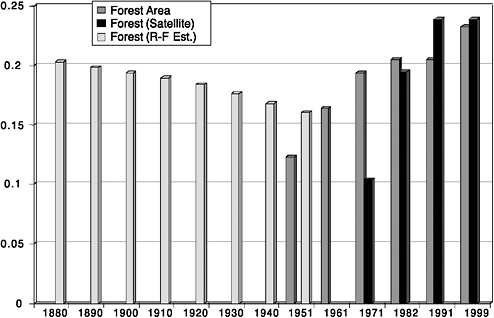
FIGURE 12-1 Proportion of total land area classified as forest (government statistics) and proportion of land forested, India, 1880-1999.
SOURCES: Richards and Flint (1994) and satellite data.
Richards and Flint (1994) indicate that forest cover declined from 20 percent of total land in India in 1880 to about 16 percent in 1950.5Figure 12-1 also shows, however, that the proportion of land designated by the Indian government as forest land (Department of Agriculture and Cooperation, 1997; Food and Agriculture Organization, 2000) increased from 12 percent in 1951 to over 23 percent in 1999. The time series of tree coverage for India based on satellite imagery that we carried out, which are also presented in the figure, indicate that the increase in officially designated forest land has been accompanied, with a lag, by increases in the proportion of land covered by forests, from just over 10 percent in 1971 to over 24 percent in 1999.
This sustained increased in forest cover is remarkable when set in the context of overall rates of economic and population growth in the study villages. Basic statistics derived from the household surveys as well as the 1990 census are presented in Table 12-1. Average population size in the study villages almost doubled over the 1971-1999 period, from 2,033 to 3,877, a 90 percent increase. There was a similar expansion in household income, which rose from 2,846 to 5,214 rupees (in 1982 rupees), an increase of 83 percent. There was also substantial real wage growth from 6.7 to 16.7 1982 rupees, an increase of 150 percent. Evidently growth in forest cover, at least at the national level, is not inconsistent with substantial rates of growth in population and economic activity.
To address possible mechanisms underlying these changes, we examined a number of hypotheses as to why forest area might be increasing in India. The statistical analyses for this work consisted primarily of estimation of a series of equations relating forest cover at the village level to agricultural productivity, household size, population size, and measures of infrastructure. To account for unmeasured differences across villages in climatic conditions and biophysical constraints, we used fixed effects,6 relating changes over time in forest cover to changes over time in economic and population conditions. The issue here is that conditions that increase the propensity for forest growth in a particular area may be correlated, in the cross-section, with both agricultural productivity and population: more favorable soil conditions will promote forest growth but will also raise agricultural productivity and support higher population densities. Thus the cross-sectional correlation between agricultural productivity and forest cover may be positive, even if an increase in agricultural productivity, for given soil conditions, will tend to decrease forest cover. Indeed, this is
|
5 |
Richards and Flint provide estimates of forest cover for 1880, 1920, and 1950. The intervening years are interpolated in the figure. |
|
6 |
Seto (Chapter 8) uses a fixed-effects estimator to examine land cover change in China for similar reasons. |
TABLE 12-1 Village Characteristics (Mean and SD), by Survey and Census Year
|
Variable |
1971 |
1982 |
1991 |
1999 |
|
Proportion of land forested (NDP) |
.105a (.176) |
.210b (.264) |
.239c (.198) |
.239d (.294) |
|
Proportion of biomass attributable to forests |
.0271a (.0487) |
.0579b (.0790) |
.0462c (.0235) |
.0842d (.1195) |
|
Mean net cultivated area (acres) |
1,344f (1,575) |
1,564g (1,579) |
NA |
1,541h (1,641) |
|
Village population size |
2,033e (3,121) |
2,642e (3,466) |
3,311e (4,948) |
3,877h (5,510) |
|
Household size |
5.88 (1.24) |
6.12 (1.72) |
6.05 (1.51) |
6.51 (2.53) |
|
High yielding varieties yield (1971 rupees/acre) |
321.7f (384.3) |
561.2g (353.3) |
NA |
1001.9h (500.4) |
|
Annual rainfall (mm) |
1,153.4i (547.1) |
1,012.1i (285.1) |
944.0i (462.8) |
1,004.3i (647.8) |
|
Male agricultural wage (1982 rupees/day) |
6.68f (2.69) |
9.99g (5.92) |
NA |
16.7h (5.08) |
|
Land price (1982 rupees) |
8950.0f (7910.3) |
8965.4g (9792.5) |
NA |
27218h (26395) |
|
Household income (1982 rupees) |
2,845.6f (1,451.5) |
3,071.3g (1,806.8) |
NA |
5,213.9 (7,738.0) |
|
Paved (pucca) access road |
NA |
.290g (.455) |
.706e (.457) |
.731h (.444) |
|
Factory in village |
.135f (.343) |
.622g (.486) |
NA |
.949h (.221) |
|
Village in an Intensive Agricultural District Program districtf |
.215 |
|||
|
Proportion of land planted in rice in 1971f |
.297 |
|||
|
Proportion of land planted in wheat in 1971f |
.116 |
|||
|
Number of villages |
253 |
242 |
234 |
253 |
|
aLandsat 1. bLandsat 3. cLandsat 4. dLandsat 7. eIndia Census. fAdditional Rural Income Survey, 1970-1971. gRural Economic Development Survey, 1981-1982. hRural Economic Development Survey, 1999. iNational Climate Data Center, monthly global surface data. SOURCE: Foster and Rosenzweig (2003). |
||||
exactly what was observed—in the cross-section, a doubling of agricultural productivity is associated with a 5-point increase in the fraction of the village area that is forested. However, using differences and instrumenting to account for the fact that actual agricultural yields measure with error the true expected yields at a given point in time, we found that a doubling of agricultural productivity resulted in a 30-point decline in forest area.
Our results allow us to dismiss three of the primary hypotheses that might have been thought to govern this change based on the existing literature. First, there is no evidence that increased seed productivity in India has led to decreased need for agricultural land and thus the regrowth of forests. In fact, given that grain markets in India have been essentially integrated and tied to world prices over the study period, one would expect the opposite effect—as agricultural land becomes more productive due to higher yield, one has an incentive to move more land from forest to agricultural purposes and to export the surplus. As noted, this effect is readily evident in the data. Those areas experiencing the most rapid growth of agricultural productivity also experienced the most decline (or least growth) in forest cover. This result corresponds with those of the Yaqui Valley in Mexico (Matson et al., Chapter 10) and that of the Nang Rong area of Thailand (Walsh et al., Chapter 6), where the opening of an agricultural commodity market resulted in a substantial transition from forest to crop land.
Second, while there is some evidence that rural wages have risen in part as a consequence of growth in the nonfarm sector, there is no evidence that this rise in wages has importantly affected forest cover given household income, household size, and the returns to traditional agricultural land. It should be noted at the outset that whether one believes that rising wages should have an effect on forest cover depends very much on one’s model of forest management. On one hand, if the primary source of forest decline is the nonsustainable extraction of forest resources (e.g., cutting of trees for firewood or fodder greater than the capacity of the forests to regenerate), then rising wages, by providing other opportunities for labor, will tend to decrease the extraction of these resources and thus increase forests. On the other hand, if forest area is being managed as an agricultural resource, then the effects of a rise in the wage, given household income and the returns to agricultural land, will depend on how sensitive the consumption of forest goods is to the effective price of these goods. The intuition here is that rising wages will reduce the amount of labor per unit area used in the extraction of forest resources. This, in turn, reduces the quantity of forest goods produced. If the demand for forest goods is fairly sensitive to price, then the price will rise a small amount but forest area will not be much affected. Alternatively, if the demand for forest goods is not much affected by their price, then the price of forest goods will have to rise a great deal in response to this higher cost of
labor. There will be thus a high return to holding land as forests, and more land may be converted from traditional agriculture to forests.
Third, there is little evidence that income change at the local level importantly affects forest cover. Again, the theoretical effects are ambiguous and depend on how forest area is managed, as well as, in this case, on how responsive demand for forest products is to increases in household income. An increase in income may tend to increase demand for wood products for use in housing and furniture, for example, while decreasing demand for wood products in the form of firewood. If local demand must largely be met by local supply, then an income-induced increase in demand will have different effects on forest area depending, as before, on how forest resources are managed. If forest resource extraction is efficiently managed, then an increase (decrease) in demand will result in an increase (decrease) in forest area and conversely in the case of nonsustainable management. An additional income effect may be in place if higher incomes result in greater demand for environmental quality in terms of more or healthier forests or increased ability to pay for the protection of these resources.
Having examined these three hypotheses, we then proposed a rather different story—that growth in forest area is largely driven by demand for wood and paper products at the national level coupled with the trade barriers that, until recently, have discouraged the importation of these products into the country. There is ample evidence to support this view. First, there has been substantial growth in plantation forests in India—that is, a substantial fraction of forests are now literally being managed as agricultural commodities. Second, growth in demand for paper and wood products has substantially exceeded growth in net imports of these products. Third, given relatively low density of forest cover in most parts of the country as well as protections in place in others, there is little opportunity for suppliers to meet this demand through the cutting of old-growth forests. Finally, at the cross-national level, there is a strong relationship between income growth and forest growth among countries with relatively closed economies (i.e., those economies with significant barriers to trade) but no such relationship among countries with relatively open economies, in which changes in demand are largely met through trade (Foster and Rosenzweig, 2003).
Thus given the underlying market structures and conditions, population and economic growth have actually promoted growth in forest cover rather than decreasing it, as has generally been assumed. But this overall pattern of effects, which is driven through the national demand for forest products, does not necessarily imply that population does not have important adverse effects on forest cover at the local level.
In particular, our results suggest that population has a variety of effects on forest cover and that there is an important distinction to be made between population growth due to expansion of households and population growth
due to an expansion in household size, a point also emphasized in Liu’s work in the Wolong Nature Reserve of China (Liu et al., Chapter 9). As discussed in the theory section, how household size and the number of households affect forest cover is importantly governed by the structure of demand for, the technology of production of, and the process of management of forest resources and cannot in general be determined on theoretical grounds. Empirically, we find that the effects of an expansion in household size for given number of household is on average small. On net, a doubling of household size results in a 4-point decline in the forest area. By contrast a doubling in the number of households for a given household size results in a 9-point rise in the fraction of forest area. Moreover, this effect does not appear to be a consequence of the fact that an increase in the number of households increases the supply of labor, as the household effect is observed net of wages and land prices. These results suggest, as assumed in the baseline model, that local demand for forest products is met at least in part through local production, just as, at the national level, supply responds to demand. The fact that increases in household size have a different impact than do increases in the number of households suggests, in addition, that the organization of people into households affects the demand for forest products and thus forest area through scale effects. The fact that an increase in household size on average decreases forest area also indicates that there is an important sense in which forest resources are not efficiently managed.
In our second paper (Foster, Rosenzweig, and Behrman, 2003), we look at this issue more directly by focusing on how commons management of forest land impacts the local-level relationship between changes in agricultural productivity, population, and wages and changes in forest area. We find in particular that adverse impacts on forest area are stronger in those areas in which forest land is commonly held. In those areas in which forests are commonly held, we reject the implication of the benchmark model that an expansion in household size, which raises demand for forest products, should also raise forest area. But this implication is not rejected in areas in which forests are not commonly managed. These results suggest that a clear distinction needs to be drawn between forest area that is privately owned and managed, such as plantation forests, and more traditional forest commons.
Finally, consistent with results from other studies reported in this volume (Moran, Brondizion, and VanWey, Chapter 5; Walsh et al., Chapter 6; Fischer and O’Neill, Chapter 3), we find that the availability of high-quality roads tends to decrease forest cover. As a high-quality road does not significantly increase land prices but does push up wages, it appears that the primary effect of roads in India is not through an increase in the price farmers receive for agricultural commodities but through an expansion in labor opportunities outside the forest and the agricultural sector.
SCALE
The primary generalizable theme that has arisen in the context of this work is the critical link between the nature of the questions being examined and the scale at which the analysis takes place. This issue of appropriate scale is a major source of the underlying strength of this work as well as a basis for some of the key limitations.
In addressing this issue it is helpful to distinguish between the scale of analysis and the unit of analysis. For the purpose of this chapter, the scale of analysis refers to the overall geographical coverage of the data, whereas the unit of analysis refers to the underlying source of variation that is examined in a particular study region. Thus a unit of analysis may consist of an individual, a household, a village, a district, or a state, and the scale of analysis will in general consist of a collection of individual units at a higher level of aggregation.
The reason for making this distinction is that a given mechanism can be uncovered statistically only to the extent that mechanism is relatively fixed at the scale of analysis. Suppose one wishes to investigate a mechanism that links increases in village population to changes in forest cover. In this case, the unit of analysis must be the village, and the scale of analysis will be a collection of villages, say a country, with different levels of population growth. If the unit and scale of analyses are smaller than this, for example, then there is little basis for determining whether higher population growth puts pressure on local forests. Moreover, this analysis works only if the mechanism is relatively fixed across the scale of analysis. If the relationship between population and forest cover varies across villages, then an analysis based on a comparison across villages would provide little basis for inference about such a mechanism.
In the context of our work, the appropriate scale of analysis has been importantly governed by the size of the market as well as the availability of data. Table 12-2 provides a simple perspective on the different scales, units, and questions examined in our work. Consider first the question of whether increases in income increase or decrease demand for fuel or wood products. We assume that, for example, firewood is easily traded across households within a village but not easily traded between households in different villages. As a consequence of the first assumption, it is a reasonable approximation to assume that the unit cost of firewood is similar for households living in the same village. As a consequence of the second assumption, this unit cost varies from village to village. Given these two assumptions, and in the absence of direct measures of firewood price, the best way to measure the sensitivity of demand for forest products to income is through within-village variation in firewood consumption. Thus the appropriate scale of analysis is the village, and the appropriate unit of analysis is the household.
TABLE 12-2 Questions Asked and the Appropriate Scale and Unit of Analysis
|
Question |
Unit |
Scale |
Comment |
|
Effects of income on wood demand? |
Household |
Village |
Tradability within village |
|
Effects of HYV growth on forests? |
Village |
Country |
One market within country, world price given |
|
Demand for wood caused tree growth? |
Country |
World |
Only linked in closed economies |
Now turn to the question of the appropriate scale for examining the effects of technical change in agriculture in India on forest cover. In this context we assume that grains are fully tradable across villages and even nations so that, from the perspective of any given village and even India as a whole, the price of grains may be taken as given. In this context a comparison of rates of forest growth in regions with different levels of productivity growth in agriculture provides a reasonable basis of inference about decisions to allocate land between traditional agriculture and forests. The appropriate unit of analysis is thus the village, and the appropriate scale is the country. In the absence of the assumption that there is one market in the country, one would lose the ability to separate the production-side from the demand-side effects. That is, the measured effect would reflect the direct effects of productivity in agriculture on the relative productivity of land devoted to agriculture minus an effect due to the declining local price, which is determined, in turn, by the price responsiveness of demand for the agricultural products. A similar convolution of demand and supply effects would occur to the extent that India cannot take world grain prices as given, because it is a relatively large producer and consumer of grains. In this case, the measured effect of the Green Revolution would only incorporate the production effect on forests and miss the fact that the Green Revolution in India may have helped, all else being equal, to lower world grain prices and thus decrease the incentive to convert forest land to agriculture.
Finally, consider the argument that overall demand for paper and wood products in India was largely responsible for the growth in forest cover over the 30-year study period. Under the maintained assumption, for example, that paper markets across India are reasonably well integrated, there is little basis on which to test the hypothesis that a rise in demand for paper products results in increased forest cover. This is because local demand for paper products in an integrated market is not linked to the supply in that area. There is, in effect, no systematic variation in demand for paper prod-
ucts across India. The only direct test of the idea is to turn to the unit of analysis of the country with the set of nations as the appropriate scale. Even this comparison, however, does not work in the case of relatively open economies—one needs the frictions created by a lack of openness in order to establish whether, indeed, increases in demand for paper products importantly drive forest cover.
From this perspective, it is clear that the process of scaling up and scaling down requires a great deal of conceptualization about the mechanisms in place. The finding that, for example, increases in household size at the level of the village tend to result in decreases in forest cover does not at all imply that increases in household size at the national level will decrease forest cover. To the extent that forest growth is driven by demand for paper products, a relatively tradable good, population growth at the national level may increase forest cover in a relatively closed economy. At the local level, however, increases in household size depress wages and increase rents, which may shift production from forests to more traditional agriculture, if the latter is relatively labor intensive.
FUTURE WORK
As noted at the beginning of this chapter, one of the primary motivations for this work was to examine issues of fertility externalities. First, in the early stages of the analysis, it became clear that, given existing data, we could do little more than conduct an indirect test through establishing whether changes in forest area reflected a commons tragedy as well as generally to determine whether increased forest area was associated with higher or lower fertility. A more direct test for the presence of a fertility externality required more detailed data on time spent by different household members in the extraction of forest products, as well as measurement of the relative importance of different fuel sources. This type of information has been incorporated into the 1999 round of the survey, and we hope to pursue this matter in some detail in the future.
Second, there is a need to understand and model the processes of demographic change and how this interacts with the land cover more generally. It is clear from our results that household size and the number of households, while both contributing overall to population growth, have effects on forest cover that differ in important ways. In other work (Foster and Rosenzweig, 2002), we have constructed a model of household division that relies importantly on the tension between the economic savings associated with joint consumption of a public good and tensions across subhousehold units over the preferred division of expenditures between public and private goods. Given that fuel and dwelling expenditures have a public component and may be influenced by land cover, there may be feedbacks operating
between forest cover and household division that importantly impact population-environment relationships. There is also a need to better understand the role of migration as a source of change in household size and composition and how this interacts with changes in land cover, an issue raised by Walsh et al. (Chapter 6 in this volume) in the context of Thailand.
A third area in which more progress needs to be made is the identification of different types of forest growth. As noted, growth in plantation forests has played a major role in increasing forest cover in India generally. Thus much of the forest growth may have been in terms of a small number of marketable species. More generally, there is reason to believe that the species and diversity of forests in areas where forests are growing are substantially different from those in place in the early nineteenth century, differences that are also evident in the process of secondary secession in other regions, such as Brazil (Moran et al., Chapter 5). More detailed classification of the remotely sensed imagery may provide a basis for providing a richer perspective on changes in forest cover in India, thus assessing the extent to which the natural diversity is or is not being preserved.
CONCLUSION
This project shares much in common with other studies of population and environment that appear in this volume. First, the methodologies and even the questions asked have evolved importantly in the course of the survey. Our initial focus on issues of commons management have been retained, but we had no sense when beginning the analysis that a primary empirical fact to be explained was the rise in forest cover in India in the face of rapid population and economic growth. This is not to diminish the importance of the decline in forests in some areas or to suggest that changes in species and diversity of forests are not an important concern. It does suggest, however, that the field of research is at a stage in which an important component of any analysis will be to identify the salient issues and questions in a given research setting.
Second, the project involves the integration of local representative survey data with remotely sensed imagery. Given that the survey data that provided the starting point for our analysis did not contain detailed information on forest cover, the unique temporal frame of our study could not have been possible had we not been able to integrate into the analysis previously collected remotely sensed data. At the same time, however, the earliest remotely sensed images were of a different quality and in a different medium than those collected in more recent years. This raised possible issues of comparability and has limited to some extent our ability to carry out more refined analysis of forest cover. Methodological work on how best to integrate remotely sensed images of different quality and type across regions with substantially different agroclimatic conditions is clearly needed.
There are also two important aspects of our project that distinguish it from most of the other projects discussed in this volume. First, the temporal and geographical scale in our analysis is relatively large. This scale is, in my view, essential in that there is substantial local-level geographic and temporal spillover between population and environmental processes. Because of this, many important population-environment interactions can be examined only through studies at a very large scale. Patterns observed at lower scales may be interesting in their own right, but they are likely to provide little insight into these larger scale interactions. Conversely, however, there is likely to be variation in local-level processes, such as the constraints of biophysical processes and even the operation of markets or political systems. There is thus a clear need for a balance between large-scale studies such as ours that partially gloss over local-level variation and more local-level studies that focus on particular conditions and environments and help to identify the magnitude and significance of this local-level variation.
Finally, an important feature of our project has been the development of a specific analytic structure to focus attention on the critical mechanisms underlying population-environment interactions as well as to frame the empirical analysis. The fact that this project has used such a structure, rather than a more generalized characterization of pathways linking various types of conditions and outcomes, may be considered a potential weakness, in that many of the specific assumptions that have been incorporated may hold only approximately in practice. However, the use of specific structure has also played a very important role in allowing us to go beyond a characterization of empirical regularities. In particular, the approach has helped us to identify specific answerable research questions that we might otherwise have missed. As this research continues into a more detailed assessment of household-level processes and how they interact with environmental conditions, this structured approach will continue to play a critical role in guiding our research.
REFERENCES
Brown, C. 2000 The Global Outlook for Future Wood Supply from Forest Plantations. (Working Paper No. GFPOS/WP/03.) Rome, Italy: Forestry Policy and Planning Division, Food and Agricultural Organization.
Cropper, M., and C. Griffiths 1984 The interaction of population growth and environmental quality. American Economic Review 84:250-254.
Dasgupta, P. 1995 An Inquiry into Well-Being and Destitution. Oxford, England: Clarendon Press.
Department of Agriculture and Cooperation 1997 Agricultural Statistics at a Glance. New Delhi: Directorate of Economics and Statistics, Department of Agriculture and Cooperation, Ministry of Agriculture, Government of India.
Dyson, T., and M. Moore 1983 On kinship structure, female autonomy, and demographic behavior in India. Population and Development Review 9(1):35-60.
Filmer, D., and L. Pritchett 1986 Environmental Degradation and the Demand for Children: Searching for the Vicious Circle. (Policy Research Working Paper No. 1623.) Washington, DC: World Bank.
Firestone, L. 2000 Land-Cover Change in Eastern Gujarat During the Green Revolution: A Case Study in the Use of Satellite Imagery in Social Science and Environmental Research. Unpublished undergraduate thesis, Brown University.
Food and Agriculture Organization 2000 Forest Resources Assessment 2000. Rome, Italy: Food and Agriculture Organization of the United Nations.
Foster, A.D., and M.R. Rosenzweig 2002 Household public goods, household division, and rural economic growth. Review of Economic Studies 69(4):839-69.
2003 Economic growth and the rise of forests. Quarterly Journal of Economics 118(2): 601-637.
Foster, A.D., M.R. Rosenzweig, and J. Behrman 2003 Population, Income and Forest Growth: Management of Village Common Land in India. Unpublished manuscript, Brown University.
Hardin, G. 1968 The tragedy of the commons. Science 162:1243-1248.
Harris, J.M. 2002 Environmental and Resource Economics: A Contemporary Approach. Boston, MA: Houghton Mifflin.
Jodha, N.S. 1985 Population growth and the decline of common property resources in India. Population and Development Review 11(33):247-264.
Kumar, N., N. Saxena, Y. Alagh, and K. Mitra 2000 Alleviating Poverty Through Forest Development, Evaluation Country Case Studies Series. Washington, DC: World Bank.
Lee, R. 1990 Population policy and externalities to childbearing. Pp. 17-32 in Annals of the American Academy of Political and Social Science, special issue, S. Preston, ed. Philadelphia, PA: American Academy of Political and Social Science.
1991 Evaluating externalities to childbearing in developing countries: The case of India. In Consequences of Rapid Population Growth in Developing Countries, G. Tapinos, D. Blanchet, and D. Horlacher, eds. New York: Taylor and Francis.
National Climate Data Center 1997 Monthly Global Surface Data. Asheville, NC: National Climate Data Center.
Nerlove, M.L. 1991 Population and the environment: A parable of firewood and other tales. American Journal of Agricultural Economics 73:1334-1347.
Nerlove, M.L., and A. Meyer 1997 Endogenous fertility and the environment: A parable of firewood. In The Environment and Emerging Development Issues, P. DasGupta and K.-G. Mäler, eds. New York: Oxford University Press.
Ostrom, E. 1990 Governing the Commons: The Evolution of Institutions for Collective Action. New York: Cambridge University Press.
Pender, J. 1999 Rural Population Growth, Agricultural Change and Natural Resource Management in Developing Countries: A Review of Hypotheses and Some Evidence from Honduras. (Discussion Paper 48.) Washington, DC: International Food Policy Research Institute, Environment and Production Technology Division.
Richards, J.F., and E.P. Flint 1994 Historic Land Use and Carbon Estimates for South and Southeast Asia: 1880–1980. (Environmental Sciences Division Publication No. 4174.) Oak Ridge, TN: Carbon Dioxide Information Analysis Center, Oak Ridge National Laboratory.
Rouse, J.W. Jr., R.H. Haas, D.W. Deering, J.A. Schell, and J.C. Harlan 1974 Monitoring the Vernal Advancement and Retrogradation (Green Wave Effect) of Natural Vegetation. (Type III Final Report.) Greenbelt, MD: NASA Goddard Space Flight Center.
Sedjo, R.A. 1995 Forests: Conflicting signals. In The True State of the Planet, R. Bailey, ed. New York: The Free Press.
Wulder, M. 1998 Optical remote-sensing techniques for the assessment of forest inventory and biophysical parameters. Progress in Physical Geography 22:449-476.


