
5
What Actions Should America Take in K–12 Science and Mathematics Education to Remain Prosperous in the 21st Century?
10,000 TEACHERS, 10 MILLION MINDS
Recommendation A: Increase America’s talent pool by vastly improving K–12 science and mathematics education.
The US system of public education must lay the foundation for developing a workforce that is literate in mathematics and science, among other subjects. It is the creative intellectual energy of our workforce that will drive successful innovation and create jobs for all citizens.
In 1944, during the final phases of a global war, President Franklin D. Roosevelt asked Vannevar Bush, his White House director of scientific research, to study areas of public policy having to do with science. The president observed, “New frontiers of the mind are before us, and if they are pioneered with the same vision, boldness and drive with which we have waged this war, we can create a fuller and more fruitful employment and a fuller and more fruitful life.” In the intervening years, our country appears to have lost sight of the importance of scientific literacy for our citizens, and it has become increasingly reliant on international students and workers to fuel our knowledge economy.
The lack of a natural constituency for science causes short- and long-term damage. Without basic scientific literacy, adults cannot participate effectively in a world increasingly shaped by science and technology. Without a flourishing scientific and engineering community, young people are not motivated to dream of “what can be,” and they will have no motivation to become the next generation of scientists and engineers who can address persistent national problems, including national and homeland security,
healthcare, the provision of energy, the preservation of the environment, and the growth of the economy, including the creation of jobs.
Laying a foundation for a scientifically literate workforce begins with developing outstanding K–12 teachers in science and mathematics.1 A highly qualified corps of teachers is a critical component of the No Child Left Behind initiative.2 Improvements in student achievement are solidly linked to teacher excellence, the hallmarks of which are thorough knowledge of content, solid pedagogical skills, motivational abilities, and career-long opportunities for continuing education.3 Excellent teachers inspire young people to develop analytical and problem-solving skills, the ability to interpret information and communicate what they learn, and ultimately to master conceptual understanding. Simply stated, teachers are the key to improving student performance.
Today there is such a shortage of highly qualified K–12 teachers that many of the nation’s 15,000 school districts4 have hired uncertified or underqualified teachers. Moreover, middle and high school mathematics and science teachers are more likely than not to teach outside their own fields of study (Table 5-1). A US high school student has a 70% likelihood of being taught English by a teacher with a degree in English but about a 40% chance of studying chemistry with a teacher who was a chemistry major.
These problems are compounded by chronic shortages in the teaching workforce. About two-thirds of the nation’s K–12 teachers are expected to retire or leave the profession over the coming decade, so the nation’s schools will need to fill between 1.7 million and 2.7 million positions5 during that
|
1 |
See, for example, The Glenn Commission. Before It’s Too Late: A Report to the Nation from the National Commission on Mathematics and Science Teaching for the 21st Century. Washington, DC: US Department of Education, 2000. |
|
2 |
No Child Left Behind Act of 2001. Pub. L. No. 107-110, signed by President George W. Bush on January 8, 2001, 107th Congress. |
|
3 |
National Research Council. Learning and Understanding: Improving Advanced Study of Mathematics and Science in U.S. Schools. Washington, DC: National Academy Press, 2002. |
|
4 |
National Center for Education Statistic. 2006. “Public Elementary and Secondary Students, Staff, Schools, and School Districts: School Year 2003–04.” Available at: http://nces.ed.gov/pubs2006/2006307.pdf. |
|
5 |
National Center for Education Statistics. Predicting the Need for Newly Hired Teachers in the United States to 2008-09. NCES 1999-026. Washington, DC: US Government Printing Office, 1999. Available at: http://nces.ed.gov/pubs99/1999026.pdf. According to the Bureau of Labor Statistics, job opportunities for K–12 teachers over the next 10 years will vary from good to excellent, depending on the locality, grade level, and subject taught. Most job openings will be attributable to the expected retirement of a large number of teachers. In addition, relatively high rates of turnover, especially among beginning teachers employed in poor, urban schools, also will lead to numerous job openings for teachers. Competition for qualified teachers among some localities will likely continue, with schools luring teachers from other states and districts with bonuses and higher pay. See http://stats.bls.gov/oco/ocos069.htm#emply. |
TABLE 5-1 Students in US Public Schools Taught by Teachers with No Major or Certification in the Subject Taught, 1999-2000
|
Discipline |
Grades 5–8 |
Grades 9–12 |
|
English |
58% |
30% |
|
Mathematics |
69% |
31% |
|
Physical science |
93% |
63% |
|
Biology–life sciences |
— |
45% |
|
Chemistry |
— |
61% |
|
Physics |
— |
67% |
|
Physical education |
19% |
19% |
|
SOURCE: National Center for Education Statistics. Qualifications of the Public School Teacher Workforce: Prevalence of Out-of-Field Teaching 1987-1988 to 1999-2000. Washington, DC: US Department of Education, 2003. |
||
period, about 200,000 of them in secondary science and mathematics classrooms.6
We need to recruit, educate, and retain excellent K–12 teachers who fundamentally understand biology, chemistry, physics, engineering, and mathematics. The critical lack of technically trained people in the United States can be traced directly to poor K–12 mathematics and science instruction. Few factors are more important than this if the United States is to compete successfully in the 21st century.
The Committee on Prospering in the 21st Century recommends a package of K–12 programs that is based on tested models, including financial incentives for teachers and students and high standards for, and measurable achievement by, teachers, students, and administrators. The programs will create broad-based academic leadership for K–12 mathematics and science, and they will provide for rigorous curricula. Support for the action items in this recommendation should have the highest priority for the federal government as it addresses America’s ability to compete for quality jobs in the future.
The strengths of the proposed actions derive from their focus on teachers—those who are entering the profession and those who currently teach science and mathematics—and on the students they will teach. The recommendations cover the spectrum of K–12 teachers, and several programs are recommended to tailor education for different populations. Each recommendation has specific, measurable objectives. At the same time, we must emphasize the need for research and evaluation to serve as a foundation for
|
6 |
National Research Council. Attracting Science and Mathematics PhDs to Secondary School Education. Washington, DC: National Academy Press, 2000. Available at: http://www.nap.edu/catalog/9955.html. |
change in K–12 mathematics and science education. In particular, a better understanding of what actions can be taken to excite children about science, mathematics, and technology would be useful in designing future educational programs.
The first two action items focus on K–12 teacher education and professional development. They are designed to give new K–12 science, mathematics, and technology teachers a solid science, mathematics, and technology foundation; provide continuing professional development for current teachers and for those entering the profession from technology-sector jobs so they gain mastery in science and mathematics and the means to teach those subjects; and provide continuing education for current teachers in grades 6–12 so they can teach vertically aligned advanced science and mathematics courses.7 One fortunate spinoff of enhanced education of K–12 teachers is that salaries—in many school districts—are tied to teacher educational achievements.
ACTION A-1:
10,000 TEACHERS FOR 10 MILLION MINDS
Annually recruit 10,000 science and mathematics teachers by awarding 4-year scholarships and thereby educating 10 million minds. Our public education system must attract at least 10,000 of our best college graduates to the teaching profession each year. A competitive federal scholarship program will allow bright, motivated students to earn bachelors’ degrees in science, engineering, and mathematics with concurrent certification as K– 12 mathematics and science teachers.
Students could enter the program at any of several points and would receive annual scholarships of up to $20,000 per year for tuition and qualified educational expenses. Awards would be given on the basis of academic merit.8 Each scholarship would carry a 5-year postgraduate commitment to teach in a public school.9
|
7 |
“Vertically aligned curricula” use sequenced materials over several years. An example is pre-algebra followed by algebra, geometry, trigonometry, pre-calculus, and calculus. The systematic approach to education reform emphasizes that teachers, school and district administrative personnel, and parents work together to align their efforts. See, for example, Southwest Education Development Laboratory. “Alignment in SEDL’s Working Systemically Model, 2004 Progress Report to Schools and Districts.” Available at: http://www.sedl.org/rel/resources/ws-report-summary04.pdf. |
|
8 |
Teacher education programs would be 4 years in duration with multiple entry points. A first-year student entering the program would be eligible for a 4-year scholarship, while students entering in their second or later undergraduate years would be eligible for fewer years of support. |
|
9 |
If the scholarship recipients do not fulfill the 5-year service requirement, they would be obligated to repay a prorated portion of their scholarship. |
To provide the highest quality education for students who want to become teachers, it is important to award competitive matching grants of $1 million per year, to be matched on a one-for-one basis, for 5 years to help 100 universities and colleges establish integrated 4-year undergraduate programs that lead to bachelors’ degrees in physical and life sciences, mathematics, computer science, and engineering with teacher certification.10 To qualify, science, technology, engineering, and mathematics (STEM) departments would collaborate with colleges of education to develop teacher education and certification programs with in-depth content education and subject-specific education in pedagogy. STEM departments also would offer high-quality research experiences and thorough training in the use of educational technologies. Colleges or universities without education departments or schools could collaborate with such departments in nearby colleges or universities.
A well-prepared corps of teachers is central to the development of a literate student population.11 The National Center for Teaching and America’s Future unequivocally shows the positive effect of better teaching on student achievement.12 The Center for the Study of Teaching13 reported that the most consistent and powerful predictor of student achievement in science and mathematics was the presence of teachers who were fully certified and had at least a bachelor’s degree in the subjects taught. Teachers with content expertise, like experts in all fields, understand the structure of their disciplines and have cognitive “roadmaps” for the work they assign, the assessments they use to gauge student progress, and the questions they ask in the classroom.14 The investment in educating those teachers is money well spent because they are likely to prepare internationally competitive students.
|
10 |
The institutional awards would be matching grants awarded competitively to applicants who had identified partners, such as universities, industries, or philanthropic foundations, to contribute additional resources. Public-public and public-private consortia would be encouraged. Institutions that demonstrate success would be eligible for competitive renewals. |
|
11 |
National Research Council. Attracting PhDs to K–12 Education: A Demonstration Program for Science, Mathematics, and Technology. Washington, DC: The National Academies Press, 2002. |
|
12 |
National Center for Teaching and America’s Future. Doing What Matters Most: Teaching for America’s Future. New York: NCTAF, 1996. See also H. C. Hill, B. Rowan, and D. L. Ball. “Effects of Teachers’ Mathematical Knowledge for Teaching on Student Achievement.” American Educational Research Journal 42(2)(2005):371-406. |
|
13 |
L. Darling-Hammond. Teacher Quality and Student Achievement: A Review of State Policy Evidence. New York: Center for the Study of Teaching and Policy, 1999. Available at: http://depts.washington.edu/ctpmail/Publications/PDF_versions/LDH_1999.pdf. |
|
14 |
National Research Council. How People Learn: Brain, Mind, Experience, and School: Expanded Edition. Washington, DC: National Academy Press, 2000. Available at: http://books.nap.edu/catalog/6160.html. |
Some of the nation’s top research universities are leading the way to prepare a cadre of highly skilled teachers. Two in particular have developed innovative programs that combine undergraduate degrees in science, technology, engineering, or mathematics with pedagogy education and teacher certification.
UTeach, a program in the College of Natural Sciences, headed by the Dean of Natural Sciences at the University of Texas (UT) at Austin, recruits from among the 25% of undergraduate science and mathematics students who express a serious desire to teach. As a result of this program, UT-Austin has been able to increase the number of science and math teachers it graduates who have both degrees in a science or mathematics as well as teacher certification.
Program enrollees have SAT scores above the average for the university’s College of Natural Sciences, have higher grade point averages, and are retained in the degree program at more than twice the rate of other students in that college (Figure 5-1). UTeach has a 26% minority enrollment, compared with 16% universitywide.
Each year the program graduates about 70 students who have teaching certification and bachelors’ degrees in chemistry, physics, computer science, biology, or mathematics. Students receive strong practical education and continuing mentoring, especially in the critical first few years in the classroom, as that increases effectiveness and promotes professional retention as teachers. As also shown in Figure 5-1, UTeach graduates have deep disciplinary grounding, they know how to engage students in scientific inquiry, and they know how to use new technology to improve student achievement. The UTeach experience shows that an effective scholarship program must be coupled with a teacher education program that is interesting and attractive to students. The program’s most effective tools are the field experience courses for first-year students and the use of master teachers as their supervisors.
Starting with the current academic year, the 10-campus University of California (UC) system offers its California Teach program, which, by 2010, should graduate a thousand highly qualified science and mathematics teachers each year.15 California Teach provides every STEM student in the university with an opportunity to complete the STEM major and pedagogical training in a 4-year program. Early in the program, students work as paid classroom assistants in elementary and middle schools, supervised by mentor teachers. Students enroll in seminars taught by master teachers and participate in 10-week summer institutes to help them develop methods for
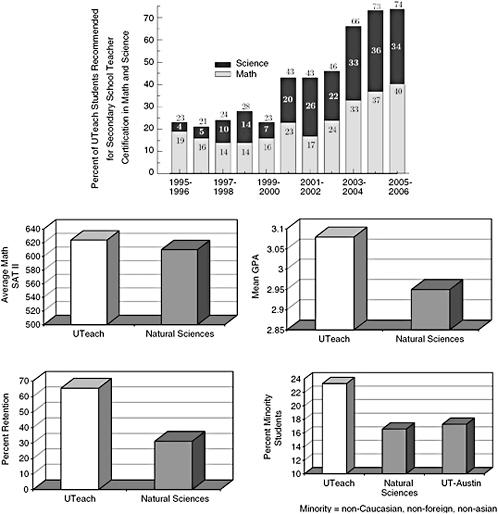
FIGURE 5-1 UTeach minority enrollment, quality of undergraduate students in the certification recommendations program, student retention, and performance compared with all students in the UT-Austin College of Natural Sciences.
SOURCE: Information based on e-mail from M. Marder of UTeach to D. Stine dated February 2, 2006.
teaching in a specific discipline. Students from throughout the university system in the California Teach program who satisfactorily complete their courses through the junior year participate in subject-area institutes. UC-San Diego, for example, might host a high school chemistry institute that would be open to students and faculty from all campuses.
At each institute, students and faculty (those from UC, those who are visiting, and master secondary school teachers) collaborate to develop case
study videos of teaching methods and approaches that will be archived by the University of California television system for use by students and faculty in subsequent institutes and by teachers in the field. Students develop the portfolios that eventually will be required of teachers to become certified by a national board. Students who complete the institutes receive $5,000 scholarships.
Both the UTeach and California Teach programs provide a continuum of pre- and in-service teacher education and professional development and established cohorts and relationships that are crucial for retaining the most talented individuals in the profession. California Teach also will provide the nation with a large-scale experiment to show which elements of teacher preparation are most effective. Replicating the strong points of such programs around the country will transform the quality of our science and mathematics teaching.16
ACTION A-2:
A QUARTER OF A MILLION TEACHERS INSPIRING YOUNG MINDS EVERY DAY
Strengthen the skills of 250,000 teachers through training and education programs at summer institutes, in master’s programs, and in Advanced Placement (AP) and International Baccalaureate (IB) training programs. Excellent professional development models exist to strengthen the skills of the 250,000 current mathematics and science teachers, but they reach too few in the profession. The four-part program recommended by the committee consists of (1) summer institutes, (2) master’s degree programs in science and mathematics, (3) training for advanced placement and International Baccalaureate teachers, and (4) development of a voluntary national K–12 science and mathematics curriculum.
We need to reach all K–12 science and mathematics teachers and provide them with high-quality continuing professional development opportunities—specifically those that emphasize rigorous content education. High-quality, content-driven professional development has a significant effect on student performance, particularly when augmented with classroom practice, year-long mentoring, and high-quality curricular materials.17
About 10% of the nation’s 3 million K–12 teachers provide instruction in science and mathematics in middle and high schools.18 The No Child Left Behind Act requires all of them to participate regularly in professional development, and in most states professional development already is required to maintain teaching credentials. Funding for continuing education now comes from the No Child Left Behind appropriation and from the states.
As the number of programs has ballooned, many teachers report that they are “buried in opportunities” for continuing education. They also complain that it is difficult to know which programs are worthwhile and which are irrelevant and disconnected. The object of this implementation action is to identify outstanding programs that improve content knowledge and pedagogical skills, especially for those who enter the profession from other careers. Over 5 years, these programs could reach all teachers of middle and high school mathematics and science. Furthermore, as these teachers become more qualified, they can be provided increased financial rewards without confronting the historical culture that largely dismisses the concept of pay-for-performance.
Action A-2 Part 1: Summer Institutes
In the first implementation action, the committee recommends a summer education program for 50,000 classroom teachers each year. Matching grants would be provided on a one-for-one basis to state and regional summer institutes to develop and provide 1- to 2-week sessions. The expected federal investment per participant is about $1,200 per week, excluding participant stipends, which would be covered by local school districts.
Summer institutes for secondary school teachers of science and mathematics have existed in various forms at least since the 1950s, often with corporate sponsors.19 The National Science Foundation (NSF) started funding teacher institutes in 1953, when shortages of adequately trained person-
nel in scientific and technical fields became increasingly evident.20 In 2004, the NSF Math and Science Partnership began making awards under a new program, Teacher Institutes for the 21st Century.21
There is a particularly strong need for elementary and middle school teachers to have a deeper education in science and mathematics.22 Many school children are systematically discouraged from learning science and mathematics because of their teachers’ lack of preparation, or in some cases, because of their teachers’ disdain for science and mathematics. In many school systems, no science at all is taught before middle school.
Teachers who are not required to teach science have little reason to increase their knowledge and skills through professional development. No Child Left Behind requirements, however, will expand testing to the sciences in 2007. Elementary school teachers thus need training now in many areas of science; they need to see the relationships between mathematics and the sciences; and, most important if they are to excite young minds, they need the ability to integrate information across disciplines. In short, all teachers need to be scientifically literate and preferably excited about science.
The Merck Institute for Science Education (MISE)23 is an in-service professional development program for K–6 teachers established in 1993 with a 10-year commitment from Merck & Company. An intensive 3-year course combines multiple-year summer institutes in inquiry-based science instruction that is tied to state and national standards with in-classroom follow-up and reinforcement from September to June. MISE also provides curriculum materials and training in their use. The current participants are K–6 teachers in New Jersey and Pennsylvania public schools. In all, about 4,000 teachers have participated in the program. Analysis by an external evaluator indicates that students of teachers who participated in MISE pro-
|
20 |
Funding for institutes for the continuing education of high school science teachers began to decline in number in the late 1960s, when the shortages of technical personnel including science teachers, began to decline. After a leveling period during the 1970s, National Science Foundation support for teacher institutes was discontinued in 1982. Support for the teacher institute programs was resumed the following year following several national reports detailing the severe problems facing science teaching and with growing recognition of the shortage of qualified science teachers. |
|
21 |
These awards are directed to disciplinary faculty of higher education institutions to work with experienced teachers of mathematics and the sciences to deepen teachers’ content knowledge and instructional skills so they may become school-based intellectual leaders in their fields. |
|
22 |
National Research Council. Science for All Children: A Guide to Improving Elementary Science Education in Your School District. Washington, DC: National Academy Press, 1997. |
|
23 |
“Merck Institute for Science Education (MISE).” Available at: http://www.mise.org/mise/index.jsp. |
fessional development programs for at least 3 years substantially outperformed those whose teachers participated for a year or less.24
Local MISE programs have made science a priority in each district. New science frameworks and instructional materials developed by MISE have been adopted by all of the participating districts. Added benefits are seen in improvements in hiring and recruitment of teachers and administrators, increased expenditures for instructional materials, changes in how teachers are observed and evaluated in the classroom, augmented instructional support services, development of new districtwide science assessments, and the leveraging of significant additional external resources for science education programs. MISE also has helped to lead the way in the creation of statewide science content standards and professional development standards.
Similar to MISE in its focus on K–6 science education is the Washington State Leadership and Assistance for Science Education Reform (LASER) program,25 which began in 1999 with a strategic planning institute to coordinate standards, curricula, and evaluation. Six more institutes have convened since then, and now 131 school districts, enrolling more than 60% of Washington’s students, are at various stages of implementing an inquiry-based science program.26
In 2005, achievement in the 5th-grade science portion of the Washington Assessment of Student Learning (WASL) was measured and correlated with teacher participation in LASER. Primary among the findings was a significant relationship between professional development among teachers and the percentage of students meeting the science standard on the 2004 test (Figure 5-2). LASER teachers’ classroom practices changed incrementally until they had more than 80 hours of professional development; at that point, more dramatic shifts to inquiry-based methods were observed.
|
24 |
Consortium for Policy Research in Education. 2002. A Report on the Eighth Year of the Merck Institute for Science Education. Philadelphia, PA: CPRE, University of Pennsylvania, 2002. Available at: http://www.mise.org/pdf/cpre2000_2001.pdf. When MISE was created in 1995, there were no districtwide or state assessments in science in Pennsylvania or New Jersey, where MISE programs were based. The absence of assessment often meant that less attention was given to science in elementary classrooms, and it meant that there was no easy way to measure the impact of MISE’s work on student learning. MISE has been exploring the use of performance tasks for districtwide assessment. For the past two years, performance tasks drawn from the Third International Mathematics and Science Study (TIMSS) have been administered in grades 3 and 7 in all four districts. This has been a collaborative project involving MISE staff, central office staff, and many interested teachers. |
|
25 |
“Washington State Leadership and Assistance for Science Education Reform (LASER) Program.” Available at: http://www.wastatelaser.org. |
|
26 |
“Inquiry” is a set of interrelated processes by which scientists and students pose questions about the natural world and investigate knowledge. Using an inquiry-based approach students learn science in a way that reflects how science actually works. See National Research Council. National Science Education Standards. Washington, DC: National Academy Press, 1995. |
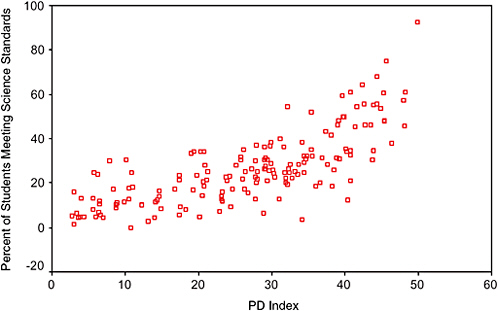
FIGURE 5-2 Professional development index relative to percent of students meeting science standards. Professional development of teachers increases student achievement in science. The scatter plot shows the PD index (total professional development hours per 100 students provided over a 3-year period to the teachers of 5th graders who took the WASL in spring 2004) compared with the percentage of students who met the WASL standards. Each box represents a school. There is a gradual increase in the percentage of students meeting the standard as the PD index increases. The data suggest the rate of increase accelerated after teachers received a critical amount of professional development, although the exact point at which that change occurred cannot be determined without access to classroom-level aggregates and the ability to track the professional development of the teachers of individual students. The relationship between professional development and student achievement holds even after adjustments for the influence of percentage of students eligible for free and reduced-price lunches and for the percentage of Asian students.
SOURCE: D. Schatz, D. Weaver, and P. D. Finch. Washington State LASER—Evaluation Results. WSTA Journal (July 22, 2005).
The system of national laboratories also can be tapped for continuing education of K–12 teachers. The Laboratory Science Teacher Professional Development program was designed by the Office of Science in the Department of Energy (DOE) to create a cadre of outstanding middle and high school science and mathematics teachers who will serve as leaders in their local and regional teaching communities.27 Through this 3-year program, teachers establish long-term relationships with DOE mentor scientists and
|
27 |
US Department of Energy, Office of Science, Office of Workforce Development for Teachers and Scientists. “Laboratory Science Teacher Professional Development Program: About LSTPD.” Available at: http://www.scied.science.doe.gov/scied/LSTPD/about.htm. |
with teaching colleagues. Teachers are expected to spend at least 4 weeks at one of the DOE laboratories during the first year and at least 2 weeks at one of the laboratories for each of 2 years after that. If such a program were used to train two teachers from each of the 15,000 school districts in the country over a 10-year period, about 3,200 teachers each year would be brought into the 17 DOE laboratories, eventually reaching a 3-year steady state of 9,600 teachers. The Science and Mathematics Education Task Force of the Secretary of Energy Advisory Board is currently reviewing such a proposal.28
The National Aeronautics and Space Administration (NASA) also has an educational program whose focus is to “inspire and motivate students to pursue careers in science, technology, engineering, and mathematics.” It supports education in schools and also participates in informal education and public outreach efforts. NASA’s programs focus on increasing elementary and secondary education participation in NASA programs; enhancing higher education capability in science, technology, engineering, and mathematics disciplines; increasing participation by underrepresented and underserved communities; expanding e-education; and expanding NASA’s participation with the informal-education community. Among its activities for teachers and students are summer academies at its flight centers and workshops.29
Action A-2 Part 2: Science and Mathematics Master’s Programs
The second element of this implementation action would, through part-time 2-year master’s degree programs granted by the colleges of science and engineering (working with the colleges of education) at the nation’s research universities, enhance the education and skills of current middle and high school science, mathematics, and technology teachers as well as those with science, mathematics, and engineering degrees who decide to pursue teaching either upon graduation or later in their career.
The master’s in science education programs (identified for each specific field) would take place over three full-time summers plus alternate weekends during the academic year in science, mathematics, and technology education for current teachers. Over the course of 5 years, it would enhance the education and skills of 50,000 current science, mathematics, and technology teachers nationwide and qualify them for higher pay under existing rules in nearly all school districts.
|
28 |
US Department of Energy. “Secretary of Energy Advisory Board: Subcommittees.” Available at: http://www.seab.energy.gov/sub/committees.htm. |
|
29 |
NASA. “Overview: NASA Education Programs.” February 1, 2004. Available at: http://education.nasa.gov/edprograms/overview/index.html. |
To implement this action, the committee recommends that the federal government provide 100 to 125 academic research universities (2 or more per state) the ability to offer four to five programs in mathematics, biology, chemistry, physics, engineering, computer science, or integrated science for a total of 500 competitive institutional grants nationwide. The programs would focus on content education and pedagogy and would each provide in-classroom training and continuous evaluation for approximately 20 inservice middle and high school teachers and career changers.30
The program’s master teachers31 would provide leadership in their own districts for all the programs included in this recommendation. They would be mentors for new college graduates teaching in their schools and for the many very able current teachers who would welcome the opportunity to upgrade their skills through summer institutes or education to become AP or IB teachers or pre-AP–IB teachers. Teachers who complete the program would receive federally funded incentive stipends of $10,000 annually for up to 5 years provided that they remain in the classroom and engage in teaching leadership activities.32 Once the 5-year limit has been reached, teachers can pursue national certification for which many states offer a financial bonus.
Students learn best from teachers who have strong content knowledge and pedagogical skills.33 Unfortunately, it is uncertain what science and mathematics preparation, beyond the basics, is the best training for teachers. Nonetheless, it is known that teachers need to stay current with their disciplines. Master’s degree programs, particularly those emphasizing content knowledge, keep teachers updated and provide working teachers the skills to teach for the future.
The Science Teacher Institute in the University of Pennsylvania’s School of Arts and Sciences and Graduate School of Education34 is a rigorous pro-
|
30 |
An example of such a program is Math for America’s Newton fellowship program in New York City. In this 5-year program, new and mid-career scientists, engineers, and mathematics receive a stipend to pursue a master’s level teaching program, obtain a teaching certificate, begin teaching, and are mentored, coached, and provided support as they begin their teaching career. See http://www.mathforamerica.org. |
|
31 |
This program may be even more effective if such master teachers would be nationally board certified, and would then become a national pool of teacher leaders. |
|
32 |
Such master teachers should also be eligible for some release time from classroom teaching to engage in leadership activities. |
|
33 |
National Research Council. Learning and Understanding: Improving Advanced Study of Mathematics and Science in U.S. Schools. Washington, DC: National Academy Press, 2002; M. Cochran-Smith and K. M. Zeichner. Studying Teacher Education. Washington, DC: American Educational Research Association, 2005; M. Allen. 2003. Eight Questions on Teacher Preparation: What Does the Research Say? Washington, DC: Education Commission of the States, 2003. Available at: http://www.ecs.org/tpreport/. |
|
34 |
“Science Teacher Institute.” Available at: http://www.sas.upenn.edu/PennSTI/. |
gram that trains middle and high school science teachers. Eighty percent of the education is in a participant’s scientific discipline and 20% percent is in pedagogy, emphasizing the secondary-classroom applications of inquiry-based instruction. At the end of 2 years (three summers and alternate Saturdays during the school year), teachers graduate with master’s of science degrees in chemistry education or integrated science education. Those teachers have demonstrated a major influence in their schools.35 They mentor other teachers, update the schools’ curricula, and recruit students into demanding science courses. They are the “teachers of teachers” who provide the academic leadership so urgently needed in school districts across the country.
An additional 50,000 of those truly outstanding teachers could inspire and support students and other teachers to work harder at mathematics and science. Our recommendation would provide the funding and structure to reach about one-sixth of the nation’s science and mathematics teachers—about three teachers in each of the more than 15,000 school districts in the nation.
Action A-2 Part 3: Advanced Placement, International Baccalaureate, and Pre-AP/IB Education
The third implementation action for the K–12 educational recommendation is a program to train an additional 70,000 AP and IB teachers and 80,000 pre-AP/IB teachers of mathematics and science (at present, the AP program serves many more students than does the IB program). Teachers from schools where there are few or no AP or IB courses would receive priority for this program. The model for this recommendation is the College Board’s AP program, which has wide acceptance in secondary and higher education. It also could be implemented in schools certified by the International Baccalaureate Organization. So long as they demonstrate satisfactory performance, AP and IB teachers would receive incentives to attend professional development seminars and to tutor and prepare students outside regular classroom hours. Under the proposed program, their development fees would be paid, and they would receive a bonus for each student who passed an AP or IB examination in mathematics or science. Implementation in each state would require the creation of a non-profit organization staffed by talented master teachers who would help local schools manage the program and enforce high standards.
The model for this recommendation is the Dallas-based AP Incentive Program (APIP),36 which offers financial incentives to prepare teachers to teach demanding courses to ever-increasing numbers of secondary school students. To serve as large a percentage of students as possible, APIP has been coupled with a pre-AP program, Laying the Foundation, which begins in the 6th grade to help students prepare for 11th-and 12th-grade AP and IB examinations. Teachers use vertically aligned lessons based on national standards and final, comprehensive end-of-course examinations to measure mastery of essential concepts. The process continues through middle and high schools to ensure that graduating seniors are prepared for college work.
The foundation for each program is intensive, 4-year professional development, focused on content, delivered by the College Board and by master teachers in local school districts. Assuming satisfactory performance, AP/IB teachers can, under the proposed program, receive annual incentive payments of $1,800 and pre-AP teachers receive annual incentive payments of $1,000. AP/IB teachers also receive a $100 bonus for each student who passes an AP examination in mathematics or science. Pre-AP teachers receive a $25 bonus for each students who passes the end-of-course examination.
To reach currently underserved areas or populations of students with specific learning needs, it might be useful to consider implementing online learning. The University of California College Prep program (UCCP) makes AP courses available to students who enroll individually or as part of a school group. In either case, they have online access to teachers and tutors. The more than 5,000 students currently enrolled are taught by certified teachers and tutored by paid university undergraduates and graduate students.
Action A-2 Part 4: K–12 Curricular Materials Modeled on World-Class Standards
The fourth part of the K–12 recommendation asks the Department of Education to convene a national panel to collect K–12 science and mathematics teaching materials that have been proven effective or develop new ones where no effective models exist. All materials would be made available online, free of charge, as a voluntary national curriculum that would provide an effective high standard for K–12 teachers.
High-quality teaching is grounded in careful vertical alignment of curricula, assessments, and student achievement standards. Efforts to directly evaluate curricular quality have often foundered in the past,37 but the need still exists. Excellent resources for the development of K–12 science, technology, and mathematics curricular materials include the National Science Education Standards,38 Project 2061,39 and numerous Web-based compendia, including the National Science Digital Library.40 Gateway to Educational Materials (GEM), sponsored by the US Department of Education, is a collaborative effort to collect materials and provide them free to educators. The GEM Web site offers more than 20,000 educational resources, catalogued by type and grade level. Although GEM can be cumbersome to use, it has been lauded as an exemplary effort. GEM also has made it clear that teacher education programs need to add a technology component.41
Project Lead the Way (PLTW) is a national program with partners in public schools, colleges and universities, and the private sector.42 The project
|
37 |
Math and Science Expert Panel. Exemplary Promising Mathematics Programs. Washington, DC: US Department of Education, 1999; National Research Council. On Evaluating Curricular Effectiveness: Judging the Quality of K–12 Mathematics Evaluations. Washington, DC: The National Academies Press, 2004. |
|
38 |
National Research Council. National Science Education Standards. Washington, DC: National Academy Press, 1996; National Council of Teachers of Mathematics. Principles and Standards for School Mathematics. Washington, DC: NCTM, 2000. Available at: http://standards.nctm.org. |
|
39 |
Project 2061, sponsored by the American Association for the Advancement of Science, is an initiative to reform K–12 education nationwide so that all high school graduates are science literate. In the first stage of its work, Project 2061 published Science for All Americans, which outlines what all students should know and be able to do in science, mathematics, and technology after 13 years of schooling. See F. J. Rutherford and A. Ahlgren. Science for All Americans. Washington, DC: AAAS, October 1990. Available at: http://www.project2061.org/default_flash.htm. |
|
40 |
The “National Digital Science Library.” See: http://nsdl.org. |
|
41 |
For example, see M. A. Fitzgerald and J. McClendon. 2002. “The Gateway to Educational Materials: An Evaluation Study, Year 3.” A technical report submitted to the US Department of Education, October 10, 2002. Available at: http://www.geminfo.org/Evaluation/Fitzgerald_02.10.pdf. |
|
42 |
PLTW is now offered in 45 states and the District of Columbia. See http://www.pltw.org/aindex.htm. |
has developed a 4-year sequence of courses that, when combined with college preparatory mathematics and science, introduces students to the scope, rigor, and discipline of engineering and engineering technology. PLTW also has developed a middle school technology curriculum, Gateway to Technology. Students participating in PLTW courses are better prepared for college engineering programs than those exposed only to the more traditional curricula.
Comprehensive teacher education is a critical component of PLTW, and the curriculum uses cutting-edge technology and software that require specialized education. Continuing education supports teachers as they implement the program and provides for continuous improvement of skills.
ACTION A-3:
ENLARGE THE PIPELINE
Enlarge the pipeline of students who are prepared to enter college and graduate with a degree in science, engineering, or mathematics by increasing the number of students who pass AP and IB science and mathematics courses. The competitiveness of US knowledge industries will be purchased largely in the K–12 classroom: We must invest in our students’ mathematics and science education. A new generation of bright, well-trained scientists and engineers will transform our future only if we begin in the 6th grade to significantly enlarge the pipeline and prepare students to engage in advanced coursework in mathematics and science.
The “other side” of the classroom equation, of course, is the students,43 our innovators of the future.44 Despite expressing an interest in the subjects, many US students avoid rigorous high school work in mathematics and science.45 All US students should be held to high expectations, and rigorous coursework should be available to all students. Particular attention should be paid to increasing the participation of those students in groups that are underrepresented in science, technology, and mathematics education, training, and employment.
The first goal of the proposed action is to have 1,500,000 students taking at least one AP or IB mathematics or science examination by 2010, an increase to 23% from 6.5% of juniors and seniors who took at least one AP or IB mathematics or science examination in 2004. We also must in-
crease the number of students who pass those examinations from 230,000 in 2004 to at least 700,000 by 2010. AP and IB programs would be voluntary and open to all and would give students a head start by providing them with college-level courses taught by outstanding high school teachers.46 The result will be better prepared undergraduates who will have a better chance of completing their bachelor’s degrees in science, engineering, and mathematics.47 Table 5-2 shows that a student who passes an AP examination has a better chance overall—regardless of ethnicity—of completing a bachelor’s degree within 6 years. Students would be eligible for a 50% examination fee rebate and a $100 mini-scholarship for each passing score on an AP or IB mathematics or science examination.
This action is built on standards, testing, and incentives to achieve excellence in science and mathematics. The APIP program has been successful across gender, ethnicity, and economic groups. The program proposed herein would give students the further background they need to study science, engineering, and mathematics as undergraduates.
Such advanced coursework can provide the foundation for students to be internationally competitive in the fields of focus. For example, US students who passed AP calculus in 2000 were administered the 1995 Trends in International Mathematics and Science Study (TIMSS) test.48 Their scores were significantly higher than the average 1995 US score, and they were higher
|
46 |
One researcher estimates that each year 25,000 interested and adequately prepared students in the United States are told they cannot take AP or IB courses. He further speculates that another 75,000 or more students who could do well elect not to take them because no one encourages them to do so. See J. Mathews. Class Struggle: What’s Wrong (and Right) with America’s Best Public High Schools. New York: Times Books, 1998. Limiting access to advanced study occurs in all kinds of educational settings, including the most competitive high schools in America—schools with adequate resources, qualified teachers, and well-prepared students. Those schools, while typically advocating college preparation for everyone, create layers of curricular differentiation, such that only a select group of students are allowed entrance into certain AP and honors courses; other students are placed in less vigorous courses. See P. Attewell. “The Winner Take-All High School: Organizational Adaptations to Educational Stratification.” Sociology of Education 74(4)(2001):267-296. For a larger discussion of access to advanced coursework, see National Research Council. 2002. Learning and Understanding: Improving Advanced Study of Mathematics and Science in U.S. Schools. Washington, DC: National Academy Press, 2002. |
|
47 |
Academic opportunities such as AP and IB programs benefit students in several ways. High school students who participate in AP and IB courses and associated examinations are exposed to college-level academic content and are challenged to complete more rigorous coursework. Students with qualifying examination scores are provided the opportunity to earn college credit or advanced placement, depending on the college or university they attend. Texas Education Agency. Advanced Placement and International Baccalaureate Examination Result in Texas 2003-2004. Document no. GE05 601 11. Austin, TX, 2005. P. 6. |
|
48 |
See Chapter 3 or Appendix D for more detailed discussion of the exam. Available at: http://nces.ed.gov/timss/. |
TABLE 5-2 Six-Year Graduation Rate of Students Who Passed AP Examinations and Students Who Did Not Take AP Examinations
|
Ethnicity |
Passed AP Examination |
Did Not Take AP Examination |
|
White |
72% |
30% |
|
Hispanic |
62% |
15% |
|
Blacks |
60% |
17% |
|
NOTES: Data are for all students graduating from Texas public high schools in 1998 and enrolling in a Texas public college or university (88,961 students). AP examinations were given in the core subjects of English, mathematics, science, and social studies to students in grades 10–12. The percentage shown is the proportion of students who obtained bachelor’s degrees or higher within 6 years of secondary-school graduation. SOURCE: National Center for Educational Accountability at: http://www.nc4ea.org. |
||
than the 1995 average scores of the students from all 14 participating countries. Similarly, US students who passed AP physics in 2000 outperformed the 1995 US national TIMSS average and exceeded the 1995 scores for all participating countries except Norway (Table 5-3). It is clear that engaging K–12 students in challenging courses taught by qualified teachers will enhance their educational experiences and may increase the number of students who enter college and complete higher education degrees.
Data from the Texas APIP demonstrate that combining incentives and teacher education can increase student participation (Figure 5-3), and APIP has increased academic performance for minority students in high school. The Dallas school district is the nation’s 12th largest. It has a 93% minority enrollment, and 81% of its students come from low-income households. Yet Dallas students achieve outstanding AP results. African American and Hispanic students pass AP examinations in mathematics, science, and English at a rate four times higher than the national average for minority students, and female students pass the examinations at twice the national rate.49
EFFECTIVE CONTINUING PROGRAMS
The committee proposed expansion of two additional approaches to improving K–12 science and mathematics education that are already in use:
-
Statewide Specialty High Schools. An effective way to increase student achievement in science and mathematics is to provide an intensive
TABLE 5-3 Achievement of US AP Calculus and Physics Students Who Participated in the Trends in International Mathematics and Science Study (TIMSS) in 2000 Compared with Average International Scores from 1995
|
Mathematics |
Physics |
||
|
|
Average Score |
|
Average Score |
|
US AP calculus students scoring |
|
Norway |
581 |
|
3, 4, or 5 |
596 |
|
|
|
|
|
US AP physics students |
|
|
US AP calculus students |
573 |
scoring 3, 4, or 5 |
577 |
|
France |
557 |
Sweden |
573 |
|
Russian Federation |
542 |
Russian Federation |
545 |
|
Switzerland |
533 |
US AP physics students |
529 |
|
Australia |
525 |
Germany |
522 |
|
Cyprus |
518 |
Australia |
518 |
|
Lithuania |
516 |
International Average |
501 |
|
Greece |
513 |
Cyprus |
494 |
|
Sweden |
512 |
Latvia |
488 |
|
Canada |
509 |
Switzerland |
488 |
|
International Average |
501 |
Greece |
486 |
|
Italy |
474 |
Canada |
485 |
|
Czech Republic |
469 |
France |
466 |
|
Germany |
465 |
Czech Republic |
451 |
|
United States |
442 |
Austria |
435 |
|
Austria |
436 |
United States |
423 |
|
NOTE: Advanced placement scores on a 5-point scale; 3 is considered a passing score by the College Board, the organization that administers the courses, and colleges and universities generally require a score of 3, 4, or 5 to qualify for course credit. SOURCE: E. J. Gonzalez, K. M. O’Connor, and J. A. Miles. How Well Do Advanced Placement Students Perform on the TIMSS Advanced Mathematics and Physics Tests? International Study Center, Lynch School of Education, Boston College, June 2001. Available at: http://www.timss.org. |
|||
-
learning experience for high-performing students.50 These schools immerse students in high-quality science and mathematics education, serve as testing grounds for curricula and materials, provide in-classroom educational opportunities for K–12 teachers, and have the resources and staff for summer programs to introduce students to science and mathematics. One model is the North Carolina School of Science and Mathematics (NCSSM), which opened in 1980. NCSSM enrolls juniors and seniors from most of North Carolina’s 100 counties. NCSSM’s unique living and learning experience

FIGURE 5-3 The number of AP examinations in mathematics, science, and English taken in APIP schools in the Dallas Independent School District (DISD). The number of AP examinations taken has increased more than 9-fold over 10 years.
SOURCE: Advanced Placement Strategies. 2005. The 2004 results are based on updated data received from the Dallas Independent School District for AP examinations in mathematics, science, and English.
-
made it the model for 16 similar schools around the world. It is the first school of its kind in the nation—a public, residential high school where students study a specialized science and mathematics curriculum. At NCSSM, teachers come for a “sabbatical year,” and the school has a structure and the personnel it needs to offer summer institutes for outstanding students.
-
Inquiry-Based Learning. Summer research programs stimulate student interest and achievement in science, mathematics, and technology. Programs that involve several institutions or public–private partnerships should be encouraged, as should those designed to stimulate low-income and minority student participation.
CONCLUSION
Public education is potentially our country’s most valuable asset, yet our system has too long ignored the development of critical teaching and workforce skills.
|
BOX 5-1 Another Point of View: K–12 Education Some of those who provided comments to the committee questioned the ability of K–12 reform based on the existing US educational model to produce effective, long-lasting improvements in the way our children learn. The United States currently spends more per student than all but one other country (Switzerland),a but it is losing ground in educational performance. Its relatively low student achievement through high school clearly shows that the system is inefficient, and dedicating additional funding to this system is not a guarantee of success. In fact, the biggest concerns involve disparate quality among K–12 institutions and the difficulty of measuring success. Some question whether K–12 education in the United States really suffers from low student achievement. International comparisons might serve merely to highlight the huge funding inequities among US school districts.b American scholastic achievement, unlike that in most other Western nations, varies widely from school to school and even from state to state. Eighth graders in high-achieving states score even in mathematics with students in the highest-achieving foreign countries. Some in other states score, on the average, about even with schoolchildren in scarcely developed nations. In the United States, many more suburban school districts can provide smaller classes, better-paid teachers, and more computers than can the schools for most urban and rural children. The underprivileged groups struggle with gross overcrowding, decayed buildings, and inadequate funding even for basic instruction. Standardized test scores generally reflect the disparate distribution of resources. |
The committee has examined a number of educational programs that have been demonstrated to work, identified core program components—strong content knowledge, practical pedagogical training, ongoing mentoring and education, and incentives—and recommended that programs be implemented as one would implement a research program: with built-in benchmarks, evaluations, and ongoing education—with the expectation that no one program will fit every situation.
Thorough education in science, mathematics, and technology will start students on the path to high-technology jobs in our knowledge economy. To develop an innovative workforce, we must begin now to improve public education in science and mathematics.51
|
51 |
For another point of view on K–12 education reform, see Box 5-1. |
|
Some commentators also argue that in industrialized countries there is no correlation between school achievement and economic success but that educational reforms often are the least controversial way of planning social improvement.c School changes are less threatening than are direct structural changes, which can involve confronting the whole organization of industry and government. Reforming education, it is claimed, is easier and less expensive than examining and correcting the societal problems that affect our schools directly—economic weaknesses, wealth and income inequality, an aging population, the prevalence of violence and drug abuse, and the restructuring of work. Because there is not a well-developed literature on the effectiveness of K–12 learning and teaching interventions, it is challenging to recommend programs with high confidence. For example, some have argued that the International Baccalaureate program has established neither teacher qualifications nor standards for faculties and that the Advanced Placement curriculum needs better quality control.d Others have suggested that summer teacher-education programs are merely vehicles for textbook companies; others argue that any teacher-education programis worthless unless there is a strong in-classroom, continuing mentoring component.
|
Virtually all quality jobs in the global economy will require certain mathematical and scientific skills. The committee’s objectives are to ensure that all students will gain these necessary skills and have the opportunity to become part of a cadre of world-class scientists and engineers who can create the new products that will in turn broadly enhance the nation’s standard of living. In short, our goal in producing highly qualified scientists and engineers is to ensure that, through their innovativeness, high-quality jobs are available to all Americans.
When fully implemented, the committee’s recommendations will produce the academic achievement in science, mathematics, and technology that every student should exhibit and will afford numerous opportunities for further learning. Excellent teachers, increasing numbers of students meeting high academic standards, and measurable results will become the academic reality.


