
6
What Actions Should America Take in Science and Engineering Research to Remain Prosperous in the 21st Century?
SOWING THE SEEDS
Recommendation B: Sustain and strengthen the nation’s traditional commitment to long-term basic research that has the potential to be transformational to maintain the flow of new ideas that fuel the economy, provide security, and enhance the quality of life.
Flat or declining research budgets for federal agencies and programs hamper long-term basic and high-risk research, funding for early-career researchers, and investments in infrastructure. Yet all of those activities are critical for attracting and retaining the best and brightest students in science and engineering and producing important research results. These factors are the seeds of innovation for the applied research and development on which our national prosperity depends.
The Committee on Prospering in the Global Economy of the 21st Century has identified a series of actions that will help restore the national investment in research in mathematics, the physical sciences, and engineering. The proposals concern basic-research funding, grants for researchers early in their careers, support for high-risk research with a high potential for payoff, the creation of a new research agency within the US Department of Energy (DOE), and the establishment of prizes and awards for breakthrough work in science and engineering.
ACTION B-1:
FUNDING FOR BASIC RESEARCH
The United States must ensure that an adequate portion of the federal research investment addresses long-term challenges across all fields, with
the goal of creating new technologies. The federal government should increase our investment in long-term basic research—ideally through reallocation of existing funds,1 but if necessary via new funds—by 10% annually over the next 7 years. It should place special emphasis on research in the physical sciences, engineering, mathematics, and information sciences and basic research conducted by the Department of Defense (DOD). This special attention does not mean that there should be a disinvestment in such important fields as the life sciences (which have seen substantial growth in recent years) or the social sciences. A balanced research portfolio in all fields of science and engineering research is critical to US prosperity. Increasingly, the most significant new scientific and engineering advances are formed to cut across several disciplines. Investments should be evaluated regularly to reprioritize the research portfolio—dropping unsuccessful programs or venues and redirecting funds to areas that appear more promising.
The United States currently spends more on research and development (R&D) than the rest of the G7 countries combined. At first glance (see Box 6-1), it might seem questionable to argue that the United States should invest more than it already does in R&D. Furthermore, federal spending on nondefense research nearly doubled, after inflation, from slightly more than $30 billion in fiscal year (FY) 1976 to roughly $55 billion in FY 2004.2
However, the committee believes that the commitment to basic research, particularly in the physical sciences, mathematics, and engineering, is inadequate. In 1965, the federal government funded more than 60% of all US R&D; by 2002 that share had fallen below 30%. During the same period, there was an extraordinary increase in corporate R&D spending: IBM, for example, now spends more than $5 billion annually3—more than the entire federal budget for physical sciences research. Corporate R&D has thus become the linchpin of the US R&D enterprise, but it cannot replace federal investment in R&D, because corporations fund relatively little basic research—for several reasons: basic research typically offers greater benefits to society than to its sponsor; it is almost by definition risky and shareholder pressure for short-term results discourages long-term, speculative investment by industry.
Although federal funding of R&D as a whole has increased in dollar terms, its share of the gross domestic product (GDP) dipped from 1.25% in 1985 to about 0.78% in 2003 (Figure 6-1). Furthermore, in recent years much of the federal research budget has been shifted to the life sciences. From 1998 to 2003, funding for the National Institutes of Health (NIH)
|
BOX 6-1 Another Point of View: Research Funding The committee heard commentary from several respondents who believe that current R&D funding is robust and that significant additional federal funding for research is unjustified. Their arguments include the following:
Some critics also worry about the challenges of implementing a rapid increase in research funding. For example, they say that doubling the NIH budget was a precipitous move. It takes time to recruit new staff and expand laboratory space, and by the time capacity has expanded, the pace of budget increases has\ve slowed and researchers have difficulty in readjusting. Others fear that reallocating additional funds to basic research will draw resources away from the commercialization efforts that are a critical part of the innovation system. |
doubled; funding for the physical sciences, engineering, and mathematics has remained relatively flat for 15 years (Figure 6-2).
The case of the National Science Foundation (NSF) illustrates the trends. Despite the authorization in 2002 to double NSF’s budget over a 5-year period, its funding has actually decreased in recent years.4 This af-
|
4 |
American Association for the Advancement of Science. “Historical Data on Federal R&D, FY 1976-2006.” March 22, 2005. Available at: http://www.aaas.org/spp/rd/hist06p2.pdf. |
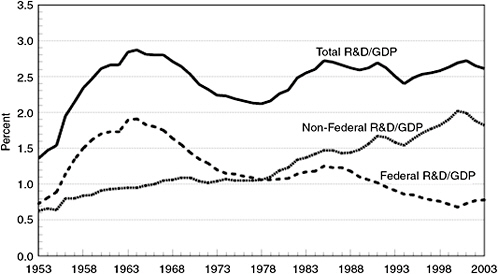
FIGURE 6-1 Research and development shares of US gross domestic product, 1953-2003.
SOURCE: NSF Division of Science Resources Statistics. “National Patterns of Research Development Resources,” annual series. Appendix Table B-9. Available at: http://www.nsf.gov/statistics/nsf05308/sectd.htm.
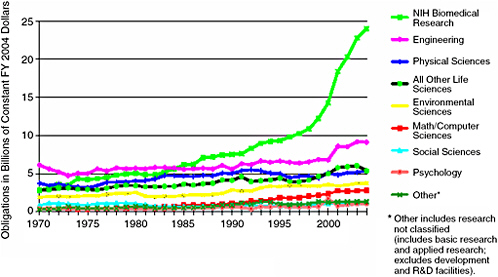
FIGURE 6-2 Trends in federal research funding by discipline, obligations in billions of constant FY 2004 dollars, FY 1970-FY 2004. Trends in federal research funding show the life sciences increasing rapidly in the late 1990s; funding for research in mathematics, computer sciences, the physical sciences, and engineering remained relatively steady.
SOURCE: American Association for the Advancement of Science. “Trends in Federal Research by Discipline, FY 1970-2004.” Available at: http://www.aaas.org/spp/rd/discip04.pdf.
fects both the number and the grant size of researcher proposals funded. In 2004, for example, only 24% of all proposals to NSF were funded, the lowest proportion in 15 years.5
Ultimately, increases in research funding must be justified by the results that can be expected rather than by the establishment of overall budget targets. But there is a great deal of evidence today that agencies do not support high-potential research because funding will not allow it. Furthermore, because of lack of funds, NSF in 2004 declined to support $2.1 billion in proposals that its independent external reviewers rated as very good or excellent.6
The DOD research picture is particularly troubling in this regard. As the US Senate Committee on Armed Services has noted, “investment in basic research has remained stagnant and is too focused on near-term demands.”7 A 2005 National Research Council panel’s assessment is similar: “In real terms the resources provided for Department of Defense basic research have declined substantially over the past decade.”8 Reductions in funding for basic research at DOD—in the “6.1 programs”—have a particularly large influence outside the department. For example, DOD funds 40% of the engineering research performed at universities, including more than half of all research in electrical and mechanical engineering, and 17% of basic research in mathematics and computer science.9
The importance of DOD basic research is illustrated by its products—in defense areas these include night vision; stealth technology; near-realtime delivery of battlefield information; navigation, communication, and weather satellites; and precision munitions. But the investments pay off for civilian applications too. The Internet, communications and weather satellites, global positioning technology, the standards that became JPEG, and even the search technologies used by Google all had origins in DOD basic research. John Deutch and William Perry point out that “the [Department of Defense] technology base program has also had a major effect on American industry. Indeed, it is the primary reason that the United States leads the world today in information technology.”10
There is also a significant federal R&D budget for homeland security. For FY 2006 the total is nearly $4.4 billion across all agencies. The Department of Homeland Security itself has a $1.5 billion R&D budget, but only a small portion—$112 million—is earmarked for basic research. The rest will be devoted to applied research ($399 million), development ($746 million), and facilities and equipment ($210 million).11
Business organizations, trade associations, military commissions, bipartisan groups of senators and representatives, and scientific and academic groups have all reiterated the critical importance of increased R&D investment across our economic, military, and intellectual landscape (Table 6-1). After reviewing the proposals provided in the table and other related materials, the committee concluded that a 10% annual increase over a 7-year period would be appropriate. This achieves the doubling that was in principle part of the NSF Authorization Act of 2002 but would expand it to other agencies, albeit over a longer period. The committee believes that this rate of growth strikes an appropriate balance between the urgency of the issue being addressed and the ability of the research community to apply new funds efficiently.
The committee is recommending special attention to the physical sciences, engineering, mathematics, and the information sciences and to DOD basic research to restore balance to the nation’s research portfolio in fields that are essential to the generation of both ideas and skilled people for the nation’s economy and national and homeland security. Most assuredly, this does not mean that there should be a disinvestment in such important fields as the life sciences or the social sciences. A balanced research portfolio in all fields of science and engineering research is critical to US prosperity.
As indicated in the National Academies report Science, Technology, and the Federal Government: National Goals for a New Era, the United States needs to be among the world leaders in all fields of research so that it can
-
Bring the best available knowledge to bear on problems related to national objectives even if that knowledge appears unexpectedly in a field not traditionally linked to that objective.
-
Quickly recognize, extend, and use important research results that occur elsewhere.
|
11 |
American Association for the Advancement of Science. R&D Funding Update March 4, 2005—Homeland Security R&D in the FY 2006 Budget. Available at: http://www.aaas.org/spp/rd/hs06.htm1. |
TABLE 6-1 Specific Recommendations for Federal Research Funding
|
Source |
Report |
Recommendation |
|
Rep. Frank Wolf (R-Virginia), chair, Subcommittee on Commerce, Justice, Science, and Related Agencies |
Letter to President George W. Bush, May 2005 |
Triple federal basic R&D over the next decade |
|
US Congress and President Bush |
NSF Authorization Act of 2002, passed by Congress; signed by the President |
Double the NSF budget over 5 years to reach $9.8 million by FY 2007 |
|
US Commission on National Security in the 21st Century (Hart–Rudman) |
Road Map for National Security: Imperative for Change, The Phase III Report, 2001 |
Double the federal R&D budget by 2010 |
|
Defense of Defense |
Quadrennial Defense Review Report, 2001 |
Allocate at least 3% of the total DOD budget for defense science and technology |
|
President’s Council of Advisors on Science and Technology (PCAST) |
Assessing the US R&D Investment, January 2003 |
Target the physical sciences and engineering to bring them “collectively to parity with the life sciences over the next 4 budget cycles” |
|
Coalition of 15 industry associations, including US Chamber of Commerce, National Association of Manufacturers, and Business Roundtable |
Tapping America’s Potential: The Education for Innovation Initiative, 2005 |
Increase R&D spending, particularly for basic research in the physical sciences and engineering, at NSF, NIST, DOD, and DOE by at least 7% annually |
|
167 Members of Congress |
Letter to Rep. Wolf, chair, Subcommittee on Commerce, Justice, Science, and Related Agencies, May 4, 2005 |
Increase NSF budget to $6.1 billion in FY 2006, 6% above the FY 2005 request |
|
68 Senators |
Letter to Sen. Pete Domenici (R-New Mexico), chair, Energy and Water Development Subcommittee |
Increase funding for DOE Office of Science by an inflation-adjusted 3.2% over FY 2005 appropriation, a 7% increase over the Bush administration’s FY 2006 request |
-
Prepare students in American colleges and universities to become leaders who can extend the frontiers of knowledge and apply new concepts.
-
Attract the brightest young students both domestically and internationally.12
ACTION B-2:
EARLY-CAREER RESEARCHERS
The federal government should establish a program to provide 200 new research grants each year at $500,000 each, payable over 5 years, to support the work of outstanding early-career researchers. The grants would be funded by federal agencies (NIH, NSF, DOD, DOE, and the National Aeronautics and Space Administration [NASA]) to underwrite new research opportunities at universities and government laboratories.
About 50,000 people hold postdoctoral appointments in the United States.13 Those early-career researchers are particularly important because they often are the forefront innovators. A report in the journal Science states
|
12 |
NAS/NAE/IOM. Science, Technology, and the Federal Government: National Goals for a New Era. Washington, DC: National Academy Press, 1993. |
|
13 |
National Science Foundation. “WebCASPAR, Integrated Science and Engineering Data System.” Available at: http://www.casper.nsf.gov. |
that postdoctoral scholars (those who had completed doctorates but who had not yet obtained long-term research positions) comprised 43% of the first authors on the research articles it published in 1999.14 However, as funding processes have become more conservative and as money becomes tighter, it has become more difficult for junior researchers to find support for new or independent research. In 2002, the median age at which investigators received a first NIH grant was 42 years, up from about 35 years in 1981.15 At NSF, the percentage of first-time applicants who received grant funding fell from 25% in 2000 to 17% in 2004.16
There is a wide divergence among fields in the use of postdoctoral researchers and in the percentages heading toward industry rather than academe. Recent trends suggest that more students are opting for postgraduate study and that the duration of postdoctoral appointments is increasing, particularly in the life sciences.17 But new researchers face challenges across a range of fields.
The problem is particularly acute in the biomedical sciences. In 1980, investigators under the age of 40 received more than half of the competitive research awards; by 2003, fewer than 17% of those awards went to researchers under 40.18 Both the percentage and the number of awards made to new investigators—regardless of age—have declined for several years; new investigators received fewer than 4% of NIH research awards in 2002.19 One conclusion is that academic biomedical researchers are spending long periods at the beginning of their careers unable to set their own research directions or establish their independence. New investigators thus have diminished freedom to risk the pursuit of independent research, and they continue instead with their postdoctoral work or with otherwise conservative research projects.20
Postdoctoral salaries are relatively low,21 although several federal programs support early-career researchers in tenure-track or equivalent posi-
tions. The NSF Faculty Early Career Development Program makes 350-400 awards annually, ranging from $400,000 to nearly $1 million over 5 years, to support career research and education.22 Corresponding DOD programs include the Office of Defense Programs’ Early Career Scientist and Engineer Award and the Navy Young Investigator Program. The Presidential Early Career Award for Scientists and Engineers (PECASE) is the highest national honor for investigators in the early stages of their careers. In 2005, there were 58 PECASE awards that each provided funding of $100,000 annually for 5 years (Table 6-2). Still, that group is a tiny fraction of the postdoctoral research population.
In making its recommendation, the committee decided to use the PECASE awards as a model for the magnitude and duration of awards. In determining the number of awards, the committee considered the number of awards in other award programs and the overall reasonableness of the extent of the program.
ACTION B-3:
ADVANCED RESEARCH INSTRUMENTATION AND FACILITIES
The federal government should establish a National Coordination Office for Advanced Research Instrumentation and Facilities to manage a fund of $500 million per year over the next 5 years—ideally through reallocation of existing funds, but if necessary via new funds—for construction and maintenance of research facilities, including the instrumentation, supplies, and other physical resources researchers need. Universities and the government’s national laboratories would compete annually for the funds.
Advanced research instrumentation and facilities (ARIF) are critical to successful research that benefits society. For example, eight Nobel prizes in physics were awarded in the last 20 years to the inventors of new instrument technology, including the electron and scanning tunneling microscopes, laser and neutron spectroscopy, particle detectors, and the integrated circuit.23 Five Nobel prizes in chemistry were awarded for successive generations of mass-spectrometry instruments and applications.
Advanced research instrumentation and facilities24 are defined as instrumentation and facilities housing closely related or interacting instruments and includes networks of sensors, databases, and cyberinfrastructure.
TABLE 6-2 Annual Number of PECASE Awards, by Agency, 2005
|
Agency |
Awards |
|
National Science Foundation |
20 |
|
National Institutes of Health |
12 |
|
Department of Energy |
9 |
|
Department of Defense |
6 |
|
Department of Commerce |
4 |
|
Department of Agriculture |
3 |
|
National Aeronautics and Space Administration |
2 |
|
Department of Veterans Affairs |
2 |
|
TOTAL |
58 |
ARIF are distinguished from other types of instrumentation by their expense and in that they are commonly acquired by large-scale centers or research programs rather than individual investigators. The acquisition of ARIF by an academic institution often requires a substantial institutional commitment and depends on high-level decision-making at both the institution and federal agencies. ARIF at academic institutions are often managed by institution administration. Furthermore, the advanced nature of ARIF often requires expert technical staff for its operation and maintenance.
A recent National Academies committee25 found that there is a critical gap in federal programs for ARIF. Although federal research agencies research do have instrumentation programs, few allow proposals for instrumentation when the capital cost is greater than $2 million. No federal research agency has an agencywide ARIF program.
In addition, the ARIF committee found that instrumentation programs are inadequately supported. Few provide funds for continuing technical support and maintenance. The programs tend to support instrumentation for specific research fields and rarely consider broader scientific needs. The shortfalls in funding for instrumentation have built up cumulatively and are met by temporary programs that address short-term issues but rarely long-term problems. The instrumentation programs are poorly integrated across (or even within) agencies. The ad hoc ARIF programs are neither well organized nor visible to most investigators, and they do not adequately match the research community’s increasing need for ARIF.
When budgets for basic research are stagnant, it is particularly difficult to maintain crucial investments in instrumentation, and facilities. The Na-
tional Science Board (NSB) reports that over the last decade funding for the US academic research instrumentation and facilities has not kept pace with funding in the rest of the world.26 Nations that are relative newcomers to science and technology research—South Korea, China, and some European nations, for example—are investing heavily in instrumentation and facilities that serve as a major attraction to scientists from throughout the world. NSB recommends increasing the share of the NSF budget devoted to such tools from the current 22 to 27%.
NSB also cites reports by other organizations that point to major deficiencies in federal research infrastructure including instrumentation and facilities.27 These organizations include:
-
The National Science and Technology Council, which in 1995 stated that $8.7 billion would be needed just to rectify then-current infrastructure deficits.28
-
NSF, which estimated in 1998 that it would cost $11.4 billion to construct, repair, or renovate US academic research facilities.29
-
NIH, which in 2001 estimated health research infrastructure needs at $5.6 billion.30
-
NASA, which reported a $900 million construction backlog in 2001 and said that $2 billion more would be needed to revitalize and modernize the aerospace research infrastructure.31
-
The DOE Office of Science, which reported that in 2001 more than 60% of its laboratory space was more than 30 years old and identified more than $2 billion in capital investments it needed for the next decade.32
-
NSF directorates, which, when surveyed in FY 2001, estimated additional infrastructure needs of $18 billion through 2010.33
-
A blue ribbon panel convened by NSF, which estimated that $850 million more per year is needed for cyber infrastructure.34
One contributor to infrastructure deficits has been the imposition by the federal government in 1991 of a 26% cap on reimbursement to universities for “administrative costs,” including funding for construction, maintenance, and operation of research facilities. Universities have in most cases been unable to increase their spending on infrastructure and have had to shift funds from other nongovernment sources to cover their investments in this area.35
NSB concludes that researchers are less productive than they could be and somewhat more likely to take positions abroad where resources are increasingly available. It is also important to note that the federal government alone has the ability to fund this type of research infrastructure. Industry has little incentive to do so, and state governments and universities do not have the resources. If the federal government fails to maintain the national research infrastructure, this infrastructure will continue to decay.
The committee used the 2001 estimates to determine the advanced research instrumentation and facilities needs of the nation. The recommendation would fund only a portion of that built-up demand, but the committee believes the proposed amount would be sufficient to at least keep the research enterprise moving forward.
The National Academies committee that developed the report on ARIF recommended that the White House Office of Science and Technology Policy (OSTP) enhance federal research agency coordination and cooperation with respect to ARIF. Federal agencies could work together to develop joint solicitations, invite researchers from diverse disciplines to present opportunities for ARIF that would be useful to many fields to multiple agencies, simultaneously, seek out and identify best practices, and discuss the appropriate balance of funding among people, tools, and ideas, which could become part of the regular White House Office of Management and Budget-OSTP budget memorandum.
Therefore, in terms of the management of this fund, this committee believes that the best model is that of a national coordination office such as the National Coordination Office for Networking and Information Technology Research and Development (NCO/NITRD).36 The National Coor-
dination Office director reports to the director of the OSTP through the assistant director for technology. Twelve agencies participate, with each agency retaining its own funds, but, through the National Coordination Office, agencies are able to work together on technical and budget planning.
The other example using the National Coordination Office is the National Nanotechnology Initiative (NNI),37 which coordinates the multi-agency efforts in nanoscale science, engineering, and technology and is managed similarly. Twenty-three federal agencies participate in the National Nanotechnology Initiative, 11 of which have an R&D budget for nanotechnology. Other federal organizations contribute with studies, applications of results, and other collaborations. A third comparable program is the global climate change program. Again, the funding remains within each agency but supports a coordinated research effort.
Federal managers will probably be in the best position to determine the management of the proposed National Coordination Office for research infrastructure, but one model might be a design analogous to the management of the major research instrumentation (MRI) program of NSF. In that program, all proposals for instrumentation are submitted to a central source—the Office of Integrative Activities (OIA). This office then distributes the proposals throughout NSF for review. Proposal evaluations are then collected and prioritized, and funding decisions are made. The funding remains in the different divisions of NSF, but funds are also pooled to support the instrument based on the relationship to that office’s mission. A similar mechanism could be used at the interagency level with the National Coordination Office acting in a similar fashion to NSF’s Office of Integrative Activities.
ACTION B-4:
HIGH-RISK RESEARCH
At least 8% of the budgets of federal research agencies should be set aside for discretionary funding managed by technical program managers in those agencies to catalyze high-risk, high-payoff research.
An important subset of basic research is the high-risk or transformative research that involves the new theories, methods, or tools that are often developed by new investigators—the group demonstrably most likely to generate radical discoveries or new technologies. These opportunities are generally first identified at the working level, not by research planning staffs. Today, there is anecdotal evidence that several barriers have reduced the national capacity for high-risk, high-payoff work:
|
37 |
See http://www.nano.gov. |
-
Flat or declining funding in many disciplines makes it harder to justify risky or unorthodox projects.
-
The peer review system tends to favor established investigators who use well-known methods.
-
Industry, university, and federal laboratories are under pressure to produce short-term results—especially DOD, which once was the nation’s largest source of basic-research funding.
-
Increased public scrutiny of government R&D spending makes it harder to justify non-peer-reviewed awards, and peer reviewers tend to place confidence in older, established researchers.
-
High-risk, high-potential projects are prone to failure, and government oversight and media and public scrutiny make those projects increasingly untenable to those responsible for the work.
A National Research Council study indicates that the Department of Defense’s budgets for basic research have declined and that “there has been a trend within DOD for reduced attention to unfettered exploration in its basic research program.”38 The Defense Advanced Research Projects Agency (DARPA) was created in part because of this consideration (see Box 6-2).39
Defense Advanced Research Projects Agency managers, unlike program managers at NSF or NIH, for example, were encouraged to fund promising work for long periods in highly flexible programs—in other words, to take risks.40 The National Institutes of Health and National Science Foundation recently acknowledged that their peer review systems today tend to screen out risky projects, and both organizations are working to reverse this trend.
In 2004, the National Institutes of Health awarded its first Director’s Pioneer Award to foster high-risk research by investigators in the early to middle stages of their careers. Similarly, in 1990 the National Science Foundation started a program called Small Grants for Exploratory Research (SGER), which allows program officers to make grants without formal external review. Small Grants Exploratory Research awards are for “preliminary work on untested and novel ideas; ventures into emerging research; and potentially transformative ideas.”41 At $29.5 million, however, the total SGER budget for 2004 was just 0.5% of NSF’s operating budget for
|
BOX 6-2 DARPA The Defense Advanced Research Projects Agency (DARPA) was established with a budget of $500 million in 1958 following the launch of Sputnik to turn innovative technology into military capabilities. The agency is highly regarded for its work on the Internet, high-speed microelectronics, stealth and satellite technologies, unmanned vehicles, and new materials.a DARPA’s FY 2005 budget is $3.1 billion. In terms of personnel, it is a small, relatively nonhierarchical organization that uses highly flexible contracting and hiring practices that are atypical of the federal government as a whole. Its workforce of 220 includes 120 technical staffers, and it can hire quickly from the academic world and industry at wages that are substantially higher than those elsewhere in the government. Researchers, as intended, typically stay with DARPA only for a few years. Lawrence Dubois says that DARPA puts the following questions to its principal investigators, individual project leaders, and program managers:b
Dubois quotes a former DARPA program manager who describes the agency this way:c Program management at DARPA is a very proactive activity. It can be likened to playing a game of multidimensional chess. As a chess player, one always knows what the goal is, but there are many ways to reach checkmate. Like a program manager, a chess player starts out with many different pieces (independent research groups) in different geographic locations (squares on the board) and with different useful capabilities (fundamental and applied research or experiment and theory, for example). One uses this team to mount a coordinated attack (in one case to solve key technical problems and for another to defeat one’s opponent). One of the challenges in both cases is that the target is continually moving. The DARPA program manager has to deal |
|
with both emerging technologies and constantly changing customer demand, whereas the chess player has to contend with his or her opponent’s king and surrounding players always moving. Thus, both face changing obstacles and opportunities. The proactive player typically wins the chess game, and it is the proactive program manager who is usually most successful at DARPA.
|
research and education. In 2004, the National Science Board convened a Task Force on Transformative Research to consider how to adapt NSF processes to encourage more funding of high-risk, potentially high-payoff research.
Several accounts indicate that although program managers might have the authority to fund at least some high-risk research, they often lack incentives do so. Partly for this reason, the percentage of effort represented by such pursuits is often quite small—1 to 3% being common. The committee believes that additional discretionary funding will enhance the transformational nature of research without requiring additional funding. Some committee members thought 5% was sufficient, others 10%. Thus, 8% seemed a reasonable compromise and is reflected in the committee’s recommended action. The degree to which such a program will be successful depends heavily on the quality and coverage of the program staff.
ACTION B-5:
USE DARPA AS A MODEL FOR ENERGY RESEARCH
The federal government should create a DARPA-like organization within the Department of Energy called the Advanced Research Projects Agency-Energy (ARPA-E) that reports to the under secretary for science and is charged with sponsoring specific R&D programs to meet the nation’s long-term energy challenges.42
|
42 |
One committee member, Lee Raymond, shares the alternative point of view on this recommendation as summarized in Box 6-3. |
|
BOX 6-3 Another Point of View: ARPA-E Energy issues are potentially some of the most profound challenges to our future prosperity and security, and science and technology will be critical in addressing them. But not everyone believes that a federal program like the proposed ARPA-E would be an effective mechanism for developing bold new energy technologies. This box summarizes some of the views the committee heard about ARPA-E from those who disagree with its utility. Some believe that such applied energy research is already well funded by the private sector—by large energy companies and, increasingly, by venture capital firms—and that the federal government should fund only basic research. They argue that there is no shortage of long-term research funding in energy, including that sponsored by the federal government. DOE is the largest individual government supporter of basic research in the physical sciences, providing more than 40% of associated federal funding. DOE provides funding and support to researchers in academe, other government agencies, nonprofit institutions, and industry. The government spends substantial sums annually on research, including $2.8 billion on basic research and on numerous technologies. Given the major investment DOE is already making in energy research, it is argued that if additional federal research is desired in a particular field of energy, it should be accomplished by reallocating and optimizing the use of funds currently being invested. It is therefore argued that no additional federal involvement in energy research is necessary, and given the concerns about the apparent shortage in scientific and technical talent, any short-term increase in federally directed research might crowd out more productive private-sector research. Furthermore, some believe that industry and venture capital investors will already fund the things that have a reasonable probability of commercial utility (the invisible hand of the free markets at work), and what is not funded by existing sources is not worthy of funding. Another concern is that an entity like ARPA-E would amount to the government’s attempt to pick winning technologies instead of letting markets decide. Many find that the government has a poor record in that arena. Government, some believe, should focus on basic research rather than on developing commercial technology. Others are more supportive of DOE research as it exists and are concerned that funding ARPA-E will take money away from traditional science programs funded by DOE’s Office of Science in high-energy physics, fusion energy research, material sciences, and so forth that are of high quality and despite receiving limited funds produce Nobel-prize-quality fundamental research and commercial spinoffs. Some believe that DOE’s model is more productive than DARPA’s in terms of research quality per federal dollar invested. |
Perhaps no experiment in the conduct of research and engineering has been more successful in recent decades than the Defense Advanced Research Projects Agency model. The new agency proposed herein is patterned after that model and would sponsor creative, out-of-the-box, transformational, generic energy research in those areas where industry by itself cannot or will not undertake such sponsorship, where risks and potential payoffs are high, and where success could provide dramatic benefits for the nation. ARPA-E would accelerate the process by which research is transformed to address economic, environmental, and security issues. It would be designed as a lean, effective, and agile—but largely independent—organization that can start and stop targeted programs based on performance and ultimate relevance. ARPA-E would focus on specific energy issues, but its work (like that of DARPA or NIH) would have significant spinoff benefits to national, state, and local government; to industry; and for the education of the next generation of researchers. The nature of energy research makes it particularly relevant to producing many spinoff benefits to the broad fields of engineering, the physical sciences, and mathematics, fields identified in this review as warranting special attention. Existing programs with similar goals should be examined to ensure that the nation is optimizing its investments in this area. Funding for ARPA-E would begin at $300 million for the initial year and increase to $1 billion over 5 years, at which point the program’s effectiveness would be reevaluated. The committee picked this level of funding the basis of its review of the budget history of other new research activities and the importance of the task at hand.
The United States faces a variety of energy challenges that affect our economy, our security, and our environment (see Box 6-4). Fundamentally, those challenges involve science and technology. Today, scientists and engineers are already working on ideas that could make solar and wind power economical; develop more efficient fuel cells; exploit energy from tar sands, oil shale, and gas hydrates; minimize the environmental consequences of fossil-fuel use; find safe, affordable ways to dispose of nuclear waste; devise workable methods to generate power from fusion; improve our aging energy-distribution infrastructure; and devise safe methods for hydrogen storage.43
ARPA-E would provide an opportunity for creative “out-of-the box” transformational research that could lead to new ways of fueling the nation and its economy, as opposed to incremental research on ideas that have already been developed. One expert explains, “The supply [of fossil-fuel sources] is adequate now and this gives us time to develop alternatives, but
|
BOX 6-4 Energy and the Economy Capital, labor, and energy are three major factors that contribute to and influence economic growth in the United States. Capital is the equipment, machinery, manufacturing plants, and office buildings that are necessary to produce goods and services. Labor is the availability of the workforce to participate in the production of goods and services. Energy is the power necessary to produce goods and services and transport them to their destinations. These three components are used to compute a country’s gross domestic product (GDP), the total of all output produced in the country. Without these three inputs, business and industry would not be able to transform raw materials into goods and services. Energy is the power that drives the world’s economy. In the industrialized nations, most of the equipment, machinery, manufacturing plants, and office buildings could not operate without an available supply of energy resources such as oil, natural gas, coal, or electricity. In fact, energy is such an important component of manufacturing and production that its availability can have a direct impact on GDP and the overall economic health of the United States. Sometimes energy is not readily available because the supply of a particular resource is limited or because its price is too high. When this happens, companies often decrease their production of goods and services, at least temporarily. On the other hand, an increase in the availability of energy—or lower energy prices—can lead to increased economic output by business and industry. Situations that cause energy prices to rise or fall rapidly and unexpectedly, as the world’s oil prices have on several occasions in recent years, can have a significant impact on the economy. When these situations occur, the economy experiences what economists call a “price shock.” Since 1970, the economy has experienced at least four such price shocks attributable to the supply of energy. Thus, the events of the last several decades demonstrate that the price and availability of a single important energy resource—such as oil—can significantly affect the world economy. SOURCE: Adapted from Dallas Federal Reserve Bank at www.dallasfed.org/educate/everyday/ev2.html. |
the scale of research in physics, chemistry, biology and engineering will need to be stepped up, because it will take sustained effort to solve the problem of long-term global energy security.”44
Although there are those who believe an organization like ARPA-E is not needed (Box 6-3), the committee concludes that it would play an important role in resolving the nation’s energy challenges; in advancing research in engineering, the physical sciences, and mathematics; and in developing the next generation of researchers. A recent report of the Secretary of Energy Advisory Board’s Task Force on the Future of Science Programs at the Department of Energy notes, “America can meet its energy needs only if we make a strong and sustained investment in research in physical science, engineering, and applicable areas of life science, and if we translate advancing scientific knowledge into practice. The current mix of energy sources is not sustainable in the long run.”45 Solutions will require coordinated efforts among industrial, academic, and government laboratories. Although industry owns most of the energy infrastructure and is actively developing new technologies in many fields, national economic and security concerns dictate that the government stimulate research to meet national needs (Box 6-4). These needs include neutralizing the provision of energy as a major driver of national security concerns. ARPA-E would invest in a broad portfolio of foundational research that is needed to invent transforming technologies that in the past were often supplied by our great industrial laboratories (see Box 6-5). Funding of research underpinning the provision of new energy sources is made particularly complex by the high-cost, high-risk, and long-term character of such work—all of which make it less suited to university or industry funding.
Among its many missions, DOE promotes the energy security of the United States, but some of the department’s largest national laboratories were established in wartime and given clearly defense-oriented missions, primarily to develop nuclear weapons. Those weapons laboratories, and some of the government’s other large science laboratories, represent significant national investments in personnel, shared facilities, and knowledge. At the end of the Cold War, the nation’s defense needs shifted and urgent new agendas became clear—development of clean sources of energy, new forms of transportation, the provision of homeland security, technology to speed environmental remediation, and technology for commercial application. Numerous proposals over recent years have laid the foundation for more extensive redeployment of national laboratory talent toward basic and applied research in areas of national priority.46
|
BOX 6-5 The Invention of the Transistor In the 1930s, the management of Bell Laboratories sought to develop a low-power, reliable, solid-state replacement for the vacuum tube used in telephone signal amplification and switching. Materials scientists had to invent methods to make highly pure germanium and silicon and to add controlled impurities with unprecedented precision. Theoretical and experimental physicists had to develop a fundamental understanding of the conduction properties of this new material and the physics of the interfaces and surfaces of different semiconductors. By investing in a large-scale assault on this problem, Bell announced the “invention” of the transistor in 1948, less than a decade after the discovery that a junction of positively and negatively doped silicon would allow electric current to flow in only one direction. Fundamental understanding was recognized to be essential, but the goal of producing an economically successful electronic-state switch was kept front-and-center. Despite this focused approach, fundamental science did not suffer: a Nobel Prize was awarded for the invention of the transistor. During this and the following effort, the foundations of much of semiconductor-device physics of the 20th century were laid. |
Introducing a small, agile, DARPA-like organization could improve DOE’s pursuit of R&D much as DARPA did for the Department of Defense. Initially, DARPA was viewed as “threatening” by much of the department’s established research organization; however, over the years it has been widely accepted as successfully filling a very important role. ARPA-E would identify and support the science and technology critical to our nation’s energy infrastructure. It also could offer several important national benefits:
-
Promote research in the physical sciences, engineering, and mathematics.
-
Create a stream of human capital to bring innovative approaches to areas of national strategic importance.
-
Turn cutting-edge science and engineering into technology for energy and environmental applications.
-
Accelerate innovation in both traditional and alternative energy sources and in energy-efficiency mechanisms.
-
Foster consortia of companies, colleges and universities, and laboratories to work on critical research problems, such as the development of fuel cells.
The agency’s basic administrative structure and goals would mirror those of DARPA, but there would be some important differences. DARPA exists mainly to provide a long-term “break-through” perspective for the armed forces. DOE already has some mechanisms for long-term research, but it sometimes lacks the mechanisms for transforming the results into technology that meets the government’s needs. DARPA also helps develop technology for purchase by the government for military use. By contrast, most energy technology is acquired and deployed in the private sector, although DOE does have specific procurement needs. Like DARPA, ARPA-E would have a very small staff, would perform no R&D itself, would turn over its staff every 3 to 4 years, and would have the same personnel and contracting freedoms now granted to DARPA. Box 6-6 illustrates some energy technologies identified by the National Commission on Energy Policy as areas of research where federal research investment is warranted that is in research areas in which industry is unlikely to invest.
ACTION B-6:
PRIZES AND AWARDS
The White House Office of Science and Technology Policy (OSTP) should institute a Presidential Innovation Award to stimulate scientific and engineering advances in the national interest. While existing Presidential awards address lifetime achievements or promising young scholars, the proposed awards would identify and recognize individuals who develop unique scientific and engineering innovations in the national interest at the time they occur.
A number of organizations currently offer prizes and awards to stimulate research, but an expanded system of recognition could push new scientific and engineering advances that are in the national interest. The current presidential honors for scientists and engineers are the National Medal of Science,47 the National Medal of Technology, and the Presidential Early Career Awards for Scientists and Engineers. The National Medal of Science and the National Medal of Technology recognize career-long achievement.
The Presidential Early Career Awards for Scientists and Engineers pro-
|
BOX 6-6 Illustration of Energy Technologies The National Commission on Energy Policy in its December 2004 report, Ending the Energy Stalemate: A Bipartisan Strategy to Meet America’s Energy Challenges, recommended doubling the nation’s annual direct federal expenditures on “energy research, development, and demonstration” (ERD&D) to identify better technologies for energy supply and efficient end use. Improved technologies, the commission indicates, will make it easier to
The commission identified what it believes to be the most promising technological options where private sector research activities alone are not likely to bring them to that potential at the pace that society’s interests warrant. They fall into the following principal clusters:
SOURCE: Chapter VI, Developing Better Energy Technologies for the Future. In National Commission on Energy Policy. 2004. Ending the Energy Stalemate: A Bipartisan Strategy to Meet America’s Energy Challenges. Available at: http://www.energycommission.org. |
gram, managed by the National Science and Technology Council, honors and supports the extraordinary achievements of young professionals for their independent research contributions.48 The White House, following recommendations from participating agencies, confers the awards annually.
New awards could encourage risk taking; offer the potential for financial or non-remunerative payoffs, such as wider recognition for important work; and inspire and educate the public about current issues of national interest. The National Academy of Engineering has concluded that prizes encourage nontraditional participants, stimulate development of potentially useful but under funded technology, encourage new uses for existing technology, and foster the diffusion of technology.49
For those reasons, the committee proposes that the new Presidential Innovation Award be managed in a way similar to that of the Presidential Early Career Awards for Scientists and Engineers. OSTP already identifies the nation’s science and technology priorities each year as part of the budget memorandum it develops jointly with the Office of Management and Budget. This year’s topics are a good starting point for fields in which innovation awards (perhaps one award for each research topic) could be given:
-
Homeland security R&D.
-
High-end computing and networking R&D.
-
National nanotechnology initiative.
-
High-temperature and organic superconductors.
-
Molecular electronics.
-
Wide-band-gap and photonic materials.
-
Thin magnetic films.
-
Quantum condensates.
-
Infrastructure (next-generation light sources and instruments with subnanometer resolution).
-
Understanding complex biological systems (focused on collaborations with physical, computational, behavioral, social, and biological researchers and engineers).
-
Energy and the environment (natural hazard assessment, disaster warnings, climate variability and change, oceans, global freshwater supplies, novel materials, and production mechanisms for hydrogen fuel).
The proposed awards would be presented, shortly after the innovations occur, to scientists and engineers in industry, academe, and government who develop unique ideas in the national interest. They would illustrate the linkage between science and engineering and national needs and provide an example to students of the contributions they could make to society by entering the science and engineering profession.
Conclusion
Research sows the seeds of innovation. The influence of federally funded research in social advancement—in the creation of new industries and in the enhancement of old ones—is clearly established. But federal funding for research is out of balance: Strong support is concentrated in a few fields while other areas of equivalent potential languish. Instead, the United States needs to be among the world leaders in all important fields of science and engineering. But, new investigators find it increasingly difficult to secure funding to pursue innovative lines of research. An emphasis on short-term goals diverts attention from high-risk ideas with great potential that may take more time to realize. And the infrastructure essential for discovery and for the creation of new technologies is deteriorating because of failure to provide the funds needed to maintain and upgrade it.


