
Science and Technology Issues in National and Homeland Security
SUMMARY
Keeping a technological edge over adversaries of the United States has long been a key component of our national security strategy. US preeminence in science and technology (S&T) is considered essential to achieving that goal, so throughout the Cold War the United States generously funded research and development, including basic research, that could contribute to national security. Since 1950, “defense” funding has been the largest component of the overall federal R&D budget, and it has been a majority of that funding since fiscal year (FY) 1981 (see Figure NHS-1). That investment has provided substantial spinoffs to the private sector, adding to the knowledge base and innovation that have fueled US productivity and prosperity.
In the wake of the September 11 attacks and the anthrax mailings, the nation has looked to S&T to help meet the new challenges of homeland security. Meanwhile, the US military is in the midst of a “transformation” that depends on taking advantage of new and emerging technologies to respond to the diffuse and uncertain threats that characterize the 21st century.
The current pursuit of national and homeland security is taking place in a profoundly different environment, however. The end of the Cold War and
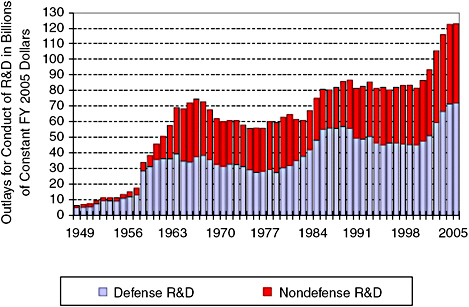
FIGURE NHS-1 Federal spending in defense and nondefense R&D, 1949-2005.
SOURCE: American Association for the Advancement of Science. Chart: Federal Spending on Defense and Nondefense R&D. Washington, DC: AAAS, February 2005. Available at: http://www.aaas.org/spp/rd/histde06.pdf.
the increasing commercialization and globalization of the traditional sources of S&T innovation for security have produced significant challenges for US national and homeland security policies. Many proposals to ensure continuing US S&T leadership see defense funding as essential to supporting this goal, requiring policies that would be able to serve both economic and national and homeland security objectives.
Federal actions that have been proposed include the following:
-
Raise the level of S&T spending to 3% of Department of Defense (DOD) spending and restore DOD’s historical commitment to basic research by directing 20% of its S&T budget to long-term research.
-
Increase the budget for mathematics, the physical sciences, and engineering research by 12% a year for the next 7 years within the research accounts of the Department of Energy (DOE), the National Science Foundation (NSF), the National Institute of Standards and Technology (NIST), and the DOD.
-
Within the DOD, set the balance of support for 6.1 basic research more in favor of unfettered exploration than of research related to short-term needs.
-
-
For homeland security R&D:
-
Commit to increase the portion of support that the Department of Homeland Security (DHS) devotes to basic research, perhaps by setting targets to be achieved within 5-10 years as the most immediate needs are satisfied.
-
Undertake a comprehensive review to identify opportunities across the entire federal homeland security R&D budget to support increased investments in basic and applied research.
-
On the applied R&D side, search for technologies that can reduce costs or provide ancillary benefits to civil society to ensure a sustainable effort against terrorist threats.
-
-
Conduct a review of the current military and dual-use export-control systems to identify policies that narrowly target exports of concern without needlessly burdening peaceful commerce; strengthen the multilateral cooperation essential to any effective export-control regime; streamline export classification, licensing, and reporting processes; and afford the President the authority and flexibility needed to advance US interests.
-
Establish a new framework for coordinating multilateral export controls based on harmonized export-control policies and enhanced defense cooperation with close allies and friends.
-
Assess whether the current system of the national laboratories that carry out defense-related research has the structure, personnel, and resources to provide the cutting-edge work and innovation to support national and homeland security R&D needs.
-
Create a new National Defense Education Act (NDEA) for the 21st century. The new NDEA would include portable graduate fellowships, institutional traineeships, incentives to create professional science and engineering (S&E) master’s programs, undergraduate loan forgiveness, grants to support new and innovative undergraduate curricula, grants to expand K–12 education outreach, summer training and research opportunities for K–12 teachers, employer S&E and foreign-language educational tax breaks, national laboratory and federal service professional incentives, and additional funds for program evaluation.
THE NATIONAL AND HOMELAND SECURITY R&D PORTFOLIO
With the end of the Cold War, US defense investment, already declining in the wake of the Reagan Administration’s massive buildup, entered the longest period of sustained decline since the end of World War II, with deep cuts in funding for weapons procurement and R&D. September 11 and the wars in Afghanistan and Iraq have more than restored overall funding levels, but serious concerns remain about the size and even more the mix of the R&D portfolio. In recent years, more and more emphasis has gone to devel-
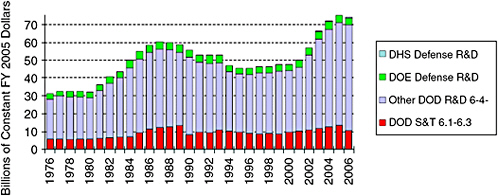
FIGURE NHS-2 Trends in defense R&D, FY 1976-FY 2006.
SOURCE: American Association for the Advancement of Science. Chart: Trends in Defense R&D: FY 1976-2006. Washington, DC: American Association for the Advancement of Science, February 2005. Available at: http://www.aaas.org/spp/rd/trdef06c.pdf.
opment as opposed to research (see Figure NHS-2). The portion of the DOD R&D budget devoted to basic research (the “6.1” account) has declined in constant dollars from 3.3% in FY 1994 to an estimated 1.9% in FY 2005 (see Figure NHS-3).1 In addition, within that account there has been increasing emphasis on research that appears more likely to yield short-term payoffs rather than the more open exploration that has been so important to past advances. The President’s budget request for FY 2006 called for a 13% cut in the 6.1 account, which by July 2005 the House of Representatives had partially restored to a 4% decrease. The House also called for a 4.2% gain in applied research (the “6.2” account) rather than the 15% reduction called for by the President’s budget request, although the gain would come largely in the form of earmarks.2
Beyond meeting the immediate perceived R&D needs of the US military, broad service policy documents, such as Joint Vision 2010 and 2020, look toward substantial expansions in the breadth and depth of S&T to support US strategy.3 The transformation goals set forth in DOD’s 2001
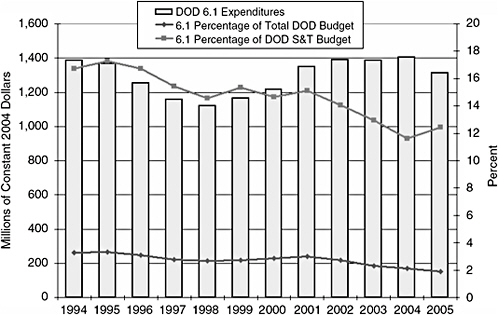
FIGURE NHS-3 Department of Defense (DOD) 6.1 expenditures, 1994-2005, in millions of constant 2004 dollars.
SOURCE: National Science Board. Science and Engineering Indicators 2004. NSB 04-01. Arlington, VA: National Science Foundation, 2004.
Quadrennial Defense Review (QDR) also depend on continuing to exploit the enhanced capabilities that can emerge from advances in S&T; the report called for significantly increasing S&T spending within the DOD budget.4
Achieving these goals will require a return to the traditional strong support for basic and applied research, in particular in the physical sciences and engineering. These goals also will demand initiatives in new and emerging areas of S&T, such as those called for by the QDR and a recent Defense Science Board study.5 In addition, these changes are considered essential to sustaining the role that defense research has played in improving the broader health of the US S&T enterprise.
Among the actions that have been proposed for the federal government are these:
-
Raise the level of S&T spending to 3% of DOD spending6 and restore DOD’s historical commitment to basic research by directing 20% of its S&T budget to long-term research.7
-
Increase the budget for mathematics, the physical sciences, and engineering research by 12% a year for the next 7 years within the research accounts of DOE, NSF, NIST, DOD.
-
Within DOD, set the balance of support for 6.1 basic research more in favor of unfettered exploration than of research related to short-term needs.
Funding for R&D for homeland security is a much more recent enterprise. The majority of US homeland security R&D funding actually occurs outside DHS (see Table NHS-1).8 After annual increases of more than $200 million in each of its first 3 years, the FY 2006 budget request for DHS R&D slowed to a 3.6% increase, or $44 million, for a total of $1.3 billion. To date, both the House and the Senate have essentially retained the requested levels, but each has made changes in how the funds would be allocated. Efforts to consolidate all DHS R&D programs into the department’s Directorate for S&T are scheduled to be completed in FY 2006.9
Basic research is at present a relatively small portion of the federal homeland security R&D portfolio. The priority is instead on efforts to use S&T to develop and field new methods and measures to increase security as quickly as possible.10 The primary exception is the biodefense program, in particular the very large National Institutes of Health research program.
The question of the balance across the homeland security R&D portfolio is an open issue. If more funding for basic research is a goal, options for the federal government include the following:
-
Commit to increase the portion of support that DHS devotes to basic research, perhaps by setting targets to be achieved within 5-10 years as the most immediate needs are satisfied.
-
Undertake a comprehensive review to identify opportunities across
|
6 |
Ibid., p. 41. |
|
7 |
Council on Competitiveness. Innovate America. Washington, DC: Council on Competitiveness, 2004. |
|
8 |
American Association for the Advancement of Science. “Table 4: Federal Homeland Security-Related R&D by Agency.” March 2005. |
|
9 |
American Association for the Advancement of Science. “R&D Funding Update on R&D in the FY 2006 DHS Budget.” 2005. |
|
10 |
For a comprehensive examination of the potential contributions of science and technology, see National Research Council. Making the Nation Safer: The Role of Science and Technology in Countering Terrorism. Washington, DC: The National Academies Press, 2002. Guides to the additional reports and current projects of the National Academies related to homeland security may be found at http://www.nationalacademies.org/subjectindex/sec.html. |
TABLE NHS-1 US Homeland Security R&D Funding, by Agency, FY 2002 to FY 2006
|
|
FY 2002 Actual |
FY 2003 Actual |
FY 2004 Actual |
FY 2005 Estimate |
FY 2006 Budget |
Change Amount |
FY 05-06 % |
|
Agriculture |
175 |
155 |
40 |
161 |
172 |
11 |
6.8% |
|
Commerce |
20 |
16 |
23 |
73 |
82 |
9 |
11.9% |
|
Department of Defense |
259 |
212 |
267 |
362 |
394 |
32 |
8.7% |
|
Department of Energy |
50 |
48 |
47 |
92 |
81 |
–12 |
–12.5% |
|
Department of Homeland Security |
266 |
737 |
1,028 |
1,243 |
1,287 |
44 |
3.6% |
|
Environmental Protection Agency |
95 |
70 |
52 |
33 |
94 |
61 |
185.1% |
|
Health and Human Services |
177 |
1,653 |
1,724 |
1,796 |
1,802 |
6 |
0.4% |
|
- National Institutes of Health |
162 |
1,633 |
1,703 |
1,774 |
1,781 |
6 |
0.4% |
|
National Aeronautics and Space Adm. |
73 |
73 |
88 |
88 |
92 |
4 |
4.5% |
|
National Science Foundation |
229 |
271 |
321 |
326 |
329 |
3 |
1.0% |
|
Transportation |
106 |
7 |
3 |
0 |
0 |
0 |
— |
|
All Other |
48 |
47 |
32 |
42 |
92 |
50 |
118.8% |
|
Total Homeland Security R&D |
1,499 |
3,290 |
3,626 |
4,216 |
4,425 |
208 |
4.9% |
|
(Total Homeland Security Spending) |
32,881 |
42,447 |
40,834 |
46,015 |
49,943 |
3,928 |
8.5% |
|
NOTE: American Association for the Advancement of Science, based on Office of Management and Budget (OMB) data from OMB’s 2003 Report to Congress on Combating Terrorism and Budget of the US Government FY 2006. Figures adjusted from OMB data by AAAS to include conduct of R&D and R&D facilities, and revised estimates of DHS R&D. Figures do not include non-R&D homeland security activities, nor do they include DOD R&D investments in overseas combating terrorism. Funding for all years includes regular appropriations and emergency supplemental appropriations. SOURCE: American Association for the Advancement of Science. Guide to R&D Funding Data: Historical Data. Washington, DC: American Association for the Advancement of Science, 2005. Available at: http://www.aaas.org/spp/rd/guihist.htm. |
|||||||
-
the entire federal homeland security R&D budget to support increased investments in basic and applied research.
-
On the applied R&D side, search for technologies that can reduce costs or provide ancillary benefits to civil society to ensure a sustainable effort against terrorist threats.
NEW SOURCES OF INNOVATION FOR SECURITY: THE TECHNOLOGY TRANSFER DILEMMA
Traditionally, US government programs were the primary driver for research into new defense-related technologies. DOD relied on a dedicated domestic industrial base, supported largely by the results of generous DOD-funded R&D in the commercial sector and universities.
That Cold War model no longer exists because of the deep cuts in US defense research investment already discussed and the dramatic increases in private-sector R&D investment, particularly in the high-technology areas such as information and communications technologies essential to transformation. The US government has attempted to come to terms with this new situation through a variety of initiatives to enable it to take advantage of innovation from the commercial sector that could “spin on” to enhance military capabilities.
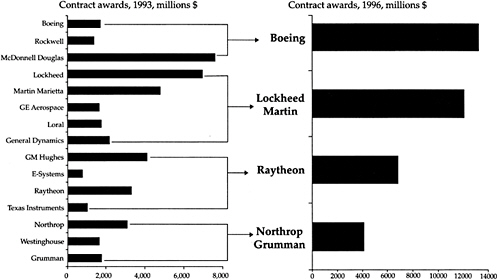
The dramatic consolidation and increasing globalization of many sectors of the traditional defense industrial base also have encouraged US efforts to find ways to enhance technology cooperation with close friends and allies. In the decade following the end of the Cold War, the 15 major US defense contractors shrank to four huge firms (see Figure NHS-4).11 Many US defense firms have embraced a global business model, and non-US firms, primarily from Europe, have gained access to the US defense market on their own or in cooperation with US companies.12
These fundamental changes in the sources and structures of innovation for national security have also made it easier for US adversaries to gain access to knowledge and technology that could improve their capabilities.13 Policies to draw on innovation from firms in the commercial sector with global mar-
kets and international workforces or to enhance international technology cooperation potentially clash with longstanding US efforts to control the leakage of technology. September 11 and increasing concerns for terrorism—especially using nuclear, chemical, or biologic agents—have exacerbated thesetensions. Faced with adversaries who are far less technologically sophisticated or who are relying on technology to make rapid advances in their capabilities—and for whom a much broader range of US technologies is thus potentially relevant than for a technologically advanced opponent like the Soviet Union—there is a natural inclination to broaden the scope of US control efforts to cover as much as possible that could be of use.
There is increasing concern that current policy initiatives serve neither technology transfer and cooperation on the one hand nor proliferation prevention on the other.14 In part, this is because technology-transfer policy is being pursued largely through a policy apparatus constructed during the Cold War that critics from many quarters charge has never genuinely adjusted to the new threats facing the United States. According to critics, continued reliance on this apparatus—in particular, the current export-control regime for military and so-called dual-use goods and technologies—might do relatively little to prevent others from gaining access to US products and know-how while damaging the capacity of the United States to draw on innovation in the commercial sector for both economic and national- and homeland-security objectives.
While critics generally share profound dissatisfaction with the current system, there is little consensus within or among the federal government, Congress, and the affected communities about remedies for the situation. These disputes are not new, but they take on particular force now because of the depth and extent of the disputes and because of their potential impact on efforts to promote the health and capacity of the US S&T enterprise.
For the federal government, there are a number of possible options, including these:
-
Conduct a review of the current US military and dual-use export-control systems to identify policies that narrowly target exports of concern without needlessly burdening peaceful commerce; strengthen the multilat-
-
eral cooperation essential to any effective export-control regime; streamline export classification, licensing, and reporting processes; and afford the President the authority and flexibility needed to advance US interests.15
-
Establish a new framework for coordinating multilateral export controls based on harmonized export-control policies and enhanced defense cooperation with close allies and friends.16
THE ROLE OF THE NATIONAL LABORATORIES IN NATIONAL AND HOMELAND SECURITY
Over the course of the Cold War, the United States created a system of national and federal laboratories, some devoted exclusively to research related to national security and some serving multiple roles. The DOE, for example, maintains 10 national laboratories that are managed through contracts with universities and private firms.17 The DOD maintains a much larger system. Other laboratories maintained by such agencies as National Aeronautics and Space Administration may also conduct defense-related work. DHS has turned to some of the existing DOE laboratories to support its new R&D enterprise;18 it also is creating the National Bioterrorism Analysis and Countermeasures Center to handle its large biodefense-research portfolio. Some of these laboratories do a mix of classified and unclassified research, and others carry out only unclassified work, in some cases to ensure the maximal openness for their basic-research programs.
Since the end of the Cold War, questions have arisen periodically about the continuing relevance of the national laboratory system. Periodic reviews of the DOE laboratories, for example, have proposed substantial changes, including consolidation of the laboratories and significant changes in management structures.19 More general concerns include how to ensure the quality of scientific personnel in the laboratories and whether measures should
|
15 |
Center for Strategic and International Studies. Technology and Security in the 21st Century: US Military Export Control Reform. Washington, DC: Center for Strategic and International Studies, 2001. |
|
16 |
Henry L. Stimson Center and Center for Strategic and International Studies. Enhancing Multilateral Export Controls for US National Security. Washington, DC: The Henry L. Stimson Center, 2001. |
|
17 |
See, for example, http://www.energy.gov/engine/content.do?BT_CODE=ST_SS16. |
|
18 |
See http://www.dhs.gov/dhspublic/display?theme=27&content=3000/. |
|
19 |
See, for example, Department of Energy. Task Force on Alternatives Futures for the Department of Energy National Laboratories (the “Galvin Commission”). Washington, DC: Secretary of Energy Advisory Board, 1995; General Accounting Office. Department of Energy National Laboratories Need Clearer Vision and Better Management. GAO/RCED-95-10. Washington, DC: General Accounting Office, January 1995; National Research Council. Maintaining High Scientific Quality at Los Alamos and Livermore National Laboratories. Washington, DC: The National Academies Press, 2004. |
introduce greater competition to increase the incentives for the laboratories to draw on the best personnel and ideas in the private sector.20
Options for the federal government to address these issues include an initial effort to:
-
Assess whether the current system of the national laboratories that carry out defense-related research has the structure, personnel, and resources to provide the cutting-edge work and innovation to support national and homeland security R&D needs.
NATIONAL DEFENSE EDUCATION ACT
Adopted by Congress in 1958, the original NDEA was intended to boost education and training in security and national-defense-related fields. NDEA was a response to the launch of Sputnik and the emerging threat to the United States posed by the Soviet Union. NDEA was funded with approximately $400 million to $500 million (in constant 2004 dollars). NDEA provided funding to enhance research facilities; fellowships to thousands of graduate students pursuing degrees in science, mathematics, engineering, and foreign languages; and low-interest loans for undergraduates in these areas.
By the 1970s, the act had been largely superseded by other programs, but its legacy remains in the form of several federal student-loan programs.21 The legislation ultimately benefited all of higher education as the notion of defense was expanded to include most disciplines and fields of study.22
The DOD workforce is critical to our nation’s security planning. This workforce, however, has experienced a real attrition of more than 13,000 personnel over the last 10 years. At the same time, DOD projects that its workforce demands will increase by more than 10% (by 2010). Indeed, several major studies23 since 1999 argue that the number of US graduates in
|
20 |
See, for example, National Research Council. National Laboratories: Building New Ways to Work Together—Report of a Workshop. Washington, DC: The National Academies Press, 2005; and the suggestions about personnel in Defense Science Board. The Defense Science Board 2001 Summer Study on Defense Science and Technology. Washington, DC: Defense Science Board, 2001. |
|
21 |
Association of American Universities. A National Defense Education Act for the 21st Century. Renewing Our Commitment to US Students, Science, Scholarship, and Society. White Paper. Washington, DC: Association of American Universities, 2005. Available at: http://www.aau.edu/education/NDEAOP.pdf. |
|
22 |
M. Parsons. “Higher Education Is Just Another Special Interest” The Chronicle of Higher Education 51(22)(2005):B20. Available at: http://chronicle.com/prm/weekly/v51/i22/22b02001.htm. |
|
23 |
See, for example, the National Science Board’s companion paper to Science and Engineering Indicators 2004. Arlington, VA: National Science Foundation, 2004. |
critical areas is not meeting national, homeland, and economic security needs (see Figure NHS-5). Science, engineering, and language skills continue to have very high priority across government and industrial sectors.
Many positions in critical-skills areas require security clearances, meaning that only US citizens may apply. While over 95% of undergraduates are US citizens, in many of the S&E fields less than 50% of those earning PhDs are US citizens. Retirements also loom on the horizon: over 60% of the federal S&E workforce is over 45, a large proportion of whom are employed by DOD (see Table NHS-2). DOD and other federal agencies face increased competition from domestic and global commercial interests for top-of-their-class, security-clearance-eligible scientists and engineers.
To ensure adequate human resources in fields important for homeland security, the National Research Council in the report Making the Nation Safer recommended that there be a human-resource development program similar to the NDEA.24 National weapons laboratories have instituted specific programs to recruit and hire critically skilled people to staff nuclear-stockpile stewardship programs—for which US citizenship is a primary consideration—including graduate and postdoctoral internship programs, programs involving local high schools and universities, and support for current employees to gain additional training (see Table NHS-3). Human-resources offices are attempting to solve workforce problems through a number of independent actions. Many agencies now have direct-hire authorities and can offer significant signing bonuses in special cases. A recent Government Accountability Office report indicates these multi-approach programs are a major reason that DOD laboratories currently do not have significant problems locating the necessary people to fill critical-skills positions.25
DOD has proposed, as part of the department’s 2006 appropriations,26 to create and fund NDEA 2005 (see Figure NHS-6). This program would extend a 2004 pilot SMART program and, as with the original NDEA, would provide scholarships and fellowships to students in critical fields of science, mathematics, engineering, and foreign languages. It would expand
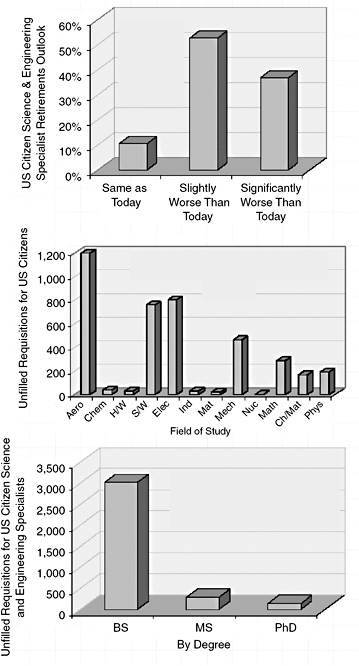
FIGURE NHS-5 Unfilled requisitions for US citizen scientists and engineers, by degree and field.
NOTE: Aero = Aerospace, Chem = Chemical, H/W = Hardware, S/W = Software, Elec = Electrical, Ind = Industrial, Mat = Materials, Mech = Mechanical, Nuc = Nuclear, Ch/Mat = Chemical/Materials, Phys = Physical.
SOURCE: E. Swallow. Chair, National Defense Industry Association Space Division and Chair, Industry Study on Critical Workforce Issues. Presentation at the National Defense Industry Association meeting, April 2005. Available at: http://proceedings.ndia.org/4340/swallow.pdf.
TABLE NHS-2 Percentage of Federal S&E Workforce Over the Age of 45, 1999-2002
|
|
1999 (percent) |
2000 (percent) |
2001 (percent) |
2002 (percent) |
|
|
Total S&Es |
44.2 |
43.5 |
43.1 |
43.4 |
|
|
All sci |
26.1 |
25.4 |
25.6 |
26.9 |
|
|
|
Comp/Math |
45.5 |
43.9 |
44.0 |
45.3 |
|
|
Life sci |
11.4 |
11.2 |
11.0 |
10.9 |
|
|
Physical sci |
26.7 |
26.2 |
26.1 |
26.2 |
|
|
Social sci |
20.4 |
20.4 |
19.7 |
19.6 |
|
All eng |
66.7 |
66.4 |
66.2 |
66.7 |
|
|
|
Aerospace |
44.7 |
43.6 |
43.0 |
42.8 |
|
|
Chemical |
62.3 |
63.6 |
65.7 |
67.6 |
|
|
Civil |
61.8 |
61.3 |
60.6 |
60.1 |
|
|
EE&Comp |
79.3 |
79.1 |
78.5 |
79.1 |
|
|
Industrial |
81.1 |
80.2 |
79.4 |
79.4 |
|
|
Mechancial |
88.2 |
88.2 |
88.4 |
89.2 |
|
|
Other eng |
54.6 |
55.1 |
55.5 |
55.9 |
|
SOURCE: Based on National Science Foundation. Federal Scientists and Engineers: 1998-2002. NSF 05-304. Arlington, VA: National Science Foundation, 2005. Table 11. |
|||||
on the original act in providing scholarships to undergraduates, including those pursuing associate degrees. The program would cover tuition, room and board, internships, tutors, and travel for all students. DOD requires a service commitment on completion of studies.
DOD has requested $10.3 million in its FY 2006 budget request for this program. SMART was initiated in 2005 as a pilot program and funded at $2.5 million. The program has generated considerable interest among students: SMART currently funds 25 students, but DOD vetted over 600 ap-plications.27
Possible actions include:
-
Create a new NDEA for the 21st century to promote the education and training of students in science, technology, engineering, mathematics, and foreign languages. The new NDEA would include portable graduate fellowships, institutional traineeships, incentives to create professional S&E
|
27 |
J. Brainard. “Defense Department Hopes to Revive Sputnik-Era Science-Education Programs” The Chronicle of Higher Education 51(36)(2005):A18. Available at: http://chronicle.com/prm/weekly/v51/i36/36a01802.htm. |
TABLE NHS-3 National Weapon Laboratories Personnel Recruitment Programs
|
|
Program |
Sponsor |
|
Pre-College (K–12) |
Materials World Modules |
Army |
|
|
STARBASE |
OSD-RA |
|
|
eCybermission |
Army |
|
Undergraduate |
Awards to Stimulate and Support Undergraduate Research Education (ASSURE) |
AFOSR with NSF |
|
|
Research Assistantships in |
DARPA with Semiconductor |
|
|
Microelectronics |
Industries Association |
|
|
Science, Mathematics, and Research for Transformation (SMART) |
AFOSR |
|
Graduate |
National Defense Science and Engineering Graduate Fellowships |
NDSEG |
|
|
Naval Research—S&T for Americas Readiness (N-STAR) |
Navy with NSF |
|
|
SMART |
AFOSR |
|
NOTE: OSD-RA = Office of the Assistant Secretary of Defense for Reserve Affairs, AFOSR = Air Force Office of Scientific Research, DARPA = Defense Advanced Research Projects Agency. SOURCE: B. Berry, Acting Deputy Undersecretary for Laboratories and Basic Science. “STEM Education Act” presentation at STARBASE Directors’ Conference, April 7, 2005. Available at: http://www.starbasedod.com/resources/SME%20Briefing-STARBASE%20Directors%20Conf%204-7-05v5%20wo%20Backup.ppt. |
||
-
master’s programs, undergraduate loan forgiveness, grants to support innovative undergraduate curricula, grants to expand K–12 education outreach, summer training and research opportunities for K–12 teachers, employer S&E and foreign-language educational tax breaks, national-laboratory and federal service professional incentives, and additional funds for program evaluation.28
|
28 |
National Research Council, 2002; R. M. Sega, Director of Defense Research and Engineering, DOD. Testimony Before the Subcommittee on Emerging Threats and Capabilities of the Senate Armed Services Committee, March 9, 2005. Available at: http://armed-services.senate.gov/statemnt/2005/March/Sega%2003-09-05.pdf; Association of American Universities, 2005. White Paper. |
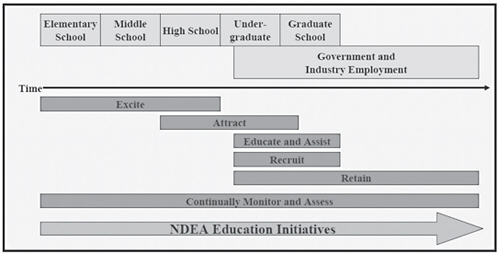
FIGURE NHS-6 DOD strategy for proposed National Defense Education Act (NDEA) within its current portfolio of workforce programs.
SOURCE: E. Swallow. Chair, National Defense Industry Association Space Division and Chair, Industry Study on Critical Workforce Issues. Presentation at the National Defense Industry Association meeting, April 2005. Available at: http://proceedings.ndia.org/4340/swallow.pdf.


