
5
Influence of Marketing on the Diets and Diet-Related Health of Children and Youth
INTRODUCTION
This chapter identifies and assesses the research on the influence of food and beverage marketing on the diets and the diet-related health of U.S. children and youth. The work of this chapter should be understood within the context of what is known about these two areas. Chapter 1 describes the breadth and complexity of these factors as well as their multidirectional quality. Chapter 2 discusses the strong evidence that the food and beverage consumption patterns of U.S. children and youth do not meet recommendations for a health-promoting diet and that an estimated 16 percent are obese. Increasing numbers of children and youth also have a variety of physical and psychosocial problems associated with diet and weight.
Chapter 3 discusses the various factors that influence young people’s food and beverage consumption habits. Chapter 4 reviews the ways in which young people are targeted for food and beverage marketing of both product categories and new product lines. A substantial proportion of such marketing is for high-calorie and low-nutrient foods and beverages. The corporate investment in advertising and other marketing practices is aimed at promoting consumer purchases—which are presumably related to consumption of the product advertised and the dietary practices and diet-related health profiles of today’s children and youth.
This chapter reviews and assesses the evidence that explores various aspects of marketing’s influence on the diets and diet-related health of our young people. The three core sections in the middle of the chapter present
the results of a systematic evidence review of peer-reviewed literature in the area. They include enough of the technical and analytic detail to support the committee’s findings about the contributions of marketing. Prior to these three sections are several that explain how the systematic evidence review was conducted, and following them are sections that address related elements such as comparison with other recent reviews and needed research. Throughout the chapter, care is taken to consider the role of marketing as one of multiple factors influencing diet and diet-related health.
The chapter begins with a description of the systematic evidence review undertaken to assess the influence of marketing on the diet and diet-related health of children and youth, including how it was organized, the criteria used for including evidence, the dimensions addressed, the coding process, the nature of the evidence examined, and the process used to review this evidence. This is followed by three sections that present the results of the systematic evidence review relevant to three relationships: (1) the relationship between marketing and precursors of diet, (2) the relationship between marketing and diet, and (3) the relationship between marketing and diet-related health. The role of factors with the potential to moderate these three relationships is then discussed. Finally, the systematic evidence review and its findings are considered in relationship to the results of other recent reports, and areas for future research are identified. A summary of the key findings concludes the chapter.
SYSTEMATIC EVIDENCE REVIEW
The committee conducted a systematic evidence review in order to investigate and summarize the empirical evidence that is directly relevant to the core question: What is the influence of food and beverage marketing on the diets and diet-related health of children and youth? The committee’s review included 123 published empirical studies identified from a set of nearly 200 in the published literature. Systematic evidence reviews are qualitatively different from meta-analyses or traditional narrative reviews (Petticrew, 2001). Systematic evidence reviews do not involve the statistical synthesis of a set of studies, the technique of meta-analyses, but rather attempt to reduce the inevitable bias from narrative reviews by developing explicit and systematic criteria for study inclusion and for assessing the level of evidentiary support provided by each study. As a result, systematic evidence reviews sometimes include far fewer studies than traditional narrative reviews, but they also typically include more than just randomized controlled trials. For example, this review includes not only many controlled experimental studies, but also many observational studies—both cross-sectional and longitudinal—on the influence of food and beverage marketing on the diets and diet-related health of children and youth.
In addition to supporting a rigorous assessment of a comparatively large body of research, a systematic evidence review is well suited for finding and describing any major gaps in the existing evidence base. The influence of television advertising intended for children, for example, has been studied fairly extensively by academic researchers. However, the influence of Internet marketing techniques, such as advergaming—developed specifically for older children and growing rapidly, unlike television advertising—has not been the subject of a single peer-reviewed, published academic study. A section at the end of the chapter presents recommended research directions derived largely from the committee’s systematic evidence review process.
The Analytic Framework
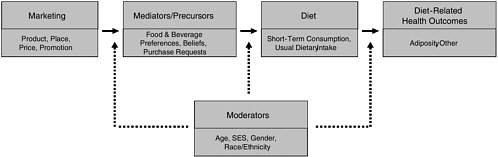
A five-element causal framework (Figure 5-1) was used in assessing the research evidence that related marketing to the diets and diet-related health of children and youth. These elements relate to the marketing-associated elements of the overall ecological schematic presented in Chapter 1.
The arrows in this framework are meant to represent potential causal mechanisms by which marketing might affect diet and diet-related health.1 At the outset, the framework was created from the committee’s identification of likely variables, relationships, and processes if food and beverage marketing were to have an effect on young people’s diet and diet-related health. For each of the major elements in the framework, multiple variables were identified to support the widest possible search for relevant research. As research was identified and reviewed, the framework was revised to better reflect what has been studied.
In the resulting framework, the initiating or exogenous factors are marketing variables. Marketing variables involve the product, such as differences in product formulation, packaging, or portion size; place, such as placement of items at eye level on supermarket shelves or availability in vending machines, convenience stores, or quick serve restaurants; price, such as the price of healthful food in a school vending machine versus the price for less healthful options; and promotion, such as television or billboard advertising. The systematic evidence review focused on marketing intended for young people ages 18 years and younger rather than on the parents of these young people. At the same time, research was included when it addressed marketing techniques that could engage either or both
young people and their parents (e.g., product placement in a popular movie that both young people and parents would watch) if the research reported results for young people.
Marketing might affect diet through a variety of mediators or precursors of diet. In general, a mediator/precursor is a factor through which causal influence passes. For example, if watching television increases obesity, this influence might be mediated by decreasing physical activity, or it might be mediated by increasing calorie intake, or by both. In the causal framework in Figure 5-1, mediators/precursors of diet are intended to capture the factors that could be directly affected by marketing and that in turn might have a direct effect on diet, but which themselves do not involve directly obtaining or consuming food. For example, television advertisements for sweetened cereals aimed at young children are effective when they cause the child to make a request to the person who purchases food for the family. Thus a common mediator to consuming food or beverage products at home is food purchase requests. Other marketing approaches aim to change purchasing behavior through influencing beliefs about what is “cool” to drink, what provides energy, or what constitutes a balanced breakfast. Still other marketing efforts seek to influence a child’s preferences for a product through its association with a well-known character, such as Darth Vader or Tony the Tiger®. Of the studies the committee reviewed on the relationship between a specific marketing factor and a precursor to diet, the great bulk involved food or beverage preferences, beliefs, or purchase requests. Thus the second element in the causal framework consists of a family of factors identified as precursors of diet. Those factors primarily include food and beverage preferences, beliefs, or purchase requests.
The third element in the causal framework is diet. For the committee’s task, diet refers to the distribution and amount of food consumed on a regular basis. Unfortunately, not all studies measured diet comprehensively in this way. Many measured some short-term dietary behavior, such as the number of pieces of fruit or candy consumed in a child-care setting during an afternoon following an exposure to television advertising for fruit or candy that morning. Short-term effects on consumption may or may not translate into longer term effects on a young person’s dietary patterns. Thus, it is important to distinguish studies that considered short-term dietary effects from those that attempted to relate marketing to a more comprehensive measure of diet. Experimental studies tended to focus on short-term consumption following some controlled exposure; cross-sectional and longitudinal studies employed broader measures of usual dietary intake, though they rarely assessed diet comprehensively.
The fourth element in the framework is diet-related health such as obesity, the metabolic syndrome, or type 2 diabetes. Nearly all the empiri-
cal research relating some marketing factor to diet-related health considered some version of the relationship between direct or indirect measures of body fat (adiposity) and television viewing. For simplicity, the term adiposity is used in this chapter to encompass the range of measures in the research reviewed.
The fifth element in the framework is moderators, variables that might alter the cause and effect relationships described in the path from marketing to diet-related health. In this domain, the committee identified age, gender, race/ethnicity, socioeconomic status, as well as whether a young person has the opportunity to make independent food purchases, can understand the persuasive intent of advertising, and has accurate nutritional knowledge as a potential moderator.
In general, a moderator is a factor that changes the nature of the causal relationship between two other factors. In the most extreme and simple case, the state of a flashlight’s batteries moderates the influence of the switch on the state of the light. When the batteries are charged, the state of the switch fully determines the state of the light. When the batteries are dead, the switch has no effect whatsoever on the light. In another example, genetic or congenital factors moderate the influence of certain drugs on their intended outcome. For example, the effect of penicillin is quite different among those not allergic. Similarly, certain factors might moderate the effect of marketing on precursors, diet, or diet-related health. For example, the influence of television advertisements on food and beverage preferences might be moderated by cognitive development, as indexed by age. Children under about age 8 generally do not understand the persuasive intent of advertising or the implications of persuasive intent for the nature of the advertising they encounter (Blosser and Roberts, 1985; Donohue et al., 1978; Robertson and Rossiter, 1974; Ward et al., 1977). Presumably, they are more readily influenced by advertising and other forms of marketing than are children older than about 8 years. Income or socioeconomic status might also moderate the effects of marketing on diet. For those in a low-income family, for example, the effect of price might be much stronger than it is for those in a high-income family. Because foods such as fruits and vegetables cost more per calorie than do French fries or cheeseburgers, socioeconomic status may be an important moderator of the influence of fruit and vegetable marketing strategies. In another example, gender may moderate teens’ reactions to marketing for sweet or high-fat foods and beverages. By early adolescence, many girls are concerned about their weight (Story et al., 1995) and, assuming that teens know that consuming sweets and high-fat foods leads to weight gain, they might be more resistant to the marketing of those foods than adolescent boys.
The arrows in the framework are not meant to reflect quantitative
strength, only the possibility of a causal element, and are primarily meant to provide a guide with which to review the relevant research. Nor is the framework meant to be exhaustive. The causal relationships flow only in one direction: from marketing through precursors and so on to diet and diet-related health. Clearly, however, the variables included in the framework might also relate bidirectionally. For example, consumer preferences for sweets or high-fat foods can clearly influence marketing strategies, among other things, influencing product formulation or the product qualities emphasized in advertising. Or, as another example, public concern about diet-related health outcomes such as nutritional inadequacies or obesity can impact product formulation and advertising claims, such as emphasizing fortified, low-fat, or whole-grain products. Such bidirectional relationships require more academic research, and their existence underlines the dynamic complexities noted in ecological perspective presented in Chapter 1.
The framework, then, provides both a causal perspective for the committee’s examination of evidence on the influence of marketing on young people’s diet and diet-related health, and a structure for organizing the empirical research on this topic. Many studies have examined the relationship between a marketing factor and a mediator/precursor. Many others ignored mediators/precursors and examined the relationship between a marketing factor and a measure of diet, and still others ignored precursors and diet, but examined the relationship between a marketing factor and some aspect of diet-related health. The analysis of the evidence presented later in this chapter is organized along these lines: evidence for a causal connection between marketing and mediator/precursor factors first, then evidence for a causal connection between marketing and diet, and finally, evidence for a causal connection between marketing and diet-related health.
Identification of Research for the Review
Unlike narrative reviews, a systematic evidence review includes explicit criteria for which studies to include and which to exclude. In establishing these criteria, the committee sought to create a body of evidence that would be both extensive and directly relevant to its charge of assessing the effects of food and beverage marketing on the diets and diet-related health of children and youth. The committee identified four distinct foci of existing research: industry and marketing sources and peer-reviewed literature; marketing and television advertising; television advertising and media use; and marketing of products other than foods and beverages. These had implications for the criteria used to determine what research was included in the systematic evidence review.
Industry and Marketing Sources and Peer-Reviewed Literature
Marketing research is carried out by many different people and organizations for many different purposes. For ease of discussion, the committee characterized them broadly into two categories: industry and marketing information and peer-reviewed literature. There are some notable differences between them. A large amount of industry and marketing information related to foods and beverages promotion to children and youth is not publicly available, but peer-reviewed literature is in the public domain. Additionally, industry and marketing sources usually focus on specific products or brands, often in comparison to other product categories or brands, whereas peer-reviewed literature is usually directed at understanding the marketing process and related effects across a wide range of product categories.
Marketing and Television Advertising
A large amount of the research about the effect of marketing on young people’s diet and diet-related health examines food and beverage advertising on television. This might be explained by three realities:
-
Advertising is the most visible and measurable component of promotion, one of the classic four marketing practices, the others being product, place, and price;
-
Advertising consumes a substantial and specific portion of a firm’s marketing budget; and
-
Of all food and beverage advertising encountered by children and adolescents, the majority occurs when they are viewing broadcast television and cable television programs.
Understanding the effects of televised advertising in today’s food and beverage marketing on young people’s diets and diet-related health contributes substantially to understanding the effects of broader marketing. Fuller understanding would come with research on other types of promotion in addition to advertising, other venues for advertising in addition to television and cable television, and other types of marketing in addition to promotion (i.e., product, place, and price). The marketing arena is complex and ever changing (see Chapter 4). Considerable work is still needed to develop a full understanding of marketing’s current role, its likely future role, and important options for enhancing its positive role in influencing young people’s diet and diet-related health. For the systematic evidence review, the committee established criteria that included all forms of market-
ing in all venues and vigorously searched for research about marketing other than television advertising.
Television Advertising and Media Use
A number of research studies deliberately use overall amount of television viewing time (primarily at home) as a measure of overall exposure to television advertising, on the assumption that advertising is a part of virtually all television viewing. Measuring home viewing assesses naturally occurring behavior and aggregates it over the many hours a day every day that most young people are watching television. Along with these benefits of measuring overall viewing come various measurement and inference challenges. In assessing the evidence on marketing’s effects, attention was given to the extent to which the measurement and inference problems were addressed when overall television viewing was used intentionally to assess overall exposure to television advertising.
A number of other studies consider overall amount of television viewing per se as an independent variable, particularly in relationship to adiposity. Many are not explicit about the exact mechanisms by which television viewing relates to adiposity or they discuss several different possibilities, often but not always including exposure to advertising for foods and beverages. For example, some of the studies specify that a measure of television viewing is meant to reflect absence of physical activity. The committee established criteria by which all such studies could be included in the evidence base. In these studies, if a relationship was found between television viewing and the outcome of interest, such as adiposity, the reason for the relationship had several plausible explanations for it. Exposure to advertising is one. The committee’s task was to determine for each study of this type whether there was good support for arguing that the relationship of television viewing to the outcome was, indeed, attributable in some degree to exposure to advertising during viewing.
Marketing of Products Other Than Foods and Beverages
There is a substantial body of research on the effect of marketing products other than foods and beverages to children and youth. In general, this research indicates that marketing can influence young people’s beliefs, actions, and preferences. Much of the research has focused on television advertising for toys, but it has also included work on advertising for cigarettes and alcohol, as well as other products and services. A discussion of some of this body of research is included elsewhere in the report, but it was not formally evaluated by the committee for the systematic
evidence review because it does not directly assess the effects of food and beverage marketing.
Final Criteria for Research Included in the Systematic Evidence Review
Based on considerations such as these, the committee’s review was limited to publicly available, scientific studies involving quantitative data on the relationship between (1) a variable involving marketing relevant to young people ages 18 years and younger, and (2) either a variable involving a mediator/precursor, or a variable involving diet, or a variable involving diet-related health.2 Studies that only considered the effect of a moderator variable and had no data pertinent to the relationship between a marketing variable and a precursor, diet, or diet-related health variable were not included. For example, if a study examined the effect of income on attitudes toward fruit and vegetables and had no measure of a marketing variable such as price or placement, then it was not included. Any study that met the inclusion criteria and employed measures that could be interpreted as assessing a marketing variable was included, whether or not the researchers intended the measure to represent that variable. For example, studies were included that used amount of television exposure as the independent variable, or that used attending a high school with Channel One programs (a specially produced high school news program that includes food and beverage advertisements) and examined precursors, diet, or diet-related health.
The criteria for a study to be included in the committee’s systematic evidence review were therefore as follows:
-
Only peer-reviewed, published research that included a full description of methods and results or that directed the reader to another publicly available report that provided the full description of methods. This research could have appeared in print books and journals or e-books and e-journals.
-
Only research reports written entirely in English.
-
Any country as the location for the research.
-
Any publication date.
-
Only original research, no review articles.
-
Only research that reported a quantitative relationship between a variable involving marketing relevant to young people (as opposed to parents only) and a variable involving a mediator/precursor, or diet, or diet-related physical health outcome for young people (as opposed to parents).
-
Any research that used an independent variable that could be interpreted as a measure for some aspect of marketing.
Only published, peer-reviewed research literature was used in this review. There are certain constraints in this respect that apply to any literature review of this sort. It is possible, for example, that investigators have not submitted for publication the results of studies in which the relationship between food and beverage marketing and a pertinent outcome was not statistically significant. In addition, peer reviewers and journal editors may have had a bias to favorably review only those studies in which the results are statistically significant. If so, then the published studies represent only a sample of all studies that have been done, and this sample is biased in the direction of statistically significant relationships between food and beverage marketing and the outcome of interest. However, if such a bias does exist, the direction of that bias should not be assumed as either an increase or decrease in the influence of marketing on the measured precursors, diet, or diet-related health.
Although a publication bias is possible in the research reviewed below, the committee considered the bias, if it exists, to be small. As will be displayed, nonsignificant results have been published in numerous and diverse sources. Moreover, an early examination of unpublished theses, dissertations, and conference papers revealed relatively few nonsignificant findings. Given the importance of the issues, the committee considered it unlikely that well-conceived and well-executed studies were not submitted or were rejected on the grounds that the results were not statistically significant.
Finding the Research
Using the guidelines described above and the many possible variables identified with the initial proposed causal framework, extensive and iterative searches for relevant literature were conducted. Briefly, the quest included an online bibliographic search of several databases, outreach to experts in relevant fields, examining published literature reviews, recourse to committee members’ personal and university libraries, and pursuing references cited in articles that were being coded for the systematic evidence review.
A two-stage process determined whether each item was included in the final systematic evidence review. One or more committee members read the titles and abstracts of more than 200 items and removed any that clearly did not meet one or more of the inclusion criteria. Many review articles, opinion pieces, studies involving adults only, and studies that did not in-
clude a marketing “causal” variable and an “effect” variable that represented a precursor to diet, diet, or diet-related health were removed. The remaining studies were assigned to two people (drawn from committee members and university students commissioned to assist in this process) for complete coding. If the two coders subsequently agreed the item did not meet the inclusion criteria, it was discarded. In the end, the systematic evidence review included 155 research results from 123 studies.
To place this collection of evidence in context, it is helpful to compare this systematic evidence review of the effects of food and beverage marketing on children and youth with the previous most extensive effort. That work, commissioned by the U.K. Food Standards Agency, reflected similar goals and identified 55 articles or entries describing 51 relevant studies for systematic review (Hastings et al., 2003). Building on the base of that work, and applying even more stringent criteria for the publication quality of the studies reviewed, we have been able to identify and assess an even larger body of evidence. Hence, this committee’s review of the evidence represents the most comprehensive and rigorous assessment to date of food and beverage marketing’s influence on children and youth.
Dimensions of the Review
Each research study that met the committee’s inclusion criteria was reviewed and then “coded” on several dimensions that were used in the systematic evidence review for the relationships between the following factors:
-
Marketing and a precursor to diet
-
Marketing and diet
-
Marketing and a diet-related health outcome
If more than one relationship was examined in a published study, a separate entry in the evidence table was created for each such relationship. In some cases this resulted in multiple results for one study. For example, one study examined four matched schools, two of which had Channel One and two of which did not (Greenberg and Brand, 1993). Outcomes measured included the students’ news knowledge, their attitudes toward foods and beverages advertised by Channel One, and their purchases of foods and beverages advertised by Channel One. For the committee’s purposes, student news knowledge was dropped from further consideration, and two entries for the evidence table were created: one representing results for a precursor study of the relationship between Channel One television advertising and food and beverage preferences, and one representing results for a
diet study of the relationship between Channel One television advertisements and usual dietary intake as measured by recent food and beverage purchases.
There were also three other circumstances under which a single publication could contribute more than one result to the evidence table. If a publication reported more than one complete study, each study was represented by at least one result in the evidence table even if each study addressed the same relationship. If a publication employed two or more entirely different samples to test the same question (not to test whether the samples were different), each sample was entered separately into the evidence table. Finally, if a publication utilized different research methods (e.g., both cross-sectional and longitudinal in a panel design) to test the same question, results from each method were entered separately into the evidence table.
Other variations that could have been treated as separate entries in the evidence table were instead incorporated into a single entry. If multiple measures were used in a study to examine a putative result of marketing, then the different measures were described, but only one result—precursor to diet, diet, or health (diet-related health outcome)—was entered into the evidence table. For example, if both skinfold thickness and body mass index (BMI) were used as measures assessing an influence of television advertising, then the entry into the evidence table was “health.” If the research participants came from different age groups from among infants and toddlers, younger children, older children, and teens, the groups were described within one result. If outcomes varied for different subgroups or different measures, they were also described within one result. In assessing the research evidence, it was at times appropriate to consider differences such as these; for example, the relationship of advertising to diet should be examined separately for children and teens. In these cases, the number of items considered in the data tables will be larger than the total number of results in the systematic evidence review table.
Each result in the evidence table was identified by author(s) and publication date of the item in which the result appeared. Its basic characteristics were then coded, three ratings were judged, a mini-abstract was written, and any coder comments were added. Coding the basic characteristics and rating the relevance of the research to the committee’s purposes are described in the next two sections.
Coding the Basic Characteristics
The marketing factor studied was recorded as the “cause” variable, and the precursor, diet, or diet-related health factor studied was recorded as the “effect” variable. For example, in Bao and Shao’s (2002) study of the effect
of radio advertisements for the Cheerwine beverage, “radio advertisements” was recorded as the cause variable, and in the Storey et al. (2003) study of the effect of television viewing on obesity, “obesity” was recorded as the effect variable. If the putative cause variable was television advertising and it was measured by overall television viewing, a special note was made in the coding.
The methods by which the cause and effect variables were measured were also recorded. For example, in Yavas and Abdul-Gader (1993), the cause variable was television advertisements, and its measure was “self-reported average number of advertisement breaks seen each evening.” Its effect variable was food purchase requests, and its measure was “self-reported frequency of advertised product requested (Likert-scale).” In the Storey et al. (2003) study of the effect of television viewing on obesity, obesity was measured by BMI calculated from self-reported height and weight, whereas in the Stettler et al. (2004) study, obesity was measured by BMI calculated from physical measures of height and weight taken by a trained technician and by skinfold thickness measured by the technician in various parts of the body. During assessment of the evidence from the body of research in the systematic evidence review, the cause and effect variables were placed into a small number of conceptual categories, and these were added into the final evidence table.
The kind of research study design was coded. For example, some studies were experiments, a few were natural experiments, many were cross-sectional (observational) studies, and some were longitudinal studies. Also coded were the sample size of the study, the age group(s) of the young people studied, and whether the relationship between the marketing variable and the effect variables was statistically significant at the 0.05 level or better. For all statistically significant results, the relationship was in the expected direction and so not explicitly coded.
Rating the Relevance of the Evidence
Relevance of the evidence for the committee’s tasks was assessed as high, medium, or low on three key dimensions: (1) the strength of the evidence for a causal relationship between a marketing variable and an outcome precursor, diet, or diet-related health variable (causal inference validity), (2) the quality of the measures used in the study, and (3) the degree to which the results in the study generalize to everyday life (ecological validity).
These criteria are not meant to assess the scholarly quality of the research reviewed. It was assumed that the peer-review process screened for this in order for the work to be published. A large, longitudinal study of television viewing and obesity might be designed and executed with impec-
cable care, but because the researchers were interested in establishing an association rather than a cause–effect relationship, its relevance to the committee’s purpose—which prioritizes the ability to make causal inferences—would result in a low rating on causal inference validity. Similarly, a carefully designed and conducted experiment on advertising and children’s product evaluation for two competing brands might be rated high on causal inference validity but, because the experiment was conducted in laboratory conditions quite different from everyday life, it might be rated low on ecological validity. Clearly, such low ratings do not reflect the quality of the research conducted; they reflect the relevance of the research to the committee’s charge to assess the effects of food and beverage marketing on young people’s diet and diet-related health. The two relevance ratings, which will be explained next, both required consideration of the nature and quality of the measures. Measure quality was, therefore, also rated, using the same high, medium, low system used for the two relevance ratings, and it also will be explained below.
Causal Inference Validity Rating. Philosophers, statisticians, economists, epidemiologists, and other social scientists have not yet achieved consensus on the definition of causation, and this debate is likely to go on for some time.3 Agreement is much more substantial, however, on the issue of causal inference, that is inferring from statistical studies the existence or absence of a causal relationship between two particular quantities, such as hours of television watched and calories expended from vigorous physical activity.4
Put another way, accounts of causal inference tend to stress the same points regardless of the precise definition of causation utilized.
The evidence for interpreting an association as causal is entirely distinct from the evidence used to judge whether an association is statistically significant. For example, the evidence required for concluding that a statistical association exists between exposure to television advertising and calories consumed is distinct from the evidence required for concluding that an increase of exposure to television advertising causes an increase in calories consumed. To underscore this distinction, the committee explicitly created two dimensions for each study in the evidence review: one to record whether the statistical evidence for an association was significant, and another to record the evidence for concluding the existence of a causal relation.
The evidence for the existence of a causal relation is a function of the study design, the measures used, and the background knowledge that is credible. The classic design for inferring causation is the randomized experimental trial. Treatment is assigned randomly, and the outcome is measured by some device or person blind to the treatment assigned. If dropout was low, or was independent of treatment, and the outcome was measured validly, then the study provides strong evidence for causality. Experimental studies on the influence of food and beverage marketing were rated high on causal inference validity if treatment was assigned randomly, dropout was not a factor, and the measures used were valid.
In an observational study, that is, a study in which the treatment, or cause variable, was not assigned but rather just passively observed, an association between a putative cause X and a putative effect Y might be explained in three ways: (1) X is a cause of Y, (2) some third factor (confounder) is a common cause of both, or (3) Y is a cause of X. The overall assessment of causal inference validity for such studies rides on how convincingly the study eliminates possibilities 2 and 3.
Time order between the putative cause and effect is the most common reason for eliminating the third possibility, and statistically adjusting, or controlling, for potential confounders is the most common methodology for eliminating the second possibility. To have confidence that statistical controls are adequate, it is important to know both that all important confounders were included in the study and, just as importantly, that all important confounders were measured with high validity, reliability, and precision (see below for explanation). Thus, observational studies were rated high on causal inference validity if the measures of the cause and effect were valid, if all plausible confounders were included and measured validly, reliably, and precisely; and if some reason could be given to eliminate the possibility that the observed association was not due to causation opposite to that predicted, that is, the putative effect causing the putative cause.
To summarize, causal inference validity of each result in the evidence table was scored as high, medium, or low on the basis of the study design, the quality of the measures employed, the drop out rate, the statistical controls used, and the background knowledge available. Because some studies did not aim to make a case for causality, and others faced extremely difficult measurement challenges, judgments about causal inference validity do not and should not coincide with judgments about the scholarly quality of a study. More detail on the criteria used for rating causal inference validity is provided in the codebook (see Appendix F-1).
Measure Quality Rating. Clearly, measurement figures heavily in these judgments. So heavily, in fact, that the quality of measures was explicitly rated as high, medium, or low for each result entered into the evidence table. The measures used in each study were rated taking into consideration three dimensions: validity, reliability, and precision. Validity refers to the extent to which a measure directly and accurately measured what it intended to measure. For example, examining grocery store receipts is a valid measure of food purchased over a week, whereas asking someone to list the food he or she intends to buy over the next week is not. Reliability assesses the extent to which the same measurement technique, applied repeatedly, is likely to yield the same results when circumstances remain unchanged. For example, measuring a 6-year-old’s cumulative exposure to lead by taking a single blood sample is highly unreliable; such measurements fluctuate markedly from day to day. Chemically determining the concentration of lead in discarded baby teeth is much more reliable (ATSDR, 2002). Precision refers to the fineness or coarseness of a measure. For example, measuring family income in number of dollars is precise, but measuring it as low, medium, or high is not.
Ecological Validity Rating. Ecological validity refers to the extent to which a study’s results are likely to generalize to the naturally occurring world of marketing and young people’s diets and diet-related health. An investigation’s research setting might be quite dissimilar to the natural system being studied. For example, a study in which 6-year-olds are removed from class and taken to a trailer near their school, shown 7 minutes of commercials, and then asked to make a series of binary choices from photographs of item-pairs is low in ecological validity. A study in which mother–child pairs are surreptitiously observed in the supermarket and each food purchase request is recorded is more ecologically valid. Also high in ecological validity are studies in which daily television viewing is measured from the use of viewing diaries or program check-off lists. The measure quality may not be high but the ecological validity is high because everyday behavior over a period of time is being measured.
Research on marketing and behavior involves a tension between causal inference validity and ecological validity. Studies that carefully isolate a small number of causal factors in a laboratory setting tend to be high on causal inference validity, but low on ecological validity. Studies that observe young people in their natural environment tend to be high on ecological validity but low on causal inference validity. Rarely do studies score high on both measures.
The Coding Process
Using these dimensions for recording characteristics and for rating measure quality and relevance, the committee constructed an initial codebook and an evidence table. Several iterations of trial coding removed ambiguities from the codebook, calibrated and refined the evaluative criteria employed, and guided final choices about the set of coding dimensions. The final codebook is available in Appendix F-1.
Two coders were assigned to each article identified as relevant to the committee’s purposes. They worked independently and resolved disagreements by discussion. If consensus was not readily obtained, other committee members were consulted. After agreement, both coders’ comments on the article along with an abstract for the piece were included, and the final coding results were compiled into an evidence table that could be sorted on any categorical coding dimension (a condensed version of the evidence table is available in Appendix F-2). Coders were drawn from committee members and selected university students commissioned to assist in this process. All received training to ensure consistency in perspectives and process. In general, coders agreed with each other. Later reviews of the evidence table suggested that both the recording and rating functions were executed consistently by all coders.
Characteristics and Relevance of Research in the Systematic Evidence Review
The systematic evidence review is based on results from published original research about the relationship of commercial food and beverage marketing to diet indirectly through mediators (or precursors), to diet directly, and to diet-related health directly. The descriptive and evaluative characteristics for all the results included in the systematic evidence review are presented in Tables 5-1 and 5-2, respectively, according to whether the result pertained to the relationship of marketing to precursor, marketing to diet, or marketing to diet-related health.
Overall, the results are drawn from many different studies rather than from a few. In total, 123 different published reports of original research
TABLE 5-1 Descriptive Characteristics of Research in the Systematic Evidence Review for the Relationship of Marketing to Precursors of Diet, Marketing to Diet, and Marketing to Diet-Related Health
|
Characteristic |
Marketing and Precursors of Diet |
Marketing and Diet |
Marketing and Diet-Related Health |
|
Total Results* |
45 |
36 |
74 |
|
Decade Published |
|||
|
1970 |
6 |
0 |
0 |
|
1980 |
21 |
10 |
4 |
|
1990 |
10 |
13 |
25 |
|
2000 |
8 |
13 |
45 |
|
Research Design |
|||
|
Experimental |
25 |
10 |
1 |
|
Natural experiment |
1 |
3 |
0 |
|
Longitudinal |
2 |
2 |
17 |
|
Cross-sectional |
17 |
21 |
56 |
|
Age Group |
|||
|
Infants and toddlers (under 2) |
0 |
0 |
1 |
|
Younger children (2–5) |
23 |
12 |
17 |
|
Older children (6–11) |
28 |
22 |
58 |
|
Teens (12–18) |
6 |
10 |
33 |
|
Sample Size |
|||
|
0–49 |
8 |
4 |
1 |
|
50–99 |
10 |
6 |
6 |
|
100–499 |
24 |
16 |
21 |
|
500–999 |
1 |
2 |
11 |
|
1,000 or more |
2 |
8 |
35 |
|
Type of Marketing |
|||
|
TV ads: experimental treatment |
24 |
9 |
0 |
|
TV ads: observed in natural setting |
0 |
0 |
2 |
|
TV ads: TV viewing only |
15 |
22 |
56 |
|
TV ads: TV campaign |
2 |
1 |
0 |
|
TV ads: TV viewing and other media use |
0 |
2 |
16 |
|
All other marketing |
4 |
2 |
0 |
|
Type of Outcome |
|||
|
Preferences |
27 |
0 |
0 |
|
Purchase requests |
14 |
0 |
0 |
|
Beliefs |
13 |
0 |
0 |
|
Short-term consumption |
0 |
9 |
0 |
|
Usual dietary intake |
0 |
27 |
0 |
|
Adiposity |
0 |
0 |
73 |
|
Other |
1 |
0 |
2 |
|
NOTE: Other types of marketing for precursors of diet were print ads, radio ads, multimedia campaign, and price and promotion. Other types of marketing for diet were product placement in film, and price and promotion. Other outcomes for precursors of diet were perceived intent and credibility of ads. Other outcomes for diet-related health were cholesterol levels and cardiovascular fitness. *One result in the evidence table could be about more than one age group or type of marketing. |
|||
TABLE 5-2 Evaluative Characteristics of Research in the Systematic Evidence Review for the Relationship of Marketing to Precursors of Diet, Marketing to Diet, and Marketing to Diet-Related Health
|
Characteristic |
Marketing and Precursors of Diet |
Marketing and Diet |
Marketing and Diet-Related Health |
|
Total Results |
45 |
36 |
74 |
|
Quality of Measures |
|||
|
High |
5 |
10 |
0 |
|
Medium |
27 |
14 |
32 |
|
Low |
13 |
12 |
42 |
|
Causal Inference Validity |
|||
|
High |
11 |
11 |
1 |
|
Medium |
20 |
9 |
18 |
|
Low |
14 |
16 |
55 |
|
Ecological Validity |
|||
|
High |
13 |
24 |
63 |
|
Medium |
19 |
10 |
9 |
|
Low |
13 |
2 |
2 |
contributed 155 different results to the systematic evidence review. On average, then, each publication accounted for 1.26 results in the evidence table. Across all three relationships, no single publication accounted for more than two results in the evidence table. When analyses delved into possible differences by age or by type of outcome, one publication could contribute more than two data points if it involved more than one age group or type of outcome. As will be discussed later, there is a clear need for more research in several areas. However, any finding that can be drawn from the research that has been done to date is based on a diverse set of studies conducted by different researchers. This fact enhances the credibility of the results.
The research spans four decades. During that time, issues addressed early on have also been addressed recently. The first few publications appeared in the 1970s, many appeared in the 1980s and 1990s, and many more have appeared halfway through the 2000s. For any of the three relationships for which findings can be drawn based on early research, there is also recent research that supports the finding and thereby reduces concern that earlier results on any of the three relationships might be different now due to societal changes (e.g., in the nature of food products or of beverage advertising).
All three main types of research designs have been used to study the
direct relationship of marketing to precursors, diet, and diet-related health. For any one relationship, at least two experimental, cross-sectional, and longitudinal research designs have been employed in sufficient numbers so that the usual limitations of one design are generally counterbalanced by the usual strengths of another design. This is true particularly in terms of the ability to determine cause and effect relationships (causal inference validity) and to relate research results to phenomena in everyday life (ecological validity).
Overall, quality and relevance are reasonably good for the research included in the systematic evidence review. Earlier in this chapter the use of high, medium, and low ratings of measure quality, ability to infer causality, and similarity to everyday life was described. These three ratings were made for every result for each of the three relationships examined. Considering the three rating scales and three relationships together, with one exception, the number of medium and high ratings is greater than or about the same as the number of low ratings. The one exception is the causal inference validity rating for research on the relationship of marketing to diet-related health. About three-quarters of the results had low causal inference validity. Thus, it was much harder to arrive at findings about the relationship of marketing to diet-related health than it was to arrive at findings for the relationship of marketing to precursors of diet or to diet itself.
In social science research in general, it is difficult—but not impossible—to achieve in the same study high ability both to determine cause and effect relationships and to relate results to everyday life. It is true as well in the specific area of the relationship of marketing to the precursors of diet, the diets of young people, and their diet-related health. In fact, just 5 (3 percent) of the 155 results had high ratings for both causal inference validity and ecological validity. Three different high relevance studies (French et al., 2001a; Gorn and Goldberg, 1982; Greenberg and Brand, 1993) each contributed one result about the relationship between marketing and diet, and one (Robinson, 1999) contributed one result about the relationship between marketing and diet and one result about the relationship between marketing and diet-related health. Because of this pattern of rather inverse relevance ratings for causal inference validity and ecological validity, which is characteristic of research addressing many different social issues, findings must be carefully drawn from all available research, weighing the contribution of each result and the characteristics and relevance of the research in which it was reported.
Research samples ranged in size from a low in the 30s to a high of more than 15,000, with the majority either in the low 100s or more that 1,000. Overall, older children were the most frequently studied, but different age groups were studied for the three relationships. For the relationship of marketing to precursors of diet, most of the research involved younger
(ages 2–5 years) and older children (ages 6–11 years), with some work with teens (ages 12–18 years). For the relationship of marketing to diet, most of the work involved older children, with quite a bit of work equally with younger children and teens. For the relationship of marketing to diet-related health, most of the work involved older children, then teens, and then younger children. The one study with infants and toddlers (under 2 years) was in this last area, diet-related health. Because of these variations in the ages of research participants and the possibility that age might moderate the relationships between marketing and precursors, diet, or diet-related health, findings were limited to those age groups for which enough research had been conducted.
Nearly all the research was about television advertising, which is the most prominent and frequent type of marketing young people encounter. Just 6 results (Auty and Lewis, 2004; Bao and Shao, 2002 [2 results]; French et al., 2001a; Macklin, 1990; Norton et al., 2000) of the 155 total were about any other type of marketing. The main types of outcomes were food and beverage preferences, purchase requests, and beliefs for the precursors of diet; short-term consumption and usual dietary intake for diet; and adiposity for diet-related health.
Overall the research included in the systematic evidence review was of sufficient size, diversity, and quality to support the derivation of several findings about the influence of marketing, specifically television advertising, on the precursors of children’s and teens’ diet, on their current diet, and on their diet-related health. Following a discussion of how the results in the evidence table were interpreted, the evidence and findings from it will be presented in three sections, first for the precursors of diet, then for diet, and finally for diet-related health.
Interpretation of the Results
Many factors were brought into play in deriving findings from the systematic evidence review. The quantity, variety, and statistical significance of results and the research from which they came influenced whether any finding was drawn and how definitive it was held to be. Pertinent results needed to be available from several different studies conducted by different researchers using different research populations and measures. A preponderance of pertinent results had to support the finding. In addition, any consistent differences between results supporting and not supporting the finding had to be taken into account. If a cogent explanation could be provided for results supporting and not supporting the finding, then the finding would need to be qualified accordingly.
Because of the committee’s charge, particular attention was given to assessing cause and effect relationships and to establishing the degree to
which such relationships are likely also to occur in everyday life in the United States. Useful findings might describe relationships between marketing and precursors, diet, or diet-related health, without being certain that one causes the other. Useful findings also might describe cause and effect relationships, without being certain that they would occur in everyday life. The most useful findings will describe the ways in which various aspects of marketing influence various aspects of precursors of diet, diet, or diet-related health, and do so with some confidence that these effects occur in the everyday lives of our young people.
In deriving findings from the systematic evidence review, the committee used a three-step process. First, it determined whether there were enough research results from which to derive a finding about a particular topic. For example, regarding the influence of televised food and beverage advertising on children’s and teens’ short-term consumption, the committee concluded there was enough evidence for both younger and older children, but “an absence of evidence” for teens. Second, for those topics for which there was sufficient evidence, the committee drew on all aspects of the evidence to decide whether there was a relationship between the marketing variable and the outcome variable. For example, there was sufficient evidence to reach findings about the relationship of televised food and beverage advertising on children’s and teens’ usual dietary intake. For younger and older children, on balance, the evidence supported the finding that advertising influenced intake, whereas for teens, on balance, the evidence supported the finding that advertising did not influence intake. Third, the committee provided a sense of the strength of the research support for the finding, using the terms “strong,” “moderate,” and “weak.” For example, for the findings regarding advertising’s influence on usual dietary intake, there was moderate evidence for such influence for younger children (ages 2–5 years), weak evidence for such influence for older children (ages 6–11 years), and weak evidence against such influence for teens (ages 12–18 years).
A rather large number of results in the systematic evidence review measured everyday television viewing as a means of assessing exposure to food and beverage advertising on television. This was a deliberate measurement choice by many of the researchers who conducted the studies included in the systematic evidence review for the relationship of marketing to precursors of diet and for the relationship of marketing to diet. In cases reviewing the relationship of marketing to diet-related health, researchers generally did not use television viewing to measure exposure to televised advertising. In such studies, television viewing was treated as a measure of several different possible variables, of a sedentary lifestyle, of time away from physical activity, and the like. Nonetheless, the research design, methods, and analyses were essentially the same as those in many studies testing
marketing’s influence on precursors of diet and on diet. For this reason, the committee included all such research in the systematic evidence review, whether or not the researchers intended their work to be about television advertising.
The committee’s decision to accept that measures of television viewing could be interpreted as assessing young people’s advertising exposure had two important ramifications. First, studies that relied on estimates of time spent watching television as an indicator of advertising exposure could not fare very well in terms of the rated measurement quality. This stems from several factors, including the possibility that part of any person’s total television time was devoted to viewing mostly noncommercial programming (e.g., public broadcasting) or that some people may leave the room during commercials, successfully avoiding exposure to the ads. Despite these possibilities, broad-based estimates of time spent watching television function reasonably well to identify an individual’s relative exposure to commercial messages, as advertising permeates the large majority of television viewed by most individuals, in particular young people.
A second important ramification of having included these studies in the systematic evidence review is that the committee must accept the burden of carefully considering alternative explanations for any association found between television advertising, measured by television viewing, and precursors of diet, diet, or diet-related health. This burden increases as one moves from precursors such as requests for foods known to be advertised on programming popular with children, to aspects of diet such as short-term choices for snacks known to be advertised on television, to health issues related to the quality of a young person’s usual diet.
To arrive at findings when television viewing was the measure of exposure to televised food and beverage advertising, plausible alternative explanations had to be generated for each outcome variable and the possibility of ruling out these alternatives examined. This was easier when the same relationship was studied with experimental methods as well as cross-sectional methods. Longitudinal methods were also informative. In addition, research that included methodological and statistical controls for alternative explanations was useful. In the absence of very well-controlled studies or a body of research that includes experimental as well as correlational methods, however, it was hard to draw many findings from research using television viewing as the measure of exposure to television advertising.
Finally, in interpreting the results, the committee kept in mind that diet and diet-related health are complex and multiply determined. There was no expectation that marketing would be the only influence on diet or diet-related health, nor did it seem likely that marketing would be the major determinant of diet or diet-related health. Moreover, people are forgetful
and changeable enough that any limited marketing experience was not expected to have more than a limited influence. With these realities in mind, the committee looked for all possible effects, including powerful and long-lasting effects on diet and diet-related health, but it also considered small effects and short-term effects both reasonable and meaningful.
Overall, the research results included in the systematic evidence review were of sufficient quality, diversity, and scope to support certain findings about the influence of marketing, including the overall finding that food and beverage marketing influences the preferences and purchase requests of children, influences consumption at least in the short term, is a likely contributor to less healthful diets, and may contribute to negative diet-related health outcomes and risks.
Presentation of the Systematic Evidence Review Analysis
The next three sections review in detail the evidence related to each of the three specific relationships. They have a similar structure. To begin, the evidentiary base for the relationship between marketing and the relevant outcome (precursors, then diet, then diet-related health) is considered in terms of the descriptive and evaluative characteristics of all significant and nonsignificant results for that relationship. Because the evidence for all three relationships is almost entirely about one form of marketing—advertising distributed via television and cable television—and a limited set of outcomes, any result about a different form of marketing or an infrequently studied outcome is then removed from the evidentiary base, and the main analysis of the results proceeds. This analysis takes into account the age of the research participants, the kind of outcome, and the causal inference validity for each significant and nonsignificant result. Each section ends with a summary of the important findings drawn from the available research about the target relationship.
In presenting the results of the systematic evidence review for the three relationships, the committee has sought to meet the likely interests of readers with varying levels of expertise in social science research. Many data tables are presented. The main points to be drawn from the tables are also described in terms that should be meaningful to all readers. Examples from the research are offered to bring life to the work. The text, particularly the introduction and findings for each of the three sections, should be useful for every reader. For some, the middle sections, the data tables, the summary evidence table (available in Appendix F-2), and references should provide enough of the analytic methods and results to support an independent assessment of the committee’s work.
SYSTEMATIC EVIDENCE REVIEW OF THE RELATIONSHIP BETWEEN MARKETING AND PRECURSORS OF DIET
This section considers the evidence relevant to the effect of marketing on precursors of diet. In order for food and beverage marketing to influence young people’s diets, one or more of several things need to occur as the result of marketing. Young people need to become aware of the product or brand or service. They need to develop some sense that consuming the food or beverage is desirable, perhaps because they expect it will taste good, give them energy, cost just a little, be easy to acquire or consume, be fun to handle, be sold in a fun environment, have a toy in the package, help them fit in with their peers, promote strong bones and teeth, please their parents, or provide some other benefit. They may need to influence their parents, older siblings or friends, or caretakers to purchase the product or brand or to go to the restaurant. In the five-element causal framework (see Figure 5-1), these relationships between marketing and the precursors of diet initiate the path from marketing to diet and diet-related health, the primary outcomes of interest to the committee.
Evidentiary Base
For the systematic evidence review of the relationship between marketing and precursors of diet, the evidence table includes 45 results from 42 different published research reports. The earliest study was published in 1974 and the latest in 2005. Table 5-3 summarizes the descriptive characteristics of those studies that reported a statistically significant relationship between any form of marketing and any mediator or precursor, and of those that reported a nonsignificant relationship. All significant results show that more exposure to marketing is associated with greater preference or more purchase requests for what was advertised or more beliefs like that presented via marketing. Virtually all studies in the systematic evidence review focused on marketing of high-calorie and low-nutrient foods and beverages, either due to researcher selection for an experiment or due to the predominant marketing of such products in naturalistic studies. Thus, most of the systematic evidence review focuses on the effects of marketing high-calorie and low-nutrient foods and beverages. No information is included that demonstrates whether the findings would apply to the marketing of more healthful foods and beverages (see Chapter 6 for a discussion of social marketing campaigns).
All but four of the results involved television advertising, occasionally using commercials the researchers had made, often using commercials taken off the air, and sometimes using a measure of likely exposure to commercials as a result of everyday television viewing. For more recent studies, television might include material available via cable television rather than
TABLE 5-3 Descriptive Characteristics of Research on the Influence of Commercial Marketing on the Precursors, or Mediators to Young People’s Diets
|
Characteristic |
Significant Results |
Nonsignificant Results |
|
Total Results* |
35 |
10 |
|
Decade Published |
||
|
1970 |
5 |
1 |
|
1980 |
13 |
8 |
|
1990 |
9 |
1 |
|
2000 |
8 |
0 |
|
Research Design |
||
|
Experimental |
18 |
7 |
|
Natural experiment |
1 |
0 |
|
Longitudinal |
2 |
0 |
|
Cross-sectional |
14 |
3 |
|
Age Group* |
||
|
Younger children (2–5) |
17 |
6 |
|
Older children (6–11) |
21 |
7 |
|
Teens (12–18) |
6 |
0 |
|
Sample Size |
||
|
0–49 |
7 |
1 |
|
50–99 |
7 |
3 |
|
100–499 |
18 |
6 |
|
500–999 |
1 |
0 |
|
1,000 or more |
2 |
0 |
|
Type of Marketing |
||
|
TV ads: experimental treatment |
18 |
6 |
|
TV ads: TV viewing only |
12 |
3 |
|
TV ads: TV campaign |
2 |
0 |
|
Print ads |
0 |
1 |
|
Radio ads |
1 |
0 |
|
Multimedia campaign |
1 |
0 |
|
Price and promotion |
1 |
0 |
|
Type of Precursor* |
||
|
Preferences |
19 |
8 |
|
Purchase requests |
13 |
1 |
|
Beliefs |
10 |
3 |
|
Intent and credibility of advertising |
1 |
0 |
|
*One result in the evidence table could be about more than one age group or type of precursor. For these two characteristics the column totals can be more than the number of results. |
||
broadcast systems. The remaining four results addressed the influence of print advertising (Macklin, 1990), radio advertising (Bao and Shao, 2002), a multimedia advertising campaign (Bao and Shao, 2002), and price and promotion (Norton et al., 2000). Twenty-three of the results were about
younger children (ages 2–5), 28 about older children (ages 6–11), and 6 about teens (ages 12–18).
Twenty-seven of the results examined the effects of food and beverage marketing on young people’s preferences. Most were experiments; some were cross-sectional designs. As an example of an experiment, Borzekowski and Robinson (2001) showed two short cartoons to preschoolers, half of whom also saw about 2.5 minutes of educational material between the two cartoons and the other half of whom saw 2.5 minutes of ads. All material had been broadcast previously on television. The advertisements were for juice, sandwich bread, donuts, candy, a fast food chicken entrée, snack cakes, breakfast cereal, peanut butter, and a toy. Immediately after viewing, children who saw the advertisements preferred the advertised brand over an alternate similar product with similar packaging, even if the advertised brand (of donut) was unfamiliar and the alternate was a local favorite. Advertisements varied in effectiveness, and advertisements run twice were more effective. The advertising effects were the same for boys and girls, children whose home language was English or Spanish, and children with varying levels of access to media. Parents also reported that television advertising influenced their children’s preferences and purchase requests.
Fourteen of the results examined the effects of food and beverage marketing on young people’s purchase requests. Somewhat more than half were cross-sectional designs; the rest were experiments. As an example of a cross-sectional design, Isler et al. (1987) had mothers of 250 children between ages 3 and 11 years keep detailed diaries for 4 weeks. Weekly in-person or telephone checks were made. For younger and older children, there were small, statistically significant relationships between the amount of television watched and the total number of requests and between the amount of television watched and the number of requests for cereal and candy; relationships were not significant for fast foods and snack foods, nor for foods such as fruits and vegetables that are advertised infrequently on television. In an experimental study, Stoneman and Brody (1982) had young children view a 20-minute television cartoon with or without advertisements for two candy bars, one chocolate drink mix, one brand of grape jelly, and two salty snack chips. Mothers separately viewed the cartoons without advertisements and did not know whether their children were seeing advertisements with the cartoons. Mothers and children then participated in a “separate study” of family shopping for weekly groceries in a mini-grocery store. A “clerk,” who was unaware of the nature of the research, surreptitiously recorded what happened. Children who had seen the commercials more often asked for products, whether or not advertised, pointed to them, grabbed them off the shelf, or put them into the grocery cart; they also did so more often for the advertised products. Mothers of these children also more often said no, put items back, and offered alterna-
tives to children’s requests. The article does not say whether children who had seen the commercials ultimately took home more requested products themselves.
Thirteen of the results examined the effects of food and beverage marketing on young people’s beliefs about foods and beverages. The majority was experiments, a few were cross-sectional designs, and one was a longitudinal panel study. As an example of a cross-sectional study, Signorielli and Staples (1997) administered questionnaires to about 400 fourth and fifth graders. Children who viewed more television knew less about which foods and beverages were healthier, and the significant relationship remained when the effects of gender, race/ethnicity, reading level, parents’ education, and parents’ occupation were all also taken into account. More recently, Harrison (2005) carried out a similar study except that children were measured twice, 6 weeks apart, for beliefs about healthier food choices offered as pairs. There were two diet food items (fat-free ice cream versus cottage cheese and Diet Coke versus orange juice, with the italicized choice being healthier) and four nondiet food items (celery versus carrots, rice cakes versus wheat bread, jelly versus peanut butter, and lettuce versus spinach). Taking into account at time 1, grade, and gender, the more children watched television at time 1 the less accurate their choices at time 2 for diet foods (both pairs have items likely to be advertised on television) but not for nondiet foods (only one of four pairs has items likely to be advertised on television).
Table 5-4 summarizes the evaluative characteristics of the 45 results included in the evidentiary base for the relationship between marketing and precursors of diet. Measurement quality was high for 5 results, medium for 27, and low for 13. Eleven of 45 were of high relevance to inferring a causal connection from marketing to the precursors of diet, 20 were of medium relevance, and 14 were of low relevance. The ability to generalize from these studies (ecological validity) was generally good. Thirteen studies were of high ecological validity, 19 medium, and 13 low. A closer examination of the distribution of significant and nonsignificant results according to the relevance of the research, specifically the ability to make a clear causal inference and the ecological validity, also revealed no difference in relevance between the studies reporting significant results and those reporting nonsignificant results (see Table 5-5). As the relevance of the research increased (high or medium ratings compared to low), the proportion of significant results remained high, providing further confidence in evidence-based findings for the influence of marketing on young people’s preferences for, purchase requests of, and beliefs about foods and beverages.
TABLE 5-4 Evaluative Characteristics of Research on the Influence of Commercial Marketing on the Precursors, or Mediators, of Young People’s Diets
|
Characteristic |
Significant Results |
Nonsignificant Results |
|
Total Results |
35 |
10 |
|
Quality of Measures |
||
|
High |
5 |
0 |
|
Medium |
21 |
6 |
|
Low |
9 |
4 |
|
Causal Inference Validity |
||
|
High |
9 |
2 |
|
Medium |
15 |
5 |
|
Low |
11 |
3 |
|
Ecological Validity |
||
|
High |
11 |
2 |
|
Medium |
14 |
5 |
|
Low |
10 |
3 |
TABLE 5-5 Relevance Ratings of Research on the Influence of Commercial Marketing on Precursors, or Mediators, to Young People’s Diets
|
Causal Inference Validity |
Ecological Validity |
Significant Results |
Nonsignificant Results |
|
Total Results |
|
35 |
10 |
|
High |
High |
0 |
0 |
|
|
Medium |
5 |
1 |
|
Low |
4 |
1 |
|
|
Medium |
High |
4 |
0 |
|
|
Medium |
5 |
3 |
|
Low |
6 |
2 |
|
|
Low |
High |
7 |
2 |
|
|
Medium |
4 |
1 |
|
Low |
0 |
0 |
Relationships Between Television Advertising and Precursors of Diet
Given the descriptive characteristics of research about the relationship of marketing to the precursors of diet, any findings about this relationship must be findings about the relationship of television advertising to food and beverage preferences, purchase requests, and beliefs among children and teens. To create a dataset that only examined these relationships, four
TABLE 5-6 Distribution of Significant and Nonsignificant Results by Causal Inference Validity for the Relationship of Television Advertising to the Food and Beverage Preferences of Younger Children, Older Children, and Teens
|
Causal Inference Validity |
Younger Children (2–5 years) |
Older Children (6–11 years) |
Teens (12–18 years) |
|||
|
Significant Results |
Nonsignificant Results |
Significant Results |
Nonsignificant Results |
Significant Results |
Nonsignificant Results |
|
|
Total Results |
7 |
4 |
12 |
5 |
2 |
0 |
|
High |
2 |
1 |
6 |
2 |
0 |
0 |
|
Medium |
5 |
2 |
6 |
2 |
2 |
0 |
|
Low |
0 |
1 |
0 |
1 |
0 |
0 |
results (from three articles: Bao and Shao, 2002; Macklin, 1990; Norton et al., 2000) were removed. The overall patterns of descriptive and evaluative characteristics and relevance ratings of the remaining 41 results did not change when results involving marketing other than television advertising and precursors other than preferences, requests, and beliefs were removed.
Tables 5-6, 5-7, and 5-8 present the distribution of significant and nonsignificant findings for the relationships of television advertising to food and beverage preferences, purchase requests, and beliefs, respectively. For each outcome, the distribution is examined according to the age of the
TABLE 5-7 Distribution of Significant and Nonsignificant Results by Causal Inference Validity for the Relationship of Television Advertising to the Food and Beverage Purchase Requests of Younger Children, Older Children, and Teens
|
Causal Inference Validity |
Younger Children (2–5 years) |
Older Children (6–11 years) |
Teens (12–18 years) |
|||
|
Significant Results |
Nonsignificant Results |
Significant Results |
Nonsignificant Results |
Significant Results |
Nonsignificant Results |
|
|
Total Results |
9 |
0 |
6 |
0 |
1 |
0 |
|
High |
2 |
0 |
0 |
0 |
0 |
0 |
|
Medium |
2 |
0 |
2 |
0 |
0 |
0 |
|
Low |
5 |
0 |
4 |
0 |
1 |
0 |
TABLE 5-8 Distribution of Significant and Nonsignificant Results by Causal Inference Validity for the Relationship of Television Advertising to the Food and Beverage Beliefs of Younger Children, Older Children, and Teens
|
Causal Inference Validity |
Younger Children (2–5 years) |
Older Children (6–11 years) |
Teens (12–18 years) |
|||
|
Significant Results |
Nonsignificant Results |
Significant Results |
Nonsignificant Results |
Significant Results |
Nonsignificant Results |
|
|
Total Results |
4 |
1 |
9 |
2 |
1 |
0 |
|
High |
0 |
0 |
1 |
0 |
0 |
0 |
|
Medium |
4 |
1 |
8 |
1 |
1 |
0 |
|
Low |
0 |
0 |
0 |
1 |
0 |
0 |
participants and the causal inference validity. Because a single result in the evidence base could apply to more than one age group, when results are characterized by age group, the total number of results may be more than the total number in the evidence table.
Television Advertising and Food and Beverage Preferences
In the research, preferences are measured in a variety of ways and include both which brand is preferred and which type of product is preferred. Examples from the research include which type of food Cub Scouts choose as a snack at their meetings (one of the types of choices had been advertised), which brand of food or beverage product is preferred when choosing between pairs of images of similar products and packaging (one of the pair had been advertised), preference for salty food or nonsalty alternatives when choosing between pairs of slides (one of the types had been advertised), and eating preference for a healthful or less healthful food or beverage product when pairs are presented (amount of television viewing used to indicate amount of exposure to advertising for the less healthful product type).
For younger and older children, the evidence clearly supports the finding that television advertising influences their food and beverage preferences (see Table 5-6). The number of significant results is about twice the number of nonsignificant results. Overall, the causal inference validity is high and medium, and the causal inference validity of the significant results is at least as good as it is for the nonsignficant results. Among the signifi-
cant results are studies measuring the immediate influence of television advertising on preferences and studies measuring longer term influence, as well as studies indicating that more exposure to advertising is associated with greater influence and that affected preferences are for product types as well as specific brands. Although the results for teens are like those for children, the total number is insufficient to support any finding.
Finding: There is strong evidence that television advertising influences the food and beverage preferences of children ages 2–11 years. There is insufficient evidence about its influence on the preferences of teens ages 12–18 years.
Television Advertising and Food and Beverage Purchase Requests
In the research, purchase requests are measured in a variety of ways and include both which brand is requested and which type of product is requested. Examples from the research include unobtrusive observations of mothers and children in a real or simulated grocery store and the children asking for a product type or putting it into the grocery cart, children’s reports of whether they would ask their mothers to buy the advertised brand of cereal, parents’ reports in interviews or questionnaires of children’s purchase requests, and a 4-week diary by the mother of her child’s product requests.
For younger and older children, the evidence clearly supports the finding that television advertising influences their food and beverage purchase requests (see Table 5-7). There are only significant results in the evidentiary base. The causal inference validity for younger children is high, medium, and low; for older children, medium and low. Among the significant results are studies measuring the immediate influence of television advertising on purchase requests and studies measuring longer term influence, as well as studies indicating that more exposure to advertising is associated with greater influence and that affected purchase requests are for product types as well as specific brands.
Finding: There is strong evidence that television advertising influences the food and beverage purchase requests of children ages 2–11 years. There is insufficient evidence about its influence on the purchase requests of teens ages 12–18 years.
Television Advertising and Food and Beverage Beliefs
In the research, food and beverage beliefs is measured in a variety of ways. Examples include judgments of the fruit content of six cereals and six
beverages, rankings of three cereals according to how good they are for children, expectations of the taste of advertised food products, judgments about the healthfulness of various foods and beverages, nutritional reasoning, knowledge of the variety of flavors for a product, descriptions of a healthful breakfast, and identification of healthful breakfasts from a range of options. In most of these studies the beliefs measured are those conveyed by advertisements for products such as breakfast cereals (what constitutes a healthful breakfast) and sugared fruit drinks (how much fruit juice is in the drink). In many cases, but certainly not all, the knowledge gained may be inaccurate or misleading in the view of nutrition experts. For this reason, the term beliefs rather than knowledge is used for this precursor of diet.
For younger and older children, the evidence clearly supports the finding that television advertising influences their belief about food and beverage composition, the healthfulness of different foods and beverages, and other aspects of nutrition (see Table 5-8). The number of significant results is much greater than the number of nonsignificant results. Overall, the causal inference validity is medium for all results except one that is high and one that is low, and the causal inference validity of the significant results is at least as good as it is for the nonsignificant results. Among the significant results are studies measuring the immediate influence of television advertising on beliefs and studies measuring longer-term influence. The one result for teens is like those for children, but insufficient to support any finding.
Finding: There is moderate evidence that television advertising influences the food and beverage beliefs of children ages 2–11 years. There is insufficient evidence about its influence on the beliefs of teens ages 12–18 years.
Television Advertising and Preferences, Requests, and Beliefs
The committee’s findings about the influence of television advertising on food and beverage preferences, purchase requests, and beliefs are supported (1) in research involving short-term exposure to television advertising and immediate subsequent testing of the dependent variable and (2) in research involving intermediate-term exposure and intermediate lengths (e.g., 1 week) of subsequent testing of the dependent variable. The research involving long-term exposure does so by measuring television viewing outside the research setting. The great majority of the results when television viewing was the measure of exposure to television advertising report a positive relationship between viewing and preferences, purchase requests, or beliefs, the same type of relationship found in studies using other more direct (often experimental) but short-term measures of exposure to television advertising. When exposure to television advertising is measured by reported viewing outside the research context, the measurement appropri-
ately segregates television viewing from video game playing and computer use; not enough is known about their advertising and what is known suggests that it is different from television advertising. If cable television viewing is included, that is reasonable given that nearly everything a child or teen would view on cable would also have advertising like that found on television. The consistency of results from a combination of experimental and correlational designs and from researcher-controlled, short-term exposure to advertising and naturally occurring, long-term exposure from home viewing provides a strong case for concluding that television advertising influences children’s food and beverage preferences, purchase requests, and beliefs. The very small amount of evidence for teens is consistent with these findings.
What, then, are the implications of these results for diet? The little available research indicates that nutritional beliefs do not have much influence on the preferences or behavior of children and teens (e.g., Murphy et al., 1995; Signorielli and Lears, 1992; Signorielli and Staples, 1997). However, there is good evidence that purchase requests exert some influence on parental purchases, bringing the requested product into the home (e.g., Galst and White, 1976; Taras et al., 1989, 2000; Ward and Wackman, 1972). It is reasonable to believe that the young person then consumes the product at least once. If the product itself or the brand is not liked, then repeat purchase is unlikely. If it is liked, then repeat purchase is possible. If the product continues to be advertised, then the young person will have repeat opportunities to be influenced to request the product. As reviewed elsewhere in the committee’s report (see Chapter 3), preferences influence diet. Preferences include biologically based preferences for sweet, salty, and fatty foods and beverages as well as preferences developed from exposure, repetitive consumption, and association with pleasant circumstances, admired models, and the like. In the systematic evidence review, preference is measured in many ways. Other research indicates that the more distal measurement methods (e.g., preference expressed on a smiley-face rating scale) are reasonable indicators of preferences expressed more directly (e.g., choosing the food or beverage to eat) (e.g., Fisher and Birch, 1995). Thus, it is likely that the influence that television advertising has on children’s and teens’ preferences and purchase requests would lead to some influence on their diets. Given the nutritional characteristics of the foods and beverages advertised on television (see Chapter 4), their diets would be adversely impacted to some degree. What would happen if healthier foods and beverages were advertised instead is an open question.
Finding: Given the findings from the systematic evidence review of the influence of marketing on the precursors of diet, and given the evidence from content analyses that the preponderance of television food and bever-
age advertising relevant to children and youth promotes high-calorie and low-nutrient products, it can be concluded that television advertising influences children to prefer and request high-calorie and low-nutrient foods and beverages.
SYSTEMATIC EVIDENCE REVIEW OF THE RELATIONSHIP BETWEEN MARKETING AND DIET
This section considers the evidence relevant to the influence of marketing on diet. In the previous section, results in which the outcome variable was a precursor to diet (e.g., food and beverage preferences, food and beverage purchase requests, or food and beverage beliefs) were considered. This section considers results in which the outcome is some dietary behavior. The difference is important because the causal connection from the precursors of diet discussed in the previous section and dietary behavior is sometimes unclear. For example, several of the results discussed in the previous section measure food or beverage preferences by asking participants5 to choose between photographs of two foods or beverages. Other results measure food or beverage purchase requests by asking young people what they will request their mother to purchase during the next visit to the supermarket. In either case, differences between individuals on these measurements might or might not translate into differences in actual food or beverage consumption or differences in diet. Self-reported intentions about future behavior are not generally reliable. In some cases, however, research has been carried out on the effect of a precursor to diet on diet itself. For example, Galst and White (1976) studied the effect of attentiveness to television on food and beverage purchase requests, and they also studied the proportion of food and beverage purchase requests acceded to by parents in the supermarket.
Evidentiary Base
The committee categorized a result on the effect of marketing on diet as relevant if it reported on a quantitative relationship between some exposure to marketing and some dietary behavior. There were 36 such results from 33 different published reports, and Table 5-9 breaks down their characteristics by several dimensions. Research has been active in this area from the 1980s through the present, involving a variety of study designs, age groups, and sample sizes. Twelve results focused on younger children (ages 2–
TABLE 5-9 Descriptive Characteristics of Research on the Influence of Commercial Marketing on Young People’s Diet
|
Characteristic |
Significant Results |
Nonsignificant Results |
|
Total Results* |
30 |
6 |
|
Decade Published |
||
|
1970 or earlier |
0 |
0 |
|
1980 |
8 |
2 |
|
1990 |
10 |
3 |
|
2000 |
12 |
1 |
|
Research Design |
||
|
Experimental |
7 |
3 |
|
Natural experiment |
2 |
1 |
|
Longitudinal |
2 |
0 |
|
Cross-sectional |
19 |
2 |
|
Age Group |
||
|
Younger children (2–5) |
12 |
0 |
|
Older children (6–11) |
18 |
4 |
|
Teens (12–18) |
7 |
3 |
|
Sample Size |
||
|
0–49 |
4 |
0 |
|
50–99 |
6 |
0 |
|
100–499 |
13 |
3 |
|
500–999 |
1 |
1 |
|
1,000 or more |
6 |
2 |
|
Type of Marketing |
||
|
TV ads: experimental treatment |
6 |
3 |
|
TV ads: TV viewing only |
29 |
3 |
|
TV ads: TV campaign |
1 |
0 |
|
TV ads: TV viewing and other media use |
2 |
0 |
|
Product placement in film |
1 |
0 |
|
Price and promotion |
1 |
0 |
|
Type of Diet Outcome |
||
|
Short-term consumption |
7 |
2 |
|
Usual dietary intake |
23 |
4 |
|
*One result in the evidence table could be about more than one age group or type of diet outcome. For these two characteristics the column totals can be more than the number of results. |
||
5 years), 22 on older children (ages 6–11 years), and 10 on teens (ages 12–18 years). As it turns out, the results vary with age, so the discussion below first presents gross findings and then separate the results according to age.
Clearly the dominant type of marketing studied involves television. Only 2 of the 36 results did not involve television: one by Auty and Lewis
(2004) on the effects of product placement in films, and one by French et al. (2001a) on the effect of vending machine prices on the consumption of low-fat snacks.
Nine of the 36 results describe experiments that probe the short-term effects of exposure to different forms of television advertising by measuring a choice involving consumption shortly after exposure. For example, in Galst (1980), over a 4-week period children ages 3–6 years were allowed to select a snack each day after, and researchers recorded which and how many sugar-added versus no-sugar-added snacks the child consumed each day. For the last 4 weeks children also watched children’s television programs and two factors were varied: (1) whether the television program included commercials for food and beverage products with added sugar content, or included commercials for fruit or milk and pro-nutritional public service announcements (PSAs); and (2) whether a female graduate student made comments (negative comments about products with added sugar when they were advertised or positive comments about healthy foods and beverages and PSAs), or remained silent. An untreated control group was also included. Children in all five groups selected sugared snacks the majority of the time, and the groups were not statistically distinguishable by the end of the experiment (week 6). At intermediate times, it did appear that the graduate student’s comments, and less so commercials for healthy food and PSAs, were somewhat effective at reducing sugared snack intake.
The remaining 27 results probe the usual dietary habits of young people along with their usual exposure to marketing. For example, Bolton (1983) asked 262 parent and child pairs to keep 16-day diaries on television exposure from which they calculated exposure to advertising, and 7-day dietary intake diaries from which they calculated snacking frequency and nutrient intake. The study found that exposure to television advertising was associated with an increased number of snacks, but that variations in parental snacking behavior (but not parental supervision) explained much more of the variation in the children’s snacking behavior than did variations in television advertising exposure.
Table 5-10 summarizes the evaluative characteristics of the 36 results. Ten of 36 were rated high for measure quality, 14 were of medium quality, and 12 of low quality. Eleven of 36 were of high relevance to inferring a causal connection (mostly the experimental studies), 9 were of medium relevance, and 16 of low relevance (mostly the cross-sectional studies of overall television viewing). The ability to generalize from these results (ecological validity) was generally very good. Twenty-four results were of high ecological validity (the bulk of them cross-sectional studies using overall television viewing as the measure of exposure to advertising), 10 were medium, and 2 were low.
Because all but two of the 36 results were about the influence of televi-
TABLE 5-10 Evaluative Characteristics of Research on the Influence of Commercial Marketing on Young People’s Diet
|
Characteristic |
Significant Results |
Nonsignificant Results |
|
Total Results |
30 |
6 |
|
Quality of Measures |
||
|
High |
8 |
2 |
|
Medium |
11 |
3 |
|
Low |
11 |
1 |
|
Causal Inference Validity |
||
|
High |
8 |
3 |
|
Medium |
7 |
2 |
|
Low |
15 |
1 |
|
Ecological Validity |
||
|
High |
20 |
4 |
|
Medium |
8 |
2 |
|
Low |
2 |
0 |
sion advertising, the remaining assessment of the evidence was carried out with those two results (Auty and Lewis, 2004; French et al., 2001a) removed. These 34 results were then divided into (1) those concerned with the influence on short-term consumption and (2) those concerned with the influence on usual dietary intake.
TABLE 5-11 Relevance Ratings of Research on the Influence of Television Advertising on Young People’s Short-Term Consumption
|
Causal Inference Validity |
Ecological Validity |
Significant Results |
Nonsignificant Results |
|
Total Results |
|
6 |
2 |
|
High |
High |
1 |
0 |
|
|
Medium |
4 |
1 |
|
Low |
1 |
0 |
|
|
Medium |
High |
0 |
0 |
|
|
Medium |
0 |
1 |
|
Low |
0 |
0 |
|
|
Low |
High |
0 |
0 |
|
|
Medium |
0 |
0 |
|
Low |
0 |
0 |
Influence of Television Advertising on Short-Term Consumption
The evidence on the overall influence of television advertising on short-term consumption is summarized in Table 5-11. Seven of the eight results are of high causal inference validity, with six having a significant influence. As we discussed in previous sections, for each causal relationship under consideration, the committee categorized the research reviewed as providing either: (1) strong, moderate, or weak evidence in favor of the existence of a causal relationship, (2) no evidence either way, or (3) strong, moderate, or weak evidence in favor of the lack of (nonexistence of) a causal relationship.
Influence of Television Advertising on Usual Dietary Intake
The evidence on the overall influence of television advertising on usual dietary intake is summarized in Table 5-12. Among the results with high causal inference validity, none showed a significant effect and two showed no effect. Conversely, among the results rated medium on the ability to infer causation, seven of eight found a significant effect. Although 15 of 16 results with low causal inference validity found a significant statistical association between exposure to television advertising and usual dietary intake these results provide little support for interpreting the association as causal. The great bulk of them are from cross-sectional studies in which television viewing and dietary habits are measured by diary or survey, both of which involve measurement difficulties, and in most of these studies little effort
TABLE 5-12 Relevance Ratings of Research on the Influence of Television Advertising on Young People’s Usual Dietary Intake
|
Causal Inference Validity |
Ecological Validity |
Significant Results |
Nonsignificant Results |
|
Total Results |
|
22 |
4 |
|
High |
High |
0 |
2 |
|
|
Medium |
0 |
0 |
|
Low |
0 |
0 |
|
|
Medium |
High |
5 |
1 |
|
|
Medium |
2 |
0 |
|
Low |
0 |
0 |
|
|
Low |
High |
13 |
1 |
|
|
Medium |
1 |
0 |
|
Low |
1 |
0 |
was exerted to rule out alternative explanations of the observed association between diet and television viewing (as the measure of exposure to television advertising).
These are gross-level findings, and a slightly more detailed analysis reveals that, not surprisingly, things are more complicated. Stratifying the 34 results that involve television advertising by the age of the research participants is illuminating.
Influence by Age
Short-Term Consumption
The systematic evidence review recorded the age of research participants for each result as younger children ages 2–5 years, older children ages 6–11 years, or teens ages 12–18 years. Table 5-13 summarizes the significance of the influence of television advertising on short-term consumption broken down by age.
Among younger children, all four results find a significant effect and are rated high on causal inference. Among older children, five results are strong on causal inference and among these, four find an effect. In contrast there are no results on the influence of television advertising on short-term consumption for teens.
Finding: There is strong evidence that television advertising influences the short-term consumption of children ages 2–11 years. There is insufficient
TABLE 5-13 Distribution of Significant and Nonsignificant Results by Causal Inference Validity for the Relationship of Television Advertising to the Short-Term Consumption of Younger Children, Older Children, and Teens
|
Causal Inference Validity |
Younger Children (2–5 years) |
Older Children (6–11 years) |
Teens (12–18 years) |
|||
|
Significant Results |
Nonsignificant Results |
Significant Results |
Nonsignificant Results |
Significant Results |
Nonsignificant Results |
|
|
Total Results |
4 |
0 |
4 |
2 |
0 |
0 |
|
High |
4 |
0 |
4 |
1 |
0 |
0 |
|
Medium |
0 |
0 |
0 |
1 |
0 |
0 |
|
Low |
0 |
0 |
0 |
0 |
0 |
0 |
evidence about its influence on the short-term consumption of teens ages 12–18 years.
These studies all consider the effect of television advertising, and there are enough results to support some findings. The one study on the influence of product placement will simply be described, because it is pertinent to the committee’s concerns and well done. In an experiment in which children ages 6–7 years and 11–12 years saw clips from a popular Hollywood movie, Auty and Lewis (2004) found, consistent with the television results, that product placement of a branded carbonated soft drink had a short-term effect on the children’s choice of beverage for refreshment during a later interview.
Usual Dietary Intake
A review of the evidence also considered differences in usual dietary intake by age and by how exposure to television advertising was measured. Some studies measured exposure to television advertising solely by measuring overall television viewing, the assumption being in these circumstances that exposure to television advertising and overall television viewing are highly correlated. Other studies also employed some explicit measure related to advertising, in some cases particular advertisements. For example, in Boynton-Jarrett et al. (2003), only overall television viewing was measured and its relationship to fruit and vegetable intake was assessed. In contrast, Hitchings and Moynihan (1998) measured the relationship between recall of advertisements for seven targeted food groups and items
TABLE 5-14 Distribution of Significant and Nonsignificant Results by Causal Inference Validity for the Relationship of Television Advertising to the Usual Dietary Intake of Younger Children, Older Children, and Teens Where a Direct Measure of Television Advertising Was Included
|
Causal Inference Validity |
Younger Children (2–5 years) |
Older Children (6–11 years) |
Teens (12–18 years) |
|||
|
Significant Results |
Nonsignificant Results |
Significant Results |
Nonsignificant Results |
Significant Results |
Nonsignificant Results |
|
|
Total Results |
3 |
0 |
4 |
1 |
0 |
2 |
|
High |
0 |
0 |
0 |
1 |
0 |
1 |
|
Medium |
1 |
0 |
2 |
0 |
0 |
0 |
|
Low |
2 |
0 |
2 |
0 |
0 |
1 |
TABLE 5-15 Distribution of Significant and Nonsignificant Results by Causal Inference Validity for the Relationship of Television Advertising to the Usual Dietary Intake of Younger Children, Older Children, and Teens Where Television Advertising Was Measured Only by Television Viewing
|
Causal Inference Validity |
Younger Children (2–5 years) |
Older Children (6–11 years) |
Teens (12–18 years) |
|||
|
Significant Results |
Nonsignificant Results |
Significant Results |
Nonsignificant Results |
Significant Results |
Nonsignificant Results |
|
|
Total Results |
5 |
0 |
9 |
1 |
6 |
1 |
|
High |
0 |
0 |
0 |
0 |
0 |
0 |
|
Medium |
2 |
0 |
3 |
1 |
1 |
1 |
|
Low |
3 |
0 |
6 |
0 |
5 |
0 |
eaten as recorded by a 3-day diary. Twenty-two of such results used only overall television viewing as a measure of advertising exposure. In 10 other results, exposure to television advertising was measured in some more explicit way. Given the difference in how directly advertising exposure is measured, the two sets of studies will be examined separately. Both are informative about the influence of exposure to television advertising on usual dietary intake.
Tables 5-14 and 5-15 present the results on usual dietary intake, broken down by age. Table 5-14 presents the results that involve a direct measure of television advertising, and Table 5-15 presents results in which exposure to advertising was measured solely by overall television viewing.
For younger children, the evidence from both Tables 5-14 and 5-15 is entirely consistent. All results show a significant influence, but none are rated high on causal inference. The committee interpreted this to indicate that there is moderate evidence that television advertising influences the usual dietary intake of younger children ages 2–5 years.
For older children, the evidence is not entirely consistent, but seems to favor an effect. Evidence for the lack of an effect is strongest from Robinson (1999), the only result in this group rated high on causal inference. Robinson staged a large interventional study in which the treatment group was exposed to classes and time management aids aimed at reducing television, video, and video game usage among third and fourth graders. Participants in the intervention group did reduce media use and had substantially lower BMIs by the end of the study, but their consumption of highly advertised foods and beverages was indistinguishable from that of the untreated con-
trol groups. In this case, the effect through media may have been not through television, but rather through the reduction in video and video game use, both of which are likely to involve much less exposure to food and beverage advertising. The Robinson study notwithstanding, the committee interprets these results collectively to indicate that there is weak evidence that television advertising influences the usual dietary intake of older children ages 6–11 years. It is worth noting that among all of the studies with medium causal inference validity (including with both younger and older children, as just described), the usual diet measures were generally either brand choice or snacking frequency.
The results for the influence of television advertising on the usual dietary intake of teens ages 12–18 years are much less compelling. First, of the two results that involve a more direct measure of television advertising (Table 5-14), both found no effect. Second, of the three results rated either high or medium on causal inference validity in Tables 5-14 and 5-15, one found an effect and two did not.
Finally, although the five remaining results found a significant effect, they are all rated low on causal inference validity because they are from correlational studies that failed to rule out alternative explanations. Furthermore, they all reported very small effects, and often include substantial caveats or limitations. For example, Crespo et al. (2001) found no effect for boys. French et al. (2001b) found that the television viewing measure was associated with fast food consumption, which the committee counted as a significant effect, but they also found that fast food consumption among teens was independent of BMI. Gracey et al. (1996) found no association between television watching and food variety score or BMI. On balance, the committee interprets these studies to indicate that there is weak evidence that television advertising does not influence the usual dietary intake of teens ages 12–18 years. This is not to say that marketing has no influence on teens. Although the evidence reviewed is limited, from the committee’s review and from other evidence it seems plausible that food and beverage marketing has a greater influence on the diet of teens through price than through advertising, whereas the opposite is true for younger children.
It should be noted that the finding for teens refers only to the influence of television advertising. It does not include the interventional study by French et al. (2001a) which found a significant effect of vending machine prices and a very small effect of product packaging on teens’ purchase of low-fat snacks. This study on the effects of price is persuasive and methodologically sound, and rates high on causal inference validity. However, it is the only study in the systematic evidence review that examines the effect of price on diet, and the committee was unwilling to come to any finding based on a single study. It is worth noting, however, that other research on the influence of price on teen consumption of alcohol and tobacco supports
the hypothesis that price may be a major determinant of teen behavior (Harwood et al., 2003; Ross and Chaloupka, 2003; Waller et al., 2003a).
Finding: There is moderate evidence that television advertising influences the usual dietary intake of younger children ages 2–5 years and weak evidence that it influences the usual dietary intake of older children ages 6–11 years. There is also weak evidence that it does not influence the usual dietary intake of teens ages 12–18 years.
If marketing influences the diets and diet-related health of children and youth, it will do so through children’s and teens’ preferences for specific foods and beverages, requests made to their parents to purchase foods or to visit restaurants, and their beliefs, attitudes, and values about foods. The committee’s systematic evidence review found strong evidence that food and beverage marketing does influence the preferences and purchase requests of children. Of 22 results on the effect of marketing on food or beverage preferences, 15 found an effect. Of 17 results on the effect of marketing on food or beverage purchase requests, 15 found an effect, and of the 8 studies on the effect of marketing on food or beverage beliefs, 5 found an effect.
The committee found evidence that purchase requests are also often successful. For example, Galst and White (1976) found that, overall, children observed in the grocery store with their parents were successful in causing purchases 45 percent of the time. Taras et al. (2000) found a significant correlation between highly advertised food or beverage products (as determined from advertising data) and parental recall of a young child’s request for food or beverage purchases and a parent’s yielding to those purchase requests. In earlier work (Taras et al., 1989) they similarly found strong agreement between the relative proportion of foods or beverages purchased by mothers and those requested by children ages 3–8 years. Other studies (e.g., Borzekowski and Poussaint, 1998; Brody et al., 1981; Donkin et al., 1993) agree that food or beverage purchase requests are often successful; thus there is evidence for a causal link from marketing through purchase requests to diet.
As reviewed elsewhere in this report (Chapter 3), food and beverage preferences—along with availability and accessibility—are among the strongest predictors of children’s and teens’ dietary intake. For example, children ages 3–5 years who indicated strong preferences for high-fat foods (for foods served at lunch) had high total fat intake; these children’s fat preferences were associated with parental adiposity (Fisher and Birch, 1995). In a study of one group of American Indians children ages 4–9 years, food preferences were the strongest predictor of food behavior (as assessed by questionnaire) and explained 71 percent of the variation in the behavior
score (Harvey-Berino et al., 1997). Preference for and frequency of consumption of 64 foods and beverages as self-reported by African American girls, ages 8–10 years, were moderately correlated; however, correlations with BMI were not significant (Sherwood et al., 2003). In children ages 8–13 years, preference for the taste of carbonated soft drinks was the strongest predictor of carbonated soft drink consumption (both measures self-reported), with those who reported the strongest taste preference 4.5 times more likely to consume carbonated soft drinks five or more times per week than those with a lower taste preference (Grimm et al., 2004). Carbonated soft drink consumption also was related to the frequency of consumption by parents.
The strongest correlates of fruit and vegetable intake among adolescents, mean age 14.9 years, were taste preferences and home availability (Neumark-Sztainer et al., 2003). Interestingly, even when taste preferences for fruits and vegetables were low, intake increased if they were available. Similarly, in fourth through sixth graders, for children with high preferences for fruit, fruit juice, and vegetables, availability was the only significant predictor of intake, whereas availability and accessibility were significantly related to consumption for children with low preferences (Cullen et al., 2003).
Although it is clear that preference influences diet, measures of preference in studies on the relationship between preference and consumption may not be the same as measures of preference in studies on the influence of marketing on preference. In those studies, it is hard to separate recall and recognition effects prompted by advertising from real preference. In Greenberg and Brand (1993), for example, marketing had a demonstrable effect on measured preference for a product, but no effect on typical consumption. That caveat aside, the evidence indicates that there is a link from marketing through preference to diet.
Nutritional beliefs do not appear to have a strong or consistent association with the preferences or diets of children and teens (as reviewed in Chapter 3). For example, focus group interviews with kindergarten students revealed they understood the general relationships among food choices, exercise, body fat, and health (Murphy et al., 1995). They were also able to name foods high in salt, fat, and sugar and thought consumption of sugar should be limited, but their self-reported food and beverage preferences were not consistent with dietary recommendations to moderate foods high in these nutrients. In the study cited of American Indian children, nutrition beliefs explained 40 percent of the variance in dietary behavior; however, although beliefs scores increased with age, they did not translate into changes in eating behavior and nutrient intakes (Harvey-Berino et al., 1997). Conversely, among another group of adolescents, health and nutrition attitudes were associated with taste preferences for
fruits and vegetables, and preferences in turn were associated with fruit/vegetable intake (Neumark-Sztainer et al., 2003).
SYSTEMATIC EVIDENCE REVIEW OF THE RELATIONSHIP BETWEEN MARKETING AND DIET-RELATED HEALTH
This section considers the evidence relevant to the influence of marketing on diet-related health. For marketing to influence young people’s diet-related health, it must influence their diet, as depicted in the five-element causal framework (see Figure 5-1) that guided the systematic evidence review. Elsewhere in this report (see Chapter 2 and Appendix D), evidence that links diet to health has been presented. Here, consonant with the committee’s charge, research that includes marketing as a possible causal factor and diet-related health as an outcome is reviewed and assessed. Such research could address any of the four major marketing elements (product, place, price, and promotion) as an influence on juvenile health outcomes such as weight, obesity, cholesterol, and type 2 diabetes. In point of fact, some research has included marketing as a consideration, but little research has intentionally focused on any aspect of the relationship of marketing to diet-related health. As noted previously, the committee acknowledges that various factors in addition to food and beverage marketing might affect this relationship, but these are not the direct subject of the committee’s inquiry and therefore the focus here is on the specific relationship of marketing to diet-related health.
The committee identified a substantial body of research that is relevant to understanding the relationship of marketing to diet-related health. These studies examined the relationship between television viewing and diet-related health, almost always juvenile adiposity. Sixty-five articles that examined this relationship were identified and included in the systematic evidence review. All but one study (Robinson, 1999) employed a correlational design, gathering data at either one or two points in time to examine the relationship between amount of television viewing and diet-related health. One study (Wong et al., 1992) examined cholesterol levels; one study (Guillaume et al., 1997) examined cardiovascular fitness and adiposity; all the rest examined adiposity. Most studies also measured some possible moderating variables such as age, race/ethnicity, or socioeconomic status or some possible alternative explanatory variables such as activity level or snacking while viewing television. Nearly all employed various statistical controls to better elucidate the underlying causal mechanisms accounting for any significant association of television viewing and diet-related health.
After careful consideration, the committee judged that it was reasonable to include these studies in the systematic evidence review for the rela-
tionship of marketing to diet-related health. Studies that intentionally used television viewing as a measure of exposure to marketing (advertising) and employed similar correlational designs had already been included in the systematic evidence review for the relationship of marketing to precursors of diet and for the relationship of marketing to diet. Moreover, television viewing is well related to exposure to food and beverage advertising because, as explicated in Chapter 4, food and beverage marketing messages are common across the television landscape, particularly in programming with the highest concentrations of youth in the audience. For this reason, any correlation reported between young people’s time watching television and precursors of diet, diet, or diet-related health may be caused by exposure during television viewing time to commercial messages for food and beverage products, which are likely to be high in calories and low in nutrients.
It becomes more difficult to infer causality in an individual study and to arrive at findings about causality from a group of studies as the outcome moves from precursor to diet to health. The increasing difficulty arises from two conditions. First, due to the decreasing proportion of experimental studies in the evidence for precursor, diet, and health outcomes, respectively, the ability to use the correlational studies to confirm results from experimental studies and arrive at findings about causality decreases from precursor to diet to health outcomes. Second, as one moves from precursor to diet to health outcomes, there is a substantial increase in the number of plausible alternative explanations for any correlation between the outcome and advertising exposure as measured by television viewing. Accordingly, for any given study that employs television viewing as a measure of exposure to television advertising, as one moves from precursor to diet to health it becomes increasingly difficult to infer causality.
In drawing on the available research to assess the influence of exposure to television advertising on adiposity, as measured by television viewing, three challenges were paramount, given the fact that all but one of the studies were correlational. One challenge is the fact that television viewing may represent or be highly associated with several other factors that could influence adiposity. In addition to exposure to commercial food and beverage advertising, a measure of television viewing may indicate or be closely associated with physical activity, snacking, propensity to engage in other sedentary activities (e.g., reading, videogaming), reduced metabolic rate, exposure to food and beverage consumption within programs, and blunting of physiological cues to satiety. A second challenge, given the correlational design of these studies, is the possibility of reverse causation. Perhaps heavier young people watch more television because it demands less of them physically. A third challenge is the possibility that television viewing and weight status are unrelated to each other, but well related to a third variable that
influences each of them independently. For example, adiposity and television viewing each vary to some degree according to socioeconomic status and racial/ethnic group, and these two independent relationships could underlie an apparent relationship between adiposity and television viewing.
As it turned out, there was a fourth challenge as well. Many studies measured a wide variety of variables that could have been included in the analyses. Reporting, however, was not always explicit enough to know which were actually included in the analyses. For example, the statement “demographic variables were entered first into the regression model” and the statistical reporting were not always sufficient to explain whether all or some, and if some, which, of the measured demographic variables were entered. Because the ability to draw causal inferences from correlational data depends heavily on the ability to rule out alternative explanations, difficulties in determining which alternative explanations had been tested limited the utility of some research.
There are several implications in the committee’s decision to accept that measures of television viewing can be used as an indication of young people’s exposure to advertising. First, because exposure to television advertising is not measured directly, measurement strength will always be rated low or medium, even for exceptionally good measurement of television viewing per se. As a corollary, in the relevance rating system, causal inference validity will always be rated medium or low due to the relatively weak measurement of exposure to advertising, the target causal variable in this systematic evidence review. Finally, in assessing the evidence, there is a substantial burden to consider alternative explanations, and strong findings about causality are unlikely.
Evidentiary Base
Sixty-five articles with relevant empirical data were identified and included in the systematic evidence review, yielding 74 distinct results (see Table 5-16). These studies began to appear in the 1980s, became more frequent in the 1990s, and have continued to accelerate in volume since 2000, with 45 results published in the literature in roughly the past 5 years.
Older children (ages 6–11 years) were most often the focus of study (58 results), with teens (ages 11–18 years, 33 results) and younger children (ages 2–5 years, 17 results) also receiving some attention. Just one result involved infants and toddlers (under age 2 years) as part of the research sample of children, and it is the only such result in the entire systematic evidence review. The use of large data sets was common, with nearly half of all results derived from samples of 1,000 or more children or teens. Much of the research relied on secondary analyses of nationally representative survey data from ongoing studies such as the National Health and Nutrition Examination Survey (NHANES).
TABLE 5-16 Descriptive Characteristics of Research on the Influence of Commercial Marketing on Young People’s Diet-Related Health
|
Characteristic |
Significant Results |
Nonsignificant Results |
|
Total Results* |
51 |
23 |
|
Decade Published |
||
|
1980 |
3 |
1 |
|
1990 |
14 |
11 |
|
2000 |
34 |
11 |
|
Research Design |
||
|
Experimental |
1 |
0 |
|
Natural experimental |
0 |
0 |
|
Longitudinal |
12 |
5 |
|
Cross-sectional |
38 |
18 |
|
Age Group* |
||
|
Infants and toddlers (under 2) |
0 |
1 |
|
Younger children (2–5) |
11 |
6 |
|
Older children (6–11) |
44 |
14 |
|
Teens (12–18) |
23 |
10 |
|
Sample Size |
||
|
0–49 |
0 |
1 |
|
50–99 |
4 |
2 |
|
100–499 |
13 |
8 |
|
500–999 |
6 |
5 |
|
1,000 or more |
28 |
7 |
|
Type of Marketing |
||
|
TV ads: observed in natural setting |
0 |
2 |
|
TV ads: TV viewing only |
41 |
15 |
|
TV ads: TV viewing and other media use |
10 |
6 |
|
Type of Diet-Related Health Outcome* |
||
|
Adiposity |
50 |
23 |
|
Other |
2 |
0 |
|
NOTE: The two “Other” outcomes were cholesterol levels and cardiovascular fitness. *One result in the evidence table could be about more than one age group or type of diet-related health outcome. For these two characteristics the column totals can be more than the number of results. |
||
This body of research almost exclusively provides evidence about the relationship of television advertising exposure to adiposity. Seventy-three of the 74 results assessed adiposity as the diet-related health outcome; one (Guillaume et al., 1997) also assessed cardiovascular fitness, and one only assessed cholesterol levels (Wong et al., 1992). Typically, adiposity was
measured by BMI, but skinfold thickness measures and designations such as obese or super obese were also used. In some of the longitudinal studies, change in BMI or other adiposity measures was assessed. All 74 results involved viewing of television advertising as the putative causal variable; 58 involved television advertising alone (or with other media measured separately), and the remaining 16 involved television advertising and some other media use—videos, music videos, video games, computer games, and computers—combined with television use such that it could not be separately assessed. This was particularly common in studies in which researchers sought to test hypotheses about the relationship between adiposity and television viewing as a form of sedentary activity. For all 74 results, exposure to television advertising was measured by overall television viewing in young people’s daily lives outside of school, either television viewing by itself or combined with time spent with other media and technology. All but two results involved self-report and/or parent-report of media use; for the other two, children’s everyday behavior was directly observed.
For the committee’s purposes, among all the media and technology that young people use, only engagement with television can reasonably serve as an indication of exposure to food and beverage marketing. Although marketing is frequently part of all media and technology, only for television is there enough good evidence about the nature and extent of food and beverage marketing to instill confidence that amount of television viewing is a reasonable measure of exposure to advertising for foods and beverages, the majority of which promote high-calorie and low-nutrient products (see Chapter 4). For this reason, in those studies that measured use of other media in addition to measuring television viewing, the committee’s focus was on the evidence about a relationship between television viewing and adiposity.
The studies that combined television use with other media use, without reporting them separately, were included in the systematic evidence review. This is because research on out-of-school use of media and technology has repeatedly demonstrated that, on average, young people spend much more time with television than with any other medium or technology. The Kaiser Family Foundation report on media use by a national sample of 8- to 18-year-olds found that, on a combined basis, just over 3 hours a day were spent on television viewing (broadcast, cable, and prerecorded), almost 1 hour a day watching videos/DVDs, and about 0.75 hours a day playing console and hand-held video games (Roberts et al., 2005). At times, media use overlapped; total media time could be less than the sum for each medium separately. The average usage times included all research participants. In fact, most (81 percent) watched television on a typical day, and fewer watched videos/DVDs (42 percent) or played console video games (41 percent) or hand-held video games (35 percent). There were some differences in media use by age, gender, and race/ethnicity, but the general findings do
TABLE 5-17 Evaluative Characteristics of Research on the Influence of Commercial Marketing on Young People’s Diet-Related Health
|
Characteristic |
Significant Results |
Nonsignificant Results |
|
Total Results |
51 |
23 |
|
Quality of Measures |
||
|
High |
0 |
0 |
|
Medium |
23 |
9 |
|
Low |
28 |
14 |
|
Causal Inference Validity |
||
|
High |
1 |
0 |
|
Medium |
13 |
5 |
|
Low |
37 |
18 |
|
Ecological Validity |
||
|
High |
44 |
19 |
|
Medium |
6 |
3 |
|
Low |
1 |
1 |
not differ. Thus, even results measuring television viewing and other media use combined are likely to be largely reflective of television viewing time. For this reason, they were included in the systematic evidence review.
Table 5-17 presents the evaluative characteristics of the 74 results, and Table 5-18 identifies the relevance of the results to the committee’s goals when both causal inference validity and ecological validity are considered
TABLE 5-18 Relevance Ratings of Research on the Influence of Commercial Marketing on Young People’s Diet-Related Health
|
Causal Inference Validity |
Ecological Validity |
Significant Results |
Nonsignificant Results |
|
Total Results |
|
51 |
23 |
|
High |
High |
1 |
0 |
|
|
Medium |
0 |
0 |
|
Low |
0 |
0 |
|
|
Medium |
High |
12 |
4 |
|
|
Medium |
1 |
1 |
|
Low |
0 |
0 |
|
|
Low |
High |
31 |
15 |
|
|
Medium |
5 |
2 |
|
Low |
1 |
1 |
together. As anticipated given the research methods and the use of television viewing as a measure of exposure to advertising, the quality of the measures was medium or low, never high, and, with the one experiment as an exception, causal inference validity was never high and most often was low. On the other hand, with two exceptions, ecological validity was never low and was most often high because the research methods and measures permitted assessment of everyday life phenomena. Also as anticipated, ecological validity tended to be higher when causal inference validity was lower (see Table 5-18). The results for the relationship of marketing to diet-related health do support generalization to everyday life, but do not make it easy to determine cause and effect.
The preponderance of results (51 of 74, 69 percent) reported a significant association between marketing and diet-related health. Examination of the data in Tables 5-16, 5-17, and 5-18 indicated that there is no apparent difference in the characteristics of the research producing significant and nonsignificant results. Further exploration of possible differences based on breakdowns using multiple variables did not change this finding. Moreover, the two relevance ratings (see Table 5-17) indicated that the significant results were from research that was at least as relevant as the research that produced the nonsignificant results: For causal inference validity, 28 percent of the significant results were rated medium (one was high) compared to 22 percent of the nonsignificant results, and for ecological validity, 86 percent of the significant results were rated high compared to 83 percent of the nonsignificant results. This general pattern did not change when causal inference validity and ecological validity were considered together (see Table 5-18).
Relationship Between Television Advertising and Adiposity
As Table 5-16 shows, available evidence about the relationship of marketing and diet-related health is almost entirely evidence about the relationship of television advertising exposure and adiposity among children and teens. In contrast to the evidence about the relationship of marketing to precursors of diet, or to diet itself, in which two or three different types of outcomes have been studied, there is only one outcome that has been studied to any degree: adiposity. Also, only one type of marketing has been studied: exposure to television advertising. To determine what can be concluded about the relationship of television advertising exposure to adiposity in children and teens, one result (Wong et al., 1992) that was not about adiposity was omitted from further consideration. Of the 73 results remaining in the evidence table, the infant/toddler sample in the Vandewater et al. (2004) study and the cardiovascular fitness outcome in the Guillaume et al. (1997) result were both removed from further consideration.
TABLE 5-19 Distribution of Significant and Nonsignificant Results by Measure of Exposure to Advertising for the Relationship of Television Advertising to the Adiposity of Younger Children, Older Children, and Teens (For Each Cell, Number of Results with Medium Causal Inference Validity Is Indicated in Parentheses)
|
Measure of Advertising Exposure |
Younger Children (2–5 years) |
Older Children (6–11 years) |
Teens (12–18 years) |
|||
|
Significant Results |
Nonsignificant Results |
Significant Results |
Nonsignificant Results |
Significant Results |
Nonsignificant Results |
|
|
Total Results |
11 (4) |
6 (2) |
44 (14*) |
14 (3) |
23 (7) |
10 (3) |
|
TV ads: observed in natural setting |
0 (0) |
2 (0) |
0 (0) |
1 (0) |
0 (0) |
0 (0) |
|
TV ads: TV viewing only |
11 (4) |
4 (2) |
35 (11*) |
8 (3) |
18 (5) |
8 (3) |
|
TV ads: TV viewing and other media use |
0 (0) |
0 (0) |
9 (3) |
5 (0) |
5 (2) |
2 (0) |
|
*One causal inference validity rating is high, not medium. |
||||||
Clearly, the descriptive and evaluative characteristics of the evidence base about the relationship between television advertising exposure and adiposity remain nearly the same as for the entire sample. Further examination of this evidence, considering the age of the participants (see Table 5-19), indicated that the preponderance of significant associations is about the same (around 75 percent) for younger children, older children, and teens, regardless of the way in which exposure to advertising was measured. Moreover, the causal inference validity status of the significant and nonsignificant results did not change from that for the whole sample and does not seem to vary by age.
Finding: Statistically, there is strong evidence that exposure to television advertising is associated with adiposity in children ages 2–11 years and teens ages 12–18 years.
As discussed elsewhere, evidence of association is not evidence of causation, and the committee’s interest is in causation and relevance to every-
day life. To assess the likelihood that the positive association between exposure to television advertising and adiposity reflected a causal influence from advertising to adiposity, the committee examined three issues: (1) whether the association could be explained by adiposity affecting exposure to television advertising; (2) whether the association could be explained by other variables that the advertising exposure measure (television viewing) could also represent; and (3) whether the association could be explained by a third variable that influenced both the advertising exposure measure and adiposity.
Whether Advertising Exposure Predicts Adiposity or Vice Versa
If the significant association found between advertising exposure and adiposity represents a causal relationship, then the question becomes which influences the other. Because advertising exposure was measured by television viewing, the obtained association could logically be explained as “adiposity influences exposure to television advertising (as measured by television viewing)” or “exposure to television advertising (as measured by television viewing) influences adiposity.” Of the 73 results that examined the relationship between children’s and teens’ exposure to television advertising and their adiposity, 1 was experimental and the remaining 72 were correlational; 17 of these 72 correlational studies employed a longitudinal design (all panel studies). The experimental and longitudinal studies provide the best evidence as to the direction of any causal relationship that might exist between advertising exposure and adiposity.
The one experimental study (Robinson, 1999) was a well-conceived and well-conducted randomized controlled trial intervention. Nearly 200 third and fourth graders and their teachers and parents participated. Over a period of 6 months, children in the experimental intervention engaged in an 18-lesson classroom curriculum to reduce television, videotape, and video game use. The intervention effort was concentrated into the first 2 months, and part of the intervention sought to bring parents into the process. The analytic framework compared the intervention and control groups on a variety of outcome measures, while covarying on age, gender, and pretest score for the specific outcome measure. As compared to the control group, the intervention group had significantly less increase in BMI and in three of four other measures of adiposity. Also, for both child and parent measures, for the intervention group compared to the control group, there was a highly significant reduction (4–6 hours a week) in television viewing and a significant reduction (about one a week) in meals eaten in front of the television set. In addition, children in the intervention group compared to the control group reported relative reductions in servings of high-fat foods, although the differences were not significant (p = 0.12). There were no
group differences in frequency of snacking while viewing, servings of highly advertised foods, other sedentary behaviors, and various measures of physical activity. Clearly the variety of findings for the intervention group compared to the control group offer interpretive challenges as to what variables are influencing adiposity and how they work together in everyday life. However, if a causal claim were to be made with respect to the link between adiposity and television advertising, the direction of influence would be from television advertising (as measured by television viewing) to adiposity.
The longitudinal studies also provided a good test of the direction of any causal relationship when they assessed advertising exposure before assessing adiposity or related prior exposure to change in adiposity. Logically, if a statistically significant association is found between advertising exposure at one time and adiposity at a later time, then any causal relationship that might exist would be described as “advertising exposure at time 1 influences adiposity at time 2” not as “adiposity at time 2 influences advertising exposure at time 1.” Two of the 17 longitudinal studies measured exposure to television advertising at the time of the last measure of adiposity and then related exposure to some aspect of the longitudinal course of adiposity. Among the 15 longitudinal studies in which advertising exposure was measured prior to adiposity, the evidence for an association between advertising exposure and adiposity is strong, with 12 (80 percent) reporting a significant relationship.
Based on the 1 result of the experimental study and the 15 results of the longitudinal studies, it is unlikely that any causal relationship that might be found between advertising exposure, as measured by television viewing, and adiposity would be explained primarily by the fact that heavier young people watch more television. The committee interprets the evidence as ruling out any reverse causation explanation. The evidence is strong and favors the finding that, if the relationship between television advertising and adiposity were causal, the direction would be that exposure to television advertising predicts adiposity rather than that adiposity predicts exposure to television advertising.
Whether Alternative Explanations Account for the Positive Association Between Exposure to Television Advertising and Adiposity
To conclude that the significant association found between television advertising exposure and adiposity reflects a causal relationship, plausible alternative explanations must be examined and, to a convincing degree, must be shown not to account for the significant positive association. To examine alternative explanations, the evidentiary base was restricted to correlational studies with a medium rather than a low causal inference validity rating (recall that there was only one experimental study in the
entire body of evidence and that was the only result with a high causal inference validity rating). A higher causal inference validity rating for correlational studies indicates more likelihood of being able to rule out various alternative explanations of findings. Consequently, studies rated medium are likely to provide information pertinent to deciding whether exposure to television advertising influences adiposity over and above, or instead of, plausible alternative explanations. There were 16 different correlational studies rated medium on causal inference validity; they yielded 17 different results.
Of the 17 results, 12 (71 percent) reported a significant relationship between exposure to television advertising, as measured by television viewing, and adiposity. The descriptive characteristics of the 12 significant and 5 nonsignificant results are presented in Table 5-20 and the evaluative characteristics are in Table 5-21. Overall, the characteristics are similar to
TABLE 5-20 Descriptive Characteristics of Cross-Sectional and Longitudinal Research on the Influence of Exposure to Television Advertising on Young People’s Adiposity, for Results with Medium Causal Inference Validity
|
Characteristic |
Significant Results |
Nonsignificant Results |
|
Total Results* |
12 |
5 |
|
Decade Published |
||
|
1980 |
1 |
0 |
|
1990 |
2 |
1 |
|
2000 |
9 |
4 |
|
Research Design |
||
|
Longitudinal |
8 |
3 |
|
Cross-Sectional |
4 |
2 |
|
Age Group* |
||
|
Younger children (2–5) |
3 |
2 |
|
Older children (6–11) |
12 |
3 |
|
Teens (12–18) |
6 |
3 |
|
Sample Size |
||
|
100–499 |
2 |
1 |
|
500–999 |
2 |
1 |
|
1,000 or more |
8 |
3 |
|
Type of Marketing |
||
|
TV ads: TV viewing only |
9 |
5 |
|
TV ads: TV viewing and other media use |
3 |
0 |
|
*One result in the evidence table could be about more than one age group, and so the column total can be more than the number of results. |
||
TABLE 5-21 Evaluative Characteristics of Cross-Sectional and Longitudinal Research on the Influence of Exposure to Television Advertising on Young People’s Adiposity, for Results with Medium Causal Inference Validity
|
Characteristic |
Significant Results |
Nonsignificant Results |
|
Total Results |
12 |
5 |
|
Quality of Measures |
||
|
High |
0 |
0 |
|
Medium |
9 |
3 |
|
Low |
3 |
2 |
|
Ecological Validity |
||
|
High |
11 |
4 |
|
Medium |
1 |
1 |
|
Low |
0 |
0 |
those of the full set of evidence (74 results, see Tables 5-16 and 5-17), and they too provide no indication of any consistent difference that would explain why some results were significant and some were not. Moreover, additional exploration, such as by age group, produced no indication of any consistent difference. Because these 17 results are exclusively from studies in which the methods and statistical analyses provide a medium degree of ability to infer causality and because 71 percent of the results favor a relationship, it is possible that the positive association reflects a causal relationship, but more analysis is needed before any finding could be drawn.
To pursue further the question of whether television advertising influences adiposity, the variables other than television viewing that were included in the 16 studies (17 results) with medium causal inference validity were identified. These variables could be roughly categorized as (1) television-related nonadvertising variables that the advertising measure, television viewing, could be assessing, (2) third variables that would account independently for both television viewing and adiposity, or (3) other adiposity-related variables. The 16 studies (17 results) varied considerably in which variables were included, and authors were only sometimes explicit about how they thought these variables functioned in assessing the factors influencing juvenile adiposity. For this reason, results will be examined simultaneously for all three types of variables (television-related nonadvertising, third, and other adiposity-related).
In addition to exposure to television advertising, several variables could be indexed by television viewing and are suspected of influencing, or known
to influence, adiposity directly or indirectly, and might explain the positive association between viewing and adiposity. Only the last is the committee’s focus.
-
Television viewing might take up time that otherwise would be given to greater physical activity, and more physical activity could lead to higher calorie expenditure, which could lead to lesser adiposity.
-
Television viewing might be an indicator of a preference for a more sedentary lifestyle, and more sedentary activity could lead to lower energy expenditure, which could lead to greater adiposity.
-
Television viewing might be a context for snacking, and more snacking could lead to higher calorie intake, which could lead to greater adiposity.
-
Television viewing might blunt one’s sensitivity to satiety cues, and greater insensitivity to satiety cues could lead to greater calorie intake when eating during viewing, which could lead to greater adiposity.
-
Television viewing might reduce one’s metabolic level, and a lower metabolic level could lead to less efficient processing of calorie intake, which could lead to greater adiposity.
-
Television viewing might be an indicator of exposure to depictions of eating and drinking within the program (either scripted or product placement), and more exposure to these depictions could increase preferences, purchase requests, and other precursors of diet which then increase calorie intake and could lead to greater adiposity.
-
Television viewing might be an indicator of exposure to food and beverage advertising, and more exposure to this advertising could increase preferences, purchase requests, and other precursors of diet, which then increase dietary intake and could lead to greater adiposity.
Realistically, several of these variables and pathways may operate simultaneously to influence adiposity. The question for the committee is whether exposure to television advertising is among them, not whether exposure to television advertising is the sole influence or the most important influence. None of the 17 results that tested enough variables to receive a medium causal inference validity rating covered all seven plausible explanations using measures other than television viewing. Not one included direct measures of satiety cues, metabolic rate, consumption depictions, or television advertising. For each of the other plausible explanations, at least one study tested one or more of them using measures other than television viewing.
In addition to examining what happens to television advertising as a potential causal variable when measures of television-related nonadvertising variables are included in the analysis, the possibility that the appar-
ent relationship is due to a third variable, independently related both to advertising exposure (as measured by viewing) and to adiposity, also must be examined. The most likely third variables are age, gender, race/ethnicity, and socioeconomic status. Each has been shown to have some relationship to television viewing, and hence to exposure to advertising, and each has been shown to have some relationship to adiposity. For example, television viewing tends to be inversely related to socioeconomic status and adiposity also tends to be inversely related to socioeconomic status. Socioeconomic status, then, could account for the obtained positive association between television viewing and adiposity. If so, when socioeconomic status is included as a variable, the positive association between the advertising measure (television viewing) and adiposity should disappear or markedly diminish. Existing evidence about the relationship of age, gender, race/ethnicity, and socioeconomic status to television viewing and to adiposity suggests that only some of the four are likely third variables. Nonetheless, they should each be examined in order to see whether the positive association between television viewing and adiposity exists when potential third variable explanations have been taken into account. If the association remains, the claim that television advertising influences adiposity cannot be rejected on the basis of existing evidence about that third variable explanation.
To examine further whether exposure to television advertising was causally connected to adiposity, each of the 17 results with medium causal inference validity was reexamined. Using the statistical analysis that included television viewing (the measure of exposure to television advertising) and the largest possible number of television-related nonadvertising, third, and other adiposity-related variables, such variables that were included in that analysis were identified. Also recorded was whether television advertising was significant in this analysis.
These counts were used in two different ways. First (see Table 5-22), for each of the five television-related nonadvertising variables and four third variables found to be included in the analyses, a comparison was made of the number of results in which television viewing was a significant predictor, and the number in which it was not a significant predictor, when that variable was included with television viewing in the statistical analysis with the largest possible number of variables in it. The same was done for two other adiposity-related variables—parental adiposity and initial child adiposity—that were included in enough of the statistical analyses to make comparisons possible. Second (see Table 5-23), a count was made of the total number of television-related nonadvertising variables, of third variables, and of other adiposity-related variables included in the statistical analysis with the largest possible number of variables in it. Also counted was the total number of variables of any type in this statistical analysis. The
TABLE 5-22 Television-Related Nonadvertising, Third, and Other Adiposity-Related Variables Included in Statistical Tests of the Relationship of Television Advertising, Measured by Television Viewing, and Adiposity, for Cross-Sectional and Longitudinal Studies with Medium Causal Inference Validity Ratings (Cell Entries Are Number of Results with That Variable Included in the Statistical Analysis with Television Viewing)
|
Variables |
Cross-Sectional Methods |
Longitudinal Methods |
Total for Both Methods |
|||
|
Significant Results (n = 4) |
Nonsignificant Results (n = 2) |
Significant Results (n = 8) |
Nonsignificant Results (n = 3) |
Significant Results (n = 12) |
Nonsignificant Results (n = 5) |
|
|
Television-Related Nonadvertising Variables |
||||||
|
Physical activity |
3 |
1 |
4 |
2 |
7 |
3 |
|
Mild or sedentary activity |
0 |
0 |
3 |
0 |
3 |
0 |
|
Other media use |
1 |
0 |
1 |
1 |
2 |
1 |
|
Snacking context |
1 |
0 |
1 |
0 |
2 |
0 |
|
Diet |
3 |
1 |
4 |
1 |
7 |
2 |
|
Third Variables |
||||||
|
Age |
4 |
2 |
4 |
3 |
8 |
5 |
|
Gender |
4* |
2 |
7* |
3* |
11 |
5 |
|
Race/ethnicity |
3 |
2 |
6** |
2 |
9 |
4 |
|
Statuses |
4 |
2 |
7 |
2 |
11 |
4 |
|
Other Adiposity-Related Variables |
||||||
|
Parent adiposity |
0 |
0 |
5 |
1 |
5 |
1 |
|
Initial adiposity |
n/a |
n/a |
6 |
2 |
n/a |
n/a |
|
1–10 other variables* |
3 |
1 |
7 |
3 |
10 |
4 |
|
*One result is from a study of girls only. **One result is from a study of non-Hispanic Caucasians only. |
||||||
TABLE 5-23 Number of Variables Total and by Type Included in Statistical Tests of the Relationship of Television Advertising, Measured by Television Viewing, and Adiposity, for Cross-Sectional and Longitudinal Studies with Medium Causal Inference Validity Ratings (Cell Entries Are Number of Results with the Indicated Number of Variables [Left Column] Included in the Statistical Analysis with Television Viewing)
|
Variables |
Cross-Sectional Methods |
Longitudinal Methods |
Total for Both Methods |
|||
|
Significant Results (n = 4) |
Nonsignificant Results (n = 2) |
Significant Results (n = 8) |
Nonsignificant Results (n = 3) |
Significant Results (n = 12) |
Nonsignificant Results (n = 5) |
|
|
Television-Related Nonadvertising Variables in Test (5 maximum) |
||||||
|
0 |
0 |
1 |
2 |
1 |
2 |
2 |
|
1 |
1 |
0 |
1 |
1 |
2 |
1 |
|
2 |
2 |
1 |
3 |
0 |
5 |
1 |
|
3 |
1 |
0 |
2 |
1 |
3 |
1 |
|
Third Variables in Test (4 maximum) |
||||||
|
1 |
0 |
0 |
0 |
0 |
0 |
0 |
|
2 |
0 |
0 |
1 |
0 |
1 |
0 |
|
3 |
1 |
0 |
6 |
2 |
7 |
2 |
|
4 |
3 |
2 |
1 |
1 |
4 |
3 |
|
Other Adiposity-Related Variables in Test |
||||||
|
0 |
4 |
2 |
1 |
1 |
5 |
3 |
|
1 (maximum cross-sectional) |
0 |
0 |
3 |
1 |
3 |
1 |
|
2 (maximum longitudinal) |
n/a |
n/a |
4 |
1 |
n/a |
n/a |
|
Total Variables in Test (21 maximum) |
||||||
|
3–4 |
0 |
1 |
0 |
0 |
0 |
1 |
|
5–6 |
1 |
0 |
0 |
1 |
1 |
1 |
|
7–8 |
2 |
1 |
2 |
1 |
4 |
2 |
|
9–10 |
0 |
0 |
3 |
0 |
3 |
0 |
|
11–12 |
1 |
0 |
2 |
0 |
3 |
0 |
|
14 |
0 |
0 |
0 |
1 |
0 |
1 |
|
21 |
0 |
0 |
1 |
0 |
1 |
0 |
number of results for which television advertising was significant and nonsignificant was compared as the number of television-related nonadvertising, third, other adiposity-related, and all variables in the analysis increased.
In each approach, if television viewing is significant in the preponderance of the results, then the claim that television advertising influences adiposity cannot be rejected. This is so because the statistical analyses tested whether the positive association between the television advertising measure and adiposity was explained by the television-related nonadvertising, third, and other adiposity-related variables. If the association were explained by any one or number of these variables (and assuming the variables were well measured), then there would be no significant association between the advertising measure (television viewing) and adiposity when the explanatory variables were included with television viewing in the analysis predicting adiposity.
The evidence presented in Table 5-22 indicates the extent to which the statistically significant positive association between exposure to television advertising, as measured by television viewing, and adiposity is accounted for by a television-related nonadvertising, third, or other adiposity-related variable. For alternative interpretations of what television viewing measures (nonadvertising variables in the table), there are either no results (for satiety cues, metabolic rate, and consumption depictions) or too few results (mild or sedentary activity and snacking context) to directly address the question. For physical activity and diet, when each was measured by something other than television viewing and included in the statistical analysis, the positive, statistically significant association between the television viewing measure and adiposity remained for 54 percent and 78 percent of the results, respectively. As described earlier, depending on how diet is measured it could be an indicator of snacking frequency and context, sensitivity to satiety cues, exposure to consumption depictions, or exposure to television advertising. The diet measures used in the 17 studies are sufficiently varied that their meaning and the implications of findings involving different measures cannot be further unraveled. For other media use, which could indicate mild or sedentary activity preference, time taken away from physical activity, or exposure to some uncertain amount of food and beverage marketing or consumption depiction, the association between television viewing and adiposity was significant for 67 percent of the results. Overall, then, for the television-related nonadvertising variable interpretations of the television viewing measure that can be assessed, there is some evidence that the positive association between advertising exposure, as measured by television viewing, and adiposity remains when these alternatives are taken into account. Thus, the claim that television advertising influences adiposity cannot be rejected on the basis of current evidence about nonadvertising interpretations of the television viewing measure.
It should be noted that the evidence presented here does not offer any indication as to whether the plausible television-related nonadvertising variables do, indeed, explain the positive association between television viewing and adiposity. Table 5-22 only shows how the advertising exposure interpretation holds up when these plausible alternative explanations are considered simultaneously. If any television-related nonadvertising variable (which it is argued is measured by television viewing) were to be considered causal, then there would need to be evidence that the television-related nonadvertising variable is well correlated with television viewing, that it influences adiposity, and that it does so when advertising, other television-related nonadvertising, third, and other adiposity-related variables are simultaneously taken into account. None of that evidence is assessed here. A general review of the research literature and of the analyses conducted in the 16 articles analyzed here suggested there is limited evidence, and it is not highly supportive of a claim that any of the television-related nonadvertising variables both is indexed by television viewing and also independently influences adiposity. By the same token, because the measurement of many of the key variables is problematic, the inability to find a relationship does not rule out its existence.
The same points can be made for the third variable explanations, which are described next. For third variable explanations of the positive association between television advertising, as measured by television viewing, and adiposity, the evidence is clear (see Table 5-22). Neither age nor gender nor race/ethnicity nor socioeconomic status explains the association. These variables were included in most analyses. When they were, the positive association between exposure to television advertising, as measured by television viewing, and adiposity was statistically significant in the great majority of the results.
For most other adiposity-related variables that might explain the positive association between television advertising exposure and adiposity, or produce meaningful variations in the association, in general there is not enough evidence to assess any role they might play. Among the 16 studies (17 results), the number of these other adiposity-related variables included in analyses with television viewing ranged from 1 to 10. Examples are region, population density, parental smoking, maternal marital status, maternal diabetes, child’s birth weight, and child’s initial adiposity.
Two other adiposity-related variables were included in enough analyses that it is possible to assess whether the television advertising–adiposity relationship exists when they are taken into account. For parental adiposity, which is known to be associated with child adiposity, the number of significant results for the television viewing measure of advertising exposure is still large compared to the number of nonsignificant results. The same is true for the child’s initial adiposity, which could only be included in
analyses in longitudinal studies. Prior adiposity is probably the strongest predictor of current or future adiposity. Nonetheless, when early adiposity is taken into account, the positive association between television viewing and adiposity is statistically significant. Because television viewing is significantly associated with adiposity when a variety of other adiposity-related variables, including parental and initial child adiposity, are included in the analyses, the claim that television advertising influences adiposity cannot be rejected on the basis of the current evidence.
The second approach to testing the claim is presented in Table 5-23. Here the number of results for which television advertising was significant and nonsignificant is compared as the number of television-related nonadvertising, third, other adiposity-related, and all variables in the analysis increased. Again, the counts are taken from the statistical analysis that predicted adiposity, included television viewing (the measure of advertising exposure) as a predictor, and had the largest number of television-related nonadvertising, third, and other adiposity-related variables in the analysis. For the television-related nonadvertising variables, as more variables of that type were included, from none to three, the percentage of significant results tended to increase. For third variables, as the number of variables increased from one to four, the percentage of significant results decreased from 100 percent to 57 percent with all four third variables included in the analysis. For other adiposity-related variables, as the number of variables increased from none to two, the percentage of significant results increased somewhat. For the total number of variables, no matter what type, except for the two studies with the largest number of variables (14, 21) in which television viewing was respectively not significantly and significantly associated with adiposity, as the number of variables in the analysis increased from 3 to 12, the percentage of significant results also increased. Overall, then, because in most cases television viewing remained significantly associated with adiposity for the majority of results when more variables were included in the analyses, the claim that television advertising influences adiposity cannot be rejected on the basis of the evidence at hand.
In summary, the 17 results from cross-sectional and longitudinal studies with medium causal inference validity provided useful—but not conclusive—information about the likelihood that the positive association reflected a causal relationship of exposure to television advertising on adiposity. The majority of studies that provided evidence about plausible alternative explanations of the statistically significant positive association between exposure to television advertising and adiposity did not convincingly demonstrate that this association was explained by these alternative variables and not explained by exposure to television advertising. However, it is an unwarranted inference that alternative explanations can therefore be
ruled out. This is partly due to the difficulty of exhaustively including all plausible alternative explanations in any given study and partly due to the difficulty of accurately and precisely measuring each alternative.
If, for example, television viewing had a causal influence on adiposity solely through decreasing physical activity, and no third factor or other alternative variable mattered—including exposure to television advertising—then television viewing and adiposity would be associated, but this association would disappear after statistically controlling for physical activity. If physical activity were measured with error, however, then the association between television viewing and adiposity would not disappear after controlling for physical activity using the imprecise measure of it. It is difficult to measure dietary intake, physical activity, and other factors that are plausible alternative explanations for the connection between television viewing and adiposity, and such measurement is rarely done with high validity, precision, and reliability. Thus, even though the association between exposure to television advertising and adiposity continued to be significant in the majority of studies that statistically adjusted for alternative or third variables, it is still possible that this is due to measurement error and not due to the association reflecting a causal influence of television advertising on adiposity.
Although current evidence does not allow a definite finding on this matter, it does suggest that any causal relationship that might exist would constitute a relatively small influence of exposure to television advertising on young people’s adiposity. Two types of evidence support this inference. One is that the research examined typically explained a small rather than large amount of the overall variability in adiposity among the young people being studied. For example, Storey et al. (2003) examined multivariate models of the relationship between demographic and lifestyle variables and adiposity using data from two national surveys. For data from the Continuing Survey of Food Intake for Individuals (CSFII) 1994–1996 and 1998, analyses that took into account diet, age, gender, race/ethnicity, socioeconomic status, and two other adiposity-related variables, in addition to television viewing, accounted for 8.5 percent of the variability in children’s adiposity and 11.4 percent of the variability in teens’ adiposity. For data from the NHANES III, analyses that took into account physical activity, diet, age, gender, race/ethnicity, socioeconomic status, and two other adiposity-related variables accounted for just about the same amount of variability in children’s and teens’ adiposity. Other research in the evidence base provided varying estimates, but none indicated that all the variables studied together accounted for most of the variability in young people’s adiposity. Better prediction might come about through the inclusion of more of the influential variables and better measurement of them, but
current evidence indicates that the explanatory variables at hand, including exposure to television advertising, altogether do not account for a substantial amount of the variability in juvenile adiposity.
Given that exposure to television advertising is just one of the likely influences on adiposity that is included in these analyses, if this exposure has a direct causal and independent influence on adiposity, it will be smaller still than the influence of all variables together. In fact, those studies that have provided estimates of that influence suggest that it would be small. For example, Storey et al. (2003) estimated that for every additional hour of daily television viewing, children’s and teens’ BMI could increase by about 0.2, and Dietz and Gortmaker (1985) estimated that the prevalence of teenage obesity could increase by about 2 percent of teens. Although any causal influence of television advertising on adiposity is likely to be very small, it is not necessarily inconsequential. In a national population of about 75 million young people under age 18 years (U.S. Census Bureau, 2005), 2 percent is 1.5 million young people. With these factors in mind, if exposure to television advertising directly influences childhood adiposity, the influence would be consequential when aggregated over the entire population of American children and teens.
In summary, as was the case when examining the influence of marketing on precursors of diet and on diet itself, most of the research relevant to marketing’s influence on diet-related health is about the effects of television advertising of foods and beverages. The one diet-related health outcome that has been studied to any degree is adiposity. Most of the research about television advertising and adiposity has not focused explicitly on exposure to television advertising as the causal variable, but it is amenable to use for the committee’s purposes because it measures television viewing, which is well correlated with exposure to television advertising (Chapter 4).
Finding: The association between adiposity and exposure to television advertising remains after taking alternative explanations into account, but the research does not convincingly rule out other possible explanations for the association; therefore, current evidence is not sufficient to arrive at any finding about a causal relationship from television advertising to adiposity among children and youth. It is important to note that even a small influence, aggregated over the entire population of American children and youth, would be consequential in impact.
This finding is based entirely on the available research that permits examination of the relationship between exposure to television advertising and adiposity. When this research is considered in the context of the research reviewed earlier on the relationship of television advertising to precursors of diet and to diet itself, there is some basis for concluding that
there may be a causal connection. Moreover, as depicted in the analytic framework (see Figure 5-1) and assessed in earlier parts of this chapter, there is reason to believe that marketing influences the precursors of diet, and these precursors are associated to some degree with diet. The relationships between dietary deficiencies and excesses and adverse health outcomes are summarized in Chapter 2 and Appendix D.
MODERATORS OF MARKETING INFLUENCE
The systematic evidence review indicates that television advertising is related to the precursors of diet (e.g., food preferences), diet, and diet-related health (particularly adiposity). The question addressed in this section is whether these relationships are moderated by age, gender, race/ ethnicity, or socioeconomic status. The systematic evidence review compared the pattern of results between different age groups across different studies. In this section, a narrative review considers the comparisons that were made within each study.
Statistically speaking, a moderator effect occurs when a relationship between two variables differs according to levels of a third variable in which case that third variable is a moderator of the relationship between the first two variables. As an example, suppose that food advertising influenced food preference in younger children (ages 2 to 5 years), but not in older children and teens. In this hypothetical example, age would be a moderator of the effect of advertising on food preference.
Each study in the systematic evidence review was examined for moderator effects. In many studies, however, investigators did not test for moderator effects. For example, a study might test the relationship between the amount of television viewing and adiposity in Hispanic/Latino and white children. Finding that Hispanic/Latino children had greater adiposity than white children, the study might enter race/ethnicity as a statistical control variable, examining the relationship between television viewing and adiposity after adjusting for the relationship between race/ethnicity and adiposity. Such an approach does not explicitly test whether race/ ethnicity is a moderator variable, that is, whether the strength of the relationship between television viewing and adiposity differs between white and Hispanic/Latino children. To test for a moderator effect, the study must, in one way or another, determine whether the statistical relationships differ at different levels of the moderator variable.
In the review of moderators, if a study explicitly tested interaction effects, or if the study explicitly determined whether subgroups of the larger sample did or did not show differing effects, the study was considered as testing for moderator effects. The variables reviewed as potential moderators were age, gender, race/ethnicity, and socioeconomic status. Because
moderator effects were not subjected to the same stringent analyses done for the effects described earlier in this chapter as part of the systematic evidence review, the following should be considered a narrative review of moderator effects.
Age
The systematic evidence review examined whether, across studies, there were age group differences in the influence of television food and beverage advertising. It found that there were no differences in effects on young and older children and that in both age groups, there were relationships between food and beverage advertising and precursors of diet, diet, and diet-related health. Findings with respect to teens were not as clear because of lack of evidence or, in the case of diet, lack of effect. In the present section, studies are reviewed that analyzed for moderating effects of age.
Eight studies tested the relationship between advertising and precursors of diet from younger to older children, with six finding that age did not moderate the influence of television advertising. Of the two studies that found an effect of age as a moderator, one (Faber et al., 1984) found that younger children were more likely to recall a health message that was based on fear than were older children and teens. The other study (Kunkel, 1988) found that younger children were more influenced by cereal commercials than were older children, although this difference disappeared when the advertisements were presented in a host-selling format (use of the same characters in commercials as are featured in the adjacent program content), a tactic that is prohibited on broadcast television by the U.S. Federal Communications Commission (FCC, 1974). Overall, age has not been found to be a consistent moderator of advertising effects on precursors of diet. This finding is consistent with that of the systematic evidence review.
A review of the studies on the influence of advertising on diet leads to a similar finding. Of four studies that tested age as a moderator from younger to older children and that involved experimental use of television advertising or product placement, none found that age was a significant moderator, although all found the advertising and product placement to influence food and beverage choices. Two studies examined diet in relation to amount of television viewing as a measure of advertising exposure, one using teens and one using older children. Neither found age differences in effects within the teen years or within the older children. Again, there is no evidence that age is a consistent moderator of the effects of television advertising and again, there is little evidence with respect to teens, especially in comparison to younger ages.
When the relationship of adiposity and television viewing as a measure of advertising exposure was considered, it was found that seven studies
tested age as a moderator. Of these, five found age to be a nonsignificant moderator, one found a larger relationship of television viewing to adiposity in children ages 9 to 18 years than in children ages 5 to 8 years (Gray and Smith, 2003), and one found a larger relationship in 8-year-olds than in 12-year-olds (Maffeis et al., 1998). In other words, although there is a consistent relationship indicating that advertising exposure, as measured by amount of television viewing, is associated with adiposity in children, there is no evidence that this relationship is consistently moderated by age. This conclusion is consistent with that of the systematic evidence review.
In nearly all the studies considered above, tests of age as a moderator have not been theoretically motivated. In particular, none of the studies have considered the possibility that understanding of the persuasive intent behind advertising may be important. In general, of course, such understanding would be less in younger children. As discussed below, the most appropriate comparisons would consider children younger and older than age 8 years in order to test the premise that understanding of persuasive intent may be an important moderator of advertising effects.
Persuasive Intent
Related to the moderator of age, but worthy of separate mention is the issue of the understanding of persuasive intent. This topic has been a part of public policy discussions about the legitimacy of advertising to children. At what point do children perceive advertising as a message category that is separate and distinct from television programming? When do they begin to apply a degree of skepticism to their understanding of advertising claims and appeals? Researchers have examined age-related developmental differences in children’s comprehension of the nature and purpose of television advertising quite extensively, affording strong confidence in the conclusions that can be drawn across studies.
Children must acquire two basic information processing skills to achieve mature comprehension of advertising messages: capacity to discriminate commercial from noncommercial content and ability to attribute persuasive intent to advertising, adjusting their interpretation of commercial messages accordingly (Gunter et al., 2005; John, 1999; Kunkel, 2001; Young, 1990). Each of these capabilities develops over time, as a result of cognitive growth and development more than the accumulation of exposure to media content (Kunkel, 2001).
Program/Commercial Discrimination
Estimates of the age at which children can consistently discriminate advertisements as separate and distinct from adjacent programming range
from as young as age 3 years to as old as age 6 years (Gunter et al., 2005). The variability depends on the nature of the measurement strategy used by the researcher as well as the difficulty of the particular task, which can be affected by the advertising and programming selected for testing. For example, when both programs and advertisements employ similar animation formats, drawing perceptual distinctions may be more challenging than when one format is animated and another uses live action. In general, most reviews of research agree that children can discriminate perceptually between television programming and advertising consistently by the ages of 4 to 5 years (John, 1999; Kunkel, 2001; Kunkel et al., 2004).
No studies could be located that examined development of skills to identifying advertising in print media. Presumably this is because there would be little variance at such a task by the time children’s literacy skills had matured to the point where they would likely encounter print advertising in their natural environment. As was noted in Chapter 4, advertising to children is growing substantially on the Internet. In this context, however, researchers have yet to evaluate children’s ability to recognize commercial content. Given widespread recognition that the boundaries between commercial and noncommercial content are more blurred on the Internet than in traditional print, radio, or television media, there is some reason to expect a delay in the development of children’s ability to recognize advertising on the Internet as compared to other media. This is an issue that should be addressed by future research.
Comprehension of Advertising’s Persuasive Intent
Television advertising intends to persuade. Older children and adults recognize this concept and often use it to “discount” self-interested claims and appeals included in commercial messages. In contrast, young children do not yet comprehend the persuasive intent of advertising and hence may be more susceptible to its influence. It is important to consider the age at which children develop the ability to attribute persuasive intent to advertising, because such knowledge should logically moderate the effects of commercial persuasion.
The most rudimentary aspect of children’s comprehension of persuasive intent in advertising is the recognition that a commercial wants the viewer to buy the product. In fact, however, merely understanding that an advertisement “intends to sell” does not represent all or even most elements of mature comprehension of persuasive intent. The best explication of mature comprehension of the persuasive intent of advertising was offered by Roberts (1983). Roberts posited four key elements that must be understood: (1) The source of the message has other interests and perspectives
than the receiver; (2) the source intends to persuade; (3) persuasive messages are biased; and (4) biased messages demand different interpretive strategies than unbiased messages. In summary, children who have developed a mature ability to recognize persuasive intent in advertising recognize the inherent bias, exaggeration, and self-interest of commercial messages, and can apply that knowledge in shaping their reactions to advertising.
The ability to recognize persuasive intent in advertising clearly requires the child to take the perspective of another into account. Young children tend to be highly egocentric, and to have difficulty considering the perspective of another person (Flavell, 1977; Kurdek and Rodgon, 1975; Selman, 1971). Accordingly, children’s ability to produce persuasive messages that reflect sensitivity to a listener’s perspective is highly constrained in the preschool and early elementary years (Kline and Clinton, 1998; Weiss and Sachs, 1991). It is not surprising, then, to find that young children under the ages of approximately 7–8 years also have great difficulty recognizing the persuasive intent that necessarily underlies all television advertising.
Numerous empirical studies (e.g., Blosser and Roberts, 1985; Donohue et al., 1978; Robertson and Rossiter, 1974; Ward et al., 1977) indicate that at least half or more of children under the ages of 7–8 years are generally unable to recognize the persuasive intent of television advertising, even when this skill is measured in only its most rudimentary form of selling intent (i.e., a commercial intends to sell a product). Although much of this research was conducted several decades ago in response to Federal Trade Commission concern with the issue, more recent studies of the topic (Bjurstrom, 1994; Gunter et al., 2005; Oates et al., 2002; Chapter 1) corroborate the identical patterns identified in the earlier research.
In summary, the ability to recognize persuasive intent in television advertising begins to appear in its most basic form at approximately ages 7–8 years, but it is not consolidated and consistently applied until later years. Indeed, several studies have demonstrated that even when older children and adolescents possess mature knowledge about advertising’s persuasive intent, such understanding is not consistently applied to effectively defend against commercial claims, appeals, and persuasive outcomes (Brucks et al., 1988; Derbaix and Bree, 1997; Linn et al., 1982). Moreover, although the age at which children understand persuasive intent in advertising has been well established for television, the issue has not yet been scrutinized on the Internet. Given the greater overall blurring of boundaries between commercial and noncommercial messages on the Internet, there is reason to expect that such ability may be delayed in surfacing as compared to the developmental patterns established as normative for television. This is a topic that should be addressed by future research.
Finding: Most children ages 8 years and under do not effectively comprehend the persuasive intent of marketing messages, and most children ages 4 years and under cannot consistently discriminate between television advertising and programming. The evidence is currently insufficient to determine whether or not this meaningfully alters the ways in which food and beverage marketing messages influence children.
Gender
Unlike age, there are no general theoretical reasons to suppose that boys may be differentially affected by food and beverage advertising as compared to girls. Eight studies that examined television advertising and precursors of diet tested gender as a potential statistical moderator. Of these, six studies found that gender was not significant as a moderator. Of the two finding that gender was a significant moderator, both (Miller and Busch, 1979; Pine and Nash, 2003) found that girls’ product preference was more influenced by advertising than was boys’. Five studies used amount of television viewing to measure advertising exposure and tested gender as a moderator of precursors of diet: four found no significant differences, and one (Signorielli and Lears, 1992) found that boys were more influenced by television in eating intention than were girls.
One study tested gender differences in the influence of television advertising on young children’s food consumption (Jeffrey et al., 1982). It found that boys were more influenced by advertising for low-nutrition products than were girls. When amount of television viewing was the measure of advertising exposure in relation to diet, six studies tested gender effects. Two found gender to be not significant as a moderator, two found effects to be larger in boys, and two found effects to be larger in girls.
Twenty-five studies that examined the amount of television viewing (as a measure of exposure to advertising) in relation to adiposity tested gender moderator effects. Of these, 14 found gender to be not significant as a moderator, and 8 found that girls showed larger effects than did boys. Three studies showed larger effects in boys than girls.
Although the majority of studies found that gender was not significant as a moderator, there was some slight trend for greater effects in girls than in boys. This was particularly true for the relationship between when advertising exposure was measured by amount of television viewing and adiposity was the outcome variable. Because adiposity was nearly always measured as BMI, some caution is needed in interpreting this relationship. There is some evidence that BMI may be a more appropriate measure of adiposity in girls, especially adolescents, than in boys (Sardinha et al., 1999).
Nevertheless, girls may be more vulnerable than are boys to the health-related effects of television advertising (as measured by television viewing).
Race and Ethnicity
Overall, only a few studies have examined whether race and ethnicity moderates the effects of television advertising. None of these studies have employed products or advertising that were identified as targeting a particular racial or ethnic group. Three studies tested race and ethnicity as a moderator of the influence of advertising on precursors of diet. Two (Miller and Busch, 1979; Stoneman and Brody, 1981) found that white children were more influenced by advertising than were African American children. One (Barry and Hansen, 1973) found that African American children were more influenced than were white children. One study (Borzekowski and Robinson, 2001) found no difference between home English and Spanish speakers in the influence of advertising.
Two studies examined race and ethnicity in considering television advertising, measured by amount of television viewing, in relation to precursors of diet. One (Signorielli and Lears, 1992) found that minorities (African American, Hispanic/Latino) were more influenced than were whites. Another study found no race differences (Carruth et al., 1991).
Three studies tested moderating influences of race and ethnicity on the influence of television advertising on diet. Robinson (1999) found ethnicity to be nonsignificant, Robinson and Killen (1995) found that African American and white girls were less influenced by television advertising than were Hispanic/Latina girls and all boys, and Signorielli and Lears (1992) found that minorities were more influenced than were whites. Two studies examined home language as a moderator, with one finding no significant effect among English- and Spanish-speaking Hispanic/Latino Americans (Borzekowski and Poussaint, 1998), and another finding that in Quebec, English speakers were more influenced by American commercial television than French speakers were (Goldberg, 1990).
With respect to the relationship between amount of television advertising exposure, as measured by overall television viewing, and adiposity, seven studies examined race and ethnicity with two finding nonsignificant moderator effects. One study found greater effects in whites than in minorities, one found greater effects in whites than in American Indians, one found greater effects in African Americans and in American Indians than in whites, and one found greater effects in African Americans than whites.
Overall, when tested, moderator effects of race/ethnicity, or home language were frequently found, but they were not consistent across studies. In particular, there is no consistent evidence that whites are more or less affected by food and beverage advertising than are minorities.
Socioeconomic Status
Although studies frequently reported the socioeconomic status of their research participants, and frequently used it as a control variable in analyses, only a few studies examined socioeconomic status as a moderator of effects. One study tested amount of exposure to television advertising, measured by overall viewing, in relation to precursors of diet, with no significant socioeconomic status moderator effect (Reid et al., 1980). Two studies examined amount of advertising exposure, with a television viewing measure in relation to diet, with one study of young children finding socioeconomic status to be a nonsignificant moderator (Borzekowski and Poussaint, 1998) and another finding that low-income older children were more influenced by television than were high-income older children (Goldberg, 1990). With respect to adiposity and television advertising exposure (measured by viewing), one study (Muller et al., 1999) found that low-socioeconomic-status children showed a greater effect than did middle- and high-socioeconomic-status children. In sum, there is no consistent effect of socioeconomic status in moderating the influence of food and beverage advertising on television. That said, few studies have tested the moderating effect of socioeconomic status.
Summary of Moderator Effects
Moderator effects have not been tested frequently, and when they have, the most frequent finding is that they are not significant. When differences occur, there appears to be a somewhat greater influence of television advertising on girls than on boys. Age is rarely a significant moderator, and when it is, the effects are not consistent across studies. A theoretically important moderator, understanding of the persuasive intent of advertising, has not been studied in relation to advertising influence on precursors of diet, diet, or diet-related health, although before certain ages children are not able to discriminate between television advertising and programming or to comprehend the persuasive intent of marketing messages. Overall, the evidence concerning moderator effects is insufficient to come to any findings on age, race/ethnicity, or socioeconomic status as moderators of the effects of television food and beverage advertising.
RELATIONSHIP TO OTHER RECENT ASSESSMENTS
In addition to the U.S. attention to this topic, several related reviews of research on food and beverage marketing and childhood obesity have been produced in recent years in other countries and through international organizations. Among these are a systematic evidence review sponsored by
the United Kingdom’s Food Standards Agency (Hastings et al., 2003); a narrative research review conducted by the United Kingdom’s Office of Communications (Ofcom), the new regulator for the UK communications industries (Ofcom, 2004); a collaborative analysis of research from 20 European countries sponsored by the European Commission and administered through the European Heart Network (Matthews et al., 2005); and a series of related reports published by the World Health Organization (WHO) examining the possible linkages between marketing and childhood obesity (WHO and FAO, 2003), as well as the international regulatory environment for addressing such concerns (Hawkes, 2004).
These international reports all concur on a number of fundamental conclusions. First, they all find that advertising directed to children, particularly on television, is heavily populated by commercials for foods that pose adiposity and related health risks for children when consumed in abundance, although each report prefers different language for labeling such commodities. For example, the Ofcom (2004) report terms such food products “high in fat, salt, and sugar” and uses the acronym HFSS in an effort to be sensitive to the argument that there are no less healthful foods, whereas the European Heart Network’s report explicitly rejects such argument and uses the term “unhealthy foods” to describe the dominant category of edibles marketed to children (Matthews et al., 2005). Second, all these reports agree that food marketers spend significant resources to advertise to children, and that children consequently have heavy exposure to such advertising. And third, they all agree (ones that address this topic) that children under age 8 years have limited ability to recognize persuasive intent in commercials, leading to the expectation that food advertising to young children may be particularly effective (Hastings et al., 2003; Ofcom, 2004; WHO and FAO, 2003).
On the critical question of the direct evidence linking marketing to children’s food consumption and to childhood obesity, the research reviews take somewhat different paths to end up at similar points, reaching conclusions consonant with those established by this committee’s own analysis presented earlier in this chapter. Most of the reports employ a traditional narrative approach in which the relevant research is reviewed and evaluated in interpretive fashion. Some, such as the Ofcom (2004) report, buttress their analysis with commissioned literature review papers prepared by media effects experts (Livingstone, 2004; Livingstone and Helsper, 2004).
The key conclusion of the Ofcom report holds that television “… advertising has a modest, direct effect on children’s food choices” (Ofcom, 2004, P. 23). It notes further that indirect effects are likely to be larger, but that there is insufficient evidence at the present time to determine their size relative to other factors. The WHO and FAO (2003) report concludes that the heavy marketing of high-calorie and low-nutrient foods and fast food
outlets represents a probable increased risk for childhood obesity. This report is supported by selected background reviews (Hawkes, 2002; Swinburn et al., 2004), including an international analysis of the marketing activities of food and beverage industries. The European Heart Network report (Matthews et al., 2005) does not directly engage the advertising effects literature, opting instead to conclude that television “advertising of unhealthy food to children should be prohibited” (P. 14) based solely on the evidence of its pervasiveness in the children’s advertising environment and implicit assumptions about its efficacy. In its recently published report Preventing Childhood Obesity, the British Medical Association (2005) concludes that “marketing is effective in influencing food choices made by children and parents” (P. 27) and similarly recommends an outright ban on food advertising to children because many children lack the capability to “make informed judgments about the advertisements they see” (P. 27).
As noted earlier, the Hastings et al. (2003) study conducted for the United Kingdom Food Standards Agency is the analysis most directly comparable to the investigation this committee has pursued and reported earlier in this chapter. There were some differences between the two, in scope, in depth, and in the nature of the evidence base. For example, our committee chose not to undertake a separate systematic evidence review of the nature and extent of food advertising to children, relying instead on the extensive information and consensus from work done elsewhere. On the other hand, our committee considered a substantially more extensive body of peer-reviewed evidence for its systematic review of the evidence on the influence of food marketing on children. Despite the differences, the findings presented in this chapter are fundamentally similar and certainly complementary to the conclusions derived from the Hastings et al. (2003) systematic evidence review. Our more extensive base of research evidence has afforded us the ability to draw somewhat more detailed conclusions than those of Hastings et al. (2003), reflecting a natural step forward in the progress of science that is a function of the increased accumulation of evidence across studies. Especially clear from any perspective, is the substantial need for further investigation in this area.
RECOMMENDATIONS FOR FUTURE RESEARCH
The systematic evidence review found that there are several important gaps in the existing research relating marketing to diet and diet-related health. First and foremost, the great preponderance of research done to date has narrowly focused on, in marketing, television and television advertising, and in diet-related health, obesity. There has been almost no research on the influence of other forms of food and beverage marketing as they relate to diet and diet-related health. Even within the domain of television,
most of the research that relates television viewing to diet and to diet-related health does not distinguish exposure to food and beverage advertising from exposure to television in general. This lack of relevant research severely constrains the findings that can be drawn about the influence of food and beverage marketing on the diet and diet-related health of American children and youth. For example, of the 36 results involving the effect of marketing on diet, only 2 did not involve television: one by Auty and Lewis (2004) on the effects of product placement in films, and one by French et al. (2001a) on the effect of vending machine prices and signage on the consumption of low-fat snacks. Of the 74 results involving the influence of marketing on diet-related health, all involved television.
Second, although the research in this area depends crucially on accurately measuring dietary intake, physical activity, family habits, and other factors involved in the relationships among marketing, diet, and diet-related health, commonly used measures are known to be problematic and are seriously impeding the science in this area. Extremely little is known about how much error infects these measures, and being able to reliably tease apart and quantify the different mechanisms by which controllable factors such as marketing, media use, or physical activity might influence diet and diet-related health depends crucially on such knowledge. For example, broad consensus exists that if television viewing affects obesity, then it must be either through physical activity or through dietary intake. Proctor et al. (2003) found a significant association between television viewing and obesity, but they could not eliminate this association even after controlling for both physical activity and diet. The only plausible explanation for this discrepancy is measurement error for either physical activity or diet or both. Similarly, Robinson (1999) found that an intervention that reduced the amount of television viewing, video watching, and game playing resulted in a significant decrease in obesity, but he also found that, as measured, there was no decrease in high-fat food intake, moderate to vigorous physical activity, consumption of highly advertised foods, or cardio respiratory fitness. Likewise, data on dietary intake trends for children over the past 30 years are inconsistent, yielding different findings from different measures and yielding findings that are often difficult to interpret (see Chapter 2). As discussed above in the finding to the consideration of studies relating marketing to diet-related health, eliminating alternative explanations of an association in cross-sectional studies requires accurate measurement of alternative mechanisms.
New Forms of Research
The committee therefore recommends that resources be made available to support new research on food marketing and its influence on diet and
diet-related health and research on improving measurement strategies for factors involved centrally in this research. Much of this research must be interdisciplinary and fairly large scale in nature, although some highly focused small-scale research is also desirable. More specifically, the committee suggests several specific forms of research that would improve our knowledge in this area.
Broader Research
-
Marketing other than television There should be extensive experimental and observational investigations of the influence of food marketing practices other than television advertising. These include print advertising, billboard advertising, Internet advertising, advergaming, contests and sweepstakes, kids’ clubs, product placement in movies and computer games, and product placement strategies at points of purchase.
-
Health other than obesity There should be more research focused on food marketing in relationship to overall diet as well as health outcomes, in addition to obesity, including blood lipid profiles, blood pressure, blood sugar, vitamin and mineral status, and others in addition to adiposity.
Measurement
-
Improved measurement There should be research focused on understanding, reducing, and quantifying measurement error for dietary intake, physical activity, exposure to marketing, and other factors crucial to this research.
Intervention Research
-
Healthful diet promotion Research should be conducted on intervention strategies promoting healthful diets that incorporate the most effective and powerful techniques employed by food and beverage marketers. Research should evaluate these strategies in the context of less healthy food and beverage choices and advertising for less healthy foods and beverages that remain available to young people.
Longitudinal Research
-
The National Children’s Study The proposed, longitudinal study of 100,000 American children from prenatal development to age 21 years should include measures of exposure to food and beverage marketing, diet, energy expenditure, and diet-related health. More than any other panel study, the National Children’s Study has the potential to determine the
-
relative importance of food and beverage marketing, as compared to other factors in children’s lives, to diet-related health.
Separating Mechanisms
-
Marketing compared to media use There is now evidence that reducing television, video games, and video watching reduces BMI. If marketing has an influence, then reducing television viewing should have more of an influence than reducing video game playing or video watching, as the latter involve less marketing and often no marketing of foods and beverages. More research is needed on teasing apart effects from just participating in media and effects from the marketing occurring in that media.
-
Snacking and marketing There is some evidence that snacking while watching television may play a role in obesity. Detailed observational and experimental research should study this phenomenon. For example, is snacking stimulated by food advertising or depictions of eating and drinking during television programming? Do people consume more while watching television because they are distracted from monitoring internal satiety signals? Or does engagement in other kinds of activities than television viewing distract people from internal hunger signals?
-
Parents of young children Food preferences and eating habits are to a substantial extent established in early childhood. Research is needed on parents’ knowledge of healthful nutrition for children and on feeding practices during infancy and the preschool years. A special focus should be put on first-time parents and the degree to which their feeding practices are shaped by food and beverage marketing.
-
Persuasive intent Children’s understanding of the persuasive intent of television advertising has been suggested as a likely moderator of effects, but no systematic research has yet been pursued to elucidate this relationship. Such investigation is warranted to better understand whether the developing child’s ability to comprehend the inherent bias and exaggeration of advertising is important in helping children to defend more effectively against commercial persuasion. Given the migration of child-directed food and beverage to other forms of marketing across a diverse range of new media and advertising contexts, it may be equally valuable to investigate the possible moderating effect of persuasive intent attribution in media contexts other than television. Such evidence may be particularly important because many of these new forms of marketing are less transparent and regulated than is television advertising. Given the greater blurring of boundaries between commercial and noncommercial content on new media such as the Internet (Chapter 4), the age of effective comprehension of persuasive intent of these new forms may be considerably older than that for television advertising.
Family Studies
-
Modern family life In-depth family studies should be undertaken to understand how marketing influences food and beverage purchases, food and beverage availability in the home, meal preparation, and snacks. These studies should take into account the time and financial pressures on the modern American family.
In the process of carrying out the systematic evidence review, the committee identified several areas in which additional research was needed in order to address various elements of the committee’s charge. It also realized that changes to research methods could increase the relevance of the research to the committee’s purposes. These areas and changes have been described in this section.
Finding: New research is needed on food and beverage marketing and its impact on diet and diet-related health and on improving measurement strategies for factors involved centrally in this research. Much of this research must be interdisciplinary and fairly large-scale in nature, although some highly-focused small-scale research is also desirable. Among the specific research needed are studies of newer promotion techniques, newer venues, and healthier products and portion sizes.
SUMMARY
This chapter has focused on the identification and assessment of the research evidence about the influence of food and beverage marketing on the diets and diet-related health of children and youth. The committee conducted a wide search, including online databases, literature reviews, and outreach to experts, to identify a set of relevant and important research evidence. An explicit selection process identified studies to be included in the review. Using a causal framework and a systematic evidence review process, the committee assessed the available evidence on the influence of food and beverage marketing on young people’s diets and diet-related health.
The committee found a large body of peer-reviewed, published research (155 results from 123 studies). The research spans more than three decades, from the 1970s to the present. Results from earlier research are broadly consistent with more recent research in the same area. All three main research designs—experimental, cross-sectional, and longitudinal—were employed, such that the usual limitations associated with a particular approach are counterbalanced by other approaches. All but 6 of the 155 results had television advertising as the marketing variable.
In general, quality ratings were reasonably good across the spectrum of categories included in the systematic evidence review; with one exception, the numbers of high- and medium-quality ratings were equal to or greater than the numbers of low ratings for measure quality, causal inference validity, and ecological validity. As anticipated, many results from cross-sectional observational and longitudinal studies were rated low on causal inference validity, and many results from experiments were rated low on ecological validity—typical for the respective designs employed. The research results included in the systematic evidence review were of sufficient quality, diversity, and scope to support several findings about the influence of marketing. The overall finding from the research was that food and beverage marketing influences the preferences and purchase requests of children, influences consumption at least in the short term, is a likely contributor to less healthful diets, and may contribute to negative diet-related health outcomes and risks. The overall finding is drawn from a systematic evidence review of research in three areas, and the findings from these three areas provide more specific information in support of the general finding.
With respect to the specific influence of food and beverage marketing on the precursors (e.g., food preferences and purchase requests) of young people’s diet, a systematic evidence review supported the following findings:
-
There is strong evidence that television advertising influences the food and beverage preferences of children ages 2–11 years. There is insufficient evidence about its influence on the preferences of teens ages 12–18 years.
-
There is strong evidence that television advertising influences the food and beverage purchase requests of children ages 2–11 years. There is insufficient evidence about its influence on the purchase requests of teens ages 12–18 years.
-
There is moderate evidence that television advertising influences the food and beverage beliefs of children ages 2–11 years. There is insufficient evidence about its influence on the beliefs of teens ages 12–18 years.
-
Given the findings from the systematic evidence review of the influence of marketing on the precursors of diet, and given the evidence from content analyses that the preponderance of television food and beverage advertising relevant to children and youth promotes high-calorie and low-nutrient products, it can be concluded that television advertising influences children to prefer and request high-calorie and low-nutrient foods and beverages.
With respect to the specific influence of food and beverage marketing on young people’s diets, a systematic evidence review supported the following findings:
-
There is strong evidence that television advertising influences the short-term consumption of children ages 2–11 years. There is insufficient evidence about its influence on the short-term consumption of teens ages 12–18 years.
-
There is moderate evidence that television advertising influences the usual dietary intake of younger children ages 2–5 years and weak evidence that it influences the usual dietary intake of older children ages 6–11 years. There is also weak evidence that it does not influence the usual dietary intake of teens ages 12–18 years.
With respect to the specific influence of food and beverage marketing on young people’s diet-related health, a systematic evidence review relied on research investigating the relation between amount of television viewing, among other variables, and diet-related health. Amount of television viewing is highly correlated with amount of exposure to television advertising and is frequently used as a measure of advertising exposure. The committee’s purposes are served by reviewing research about television viewing and diet-related health, but findings about advertising effects are difficult because of measurement quality, alternative explanations of findings, and other factors. With these caveats noted, the systematic evidence review supported the following findings:
-
Statistically, there is strong evidence that exposure to television advertising is associated with adiposity in children ages 2–11 years and teens ages 12–18 years.
-
The association between adiposity and exposure to television advertising remains after taking alternative explanations into account, but the research does not convincingly rule out other possible explanations for the association; therefore, current evidence is not sufficient to arrive at any finding about a causal relationship from television advertising to adiposity. It is important to note that even a small influence, aggregated over the entire population of American children and youth, would be consequential in impact.
In addition to conducting a systematic evidence review of the research examining the relationships of marketing to the precursors of diet, to diet, and to diet-related health, the committee conducted a narrative review of this research and other relevant research in order to understand the role of
moderators in altering the marketing relationships. The committee found the literature too small altogether and too varied in topic to support any conclusions about the ways in which differences in age, gender, race/ ethnicity (including home language), and socioeconomic status may alter (moderate) the influence of marketing on these precursors. However, with respect to age, the committee found that:
-
Most children ages 8 years and under do not effectively comprehend the persuasive intent of marketing messages, and most children ages 4 years and under cannot consistently discriminate between television advertising and programming. The evidence is currently insufficient to determine whether or not this meaningfully alters the ways in which food and beverage marketing messages influence children.
Finally, both the systematic evidence review and the narrative review revealed areas in which new research is needed, as well as the characteristics of research that is most likely to be helpful to committees addressing charges such as ours. Specific recommendations for future research are offered in a preceding section. The committee’s overall finding is as follows:
-
New research is needed on food and beverage marketing and its impact on diet and diet-related health and on improving measurement strategies for factors involved centrally in this research. Much of this research must be interdisciplinary and fairly large-scale in nature, although some highly-focused small-scale research is also desirable. Among the specific research needed are studies of newer promotion techniques, newer venues, and healthier products and portion sizes.
REFERENCES
*Andersen RE, Crespo CJ, Bartlett SJ, Cheskin LJ, Pratt M. 1998. Relationship of physical activity and television watching with body weight and level of fatness among children: Results from the Third National Health and Nutrition Examination Survey. J Am Med Assoc 279(12):938–942.
*Anderson DR, Huston AC, Schmitt KL, Linebarger DL, Wright JC. 2001. Early childhood television viewing and adolescent behavior: The recontact study. Mon Soc Res Child Dev 66(1):I–VIII, 1–147.
*Armstrong CA, Sallis JF, Alcaraz JE, Kolody B, McKenzie TL, Hovell MF. 1998. Children’s television viewing, body fat, and physical fitness. Am J Health Promot 12(6):363–368.
ATSDR (Agency for Toxic Substances and Disease Registry). 2002. Analytical Methods. [Online]. Available at: http://www.atsdr.cdc.gov/toxprofiles/tp13-c6.pdf [accessed October 14, 2005].
*These references are studies included in the systematic evidence review.
*Auty S, Lewis C. 2004. Exploring children’s choice: The reminder effect of product placement. Psychol Market 21(9):697–713.
*Bao Y, Shao AT. 2002. Nonconformity advertising to teens. J Ad Res 42(3):56–65.
*Barry TE, Gunst RF. 1982. Children’s advertising: The differential impact of appeal strategy. Current Issues Res Ad 5:113–125.
Barry TE, Hansen RW. 1973. How race affects children’s TV commercials. J Ad Res 13(5): 63–67.
*Berkey CS, Rockett HR, Field AE, Gillman MW, Frazier AL, Camargo CA Jr, Colditz GA. 2000. Activity, dietary intake, and weight changes in a longitudinal study of preadolescent and adolescent boys and girls. Pediatrics 105(4):E56.
*Berkey CS, Rockett HR, Gillman MW, Colditz GA. 2003. One-year changes in activity and in inactivity among 10- to 15-year-old boys and girls: Relationship to change in body mass index. Pediatrics 111(4 Pt 1):836–843.
Bjurstrom E. 1994. Children and Television Advertising. Report No. 1994/95:8. Stockholm, Sweden: Swedish Consumer Agency.
Blosser BJ, Roberts DF. 1985. Age differences in children’s perceptions of message intent. Responses to TV news, commercials, educational spots, and public service announcements. Commun Res 12(4):455–484.
*Bogaert N, Steinbeck KS, Baur LA, Brock K, Bermingham MA. 2003. Food, activity and family—environmental vs. biochemical predictors of weight gain in children. Eur J Clin Nutr 57(10):1242–1249.
*Bolton RN. 1983. Modeling the impact of television food advertising on children’s diets. Current Issues and Research in Advertising 6(1):173–199.
*Borzekowski DLG, Poussaint AF. 1998. Latino American Preschoolers and the Media. Philadelphia, PA: Annenberg Public Policy Center of the University of Pennsylvania.
*Borzekowski DL, Robinson TN. 2001. The 30-second effect: An experiment revealing the impact of television commercials on food preferences of preschoolers. J Am Diet Assoc 101(1):42–46.
*Boynton-Jarrett R, Thomas TN, Peterson KE, Wiecha J, Sobol AM, Gortmaker SL. 2003. Impact of television viewing patterns on fruit and vegetable consumption among adolescents. Pediatrics 112(6 Pt 1):1321–1326.
British Medical Association. 2005. Preventing Childhood Obesity. London, UK: British Medical Association.
*Brody GH, Stoneman Z, Lane TS, Sanders AK. 1981. Television food commercials aimed at children, family grocery shopping, and mother–children interactions. Family Relations 30:435–439.
Brucks M, Armstrong GM, Goldberg ME. 1988. Children’s use of cognitive defenses against television advertising: A cognitive response approach. J Consum Res 14:471–482.
*Burke V, Beilin LJ, Simmer K, Oddy WH, Blake KV, Doherty D, Kendall GE, Newnham JP, Landau LI, Stanley FJ. 2005. Predictors of body mass index and associations with cardiovascular risk factors in Australian children: A prospective cohort study. Int J Obes Relat Metab Disord 29(1):15–23.
*Cantor J. 1981. Modifying children’s eating habits through television ads: Effects of humorous appeals in a field setting. J Broadcasting 23(1):37–47.
*Carruth BR, Goldberg DL, Skinner JD. 1991. Do parents and peers mediate the influence of television advertising on food-related purchases? J Adolesc Res 6(2):253–271.
*Christenson PG. 1982. Children’s perceptions of TV commercials and products. The effects of PSAs. Commun Res 9(4):491–524.
*Clancy-Hepburn K, Hickey AA, Nevill G. 1974. Children’s behavior responses to TV food advertisements. J Nutr Ed 6(3):93–96.
*Clarke TK. 1984. Situational factors affecting preschoolers’ responses to advertising. J Acad Marketing Sci 12(4):25–40.
*Coon KA, Goldberg J, Rogers BL, Tucker KL. 2001. Relationships between use of television during meals and children’s food consumption patterns. Pediatrics 107(1):e7.
*Crespo CJ, Smit E, Troiano RP, Bartlett SJ, Macera CA, Andersen RE. 2001. Television watching, energy intake, and obesity in US children: Results from the third National Health and Nutrition Examination Survey, 1988–1994. Arch Pediatr Adolesc Med 155(3):360–365.
*Crooks DL. 2000. Food consumption, activity, and overweight among elementary school children in an Appalachian Kentucky community. Am J Phys Anthropol 112(2):159–170.
Cullen KW, Baranowski T, Owens E, Marsh T, Rittenberry L, de Moor C. 2003. Availability, accessibility, and preferences for fruit, 100% fruit juice, and vegetables influence children’s dietary behavior. Health Ed Behav 30(5):615–626.
*Dawson BL, Jeffrey DB, Walsh JA. 1988. Television food commercials’ effect on children’s resistance to temptation. J Appl Soc Psychol 18(16):1353–1360.
*Deheeger M, Rolland-Cachera MF, Fontvieille AM. 1997. Physical activity and body composition in 10 year old French children: Linkages with nutritional intake? Int J Obes Relat Metab Disord 21(5):372–379.
*Dennison BA, Erb TA, Jenkins PL. 2002. Television viewing and television in bedroom associated with overweight risk among low-income preschool children. Pediatrics 109(6): 1028–1035.
Derbaix C, Bree J. 1997. The impact of children’s affective reactions elicited by commercials on attitudes toward the advertisement and the brand. Int J Res Marketing 14:207–229.
*Dietz WH Jr, Gortmaker SL. 1985. Do we fatten our children at the television set? Obesity and television viewing in children and adolescents. Pediatrics 75(5):807–812.
*Donkin AJM, Neale RJ, Tilston C. 1993. Children’s food purchase requests. Appetite 21(3):291–294.
*Donohue TR. 1975. Effect of commercials on black children. J Advertising Res 15(6):41–47.
Donohue TR, Meyer TP, Henke LL. 1978. Black and white children: Perceptions of TV commercials. J Marketing 42(4):34–40.
*Dowda M, Ainsworth BE, Addy CL, Saunders R, Riner W. 2001. Environmental influences, physical activity, and weight status in 8- to 16-year-olds. Arch Pediatr Adolesc Med 155(6):711–717.
*duRant RH, Baranowski T, Johnson M, Thompson WO. 1994. The relationship among television watching, physical activity, and body composition of young children. Pediatrics 94(4 Pt 1):449–455.
*duRant RH, Thompson WO, Johnson M, Baranowski T. 1996. The relationship among television watching, physical activity, and body composition of 5- or 6-year-old children. Pediatric Exerc Sci 8:15–26.
*Dwyer JT, Stone EJ, Yang M, Feldman H, Webber LS, Must A, Perry CL, Nader PR, Parcel GS. 1998. Predictors of overweight and overfatness in a multiethnic pediatric population. Child and Adolescent Trial for Cardiovascular Health Collaborative Research Group. Am J Clin Nutr 67(4):602–610.
*Eisenmann JC, Bartee RT, Wang MQ. 2002. Physical activity, TV viewing, and weight in U.S. youth: 1999 Youth Risk Behavior Survey. Obes Res 10(5):379–385.
*Faber RJ, Meyer TP, Miller MM. 1984. The effectiveness of health disclosures within children’s television commercials. J Broadcasting 28(4):463–476.
FCC (U.S. Federal Communications Commission). 1974. Children’s television programs: Report and policy statement. Federal Register 39:39396–39409.
Fisher JO, Birch LL. 1995. Fat preferences and fat consumption of 3-year-old to 5-year-old children are related to parental adiposity. J Am Diet Assoc 95(7):759–764.
Flavell JH. 1977. Cognitive Development. Englewood Cliffs, NJ: Prentice-Hall.
*Fontvieille AM, Kriska A, Ravussin E. 1993. Decreased physical activity in Pima Indian compared with Caucasian children. Int J Obes Relat Metab Disord 17(8):445–452.
*Francis LA, Lee Y, Birch LL. 2003. Parental weight status and girls’ television viewing, snacking, and body mass indexes. Obes Res 11(1):143–151.
*French SA, Jeffery RW, Story M, Breitlow KK, Baxter JS, Hannan P, Snyder MP. 2001a. Pricing and promotion effects on low-fat vending snack purchases: The CHIPS Study. Am J Public Health 91(1):112–117.
*French SA, Story M, Neumark-Sztainer D, Fulkerson JA, Hannan P. 2001b. Fast food restaurant use among adolescents: Associations with nutrient intake, food choices and behavioral and psychosocial variables. Int J Obes Relat Metab Disord 25(12): 1823–1833.
*Galst JP. 1980. Television food commercials and pro-nutritional public service announcements as determinants of young children’s snack choices. Child Dev 51:935–938.
*Galst JP, White MA. 1976. The unhealthy persuader: The reinforcing value of television and children’s purchase-influencing attempts at the supermarket. Child Dev 47:1089–1096.
*Giammattei J, Blix G, Marshak HH, Wollitzer AO, Pettitt DJ. 2003. Television watching and soft drink consumption: Associations with obesity in 11- to 13-year-old schoolchildren. Arch Pediatr Adolesc Med 157(9):882–886.
Glymour CN, Cooper GF. 1999. Causation, Computation, and Discovery. Menlo Park, CA: AAAI Press.
*Goldberg ME. 1990. A quasi-experiment assessing the effectiveness of TV advertising directed to children. J Marketing Res 27(4):445–454.
*Goldberg ME, Gorn GJ, Gibson W. 1978. TV messages for snack and breakfast foods: Do they influence children’s preferences? J Consum Res 5:73–81.
*Gordon-Larsen P, Adair LS, Popkin BM. 2002. Ethnic differences in physical activity and inactivity patterns and overweight status. Obes Res 10(3):141–149.
*Gorn GJ, Florsheim R. 1985. The effects of commercials for adult products on children. J Consumer Res 11(4):962–967.
*Gorn GJ, Goldberg ME. 1980. Children’s responses to repetitive television commercials. J Consum Res 6:421–424.
*Gorn GJ, Goldberg ME. 1982. Behavioral evidence of the effects of televised food messages on children. J Consum Res 9:200–205.
*Gortmaker SL, Must A, Sobol AM, Peterson K, Colditz GA, Dietz WH. 1996. Television viewing as a cause of increasing obesity among children in the United States, 1986–1990. Arch Pediatr Adolesc Med 150(4):356–362.
*Gracey D, Stanley N, Burke V, Corti B, Beilin LJ. 1996. Nutritional knowledge, beliefs, and behaviours in teenage school students. Health Ed Res 11(2):187–204.
*Graf C, Koch B, Dordel S, Schindler-Marlow S, Icks A, Schuller A, Bjarnason-Wehrens B, Tokarski W, Predel HG. 2004. Physical activity, leisure habits and obesity in first-grade children. Eur J Cardiovasc Prev Rehabil 11(4):284–290.
*Gray A, Smith C. 2003. Fitness, dietary intake, and body mass index in urban Native American youth. J Am Diet Assoc 103(9):1187–1191.
*Greenberg BS, Brand JE. 1993. Television news and advertising in schools: The Channel One controversy. J Commun 43(1):143–151.
Grimm GC, Harnack L, Story M. 2004. Factors associated with soft drink consumption in school-aged children. J Am Diet Assoc 104(8):1244–1249.
*Grund A, Dilba B, Forberger K, Krause H, Siewers M, Rieckert H, Muller MJ. 2000. Relationships between physical activity, physical fitness, muscle strength and nutritional state in 5- to 11-year-old children. Eur J Appl Physiol 82(5-6):425–438.
*Guillaume M, Lapidus L, Bjorntorp P, Lambert A. 1997. Physical activity, obesity, and cardiovascular risk factors in children. The Belgian Luxembourg Child Study II. Obes Res 5(6):549–556.
Gunter B, Oates C, Blades M. 2005. Advertising to Children on TV. Content, Impact, and Regulation. Mahwah, NJ: Lawrence Erlbaum Associates.
*Halford JC, Gillespie J, Brown V, Pontin EE, Dovey TM. 2004. Effect of television advertisements for foods on food consumption in children. Appetite 42(2):221–225.
*Harrison K. 2005. Is ‘fat free’ good for me? A panel study of television viewing and children’s nutritional knowledge and reasoning. Health Commun 17(2):117–132.
Harvey-Berino J, Hood V, Rourke J, Terrance T, Dorwaldt A, Secker-Walker R. 1997. Food preferences predict eating behavior of very young Mohawk children. J Am Diet Assoc 97(7):750–753.
Harwood EM, Erickson DJ, Fabian LE, Jones-Webb R, Slater S, Chaloupka FJ. 2003. Effects of communities, neighborhoods and stores on retail pricing and promotion of beer. J Stud Alcohol 64(5):720–726.
Hastings G, Stead M, McDermott L, Forsyth A, MacKintosh A, Rayner M, Godfrey C, Caraher M, Angus K. 2003. Review of Research on the Effects of Food Promotion to Children. Glasgow, UK: Center for Social Marketing, University of Strathclyde.
Hawkes C. 2002. Marketing activities of global soft drink and fast food companies in emerging markets: A review. In: Uusitalo U, ed. Globalization, Diets, and Non-Communicable Diseases. Geneva: World Health Organization.
Hawkes C. 2004. Marketing Food to Children: The Global Regulatory Environment. Geneva: World Health Organization.
*Hernandez B, Gortmaker SL, Colditz GA, Peterson KE, Laird NM, Parra-Cabrera S. 1999. Association of obesity with physical activity, television programs and other forms of video viewing among children in Mexico City. Int J Obes Relat Metab Disord 23(8): 845–854.
*Heslop LA, Ryans AB. 1980. A second look at children and the advertising of premiums. J Consumer Res 6(4):414–420.
*Hitchings E, Moynihan PJ. 1998. The relationship between television food advertisements recalled and actual foods consumed by children. J Hum Nutr Diet 11:511–517.
Holland P. 1986. Statistics and Causal Inference. J Am Statistical Assoc 81:945–970.
*Horn OK, Paradis G, Potvin L, Macaulay AC, Desrosiers S. 2001. Correlates and predictors of adiposity among Mohawk children. Prev Med 33(4):274–281.
*Hoy MG, Young CE, Mowen JC. 1986. Animated host-selling advertisements: Their impact on young children’s recognition, attitudes, and behavior. J Pub Policy Marketing 5: 171–184.
*Isler L, Popper ET, Ward S. 1987. Children’s purchase requests and parental responses: Results from a diary study. J Advert Res 27(5):28–39.
*Janz KF, Levy SM, Burns TL, Torner JC, Willing MC, Warren JJ. 2002. Fatness, physical activity, and television viewing in children during the adiposity rebound period: the Iowa Bone Development Study. Prev Med 35(6):563–571.
*Jeffrey DB, McLellarn RW, Fox DT. 1982. The development of children’s eating habits: The role of television commercials. Health Ed Q 9(2 suppl 3):174–189.
John D. 1999. Consumer socialization of children: A retrospective look at twenty-five years of research. J Consumer Res 26(3):183–213.
*Kant AK, Graubard BI. 2003. Predictors of reported consumption of low-nutrient-density foods in a 24-h recall by 8–16 year old US children and adolescents. Appetite 41(2): 175–180.
*Katzmarzyk PT, Malina RM, Song TM, Bouchard C. 1998. Television viewing, physical activity, and health-related fitness of youth in the Quebec Family Study. J Adolesc Health 23(5):318–325.
*Kaur H, Choi WS, Mayo MS, Harris KJ. 2003. Duration of television watching is associated with increased body mass index. J Pediatr 143(4):506–511.
*Klein-Platat C, Oujaa M, Wagner A, Haan MC, Arveiler D, Schlienger JL, Simon C. 2005. Physical activity is inversely related to waist circumference in 12-y-old French adolescents. Int J Obes Relat Metab Disord 29(1):9–14.
Kline SL, Clinton BL. 1998. Developments in children’s persuasive message practices. Commun Ed 47(April):120–136.
*Krassas GE, Tzotzas T, Tsametis C, Konstantinidis T. 2001. Determinants of body mass index in Greek children and adolescents. J Pediatr Endocrinol Metab 14(suppl 5): 1327–1333.
*Kunkel D. 1988. Children and host-selling television commercials. Commun Res 15(1): 71–92.
Kunkel D. 2001. Children and television advertising. In: Singer DG, Singer JL, eds. Handbook of Children and the Media. Thousand Oaks, CA: Sage Publications. Pp. 375–393.
Kunkel D, Wilcox BL, Cantor J, Palmer E, Linn S, Dowrick P. 2004. Report of The APA Task Force on Advertising and Children. Section: Psychological Issues in the Increasing Commercialization of Childhood. [Online]. Available at: http://www.apa.org/releases/childrenads.pdf [accessed September 3, 2004].
Kurdek LA, Rodgon MM. 1975. Perceptual, cognitive, and affective perspective taking in kindergarten through sixth-grade children. Dev Psychol 11(5):643–650.
*Levin S, Martin MW, Riner WF. 2004. TV viewing habits and body mass index among South Carolina Head Start children. Ethn Dis 14(3):336–339.
*Lewis MK, Hill AJ. 1998. Food advertising on British children’s television: A content analysis and experimental study with nine-year olds. Int J Obes Relat Metab Disord 22(3): 206–214.
*Lin BH, Huang CL, French SA. 2004. Factors associated with women’s and children’s body mass indices by income status. Int J Obes Relat Metab Disord 28(4):536–542.
Linn MC, de Benedictis T, Delucchi K. 1982. Adolescent reasoning about advertisements: Preliminary investigations. Child Dev 53:1599–1613.
Livingstone S. 2004. Appendix 1. A commentary on the research evidence regarding the effects of food promotion on children. In: Office of Communications (Ofcom). Childhood Obesity—Food Advertising in Context. Children’s Food Choices, Parents’ Understanding and Influence, and the Role of Food Promotion. London, UK: Ofcom.
Livingstone S, Helsper E. 2004. Appendix 2. Advertising foods to children: Understanding promotion in the context of children’s daily lives. In: Office of Communications (Ofcom). Childhood Obesity—Food Advertising in Context. Children’s Food Choices, Parents’ Understanding and Influence, and the Role of Food Promotion. London, UK: Ofcom.
*Locard E, Mamelle N, Billette A, Miginiac M, Munoz F, Rey S. 1992. Risk factors of obesity in a five year old population. Parental versus environmental factors. Int J Obes Relat Metab Disord 16(10):721–729.
*Macklin MC. 1990. The influence of model age on children’s reactions to advertising stimuli. Psychol Marketing 7(4):295–310.
*Macklin MC. 1994. The effects of an advertising retrieval cue on young children’s memory and brand evaluations. Psychol Marketing 11(3):291–311.
*Maffeis C, Talamini G, Tato L. 1998. Influence of diet, physical activity and parents’ obesity on children’s adiposity: A four-year longitudinal study. Int J Obes Relat Metab Disord 22(8):758–764.
*Manios Y, Yiannakouris N, Papoutsakis C, Moschonis G, Magkos F, Skenderi K, Zampelas A. 2004. Behavioral and physiological indices related to BMI in a cohort of primary schoolchildren in Greece. Am J Hum Biol 16(6):639–647.
*Matheson DM, Killen JD, Wang Y, Varady A, Robinson TN. 2004. Children’s food consumption during television viewing. Am J Clin Nutr 79(6):1088–1094.
Matthews A, Cowburn G, Rayner M, Longfield J, Powell C. 2005. The Marketing of Unhealthy Food to Children in Europe. A Report of Phase 1 of ‘The Children, Obesity and Associated Avoidable Chronic Diseases’ Project. Brussels: European Heart Network.
*McMurray RG, Harrell JS, Deng S, Bradley CB, Cox LM, Bangdiwala SI. 2000. The influence of physical activity, socioeconomic status, and ethnicity on the weight status of adolescents. Obes Res 8(2):130–139.
*Miller JH, Busch P. 1979. Host selling vs. premium TV commercials: An experimental evaluation of their influence on children. J Market Res 16(3):323–332.
*Morton HN. 1990. A survey of the television viewing habits, food behaviours, and perception of food advertisements among south Australian year 8 high school students. J Home Econ Assoc Australia 22(2):34–36.
*Muller MJ, Koertzinger I, Mast M, Langnase K, Grund A. 1999. Physical activity and diet in 5 to 7 years old children. Pub Health Nutr 2(3A):443–444.
Murphy AS, Youatt JP, Hoerr SL, Sawyer CA, Andrews SL. 1995. Kindergarten students’ food preferences are not consistent with their knowledge of the Dietary Guidelines. J Am Diet Assoc 95(2):219–223.
Neumark-Sztainer D, Wall M, Perry C, Story M. 2003. Correlates of fruit and vegetable intake among adolescents. Findings from Project EAT. Prev Med 37(3):198–208.
*Norton PA, Falciglia GA, Ricketts C. 2000. Motivational determinants of food preferences in adolescents and pre-adolescents. Ecology Food Nutr 39(3):169–182.
Oates C, Blades M, Gunter B. 2002. Children and television advertising: When do they understand persuasive intent? J Consum Behav 1(3):238–245.
*Obarzanek E, Schreiber GB, Crawford PB, Goldman SR, Barrier PM, Frederick MM, Lakatos E. 1994. Energy intake and physical activity in relation to indexes of body fat: The National Heart, Lung, and Blood Institute Growth and Health Study. Am J Clin Nutr 60(1):15–22.
Ofcom (Office of Communications). 2004. Childhood Obesity—Food Advertising in Context. Children’s Food Choices, Parents’ Understanding and Influence, and the Role of Food Promotion. London, UK: Ofcom.
*O’Loughlin J, Gray-Donald K, Paradis G, Meshefedjian G. 2000. One- and two-year predictors of excess weight gain among elementary schoolchildren in multiethnic, low-income, inner-city neighborhoods. Am J Epidemiol 152(8):739–746.
*Palmer EL, McDowell CN. 1981. Children’s understanding of nutritional information presented in breakfast cereal commercials. J Broadcasting 25(3):295–301.
*Pate RR, Ross JG. 1987. Factors associated with health-related fitness. The National Children and Youth Fitness Study II. J Physical Ed Recreat Dance 58:93–95.
Pearl J. 2000. Causality: Models, Reasoning, and Inference. New York: Cambridge University Press.
*Peterson PE, Jeffrey DB, Bridgwater CA, Dawson B. 1984. How pronutrition television programming affects children’s dietary habits. Dev Psychol 20(1):55–63.
Petticrew M. 2001. Systematic reviews from astronomy to zoology: Myths and misconceptions. Br Med J 322(7278):98–101.
*Pine KJ, Nash A. 2003. Barbie or Betty? Preschool children’s preference for branded products and evidence for gender-linked differences. Dev Behav Pediatr 24(4):219–224.
*Proctor MH, Moore LL, Gao D, Cupples LA, Bradlee ML, Hood MY, Ellison RC. 2003. Television viewing and change in body fat from preschool to early adolescence: The Framingham Children’s Study. Int J Obes Relat Metab Disord 27(7):827–833.
*Reid LN, Bearden WO, Teel JE. 1980. Family income, TV viewing and children’s cereal ratings. Journalism Q 57(2):327–330.
*Reilly JJ, Armstrong J, Dorosty AR, Emmett PM, Ness A, Rogers I, Steer C, Sherriff A. 2005. Early life risk factors for obesity in childhood: Cohort study. Br Med J 330(7504): 1357–1364.
*Resnik A, Stern BL. 1977. Children’s television advertising and brand choice: A laboratory experiment. J Advertisng 6:11–17.
*Ritchey N, Olson C. 1983. Relationships between family variables and children’s preference for and consumption of sweet foods. Ecology Food Nutr 13:257–266.
Roberts DF, Foehr UG, Rideout V. 2005. Generation M: Media in the Lives of 8–18 Year Olds. Menlo Park, CA: Henry J. Kaiser Family Foundation.
Roberts P. 1983. Children and commercials: Issues, evidence, interventions. Prevention Hum Services 2:19–35.
Robertson TS, Rossiter JR. 1974. Children and commercial persuasion: An attribution theory analysis. J Consumer Res 1(1):13–20.
Robins JM. 1988. Confidence intervals for causal parameters. Stat Med 7(7):773–785.
*Robinson TN. 1999. Reducing children’s television viewing to prevent obesity. A randomized controlled trial. J Am Med Assoc 282(16):1561–1567.
*Robinson TN, Killen JD. 1995. Ethnic and gender differences in the relationships between television viewing and obesity, physical activity, and dietary fat intake. J Health Educ 26(2):S91–S98.
*Robinson TN, Hammer LD, Killen JD, Kraemer HC, Wilson DM, Hayward C, Taylor CB. 1993. Does television viewing increase obesity and reduce physical activity? Cross-sectional and longitudinal analyses among adolescent girls. Pediatrics 91(2):273–280.
Rosenbaum PR. 2002. Observational Studies. 2nd ed. New York: Springer.
Ross H, Chaloupka FJ. 2003. The effect of cigarette prices on youth smoking. Health Econ 12(3):217–230.
*Ross RP, Campbell T, Huston-Stein A, Wright JC. 1981. Nutritional misinformation of children: A developmental and experimental analysis of the effects of televised food commercials. J Appl Dev Psychol 1:329–347.
Rubin D. 1974. Estimating causal effects of treatments in randomized and nonrandomized studies. J Ed Psychol 66:688–701.
Sardinha LB, Going SB, Teixeira PJ, Lohman TG. 1999. Receiver operating characteristic analysis of body mass index, triceps skinfold thickness, and arm girth for obesity screening in children and adolescents. Am J Clin Nutr 70(6):1090–1095.
Selman R. 1971. Taking another’s perspective: Role taking development in early childhood. Child Dev 42:1721–1734.
*Shannon B, Peacock J, Brown MJ. 1991. Body fatness, television viewing and calorie-intake of a sample of Pennsylvania sixth grade children. J Nutr Educ 23(6):262–268.
*Sherwood NE, Story M, Neumark-Sztainer D, Adkins S, Davis M. 2003. Development and implementation of a visual card-sorting technique for assessing food and activity preferences and patterns in African American girls. J Am Diet Assoc 103(11):1473–1479.
*Signorielli N, Lears M. 1992. Television and children’s conceptions of nutrition: Unhealthy messages. Health Commun 4(4):245–257.
*Signorielli N, Staples J. 1997. Television and children’s conceptions of nutrition. Health Commun 9(4):289–301.
Sobel ME. 1996. An introduction to causal inference. Sociol Methods Res 24(3):353–379.
Spirtes P, Glymour CN, Scheines R. 2000. Causation, Prediction, and Search. 2nd ed. Cambridge, MA: MIT Press.
Spirtes P, Scheines R, Glymour C, Richardson T, Meek C. 2004. Causal inference. In: Kaplan D, ed. The Sage Handbook of Quantitative Methodology in the Social Sciences. Thousand Oaks, CA: Sage Publications. Pp. 445–475.
*Stettler N, Signer TM, Suter PM. 2004. Electronic games and environmental factors associated with childhood obesity in Switzerland. Obes Res 12(6):896–903.
*Stoneman Z, Brody GH. 1981. Peers as mediators of television food advertisements aimed at children. Dev Psychol 17(6):853–858.
*Stoneman Z, Brody GH. 1982. The indirect impact of child-oriented advertisements on mother–child interactions. J Appl Dev Psychol 2:369–376.
*Storey ML, Forshee RA, Weaver AR, Sansalone WR. 2003. Demographic and lifestyle factors associated with body mass index among children and adolescents. Int J Food Sci Nutr 54(6):491–503.
Story M, French SA, Resnick MD, Blum RW. 1995. Ethnic/racial and socioeconomic differences in dieting behaviors and body image perceptions in adolescents. Int J Eat Disord 18(2):173–179.
*Sugimori H, Yoshida K, Izuno T, Miyakawa M, Suka M, Sekine M, Yamagami T, Kagamimori S. 2004. Analysis of factors that influence body mass index from ages 3 to 6 years: A study based on the Toyama cohort study. Pediatr Int 46(3):302–310.
Swinburn BA, Caterson I, Seidell JC, James WP. 2004. Diet, nutrition and the prevention of excess weight gain and obesity. Pub Health Nutr 7(1A):123–146.
*Tanasescu M, Ferris AM, Himmelgreen DA, Rodriguez N, Perez-Escamilla R. 2000. Biobehavioral factors are associated with obesity in Puerto Rican children. J Nutr 130(7): 1734–1742.
*Taras HL, Sallis JF, Patterson TL, Nader PR, Nelson JA. 1989. Television’s influence on children’s diet and physical activity. Dev Behav Pediatr 10(4):176–180.
*Taras H, Zive M, Nader P, Berry CC, Hoy T, Boyd C. 2000. Television advertising and classes of food products consumed in a paediatric population. Int J Ad 19:487–493.
*Toyran M, Ozmert E, Yurdakok K. 2002. Television viewing and its effect on physical health of schoolage children. Turk J Pediatr 44(3):194–203.
*Tremblay MS, Willms JD. 2003. Is the Canadian childhood obesity epidemic related to physical inactivity? Int J Obes Relat Metab Disord 27(9):1100–1105.
*Trost SG, Kerr LM, Ward DS, Pate RR. 2001. Physical activity and determinants of physical activity in obese and non-obese children. Int J Obes Relat Metab Disord 25(6):822–829.
*Tucker LA. 1986. The relationship of television viewing to physical fitness and obesity. Adolescence 21(84):797–806.
U.S. Census Bureau. 2005. Table 2: Annual Estimates of the Population by Selected Age Groups and Sex for the United States: April 1, 2000 to July 1, 2004 (NC-EST2004-02). [Online]. Available at: http://www.census.gov/popest/national/asrh/NC-EST2004/NC-EST2004-02.xls [accessed October 21, 2005].
*Utter J, Neumark-Sztainer D, Jeffery R, Story M. 2003. Couch potatoes or French fries: Are sedentary behaviors associated with body mass index, physical activity, and dietary behaviors among adolescents? J Am Diet Assoc 103(10):1298–1305.
*Vandewater EA, Shim MS, Caplovitz AG. 2004. Linking obesity and activity level with children’s television and video game use. J Adolesc 27(1):71–85.
*Wake M, Hesketh K, Waters E. 2003. Television, computer use and body mass index in Australian primary school children. J Paediatr Child Health 39(2):130–134.
Waller BJ, Cohen JE, Ferrence R, Bull S, Adlaf EM. 2003a. The early 1990s cigarette price decrease and trends in youth smoking in Ontario. Can J Public Health 94(1):31–35.
*Waller CE, Du S, Popkin BM. 2003b. Patterns of overweight, inactivity, and snacking in Chinese children. Obes Res 11(8):957–961.
Ward S, Wackman D. 1972. Television advertising and intrafamily influence: Children’s purchase influence attempts and parental yielding. In: Rubinstein EA, Comstock GA, Murray JP, eds. Television and Social Behavior, vol IV: Television in Day-to-Day Life: Patterns of Use. Washington DC: National Institute of Mental Health. Pp. 516–525.
Ward S, Wackman DB, Wartella E. 1977. How Children Learn to Buy: The Development of Consumer Information-Processing Skills. Beverly Hills, CA: Sage Publications.
Wasserman L. 2004. All of Statistics. A Concise Course in Statistical Inference. New York: Springer.
Weiss DM, Sachs J. 1991. Persuasive strategies used by preschool children. Discourse Processes 14:55–72.
WHO and FAO (World Health Organization and Food and Agriculture Organization). 2003. Diet, Nutrition, and the Prevention of Chronic Diseases. WHO Technical Report Series No. 916. Geneva, Switzerland: WHO.
*Wolf AM, Gortmaker SL, Cheung L, Gray HM, Herzog DB, Colditz GA. 1993. Activity, inactivity, and obesity: Racial, ethnic, and age differences among schoolgirls. Am J Public Health 83(11):1625–1627.
*Wong ND, Hei TK, Qaqundah PY, Davidson DM, Bassin SL, Gold KV. 1992. Television viewing and pediatric hypercholesterolemia. Pediatrics 90(1):75–79.
*Woodward DR, Cumming FJ, Ball PJ, Williams HM, Hornsby H, Boon JA. 1997. Does television affect teenagers’ food choices? J Human Nutr Diet 10:229–235.
*Yavas U, Abdul-Gader A. 1993. Impact of TV commercials on Saudi children’s purchase behaviour. Marketing Intelligence Planning 11(2):37–43.
Young BM. 1990. Television Advertising and Children. Oxford, UK: Clarendon Press.
*Zive MM, Frank-Spohrer GC, Sallis JF, McKenzie TL, Elder JP, Berry CC, Broyles SL, Nader PR. 1998. Determinants of dietary intake in a sample of white and Mexican-American children. J Am Diet Assoc 98(11):1282–1289.


