
1
Introduction
Instruments are the key to the advancement of scientific, engineering, and medical research and the development of new and improved technologies. Progress in research impacts every aspect of our modern lives—from agriculture and health to national and homeland security. Instrumentation is a critical component of the research enterprise and thus is in part responsible for the benefits that research brings to society. The National Academies Committee on Advanced Research Instrumentation was charged with examining the nation’s investment in instrumentation and determining whether an interagency program to promote the development of new instruments is warranted.
HISTORICAL ROOTS
This study followed a tradition of instrumentation assessments.1 Many of the issues identified in the past still resonate. The first National Science Foundation (NSF) study on federal funding of scientific instruments and facilities occurred in 1954 and resulted in a discussion of the need for facilities and equipment in NSF’s 1955 and 1956 annual reports. The following, from the 1956 annual report is of particular note:
To the increased need for basic research and the training of scientists, we must add the urgent need for general research equipment to supplement and replace the obsolete equipment now in use. For that matter, there is a great need to renovate research facilities of all kinds at colleges and universities.2
The National Academies first examined the issues surrounding instrumentation in 1964 at the request of the House Committee on Science and Astronautics. The National Academy of Sciences Committee on Science and Public Policy (today’s Committee on Science, Engineering, and Public Policy) was tasked to address the subject of instrumentation. The resulting report, Basic Research and National Goals, included two essays that discussed the rising cost of instrumentation3 and how heavy investment in large research facilities was accompanied by rising operation and maintenance costs.4 In 1970, the National Science Board (NSB) stated in its recommendations to Congress that
The acquisition and construction of new instrumentation is the pacing item for research in much of the physical science…. Expensive research facilities, including instrumentation, should be established as national or regional resources…. Federal agencies should be prepared to bear part of the added cost of utilization of such facilities as a trade-off against duplicating facilities and expensive instrumentation at additional locations.5
In 1971, NSF and the National Academies conducted a joint study that examined instrumentation needs in 10 fields of science. Throughout the 1970s and 1980s, a number of reports, largely from the Association of American Universities, highlighted an increased need for capital investment in instruments.
NSF conducted four comprehensive national surveys of academic research instrumentation in the period 1982-1993. Information on the status and funding of instruments and the operations, maintenance, and repair costs were collected. Results highlighted the differing requirements of various research fields and enabled NSF to assess the needs of the nation’s research communities.
The most recent NSF assessment, the 1993 Survey of Academic Research Instruments and Instrumentation Needs, surveyed instruments with capital costs
TABLE 1-1 NSF Future Infrastructure Needs, FY 2003-2012
|
Range of Project Cost, millions of dollars |
Total, millions of dollars |
Percent |
|
1-10 |
3,950 |
20 |
|
11-50 |
5,400 |
29 |
|
51-250 |
6,800 |
37 |
|
251-500 |
1,700 |
9 |
|
>500 |
1,000 |
5 |
|
All projects |
18,850 |
100 |
|
Source: National Science Board (2003). |
||
of $20,000 or more (1993 dollars) in agriculture, biology, computer science, environmental sciences, chemistry, physics and astronomy, and engineering at medical and nonmedical university laboratories and laboratories managed by universities. The survey assessed the condition and age of the instruments, their capital cost, and annual expenditures on their maintenance and repair. The survey6 found that 22% of the instrument expenditures was for instruments that cost $1 million or more. The federal government supported about half the total cost of the instruments reported in the survey, and academic institutions about 30%.
More recently, an NSB report7 recommended that a larger portion of the NSF budget be devoted to infrastructure, including instrumentation. The board highlighted an outstanding need for the support of midsize infrastructure, including, in the present committee’s terminology, advanced research instrumentation and facilities (ARIF). Table 1-1 excerpts a 10-year projection of future science and engineering (S&E) infrastructure needs. From data provided by each of the NSF directorates and the Office of Polar Programs, the board estimated a funding need of $18.9 billion over the next 10 years.8 For FY 2003-2012, the NSB estimated a need for $3.95 billion for infrastructure projects that each cost between $1 million and $10 million; assuming an even distribution, that translates to 646 infrastructure projects of over $2 million each over 10 years—about 65 per year. In the range of $11 million to $50 million, the NSB reports a need of $5.4 billion over 10 years and thus roughly 177 projects total—18 per year—assuming the projects cost $30.5 million on average. The number of estimated projects is in line with the results of the present committee’s survey of academic institutions.
According to the NSB report, many NSF directorates identified a midsize infrastructure (capital cost, millions to tens of millions) funding gap. The NSB identified several high-priority but unfunded instruments and projects that fall into that gap, including incoherent scatter radar, replacement of an Arctic regional research vessel, replacement or upgrade of submersibles, beamline instrumentation for neutron science, and major upgrades of computational capability. According to the NSB, in many cases midsize instruments and projects do not fall under NSF’s Major Research Equipment and Facilities Construction (MREFC) account because they combine research and instrumentation construction. The board noted that these projects are essential to the nation’s research enterprise, citing the magnetic resonance imager and laser eye surgery, which had their start in research on advanced instrumentation.
The NSB directed NSF to increase its infrastructure investment from 22% to the high end of the historical range (22-27%). That resulted in changes in the NSF tools budget as shown below:
-
FY 2002 tools: $1.1 billion (22%)
-
FY 2005 tools: $1.4 billion (25.7%)
-
PB9 2006 tools: $1.5 billion (27.4%)
The board requested that NSF use the funds in part to advance instrument technology, address the increased need for midsize infrastructure, increase support for large facility projects (otherwise known as MREFC), and deploy advanced cyberinfrastructure. The infrastructure report also recommended that NSF expand education and training opportunities at new and existing research facilities for K-12 students and teachers, undergraduates, graduate students, and mature researchers to educate people in how S&E instruments and facilities work.
Figure 1-1 shows the funding provided in the general NSF “tools” category, which includes all types of equipment, instrumentation, and facilities, and in the MREFC and Major Research Instrumentation (MRI) categories.
Anita Jones, a former member of the NSB who helped develop the NSB infrastructure report, offered the following personal observations in her presentation to the committee:10
-
Midsize infrastructure rarely stands alone. Both midsize and large infrastructure typically require staff for effective use.
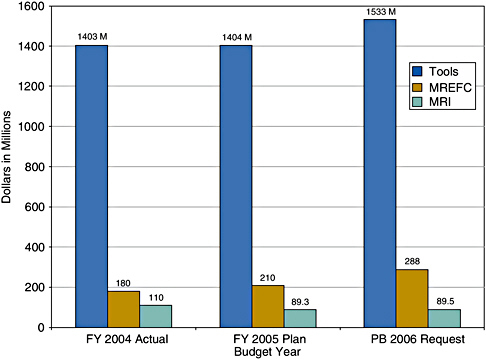
FIGURE 1-1 National Science Foundation Tools, Major Research Equipment and Facilities Construction (MREFC), and Major Research Instrumentation (MRI) budgets, FY 2004-2006.
Source: Analysis by committee of data from National Science Foundation (2005).
-
The lag between proposal and funding of both midsize and large facilities debilitates research progress.
-
Cyberinfrastructure is a major issue for academic researchers because NSF invests more in the “high middle end” of computation than in software tools or high-performance cyberfacilities. Furthermore, security restrictions and processes present obstacles for academics who wish to use Department of Energy (DOE) and Department of Defense (DOD) high-performance computing facilities.
-
The organization of distributed resources is lagging.
-
The cost of infrastructure per principal investigator is increasing in all categories, and there is competition between the need for funding for infrastructure and for students.
-
It is unknown whether instrument research is sufficiently vigorous.
-
For NSF, new kinds of midsize infrastructure include long-lived (digital) data collections, which have a propensity to become permanent rather than retiring and therefore involve large continuing investments.
Other recent federal government reports include a 1995 National Science and Technology Council study, which stated that academic research infrastructure needs substantial renewal and provided a conservative cost estimate of $8.7 billion for facilities and instrumentation,11 a 1998 NSF survey of academic research facilities, which estimated the cost of deferred capital projects to be $7 billion for the construction of new facilities and $4.4 billion for the repair or renovation of existing facilities,12 and a 2001 report to the director of the National Institutes of Health (NIH), which found that $5.6 billion was needed for biomedical research equipment.13
According to the 2004 NSB S&E indicators report, about $1.5 billion was spent for academic research equipment in 2001. The federal government share in research equipment expenditures declined from about 62% to 55% from 1983 to 2001. The funds spent for academic research equipment on the average over the past 5 documented years (1997-2001) were concentrated in three fields: life sciences (41%), engineering (23%), and physical sciences (18%).
HOW IS INSTRUMENTATION DIFFERENT TODAY IN ITS USE?
Since the last survey of instruments was conducted over a decade ago, the instrumentation needs of the nation’s research communities have changed. A need for entirely new types of instruments—such as networks, computational tools, surveys, and distributed sensor systems—has emerged. And the need for particular types of instruments and facilities has broadened, crossing scientific, engineering, and medical disciplines; instruments that were once of interest only to specialists are now required by scientists in a wide array of disciplines to solve critical research problems.
As instrumentation has grown more and more complex, research has become increasingly dependent on instruments that require highly specialized knowledge
and training for their proper use. The problem-oriented approach to research often demands bringing many different techniques to bear on a research question. As a consequence, demand for a number of particular advanced instruments has increased. The advanced instruments are often required by a number of users who are not well versed in their effective use.
Many different types of technical staff are vital to instrumentation. Specialists in electronics and machining, for example, are often highly involved in instrument development and in the modification and enhancement of existing instruments. Although such specialists are quite important, the committee wishes to emphasize the particular problem of the career paths of technical research support staff who maintain, operate, and manage existing instrumentation. The committee refers to such personnel as PhD-level technical research support staff to emphasize their involvement in research and the advanced nature of their work. Because of the increasingly complex nature of instrumentation and the scope of their duties, such staff often require a high level of education. A doctorate is not requisite, but the support of advanced instruments often demands an equivalent level of skill.
OVERVIEW OF REPORT
As discussed in the preface, the purpose of this study is to examine current federal programs and policies for the acquisition and development of advanced research instrumentation and the status of such instruments on university campuses and to determine whether an interagency instrumentation program is warranted. Chapter 2 of this report describes the significance of instrumentation and provides a definition of ARIF and examples of ARIF in various fields. Chapter 3 presents an overview of the issues regarding instrumentation and ARIF in particular at academic institutions. Chapter 4 provides information on the instrumentation funding practices of various federal agencies: NSF, NIH, DOE, the National Aeronautics and Space Administration, DOD, the Department of Homeland Security, the US Department of Defense, the US Department of Agriculture, and the National Oceanic and Atmospheric Administration. NSF is of particular focus, because this study has its origins in the NSF Authorization Act of 2002. Chapter 5 summarizes the committee’s findings and recommendations for making the most effective use of federal resources for ARIF by providing responses to each of the questions in its charge.
FINDINGS
F1-1: In recent years, the nature of S&E research has changed dramatically, as have the instruments that support and advance this research. In addition to
many other factors, the rise in interdisciplinary research, with its focus on large-scale problems that require a variety of techniques, demands more advanced instrumentation. As a result,
-
The need for particular instruments has broadened, crossing scientific and engineering disciplines.
-
Instruments that were once of interest only to specialists are required by a wide array of scientists to solve critical research problems.
-
The need for new types of instruments—such as distributed networks, cybertools, longitudinal surveys, and sensor arrays—is increasing.
-
Researchers have become increasingly dependent on advanced instruments that require highly specialized knowledge and training for their proper use and greatest effectiveness.
F1-2: According to the 2003 NSB infrastructure report, over $9 billion will be required in FY 2003-2012 for infrastructure projects that each cost between $1 million and $50 million.
F1-3: According to the 2004 NSB S&E indicators report, the share of research equipment expenditures funded by the federal government declined from about 62% to 55% from 1983 to 2001.
F1-4: The funds spent for academic research equipment on the average over the last 5 documented years (1997-2001) were concentrated in three fields: life sciences (41%), engineering (23%), and physical sciences (18%), according to the 2004 NSB S&E indicators report.
F1-5: Because federal agencies use different metrics to track their expenditures, it is difficult to make quantitative comparisons of agency investments in instrumentation. However, it is clear that NIH devotes a much smaller fraction of its research budget to instrumentation than NSF does.


